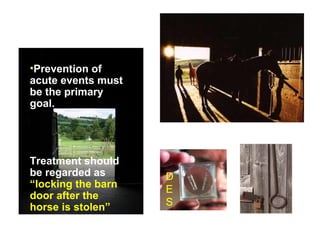
•Prevention of
acute events must
be the primary
goal.
Treatment should
be regarded as
“locking the barn
door after the
horse is stolen”
Eugene Braunwald
D
E
S
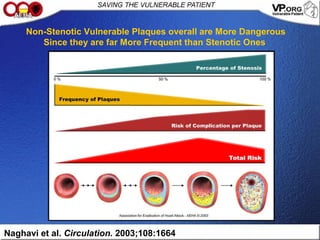
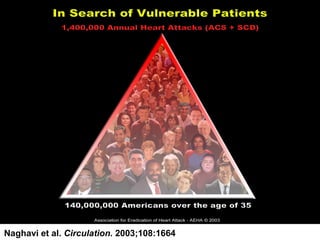
Naghavi et al. Circulation. 2003;108:1664
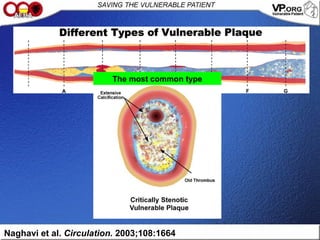
Non-Stenotic Vulnerable Plaques overall are More Dangerous
Since they are far More Frequent than Stenotic Ones
Introducing
The Vulnerable Patient Consensus Statement
Published in
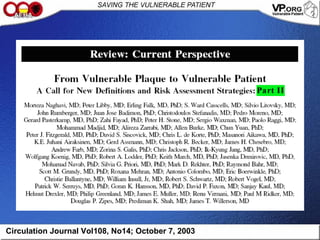
Circulation Journal Vol108, No14; October 7, 2003
Naghavi et al. Circulation. 2003;108:1664
The most common type
Naghavi et al. Circulation. 2003;108:1664
•Prevention of
acute events must
be the primary
goal.
Treatment should
be regarded as
“locking the barn
door after the
horse is stolen”
D
E
S
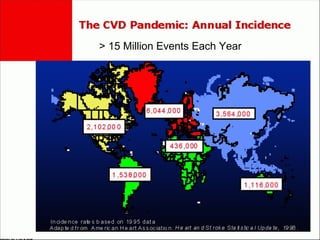
> 15 Million Events Each Year
CVD Genotyping?
Naghavi et al. Circulation. 2003;108:1664
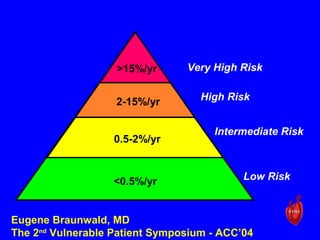
<0.5%/yr
0.5-2%/yr
2-15%/yr
>15%/yr Very High Risk
High Risk
Intermediate Risk
Low Risk
Eugene Braunwald, MD
The 2nd
Vulnerable Patient Symposium - ACC’04
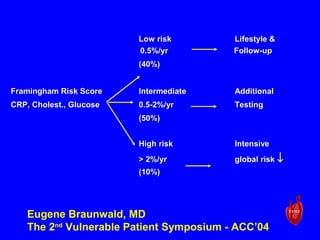
Low riskLow risk Lifestyle &Lifestyle &
0.5%/yr0.5%/yr Follow-upFollow-up
(40%)(40%)
Framingham Risk ScoreFramingham Risk Score IntermediateIntermediate AdditionalAdditional
CRP, Cholest., GlucoseCRP, Cholest., Glucose 0.5-2%/yr0.5-2%/yr TestingTesting
(50%)(50%)
High riskHigh risk IntensiveIntensive
> 2%/yr> 2%/yr global riskglobal risk ↓↓
(10%)(10%)
Eugene Braunwald, MD
The 2nd
Vulnerable Patient Symposium - ACC’04
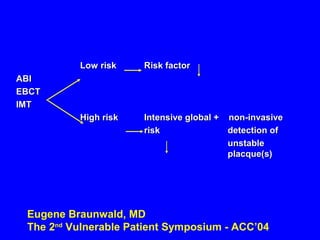
Low riskLow risk Risk factorRisk factor
ABIABI
EBCTEBCT
IMTIMT
High riskHigh risk Intensive global + non-invasiveIntensive global + non-invasive
riskrisk detection ofdetection of
unstableunstable
placque(s)placque(s)
Eugene Braunwald, MD
The 2nd
Vulnerable Patient Symposium - ACC’04
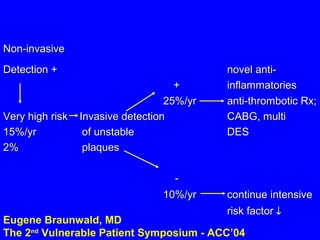
Non-invasiveNon-invasive
Detection +Detection + novel anti-novel anti-
++ inflammatoriesinflammatories
25%/yr25%/yr anti-thrombotic Rx;anti-thrombotic Rx;
Very high risk Invasive detectionVery high risk Invasive detection CABG, multiCABG, multi
15%/yr15%/yr of unstableof unstable DESDES
2%2% plaquesplaques
--
10%/yr10%/yr continue intensivecontinue intensive
risk factorrisk factor ↓↓
Eugene Braunwald, MD
The 2nd
Vulnerable Patient Symposium - ACC’04
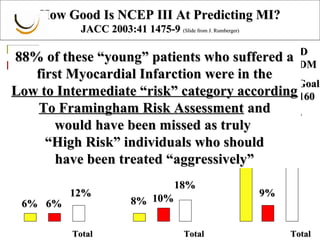
How Good Is NCEP III At Predicting MI?How Good Is NCEP III At Predicting MI?
JACC 2003:41 1475-9JACC 2003:41 1475-9 (Slide from J. Rumberger)(Slide from J. Rumberger)
222 patients with 1222 patients with 1stst
acute MI, no prior CADacute MI, no prior CAD
men <55 y/o (75%), women <65 (25%), no DMmen <55 y/o (75%), women <65 (25%), no DM
RiskRisk
>20%/>20%/
10 yrs.10 yrs.
RiskRisk
10-20%/10-20%/
10 yrs.10 yrs.
RiskRisk
<10%/<10%/
10 yrs.10 yrs.
NCEP GoalNCEP Goal
LDL<100LDL<100
NCEP GoalNCEP Goal
LDL<160LDL<160
NCEP GoalNCEP Goal
LDL<130LDL<130
Qualify for RxQualify for Rx
Not-Qualify for RxNot-Qualify for Rx
6%6% 6%6%
TotalTotal
12%12%
8%8% 10%10%
TotalTotal
18%18%
61%61%
9%9%
TotalTotal
70%70%
88% of these “young” patients who suffered a88% of these “young” patients who suffered a
first Myocardial Infarction were in thefirst Myocardial Infarction were in the
Low to Intermediate “risk” category accordingLow to Intermediate “risk” category according
To Framingham Risk AssessmentTo Framingham Risk Assessment andand
would have been missed as trulywould have been missed as truly
““High Risk” individuals who shouldHigh Risk” individuals who should
have been treated “aggressively”have been treated “aggressively”
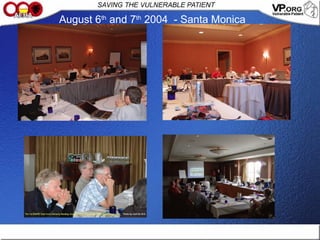
August 6th
and 7th
2004 - Santa Monica
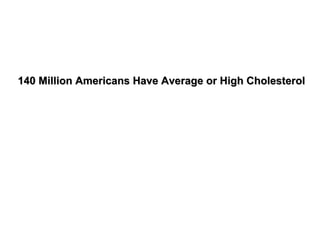
140 Million Americans Have Average or High Cholesterol140 Million Americans Have Average or High Cholesterol
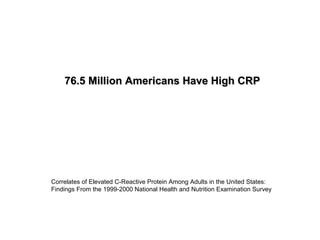
76.5 Million Americans Have High CRP76.5 Million Americans Have High CRP
Correlates of Elevated C-Reactive Protein Among Adults in the United States:
Findings From the 1999-2000 National Health and Nutrition Examination Survey
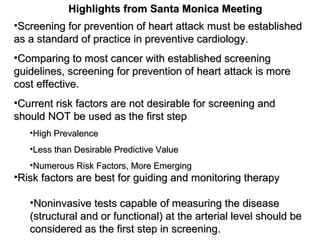
•Screening for prevention of heart attack must be establishedScreening for prevention of heart attack must be established
as a standard of practice in preventive cardiology.as a standard of practice in preventive cardiology.
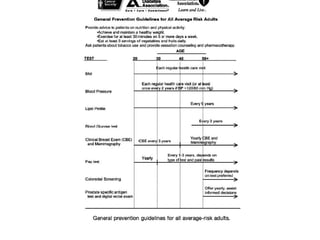
•Comparing to most cancer with established screeningComparing to most cancer with established screening
guidelines, screening for prevention of heart attack is moreguidelines, screening for prevention of heart attack is more
cost effective.cost effective.
•Current risk factors are not desirable for screening andCurrent risk factors are not desirable for screening and
should NOT be used as the first stepshould NOT be used as the first step
•High PrevalenceHigh Prevalence
•Less than Desirable Predictive ValueLess than Desirable Predictive Value
•Numerous Risk Factors, More EmergingNumerous Risk Factors, More Emerging
•Risk factors are best for guiding and monitoring therapyRisk factors are best for guiding and monitoring therapy
•Noninvasive tests capable of measuring the diseaseNoninvasive tests capable of measuring the disease
(structural and or functional) at the arterial level should be(structural and or functional) at the arterial level should be
considered as the first step in screening.considered as the first step in screening.
Highlights from Santa Monica MeetingHighlights from Santa Monica Meeting
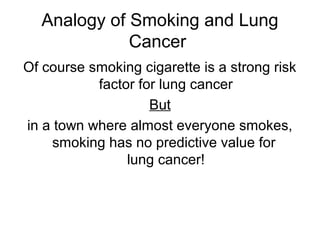
Analogy of Smoking and Lung
Cancer
Of course smoking cigarette is a strong risk
factor for lung cancer
But
in a town where almost everyone smokes,
smoking has no predictive value for
lung cancer!
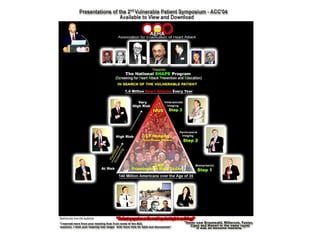
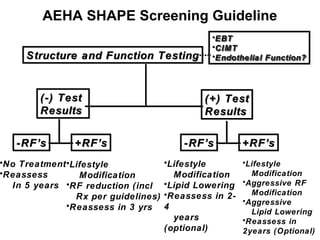
AEHA SHAPE Screening Guideline
Structure and Function TestingStructure and Function Testing
•EBTEBT
•CIMTCIMT
•Endothelial Function?Endothelial Function?
•EBTEBT
•CIMTCIMT
•Endothelial Function?Endothelial Function?
(-) Test
Results
(-) Test
Results
(+) Test
Results
(+) Test
Results
-RF’s-RF’s +RF’s+RF’s
•Lifestyle
Modification
•RF reduction (incl
Rx per guidelines)
•Reassess in 3 yrs
-RF’s-RF’s +RF’s+RF’s
•Lifestyle
Modification
•Aggressive RF
Modification
•Aggressive
Lipid Lowering
•Reassess in
2years (Optional)
•No Treatment
•Reassess
In 5 years
•Lifestyle
Modification
•Lipid Lowering
•Reassess in 2-
4
years
(optional)
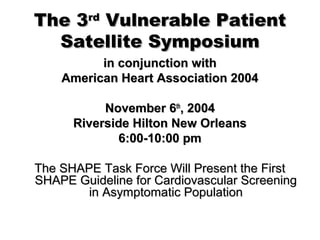
The 3The 3rdrd
Vulnerable PatientVulnerable Patient
Satellite SymposiumSatellite Symposium
in conjunction within conjunction with
American Heart Association 2004American Heart Association 2004
November 6November 6thth
, 2004, 2004
Riverside Hilton New OrleansRiverside Hilton New Orleans
6:00-10:00 pm6:00-10:00 pm
The SHAPE Task Force Will Present the FirstThe SHAPE Task Force Will Present the First
SHAPE Guideline for Cardiovascular ScreeningSHAPE Guideline for Cardiovascular Screening
in Asymptomatic Populationin Asymptomatic Population

My talk at tct04

  • 3.
    •Prevention of acute eventsmust be the primary goal. Treatment should be regarded as “locking the barn door after the horse is stolen” Eugene Braunwald D E S
  • 5.
    Naghavi et al.Circulation. 2003;108:1664 Non-Stenotic Vulnerable Plaques overall are More Dangerous Since they are far More Frequent than Stenotic Ones
  • 7.
    Introducing The Vulnerable PatientConsensus Statement Published in
  • 8.
    Circulation Journal Vol108,No14; October 7, 2003
  • 9.
    Naghavi et al.Circulation. 2003;108:1664 The most common type
  • 10.
    Naghavi et al.Circulation. 2003;108:1664
  • 11.
    •Prevention of acute eventsmust be the primary goal. Treatment should be regarded as “locking the barn door after the horse is stolen” D E S
  • 12.
    > 15 MillionEvents Each Year
  • 13.
    CVD Genotyping? Naghavi etal. Circulation. 2003;108:1664
  • 15.
    <0.5%/yr 0.5-2%/yr 2-15%/yr >15%/yr Very HighRisk High Risk Intermediate Risk Low Risk Eugene Braunwald, MD The 2nd Vulnerable Patient Symposium - ACC’04
  • 16.
    Low riskLow riskLifestyle &Lifestyle & 0.5%/yr0.5%/yr Follow-upFollow-up (40%)(40%) Framingham Risk ScoreFramingham Risk Score IntermediateIntermediate AdditionalAdditional CRP, Cholest., GlucoseCRP, Cholest., Glucose 0.5-2%/yr0.5-2%/yr TestingTesting (50%)(50%) High riskHigh risk IntensiveIntensive > 2%/yr> 2%/yr global riskglobal risk ↓↓ (10%)(10%) Eugene Braunwald, MD The 2nd Vulnerable Patient Symposium - ACC’04
  • 17.
    Low riskLow riskRisk factorRisk factor ABIABI EBCTEBCT IMTIMT High riskHigh risk Intensive global + non-invasiveIntensive global + non-invasive riskrisk detection ofdetection of unstableunstable placque(s)placque(s) Eugene Braunwald, MD The 2nd Vulnerable Patient Symposium - ACC’04
  • 18.
    Non-invasiveNon-invasive Detection +Detection +novel anti-novel anti- ++ inflammatoriesinflammatories 25%/yr25%/yr anti-thrombotic Rx;anti-thrombotic Rx; Very high risk Invasive detectionVery high risk Invasive detection CABG, multiCABG, multi 15%/yr15%/yr of unstableof unstable DESDES 2%2% plaquesplaques -- 10%/yr10%/yr continue intensivecontinue intensive risk factorrisk factor ↓↓ Eugene Braunwald, MD The 2nd Vulnerable Patient Symposium - ACC’04
  • 19.
    How Good IsNCEP III At Predicting MI?How Good Is NCEP III At Predicting MI? JACC 2003:41 1475-9JACC 2003:41 1475-9 (Slide from J. Rumberger)(Slide from J. Rumberger) 222 patients with 1222 patients with 1stst acute MI, no prior CADacute MI, no prior CAD men <55 y/o (75%), women <65 (25%), no DMmen <55 y/o (75%), women <65 (25%), no DM RiskRisk >20%/>20%/ 10 yrs.10 yrs. RiskRisk 10-20%/10-20%/ 10 yrs.10 yrs. RiskRisk <10%/<10%/ 10 yrs.10 yrs. NCEP GoalNCEP Goal LDL<100LDL<100 NCEP GoalNCEP Goal LDL<160LDL<160 NCEP GoalNCEP Goal LDL<130LDL<130 Qualify for RxQualify for Rx Not-Qualify for RxNot-Qualify for Rx 6%6% 6%6% TotalTotal 12%12% 8%8% 10%10% TotalTotal 18%18% 61%61% 9%9% TotalTotal 70%70% 88% of these “young” patients who suffered a88% of these “young” patients who suffered a first Myocardial Infarction were in thefirst Myocardial Infarction were in the Low to Intermediate “risk” category accordingLow to Intermediate “risk” category according To Framingham Risk AssessmentTo Framingham Risk Assessment andand would have been missed as trulywould have been missed as truly ““High Risk” individuals who shouldHigh Risk” individuals who should have been treated “aggressively”have been treated “aggressively”
  • 21.
  • 24.
    140 Million AmericansHave Average or High Cholesterol140 Million Americans Have Average or High Cholesterol
  • 25.
    76.5 Million AmericansHave High CRP76.5 Million Americans Have High CRP Correlates of Elevated C-Reactive Protein Among Adults in the United States: Findings From the 1999-2000 National Health and Nutrition Examination Survey
  • 27.
    •Screening for preventionof heart attack must be establishedScreening for prevention of heart attack must be established as a standard of practice in preventive cardiology.as a standard of practice in preventive cardiology. •Comparing to most cancer with established screeningComparing to most cancer with established screening guidelines, screening for prevention of heart attack is moreguidelines, screening for prevention of heart attack is more cost effective.cost effective. •Current risk factors are not desirable for screening andCurrent risk factors are not desirable for screening and should NOT be used as the first stepshould NOT be used as the first step •High PrevalenceHigh Prevalence •Less than Desirable Predictive ValueLess than Desirable Predictive Value •Numerous Risk Factors, More EmergingNumerous Risk Factors, More Emerging •Risk factors are best for guiding and monitoring therapyRisk factors are best for guiding and monitoring therapy •Noninvasive tests capable of measuring the diseaseNoninvasive tests capable of measuring the disease (structural and or functional) at the arterial level should be(structural and or functional) at the arterial level should be considered as the first step in screening.considered as the first step in screening. Highlights from Santa Monica MeetingHighlights from Santa Monica Meeting
  • 28.
    Analogy of Smokingand Lung Cancer Of course smoking cigarette is a strong risk factor for lung cancer But in a town where almost everyone smokes, smoking has no predictive value for lung cancer!
  • 29.
    AEHA SHAPE ScreeningGuideline Structure and Function TestingStructure and Function Testing •EBTEBT •CIMTCIMT •Endothelial Function?Endothelial Function? •EBTEBT •CIMTCIMT •Endothelial Function?Endothelial Function? (-) Test Results (-) Test Results (+) Test Results (+) Test Results -RF’s-RF’s +RF’s+RF’s •Lifestyle Modification •RF reduction (incl Rx per guidelines) •Reassess in 3 yrs -RF’s-RF’s +RF’s+RF’s •Lifestyle Modification •Aggressive RF Modification •Aggressive Lipid Lowering •Reassess in 2years (Optional) •No Treatment •Reassess In 5 years •Lifestyle Modification •Lipid Lowering •Reassess in 2- 4 years (optional)
  • 30.
    The 3The 3rdrd VulnerablePatientVulnerable Patient Satellite SymposiumSatellite Symposium in conjunction within conjunction with American Heart Association 2004American Heart Association 2004 November 6November 6thth , 2004, 2004 Riverside Hilton New OrleansRiverside Hilton New Orleans 6:00-10:00 pm6:00-10:00 pm The SHAPE Task Force Will Present the FirstThe SHAPE Task Force Will Present the First SHAPE Guideline for Cardiovascular ScreeningSHAPE Guideline for Cardiovascular Screening in Asymptomatic Populationin Asymptomatic Population