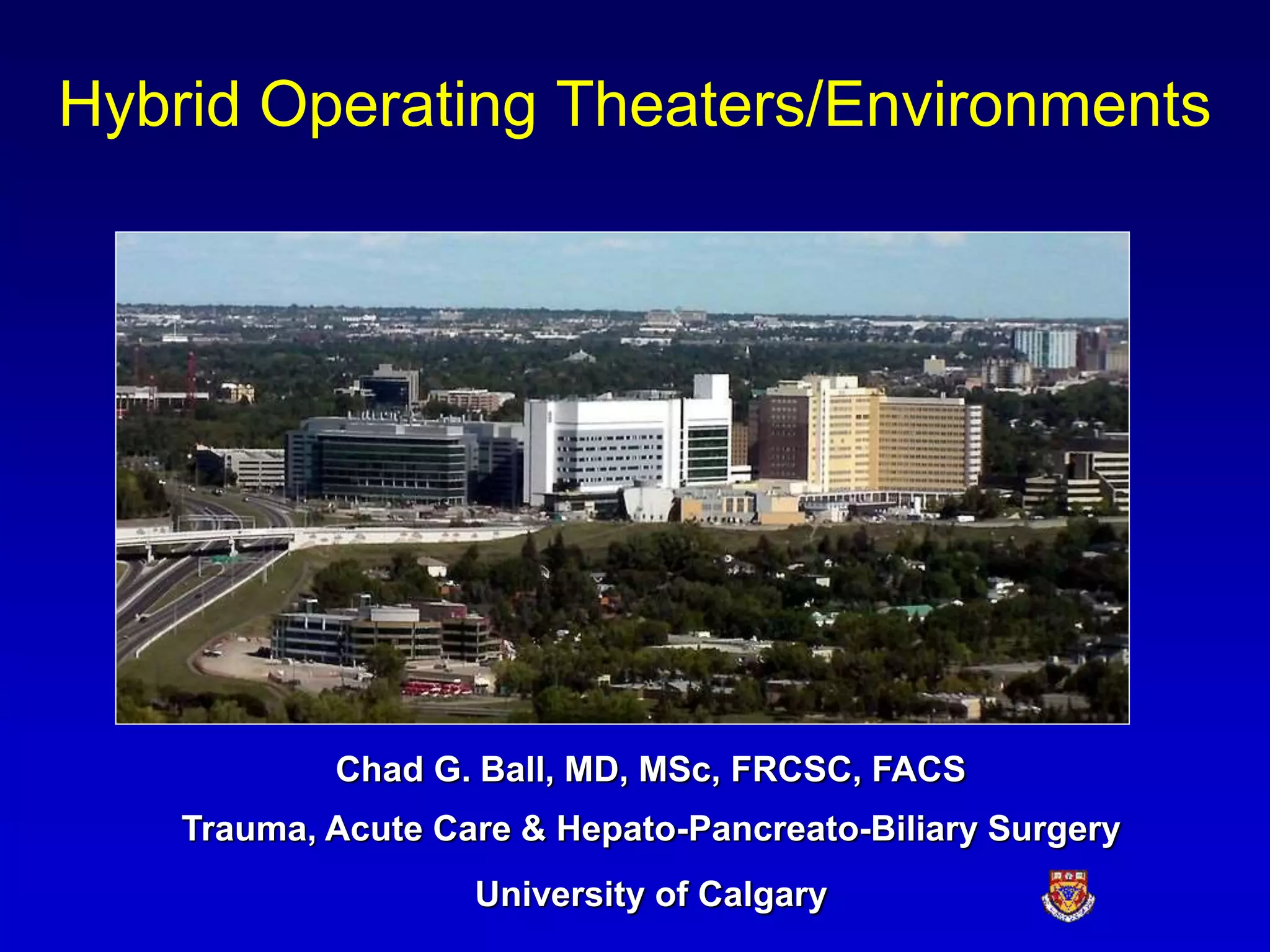
Hybrid Operating Theaters/Environments
Chad G. Ball, MD, MSc, FRCSC, FACS
Trauma, Acute Care & Hepato-Pancreato-Biliary Surgery
University of Calgary
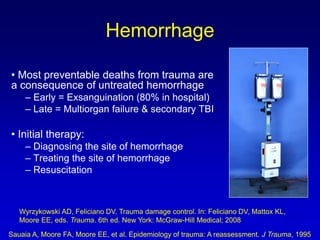
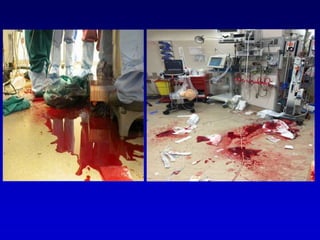
• Most preventable deaths from trauma are
a consequence of untreated hemorrhage
– Early = Exsanguination (80% in hospital)
– Late = Multiorgan failure & secondary TBI
• Initial therapy:
– Diagnosing the site of hemorrhage
– Treating the site of hemorrhage
– Resuscitation
Hemorrhage
Wyrzykowski AD, Feliciano DV. Trauma damage control. In: Feliciano DV, Mattox KL,
Moore EE, eds. Trauma. 6th ed. New York: McGraw-Hill Medical; 2008
Sauaia A, Moore FA, Moore EE, et al. Epidemiology of trauma: A reassessment. J Trauma, 1995
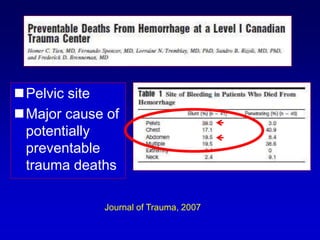
Pelvic site
Major cause of
potentially
preventable
trauma deaths
Journal of Trauma, 2007
Many patients with vascular injuries will
present with exsanguinating hemorrhage,
and are best treated by expeditious
laparotomy, formal vascular exploration
and definitive repair
Disclaimer !
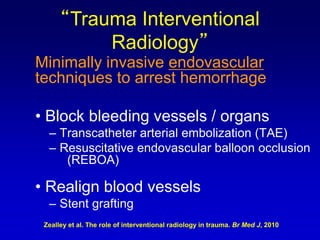
Minimally invasive endovascular
techniques to arrest hemorrhage
• Block bleeding vessels / organs
– Transcatheter arterial embolization (TAE)
– Resuscitative endovascular balloon occlusion
(REBOA)
• Realign blood vessels
– Stent grafting
“Trauma Interventional
Radiology”
Zealley et al. The role of interventional radiology in trauma. Br Med J, 2010
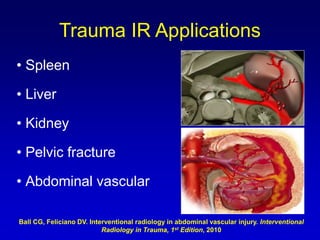
• Spleen
• Liver
• Kidney
• Pelvic fracture
• Abdominal vascular
Trauma IR Applications
Ball CG, Feliciano DV. Interventional radiology in abdominal vascular injury. Interventional
Radiology in Trauma, 1st Edition, 2010
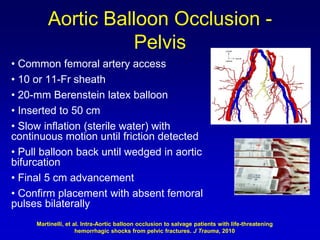
• Common femoral artery access
• 10 or 11-Fr sheath
• 20-mm Berenstein latex balloon
• Inserted to 50 cm
• Slow inflation (sterile water) with
continuous motion until friction detected
• Pull balloon back until wedged in aortic
bifurcation
• Final 5 cm advancement
• Confirm placement with absent femoral
pulses bilaterally
Aortic Balloon Occlusion -
Pelvis
Martinelli, et al. Intra-Aortic balloon occlusion to salvage patients with life-threatening
hemorrhagic shocks from pelvic fractures. J Trauma, 2010
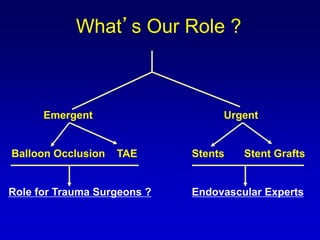
What’s Our Role ?
Emergent
Balloon Occlusion TAE
Role for Trauma Surgeons ?
Urgent
Stents Stent Grafts
Endovascular Experts
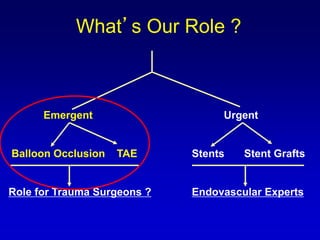
What’s Our Role ?
Emergent
Balloon Occlusion TAE
Role for Trauma Surgeons ?
Urgent
Stents Stent Grafts
Endovascular Experts
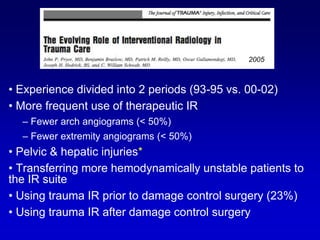
• Experience divided into 2 periods (93-95 vs. 00-02)
• More frequent use of therapeutic IR
– Fewer arch angiograms (< 50%)
– Fewer extremity angiograms (< 50%)
• Pelvic & hepatic injuries*
• Transferring more hemodynamically unstable patients to
the IR suite
• Using trauma IR prior to damage control surgery (23%)
• Using trauma IR after damage control surgery
2005
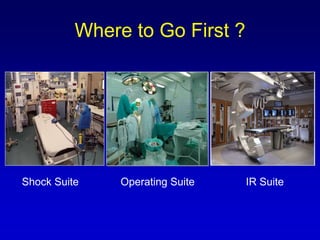
Where to Go First ?
Shock Suite Operating Suite IR Suite
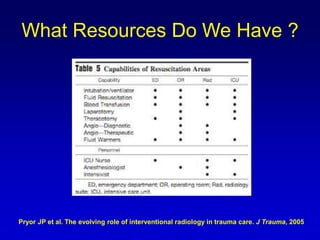
What Resources Do We Have ?
Pryor JP et al. The evolving role of interventional radiology in trauma care. J Trauma, 2005
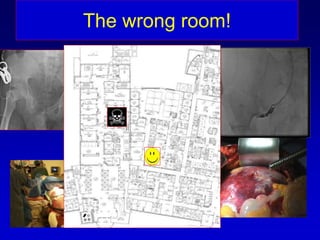
The wrong room!
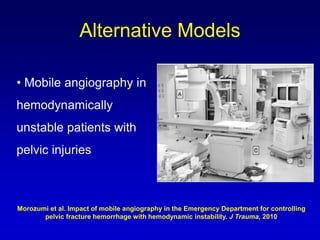
• Mobile angiography in
hemodynamically
unstable patients with
pelvic injuries
Alternative Models
Morozumi et al. Impact of mobile angiography in the Emergency Department for controlling
pelvic fracture hemorrhage with hemodynamic instability. J Trauma, 2010
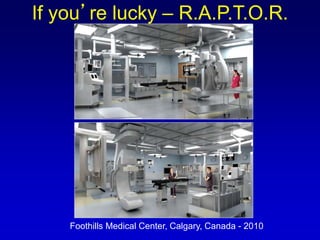
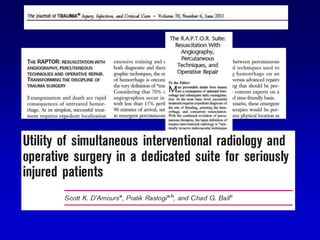
If you’re lucky – R.A.P.T.O.R.
Foothills Medical Center, Calgary, Canada - 2010
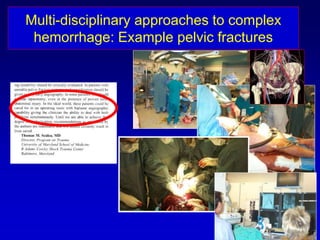
Multi-disciplinary approaches to complex
hemorrhage: Example pelvic fractures
• Up to 70% of emergency on-call angiography
occurs in an “out-of-hours” time frame
• Less than 15% of pelvic angiography is
performed within 90 minutes of arrival
• Scenarios demand cognitive changes in the
priority and urgency of care
What’s our Role ?
Ashleigh et al. a cross-site vascular radiology on-call services. Clin Radiol, 2005
Miller et al. External fixation or arteriogram in bleeding pelvic fractures: initial therapy
guided by markers of arterial hemorrhage. J Trauma, 2003
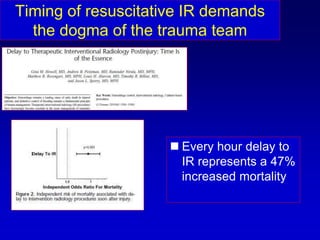
Timing of resuscitative IR demands
the dogma of the trauma team
 Every hour delay to
IR represents a 47%
increased mortality
We were doing no better…
The Process
• Conceptualization – Utopia
• Conceptualization – Practicalities
• Technology selection
• Room layout and design
• Human factors planning
• Oversight and QA
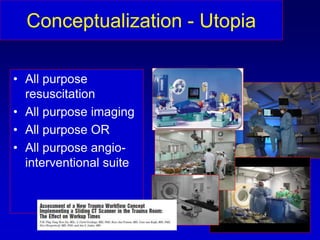
Conceptualization - Utopia
• All purpose
resuscitation
• All purpose imaging
• All purpose OR
• All purpose angio-
interventional suite
Conceptualization - Practicalities
 Expensive
 Budget:
– Donations: 3 million
– Government funds >2
million in capital funds
 “What exactly do you
want the RAPTOR for
???”
McCaig Tower
Calgary Health Trust
 Decision to fund the
RAPTOR as the
major charitable
fundraising activity
for 2008-2010
 Gala social events
– donations
– Auctions
 Single private donation
of $1.5 million
– Anonymous source
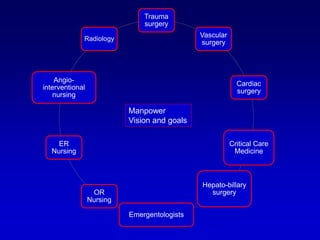
Trauma
surgery
Vascular
surgery
Cardiac
surgery
Critical Care
Medicine
Hepato-billary
surgery
Emergentologists
OR
Nursing
ER
Nursing
Angio-
interventional
nursing
Radiology
Manpower
Vision and goals
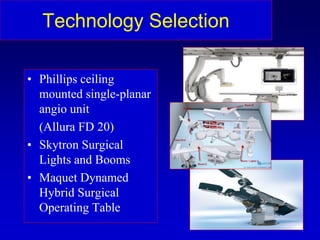
Technology Selection
• Phillips ceiling
mounted single-planar
angio unit
(Allura FD 20)
• Skytron Surgical
Lights and Booms
• Maquet Dynamed
Hybrid Surgical
Operating Table

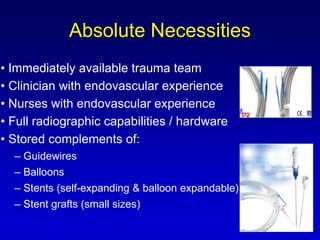
• Immediately available trauma team
• Clinician with endovascular experience
• Nurses with endovascular experience
• Full radiographic capabilities / hardware
• Stored complements of:
– Guidewires
– Balloons
– Stents (self-expanding & balloon expandable)
– Stent grafts (small sizes)
Absolute Necessities
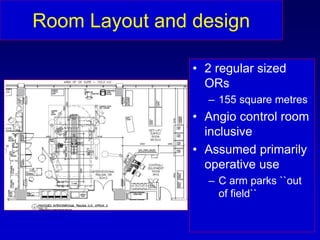
Room Layout and design
• 2 regular sized
ORs
– 155 square metres
• Angio control room
inclusive
• Assumed primarily
operative use
– C arm parks ``out
of field``
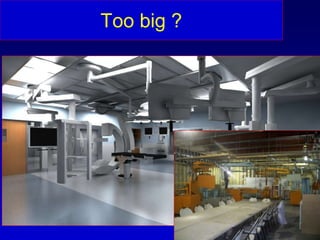
Too big ?
Smaller – design mock-up
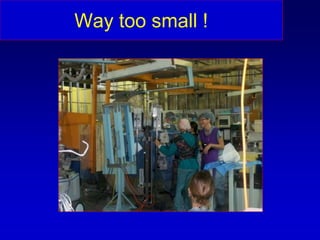
Way too small !
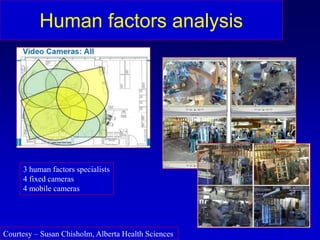
Human factors analysis
Courtesy – Susan Chisholm, Alberta Health Sciences
3 human factors specialists
4 fixed cameras
4 mobile cameras
Courtesy – Susan Chisholm, Alberta Health Sciences
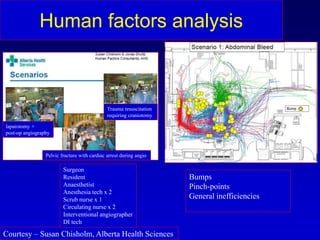
Human factors analysis
Surgeon
Resident
Anaesthetist
Anesthesia tech x 2
Scrub nurse x 1
Circulating nurse x 2
Interventional angiographer
DI tech
Bumps
Pinch-points
General inefficiencies
laparotomy +
post-op angiography
Pelvic fracture with cardiac arrest during angio
Trauma resuscitation
requiring craniotomy
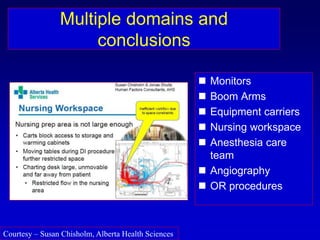
Multiple domains and
conclusions
 Monitors
 Boom Arms
 Equipment carriers
 Nursing workspace
 Anesthesia care
team
 Angiography
 OR procedures
Courtesy – Susan Chisholm, Alberta Health Sciences
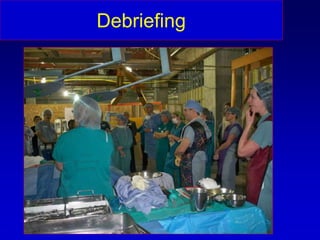
Debriefing
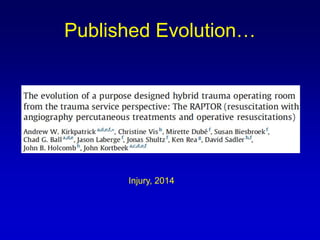
Published Evolution…
Injury, 2014
Oversight and QA
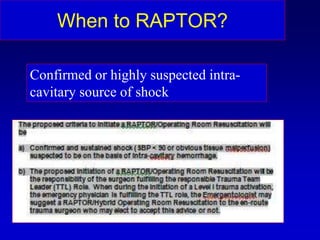
When to RAPTOR?
Confirmed or highly suspected intra-
cavitary source of shock
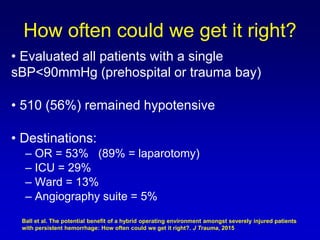
• Evaluated all patients with a single
sBP<90mmHg (prehospital or trauma bay)
• 510 (56%) remained hypotensive
• Destinations:
– OR = 53% (89% = laparotomy)
– ICU = 29%
– Ward = 13%
– Angiography suite = 5%
How often could we get it right?
Ball et al. The potential benefit of a hybrid operating environment amongst severely injured patients
with persistent hemorrhage: How often could we get it right?. J Trauma, 2015
ED n=911
WARD 6%
ICU 100% CT 66%
ICU 70%
ICU 24%
ICU 79%
ICU 50%
ICU 75%
ICU 6%
ICU 2%
ANGIO 6%
DEAD 10%
DEAD 7%
DEAD 2%
DEAD 21%
DEAD 4%
DEAD 44%
DEAD 2%
DEAD 14%
OR 18%
Ward 22%
OR 42%
OR 47%
OR 7%
OR 12%
WARD 23%
WARD 85%
WARD 30%
WARD 25%
ANGIO 7%
ICU 93%
ICU 23%
WARD 28%
ICU 90%
ICU 74%
ANGIO 1%
DEAD 3%
Ward 94%
ICU 6%
ICU 100%
DEAD 9%
ICU 73%
ICU 100%
DEAD 23%
WARD 18%
ICU 58%
ANGIO 1%
DEAD 100%
DEAD 19%
OR 14%
ICU 62%
ANGIO 5% ICU 100%
ICU 100%
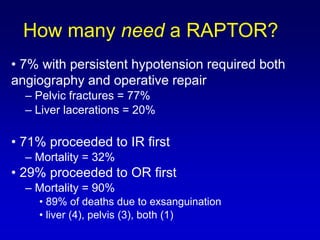
• 7% with persistent hypotension required both
angiography and operative repair
– Pelvic fractures = 77%
– Liver lacerations = 20%
• 71% proceeded to IR first
– Mortality = 32%
• 29% proceeded to OR first
– Mortality = 90%
• 89% of deaths due to exsanguination
• liver (4), pelvis (3), both (1)
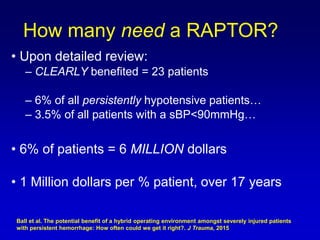
How many need a RAPTOR?
• Upon detailed review:
– CLEARLY benefited = 23 patients
– 6% of all persistently hypotensive patients…
– 3.5% of all patients with a sBP<90mmHg…
• 6% of patients = 6 MILLION dollars
• 1 Million dollars per % patient, over 17 years
How many need a RAPTOR?
Ball et al. The potential benefit of a hybrid operating environment amongst severely injured patients
with persistent hemorrhage: How often could we get it right?. J Trauma, 2015
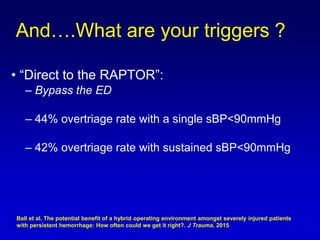
• “Direct to the RAPTOR”:
– Bypass the ED
– 44% overtriage rate with a single sBP<90mmHg
– 42% overtriage rate with sustained sBP<90mmHg
And….What are your triggers ?
Ball et al. The potential benefit of a hybrid operating environment amongst severely injured patients
with persistent hemorrhage: How often could we get it right?. J Trauma, 2015
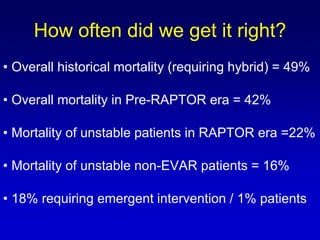
• Overall historical mortality (requiring hybrid) = 49%
• Overall mortality in Pre-RAPTOR era = 42%
• Mortality of unstable patients in RAPTOR era =22%
• Mortality of unstable non-EVAR patients = 16%
• 18% requiring emergent intervention / 1% patients
How often did we get it right?
Thank-you!Thanou!
Thank-you!

RAPTOR

  • 1.
    Hybrid Operating Theaters/Environments ChadG. Ball, MD, MSc, FRCSC, FACS Trauma, Acute Care & Hepato-Pancreato-Biliary Surgery University of Calgary
  • 2.
    • Most preventabledeaths from trauma are a consequence of untreated hemorrhage – Early = Exsanguination (80% in hospital) – Late = Multiorgan failure & secondary TBI • Initial therapy: – Diagnosing the site of hemorrhage – Treating the site of hemorrhage – Resuscitation Hemorrhage Wyrzykowski AD, Feliciano DV. Trauma damage control. In: Feliciano DV, Mattox KL, Moore EE, eds. Trauma. 6th ed. New York: McGraw-Hill Medical; 2008 Sauaia A, Moore FA, Moore EE, et al. Epidemiology of trauma: A reassessment. J Trauma, 1995
  • 3.
    Pelvic site Major causeof potentially preventable trauma deaths Journal of Trauma, 2007
  • 4.
    Many patients withvascular injuries will present with exsanguinating hemorrhage, and are best treated by expeditious laparotomy, formal vascular exploration and definitive repair Disclaimer !
  • 6.
    Minimally invasive endovascular techniquesto arrest hemorrhage • Block bleeding vessels / organs – Transcatheter arterial embolization (TAE) – Resuscitative endovascular balloon occlusion (REBOA) • Realign blood vessels – Stent grafting “Trauma Interventional Radiology” Zealley et al. The role of interventional radiology in trauma. Br Med J, 2010
  • 7.
    • Spleen • Liver •Kidney • Pelvic fracture • Abdominal vascular Trauma IR Applications Ball CG, Feliciano DV. Interventional radiology in abdominal vascular injury. Interventional Radiology in Trauma, 1st Edition, 2010
  • 8.
    • Common femoralartery access • 10 or 11-Fr sheath • 20-mm Berenstein latex balloon • Inserted to 50 cm • Slow inflation (sterile water) with continuous motion until friction detected • Pull balloon back until wedged in aortic bifurcation • Final 5 cm advancement • Confirm placement with absent femoral pulses bilaterally Aortic Balloon Occlusion - Pelvis Martinelli, et al. Intra-Aortic balloon occlusion to salvage patients with life-threatening hemorrhagic shocks from pelvic fractures. J Trauma, 2010
  • 9.
    What’s Our Role? Emergent Balloon Occlusion TAE Role for Trauma Surgeons ? Urgent Stents Stent Grafts Endovascular Experts
  • 10.
    What’s Our Role? Emergent Balloon Occlusion TAE Role for Trauma Surgeons ? Urgent Stents Stent Grafts Endovascular Experts
  • 11.
    • Experience dividedinto 2 periods (93-95 vs. 00-02) • More frequent use of therapeutic IR – Fewer arch angiograms (< 50%) – Fewer extremity angiograms (< 50%) • Pelvic & hepatic injuries* • Transferring more hemodynamically unstable patients to the IR suite • Using trauma IR prior to damage control surgery (23%) • Using trauma IR after damage control surgery 2005
  • 12.
    Where to GoFirst ? Shock Suite Operating Suite IR Suite
  • 13.
    What Resources DoWe Have ? Pryor JP et al. The evolving role of interventional radiology in trauma care. J Trauma, 2005
  • 14.
  • 15.
    • Mobile angiographyin hemodynamically unstable patients with pelvic injuries Alternative Models Morozumi et al. Impact of mobile angiography in the Emergency Department for controlling pelvic fracture hemorrhage with hemodynamic instability. J Trauma, 2010
  • 16.
    If you’re lucky– R.A.P.T.O.R. Foothills Medical Center, Calgary, Canada - 2010
  • 18.
    Multi-disciplinary approaches tocomplex hemorrhage: Example pelvic fractures
  • 19.
    • Up to70% of emergency on-call angiography occurs in an “out-of-hours” time frame • Less than 15% of pelvic angiography is performed within 90 minutes of arrival • Scenarios demand cognitive changes in the priority and urgency of care What’s our Role ? Ashleigh et al. a cross-site vascular radiology on-call services. Clin Radiol, 2005 Miller et al. External fixation or arteriogram in bleeding pelvic fractures: initial therapy guided by markers of arterial hemorrhage. J Trauma, 2003
  • 20.
    Timing of resuscitativeIR demands the dogma of the trauma team  Every hour delay to IR represents a 47% increased mortality
  • 21.
    We were doingno better…
  • 22.
    The Process • Conceptualization– Utopia • Conceptualization – Practicalities • Technology selection • Room layout and design • Human factors planning • Oversight and QA
  • 23.
    Conceptualization - Utopia •All purpose resuscitation • All purpose imaging • All purpose OR • All purpose angio- interventional suite
  • 24.
    Conceptualization - Practicalities Expensive  Budget: – Donations: 3 million – Government funds >2 million in capital funds  “What exactly do you want the RAPTOR for ???” McCaig Tower
  • 25.
    Calgary Health Trust Decision to fund the RAPTOR as the major charitable fundraising activity for 2008-2010  Gala social events – donations – Auctions  Single private donation of $1.5 million – Anonymous source
  • 26.
  • 27.
    Technology Selection • Phillipsceiling mounted single-planar angio unit (Allura FD 20) • Skytron Surgical Lights and Booms • Maquet Dynamed Hybrid Surgical Operating Table
  • 28.
    • Immediately availabletrauma team • Clinician with endovascular experience • Nurses with endovascular experience • Full radiographic capabilities / hardware • Stored complements of: – Guidewires – Balloons – Stents (self-expanding & balloon expandable) – Stent grafts (small sizes) Absolute Necessities
  • 29.
    Room Layout anddesign • 2 regular sized ORs – 155 square metres • Angio control room inclusive • Assumed primarily operative use – C arm parks ``out of field``
  • 30.
  • 31.
  • 32.
  • 33.
    Human factors analysis Courtesy– Susan Chisholm, Alberta Health Sciences 3 human factors specialists 4 fixed cameras 4 mobile cameras
  • 34.
    Courtesy – SusanChisholm, Alberta Health Sciences Human factors analysis Surgeon Resident Anaesthetist Anesthesia tech x 2 Scrub nurse x 1 Circulating nurse x 2 Interventional angiographer DI tech Bumps Pinch-points General inefficiencies laparotomy + post-op angiography Pelvic fracture with cardiac arrest during angio Trauma resuscitation requiring craniotomy
  • 35.
    Multiple domains and conclusions Monitors  Boom Arms  Equipment carriers  Nursing workspace  Anesthesia care team  Angiography  OR procedures Courtesy – Susan Chisholm, Alberta Health Sciences
  • 36.
  • 37.
  • 38.
  • 39.
    When to RAPTOR? Confirmedor highly suspected intra- cavitary source of shock
  • 41.
    • Evaluated allpatients with a single sBP<90mmHg (prehospital or trauma bay) • 510 (56%) remained hypotensive • Destinations: – OR = 53% (89% = laparotomy) – ICU = 29% – Ward = 13% – Angiography suite = 5% How often could we get it right? Ball et al. The potential benefit of a hybrid operating environment amongst severely injured patients with persistent hemorrhage: How often could we get it right?. J Trauma, 2015
  • 42.
    ED n=911 WARD 6% ICU100% CT 66% ICU 70% ICU 24% ICU 79% ICU 50% ICU 75% ICU 6% ICU 2% ANGIO 6% DEAD 10% DEAD 7% DEAD 2% DEAD 21% DEAD 4% DEAD 44% DEAD 2% DEAD 14% OR 18% Ward 22% OR 42% OR 47% OR 7% OR 12% WARD 23% WARD 85% WARD 30% WARD 25% ANGIO 7% ICU 93% ICU 23% WARD 28% ICU 90% ICU 74% ANGIO 1% DEAD 3% Ward 94% ICU 6% ICU 100% DEAD 9% ICU 73% ICU 100% DEAD 23% WARD 18% ICU 58% ANGIO 1% DEAD 100% DEAD 19% OR 14% ICU 62% ANGIO 5% ICU 100% ICU 100%
  • 43.
    • 7% withpersistent hypotension required both angiography and operative repair – Pelvic fractures = 77% – Liver lacerations = 20% • 71% proceeded to IR first – Mortality = 32% • 29% proceeded to OR first – Mortality = 90% • 89% of deaths due to exsanguination • liver (4), pelvis (3), both (1) How many need a RAPTOR?
  • 44.
    • Upon detailedreview: – CLEARLY benefited = 23 patients – 6% of all persistently hypotensive patients… – 3.5% of all patients with a sBP<90mmHg… • 6% of patients = 6 MILLION dollars • 1 Million dollars per % patient, over 17 years How many need a RAPTOR? Ball et al. The potential benefit of a hybrid operating environment amongst severely injured patients with persistent hemorrhage: How often could we get it right?. J Trauma, 2015
  • 45.
    • “Direct tothe RAPTOR”: – Bypass the ED – 44% overtriage rate with a single sBP<90mmHg – 42% overtriage rate with sustained sBP<90mmHg And….What are your triggers ? Ball et al. The potential benefit of a hybrid operating environment amongst severely injured patients with persistent hemorrhage: How often could we get it right?. J Trauma, 2015
  • 48.
    • Overall historicalmortality (requiring hybrid) = 49% • Overall mortality in Pre-RAPTOR era = 42% • Mortality of unstable patients in RAPTOR era =22% • Mortality of unstable non-EVAR patients = 16% • 18% requiring emergent intervention / 1% patients How often did we get it right?
  • 49.