CENTRAL BICOL STATE UNIVERSITY OF AGRICULTURE
San Jose, Pili, Camarines Sur

College of Arts and Sciences
Department of Natural and Applied Sciences

GENETICS

Mutation
Structural Changes
Prepared by

Ferrer, Anthony B.
BSE 4B
Submitted to

Mrs. Melinda Pan
Instructor
Objectives
At the end of the lesson the students are
expected to;
1. Define what is mutation
2. Enumerate the three types of
mutation and its respective examples
3. Perform how mutation occur in
terms of changes in chromosome structure
4. Appreciate the importance of
mutation in the world of genetics
Change in the genes brought about
by the change in the hereditary material
called DNA.
This mutation could
be changes in quantity or
quality that may or may not
affect the phenotype of an
organism.

Mutations are
responsible for the
evolution of group of
organisms for it is
transferred from one
generation to another
Mutations are cause by mutagens or
mutagenic agents
•
•
•
•

Radiation
Chemicals
Extremes of temperature and
Microbial infection

These can alter the kind of nucleotides in
and the size of DNA
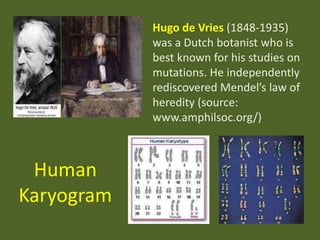
Hugo de Vries (1848-1935)
was a Dutch botanist who is
best known for his studies on
mutations. He independently
rediscovered Mendel’s law of
heredity (source:
www.amphilsoc.org/)

Human
Karyogram
3 Types of Mutation

1. Change in structure of
chromosome
2. Change in the number of
chromosome
3. Change in DNA sequence
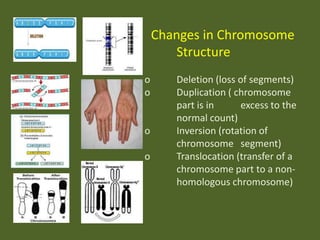
Changes in Chromosome
Structure
o
o

o
o

Deletion (loss of segments)
Duplication ( chromosome
part is in
excess to the
normal count)
Inversion (rotation of
chromosome segment)
Translocation (transfer of a
chromosome part to a nonhomologous chromosome)
Change in Chromosome Number

•

Euploidy (whole genome) - the
total information carried by the
genetic code of a particular organism.
•

Aneuploidy (change in number of
chromosome)
Examples of Aneuploidy
o
o
o
o

Klinefelter’s syndrome (2n=47, 44 autosomes
XXY)
Turner’s syndrome (2n=45, 44 autosome + 44
autosome + X)
Metafemale (2n=47, 44 autosomes + XXX)
Down’s syndrome or trisomy 21 (2n=47, 3 in the
21st chromosome)

Aneuploidy is often caused by a phenomenon called
nondisjunction; or inability of the homologous sex
chromosome to segregate during meiosis.
Changes involving DNA sequence
o
o
o

o

Microlesion or joined mutation
(involves are nucleotides pair only)
Frameshift mutation (addition of two
or more nucleotide)
Transition mutation (purine to purine
as pyrimidine to pyrimidine)
Transversion mutation (purine to
pyrimidine or in vice versa)
Other Examples of Mutation
•
•
•
•
•
•

•
•

Albinism ( absence of pigment in the skin)
Sickle cell anemia ( inability of RBC to transport oxygen)
Trisomy 21 or Down’s Syndrome ( presence of
chromosome or position 21st)
Hemophilia (inability of the blood to clot)
Huntington’s disease ( deterioration of the brain tissue)
Cystic fibrosis ( mucus clogging of organs such as lungs,
liver and pancreas due to a defective chloride, on
transport channel)
Tay-sach’s disease – CNS ( ultimately causing death most
common to Jewish and Eastern Europe descent)
Muscular Dystrophy – (disease in which the muscles of
the body gets weaker and weaker and slowly stop
working because of lack of certain protein)
Thank You Very Much
for Listening
ferreranthonyb_o9o713

Mutation genetics

  • 1.
    CENTRAL BICOL STATEUNIVERSITY OF AGRICULTURE San Jose, Pili, Camarines Sur College of Arts and Sciences Department of Natural and Applied Sciences GENETICS Mutation Structural Changes Prepared by Ferrer, Anthony B. BSE 4B Submitted to Mrs. Melinda Pan Instructor
  • 2.
    Objectives At the endof the lesson the students are expected to; 1. Define what is mutation 2. Enumerate the three types of mutation and its respective examples 3. Perform how mutation occur in terms of changes in chromosome structure 4. Appreciate the importance of mutation in the world of genetics
  • 3.
    Change in thegenes brought about by the change in the hereditary material called DNA.
  • 4.
    This mutation could bechanges in quantity or quality that may or may not affect the phenotype of an organism. Mutations are responsible for the evolution of group of organisms for it is transferred from one generation to another
  • 5.
    Mutations are causeby mutagens or mutagenic agents • • • • Radiation Chemicals Extremes of temperature and Microbial infection These can alter the kind of nucleotides in and the size of DNA
  • 6.
    Hugo de Vries(1848-1935) was a Dutch botanist who is best known for his studies on mutations. He independently rediscovered Mendel’s law of heredity (source: www.amphilsoc.org/) Human Karyogram
  • 7.
    3 Types ofMutation 1. Change in structure of chromosome 2. Change in the number of chromosome 3. Change in DNA sequence
  • 8.
    Changes in Chromosome Structure o o o o Deletion(loss of segments) Duplication ( chromosome part is in excess to the normal count) Inversion (rotation of chromosome segment) Translocation (transfer of a chromosome part to a nonhomologous chromosome)
  • 9.
    Change in ChromosomeNumber • Euploidy (whole genome) - the total information carried by the genetic code of a particular organism. • Aneuploidy (change in number of chromosome)
  • 10.
    Examples of Aneuploidy o o o o Klinefelter’ssyndrome (2n=47, 44 autosomes XXY) Turner’s syndrome (2n=45, 44 autosome + 44 autosome + X) Metafemale (2n=47, 44 autosomes + XXX) Down’s syndrome or trisomy 21 (2n=47, 3 in the 21st chromosome) Aneuploidy is often caused by a phenomenon called nondisjunction; or inability of the homologous sex chromosome to segregate during meiosis.
  • 11.
    Changes involving DNAsequence o o o o Microlesion or joined mutation (involves are nucleotides pair only) Frameshift mutation (addition of two or more nucleotide) Transition mutation (purine to purine as pyrimidine to pyrimidine) Transversion mutation (purine to pyrimidine or in vice versa)
  • 12.
    Other Examples ofMutation • • • • • • • • Albinism ( absence of pigment in the skin) Sickle cell anemia ( inability of RBC to transport oxygen) Trisomy 21 or Down’s Syndrome ( presence of chromosome or position 21st) Hemophilia (inability of the blood to clot) Huntington’s disease ( deterioration of the brain tissue) Cystic fibrosis ( mucus clogging of organs such as lungs, liver and pancreas due to a defective chloride, on transport channel) Tay-sach’s disease – CNS ( ultimately causing death most common to Jewish and Eastern Europe descent) Muscular Dystrophy – (disease in which the muscles of the body gets weaker and weaker and slowly stop working because of lack of certain protein)
  • 13.
    Thank You VeryMuch for Listening ferreranthonyb_o9o713