MUTATION
Presented by:
Tousif Khan
Subham Karmakar
Suravi Saha Roy
Pranab Karmakar
Rahul Naskar
Vijaygarh Jyotish Ray College
Zoology dept.
Created by Tousif Khan
Mutation
A mutation is a permanent alteration in the DNA sequence that
makes up a gene, such that the sequence differs from what is found in
most people. Mutations range in size; they can affect anywhere from a
single DNA building block (base pair) to a large segment of a
chromosome that includes multiple genes.
Types of Chromosomal Mutation
Deletion
Duplication
Inversion
Translocation
Disjunction
Inversion
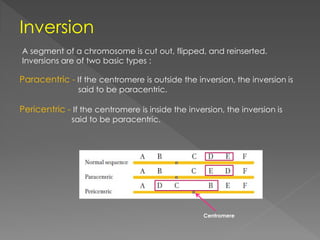
A segment of a chromosome is cut out, flipped, and reinserted.
Inversions are of two basic types :
Paracentric - If the centromere is outside the inversion, the inversion is
said to be paracentric.
Pericentric - If the centromere is inside the inversion, the inversion is
said to be paracentric.
Centromere
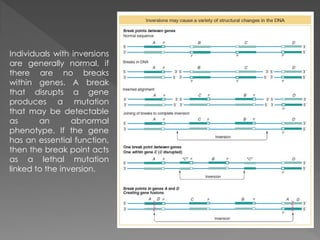
Individuals with inversions
are generally normal, if
there are no breaks
within genes. A break
that disrupts a gene
produces a mutation
that may be detectable
as an abnormal
phenotype. If the gene
has an essential function,
then the break point acts
as a lethal mutation
linked to the inversion.
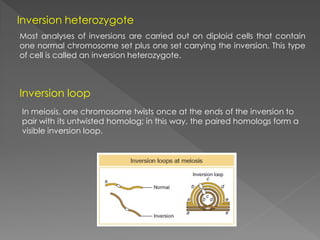
Inversion heterozygote
Most analyses of inversions are carried out on diploid cells that contain
one normal chromosome set plus one set carrying the inversion. This type
of cell is called an inversion heterozygote.
Inversion loop
In meiosis, one chromosome twists once at the ends of the inversion to
pair with its untwisted homolog; in this way, the paired homologs form a
visible inversion loop.
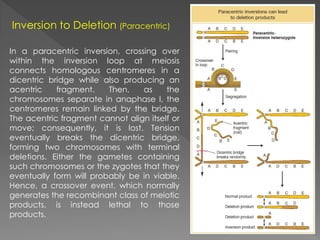
In a paracentric inversion, crossing over
within the inversion loop at meiosis
connects homologous centromeres in a
dicentric bridge while also producing an
acentric fragment. Then, as the
chromosomes separate in anaphase I, the
centromeres remain linked by the bridge.
The acentric fragment cannot align itself or
move; consequently, it is lost. Tension
eventually breaks the dicentric bridge,
forming two chromosomes with terminal
deletions. Either the gametes containing
such chromosomes or the zygotes that they
eventually form will probably be in viable.
Hence, a crossover event, which normally
generates the recombinant class of meiotic
products, is instead lethal to those
products.
Inversion to Deletion (Paracentric)
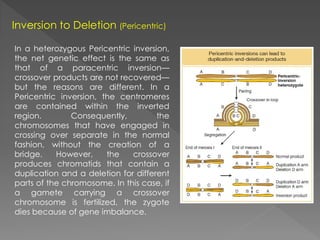
In a heterozygous Pericentric inversion,
the net genetic effect is the same as
that of a paracentric inversion—
crossover products are not recovered—
but the reasons are different. In a
Pericentric inversion, the centromeres
are contained within the inverted
region. Consequently, the
chromosomes that have engaged in
crossing over separate in the normal
fashion, without the creation of a
bridge. However, the crossover
produces chromatids that contain a
duplication and a deletion for different
parts of the chromosome. In this case, if
a gamete carrying a crossover
chromosome is fertilized, the zygote
dies because of gene imbalance.
Inversion to Deletion (Pericentric)
Mutation

Mutation

  • 1.
    MUTATION Presented by: Tousif Khan SubhamKarmakar Suravi Saha Roy Pranab Karmakar Rahul Naskar Vijaygarh Jyotish Ray College Zoology dept. Created by Tousif Khan
  • 2.
    Mutation A mutation isa permanent alteration in the DNA sequence that makes up a gene, such that the sequence differs from what is found in most people. Mutations range in size; they can affect anywhere from a single DNA building block (base pair) to a large segment of a chromosome that includes multiple genes. Types of Chromosomal Mutation Deletion Duplication Inversion Translocation Disjunction
  • 3.
    Inversion A segment ofa chromosome is cut out, flipped, and reinserted. Inversions are of two basic types : Paracentric - If the centromere is outside the inversion, the inversion is said to be paracentric. Pericentric - If the centromere is inside the inversion, the inversion is said to be paracentric. Centromere
  • 4.
    Individuals with inversions aregenerally normal, if there are no breaks within genes. A break that disrupts a gene produces a mutation that may be detectable as an abnormal phenotype. If the gene has an essential function, then the break point acts as a lethal mutation linked to the inversion.
  • 5.
    Inversion heterozygote Most analysesof inversions are carried out on diploid cells that contain one normal chromosome set plus one set carrying the inversion. This type of cell is called an inversion heterozygote. Inversion loop In meiosis, one chromosome twists once at the ends of the inversion to pair with its untwisted homolog; in this way, the paired homologs form a visible inversion loop.
  • 6.
    In a paracentricinversion, crossing over within the inversion loop at meiosis connects homologous centromeres in a dicentric bridge while also producing an acentric fragment. Then, as the chromosomes separate in anaphase I, the centromeres remain linked by the bridge. The acentric fragment cannot align itself or move; consequently, it is lost. Tension eventually breaks the dicentric bridge, forming two chromosomes with terminal deletions. Either the gametes containing such chromosomes or the zygotes that they eventually form will probably be in viable. Hence, a crossover event, which normally generates the recombinant class of meiotic products, is instead lethal to those products. Inversion to Deletion (Paracentric)
  • 7.
    In a heterozygousPericentric inversion, the net genetic effect is the same as that of a paracentric inversion— crossover products are not recovered— but the reasons are different. In a Pericentric inversion, the centromeres are contained within the inverted region. Consequently, the chromosomes that have engaged in crossing over separate in the normal fashion, without the creation of a bridge. However, the crossover produces chromatids that contain a duplication and a deletion for different parts of the chromosome. In this case, if a gamete carrying a crossover chromosome is fertilized, the zygote dies because of gene imbalance. Inversion to Deletion (Pericentric)