• Less is known about Ancient Roman music than is
  known about the music of ancient Greece. There is a
  number of at least partially extant sources on the
  music of the Greeks. For example, much is known
  about the theories of Pythagoras and Aristoxenus
  (some of it from Greek sources and some through the
  writings of later Roman authors), and there exist about
  40 deciphered examples of Greek musical notation.
  Very little survives about the music of the Romans,
  however. There are various reasons for this, one of
  which is that early fathers of the Christian church were
  aghast at the music of theatre, festivals, and pagan
  religion and suppressed it once Christianity became
  the official religion of the Roman empire.
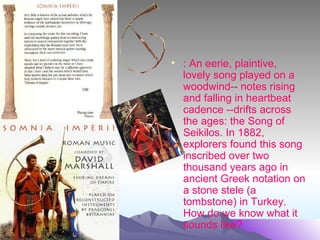
• : An eerie, plaintive,
  lovely song played on a
  woodwind-- notes rising
  and falling in heartbeat
  cadence --drifts across
  the ages: the Song of
  Seikilos. In 1882,
  explorers found this song
  inscribed over two
  thousand years ago in
  ancient Greek notation on
  a stone stele (a
  tombstone) in Turkey.
  How do we know what it
  sounds like?
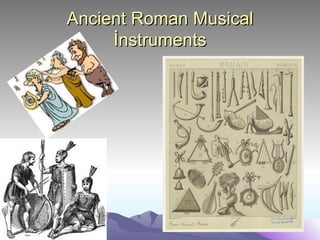
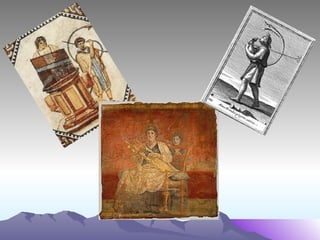
Ancient Roman Musical
     İnstruments
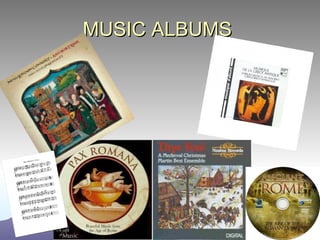
MUSIC ALBUMS
SAMPLE MUSIC
•   Robin Hood and Little John,
    They both are gone to the fair, O!
    And we will go to the merry green-wood,
    To see what they do there, O!
    And for to chase, O!
    To chase the buck and doe.
    [Chorus:]
    With ha-lan-tow, rumble, O!
    For we were up as soon as any day, O!
    And for to fetch the summer home,
    The summer and the may, O!
    For summer is a-come, O!
    And winter is a-gone, O!
•   Where are those Spaniards
    That make so great a boast, O?
    They shall eat the grey goose feather,
    And we will eat the roast, O!
    In every land, O!
    The land where'er we go.
    With ha-lan-tow, &c
•   As for Saint George, O!
    Saint George he was a knight, O!
    Of all the knights in Christendom,
    Saint George is the right, O!
    In every land, O!
    The land where'er we go.
    With ha-lan-tow, &c.
Ancient roman music

Ancient roman music

  • 2.
    • Less isknown about Ancient Roman music than is known about the music of ancient Greece. There is a number of at least partially extant sources on the music of the Greeks. For example, much is known about the theories of Pythagoras and Aristoxenus (some of it from Greek sources and some through the writings of later Roman authors), and there exist about 40 deciphered examples of Greek musical notation. Very little survives about the music of the Romans, however. There are various reasons for this, one of which is that early fathers of the Christian church were aghast at the music of theatre, festivals, and pagan religion and suppressed it once Christianity became the official religion of the Roman empire.
  • 3.
    • : Aneerie, plaintive, lovely song played on a woodwind-- notes rising and falling in heartbeat cadence --drifts across the ages: the Song of Seikilos. In 1882, explorers found this song inscribed over two thousand years ago in ancient Greek notation on a stone stele (a tombstone) in Turkey. How do we know what it sounds like?
  • 4.
  • 5.
  • 6.
    SAMPLE MUSIC • Robin Hood and Little John, They both are gone to the fair, O! And we will go to the merry green-wood, To see what they do there, O! And for to chase, O! To chase the buck and doe. [Chorus:] With ha-lan-tow, rumble, O! For we were up as soon as any day, O! And for to fetch the summer home, The summer and the may, O! For summer is a-come, O! And winter is a-gone, O! • Where are those Spaniards That make so great a boast, O? They shall eat the grey goose feather, And we will eat the roast, O! In every land, O! The land where'er we go. With ha-lan-tow, &c • As for Saint George, O! Saint George he was a knight, O! Of all the knights in Christendom, Saint George is the right, O! In every land, O! The land where'er we go. With ha-lan-tow, &c.