Introduction to Murabaha
Version 2.0
Release Date:
Jamad ul Thani 31, 1430 H
June 25, 2009
Prepared By:
Product Development and Shariah
Compliance Department
• Murabaha is a particular kind of sale and not a
financing in its origin.
• Where the transaction is done on a “cost plus
profit” basis i.e. the seller discloses the cost to the
buyer and adds a certain profit to it to arrive at the
final selling price.
Definition of Murabaha
• The distinguishing feature of Murabaha from
ordinary sale is:
- The seller discloses the cost to the buyer.
- And a known profit is added.
Murabaha
Basic rules for Murabaha financing:
• Asset to be sold must exist.
• Sale price should be determined.
• Sale must be unconditional.
• Assets to be sold:
a) Should not be used for un-Islamic purpose.
b) Should be in ownership of the seller at the
time of sale; physical or constructive.
Murabaha
Step by step Murabaha Financing
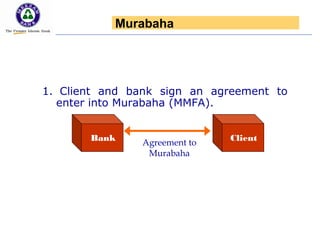
1. Client and bank sign an agreement to
enter into Murabaha (MMFA).
Agreement to
Murabaha
Bank Client
Murabaha
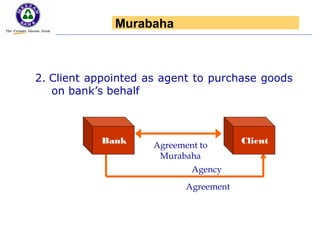
2. Client appointed as agent to purchase goods
on bank’s behalf
Agency
Agreement
Agreement to
Murabaha
Bank Client
Murabaha
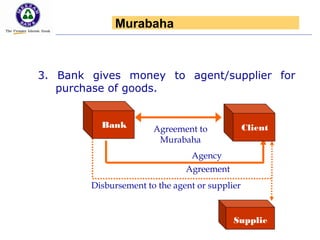
3. Bank gives money to agent/supplier for
purchase of goods.
Disbursement to the agent or supplier
Agency
Agreement
Supplie
r
Agreement to
Murabaha
Bank Client
Murabaha
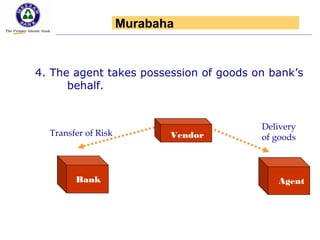
4. The agent takes possession of goods on bank’s
behalf.
Transfer of Risk
Delivery
of goodsVendor
Bank Agent
Murabaha
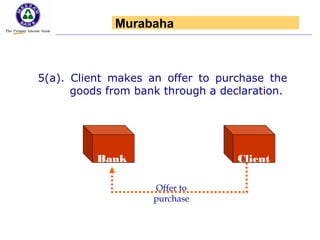
5(a). Client makes an offer to purchase the
goods from bank through a declaration.
Offer to
purchase
Bank Client
Murabaha
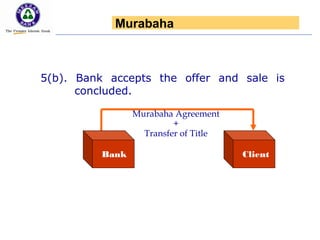
5(b). Bank accepts the offer and sale is
concluded.
Murabaha Agreement
+
Transfer of Title
Bank Client
Murabaha
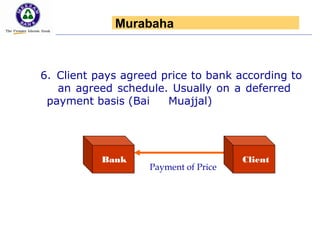
6. Client pays agreed price to bank according to
an agreed schedule. Usually on a deferred
payment basis (Bai Muajjal)
Payment of Price
Bank Client
Murabaha
Application of Murabaha
• Purchase of raw material; for meeting
working capital needs of trade and industry.
• Medium to long term requirements for
purchase of land, building and equipment.
• Trade finance products including imports,
exports and bill purchase.
Applications of Murabaha

Murabaha mbl

  • 1.
    Introduction to Murabaha Version2.0 Release Date: Jamad ul Thani 31, 1430 H June 25, 2009 Prepared By: Product Development and Shariah Compliance Department
  • 2.
    • Murabaha isa particular kind of sale and not a financing in its origin. • Where the transaction is done on a “cost plus profit” basis i.e. the seller discloses the cost to the buyer and adds a certain profit to it to arrive at the final selling price. Definition of Murabaha
  • 3.
    • The distinguishingfeature of Murabaha from ordinary sale is: - The seller discloses the cost to the buyer. - And a known profit is added. Murabaha
  • 4.
    Basic rules forMurabaha financing: • Asset to be sold must exist. • Sale price should be determined. • Sale must be unconditional. • Assets to be sold: a) Should not be used for un-Islamic purpose. b) Should be in ownership of the seller at the time of sale; physical or constructive. Murabaha
  • 5.
    Step by stepMurabaha Financing
  • 6.
    1. Client andbank sign an agreement to enter into Murabaha (MMFA). Agreement to Murabaha Bank Client Murabaha
  • 7.
    2. Client appointedas agent to purchase goods on bank’s behalf Agency Agreement Agreement to Murabaha Bank Client Murabaha
  • 8.
    3. Bank givesmoney to agent/supplier for purchase of goods. Disbursement to the agent or supplier Agency Agreement Supplie r Agreement to Murabaha Bank Client Murabaha
  • 9.
    4. The agenttakes possession of goods on bank’s behalf. Transfer of Risk Delivery of goodsVendor Bank Agent Murabaha
  • 10.
    5(a). Client makesan offer to purchase the goods from bank through a declaration. Offer to purchase Bank Client Murabaha
  • 11.
    5(b). Bank acceptsthe offer and sale is concluded. Murabaha Agreement + Transfer of Title Bank Client Murabaha
  • 12.
    6. Client paysagreed price to bank according to an agreed schedule. Usually on a deferred payment basis (Bai Muajjal) Payment of Price Bank Client Murabaha
  • 13.
  • 14.
    • Purchase ofraw material; for meeting working capital needs of trade and industry. • Medium to long term requirements for purchase of land, building and equipment. • Trade finance products including imports, exports and bill purchase. Applications of Murabaha

Editor's Notes

  • #10 STEP BY STEP MURABAHA FINANCING 1.The client and the institution sign an overall agreement whereby the institution promises to sell and the client promises to buy the commodity from time to time on an agreed ratio of profit added to the cost. This agreement may specify the limit up-to which the facility may be availed. 2.An agency agreement is signed by both parties in which the institution appoints the client as his agent for purchasing the commodity on its behalf. 3.The client purchases the commodity on behalf of the institution and takes possession as the agent of the institution. 4.The client informs the institution that it has purchased the commodity and simultaneously makes an offer to purchase it from the institution. 5.The institution accepts the offer and the sale is concluded whereby ownership as well as risk is transferred to the client. All the above are necessary to effect a valid murabaha. If the institution purchases the commodity directly from the supplier it does not need any agency agreement. Note: The most essential element of the transaction is that the commodity must remain in the risk of the institution during the period between the third and the fifth stage. The above is the only way by which this transaction is distinguished from an ordinary interest-based transaction