ISLAMIC
BANKING AND
FINANCE
Mahyuddin Khalid
emkay@salam.uitm.edu.my
TREASURY
CONTENT
 Islamic Inter-Bank Money Market
 Foreign Exchange Trading
2
ISLAMIC INTER-BANK MONEY
MARKET
 Introduced : BNM on 3 January 1994.
 Short-term intermediary : Provide ready
source of short-term investment outlets based
on the principles of shariah.
 Aim : Facilitating the bank with shortage of
liquidity and with excess of liquidity.
 Match the funding requirement.
 Participating banks : Commercial
banks, Merchant Banks, eligible Finance
companies and eligible discount houses (bill
broker).
3
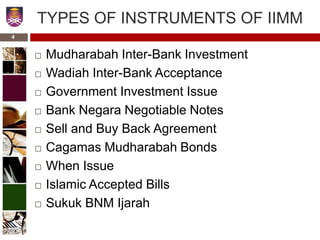
TYPES OF INSTRUMENTS OF IIMM
 Mudharabah Inter-Bank Investment
 Wadiah Inter-Bank Acceptance
 Government Investment Issue
 Bank Negara Negotiable Notes
 Sell and Buy Back Agreement
 Cagamas Mudharabah Bonds
 When Issue
 Islamic Accepted Bills
 Sukuk BNM Ijarah
4
MUDHARABAH INTER-BANK
INVESTMENT
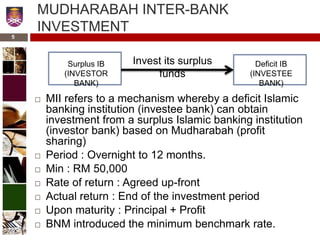
 MII refers to a mechanism whereby a deficit Islamic
banking institution (investee bank) can obtain
investment from a surplus Islamic banking institution
(investor bank) based on Mudharabah (profit
sharing)
 Period : Overnight to 12 months.
 Min : RM 50,000
 Rate of return : Agreed up-front
 Actual return : End of the investment period
 Upon maturity : Principal + Profit
 BNM introduced the minimum benchmark rate.
Surplus IB
(INVESTOR
BANK)
Deficit IB
(INVESTEE
BANK)
Invest its surplus
funds
5
WADIAH ACCEPTANCE
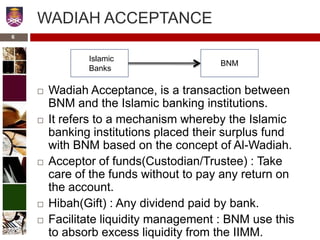
 Wadiah Acceptance, is a transaction between
BNM and the Islamic banking institutions.
 It refers to a mechanism whereby the Islamic
banking institutions placed their surplus fund
with BNM based on the concept of Al-Wadiah.
 Acceptor of funds(Custodian/Trustee) : Take
care of the funds without to pay any return on
the account.
 Hibah(Gift) : Any dividend paid by bank.
 Facilitate liquidity management : BNM use this
to absorb excess liquidity from the IIMM.
Islamic
Banks
BNM
6
GOVERNMENT INVESTMENT
ISSUES (GII)
 Government raise funds : Issuance of non-
interest bearing.
 Primary Reason : IB want to hold liquid papers
meet statutory liquidity requirements and
investment (To park idle fund).
 Introduced in July1983 under the concept of
Qard al-Hasan. The concept of Qard al-Hasan
does not satisfy the GII as tradable instruments
in the secondary market.
 To address this shortfall, BNM opens a window to
facilitate the players to sell and purchase the
papers with the central bank. The price sold or
purchase by the players is determined by
BNM, which maintains a system to record any
movement in the GII.
7
BANK NEGARA MONETARY NOTES-i
(BNMNiI)
 BNMN-i are Islamic securities issued by Bank
Negara Malaysia replacing the existing Bank
Negara Negotiable Notes (BNNN) for
purposes of managing liquidity in the Islamic
financial market.
 The instruments will be issued using Islamic
principles which are deemed acceptable to
Shariah requirement.
 Maturity : Lengthened from 1 year to 3 years.
 Can be issued depends on investor’s demand
 Discounted Basis
 Coupon-Bearing Basis
8
SELL AND BUY BACK AGREEMENT
(SBBA)
 Entered by : 2 parties.
 Bilateral Agreement.
 Two separate agreement :
 First Agreement : Seller (owner) sells & Buyer
(investor) buys at a specified price agreed by
both.
 Forward Purchase Agreement : Buyer promises
to sell back to the original owner who should buy
it back at a specified price and future date.
9
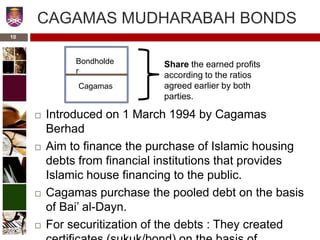
CAGAMAS MUDHARABAH BONDS
 Introduced on 1 March 1994 by Cagamas
Berhad
 Aim to finance the purchase of Islamic housing
debts from financial institutions that provides
Islamic house financing to the public.
 Cagamas purchase the pooled debt on the basis
of Bai’ al-Dayn.
 For securitization of the debts : They created
Bondholde
r
Cagamas
Share the earned profits
according to the ratios
agreed earlier by both
parties.
10
WHEN ISSUES (WI)
 When Issues is a Transaction of sale and
purchase of debt securities before the
securities is being issued.
 The National Shariah Advisory Council
viewed that the WI transaction is allowed
based on the permissibility to promise for sale
and purchase transactions.
11
ISLAMIC ACCEPTED BILLS (AB-i)
 Objective : Encourage and promote domestic
and foreign trade.
 Types of AB-i :
 Imports and Local Purchases
 Exports and Local Sales
 The AB-i is formulated based on the Shariah
concepts of:
 Al-Murabahah
 Bai’ ad-Dayn
12
AB-i IMPORTS & LOCAL
PURCHASES
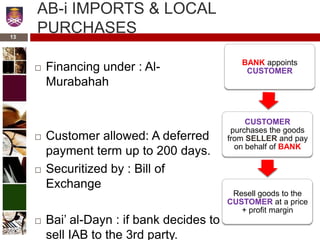
 Financing under : Al-
Murabahah
 Customer allowed: A deferred
payment term up to 200 days.
 Securitized by : Bill of
Exchange
 Bai’ al-Dayn : if bank decides to
sell IAB to the 3rd party.
BANK appoints
CUSTOMER
CUSTOMER
purchases the goods
from SELLER and pay
on behalf of BANK
Resell goods to the
CUSTOMER at a price
+ profit margin
13
AB-i EXPORT & LOCAL SALES
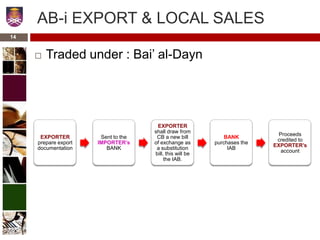
 Traded under : Bai’ al-Dayn
EXPORTER
prepare export
documentation
Sent to the
IMPORTER’s
BANK
EXPORTER
shall draw from
CB a new bill
of exchange as
a substitution
bill, this will be
the IAB.
BANK
purchases the
IAB
Proceeds
credited to
EXPORTER’s
account
14
ISLAMIC NEGOTIABLE INSTRUMENTS
(INI)
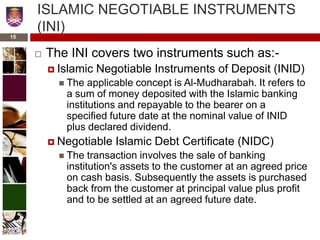
 The INI covers two instruments such as:-
 Islamic Negotiable Instruments of Deposit (INID)
 The applicable concept is Al-Mudharabah. It refers to
a sum of money deposited with the Islamic banking
institutions and repayable to the bearer on a
specified future date at the nominal value of INID
plus declared dividend.
 Negotiable Islamic Debt Certificate (NIDC)
 The transaction involves the sale of banking
institution's assets to the customer at an agreed price
on cash basis. Subsequently the assets is purchased
back from the customer at principal value plus profit
and to be settled at an agreed future date.
15
ISLAMIC PRIVATE DEBT
SECURITIES
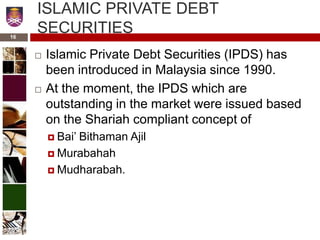
 Islamic Private Debt Securities (IPDS) has
been introduced in Malaysia since 1990.
 At the moment, the IPDS which are
outstanding in the market were issued based
on the Shariah compliant concept of
 Bai’ Bithaman Ajil
 Murabahah
 Mudharabah.
16
AR-RAHNU AGREEMENT-i (RA-i)
 Under RA-i:
 The Lender will provide a loan to the borrower based on
the concept of Qard al- Hasan.
 The borrower will pledge its securities as collateral for the
loan granted.
 However, in the event where the borrower fails to
repay the loan on maturity date, the lender has the
right to sell the pledged securities and use the
proceeds from the sale of the securities to settle the
loan. If there is surplus money, the lender will return
the balance to the borrower.
 BNM will use RA-i as a liquidity management tool for
its money market operations.
 Return from the RA-i will be in the form of gift (hibah)
and is determined based on the average inter bank
money market rates.
17
SUKUK BANK NEGARA MALAYSIA IJARAH
(SBNMI)
 This sukuk based on the Ijarah or ‘sale and lease
back’ concept.
 A special purpose vehicle, BNM Sukuk Berhad
has been established to issue the sukuk Ijarah.
The proceeds from the issuance will be used to
purchase BNM’s assets.
 Assets then be leased to BNM : For rental
payment (distributed to investors as a return on
semi-annual basis)
 Maturity : End of the lease tenure (then sell the
assets back to BNM)
 BNM Sukuk BHD : Issue the Sukuk Ijarah.
18
FOREIGN EXCHANGE
 Foreign Exchange is the exchange of one
currency for another, or the conversion of one
currency into another currency.
 Foreign exchange transactions encompass
everything from the conversion of currencies to
billion-dollar payments made by corporate giants
and governments for goods and services
purchased overseas
 Increasing globalization has led to a massive
increase in the number of foreign exchange
transactions.
 The Foreign Exchange is formulated based on
the Shariah concepts of Bai’ al-Sarf.
19
FOREIGN EXCHANGE
 Definition of Bai' al-Sarf:
 Sale of money for money such as the sale of gold-for-gold or
silver-for-silver.
 Bai' al-sarf is applicable to modern spot forex which is
based on the spot rate which the deal settlement is
expected to be completed shortly after the contract has
been executed.
 Majority of scholars opine that different currencies of
different countries consist of different intrinsic values
and purchasing power.
 Condition of Bai' al-sarf:
 Taking possession before leaving one another
 Equal for equal transaction
 Freedom from khiyar syarat (option of condition)
 Non deferment
20
FOREIGN EXCHANGE
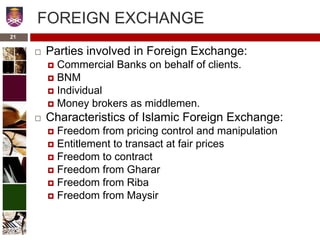
 Parties involved in Foreign Exchange:
 Commercial Banks on behalf of clients.
 BNM
 Individual
 Money brokers as middlemen.
 Characteristics of Islamic Foreign Exchange:
 Freedom from pricing control and manipulation
 Entitlement to transact at fair prices
 Freedom to contract
 Freedom from Gharar
 Freedom from Riba
 Freedom from Maysir
21
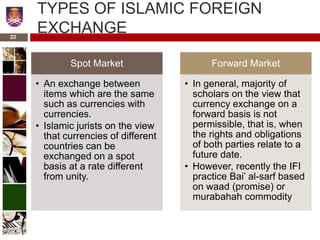
TYPES OF ISLAMIC FOREIGN
EXCHANGE
Spot Market
• An exchange between
items which are the same
such as currencies with
currencies.
• Islamic jurists on the view
that currencies of different
countries can be
exchanged on a spot
basis at a rate different
from unity.
Forward Market
• In general, majority of
scholars on the view that
currency exchange on a
forward basis is not
permissible, that is, when
the rights and obligations
of both parties relate to a
future date.
• However, recently the IFI
practice Bai’ al-sarf based
on waad (promise) or
murabahah commodity
22
END OF CHAPTEFR23

Fundamental of Islamic Banking - Treasury

  • 1.
  • 2.
    CONTENT  Islamic Inter-BankMoney Market  Foreign Exchange Trading 2
  • 3.
    ISLAMIC INTER-BANK MONEY MARKET Introduced : BNM on 3 January 1994.  Short-term intermediary : Provide ready source of short-term investment outlets based on the principles of shariah.  Aim : Facilitating the bank with shortage of liquidity and with excess of liquidity.  Match the funding requirement.  Participating banks : Commercial banks, Merchant Banks, eligible Finance companies and eligible discount houses (bill broker). 3
  • 4.
    TYPES OF INSTRUMENTSOF IIMM  Mudharabah Inter-Bank Investment  Wadiah Inter-Bank Acceptance  Government Investment Issue  Bank Negara Negotiable Notes  Sell and Buy Back Agreement  Cagamas Mudharabah Bonds  When Issue  Islamic Accepted Bills  Sukuk BNM Ijarah 4
  • 5.
    MUDHARABAH INTER-BANK INVESTMENT  MIIrefers to a mechanism whereby a deficit Islamic banking institution (investee bank) can obtain investment from a surplus Islamic banking institution (investor bank) based on Mudharabah (profit sharing)  Period : Overnight to 12 months.  Min : RM 50,000  Rate of return : Agreed up-front  Actual return : End of the investment period  Upon maturity : Principal + Profit  BNM introduced the minimum benchmark rate. Surplus IB (INVESTOR BANK) Deficit IB (INVESTEE BANK) Invest its surplus funds 5
  • 6.
    WADIAH ACCEPTANCE  WadiahAcceptance, is a transaction between BNM and the Islamic banking institutions.  It refers to a mechanism whereby the Islamic banking institutions placed their surplus fund with BNM based on the concept of Al-Wadiah.  Acceptor of funds(Custodian/Trustee) : Take care of the funds without to pay any return on the account.  Hibah(Gift) : Any dividend paid by bank.  Facilitate liquidity management : BNM use this to absorb excess liquidity from the IIMM. Islamic Banks BNM 6
  • 7.
    GOVERNMENT INVESTMENT ISSUES (GII) Government raise funds : Issuance of non- interest bearing.  Primary Reason : IB want to hold liquid papers meet statutory liquidity requirements and investment (To park idle fund).  Introduced in July1983 under the concept of Qard al-Hasan. The concept of Qard al-Hasan does not satisfy the GII as tradable instruments in the secondary market.  To address this shortfall, BNM opens a window to facilitate the players to sell and purchase the papers with the central bank. The price sold or purchase by the players is determined by BNM, which maintains a system to record any movement in the GII. 7
  • 8.
    BANK NEGARA MONETARYNOTES-i (BNMNiI)  BNMN-i are Islamic securities issued by Bank Negara Malaysia replacing the existing Bank Negara Negotiable Notes (BNNN) for purposes of managing liquidity in the Islamic financial market.  The instruments will be issued using Islamic principles which are deemed acceptable to Shariah requirement.  Maturity : Lengthened from 1 year to 3 years.  Can be issued depends on investor’s demand  Discounted Basis  Coupon-Bearing Basis 8
  • 9.
    SELL AND BUYBACK AGREEMENT (SBBA)  Entered by : 2 parties.  Bilateral Agreement.  Two separate agreement :  First Agreement : Seller (owner) sells & Buyer (investor) buys at a specified price agreed by both.  Forward Purchase Agreement : Buyer promises to sell back to the original owner who should buy it back at a specified price and future date. 9
  • 10.
    CAGAMAS MUDHARABAH BONDS Introduced on 1 March 1994 by Cagamas Berhad  Aim to finance the purchase of Islamic housing debts from financial institutions that provides Islamic house financing to the public.  Cagamas purchase the pooled debt on the basis of Bai’ al-Dayn.  For securitization of the debts : They created Bondholde r Cagamas Share the earned profits according to the ratios agreed earlier by both parties. 10
  • 11.
    WHEN ISSUES (WI) When Issues is a Transaction of sale and purchase of debt securities before the securities is being issued.  The National Shariah Advisory Council viewed that the WI transaction is allowed based on the permissibility to promise for sale and purchase transactions. 11
  • 12.
    ISLAMIC ACCEPTED BILLS(AB-i)  Objective : Encourage and promote domestic and foreign trade.  Types of AB-i :  Imports and Local Purchases  Exports and Local Sales  The AB-i is formulated based on the Shariah concepts of:  Al-Murabahah  Bai’ ad-Dayn 12
  • 13.
    AB-i IMPORTS &LOCAL PURCHASES  Financing under : Al- Murabahah  Customer allowed: A deferred payment term up to 200 days.  Securitized by : Bill of Exchange  Bai’ al-Dayn : if bank decides to sell IAB to the 3rd party. BANK appoints CUSTOMER CUSTOMER purchases the goods from SELLER and pay on behalf of BANK Resell goods to the CUSTOMER at a price + profit margin 13
  • 14.
    AB-i EXPORT &LOCAL SALES  Traded under : Bai’ al-Dayn EXPORTER prepare export documentation Sent to the IMPORTER’s BANK EXPORTER shall draw from CB a new bill of exchange as a substitution bill, this will be the IAB. BANK purchases the IAB Proceeds credited to EXPORTER’s account 14
  • 15.
    ISLAMIC NEGOTIABLE INSTRUMENTS (INI) The INI covers two instruments such as:-  Islamic Negotiable Instruments of Deposit (INID)  The applicable concept is Al-Mudharabah. It refers to a sum of money deposited with the Islamic banking institutions and repayable to the bearer on a specified future date at the nominal value of INID plus declared dividend.  Negotiable Islamic Debt Certificate (NIDC)  The transaction involves the sale of banking institution's assets to the customer at an agreed price on cash basis. Subsequently the assets is purchased back from the customer at principal value plus profit and to be settled at an agreed future date. 15
  • 16.
    ISLAMIC PRIVATE DEBT SECURITIES Islamic Private Debt Securities (IPDS) has been introduced in Malaysia since 1990.  At the moment, the IPDS which are outstanding in the market were issued based on the Shariah compliant concept of  Bai’ Bithaman Ajil  Murabahah  Mudharabah. 16
  • 17.
    AR-RAHNU AGREEMENT-i (RA-i) Under RA-i:  The Lender will provide a loan to the borrower based on the concept of Qard al- Hasan.  The borrower will pledge its securities as collateral for the loan granted.  However, in the event where the borrower fails to repay the loan on maturity date, the lender has the right to sell the pledged securities and use the proceeds from the sale of the securities to settle the loan. If there is surplus money, the lender will return the balance to the borrower.  BNM will use RA-i as a liquidity management tool for its money market operations.  Return from the RA-i will be in the form of gift (hibah) and is determined based on the average inter bank money market rates. 17
  • 18.
    SUKUK BANK NEGARAMALAYSIA IJARAH (SBNMI)  This sukuk based on the Ijarah or ‘sale and lease back’ concept.  A special purpose vehicle, BNM Sukuk Berhad has been established to issue the sukuk Ijarah. The proceeds from the issuance will be used to purchase BNM’s assets.  Assets then be leased to BNM : For rental payment (distributed to investors as a return on semi-annual basis)  Maturity : End of the lease tenure (then sell the assets back to BNM)  BNM Sukuk BHD : Issue the Sukuk Ijarah. 18
  • 19.
    FOREIGN EXCHANGE  ForeignExchange is the exchange of one currency for another, or the conversion of one currency into another currency.  Foreign exchange transactions encompass everything from the conversion of currencies to billion-dollar payments made by corporate giants and governments for goods and services purchased overseas  Increasing globalization has led to a massive increase in the number of foreign exchange transactions.  The Foreign Exchange is formulated based on the Shariah concepts of Bai’ al-Sarf. 19
  • 20.
    FOREIGN EXCHANGE  Definitionof Bai' al-Sarf:  Sale of money for money such as the sale of gold-for-gold or silver-for-silver.  Bai' al-sarf is applicable to modern spot forex which is based on the spot rate which the deal settlement is expected to be completed shortly after the contract has been executed.  Majority of scholars opine that different currencies of different countries consist of different intrinsic values and purchasing power.  Condition of Bai' al-sarf:  Taking possession before leaving one another  Equal for equal transaction  Freedom from khiyar syarat (option of condition)  Non deferment 20
  • 21.
    FOREIGN EXCHANGE  Partiesinvolved in Foreign Exchange:  Commercial Banks on behalf of clients.  BNM  Individual  Money brokers as middlemen.  Characteristics of Islamic Foreign Exchange:  Freedom from pricing control and manipulation  Entitlement to transact at fair prices  Freedom to contract  Freedom from Gharar  Freedom from Riba  Freedom from Maysir 21
  • 22.
    TYPES OF ISLAMICFOREIGN EXCHANGE Spot Market • An exchange between items which are the same such as currencies with currencies. • Islamic jurists on the view that currencies of different countries can be exchanged on a spot basis at a rate different from unity. Forward Market • In general, majority of scholars on the view that currency exchange on a forward basis is not permissible, that is, when the rights and obligations of both parties relate to a future date. • However, recently the IFI practice Bai’ al-sarf based on waad (promise) or murabahah commodity 22
  • 23.