Understanding Murabaha: Process
and Practical Applications
Presented by: Kashaf e Noor
Introduction to Murabaha
Murabaha is a type of Islamic financing structure where a seller sells a good
to a buyer at an agreed price, which includes a profit margin.
This contract is a cost-plus-profit arrangement, commonly used in Islamic
finance to avoid interest (Riba), ensuring compliance with Shariah law.
Key Principles of Murabaha
• Shariah Compliance:
Murabaha follows Islamic principles by avoiding Riba (interest), which is
prohibited in Islam. It is structured as a sale, not a loan.
• Transparency:
Both the cost of the asset and the profit margin are disclosed upfront to the
buyer.
• Asset-backed Transaction:
Murabaha involves tangible, identifiable goods, ensuring the transaction is
based on real assets.
• No Interest:
The profit is agreed upon at the time of sale and does not compound over
time like interest.
Murabaha Process Step-by-Step
• Step 1: Request for Financing
 The buyer requests financing to purchase a specific asset or product, such as a house or vehicle.
• Step 2: Agreement on Terms
 The buyer and the Islamic financial institution agree on the cost of the asset and the profit margin.
• Step 3: Purchase of Goods
 The financial institution purchases the asset from the supplier and takes ownership of it.
• Step 4: Sale to the Buyer
 The financial institution sells the asset to the buyer at the agreed-upon price, which includes the
original cost plus the profit margin.
• Step 5: Payment Terms
 The buyer repays the financial institution, either in a lump sum or through installments, based on
the pre-agreed schedule.
• Step 6: Transfer of Ownership
 Ownership of the asset is transferred to the buyer after the sale.
Can anyone give an example of a product or asset that might be financed through
Murabaha?
Murabaha Contract Example
• Asset: A car
• Cost Price: $20,000
• Profit Margin: $3,000
• Total Sale Price: $23,000
• Payment Terms: 12 monthly installments of $1,916.67 each
• The bank buys the car for $20,000.
• The bank sells the car to the buyer for $23,000, with a clear profit of $3,000.
• The buyer repays $23,000 in installments over 12 months, with no interest
or hidden fees.
Advantages of Murabaha
• Shariah Compliance:
Ensures that the financing adheres to Islamic law, which prohibits interest.
• Fixed Profit Margin:
The profit is fixed and agreed upon upfront, offering transparency and
certainty for both parties.
• Tangible Assets:
Murabaha is tied to real, physical assets, which reduces the speculative risk.
• No Compounding:
Unlike loans with interest, Murabaha repayments do not compound over
time.
How do you think Murabaha can help those who are avoiding conventional
loans due to religious reasons
Challenges of Murabaha
• Higher Cost for the Buyer:
The price in Murabaha transactions can be higher than the market price
due to the added profit margin.
• Asset Ownership Risk:
Since the bank must own the asset before selling it, it bears any risks
associated with the asset during that period.
• Limited to Tangible Goods:
Murabaha is only applicable to physical goods and assets, which limits its
use in certain financial contexts.
• No Flexibility in Payment:
While the repayment terms are fixed, the buyer has little flexibility if they
need to change the payment schedule.
Practical Applications of
Murabaha
• Home Financing (Islamic Mortgages):
 Financial institutions use Murabaha to help clients purchase homes. The bank buys
the property and resells it at a higher price, allowing the buyer to make fixed
payments over time.
• Vehicle Financing:
 Banks and financial institutions can offer Murabaha contracts for purchasing vehicles,
where they purchase the vehicle from the dealership and resell it to the buyer with a
profit margin.
• Trade Financing:
 Murabaha can be used in trade financing, where the bank buys goods on behalf of a
business and sells them at a profit to the business, which will then resell the goods in
the market.
• Educational Financing:
 Islamic financial institutions may offer Murabaha financing for education-related
expenses, such as tuition fees, where the student repays the cost over time.
Can you think of any other industries or sectors where Murabaha could be
applied
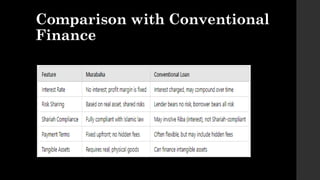
Comparison with Conventional
Finance
THANK YOU

finace presentation .pptx

  • 1.
    Understanding Murabaha: Process andPractical Applications Presented by: Kashaf e Noor
  • 2.
    Introduction to Murabaha Murabahais a type of Islamic financing structure where a seller sells a good to a buyer at an agreed price, which includes a profit margin. This contract is a cost-plus-profit arrangement, commonly used in Islamic finance to avoid interest (Riba), ensuring compliance with Shariah law.
  • 3.
    Key Principles ofMurabaha • Shariah Compliance: Murabaha follows Islamic principles by avoiding Riba (interest), which is prohibited in Islam. It is structured as a sale, not a loan. • Transparency: Both the cost of the asset and the profit margin are disclosed upfront to the buyer. • Asset-backed Transaction: Murabaha involves tangible, identifiable goods, ensuring the transaction is based on real assets. • No Interest: The profit is agreed upon at the time of sale and does not compound over time like interest.
  • 4.
    Murabaha Process Step-by-Step •Step 1: Request for Financing  The buyer requests financing to purchase a specific asset or product, such as a house or vehicle. • Step 2: Agreement on Terms  The buyer and the Islamic financial institution agree on the cost of the asset and the profit margin. • Step 3: Purchase of Goods  The financial institution purchases the asset from the supplier and takes ownership of it. • Step 4: Sale to the Buyer  The financial institution sells the asset to the buyer at the agreed-upon price, which includes the original cost plus the profit margin. • Step 5: Payment Terms  The buyer repays the financial institution, either in a lump sum or through installments, based on the pre-agreed schedule. • Step 6: Transfer of Ownership  Ownership of the asset is transferred to the buyer after the sale.
  • 5.
    Can anyone givean example of a product or asset that might be financed through Murabaha?
  • 6.
    Murabaha Contract Example •Asset: A car • Cost Price: $20,000 • Profit Margin: $3,000 • Total Sale Price: $23,000 • Payment Terms: 12 monthly installments of $1,916.67 each • The bank buys the car for $20,000. • The bank sells the car to the buyer for $23,000, with a clear profit of $3,000. • The buyer repays $23,000 in installments over 12 months, with no interest or hidden fees.
  • 7.
    Advantages of Murabaha •Shariah Compliance: Ensures that the financing adheres to Islamic law, which prohibits interest. • Fixed Profit Margin: The profit is fixed and agreed upon upfront, offering transparency and certainty for both parties. • Tangible Assets: Murabaha is tied to real, physical assets, which reduces the speculative risk. • No Compounding: Unlike loans with interest, Murabaha repayments do not compound over time.
  • 8.
    How do youthink Murabaha can help those who are avoiding conventional loans due to religious reasons
  • 9.
    Challenges of Murabaha •Higher Cost for the Buyer: The price in Murabaha transactions can be higher than the market price due to the added profit margin. • Asset Ownership Risk: Since the bank must own the asset before selling it, it bears any risks associated with the asset during that period. • Limited to Tangible Goods: Murabaha is only applicable to physical goods and assets, which limits its use in certain financial contexts. • No Flexibility in Payment: While the repayment terms are fixed, the buyer has little flexibility if they need to change the payment schedule.
  • 10.
    Practical Applications of Murabaha •Home Financing (Islamic Mortgages):  Financial institutions use Murabaha to help clients purchase homes. The bank buys the property and resells it at a higher price, allowing the buyer to make fixed payments over time. • Vehicle Financing:  Banks and financial institutions can offer Murabaha contracts for purchasing vehicles, where they purchase the vehicle from the dealership and resell it to the buyer with a profit margin. • Trade Financing:  Murabaha can be used in trade financing, where the bank buys goods on behalf of a business and sells them at a profit to the business, which will then resell the goods in the market. • Educational Financing:  Islamic financial institutions may offer Murabaha financing for education-related expenses, such as tuition fees, where the student repays the cost over time.
  • 11.
    Can you thinkof any other industries or sectors where Murabaha could be applied
  • 12.
  • 13.