Islamic Finance An introduction of the Islamic financial Instruments
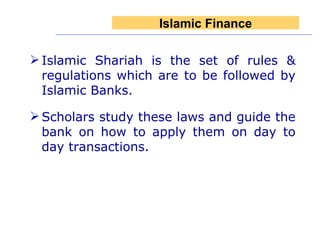
Islamic Shariah is the set of rules & regulations which are to be followed by Islamic Banks. Scholars study these laws and guide the bank on how to apply them on day to day transactions. Islamic Finance
BASIC RULES OF SALE
Since Murabaha is a sale transaction, rules of Shariah regarding sale need to be understood. Sale is defined in Shariah as  “ Exchange of a thing of value, by another thing of value, with mutual consent” Rules of Sale
“ But Allah has permitted trade” [2:275], “ But take witnesses whenever you make a commercial contract” [2:282], “ But let there be among you traffic and trade by mutual good will” [4:29],  “ It is no crime for you to seek the bounty of your Lord” [2:198]. Legitimacy of sale
Rule 1 The subject of sale must exist at the time of sale Rule 2   The subject of sale must be in the ownership of seller at the time of sale. Hence, what is not owned by the seller cannot be sold. Rules of Sale
Rule 3   The subject of sale must be in the physical or constructive ownership of seller at the time of sale. “ Constructive Possession” means where the buyer has not taken physical delivery of goods, but the goods are under his control. And all rights and liabilities of the goods have passed to him,i.e. the goods are at his risk. Rules of Sale
Rule 4 The sale must be instant and absolute. Thus a sale attributed to a future date or a sale contingent on a future event is void. Rules of Sale
Rule 5 The subject of sale should be an object of value. A thing having no value according to the usage of trade cannot be sold. Rule 6   The subject of sale should not be a thing used for a Haram purpose, e.g. pork, wine etc. The subject should be Maal-e-mutaqawwam Rules of Sale
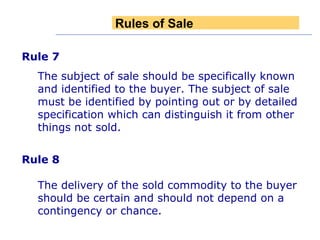
Rule 7  The subject of sale should be specifically known and identified to the buyer. The subject of sale must be identified by pointing out or by detailed specification which can distinguish it from other things not sold. Rule 8   The delivery of the sold commodity to the buyer should be certain and should not depend on a contingency or chance. Rules of Sale
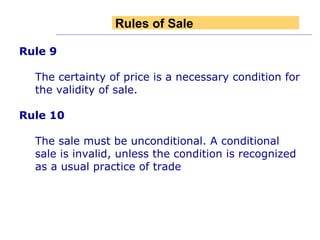
Rule 9 The certainty of price is a necessary condition for the validity of sale.  Rule 10 The sale must be unconditional. A conditional sale is invalid, unless the condition is recognized as a usual practice of trade Rules of Sale
MURABAHA
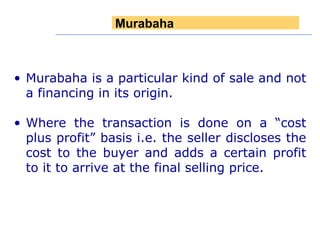
Murabaha is a particular kind of sale and not a financing in its origin. Where the transaction is done on a “cost plus profit” basis i.e. the seller discloses the cost to the buyer and adds a certain profit to it to arrive at the final selling price. Murabaha
The distinguishing feature of Murabaha from ordinary sale is: The seller discloses the cost to the buyer. - And a known profit is added.   Murabaha
Payment of Murabaha price may be: 1) At spot 2) In installments In lump sum after a certain time Hence, Murabaha does not necessarily imply the concept of deferred payment. Murabaha
TYPES OF MURABAHA 1) Direct – where the financier himself purchases directly from the market or 3 rd  party. Indirect – where the financier appoints the customer as an ‘Agent’ to make purchases from the market before buying it from the bank.  Murabaha
The Holy Quran says “And Allah has permitted trade” (2:275) It is further mentioned“But let there be among you traffic and trade by mutual goodwill” (4:29) According to Imam Shafi in Al-Umm: “If an individual shows another a good and says: buy this, and I will give you this much profit in it; and then the second man buys it then the purchase is valid. If the first party said: I will give you this much profit in it , but I retain an option, then he may conclude the sale or leave it.”(See Financial Transactions in Islamic Jurisprudence Vol1 Pg 361) Shari’a Source
As for making the promise to purchase the item once the bank acquires it binding on the ultimate buyer, we may take a ruling by ‘Ibn Shabramah from the Maliki school that any promise that does not result in permitting that which is forbidden or forbidding that which is permitted is binding.  The Malikis use this principle to make the promise binding, especially if the promise leads another entity to undertake a financial obligation. Shari’a Source
In the first Conference in Dubai (1979), it was ruled that: “This type of promise is legally binding on both parties based on the Maliki ruling, and religiously binding on both parties for all the other schools. In this regard, what is religiously binding can be made legally binding if this is beneficial and can be regulated legally.” Shari’a Source
The second Conference in Kuwait (1983) ruled thus: “The conference determines that the mutual promises involved in murabaha sales to the one who orders the initial purchase is permitted after the bank owns and gains possession of the sold object, and then sells it to the one who ordered its purchase with the promised profit margin.  This sale is valid as long as the bank is exposed to the risk of destruction of the goods prior to delivering it to the final buyer, as well as the obligation to accept the return of the goods if a concealed defect was found. .” Shari’a Source
Cost-plus, sale is a legally permissible contract by the testimony of the majority of jurists and companions of the Prophet (pbuh). This type of sale satisfies all the legal requirements for sale, and it provides a valuable service in economic markets since it allows those knowledgeable of market conditions to make a profit and those without such knowledge to obtain the goods at a good price. It was narrated that ‘Ibn Masud (RA) ruled that there was no harm in declared lump-sum or percentage profit margins. Shari’a Source
The conditions of  murabaha  are as follows:  Knowledge of the initial price: The second buyer must know the price at which the seller obtained the object of sale, since knowledge of the price is a fundamental condition for the validity of sale. Knowledge of the profit margin: Since the profit margin is a component of the price at which the second buyer obtains the goods, knowledge of that margin is essential for knowledge of the price, which is in turn a condition of validity for the sale. Shari’a Source
The present day Murabaha transactions are being practiced under the guidelines given by  Accounting & Auditing Organization of Islamic Financial Institutions (AAOIFI)  and  Islamic Fiqh Academy  which have representation of scholars of all Islamic Fiqhs. Murabaha
Basic rules for Murabaha financing: Asset to be sold must exist. Sale price should be determined. Sale must be unconditional. Assets to be sold: Cannot be used for un-Islamic purposes. Should be in ownership of the seller at the time of sale; physical or constructive. Murabaha
Basic rules for Murabaha financing: Re-negotiation of price after concluding the transaction and roll over of Murabaha are not permitted. Discounting of Murabaha instrument is not permitted. Murabaha
Step by step Murabaha financing (under Agency arrangement)
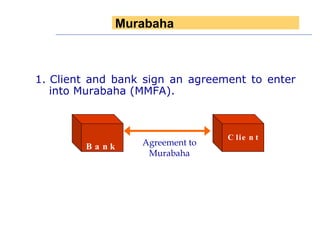
1.   Client and bank sign an agreement to enter into Murabaha (MMFA).  Agreement to Murabaha Bank Client Murabaha
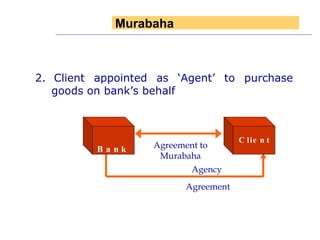
2.   Client appointed as ‘Agent’ to purchase goods on bank’s behalf Agency  Agreement Agreement to Murabaha Bank Client Murabaha
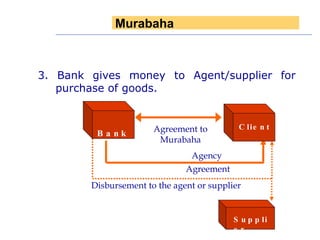
3. Bank gives money to Agent/supplier for purchase of goods. Disbursement to the agent or supplier Agency  Agreement Supplier Agreement to Murabaha Bank Client Murabaha
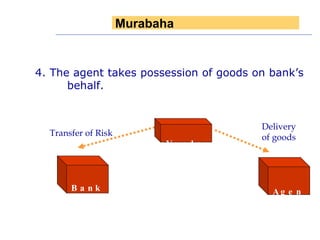
4. The agent takes possession of goods on bank’s  behalf. Transfer of Risk Delivery of goods  Vendor Bank Agent Murabaha
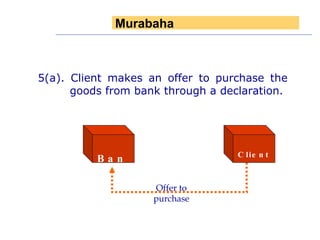
5(a). Client makes an offer to purchase the  goods from bank through a declaration. Offer to purchase Bank Client Murabaha
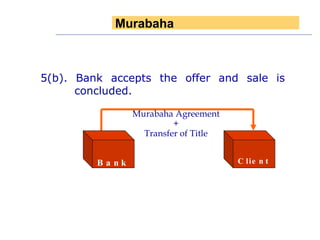
5(b). Bank accepts the offer and sale is concluded. Murabaha Agreement +  Transfer of Title Bank Client Murabaha
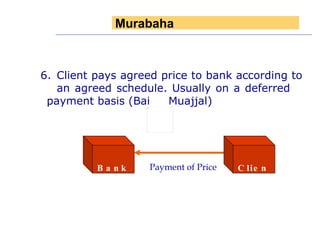
6. Client pays agreed price to bank according to  an agreed schedule. Usually on a deferred  payment basis (Bai  Muajjal) Payment of Price Bank Client Murabaha
MURABAHA DOCUMENTATION
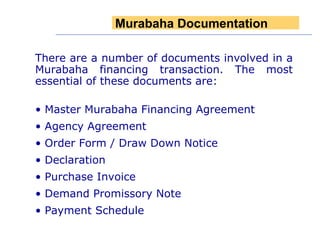
There are a number of documents involved in a Murabaha financing transaction. The most essential of these documents are: Master Murabaha Financing Agreement Agency Agreement Order Form / Draw Down Notice Declaration  Purchase Invoice Demand Promissory Note Payment Schedule Murabaha Documentation
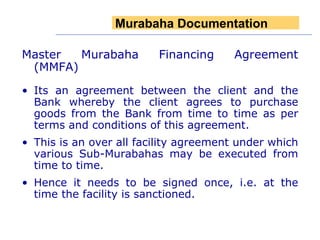
Master Murabaha Financing Agreement (MMFA) Its an agreement between the client and the Bank whereby the client agrees to purchase goods from the Bank from time to time as per terms and conditions of this agreement. This is an over all facility agreement under which various Sub-Murabahas may be executed from time to time. Hence it needs to be signed once, i.e. at the time the facility is sanctioned. Murabaha Documentation
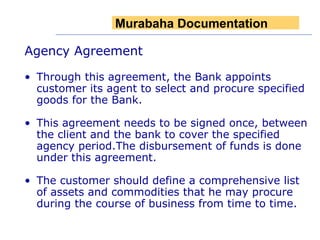
Agency Agreement Through this agreement, the Bank appoints customer its agent to select and procure specified goods for the Bank. This agreement needs to be signed once, between the client and the bank to cover the specified agency period.The disbursement of funds is done under this agreement. The customer should define a comprehensive list of assets and commodities that he may procure during the course of business from time to time.   Murabaha Documentation
Order Form This document is executed at the time of each sub-Murabaha request i.e. each time when the customer requires funds for the purchase of assets. Through this document customer requests the bank to purchase the assets from the supplier and undertakes that it will purchase the assets from the bank once the bank acquires them from the market.   The customer also undertakes to compensate for the actual loss the bank may suffer in case he fails to purchase the assets from the bank. Murabaha Documentation
Declaration This is the most important part of the Murabaha process.  Declaration is to be signed by the customer immediately after the purchase of goods as Bank’s agent but before the actual consumption. This document establishes the actual sale transaction, i.e. transfer of ownership of goods from the Bank to the customer At this stage the specific details of the assets must be known i.e. quantity, quality, cost etc. Murabaha Documentation
Declaration Purchase Evidences in the form of bills, sale invoice, sales tax invoice must be furnished along with the Declaration, specifying the full details of the goods purchased. The cost of goods must be inclusive of all cost including sales tax, transportation and handling etc.  Proper timing of declaration is extremely important especially in cases of perishable or immediately consumable commodities. Murabaha price (Cost of Goods + Profit) should be determined at this stage and stated clearly in the Declaration. Murabaha Documentation
Payment Schedule The Payment Schedule specifies the amount that the Client will make from time to time or at once towards the payment of Murabaha price.  This shall be implemented after the execution of Declaration.  The dates mentioned in the schedule corresponds to the day when the payment becomes due on the client.  Murabaha Documentation
Practical Issues in Murabaha
1 .   Timing of Declaration  A Murabaha financing arrangement consists of a series of documents to be executed at various stages, the sequence and timing of which is extremely important. Through declaration, the client and the bank execute an important step of a valid Murabaha sale i.e. Offer & Acceptance Declaration is to be signed by the customer when it has  purchased and taken possession of the goods as the Bank’s agent. Declaration must be signed while the goods are still in existence  and have not been used in the production process or sold to some other entity. Issues in Murabaha
2. Rollover in Murabaha Rollover in Murabaha is not possible since each Murabaha transaction is for the purchase of a particular asset. A new Murabaha can only be executed for the purchase of new assets. It is advisable that there must be a gap of 1-2 days between maturity of the previous Murabaha and disbursement of the new one.  Issues in Murabaha
3. Rebate on early payments This is normally prohibited by Shariah Board since it can make the Murabaha transaction similar to conventional debt. Issues in Murabaha
4. Penalty on late payments As soon as the Murabaha is executed (declaration signed) the Murabaha price becomes a receivable (Dayn) for the Bank. As per the rules of Islamic fiqh any amount charged over and above the “dayn” amount will be Riba. Hence bank cannot charge any late payment charges. The bank may, however, ask the customer to pay a forced charity in case of overdues so as to create a disincentive for him to delay the payment Issues in Murabaha
5.  Subject matter of Murabaha Murabaha cannot be done in all commodities, e.g. Murabaha can not be done in currencies.  Murabaha cannot be used for paying utility bills, wages, overhead expenses, etc.  As per general rules of sale subject matter must be: - In existence - Having intrinsic utility - Usable for a Halal purpose (buyer must intend   to use it for the same purpose) - Capable of ownership/delivery - Specified and quantified at the time of sale - Must be in Bank’s ownership/possession at the   time of sale  Issues in Murabaha
6.  Purchase Invoice (evidence) In order to ensure that the customer actually purchased the assets as claimed, the customer is required to submit asset purchase evidence along with declaration. The purchase evidence must confirm that the asset purchase took place after the agency agreement. Asset purchase may be in the form of Invoices, delivery orders, Bill of entry, truck receipts etc. Issues in Murabaha
6.  Purchase Invoice (evidence)…..(Contd) In some cases, however, it may be too burdensome for the client to submit all the invoices as the number of invoices may run into hundreds.  For example, cotton purchases are generally in small quantities from various sources and hence for each Sub-Murabaha there may be too many invoices to submit. It is suggested to furnish samples of invoices along with summary of all purchases. Issues in Murabaha
7.  Direct Payment in Murabaha Currently in many cases the disbursement is made to the customer as an agent. In order to ensure transparency of the Murabaha it is better that the bank disburses the funds directly to the supplier. Issues in Murabaha
7.  Direct Payment in Murabaha…..(Contd) Direct payment can be made in the following ways: - The bank can pay the supplier directly via  cash, cheque, wire transfer, pay-order etc. - The bank may credit the Murabaha funds in  the customer’s account and only allow him to  issue pay orders/demand drafts from his  account in favor of  the suppliers. Issues in Murabaha
Purchase of raw material;  for meeting working capital needs of trade and industry. Medium to long term requirements for purchase of land, building and equipment. Trade finance products including imports, exports and alternative to bill purchase. Applications of Murabaha
IJARAH
Ijarah is a term of Islamic Fiqh Literally, it means “To give something on  rent” The term “Ijarah” is used in two situations: It means ‘To employ the services of a person on wages’ e.g. “A” hires a porter at the airport to carry his luggage Another type of Ijarah relates to paying rent for use of an asset or property defined as “LAND” in Islamic Economics Ijarah
Leases, like sales, are among the contracts that are explicitly discussed in Islamic Law Leases differ from sales due to the time limitation involved in leases, in contrast to sales where no time limit is allowed.  The proof from the Sunnah is derived from the Hadith: “Pay the hired worker his wages before his sweat dries off”. Ijarah: Shari’a Source
Narrated by Ahmad, Abu Dawud, and Al-Nasai with the wording: “The farmers during the time of the Prophet (pbuh) used to pay rent for the land in water and seeds. He (pbuh) forbade them from doing that, and ordered them to use gold and silver (money) to pay the rent” It is impermissible to charge a rental for gold or silver coins, or for any consumable good measurable by weight or volume.  Ijarah: Shari’a Source
Ijarah is an Islamic alternative of Leasing. Leasing backed by an acceptable contract is an acceptable transaction under Shariah. The question of whether or not the transaction of leasing is Shariah compliant depends on the terms and conditions of the contract.  Several characteristics of conventional agreements may not conform to Shariah thus making the transaction un-Islamic and thereby invoking a prohibition. Ijarah as a mode of financing
Risk and rewards of ownership lies with the owner i.e. any loss to the asset beyond the control of the lessee should be borne by the Lessor.  Late payment penalty cannot be charged to the income of the Lessor.  Lease and Sale agreement should be separate and non contingent. Key Differences
Difference b/w Conventional Lease & Ijarah
Difference b/w Conventional Lease & Ijarah The Lessor cannot increase the rent unilaterally Expenses to be borne by the parties: Lessor -  expenses relating to the corpus of the asset i.e. insurance, accidental repairs etc. will be borne by the lessor Lessee -  actual operating/overhead expenses related to running the asset will be borne by the lessee Ijarah
Difference b/w Conventional Lease & Ijarah 3.  Two contracts into one contract is not permissible in Shariah therefore, the bank cannot have the agreement of hire and purchase into one agreement, only the bank can undertake/promise to purchase the leased asset 4. Under  conventional  Lease, the Lease rental starts from the date of payment by Lessor.Under  Shariah , the correct way to charge rent is after delivery of the asset to the Lessee. Because rent is charged for use of the asset Ijarah
Procedure of Ijarah
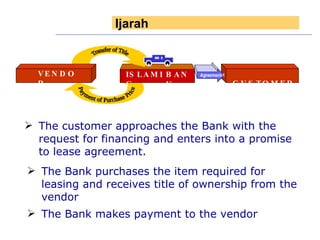
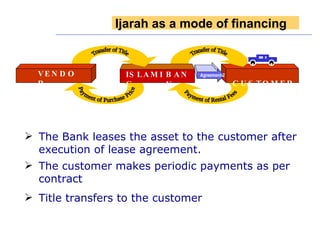
MECHANICS  The Bank makes payment to the vendor The Bank purchases the item required for leasing and receives title of ownership from the vendor The customer approaches the Bank with the request for financing and enters into a promise to lease agreement. CUSTOMER Payment of Purchase Price ISLAMIC BANK Transfer of Title VENDOR . . Agreement-1 Ijarah
MECHANICS  The customer makes periodic payments as per contract The Bank leases the asset to the customer after execution of lease agreement. Title transfers to the customer Payment of Rental Fees CUSTOMER Transfer of Title Payment of Purchase Price ISLAMIC BANK Transfer of Title VENDOR . . Agreement-2 Ijarah as a mode of financing
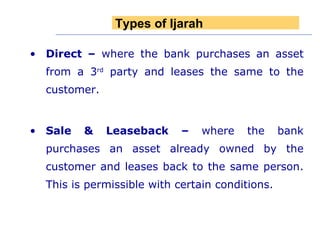
Direct   –  where the bank purchases an asset from a 3 rd  party and leases the same to the customer. Sale & Leaseback –  where the bank purchases an asset already owned by the customer and leases back to the same person. This is permissible with certain conditions.   Types of Ijarah
Rules of Ijarah
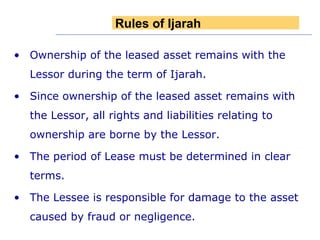
Ownership of the leased asset remains with the Lessor during the term of Ijarah. Since ownership of the leased asset remains with the Lessor, all rights and liabilities relating to ownership are borne by the Lessor. The period of Lease must be determined in clear terms. The Lessee is responsible for damage to the asset caused by fraud or negligence. Rules of Ijarah
Any damage to the asset not caused by the Lessee’s neglect, is to be borne by the Lessor. Normal maintenance is Lessee’s responsibility Lease rentals for the entire lease period must be fixed;  Different amounts of rents can be fixed for different periods, but they must be known. The rent may be tied to a known benchmark, acceptable to both the parties. Rules of Ijarah
The Lease period will start when the asset has  been delivered to the Lessee - in a usable condition - whether or not the Lessee has started using it Insurance is a cost related to ownership of the assets, and therefore should be borne by the Lessor Rules of Ijarah
Ijarah Documentation
Undertaking to Ijarah  Ijarah Agreement Description of the Ijarah Asset  Schedule of of Ijarah Rentals Receipt of Asset Demand Promissory Note Undertaking to Purchase Ijarah Asset  Sale Deed Ijarah Documentation
For long  and medium term fixed asset financing BMR Retail products Applications of Ijarah
Diminishing Musharakah
Musharakah is a form of partnership (Shirkat) between two or more parties  whereby each party contributes to the capital of the partnership in equal or varying proportions either to establish a new venture or share in an existing one.  There are two types of Shirkah:  Shirkat-ul-Milk  Shirkat-ul-Aqd Musharakah
Shirkat-ul-Milk  Joint ownership of two or more persons in a particular property. Shirkat-ul-Aqd A partnership affected by mutual contract. It can also be translated as a joint commercial enterprise.  Musharakah
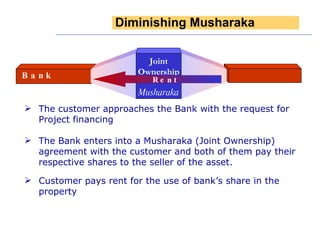
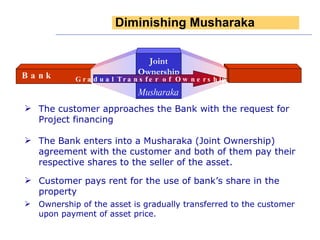
In Diminishing Musharakah the bank and the client participate either in joint ownership of  a property or an equipment,  or in a joint commercial enterprise The share of the bank is divided into a number of units The client purchases these units one by one periodically until he is the sole owner of the property. Diminishing   Musharakah
Most commonly, Diminishing Musharakah is used in cases of Shirkat-ul-Milk  This concept is based on Declining ownership of the financier Three components  involved : Joint ownership of the Bank and the customer Customer as  a lessee uses the share of  the bank  Redemption of the share of the Bank by the customer Diminishing   Musharakah
Concept of Musha’   Musha’ means undivided ownership of the asset  Lease of Musha  It is allowed to lease Musha to other joint owner . Diminishing   Musharakah
Shariah Principles
To create joint ownership in property is called Shirkat-ul-Milk and is expressly allowed by all schools of Islamic Jurisprudence. All Muslim Jurists agree on the permissibility of the Financier leasing his share in property to client and charging him rent i.e. the permissibility of leasing one’s share to his partner. Promise of client to purchase units of share of financier is also allowed. Shariah Principles
The Transactions cannot be combined in a single agreement and they have to be executed independently. This is  because it is a well settled rule of Islamic Jurisprudence that one transaction cannot be made a condition for another. Instead of making the transactions a pre-condition for one another there can be one-sided promises from one party to another Shariah Principles
Bai Bilwafa is a special arrangement of sale of a house whereby the buyer promises to the seller that whenever the latter gives him back the price of the house, he will resell the house to him. If the resale is made condition to the first sale it is not allowed. However if the buyer promises to resell the house whenever the seller offers him the same price the sale has been allowed by Hanafi Jurists. Even if the promise has been made before effecting the first sale, after which the sale is effected, it is also allowed by certain Hanafi Jurists.(See Jami’ul-Fusoolain and Radd al-Mukhtar). “ Bai Bilwafa”   Shari’a Source
By binding two contracts into one the first sale is made subject to the second sale. If for some reason the second sale doesn’t occur the first sale will become void. But if a promise is made by the buyer and he doesn’t fulfill the promise in future the First sale would remain valid.  Shari’a Source
Basic Structure
The Bank enters into a Musharaka (Joint Ownership) agreement with the customer and both of them pay their respective shares to the seller of the asset. Customer pays rent for the use of bank’s share in the property The customer approaches the Bank with the request for Project financing   Rent C USTOMER Bank Joint Ownership Musharaka Diminishing Musharaka
The Bank enters into a Musharaka (Joint Ownership) agreement with the customer and both of them pay their respective shares to the seller of the asset. Ownership of the asset is gradually transferred to the customer upon payment of asset price. Customer pays rent for the use of bank’s share in the property The customer approaches the Bank with the request for Project financing   Gradual Transfer of Ownership C USTOMER Bank Joint Ownership Musharaka Diminishing Musharaka
Legal Documentation
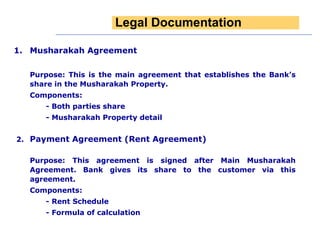
Musharakah Agreement   Purpose: This is the main agreement that establishes the Bank’s share in the Musharakah Property. Components:  - Both parties share       - Musharakah Property detail   2.  Payment Agreement (Rent Agreement)     Purpose: This agreement is signed after Main Musharakah Agreement. Bank gives its share to the customer via this agreement.   Components: - Rent Schedule  - Formula of calculation Legal Documentation
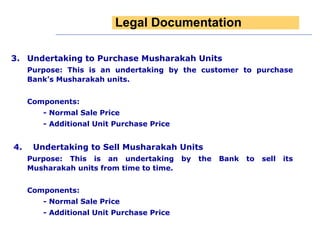
3. Undertaking to Purchase Musharakah Units   Purpose: This is an undertaking by the customer to purchase Bank’s Musharakah units.   Components:      - Normal Sale Price - Additional Unit Purchase Price   4.    Undertaking to Sell Musharakah Units   Purpose: This is an undertaking by the Bank to sell its Musharakah units from time to time.   Components:      - Normal Sale Price - Additional Unit Purchase Price Legal Documentation
APPLICATION
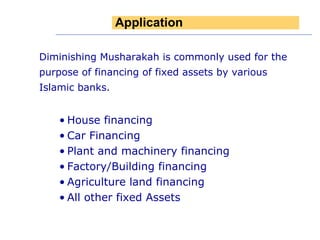
Diminishing Musharakah is commonly used for the purpose of financing of fixed assets by various Islamic banks. House financing Car Financing Plant and machinery financing Factory/Building financing Agriculture land financing All other fixed Assets Application
The Way Forward
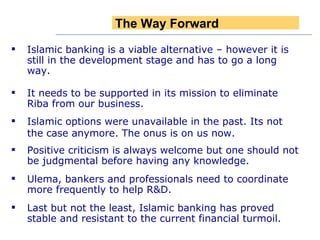
Islamic banking is a viable alternative – however it is still in the development stage and has to go a long way. It needs to be supported in its mission to eliminate Riba from our business. Islamic options were unavailable in the past. Its not the case anymore. The onus is on us now. Positive criticism is always welcome but one should not be judgmental before having any knowledge. Ulema, bankers and professionals need to coordinate more frequently to help R&D.   Last but not the least, Islamic banking has proved stable and resistant to the current financial turmoil. The Way Forward
Thank you

Islamic Finance

  • 1.
    Islamic Finance Anintroduction of the Islamic financial Instruments
  • 2.
    Islamic Shariah isthe set of rules & regulations which are to be followed by Islamic Banks. Scholars study these laws and guide the bank on how to apply them on day to day transactions. Islamic Finance
  • 3.
  • 4.
    Since Murabaha isa sale transaction, rules of Shariah regarding sale need to be understood. Sale is defined in Shariah as “ Exchange of a thing of value, by another thing of value, with mutual consent” Rules of Sale
  • 5.
    “ But Allahhas permitted trade” [2:275], “ But take witnesses whenever you make a commercial contract” [2:282], “ But let there be among you traffic and trade by mutual good will” [4:29], “ It is no crime for you to seek the bounty of your Lord” [2:198]. Legitimacy of sale
  • 6.
    Rule 1 Thesubject of sale must exist at the time of sale Rule 2 The subject of sale must be in the ownership of seller at the time of sale. Hence, what is not owned by the seller cannot be sold. Rules of Sale
  • 7.
    Rule 3 The subject of sale must be in the physical or constructive ownership of seller at the time of sale. “ Constructive Possession” means where the buyer has not taken physical delivery of goods, but the goods are under his control. And all rights and liabilities of the goods have passed to him,i.e. the goods are at his risk. Rules of Sale
  • 8.
    Rule 4 Thesale must be instant and absolute. Thus a sale attributed to a future date or a sale contingent on a future event is void. Rules of Sale
  • 9.
    Rule 5 Thesubject of sale should be an object of value. A thing having no value according to the usage of trade cannot be sold. Rule 6 The subject of sale should not be a thing used for a Haram purpose, e.g. pork, wine etc. The subject should be Maal-e-mutaqawwam Rules of Sale
  • 10.
    Rule 7 The subject of sale should be specifically known and identified to the buyer. The subject of sale must be identified by pointing out or by detailed specification which can distinguish it from other things not sold. Rule 8 The delivery of the sold commodity to the buyer should be certain and should not depend on a contingency or chance. Rules of Sale
  • 11.
    Rule 9 Thecertainty of price is a necessary condition for the validity of sale. Rule 10 The sale must be unconditional. A conditional sale is invalid, unless the condition is recognized as a usual practice of trade Rules of Sale
  • 12.
  • 13.
    Murabaha is aparticular kind of sale and not a financing in its origin. Where the transaction is done on a “cost plus profit” basis i.e. the seller discloses the cost to the buyer and adds a certain profit to it to arrive at the final selling price. Murabaha
  • 14.
    The distinguishing featureof Murabaha from ordinary sale is: The seller discloses the cost to the buyer. - And a known profit is added. Murabaha
  • 15.
    Payment of Murabahaprice may be: 1) At spot 2) In installments In lump sum after a certain time Hence, Murabaha does not necessarily imply the concept of deferred payment. Murabaha
  • 16.
    TYPES OF MURABAHA1) Direct – where the financier himself purchases directly from the market or 3 rd party. Indirect – where the financier appoints the customer as an ‘Agent’ to make purchases from the market before buying it from the bank. Murabaha
  • 17.
    The Holy Quransays “And Allah has permitted trade” (2:275) It is further mentioned“But let there be among you traffic and trade by mutual goodwill” (4:29) According to Imam Shafi in Al-Umm: “If an individual shows another a good and says: buy this, and I will give you this much profit in it; and then the second man buys it then the purchase is valid. If the first party said: I will give you this much profit in it , but I retain an option, then he may conclude the sale or leave it.”(See Financial Transactions in Islamic Jurisprudence Vol1 Pg 361) Shari’a Source
  • 18.
    As for makingthe promise to purchase the item once the bank acquires it binding on the ultimate buyer, we may take a ruling by ‘Ibn Shabramah from the Maliki school that any promise that does not result in permitting that which is forbidden or forbidding that which is permitted is binding. The Malikis use this principle to make the promise binding, especially if the promise leads another entity to undertake a financial obligation. Shari’a Source
  • 19.
    In the firstConference in Dubai (1979), it was ruled that: “This type of promise is legally binding on both parties based on the Maliki ruling, and religiously binding on both parties for all the other schools. In this regard, what is religiously binding can be made legally binding if this is beneficial and can be regulated legally.” Shari’a Source
  • 20.
    The second Conferencein Kuwait (1983) ruled thus: “The conference determines that the mutual promises involved in murabaha sales to the one who orders the initial purchase is permitted after the bank owns and gains possession of the sold object, and then sells it to the one who ordered its purchase with the promised profit margin. This sale is valid as long as the bank is exposed to the risk of destruction of the goods prior to delivering it to the final buyer, as well as the obligation to accept the return of the goods if a concealed defect was found. .” Shari’a Source
  • 21.
    Cost-plus, sale isa legally permissible contract by the testimony of the majority of jurists and companions of the Prophet (pbuh). This type of sale satisfies all the legal requirements for sale, and it provides a valuable service in economic markets since it allows those knowledgeable of market conditions to make a profit and those without such knowledge to obtain the goods at a good price. It was narrated that ‘Ibn Masud (RA) ruled that there was no harm in declared lump-sum or percentage profit margins. Shari’a Source
  • 22.
    The conditions of murabaha are as follows:  Knowledge of the initial price: The second buyer must know the price at which the seller obtained the object of sale, since knowledge of the price is a fundamental condition for the validity of sale. Knowledge of the profit margin: Since the profit margin is a component of the price at which the second buyer obtains the goods, knowledge of that margin is essential for knowledge of the price, which is in turn a condition of validity for the sale. Shari’a Source
  • 23.
    The present dayMurabaha transactions are being practiced under the guidelines given by Accounting & Auditing Organization of Islamic Financial Institutions (AAOIFI) and Islamic Fiqh Academy which have representation of scholars of all Islamic Fiqhs. Murabaha
  • 24.
    Basic rules forMurabaha financing: Asset to be sold must exist. Sale price should be determined. Sale must be unconditional. Assets to be sold: Cannot be used for un-Islamic purposes. Should be in ownership of the seller at the time of sale; physical or constructive. Murabaha
  • 25.
    Basic rules forMurabaha financing: Re-negotiation of price after concluding the transaction and roll over of Murabaha are not permitted. Discounting of Murabaha instrument is not permitted. Murabaha
  • 26.
    Step by stepMurabaha financing (under Agency arrangement)
  • 27.
    1. Client and bank sign an agreement to enter into Murabaha (MMFA). Agreement to Murabaha Bank Client Murabaha
  • 28.
    2. Client appointed as ‘Agent’ to purchase goods on bank’s behalf Agency Agreement Agreement to Murabaha Bank Client Murabaha
  • 29.
    3. Bank givesmoney to Agent/supplier for purchase of goods. Disbursement to the agent or supplier Agency Agreement Supplier Agreement to Murabaha Bank Client Murabaha
  • 30.
    4. The agenttakes possession of goods on bank’s behalf. Transfer of Risk Delivery of goods Vendor Bank Agent Murabaha
  • 31.
    5(a). Client makesan offer to purchase the goods from bank through a declaration. Offer to purchase Bank Client Murabaha
  • 32.
    5(b). Bank acceptsthe offer and sale is concluded. Murabaha Agreement + Transfer of Title Bank Client Murabaha
  • 33.
    6. Client paysagreed price to bank according to an agreed schedule. Usually on a deferred payment basis (Bai Muajjal) Payment of Price Bank Client Murabaha
  • 34.
  • 35.
    There are anumber of documents involved in a Murabaha financing transaction. The most essential of these documents are: Master Murabaha Financing Agreement Agency Agreement Order Form / Draw Down Notice Declaration Purchase Invoice Demand Promissory Note Payment Schedule Murabaha Documentation
  • 36.
    Master Murabaha FinancingAgreement (MMFA) Its an agreement between the client and the Bank whereby the client agrees to purchase goods from the Bank from time to time as per terms and conditions of this agreement. This is an over all facility agreement under which various Sub-Murabahas may be executed from time to time. Hence it needs to be signed once, i.e. at the time the facility is sanctioned. Murabaha Documentation
  • 37.
    Agency Agreement Throughthis agreement, the Bank appoints customer its agent to select and procure specified goods for the Bank. This agreement needs to be signed once, between the client and the bank to cover the specified agency period.The disbursement of funds is done under this agreement. The customer should define a comprehensive list of assets and commodities that he may procure during the course of business from time to time. Murabaha Documentation
  • 38.
    Order Form Thisdocument is executed at the time of each sub-Murabaha request i.e. each time when the customer requires funds for the purchase of assets. Through this document customer requests the bank to purchase the assets from the supplier and undertakes that it will purchase the assets from the bank once the bank acquires them from the market. The customer also undertakes to compensate for the actual loss the bank may suffer in case he fails to purchase the assets from the bank. Murabaha Documentation
  • 39.
    Declaration This isthe most important part of the Murabaha process. Declaration is to be signed by the customer immediately after the purchase of goods as Bank’s agent but before the actual consumption. This document establishes the actual sale transaction, i.e. transfer of ownership of goods from the Bank to the customer At this stage the specific details of the assets must be known i.e. quantity, quality, cost etc. Murabaha Documentation
  • 40.
    Declaration Purchase Evidencesin the form of bills, sale invoice, sales tax invoice must be furnished along with the Declaration, specifying the full details of the goods purchased. The cost of goods must be inclusive of all cost including sales tax, transportation and handling etc. Proper timing of declaration is extremely important especially in cases of perishable or immediately consumable commodities. Murabaha price (Cost of Goods + Profit) should be determined at this stage and stated clearly in the Declaration. Murabaha Documentation
  • 41.
    Payment Schedule ThePayment Schedule specifies the amount that the Client will make from time to time or at once towards the payment of Murabaha price. This shall be implemented after the execution of Declaration. The dates mentioned in the schedule corresponds to the day when the payment becomes due on the client. Murabaha Documentation
  • 42.
  • 43.
    1 . Timing of Declaration A Murabaha financing arrangement consists of a series of documents to be executed at various stages, the sequence and timing of which is extremely important. Through declaration, the client and the bank execute an important step of a valid Murabaha sale i.e. Offer & Acceptance Declaration is to be signed by the customer when it has purchased and taken possession of the goods as the Bank’s agent. Declaration must be signed while the goods are still in existence and have not been used in the production process or sold to some other entity. Issues in Murabaha
  • 44.
    2. Rollover inMurabaha Rollover in Murabaha is not possible since each Murabaha transaction is for the purchase of a particular asset. A new Murabaha can only be executed for the purchase of new assets. It is advisable that there must be a gap of 1-2 days between maturity of the previous Murabaha and disbursement of the new one. Issues in Murabaha
  • 45.
    3. Rebate onearly payments This is normally prohibited by Shariah Board since it can make the Murabaha transaction similar to conventional debt. Issues in Murabaha
  • 46.
    4. Penalty onlate payments As soon as the Murabaha is executed (declaration signed) the Murabaha price becomes a receivable (Dayn) for the Bank. As per the rules of Islamic fiqh any amount charged over and above the “dayn” amount will be Riba. Hence bank cannot charge any late payment charges. The bank may, however, ask the customer to pay a forced charity in case of overdues so as to create a disincentive for him to delay the payment Issues in Murabaha
  • 47.
    5. Subjectmatter of Murabaha Murabaha cannot be done in all commodities, e.g. Murabaha can not be done in currencies. Murabaha cannot be used for paying utility bills, wages, overhead expenses, etc. As per general rules of sale subject matter must be: - In existence - Having intrinsic utility - Usable for a Halal purpose (buyer must intend to use it for the same purpose) - Capable of ownership/delivery - Specified and quantified at the time of sale - Must be in Bank’s ownership/possession at the time of sale Issues in Murabaha
  • 48.
    6. PurchaseInvoice (evidence) In order to ensure that the customer actually purchased the assets as claimed, the customer is required to submit asset purchase evidence along with declaration. The purchase evidence must confirm that the asset purchase took place after the agency agreement. Asset purchase may be in the form of Invoices, delivery orders, Bill of entry, truck receipts etc. Issues in Murabaha
  • 49.
    6. PurchaseInvoice (evidence)…..(Contd) In some cases, however, it may be too burdensome for the client to submit all the invoices as the number of invoices may run into hundreds. For example, cotton purchases are generally in small quantities from various sources and hence for each Sub-Murabaha there may be too many invoices to submit. It is suggested to furnish samples of invoices along with summary of all purchases. Issues in Murabaha
  • 50.
    7. DirectPayment in Murabaha Currently in many cases the disbursement is made to the customer as an agent. In order to ensure transparency of the Murabaha it is better that the bank disburses the funds directly to the supplier. Issues in Murabaha
  • 51.
    7. DirectPayment in Murabaha…..(Contd) Direct payment can be made in the following ways: - The bank can pay the supplier directly via cash, cheque, wire transfer, pay-order etc. - The bank may credit the Murabaha funds in the customer’s account and only allow him to issue pay orders/demand drafts from his account in favor of the suppliers. Issues in Murabaha
  • 52.
    Purchase of rawmaterial; for meeting working capital needs of trade and industry. Medium to long term requirements for purchase of land, building and equipment. Trade finance products including imports, exports and alternative to bill purchase. Applications of Murabaha
  • 53.
  • 54.
    Ijarah is aterm of Islamic Fiqh Literally, it means “To give something on rent” The term “Ijarah” is used in two situations: It means ‘To employ the services of a person on wages’ e.g. “A” hires a porter at the airport to carry his luggage Another type of Ijarah relates to paying rent for use of an asset or property defined as “LAND” in Islamic Economics Ijarah
  • 55.
    Leases, like sales,are among the contracts that are explicitly discussed in Islamic Law Leases differ from sales due to the time limitation involved in leases, in contrast to sales where no time limit is allowed. The proof from the Sunnah is derived from the Hadith: “Pay the hired worker his wages before his sweat dries off”. Ijarah: Shari’a Source
  • 56.
    Narrated by Ahmad,Abu Dawud, and Al-Nasai with the wording: “The farmers during the time of the Prophet (pbuh) used to pay rent for the land in water and seeds. He (pbuh) forbade them from doing that, and ordered them to use gold and silver (money) to pay the rent” It is impermissible to charge a rental for gold or silver coins, or for any consumable good measurable by weight or volume. Ijarah: Shari’a Source
  • 57.
    Ijarah is anIslamic alternative of Leasing. Leasing backed by an acceptable contract is an acceptable transaction under Shariah. The question of whether or not the transaction of leasing is Shariah compliant depends on the terms and conditions of the contract. Several characteristics of conventional agreements may not conform to Shariah thus making the transaction un-Islamic and thereby invoking a prohibition. Ijarah as a mode of financing
  • 58.
    Risk and rewardsof ownership lies with the owner i.e. any loss to the asset beyond the control of the lessee should be borne by the Lessor. Late payment penalty cannot be charged to the income of the Lessor. Lease and Sale agreement should be separate and non contingent. Key Differences
  • 59.
  • 60.
    Difference b/w ConventionalLease & Ijarah The Lessor cannot increase the rent unilaterally Expenses to be borne by the parties: Lessor - expenses relating to the corpus of the asset i.e. insurance, accidental repairs etc. will be borne by the lessor Lessee - actual operating/overhead expenses related to running the asset will be borne by the lessee Ijarah
  • 61.
    Difference b/w ConventionalLease & Ijarah 3. Two contracts into one contract is not permissible in Shariah therefore, the bank cannot have the agreement of hire and purchase into one agreement, only the bank can undertake/promise to purchase the leased asset 4. Under conventional Lease, the Lease rental starts from the date of payment by Lessor.Under Shariah , the correct way to charge rent is after delivery of the asset to the Lessee. Because rent is charged for use of the asset Ijarah
  • 62.
  • 63.
    MECHANICS TheBank makes payment to the vendor The Bank purchases the item required for leasing and receives title of ownership from the vendor The customer approaches the Bank with the request for financing and enters into a promise to lease agreement. CUSTOMER Payment of Purchase Price ISLAMIC BANK Transfer of Title VENDOR . . Agreement-1 Ijarah
  • 64.
    MECHANICS Thecustomer makes periodic payments as per contract The Bank leases the asset to the customer after execution of lease agreement. Title transfers to the customer Payment of Rental Fees CUSTOMER Transfer of Title Payment of Purchase Price ISLAMIC BANK Transfer of Title VENDOR . . Agreement-2 Ijarah as a mode of financing
  • 65.
    Direct – where the bank purchases an asset from a 3 rd party and leases the same to the customer. Sale & Leaseback – where the bank purchases an asset already owned by the customer and leases back to the same person. This is permissible with certain conditions. Types of Ijarah
  • 66.
  • 67.
    Ownership of theleased asset remains with the Lessor during the term of Ijarah. Since ownership of the leased asset remains with the Lessor, all rights and liabilities relating to ownership are borne by the Lessor. The period of Lease must be determined in clear terms. The Lessee is responsible for damage to the asset caused by fraud or negligence. Rules of Ijarah
  • 68.
    Any damage tothe asset not caused by the Lessee’s neglect, is to be borne by the Lessor. Normal maintenance is Lessee’s responsibility Lease rentals for the entire lease period must be fixed; Different amounts of rents can be fixed for different periods, but they must be known. The rent may be tied to a known benchmark, acceptable to both the parties. Rules of Ijarah
  • 69.
    The Lease periodwill start when the asset has been delivered to the Lessee - in a usable condition - whether or not the Lessee has started using it Insurance is a cost related to ownership of the assets, and therefore should be borne by the Lessor Rules of Ijarah
  • 70.
  • 71.
    Undertaking to Ijarah Ijarah Agreement Description of the Ijarah Asset Schedule of of Ijarah Rentals Receipt of Asset Demand Promissory Note Undertaking to Purchase Ijarah Asset Sale Deed Ijarah Documentation
  • 72.
    For long and medium term fixed asset financing BMR Retail products Applications of Ijarah
  • 73.
  • 74.
    Musharakah is aform of partnership (Shirkat) between two or more parties whereby each party contributes to the capital of the partnership in equal or varying proportions either to establish a new venture or share in an existing one. There are two types of Shirkah: Shirkat-ul-Milk Shirkat-ul-Aqd Musharakah
  • 75.
    Shirkat-ul-Milk Jointownership of two or more persons in a particular property. Shirkat-ul-Aqd A partnership affected by mutual contract. It can also be translated as a joint commercial enterprise. Musharakah
  • 76.
    In Diminishing Musharakahthe bank and the client participate either in joint ownership of a property or an equipment, or in a joint commercial enterprise The share of the bank is divided into a number of units The client purchases these units one by one periodically until he is the sole owner of the property. Diminishing Musharakah
  • 77.
    Most commonly, DiminishingMusharakah is used in cases of Shirkat-ul-Milk This concept is based on Declining ownership of the financier Three components involved : Joint ownership of the Bank and the customer Customer as a lessee uses the share of the bank Redemption of the share of the Bank by the customer Diminishing Musharakah
  • 78.
    Concept of Musha’ Musha’ means undivided ownership of the asset Lease of Musha It is allowed to lease Musha to other joint owner . Diminishing Musharakah
  • 79.
  • 80.
    To create jointownership in property is called Shirkat-ul-Milk and is expressly allowed by all schools of Islamic Jurisprudence. All Muslim Jurists agree on the permissibility of the Financier leasing his share in property to client and charging him rent i.e. the permissibility of leasing one’s share to his partner. Promise of client to purchase units of share of financier is also allowed. Shariah Principles
  • 81.
    The Transactions cannotbe combined in a single agreement and they have to be executed independently. This is because it is a well settled rule of Islamic Jurisprudence that one transaction cannot be made a condition for another. Instead of making the transactions a pre-condition for one another there can be one-sided promises from one party to another Shariah Principles
  • 82.
    Bai Bilwafa isa special arrangement of sale of a house whereby the buyer promises to the seller that whenever the latter gives him back the price of the house, he will resell the house to him. If the resale is made condition to the first sale it is not allowed. However if the buyer promises to resell the house whenever the seller offers him the same price the sale has been allowed by Hanafi Jurists. Even if the promise has been made before effecting the first sale, after which the sale is effected, it is also allowed by certain Hanafi Jurists.(See Jami’ul-Fusoolain and Radd al-Mukhtar). “ Bai Bilwafa” Shari’a Source
  • 83.
    By binding twocontracts into one the first sale is made subject to the second sale. If for some reason the second sale doesn’t occur the first sale will become void. But if a promise is made by the buyer and he doesn’t fulfill the promise in future the First sale would remain valid. Shari’a Source
  • 84.
  • 85.
    The Bank entersinto a Musharaka (Joint Ownership) agreement with the customer and both of them pay their respective shares to the seller of the asset. Customer pays rent for the use of bank’s share in the property The customer approaches the Bank with the request for Project financing Rent C USTOMER Bank Joint Ownership Musharaka Diminishing Musharaka
  • 86.
    The Bank entersinto a Musharaka (Joint Ownership) agreement with the customer and both of them pay their respective shares to the seller of the asset. Ownership of the asset is gradually transferred to the customer upon payment of asset price. Customer pays rent for the use of bank’s share in the property The customer approaches the Bank with the request for Project financing Gradual Transfer of Ownership C USTOMER Bank Joint Ownership Musharaka Diminishing Musharaka
  • 87.
  • 88.
    Musharakah Agreement  Purpose: This is the main agreement that establishes the Bank’s share in the Musharakah Property. Components: - Both parties share      - Musharakah Property detail   2. Payment Agreement (Rent Agreement)   Purpose: This agreement is signed after Main Musharakah Agreement. Bank gives its share to the customer via this agreement.   Components: - Rent Schedule - Formula of calculation Legal Documentation
  • 89.
    3. Undertaking toPurchase Musharakah Units   Purpose: This is an undertaking by the customer to purchase Bank’s Musharakah units.   Components:      - Normal Sale Price - Additional Unit Purchase Price   4.    Undertaking to Sell Musharakah Units   Purpose: This is an undertaking by the Bank to sell its Musharakah units from time to time.   Components:      - Normal Sale Price - Additional Unit Purchase Price Legal Documentation
  • 90.
  • 91.
    Diminishing Musharakah iscommonly used for the purpose of financing of fixed assets by various Islamic banks. House financing Car Financing Plant and machinery financing Factory/Building financing Agriculture land financing All other fixed Assets Application
  • 92.
  • 93.
    Islamic banking isa viable alternative – however it is still in the development stage and has to go a long way. It needs to be supported in its mission to eliminate Riba from our business. Islamic options were unavailable in the past. Its not the case anymore. The onus is on us now. Positive criticism is always welcome but one should not be judgmental before having any knowledge. Ulema, bankers and professionals need to coordinate more frequently to help R&D. Last but not the least, Islamic banking has proved stable and resistant to the current financial turmoil. The Way Forward
  • 94.