MURABAHA
(GROUP 3)
PRESENTED BY:
• SONIA MOBEEN (6439)
• FAREHA AHMED (6432)
• WAJEEHA PERVEZ (6197)
• SIKANDER KHAN (5390)
• NAVEED AHMED SIDDIQUI (0722)
CONTENT
• INTRODUCTION
• DEFINITION
• DIFFERENCE B/W MURABAHA & MUSAWAMAH.
• BASIC RULES OF SALES
• BAI ‘ MU’AJJAL
• EVIDENCE
• MODE OF FINANCING
• BASIC FEATURES
• ISSUES
• MISTAKES
• CONCLUSION
MURABAHA
• Murabaha is a particular kind of sale where
the seller expressively mentions the cost of
the commodity purchased, and sells it to
another person by adding some profit
thereon.
• Thus, Murabaha is not a loan given on interest
• It is a sale of a commodity for cash/deferred
price.
DIFERENCE B/W MURABAHAAND
MUSAWAMAH
MURABAHA MUSAWAMAH
Its a particular kind of
sale where the seller
discloses its cost & profit
charged.
It is a sale on agreed
price without referring to
the first price on which
the seller has purchased.
BASIC RULES OF SALES
• The subject of sale must exist.
• The subject of sale must be in the ownership.
• The subject of sale must be in the physical or
constructive possession.
• The sale must be instant and absolute.
• The subject of sale must be a property of value.
• In Islamic finance, the sale of things that are not
allowed in Islam, for instance wine, are also void
sales. -
• The subject of sale must be known and
specifically identified to the buyer.
• The delivery of the sold commodity to the buyer
must be certain
• The price must be certain at the time of
transaction.
• Price cannot be set upon the contingency of
some future event. It must be absolute at the
time of sale.
All these basic rules of sales are
important for the validation of
MURABAHA TRANSACTION
Bai’ Mu’ajjal
(sale on deferred Payment basis)
• Bai-Mu'ajjal may be defined as a contract
between a buyer and a seller under which the
seller sells certain specific goods (permissible
under Islamic Shariah and the Law of the
country), to the buyer at an agreed fixed price
payable at a certain fixed future date in lump-
sum or within a fixed period by fixed .
Bai’ Mu’ajjal
(sale on deferred Payment basis)
EXAMPLE:
if the current cost of a bag of fertilizer to the
bank is Rs. 50, the bank may sell it through its
agent to farmers needing bank finance at Rs. 55
subject to actual payment of this price after an
agreed period. The bank would, however, pay
Rs. 50 to its agent prior to or immediately after
the supply of the fertilizer by the agent under its
instructions.
EVIDENCE
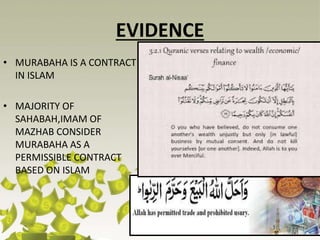
EVIDENCE
• MURABAHA IS A CONTRACT
IN ISLAM
• MAJORITY OF
SAHABAH,IMAM OF
MAZHAB CONSIDER
MURABAHA AS A
PERMISSIBLE CONTRACT
BASED ON ISLAM
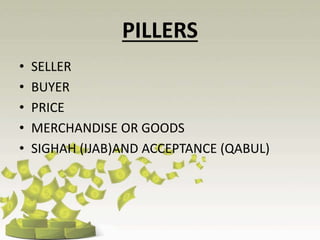
PILLERS
• SELLER
• BUYER
• PRICE
• MERCHANDISE OR GOODS
• SIGHAH (IJAB)AND ACCEPTANCE (QABUL)
MODE OF FINANCING OF
MURABAHA
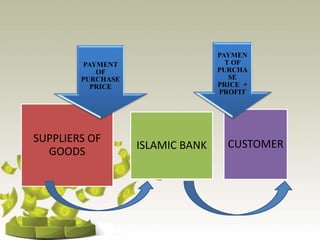
SUPPLIERS OF
GOODS
ISLAMIC BANK CUSTOMER
PAYMENT
OF
PURCHASE
PRICE
PAYMEN
T OF
PURCHA
SE
PRICE +
PROFIT
1. Client and bank sign an agreement to
enter into Murabaha (MMFA)
Agreement to
Murabaha
Bank Client
2. Client appointed as agent to purchase
goods on bank’s behalf Agency Agreement
Bank Client
Agreement to
Murabaha
Agency
Agreement
3. Bank gives money and issue purchase
Order to client for purchase of goods
AGREEMENT TO MARABAHA
Bank
Client
Agency Agreement
Disbursement to the client
4. Client purchases goods on bank’s behalf and
takes their possession.
Client purchases goods and
takes possession
Transfer of Risk
Vendor
Bank Client
5 . Client makes an offer to purchase the
goods from bank.
Offer to purchase
Bank Client
6. Client pays agreed price to bank according to an
agreed schedule. Usually on a deferred payment
basis Bai’ Mu’ajjal
Bank ClientPayment of Price
7. Bank accepts the offer(declaration submitted by the
client) and sale is concluded.
Murabaha Agreement
+
Transfer of Title
Bank Client
'buy-back' agreement
• It is also a necessary condition for the validity
of murabahah that the commodity is
purchased from a third party. The purchase of
the commodity from the client himself on a
buy back agreement is not allowed in
the Shariah. Thus murabahah based on 'buy-
back' agreement is nothing more than an
interest-based transaction.
ISSUES OF MURABAHA
1. Securities against Murabahah
Payments coming from the sale are receivables
and for this, the client may be asked to furnish a
security. It can be in the form of a mortgage or
hypothecation or some kind of lien or charge.
2. Guaranting the Murabahah
• The seller can ask the client to furnish a 3rd party
guarantee. In case of default on payment the seller
may have recourse to the guarantor who will be liable
to pay the amount guaranteed to him.
• There are two issues relating to this:
• a) The guarantor cannot charge a fee from the original
client. The reason being that a person charging a fee
for advancing a loan comes under the definition of riba
• b) However the guarantor can charge for any
documentation expenses.
3. Penalty of default
• Another issue with Murabahah is that if the client defaults in
payment of the price at the due date, the price cannot be changed
nor can penalty fees be charged.
• In order to deal with dishonest clients who default in payment
deliberately, they should be made liable to pay compensation to the
Islamic Bank for the loss suffered on account of default.
• However these should be made subject to the following conditions:
a) The defaulter may be given a grace period of at-least
one-month.
b) If it is proven beyond doubt that the client is defaulting without
valid excuse then compensation can be demanded.
4.Rollover in Murabahah
Murabahah transaction cannot be rolled over for a
further period as the old contract ends.
It should be understood that Murabahah is not a loan
rather the sale of a commodity, which is deferred to a
specific date. Once this commodity is sold, its ownership
transfers from the bank to the client and it is therefore no
more a property of the seller. Now what the seller can
claim is only the agreed price and therefore there is no
question of effecting another sale on the same
commodity between the same parties.
5.Rebate on earlier payments
• Sometimes the debtors want to pay early to
get discounts.
• However in Islam, majority ofMuslim Scholars
including the major schools of thought
consider this to be un-Islamic. However if the
Islamic bank or financial institution gives
somebody a rebate on its own, it is not
objectionable especially if the client is needy
6. Calculation of cost in Murabahah
• The Murabahah can only be effected when
the seller can ascertain the exact cost he has
incurred in acquiring the commodity he wants
to sell. If the exact cost cannot be ascertained
then Murabahah cannot take place. In this
case the sale will take place as Musawamah
i.e. sale without reference to cost.
7. Subject matter of the sale
All commodities cannot be the subject matter in
Murabahah because certain requirements need to
be fulfilled. The shares of a lawful company can be
sold or purchased on Murabahah basis because
according to the principles of Islam the shares
represent ownership into assets of the company
provided all other basic conditions of the
transaction are fulfilled. A buy back arrangement or
selling without taking their possession is not
allowed at all.
8.DIFFERENT PRICING FOR CASH
AND CREDIT SELLS
9.THE USE OF INTEREST RATE AS
BENCHMARK
10.PROMISE TO PURCHASE
MISTAKES OF MARABAHA
FINANCING
1. The most common mistake is to assume that
Murabahah can be used for all types of
transactions and financing.
This mode can only be used when a commodity
is to be purchased by the customer. If funds are
required for some other purpose Murabahah
cannot be used.
• 2. The document is signed for obtaining funds
for a specific commodity and therefore it is
important to study the subject matter of the
Murabahah
• 3. In some cases, the sale of commodity to the
client is affected before the commodity is
acquired from the supplier.
• This occurs when the various stages of the
Murabahah are skipped and the documents
are signed all together.
It is to be remembered that Murabahah is a
package of different contracts and they come
into play one after another at their respective
stages.
• 4. It is observed in some financial institutions
that Murabahah is applied on already
purchased commodities, which is not allowed
in Shariah and can be effected on not yet
purchased commodities.
CONCLUSION
• Murabaha is not a mode of finance it’s a sale on cost plus basis
• The concept of deferred payment device to use as a mode of financing
only in case where:
o Client indent to purchase a commodity
o No Murabaha sale can be effective on overhead expense, payments
of bills ,settlement of debt and purchase of currencies
o The subject matter of sale should be in the possession of the seller
either constructive or physical
o The seller i.e. Bank can make his purchaser i.e. Client his agent
under the agency contract between them
o Once the price is locked it cannot be changed or increased .
• Murabaha transaction should be carried out in a prescribed way
because it have a slight difference with the interest based loan
procedure
THANK YOU
QUESTIONS???

Murabaha final presentation

  • 2.
    MURABAHA (GROUP 3) PRESENTED BY: •SONIA MOBEEN (6439) • FAREHA AHMED (6432) • WAJEEHA PERVEZ (6197) • SIKANDER KHAN (5390) • NAVEED AHMED SIDDIQUI (0722)
  • 3.
    CONTENT • INTRODUCTION • DEFINITION •DIFFERENCE B/W MURABAHA & MUSAWAMAH. • BASIC RULES OF SALES • BAI ‘ MU’AJJAL • EVIDENCE • MODE OF FINANCING • BASIC FEATURES • ISSUES • MISTAKES • CONCLUSION
  • 4.
    MURABAHA • Murabaha isa particular kind of sale where the seller expressively mentions the cost of the commodity purchased, and sells it to another person by adding some profit thereon. • Thus, Murabaha is not a loan given on interest • It is a sale of a commodity for cash/deferred price.
  • 5.
    DIFERENCE B/W MURABAHAAND MUSAWAMAH MURABAHAMUSAWAMAH Its a particular kind of sale where the seller discloses its cost & profit charged. It is a sale on agreed price without referring to the first price on which the seller has purchased.
  • 6.
    BASIC RULES OFSALES • The subject of sale must exist. • The subject of sale must be in the ownership. • The subject of sale must be in the physical or constructive possession. • The sale must be instant and absolute. • The subject of sale must be a property of value. • In Islamic finance, the sale of things that are not allowed in Islam, for instance wine, are also void sales. -
  • 7.
    • The subjectof sale must be known and specifically identified to the buyer. • The delivery of the sold commodity to the buyer must be certain • The price must be certain at the time of transaction. • Price cannot be set upon the contingency of some future event. It must be absolute at the time of sale.
  • 8.
    All these basicrules of sales are important for the validation of MURABAHA TRANSACTION
  • 9.
    Bai’ Mu’ajjal (sale ondeferred Payment basis) • Bai-Mu'ajjal may be defined as a contract between a buyer and a seller under which the seller sells certain specific goods (permissible under Islamic Shariah and the Law of the country), to the buyer at an agreed fixed price payable at a certain fixed future date in lump- sum or within a fixed period by fixed .
  • 10.
    Bai’ Mu’ajjal (sale ondeferred Payment basis) EXAMPLE: if the current cost of a bag of fertilizer to the bank is Rs. 50, the bank may sell it through its agent to farmers needing bank finance at Rs. 55 subject to actual payment of this price after an agreed period. The bank would, however, pay Rs. 50 to its agent prior to or immediately after the supply of the fertilizer by the agent under its instructions.
  • 11.
  • 12.
    EVIDENCE • MURABAHA ISA CONTRACT IN ISLAM • MAJORITY OF SAHABAH,IMAM OF MAZHAB CONSIDER MURABAHA AS A PERMISSIBLE CONTRACT BASED ON ISLAM
  • 13.
    PILLERS • SELLER • BUYER •PRICE • MERCHANDISE OR GOODS • SIGHAH (IJAB)AND ACCEPTANCE (QABUL)
  • 14.
    MODE OF FINANCINGOF MURABAHA
  • 15.
    SUPPLIERS OF GOODS ISLAMIC BANKCUSTOMER PAYMENT OF PURCHASE PRICE PAYMEN T OF PURCHA SE PRICE + PROFIT
  • 16.
    1. Client andbank sign an agreement to enter into Murabaha (MMFA) Agreement to Murabaha Bank Client
  • 17.
    2. Client appointedas agent to purchase goods on bank’s behalf Agency Agreement Bank Client Agreement to Murabaha Agency Agreement
  • 18.
    3. Bank givesmoney and issue purchase Order to client for purchase of goods AGREEMENT TO MARABAHA Bank Client Agency Agreement Disbursement to the client
  • 19.
    4. Client purchasesgoods on bank’s behalf and takes their possession. Client purchases goods and takes possession Transfer of Risk Vendor Bank Client
  • 20.
    5 . Clientmakes an offer to purchase the goods from bank. Offer to purchase Bank Client
  • 21.
    6. Client paysagreed price to bank according to an agreed schedule. Usually on a deferred payment basis Bai’ Mu’ajjal Bank ClientPayment of Price
  • 22.
    7. Bank acceptsthe offer(declaration submitted by the client) and sale is concluded. Murabaha Agreement + Transfer of Title Bank Client
  • 23.
    'buy-back' agreement • Itis also a necessary condition for the validity of murabahah that the commodity is purchased from a third party. The purchase of the commodity from the client himself on a buy back agreement is not allowed in the Shariah. Thus murabahah based on 'buy- back' agreement is nothing more than an interest-based transaction.
  • 24.
  • 25.
    1. Securities againstMurabahah Payments coming from the sale are receivables and for this, the client may be asked to furnish a security. It can be in the form of a mortgage or hypothecation or some kind of lien or charge.
  • 26.
    2. Guaranting theMurabahah • The seller can ask the client to furnish a 3rd party guarantee. In case of default on payment the seller may have recourse to the guarantor who will be liable to pay the amount guaranteed to him. • There are two issues relating to this: • a) The guarantor cannot charge a fee from the original client. The reason being that a person charging a fee for advancing a loan comes under the definition of riba • b) However the guarantor can charge for any documentation expenses.
  • 27.
    3. Penalty ofdefault • Another issue with Murabahah is that if the client defaults in payment of the price at the due date, the price cannot be changed nor can penalty fees be charged. • In order to deal with dishonest clients who default in payment deliberately, they should be made liable to pay compensation to the Islamic Bank for the loss suffered on account of default. • However these should be made subject to the following conditions: a) The defaulter may be given a grace period of at-least one-month. b) If it is proven beyond doubt that the client is defaulting without valid excuse then compensation can be demanded.
  • 28.
    4.Rollover in Murabahah Murabahahtransaction cannot be rolled over for a further period as the old contract ends. It should be understood that Murabahah is not a loan rather the sale of a commodity, which is deferred to a specific date. Once this commodity is sold, its ownership transfers from the bank to the client and it is therefore no more a property of the seller. Now what the seller can claim is only the agreed price and therefore there is no question of effecting another sale on the same commodity between the same parties.
  • 29.
    5.Rebate on earlierpayments • Sometimes the debtors want to pay early to get discounts. • However in Islam, majority ofMuslim Scholars including the major schools of thought consider this to be un-Islamic. However if the Islamic bank or financial institution gives somebody a rebate on its own, it is not objectionable especially if the client is needy
  • 30.
    6. Calculation ofcost in Murabahah • The Murabahah can only be effected when the seller can ascertain the exact cost he has incurred in acquiring the commodity he wants to sell. If the exact cost cannot be ascertained then Murabahah cannot take place. In this case the sale will take place as Musawamah i.e. sale without reference to cost.
  • 31.
    7. Subject matterof the sale All commodities cannot be the subject matter in Murabahah because certain requirements need to be fulfilled. The shares of a lawful company can be sold or purchased on Murabahah basis because according to the principles of Islam the shares represent ownership into assets of the company provided all other basic conditions of the transaction are fulfilled. A buy back arrangement or selling without taking their possession is not allowed at all.
  • 32.
    8.DIFFERENT PRICING FORCASH AND CREDIT SELLS
  • 33.
    9.THE USE OFINTEREST RATE AS BENCHMARK
  • 34.
  • 35.
  • 36.
    1. The mostcommon mistake is to assume that Murabahah can be used for all types of transactions and financing. This mode can only be used when a commodity is to be purchased by the customer. If funds are required for some other purpose Murabahah cannot be used.
  • 37.
    • 2. Thedocument is signed for obtaining funds for a specific commodity and therefore it is important to study the subject matter of the Murabahah
  • 38.
    • 3. Insome cases, the sale of commodity to the client is affected before the commodity is acquired from the supplier. • This occurs when the various stages of the Murabahah are skipped and the documents are signed all together. It is to be remembered that Murabahah is a package of different contracts and they come into play one after another at their respective stages.
  • 39.
    • 4. Itis observed in some financial institutions that Murabahah is applied on already purchased commodities, which is not allowed in Shariah and can be effected on not yet purchased commodities.
  • 40.
  • 41.
    • Murabaha isnot a mode of finance it’s a sale on cost plus basis • The concept of deferred payment device to use as a mode of financing only in case where: o Client indent to purchase a commodity o No Murabaha sale can be effective on overhead expense, payments of bills ,settlement of debt and purchase of currencies o The subject matter of sale should be in the possession of the seller either constructive or physical o The seller i.e. Bank can make his purchaser i.e. Client his agent under the agency contract between them o Once the price is locked it cannot be changed or increased . • Murabaha transaction should be carried out in a prescribed way because it have a slight difference with the interest based loan procedure
  • 42.
  • 43.