BAI AL-INAH
CONTENT
2
• DEFINITION
• EVIDENCES
• PILLARS OF BAY AL-’INAH
• CONDITIONS OF BAY AL-’INAH
• OPINION OF SCHOLARS
• MODERN APPLICATION
DEFINITION
3
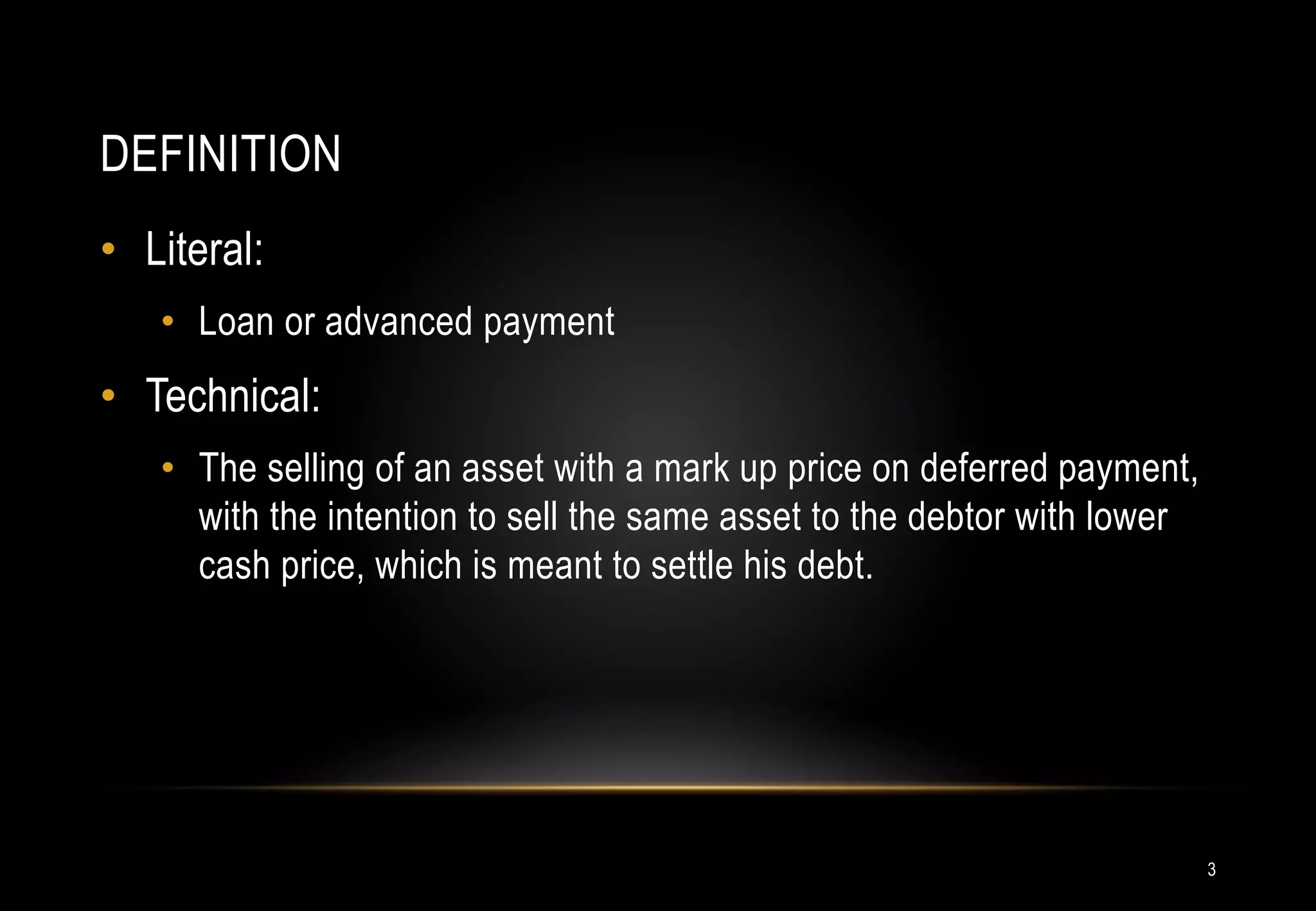
• Literal:
• Loan or advanced payment
• Technical:
• The selling of an asset with a mark up price on deferred payment,
with the intention to sell the same asset to the debtor with lower
cash price, which is meant to settle his debt.
DEFINITION
4
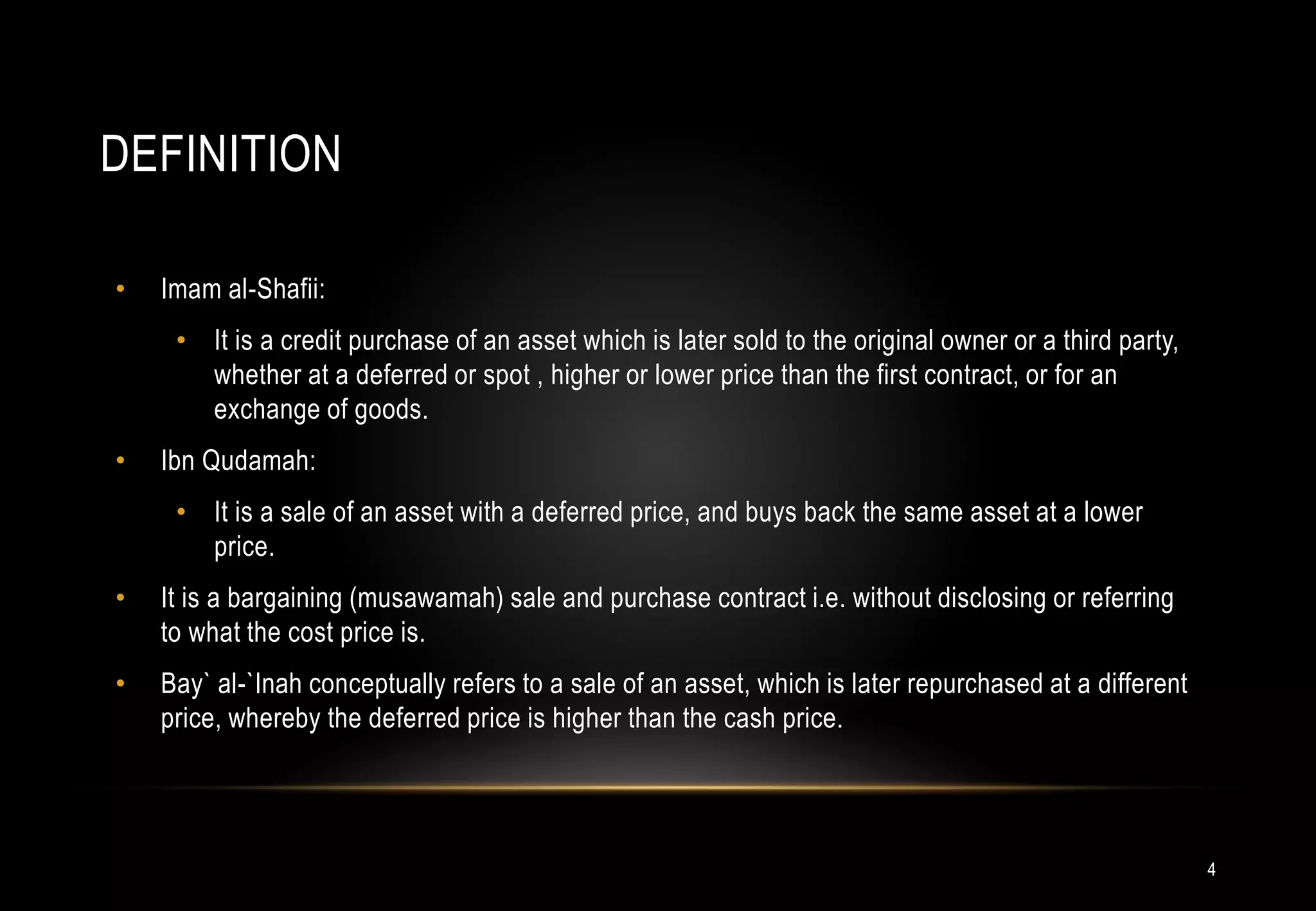
• Imam al-Shafii:
• It is a credit purchase of an asset which is later sold to the original owner or a third party,
whether at a deferred or spot , higher or lower price than the first contract, or for an
exchange of goods.
• Ibn Qudamah:
• It is a sale of an asset with a deferred price, and buys back the same asset at a lower
price.
• It is a bargaining (musawamah) sale and purchase contract i.e. without disclosing or referring
to what the cost price is.
• Bay` al-`Inah conceptually refers to a sale of an asset, which is later repurchased at a different
price, whereby the deferred price is higher than the cash price.
EVIDENCES
5
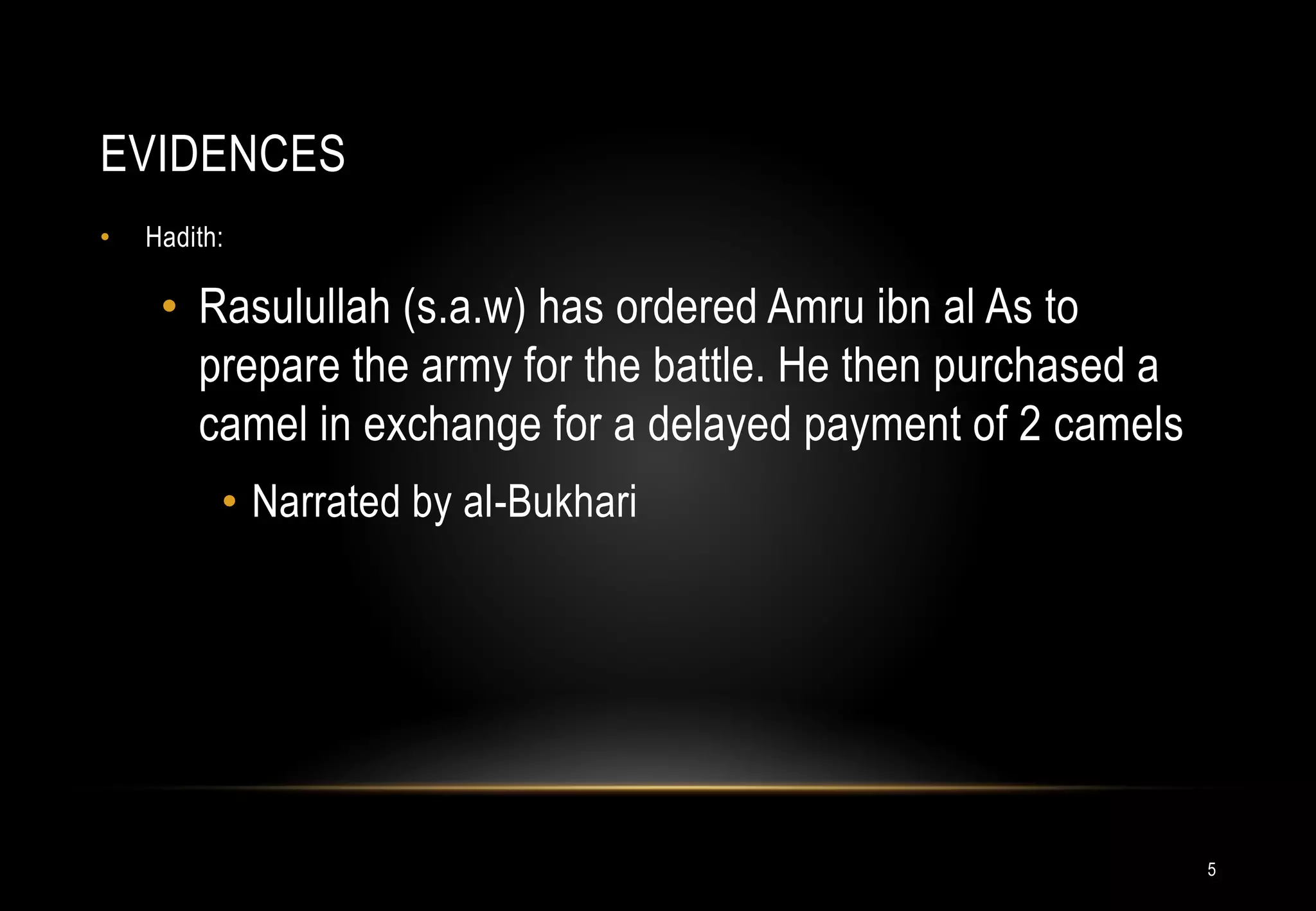
• Hadith:
• Rasulullah (s.a.w) has ordered Amru ibn al As to
prepare the army for the battle. He then purchased a
camel in exchange for a delayed payment of 2 camels
• Narrated by al-Bukhari
EVIDENCES
6
• Muslim scholars:
• Permissible based on analogy, the contract is similar to other
sale and purchase contracts i.e. the transfer of ownership is
taken place.
• The majority view that such a sale is forbidden. They are
Hanafis, Malikis, Hanbalis and some Shafi’is.
• Imam Shafi’i, Abu Yusuf, Abu Daud and Abu Thur are of the
view that this contract of sale is not contrary to Shariah
principles.
PILLARS OF BAY’ AL-’INAH
7
• Seller and buyer
• Merchandise/goods
• Price
• Sighah
FLOWS OF BAY’ AL-’INAH
8
BA
Asset
1) Sell Asset in
deferred
payment
2) Buy back Asset in cash
Price
3)Pay cash money
CONDITIONS OF BAY’ AL-’INAH
9
• Shariah Advisory Council of Bank Negara Malaysia resolved that bay’ al-'inah is still necessary
in Malaysian context.
• However market player are required to strengthen and enhance their operational process and
documentation to comply with the features of bay’ al-'inah permitted.
• Bay’ al-'inah is permissible subject to the following condition:
• The transaction of al-’inah must strictly follow the mechanism which is accepted by the
Shafie school
• The transacted item must not a ribawi item
• The buyer must receive (take possession) the good before selling it back to the original
seller
OPINION OF SCHOLARS
10
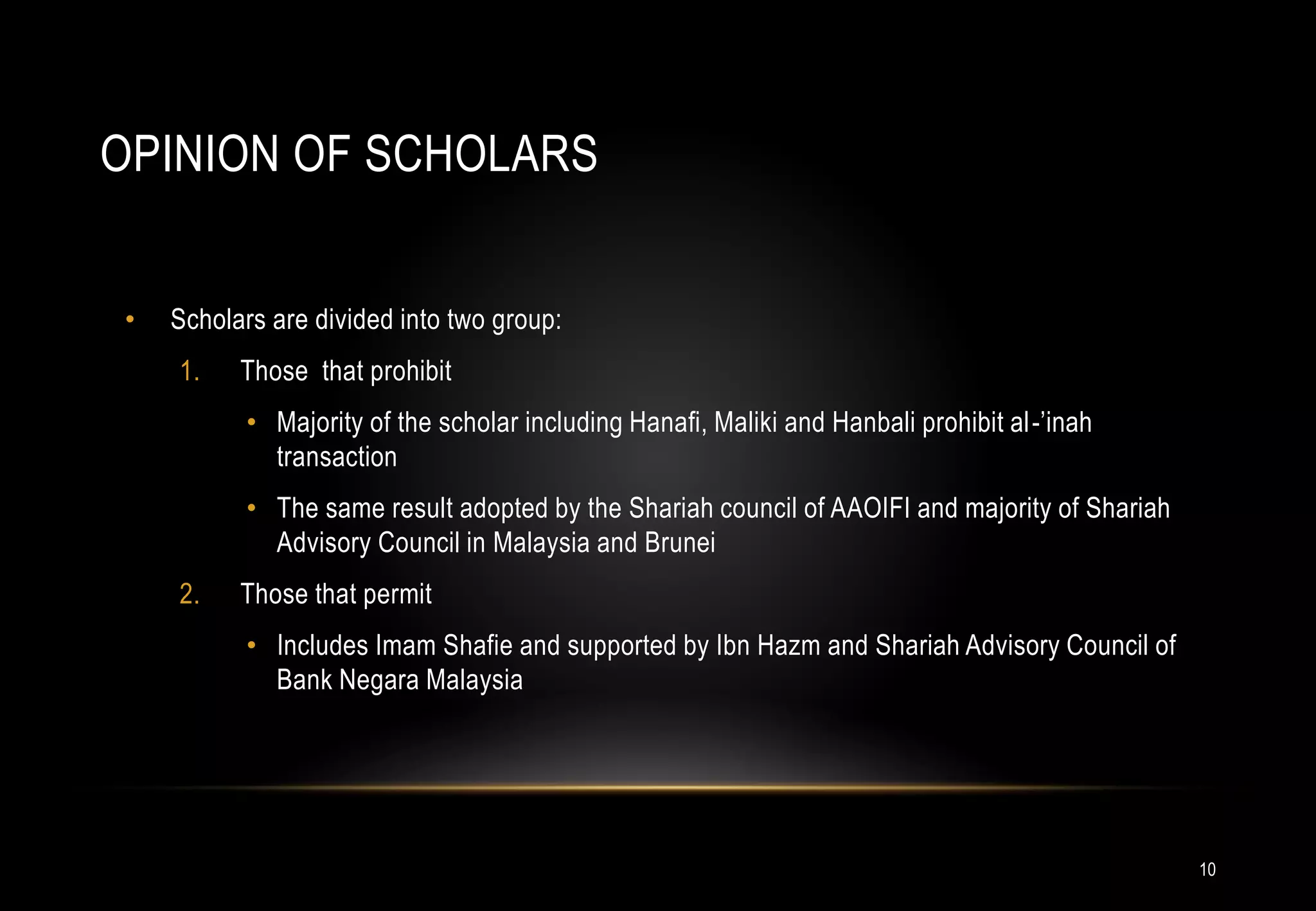
• Scholars are divided into two group:
1. Those that prohibit
• Majority of the scholar including Hanafi, Maliki and Hanbali prohibit al-’inah
transaction
• The same result adopted by the Shariah council of AAOIFI and majority of Shariah
Advisory Council in Malaysia and Brunei
2. Those that permit
• Includes Imam Shafie and supported by Ibn Hazm and Shariah Advisory Council of
Bank Negara Malaysia
JUSTIFICATION OF THOSE THAT PROHIBIT
11
• It is hilah to riba
• The underlying issue on bay’ al-'inah is the difference between the muqtada al-’aqd and the
actual motive of the contracting parties, whether to have a real contract of sale or as hilah for
liquidity or monetary purposes.
• The polemic in the issue of permissibility of bay’ al-'inah is the status of hilah.
• As far as hilah is deemed as demeaning the religion, bay’ al-'inah will not be acceptable.
• However, if hilah is regarded as a mode to solve problems (makhraj) that is much needed by the
people, bay’ al-'inah transaction may be acceptable.
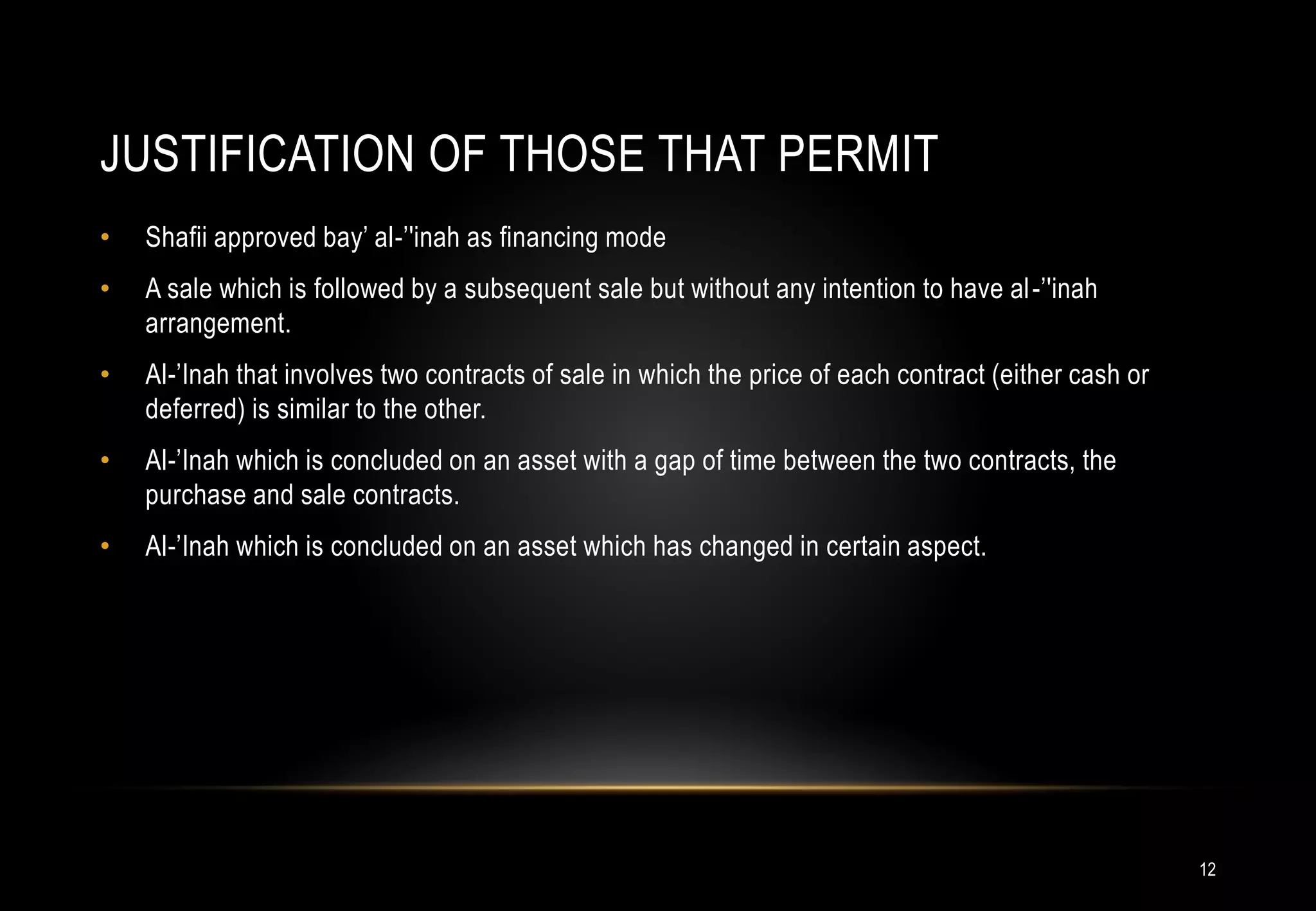
JUSTIFICATION OF THOSE THAT PERMIT
12
• Shafii approved bay’ al-’'inah as financing mode
• A sale which is followed by a subsequent sale but without any intention to have al-’'inah
arrangement.
• Al-’Inah that involves two contracts of sale in which the price of each contract (either cash or
deferred) is similar to the other.
• Al-’Inah which is concluded on an asset with a gap of time between the two contracts, the
purchase and sale contracts.
• Al-’Inah which is concluded on an asset which has changed in certain aspect.
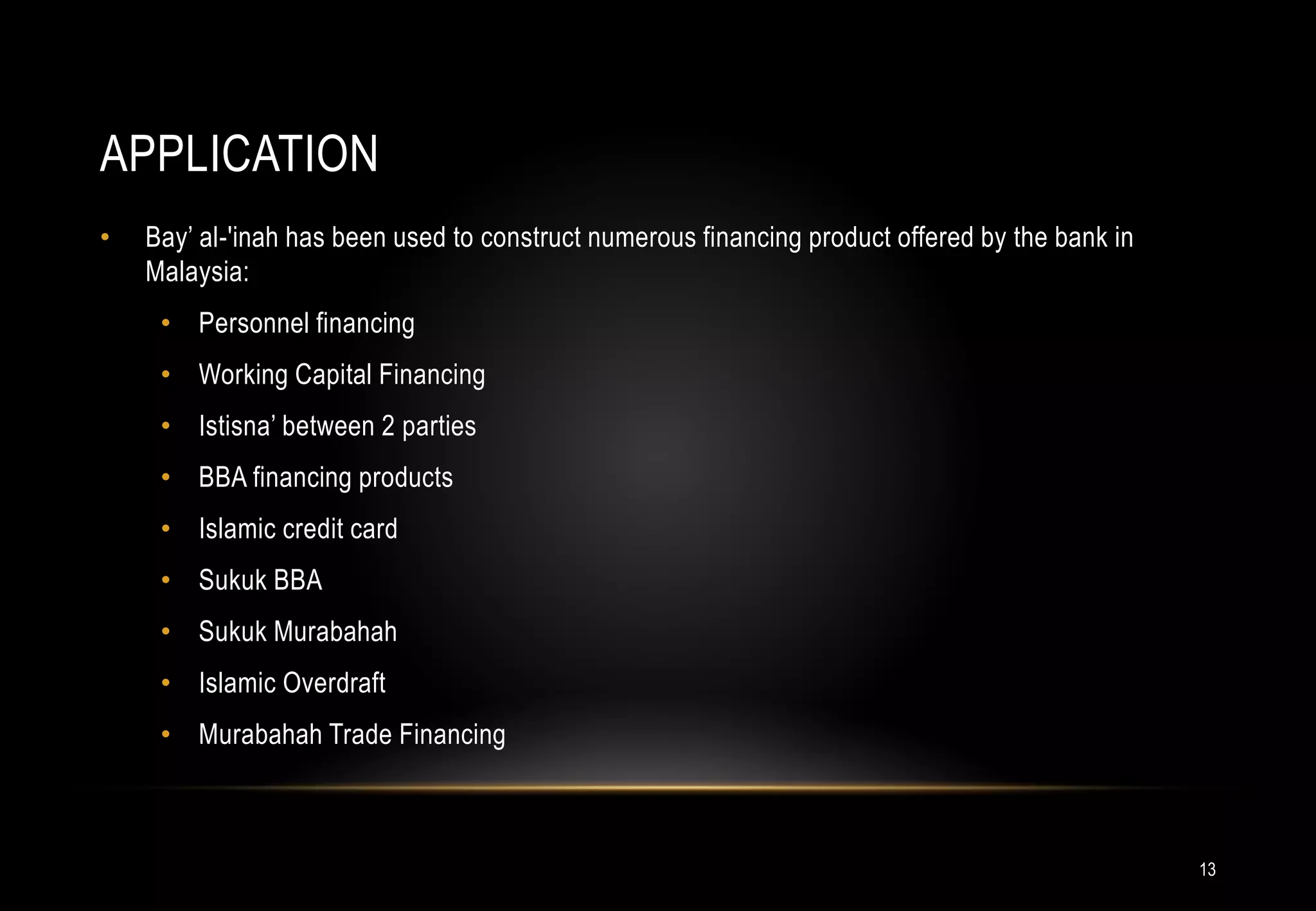
APPLICATION
13
• Bay’ al-'inah has been used to construct numerous financing product offered by the bank in
Malaysia:
• Personnel financing
• Working Capital Financing
• Istisna’ between 2 parties
• BBA financing products
• Islamic credit card
• Sukuk BBA
• Sukuk Murabahah
• Islamic Overdraft
• Murabahah Trade Financing
END OF CHAPTER
14

bay al inah

  • 1.
  • 2.
    CONTENT 2 • DEFINITION • EVIDENCES •PILLARS OF BAY AL-’INAH • CONDITIONS OF BAY AL-’INAH • OPINION OF SCHOLARS • MODERN APPLICATION
  • 3.
    DEFINITION 3 • Literal: • Loanor advanced payment • Technical: • The selling of an asset with a mark up price on deferred payment, with the intention to sell the same asset to the debtor with lower cash price, which is meant to settle his debt.
  • 4.
    DEFINITION 4 • Imam al-Shafii: •It is a credit purchase of an asset which is later sold to the original owner or a third party, whether at a deferred or spot , higher or lower price than the first contract, or for an exchange of goods. • Ibn Qudamah: • It is a sale of an asset with a deferred price, and buys back the same asset at a lower price. • It is a bargaining (musawamah) sale and purchase contract i.e. without disclosing or referring to what the cost price is. • Bay` al-`Inah conceptually refers to a sale of an asset, which is later repurchased at a different price, whereby the deferred price is higher than the cash price.
  • 5.
    EVIDENCES 5 • Hadith: • Rasulullah(s.a.w) has ordered Amru ibn al As to prepare the army for the battle. He then purchased a camel in exchange for a delayed payment of 2 camels • Narrated by al-Bukhari
  • 6.
    EVIDENCES 6 • Muslim scholars: •Permissible based on analogy, the contract is similar to other sale and purchase contracts i.e. the transfer of ownership is taken place. • The majority view that such a sale is forbidden. They are Hanafis, Malikis, Hanbalis and some Shafi’is. • Imam Shafi’i, Abu Yusuf, Abu Daud and Abu Thur are of the view that this contract of sale is not contrary to Shariah principles.
  • 7.
    PILLARS OF BAY’AL-’INAH 7 • Seller and buyer • Merchandise/goods • Price • Sighah
  • 8.
    FLOWS OF BAY’AL-’INAH 8 BA Asset 1) Sell Asset in deferred payment 2) Buy back Asset in cash Price 3)Pay cash money
  • 9.
    CONDITIONS OF BAY’AL-’INAH 9 • Shariah Advisory Council of Bank Negara Malaysia resolved that bay’ al-'inah is still necessary in Malaysian context. • However market player are required to strengthen and enhance their operational process and documentation to comply with the features of bay’ al-'inah permitted. • Bay’ al-'inah is permissible subject to the following condition: • The transaction of al-’inah must strictly follow the mechanism which is accepted by the Shafie school • The transacted item must not a ribawi item • The buyer must receive (take possession) the good before selling it back to the original seller
  • 10.
    OPINION OF SCHOLARS 10 •Scholars are divided into two group: 1. Those that prohibit • Majority of the scholar including Hanafi, Maliki and Hanbali prohibit al-’inah transaction • The same result adopted by the Shariah council of AAOIFI and majority of Shariah Advisory Council in Malaysia and Brunei 2. Those that permit • Includes Imam Shafie and supported by Ibn Hazm and Shariah Advisory Council of Bank Negara Malaysia
  • 11.
    JUSTIFICATION OF THOSETHAT PROHIBIT 11 • It is hilah to riba • The underlying issue on bay’ al-'inah is the difference between the muqtada al-’aqd and the actual motive of the contracting parties, whether to have a real contract of sale or as hilah for liquidity or monetary purposes. • The polemic in the issue of permissibility of bay’ al-'inah is the status of hilah. • As far as hilah is deemed as demeaning the religion, bay’ al-'inah will not be acceptable. • However, if hilah is regarded as a mode to solve problems (makhraj) that is much needed by the people, bay’ al-'inah transaction may be acceptable.
  • 12.
    JUSTIFICATION OF THOSETHAT PERMIT 12 • Shafii approved bay’ al-’'inah as financing mode • A sale which is followed by a subsequent sale but without any intention to have al-’'inah arrangement. • Al-’Inah that involves two contracts of sale in which the price of each contract (either cash or deferred) is similar to the other. • Al-’Inah which is concluded on an asset with a gap of time between the two contracts, the purchase and sale contracts. • Al-’Inah which is concluded on an asset which has changed in certain aspect.
  • 13.
    APPLICATION 13 • Bay’ al-'inahhas been used to construct numerous financing product offered by the bank in Malaysia: • Personnel financing • Working Capital Financing • Istisna’ between 2 parties • BBA financing products • Islamic credit card • Sukuk BBA • Sukuk Murabahah • Islamic Overdraft • Murabahah Trade Financing
  • 14.