Towards Quantifying Uncertainty in
Extrapolative Predictions
Dave Higdon, Statistical Sciences, Los Alamos National Laboratory
Derek Bingham, Statistics & Actuarial Science, Simon Fraser University
Joslin Goh, Statistics & Actuarial Science, Simon Fraser University
Mike Grosskopf, University of Michigan
M Adams, TAMU, D. Higdon VT, J. Berger Duke, D. Bingham SFU, W. Chen, Northwestern, R.
Ghanem, USC, O. Ghattas, UTexas, J. Meza, UCMerced; E. Michielssen, Mich, V. Nair, Mich, C.
Nakhleh, LANL, D Nychka, NCAR, S. Pollock, Mich, H. Stone, Princeton, A. Wilson, NCSU, M.
Zika, LLNL.
Paul Drake, UMich; James Holloway, Mich; Ken Powell, CRASH; Quentin Stout, CRASH, Marvin
Adams, TAMU, Joslin Goh, SFU; Mike Grosskopf, SFU; Erica Rutter, CRASH, Patrick Poon,
CRASH; Bruce Fryxell, UMich; Natasha Andranoa, CRASH; Carolyn Kuranz, CRASH; Paul Keite,
CRASH; Forrest Doss, CRASH; Gabor Toth, CRASH; Igor Sokolov, CRASH; Bart van der Holst,
CRASH; Eric Myr, CRASH; Ben Torralva, CRASH; Bani Mallick, TAMU; Vijay Nair UMich;
Lenny Smith, LSE; Todd Oliver, UT; Don Haynes, LANL; Mike Zika, LLNL; Leanna House, VaTech;
Yousef Marzouk, MIT; Bob Moser, UT
Jordan McDonnell, FrMarion; Nicolas Schunck, LLNL; Jason Sarich, ANL; Stefan Wild, ANL;
Witek Nazarewicz, FRIB
M Adams, TAMU,
D. Higdon VT,
J. Berger Duke,
D. Bingham SFU,
W. Chen, Northwestern,
R. Ghanem, USC,
O. Ghattas, Utexas,
J. Meza, UCMerced;
E. Michielssen, Mich,
V. Nair, Mich,
C. Nakhleh, LANL,
D Nychka, NCAR,
S. Pollock, Mich (retired);
H. Stone, Princeton,
A. Wilson, NCSU,
B. M. Zika, LLNL.
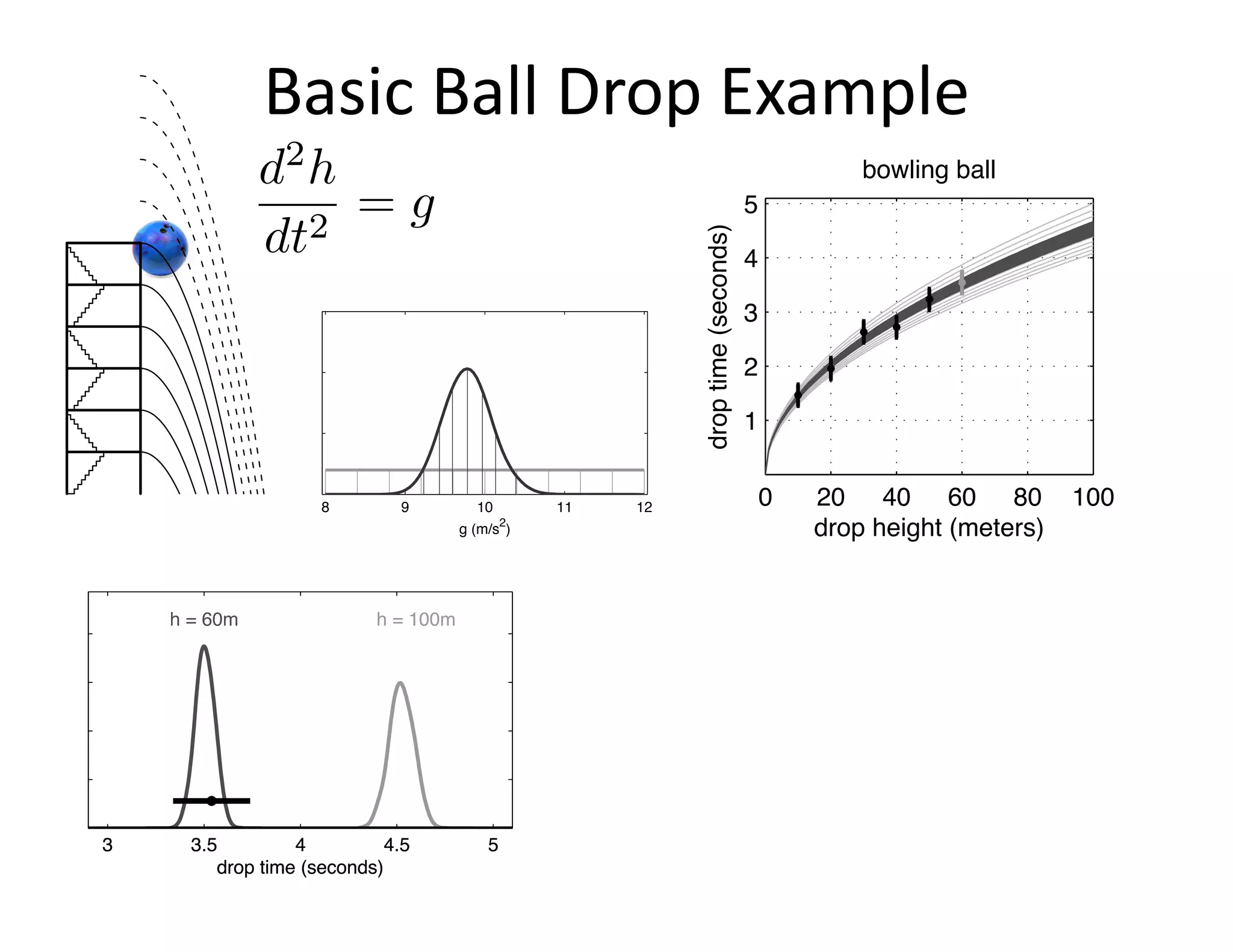
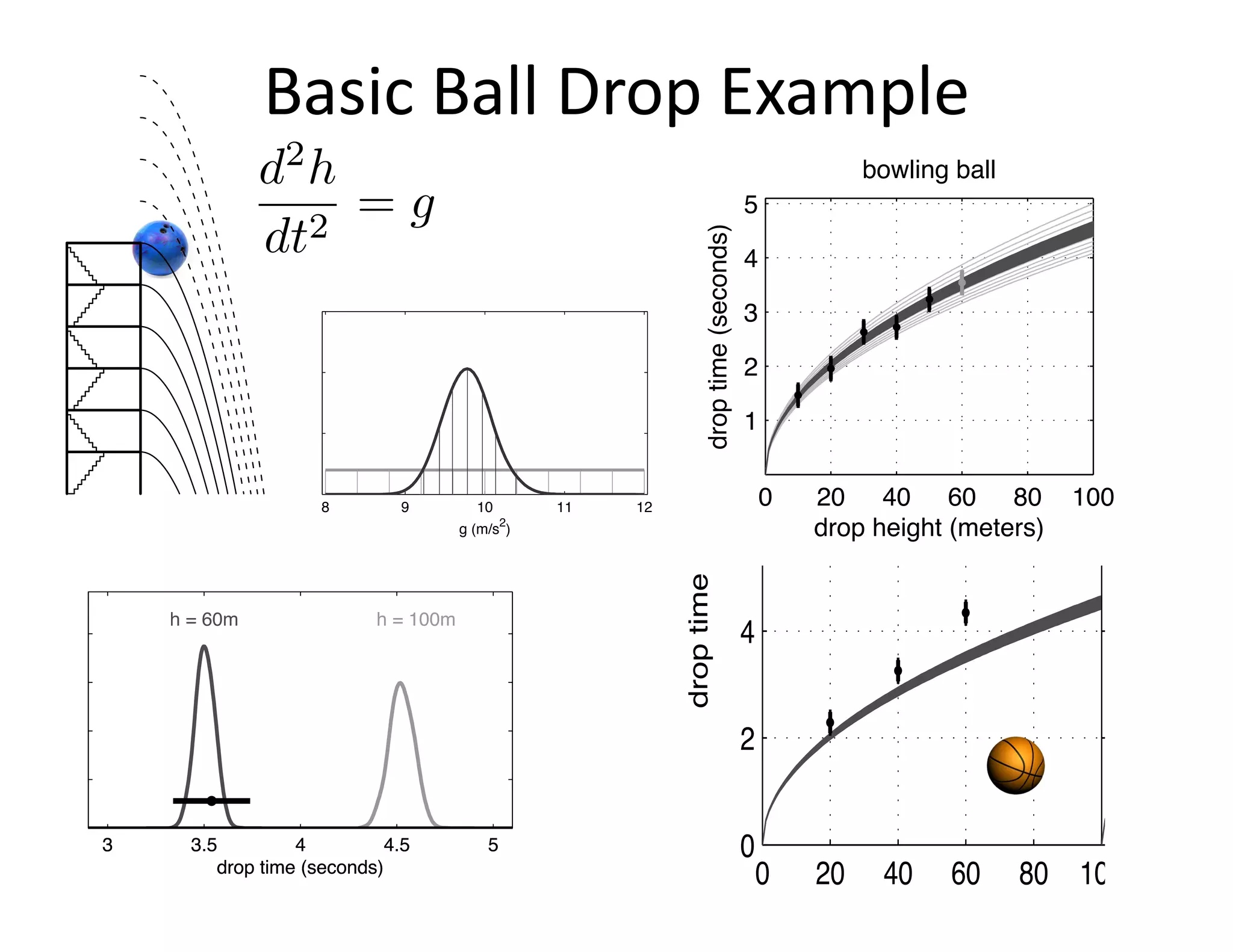
Basic Ball Drop Example
8 9 10 11 12
g (m/s
2
)
3 3.5 4 4.5 5
drop time (seconds)
h = 60m
3 3.5 4 4.5 5
drop time (seconds)
h = 60m h = 100m
d2
h
dt2
= g
0 20 40 60 80 100
1
2
3
4
5
bowling ball
droptime(seconds)
drop height (meters)
50
100
8
10
12
2
4
x=drop height
(a) model runs
=g
droptime
20 40 60 80 100
2
3
4
5
x=drop height
droptime
g
8 10 12
(c) prior uncertainty
50
100
8
10
12
2
4
x=drop height
(b) emulator
=g
droptime
20 40 60 80 100
2
3
4
5
x=drop height
droptime
g
8 10 12
(d) posterior uncertainty
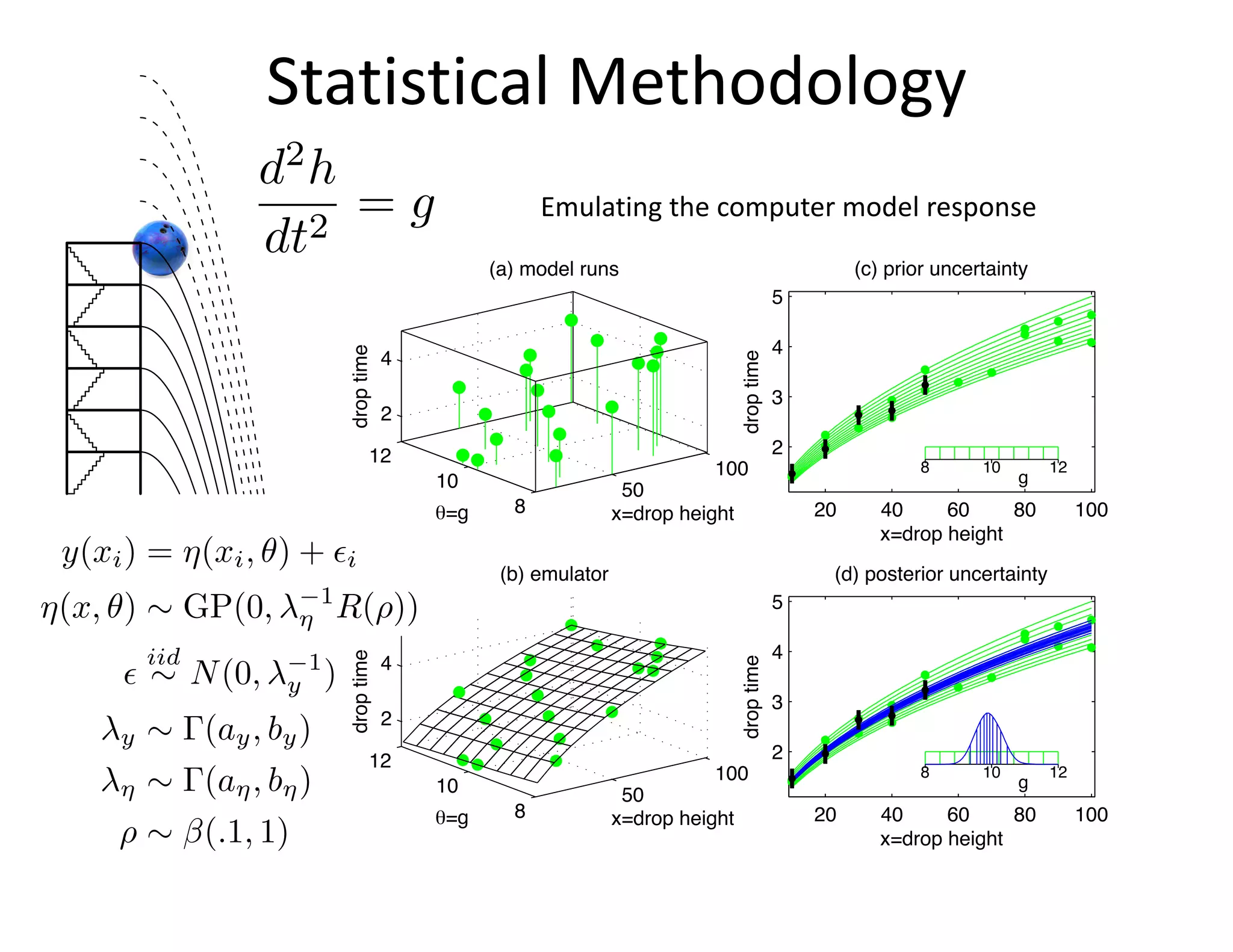
Statistical Methodology
d2
h
dt2
= g Emulating the computer model response
y(xi) = ⇤(xi, ⌅) + ⇥i
⇤(x, ⌅) ⇠ GP(0, ⇧ 1
R(⌃))
⇥
iid
⇠ N(0, ⇧ 1
y )
⇧y ⇠ (ay, by)
⇧ ⇠ (a , b )
⌃ ⇠ (.1, 1)
Basic Ball Drop Example
8 9 10 11 12
g (m/s
2
)
3 3.5 4 4.5 5
drop time (seconds)
h = 60m
3 3.5 4 4.5 5
drop time (seconds)
h = 60m h = 100m
d2
h
dt2
= g
0 20 40 60 80 100
1
2
3
4
5
bowling ball
droptime(seconds)
drop height (meters)
0 20 40 60 80 100
0
2
4
6
8
10
droptime(seconds)
basketball b
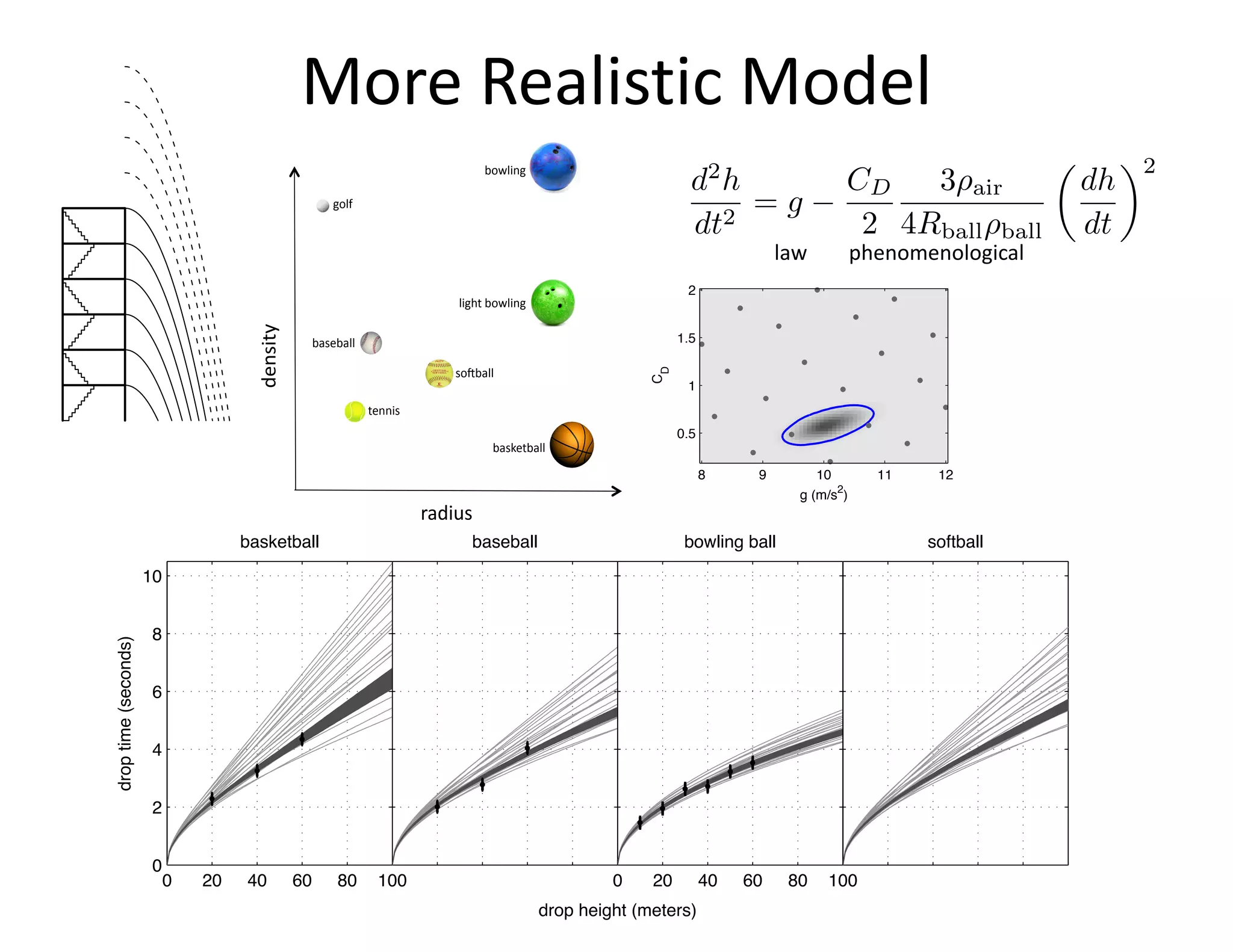
More Realistic Model
Simple'case'study:'dropping'balls'from'
a'tower'
•  Can'get'field'data'from'tossing'
objects'off'of'floors'1=6.'
•  Have'computaBonal'model'
which'predicts'drop'Bmes'
given'ball'radius,'density,'and'
floor.'
•  ComputaBonal'model'has'
parameter'for'air'fricBon'which'
depends'on'cross'secBon,'
density'and'velocity.'
•  Have'baseball,'basketball,'golf'
ball,'tennis,'light'&'heavy'
bowling'balls.'
•  Want'to'predict'soHball'drop'
Bme'from'10th'floor'(100m).'
•  Also'want'to'understand'the'
value'of'various'types'of'
potenBal'experiments'&'
simulaBons'for'the'soHball'
predicBon'at'100m.'
Slide'1'
radius'
density'
physics'design'space'
golf'
baseball'
tennis'
soHball'
basketball'
light'bowling'
bowling'
d2
h
dt2
= g
CD
2
3 air
4Rball ball
✓
dh
dt
◆2
CD
g (m/s
2
)
8 9 10 11 12
0.5
1
1.5
2
0 20 40 60 80 100
0
2
4
6
8
10
droptime(seconds)
basketball baseball
0 20 40 60 80 100
bowling ball softball
drop height (meters)
law phenomenological
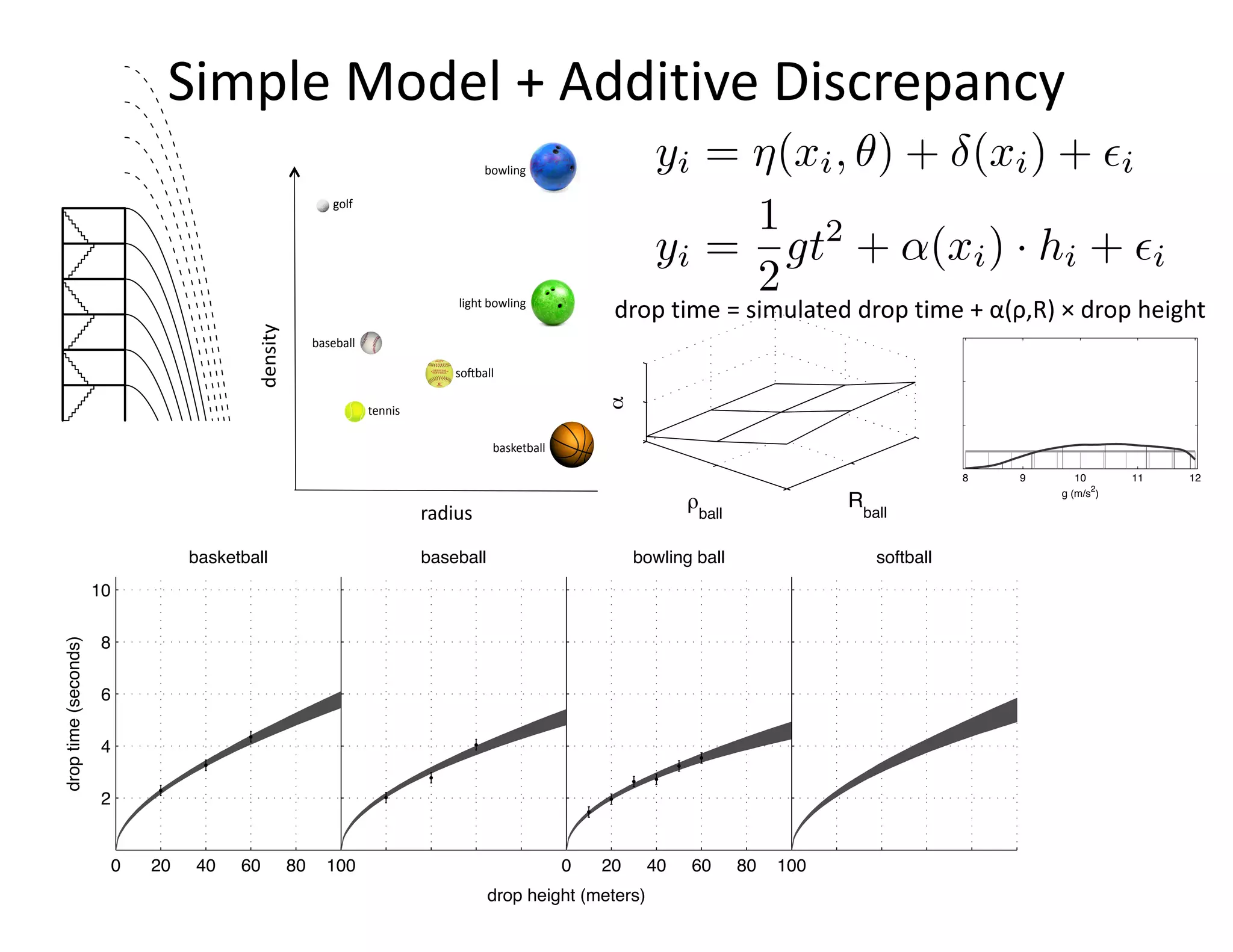
Simple Model + Additive Discrepancy
Simple'case'study:'dropping'balls'from'
a'tower'
•  Can'get'field'data'from'tossing'
objects'off'of'floors'1=6.'
•  Have'computaBonal'model'
which'predicts'drop'Bmes'
given'ball'radius,'density,'and'
floor.'
•  ComputaBonal'model'has'
parameter'for'air'fricBon'which'
depends'on'cross'secBon,'
density'and'velocity.'
•  Have'baseball,'basketball,'golf'
ball,'tennis,'light'&'heavy'
bowling'balls.'
•  Want'to'predict'soHball'drop'
Bme'from'10th'floor'(100m).'
•  Also'want'to'understand'the'
value'of'various'types'of'
potenBal'experiments'&'
simulaBons'for'the'soHball'
predicBon'at'100m.'
Slide'1'
radius'
density'
physics'design'space'
golf'
baseball'
tennis'
soHball'
basketball'
light'bowling'
bowling'
0 20 40 60 80 100
2
4
6
8
10
droptime(seconds)
basketball baseball
0 20 40 60 80 100
bowling ball softball
drop height (meters)
Rballball
drop time = simulated drop time + α(ρ,R) × drop height
8 9 10 11 12
g (m/s
2
)
yi = ⌘(xi, ✓) + (xi) + ✏i
yi =
1
2
gt2
+ ↵(xi) · hi + ✏i
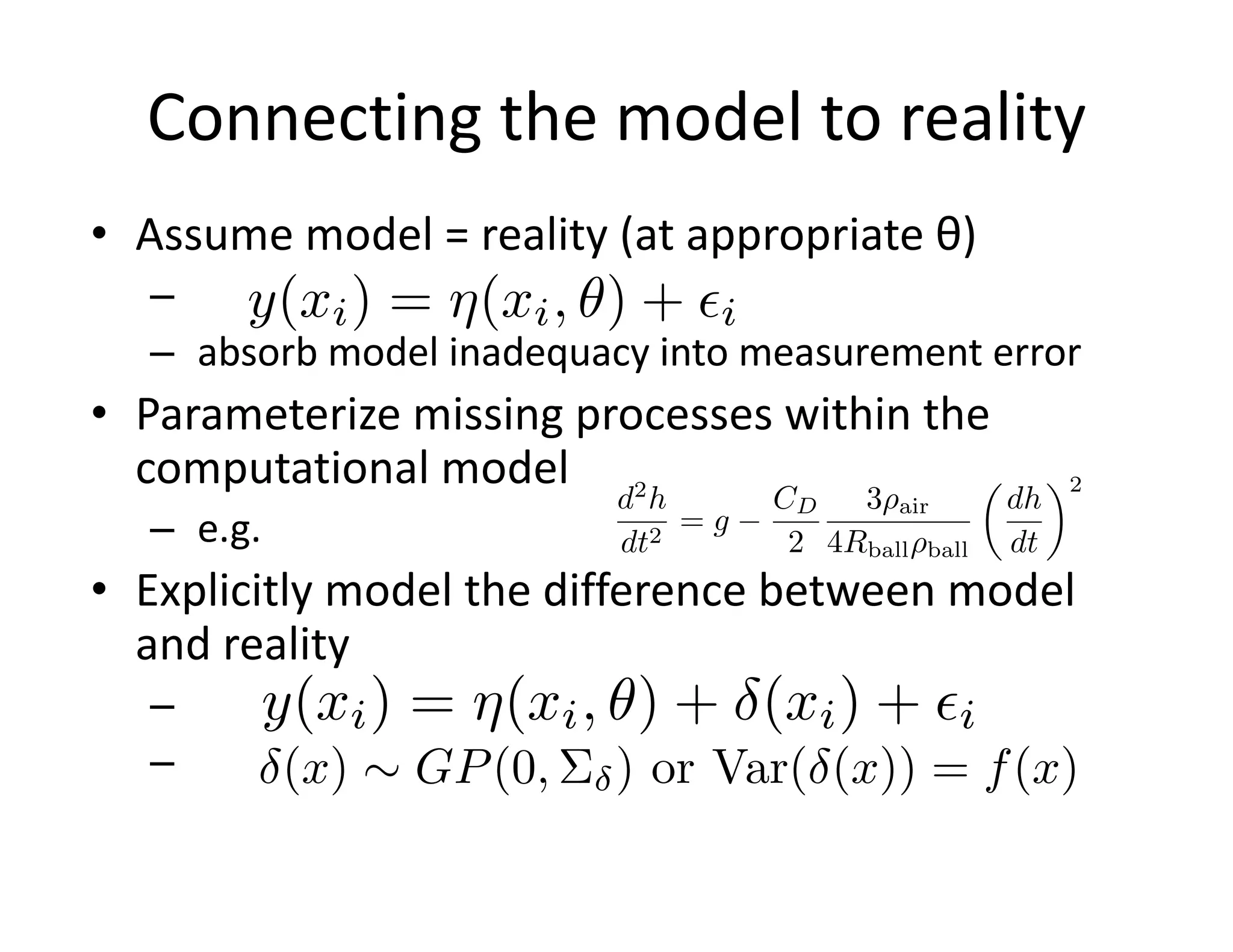
Connecting the model to reality
• Assume model = reality (at appropriate θ)
–
– absorb model inadequacy into measurement error
• Parameterize missing processes within the
computational model
– e.g.
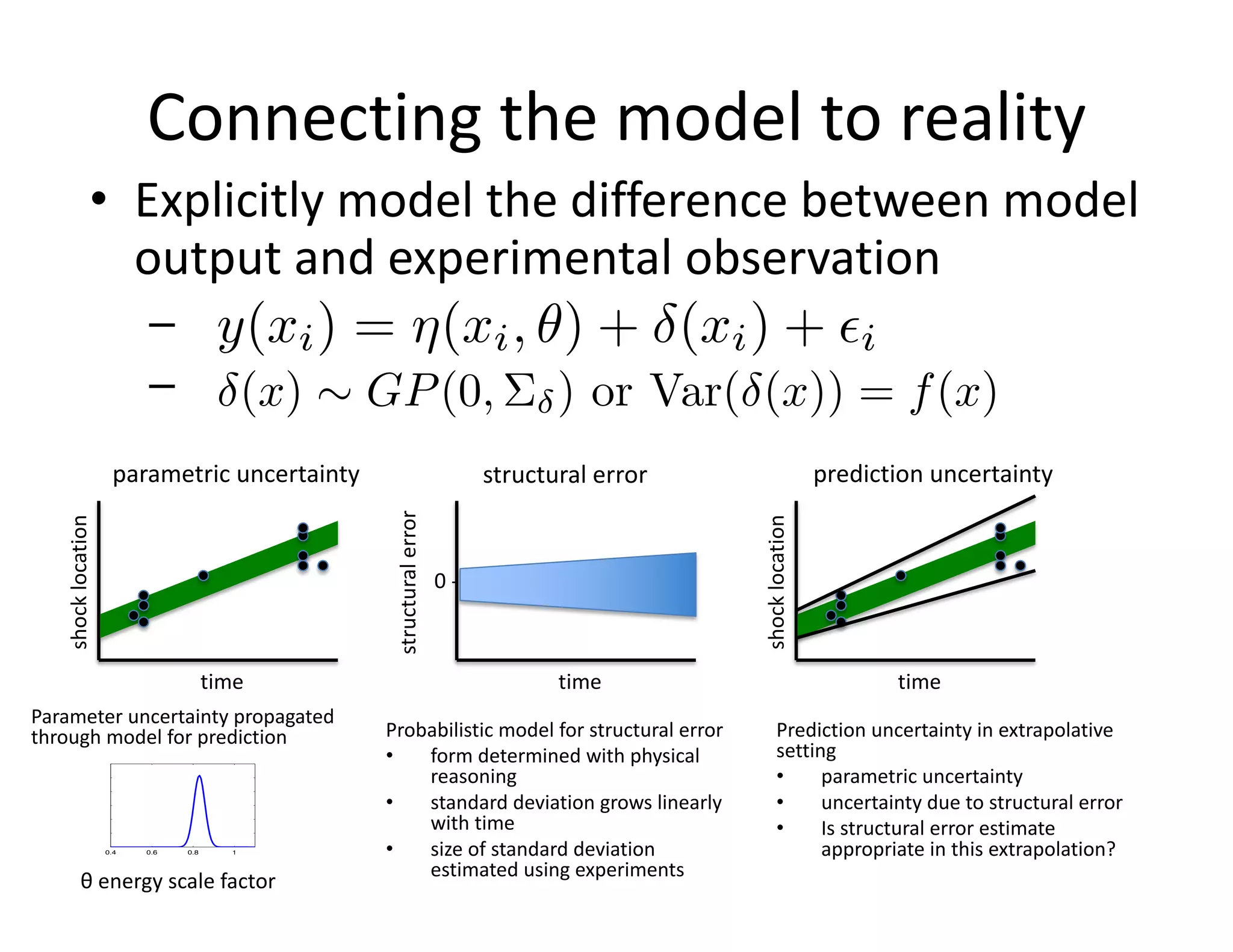
• Explicitly model the difference between model
and reality
–
–
y(xi) = ⇥(xi, ⇤) + i
d2
h
dt2
= g
CD
2
3 air
4Rball ball
✓
dh
dt
◆2
y(xi) = ⇤(xi, ⌅) + (xi) + ⇥i
(x) ⇠ GP(0, ) or Var( (x)) = f(x)
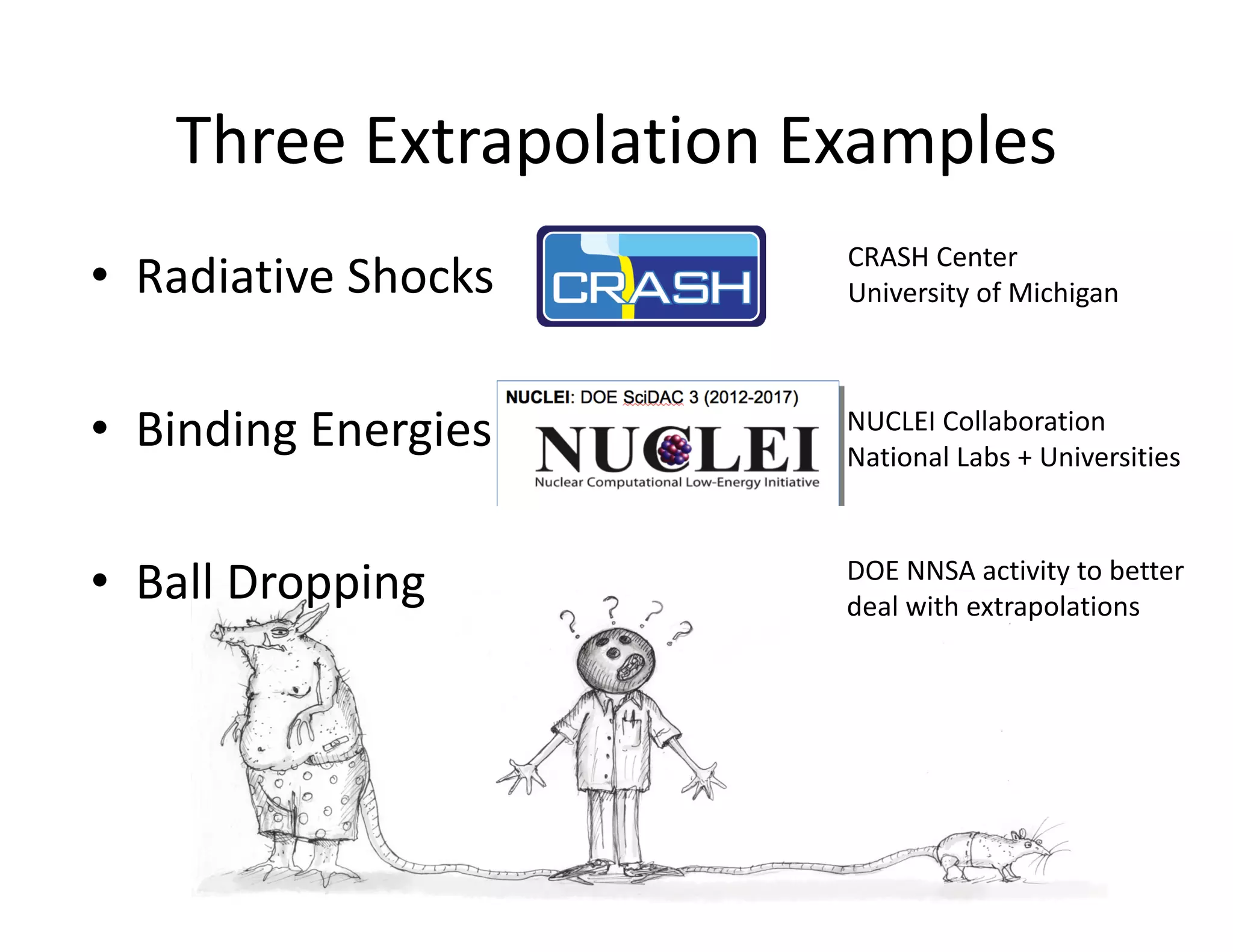
Three Extrapolation Examples
• Radiative Shocks
• Binding Energies
• Ball Dropping
CRASH Center
University of Michigan
NUCLEI Collaboration
National Labs + Universities
DOE NNSA activity to better
deal with extrapolations
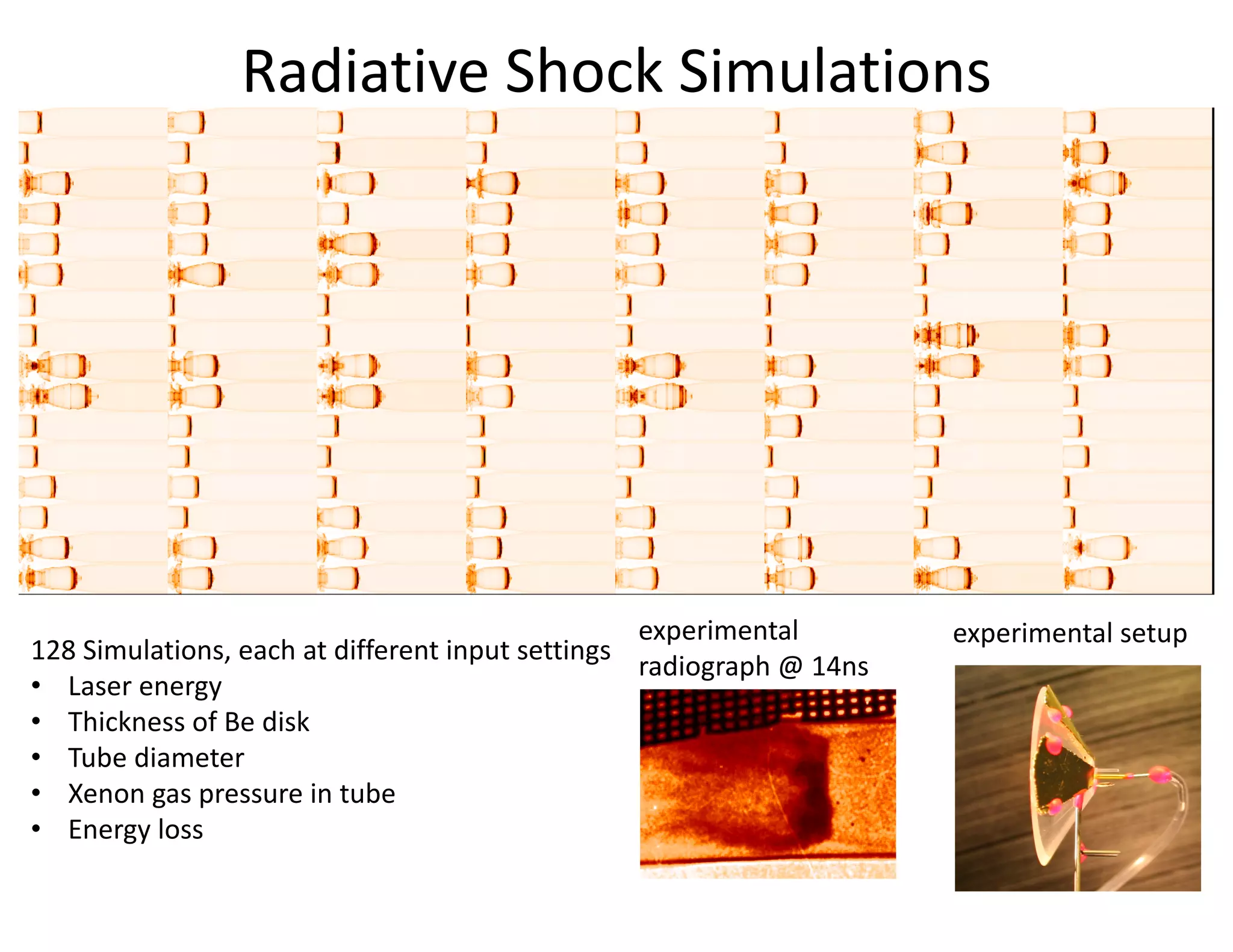
Radiative Shock Simulations
128 Simulations, each at different input settings
• Laser energy
• Thickness of Be disk
• Tube diameter
• Xenon gas pressure in tube
• Energy loss
experimental
radiograph @ 14ns
experimental setup
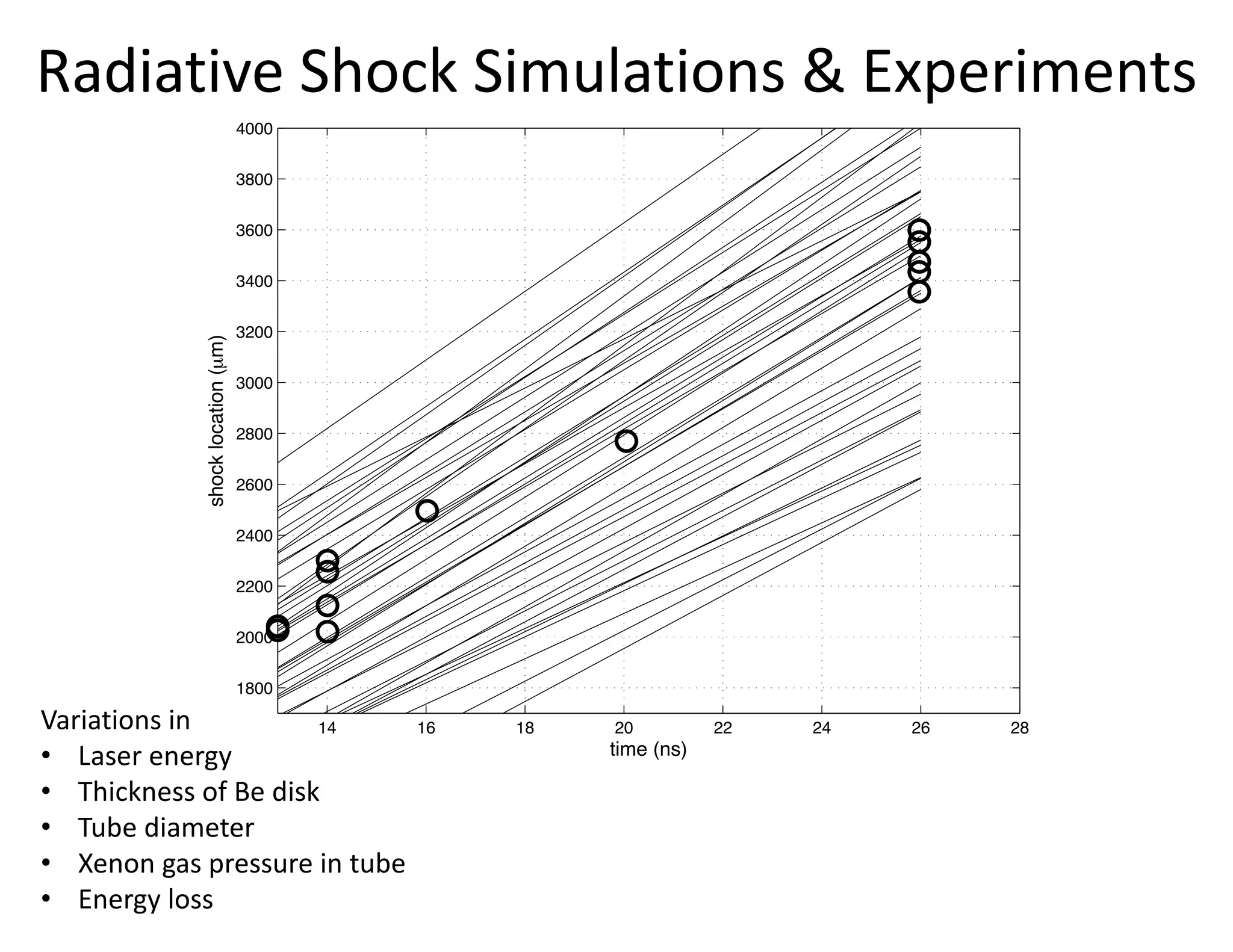
14 16 18 20 22 24 26 28
1800
2000
2200
2400
2600
2800
3000
3200
3400
3600
3800
4000
shocklocation(µm)
time (ns)
Radiative Shock Simulations & Experiments
Variations in
• Laser energy
• Thickness of Be disk
• Tube diameter
• Xenon gas pressure in tube
• Energy loss
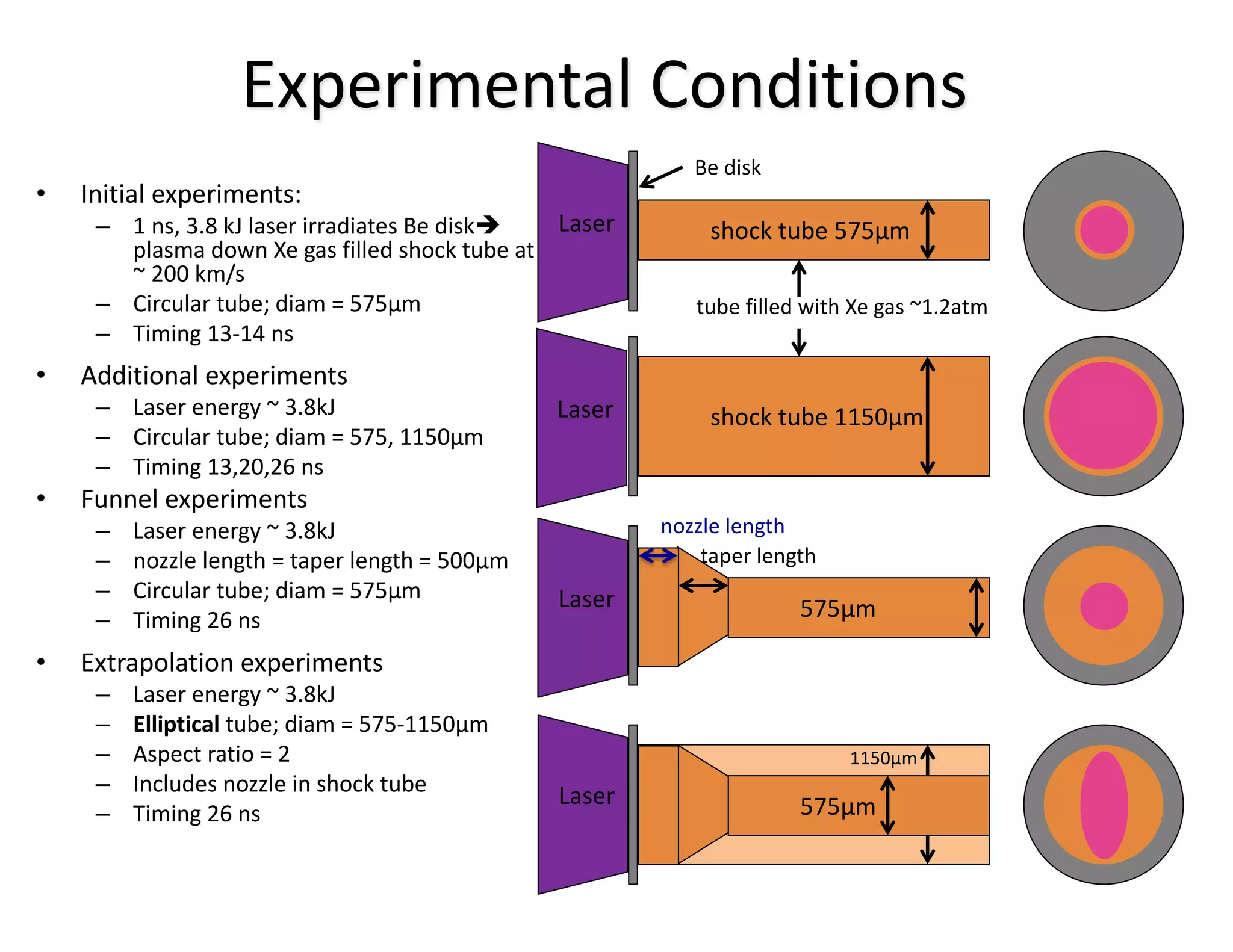
shock tube 1150μmLaser
shock tube 1150μm575μm
1150μm
Laser
shock tube 575μmLaser
Be disk
575μmLaser
taper length
nozzle length
• Initial experiments:
– 1 ns, 3.8 kJ laser irradiates Be diskè
plasma down Xe gas filled shock tube at
~ 200 km/s
– Circular tube; diam = 575μm
– Timing 13-14 ns
• Additional experiments
– Laser energy ~ 3.8kJ
– Circular tube; diam = 575, 1150μm
– Timing 13,20,26 ns
• Funnel experiments
– Laser energy ~ 3.8kJ
– nozzle length = taper length = 500μm
– Circular tube; diam = 575μm
– Timing 26 ns
• Extrapolation experiments
– Laser energy ~ 3.8kJ
– Elliptical tube; diam = 575-1150μm
– Aspect ratio = 2
– Includes nozzle in shock tube
– Timing 26 ns
tube filled with Xe gas ~1.2atm
Experimental Conditions
Connecting the model to reality
• Explicitly model the difference between model
output and experimental observation
–
–
y(xi) = ⇤(xi, ⌅) + (xi) + ⇥i
(x) ⇠ GP(0, ) or Var( (x)) = f(x)
0.4 0.6 0.8 1
− energy scale factor
θ energy scale factor
time
shocklocation
time
structuralerror
0 -
time
shocklocation
parametric uncertainty structural error prediction uncertainty
Probabilistic model for structural error
• form determined with physical
reasoning
• standard deviation grows linearly
with time
• size of standard deviation
estimated using experiments
Parameter uncertainty propagated
through model for prediction Prediction uncertainty in extrapolative
setting
• parametric uncertainty
• uncertainty due to structural error
• Is structural error estimate
appropriate in this extrapolation?
2000
3000
4000
LE=3889.6
TD=575
LE=3889.6
TD=575
LE=3882
TD=575
LE=3892.4
TD=575
LE=3892.4
TD=575
LE=3880.2
TD=575
LE=3880.2
TD=575
LE=3859.8
TD=575
LE=3859.8
TD=575
LE=3846
TD=575
2000
3000
4000
LE=3841.5
TD=575
LE=3867.4
TD=575
LE=3832
TD=1150
LE=3832
TD=1150
LE=3866
TD=1150
LE=3829
TD=575
LE=3750
TD=575
13 16 19 22 25
LE=3750
TD=575
LE=3827
TD=576.99
13 16 19 22 25
LE=3827
TD=576.99
13 16 19 22 25
2000
3000
4000
Predictions
shockposition(µm)
time (ns)
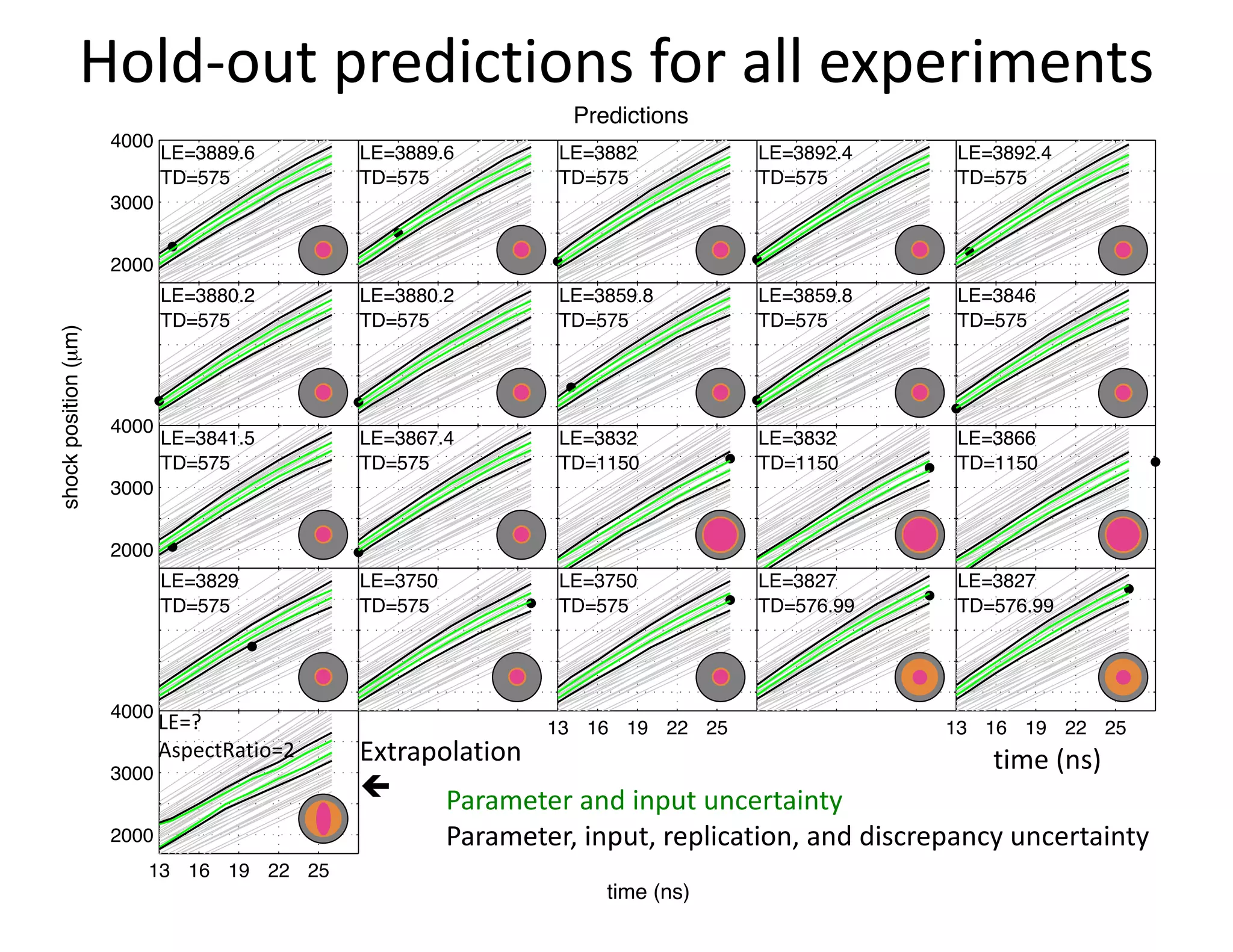
Hold-out predictions for all experiments
Parameter and input uncertainty
Parameter, input, replication, and discrepancy uncertainty
Extrapolation
ç
LE=?
AspectRatio=2
time (ns)
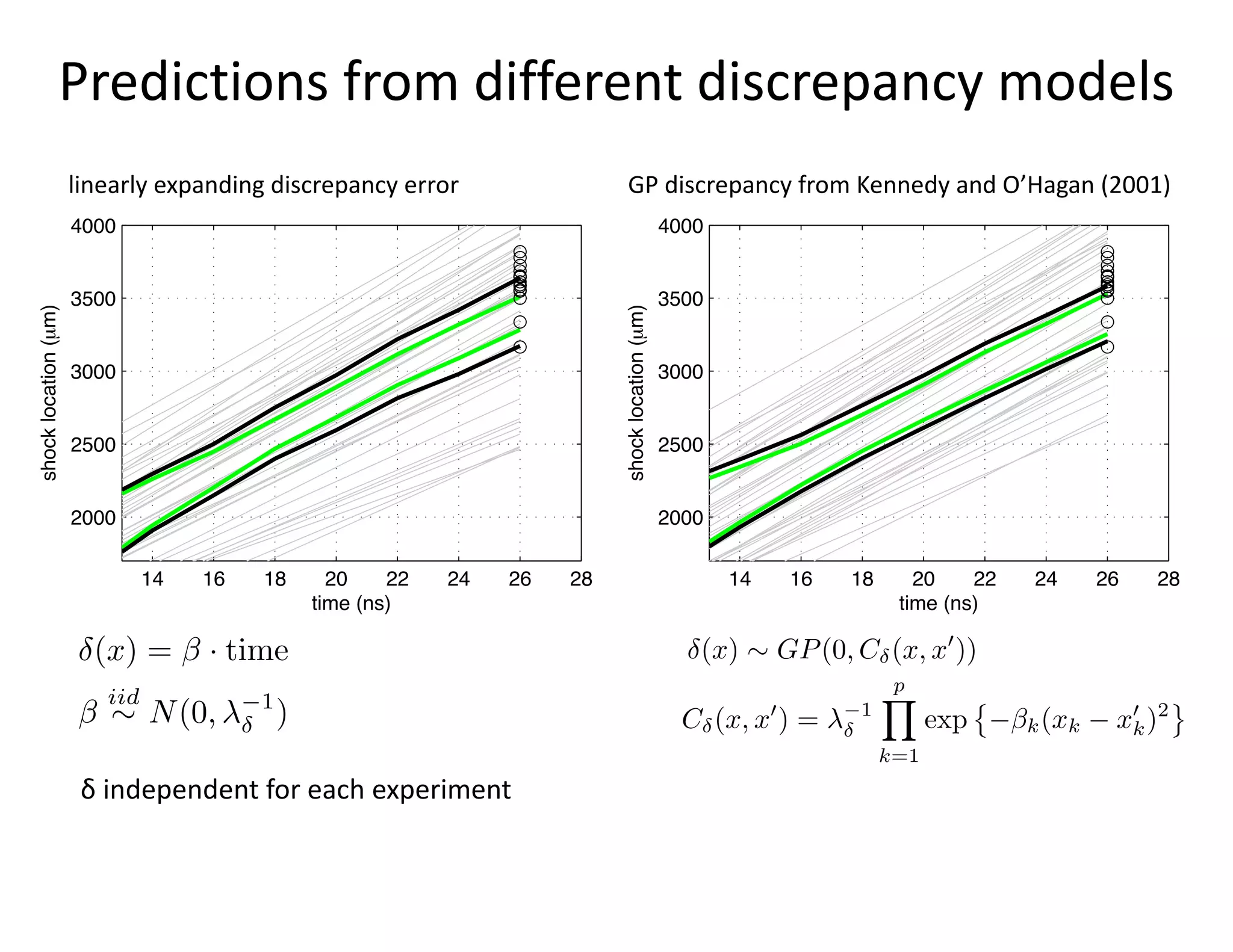
Predictions from different discrepancy models
14 16 18 20 22 24 26 28
2000
2500
3000
3500
4000
shocklocation(µm)
time (ns)
14 16 18 20 22 24 26 28
2000
2500
3000
3500
4000
shocklocation(µm)
time (ns)
linearly expanding discrepancy error GP discrepancy from Kennedy and O’Hagan (2001)
(x) ⇠ GP(0, C (x, x0
))
C (x, x0
) = 1
pY
k=1
exp k(xk x0
k)2
(x) = · time
iid
⇠ N(0, 1
)
δ independent for each experiment
14 16 18 20 22 24 26 28
2000
2500
3000
3500
4000
shocklocation(µm)
time (ns)
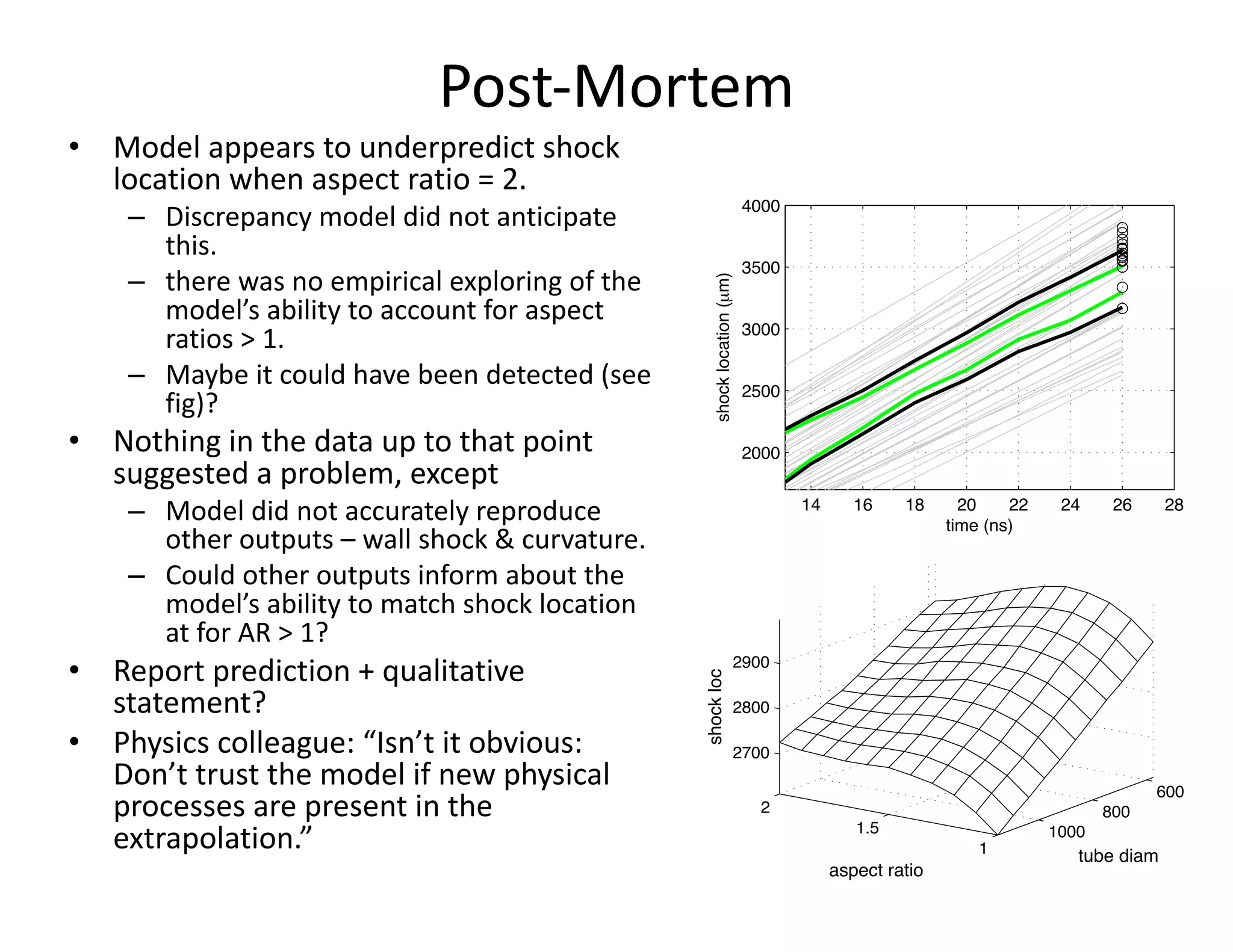
Post-Mortem
• Model appears to underpredict shock
location when aspect ratio = 2.
– Discrepancy model did not anticipate
this.
– there was no empirical exploring of the
model’s ability to account for aspect
ratios > 1.
– Maybe it could have been detected (see
fig)?
• Nothing in the data up to that point
suggested a problem, except
– Model did not accurately reproduce
other outputs – wall shock & curvature.
– Could other outputs inform about the
model’s ability to match shock location
at for AR > 1?
• Report prediction + qualitative
statement?
• Physics colleague: “Isn’t it obvious:
Don’t trust the model if new physical
processes are present in the
extrapolation.” 1
1.5
2
600
800
1000
2700
2800
2900
tube diam
aspect ratio
shockloc
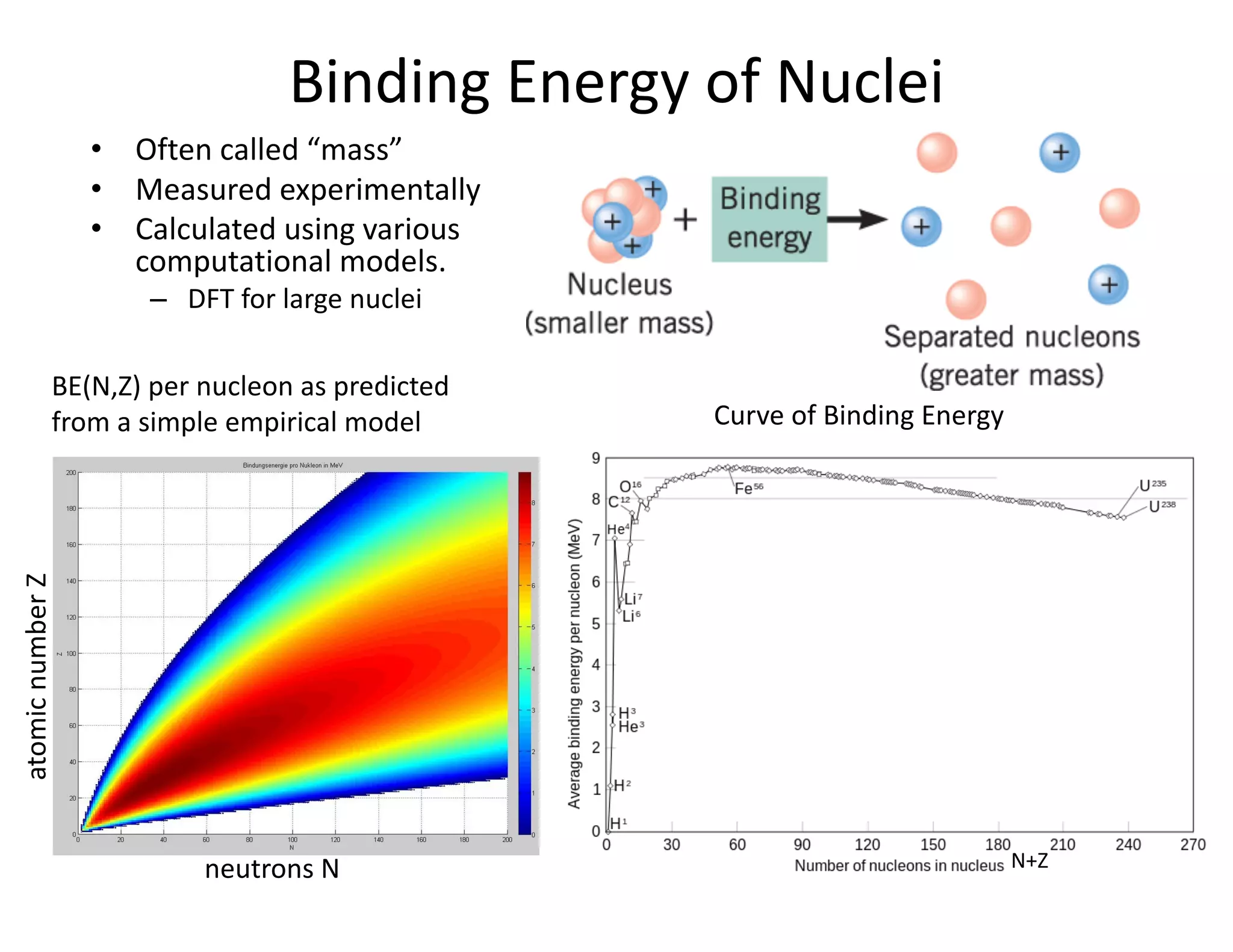
Binding Energy of Nuclei
• Often called “mass”
• Measured experimentally
• Calculated using various
computational models.
– DFT for large nuclei
BE(N,Z) per nucleon as predicted
from a simple empirical model Curve of Binding Energy
neutrons N
atomicnumberZ
N+Z
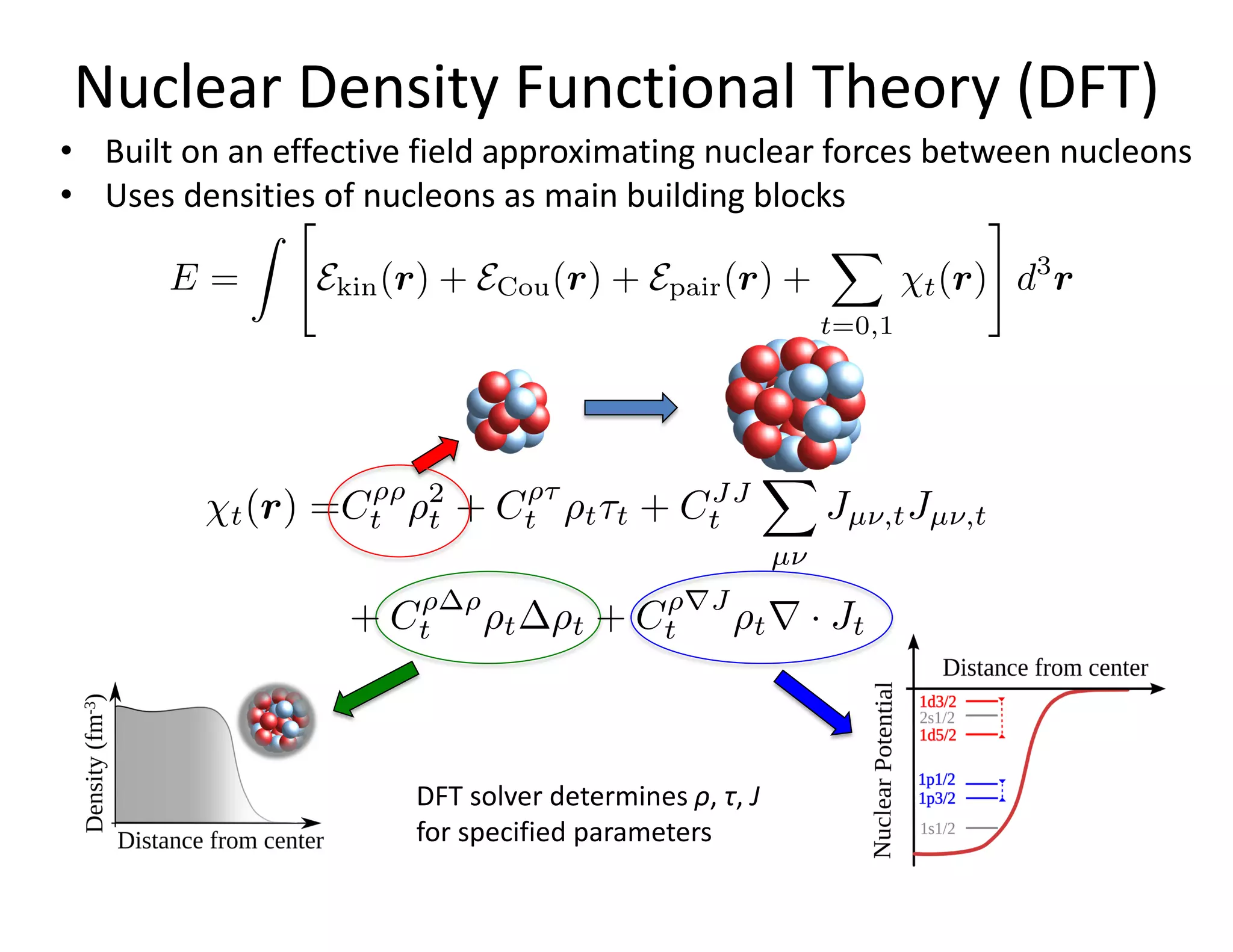
Nuclear Density Functional Theory (DFT)
• Built on an effective field approximating nuclear forces between nucleons
• Uses densities of nucleons as main building blocks
DFT solver determines ρ, τ, J
for specified parameters
E =
Z "
Ekin(r) + ECou(r) + Epair(r) +
X
t=0,1
t(r)
#
d3
r
⇤t(r) =C⇥⇥
t
2
t + C⇥⇤
t t⇥t + CJJ
t
X
µ
Jµ ,tJµ ,t
+ C⇥ ⇥
t t t + C⇥rJ
t t · Jt
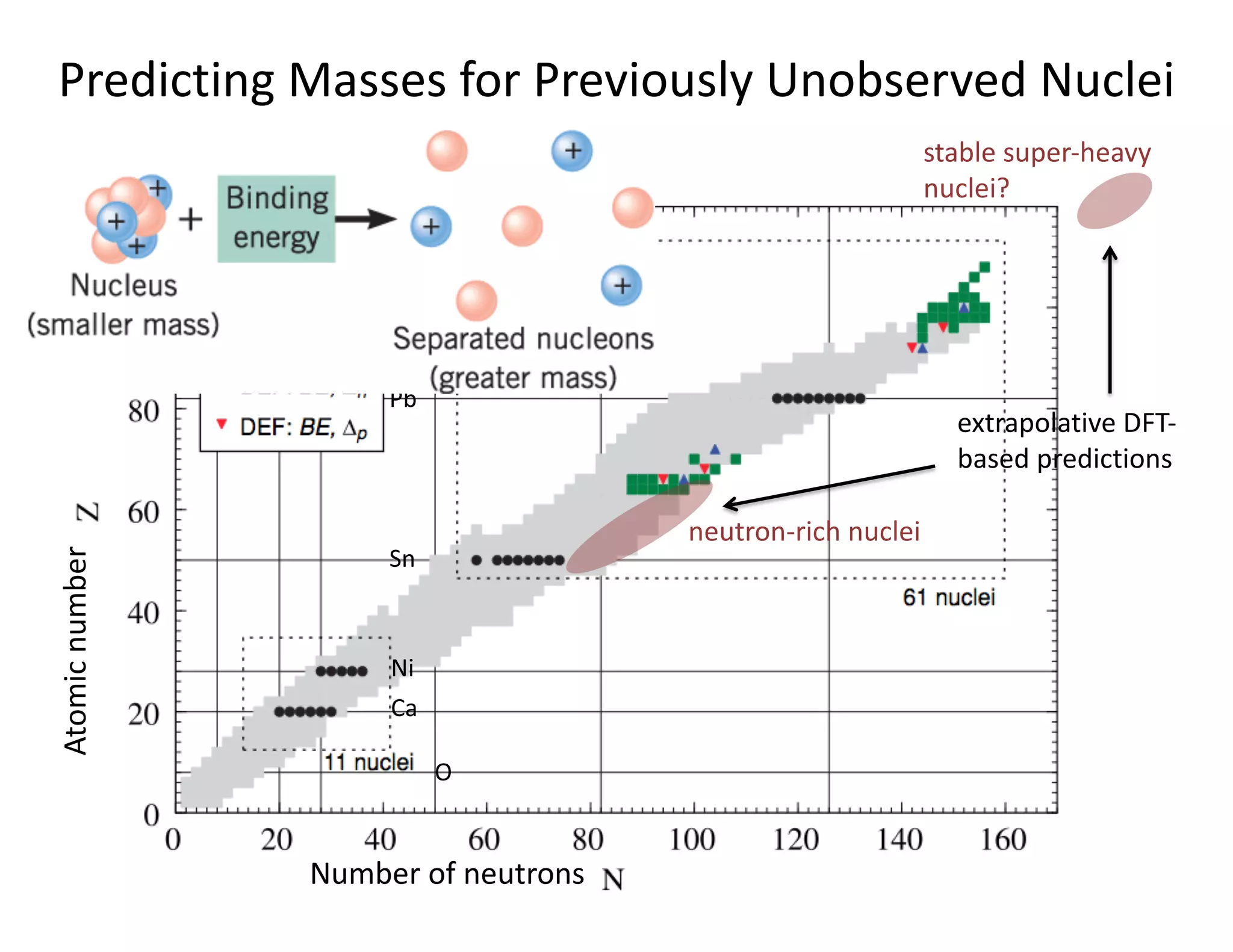
Predicting Masses for Previously Unobserved NucleiAtomicnumber
Number of neutrons
neutron-rich nuclei
stable super-heavy
nuclei?
extrapolative DFT-
based predictions
Pb
Sn
Ni
Ca
O
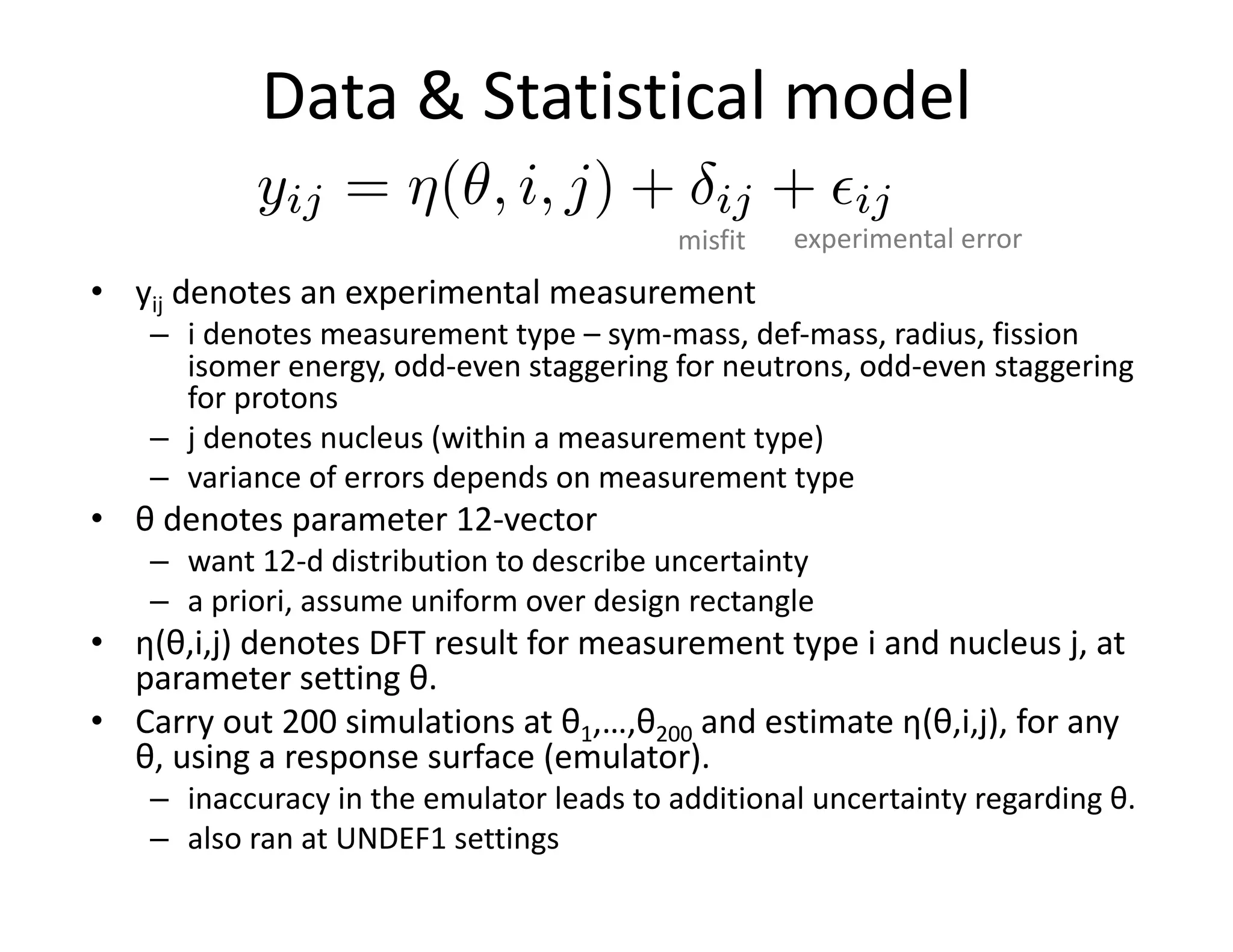
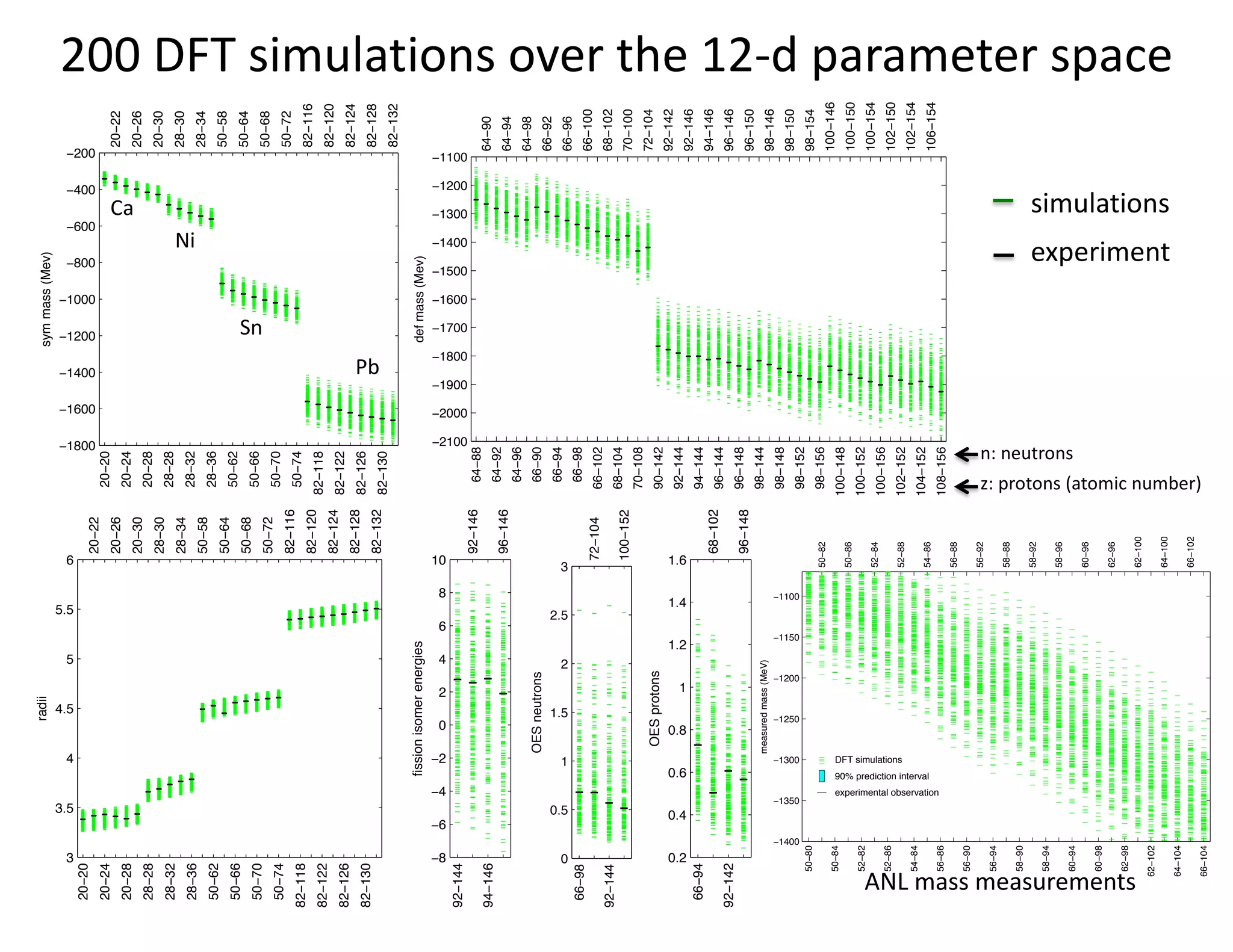
Data & Statistical model
• yij denotes an experimental measurement
– i denotes measurement type – sym-mass, def-mass, radius, fission
isomer energy, odd-even staggering for neutrons, odd-even staggering
for protons
– j denotes nucleus (within a measurement type)
– variance of errors depends on measurement type
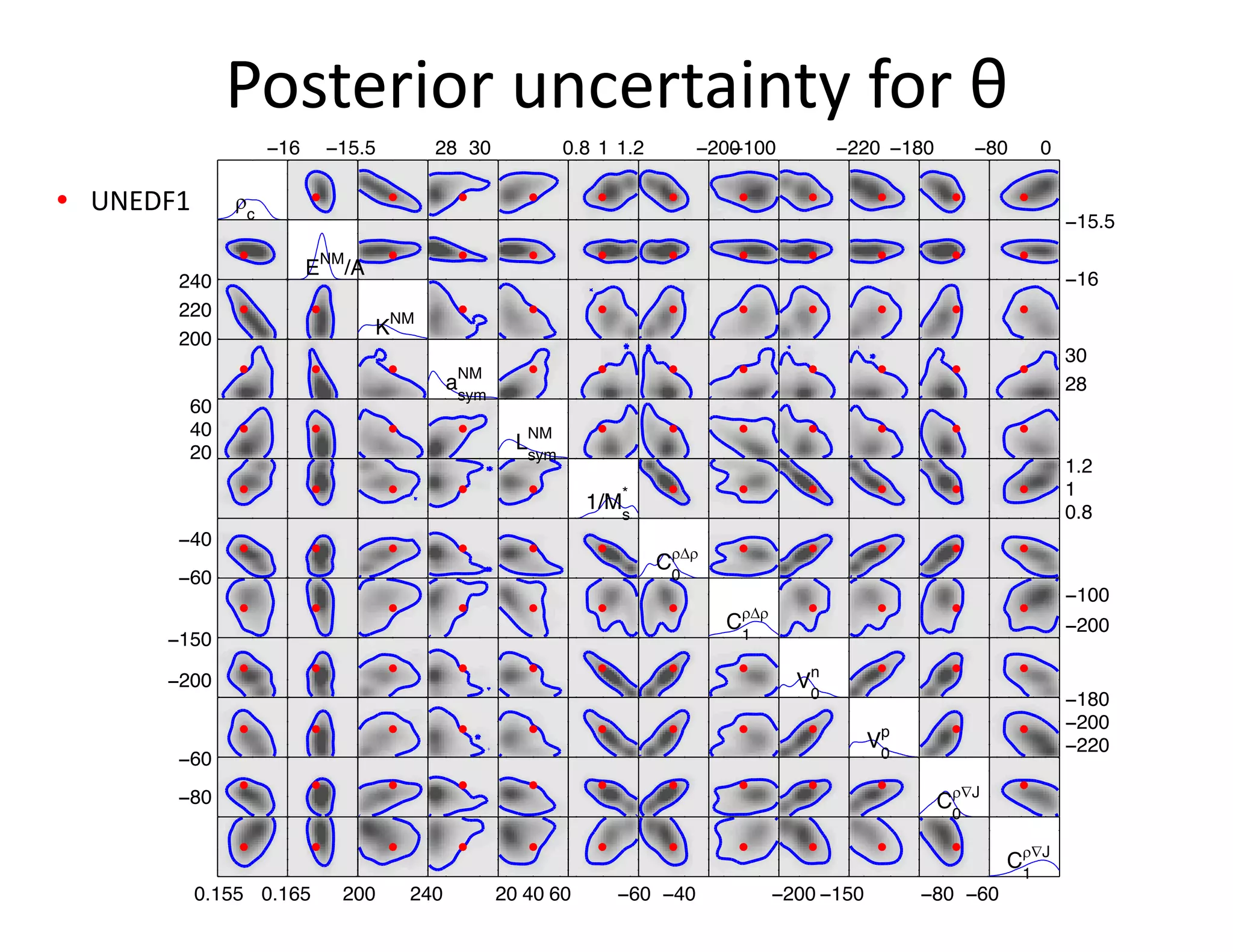
• θ denotes parameter 12-vector
– want 12-d distribution to describe uncertainty
– a priori, assume uniform over design rectangle
• η(θ,i,j) denotes DFT result for measurement type i and nucleus j, at
parameter setting θ.
• Carry out 200 simulations at θ1,…,θ200 and estimate η(θ,i,j), for any
θ, using a response surface (emulator).
– inaccuracy in the emulator leads to additional uncertainty regarding θ.
– also ran at UNDEF1 settings
yij = ⌘(✓, i, j) + ij + ✏ij
misfit experimental error
simulations
experiment
−1800
−1600
−1400
−1200
−1000
−800
−600
−400
−200
symmass(Mev)
20−20
20−24
20−28
28−28
28−32
28−36
50−62
50−66
50−70
50−74
82−118
82−122
82−126
82−130
20−22
20−26
20−30
28−30
28−34
50−58
50−64
50−68
50−72
82−116
82−120
82−124
82−128
82−132
−2100
−2000
−1900
−1800
−1700
−1600
−1500
−1400
−1300
−1200
−1100
defmass(Mev)
64−88
64−92
64−96
66−90
66−94
66−98
66−102
68−104
70−108
90−142
92−144
94−144
96−144
96−148
98−144
98−148
98−152
98−156
100−148
100−152
100−156
102−152
104−152
108−156
64−90
64−94
64−98
66−92
66−96
66−100
68−102
70−100
72−104
92−142
92−146
94−146
96−146
96−150
98−146
98−150
98−154
100−146
100−150
100−154
102−150
102−154
106−154
3
3.5
4
4.5
5
5.5
6
radii
20−20
20−24
20−28
28−28
28−32
28−36
50−62
50−66
50−70
50−74
82−118
82−122
82−126
82−130
20−22
20−26
20−30
28−30
28−34
50−58
50−64
50−68
50−72
82−116
82−120
82−124
82−128
82−132
−8
−6
−4
−2
0
2
4
6
8
10
fissionisomerenergies
92−144
94−146
92−146
96−146
0
0.5
1
1.5
2
2.5
3
OESneutrons
66−98
92−144
72−104
100−152
0.2
0.4
0.6
0.8
1
1.2
1.4
1.6
OESprotons
66−94
92−142
68−102
96−148
−1400
−1350
−1300
−1250
−1200
−1150
−1100
measuredmass(MeV) DFT simulations
90% prediction interval
experimental observation
50−80
50−84
52−82
52−86
54−84
56−86
56−90
56−94
58−90
58−94
60−94
60−98
62−98
62−102
64−104
66−104
50−82
50−86
52−84
52−88
54−86
56−88
56−92
58−88
58−92
58−96
60−96
62−96
62−100
64−100
66−102
200 DFT simulations over the 12-d parameter space
z: protons (atomic number)
n: neutrons
ANL mass measurements
Ca
Ni
Sn
Pb
simulations
experiment
−150
−100
−50
0
50
100
150
200
symmass(difffromUNDEF1)
20−20
20−24
20−28
28−28
28−32
28−36
50−62
50−66
50−70
50−74
82−118
82−122
82−126
82−130
20−22
20−26
20−30
28−30
28−34
50−58
50−64
50−68
50−72
82−116
82−120
82−124
82−128
82−132
−200
−150
−100
−50
0
50
100
150
200
defmass(difffromUNDEF1)
64−88
64−92
64−96
66−90
66−94
66−98
66−102
68−104
70−108
90−142
92−144
94−144
96−144
96−148
98−144
98−148
98−152
98−156
100−148
100−152
100−156
102−152
104−152
108−156
64−90
64−94
64−98
66−92
66−96
66−100
68−102
70−100
72−104
92−142
92−146
94−146
96−146
96−150
98−146
98−150
98−154
100−146
100−150
100−154
102−150
102−154
106−154
−0.2
−0.15
−0.1
−0.05
0
0.05
0.1
0.15
radii(difffromUNDEF1)
20−20
20−24
20−28
28−28
28−32
28−36
50−62
50−66
50−70
50−74
82−118
82−122
82−126
82−130
20−22
20−26
20−30
28−30
28−34
50−58
50−64
50−68
50−72
82−116
82−120
82−124
82−128
82−132
−10
−8
−6
−4
−2
0
2
4
6
8
fissionisomerenergies(difffromUNDEF1)
92−144
94−146
92−146
96−146
−0.5
0
0.5
1
1.5
2
2.5
OESneutrons(difffromUNDEF1)
66−98
92−144
72−104
100−152
−0.4
−0.2
0
0.2
0.4
0.6
0.8
1
OESprotons(difffromUNDEF1)
66−94
92−142
68−102
96−148
−150
−100
−50
0
50
100
150
measuredmass(MeV)
50−80
50−84
52−82
52−86
54−84
56−86
56−90
56−94
58−90
58−94
60−94
60−98
62−98
62−102
64−104
66−104
50−82
50−86
52−84
52−88
54−86
56−88
56−92
58−88
58−92
58−96
60−96
62−96
62−100
64−100
66−102
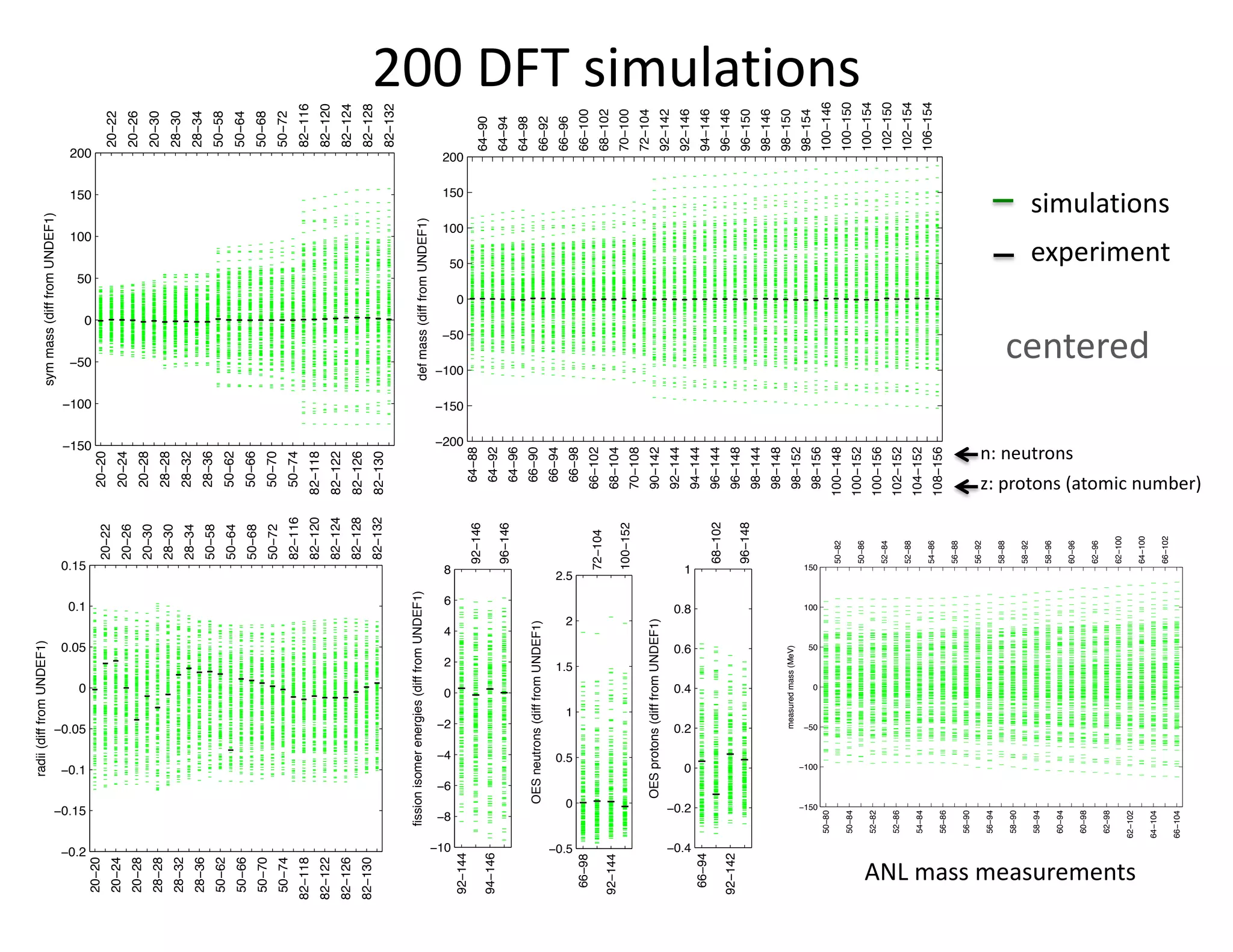
200 DFT simulations
z: protons (atomic number)
n: neutrons
centered
ANL mass measurements
simulations
experiment
−6
−4
−2
0
2
4
6
symmass(difffromUNDEF1)
20−20
20−24
20−28
28−28
28−32
28−36
50−62
50−66
50−70
50−74
82−118
82−122
82−126
82−130
20−22
20−26
20−30
28−30
28−34
50−58
50−64
50−68
50−72
82−116
82−120
82−124
82−128
82−132
−6
−4
−2
0
2
4
6
defmass(difffromUNDEF1)
64−88
64−92
64−96
66−90
66−94
66−98
66−102
68−104
70−108
90−142
92−144
94−144
96−144
96−148
98−144
98−148
98−152
98−156
100−148
100−152
100−156
102−152
104−152
108−156
64−90
64−94
64−98
66−92
66−96
66−100
68−102
70−100
72−104
92−142
92−146
94−146
96−146
96−150
98−146
98−150
98−154
100−146
100−150
100−154
102−150
102−154
106−154
−0.1
−0.05
0
0.05
0.1
radii(difffromUNDEF1)
20−20
20−24
20−28
28−28
28−32
28−36
50−62
50−66
50−70
50−74
82−118
82−122
82−126
82−130
20−22
20−26
20−30
28−30
28−34
50−58
50−64
50−68
50−72
82−116
82−120
82−124
82−128
82−132
−1
−0.8
−0.6
−0.4
−0.2
0
0.2
0.4
0.6
0.8
1
fissionisomerenergies(difffromUNDEF1)
92−144
94−146
92−146
96−146
−0.4
−0.3
−0.2
−0.1
0
0.1
0.2
0.3
0.4
OESneutrons(difffromUNDEF1)
66−98
92−144
72−104
100−152
−0.4
−0.3
−0.2
−0.1
0
0.1
0.2
0.3
0.4
OESprotons(difffromUNDEF1)
66−94
92−142
68−102
96−148
−50
−40
−30
−20
−10
0
10
20
30
40
50
measuredmass(MeV)
50−80
50−84
52−82
52−86
54−84
56−86
56−90
56−94
58−90
58−94
60−94
60−98
62−98
62−102
64−104
66−104
50−82
50−86
52−84
52−88
54−86
56−88
56−92
58−88
58−92
58−96
60−96
62−96
62−100
64−100
66−102
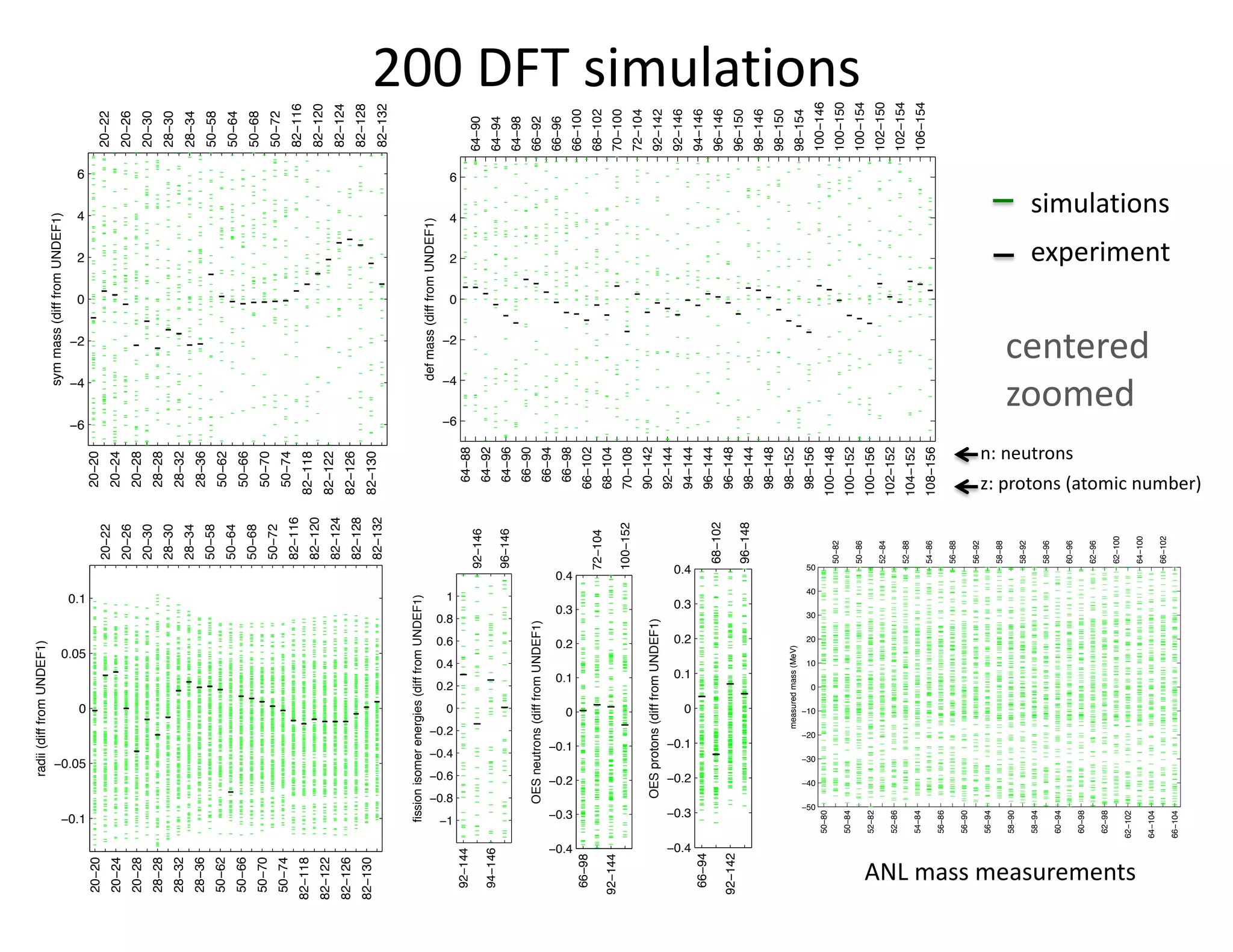
200 DFT simulations
z: protons (atomic number)
n: neutrons
centered
zoomed
ANL mass measurements
Posterior uncertainty for θ
−16 −15.5 28 30 0.8 1 1.2 −200−100 −220 −180 −80 0
−16
−15.5
200
220
240
28
30
20
40
60
0.8
1
1.2
−60
−40
−200
−100
−200
−150
−220
−200
−180
−80
−60
0.155 0.165 200 240 20 40 60 −60 −40 −200 −150 −80 −60
rc
E
NM
/A
K
NM
a
NM
sym
L
NM
sym
1/M
s
*
C
rDr
0
CrDr
1
V
n
0
Vp
0
CrÑJ
0
CrÑJ
1
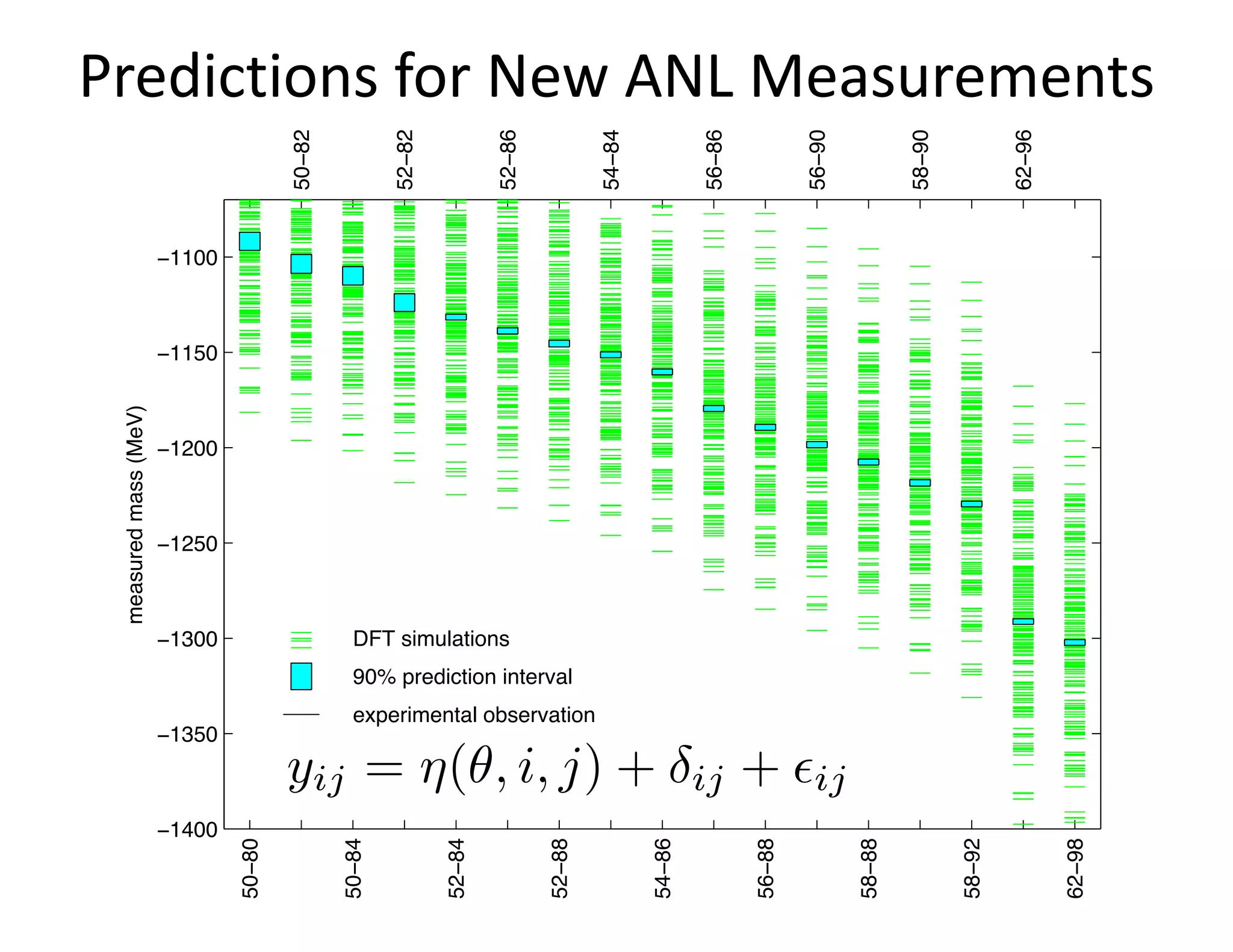
UNEDF1Ÿ
Predictions for New ANL Measurements
−1400
−1350
−1300
−1250
−1200
−1150
−1100
measuredmass(MeV)
DFT simulations
90% prediction interval
experimental observation
50−80
50−84
52−84
52−88
54−86
56−88
58−88
58−92
62−98
50−82
52−82
52−86
54−84
56−86
56−90
58−90
62−96
yij = ⌘(✓, i, j) + ij + ✏ij
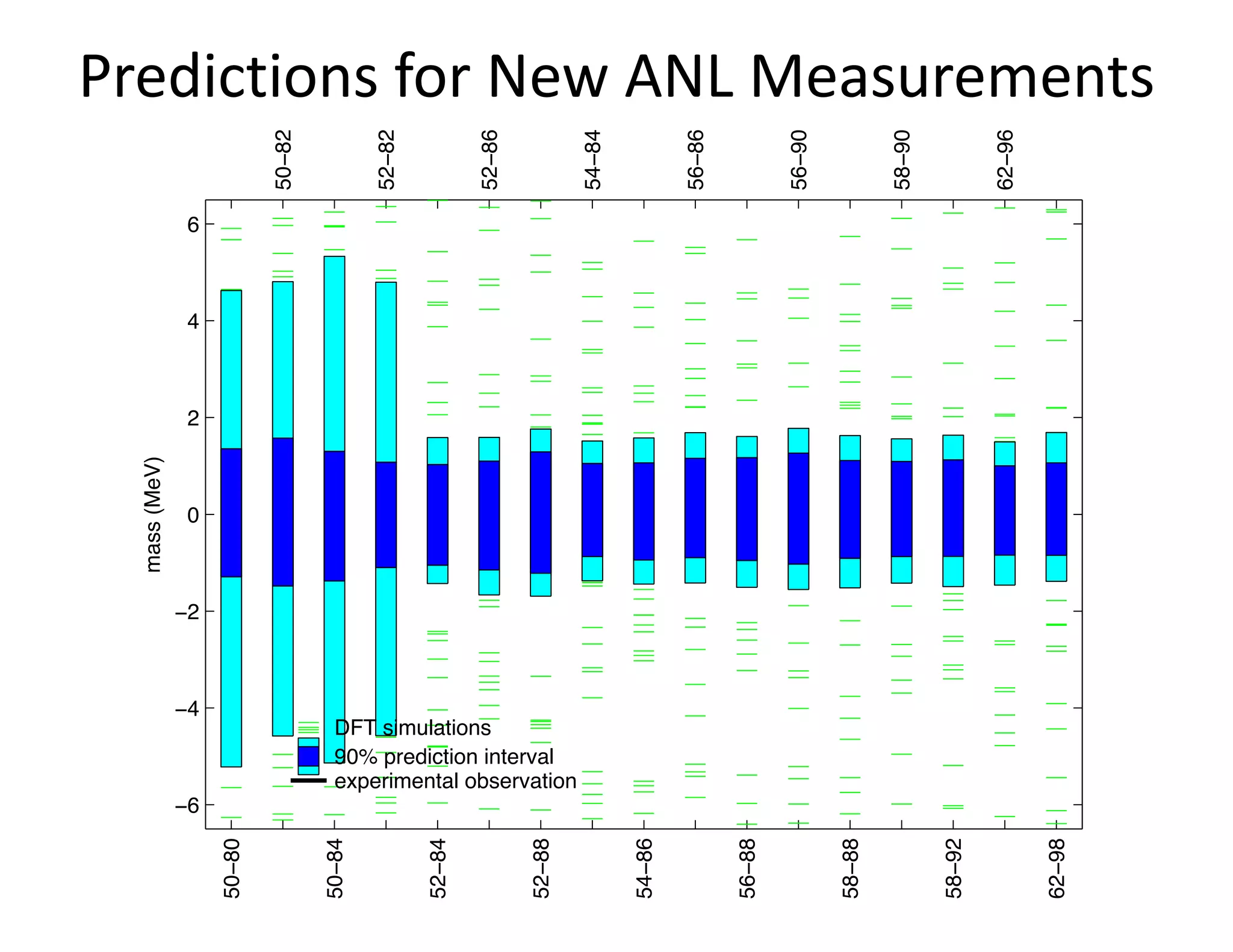
Predictions for New ANL Measurements
−6
−4
−2
0
2
4
6
mass(MeV)
DFT simulations
90% prediction interval
experimental observation
50−80
50−84
52−84
52−88
54−86
56−88
58−88
58−92
62−98
50−82
52−82
52−86
54−84
56−86
56−90
58−90
62−96
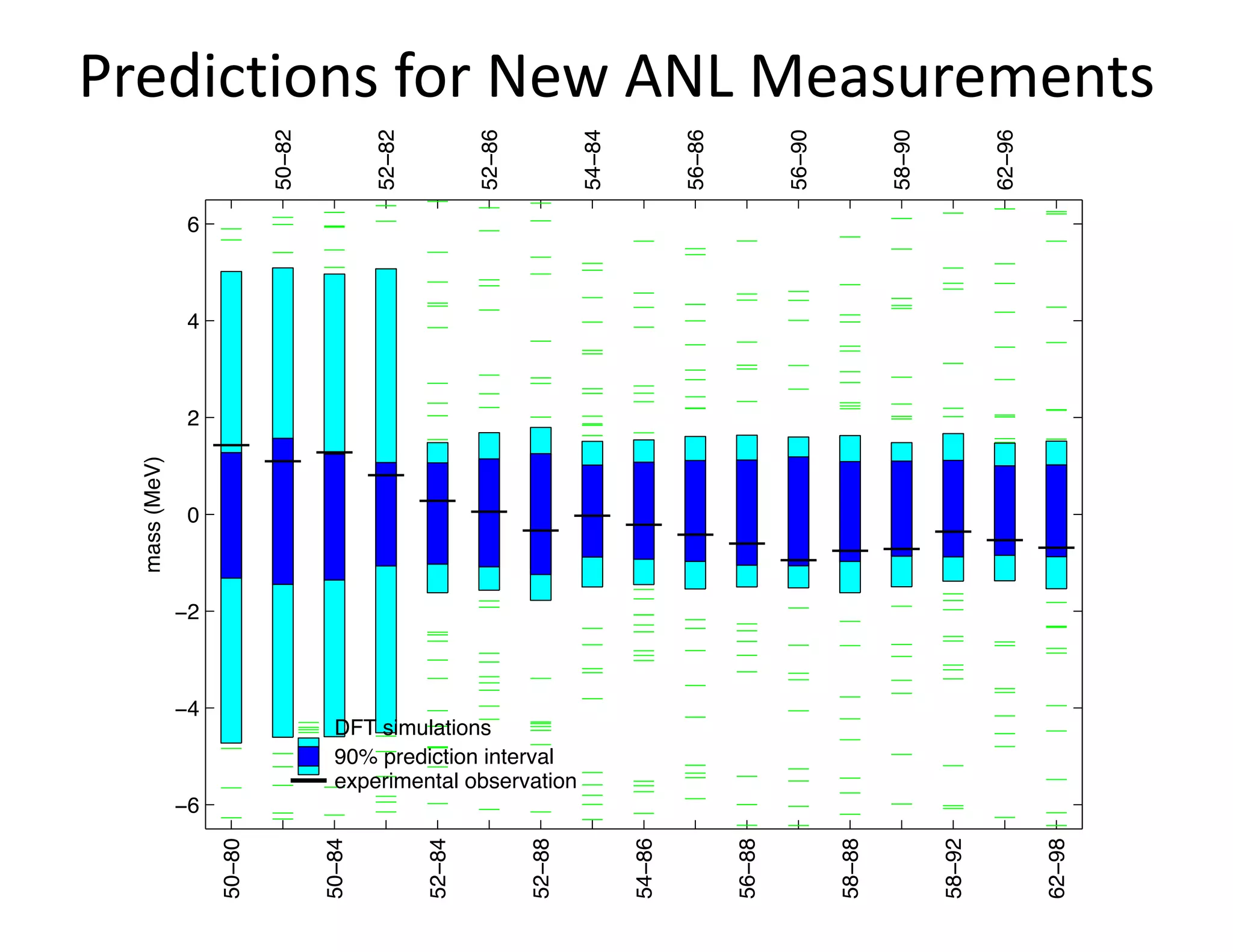
Predictions for New ANL Measurements
−6
−4
−2
0
2
4
6
mass(MeV)
DFT simulations
90% prediction interval
experimental observation
50−80
50−84
52−84
52−88
54−86
56−88
58−88
58−92
62−98
50−82
52−82
52−86
54−84
56−86
56−90
58−90
62−96
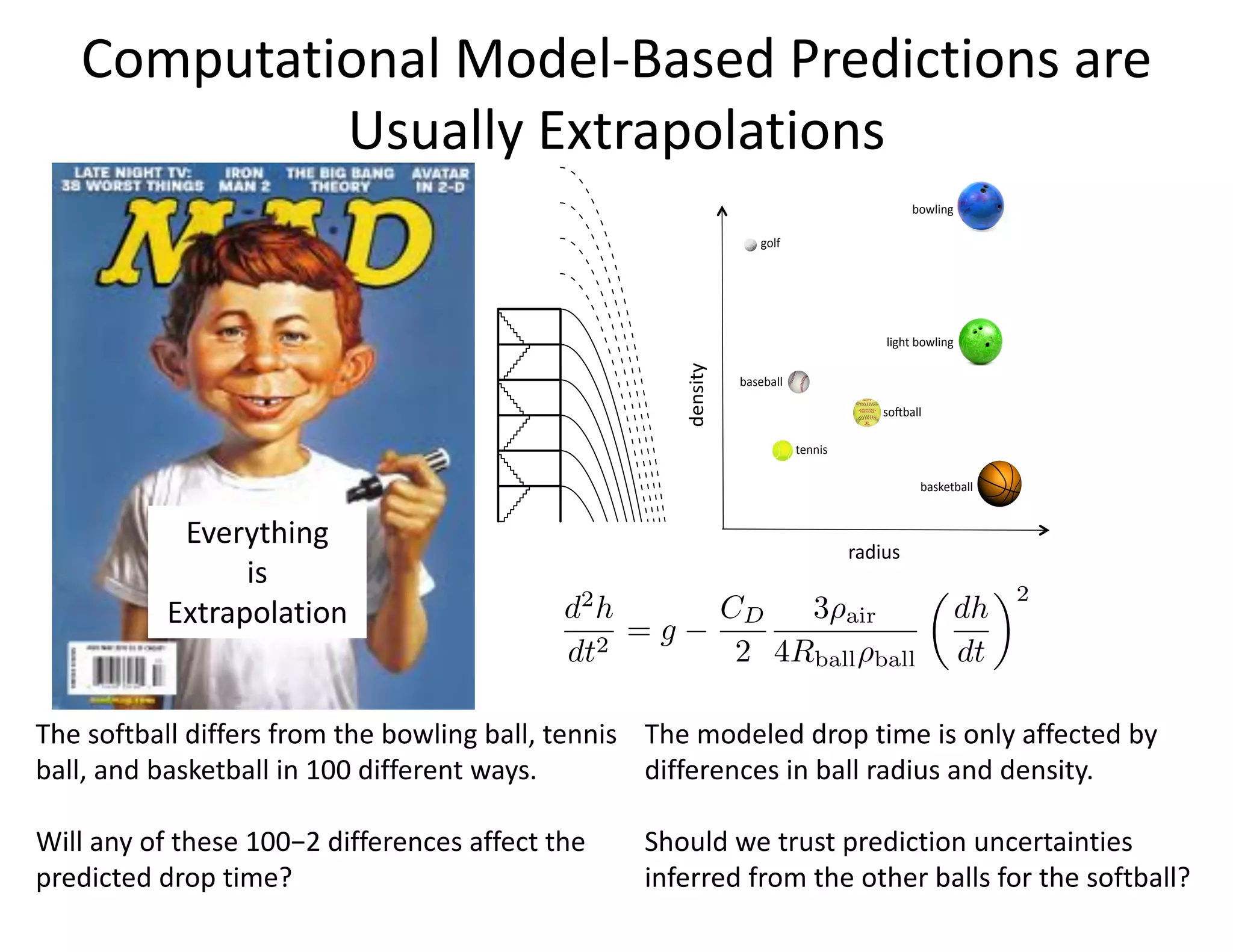
Computational Model-Based Predictions are
Usually Extrapolations
Everything
is
Extrapolation
Simple'case'study:'dropping'balls'from
a'tower'
•  Can'get'field'data'fro
objects'off'of'floors'1
•  Have'computaBonal'm
which'predicts'drop'B
given'ball'radius,'den
floor.'
•  ComputaBonal'mode
parameter'for'air'fric
depends'on'cross'sec
density'and'velocity.'
•  Have'baseball,'basket
ball,'tennis,'light'&'he
bowling'balls.'
•  Want'to'predict'soHb
Bme'from'10th'floor'(
•  Also'want'to'understa
value'of'various'types
potenBal'experiment
simulaBons'for'the'so
predicBon'at'100m.'
Slide'1'
radius'
density'
physics'design'space'
golf'
baseball'
tennis'
soHball'
basketball'
light'bowling'
bowling'
The softball differs from the bowling ball, tennis
ball, and basketball in 100 different ways.
Will any of these 100−2 differences affect the
predicted drop time?
d2
h
dt2
= g
CD
2
3 air
4Rball ball
✓
dh
dt
◆2
The modeled drop time is only affected by
differences in ball radius and density.
Should we trust prediction uncertainties
inferred from the other balls for the softball?
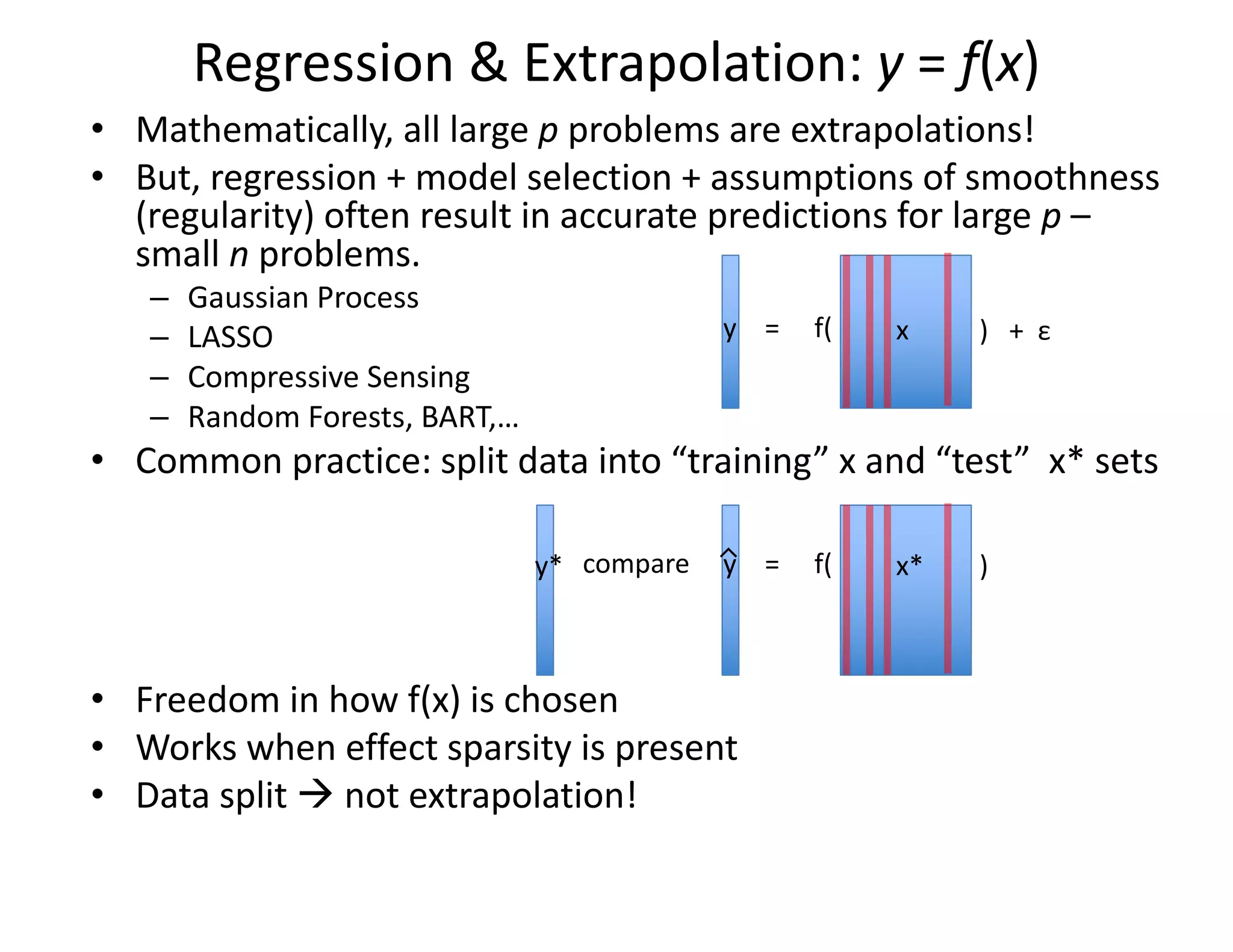
Regression & Extrapolation: y = f(x)
• Mathematically, all large p problems are extrapolations!
• But, regression + model selection + assumptions of smoothness
(regularity) often result in accurate predictions for large p –
small n problems.
– Gaussian Process
– LASSO
– Compressive Sensing
– Random Forests, BART,…
• Common practice: split data into “training” x and “test” x* sets
• Freedom in how f(x) is chosen
• Works when effect sparsity is present
• Data split à not extrapolation!
y = xf( ) + ε
y = x*f( )y* ⌃compare
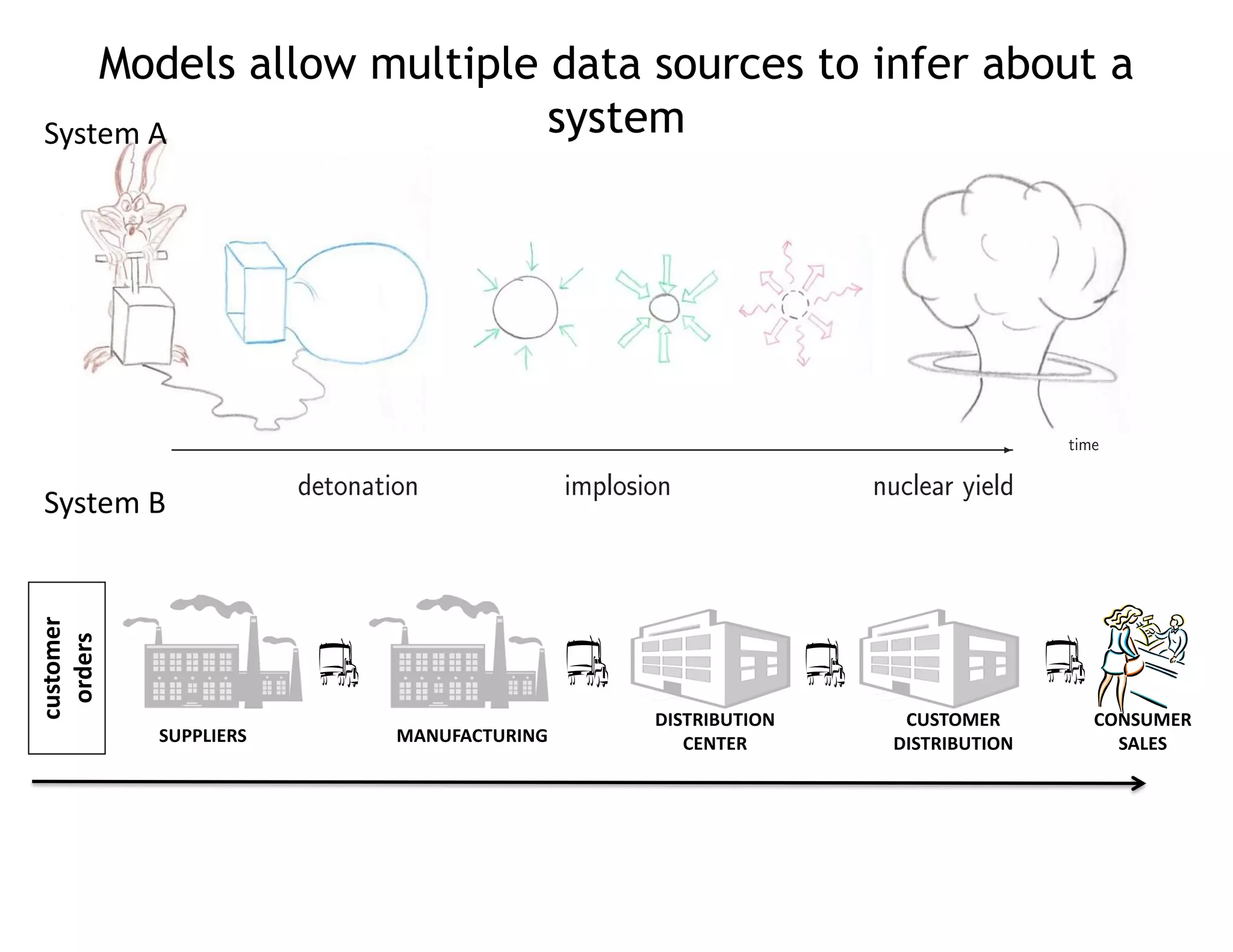
Models allow multiple data sources to infer about a
systemCombining information and quality of models
✲ time
detonation implosion nuclear yield
✇ ✇
implosion experiments
✇ ✇
sub-critcal experiments
✇ ✇
historical nuclear tests
✇ ✇
✇
off-line experiments
materials, equations of state (EOS), high explosive (HE)
System A
System B
SUPPLIERS MANUFACTURING
CUSTOMER
DISTRIBUTION
DISTRIBUTION
CENTER
CONSUMER
SALES
customer
orders
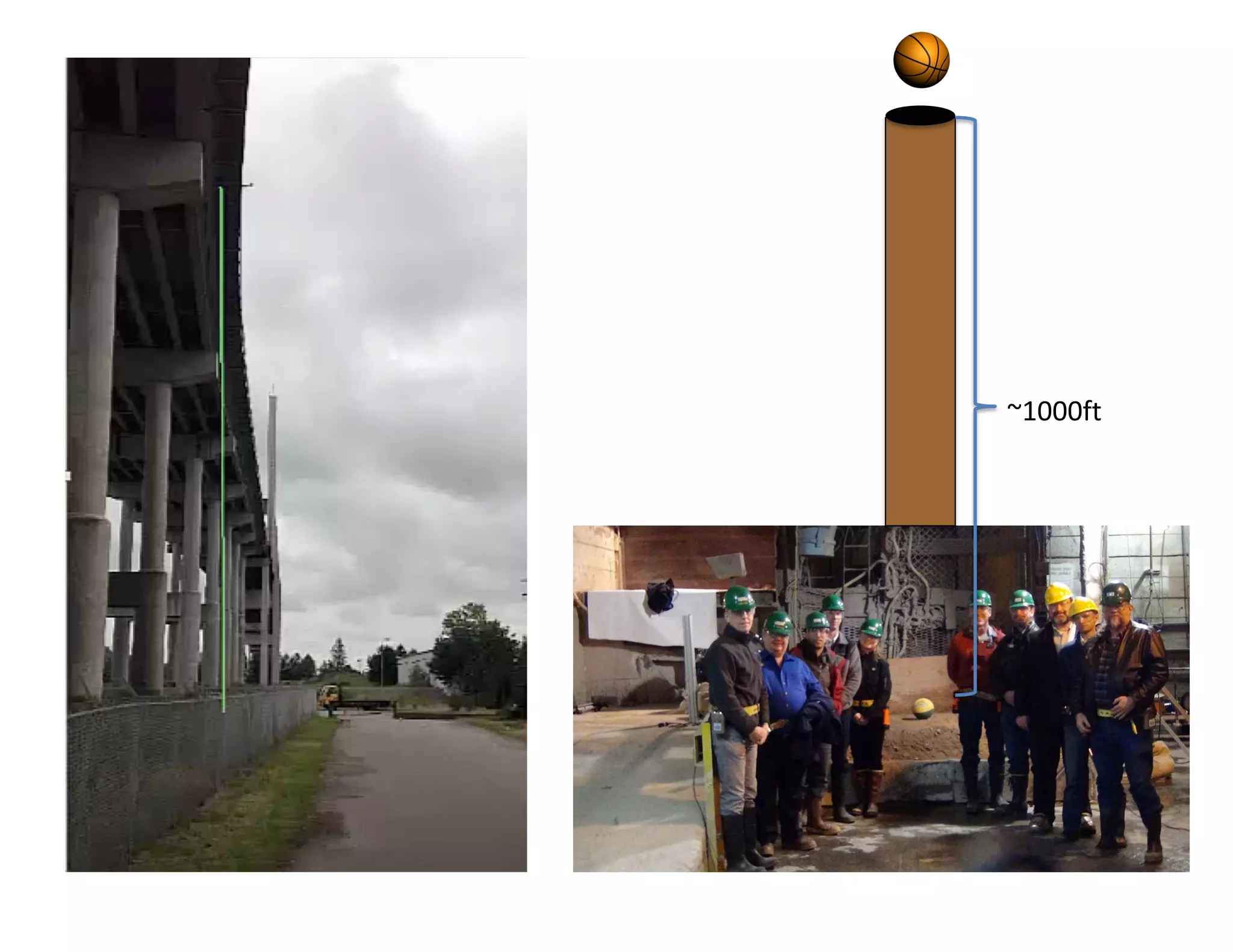
~1000ft
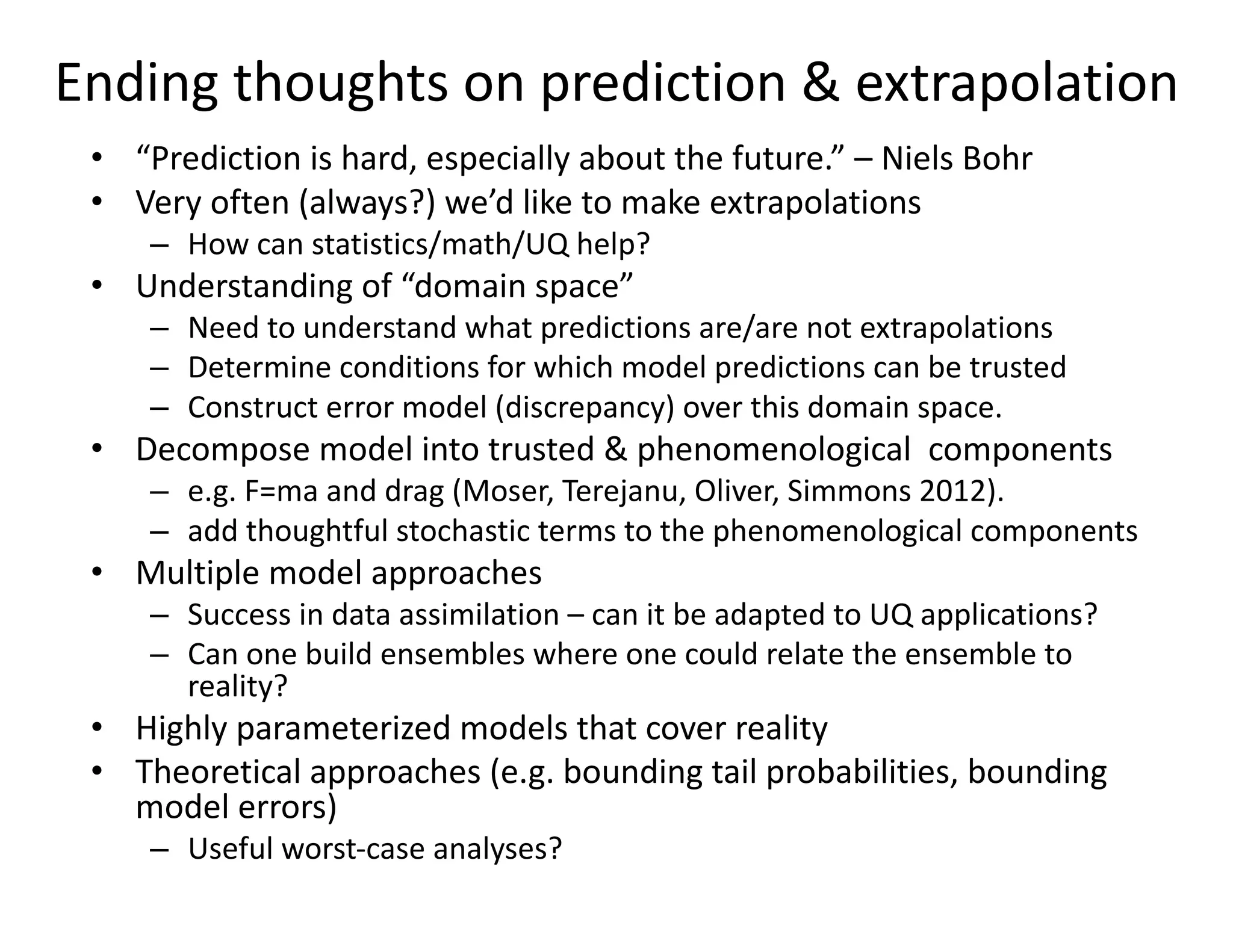
Ending thoughts on prediction & extrapolation
• “Prediction is hard, especially about the future.” – Niels Bohr
• Very often (always?) we’d like to make extrapolations
– How can statistics/math/UQ help?
• Understanding of “domain space”
– Need to understand what predictions are/are not extrapolations
– Determine conditions for which model predictions can be trusted
– Construct error model (discrepancy) over this domain space.
• Decompose model into trusted & phenomenological components
– e.g. F=ma and drag (Moser, Terejanu, Oliver, Simmons 2012).
– add thoughtful stochastic terms to the phenomenological components
• Multiple model approaches
– Success in data assimilation – can it be adapted to UQ applications?
– Can one build ensembles where one could relate the ensemble to
reality?
• Highly parameterized models that cover reality
• Theoretical approaches (e.g. bounding tail probabilities, bounding
model errors)
– Useful worst-case analyses?

MUMS Opening Workshop - Extrapolation: The Art of Connecting Model-Based Predictions to Reality - Dave Higdon, August 22, 2018