Reduction of the small gain condition
Michael Kosmykov
Centre for
Industrial Mathematics
Outline
1 Stability conditions for interconnected systems
2 Structure-preserving model reduction
3 Example
4 Conclusion and outlook
2 / 31Stability Reduction Example of reduction Summary
Centre for
Industrial Mathematics
Small gain condition
Consider Γ=(γij )n×n with γii ≡ 0, i = 1, . . . , n. Operator
Γ : Rn
+ → Rn
+ is defined by:
Γ(s) :=



max{γ1,2(s2), . . . , γ1,n(sn)}
...
max{γn1(s1), . . . , γn,n−1(sn−1)}


 , s ∈ Rn
+.
Small gain theorem (Dashkovskiy, R¨uffer, Wirth 2007).
Assume that each subsystem Σi is ISS. If Γ(s) ≥ s, ∀s ∈ Rn
+{0},
then Σ is ISS.
a ≥ b, a, b ∈ Rn ⇒ ∃ i ∈ {1, . . . , n} : ai < bi .
3 / 31Stability Reduction Example of reduction Summary
Centre for
Industrial Mathematics
ISS-Lyapunov function
Definition
Continuous function V : Rn → R+ is called an ISS Lyapunov
function for Σ, if it is loc. Lip. cont. on Rn{0} and
∃ψ1, ψ2 ∈ K∞ such that
ψ1( x ) ≤ V (x) ≤ ψ2( x ), ∀x ∈ Rn
.
∃γ ∈ K, and p.d.f. α such that in all points of dif. of V
V (x) ≥ γ( u ) ⇒ V (x)f (x, u) ≤ −α( x ).
Theorem (Dashkovskiy, R¨uffer, Wirth 2010)
Σ is ISS ⇔ Σ has (not necessarily smooth) ISS Lyapunov function.
4 / 31Stability Reduction Example of reduction Summary
Centre for
Industrial Mathematics
ISS-Lyapunov function for subsystems
∃ψ1, ψ2∈K∞ : ψi1( xi )≤Vi (xi )≤ψ2i ( xi ), ∀xi ∈Rni .
∃γij ∈K∞ ∪ {0}, j=i, ∃γi ∈K: in all points of dif. of Vi
Vi (xi ) ≥ max{max
j,j=i
γij (Vj (xj )), γi ( u )} ⇒
Vi (xi )fi (x, u) ≤ −αi ( xi ).
Small gain theorem (in terms of Lyapunov functions)
Assume ∃ ISS-Lyapunov functions Vi for Σi . If Γ(s) ≥ s for all
s = 0, s ≥ 0 is satisfied, then ∃ ISS-Lyapunov function V for Σ:
V (x) = max
i=1,...,n
σ−1
i (Vi (xi )),
where σ := (σ1, . . . , σn)T , σi ∈ K∞, satisfies:
Γ(σ(r)) ≤ σ(r), ∀ r > 0.
5 / 31Stability Reduction Example of reduction Summary
Centre for
Industrial Mathematics
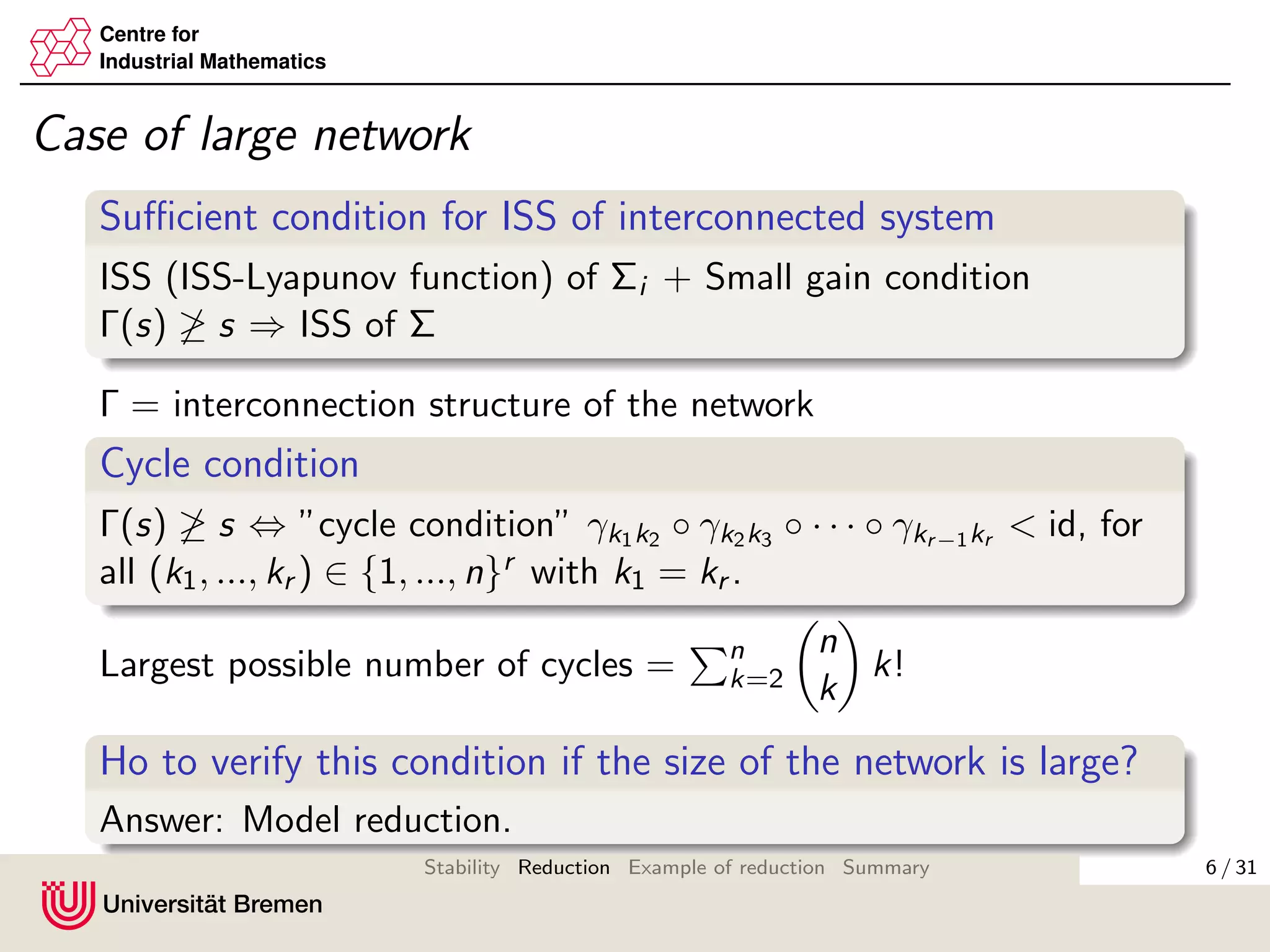
Case of large network
Sufficient condition for ISS of interconnected system
ISS (ISS-Lyapunov function) of Σi + Small gain condition
Γ(s) ≥ s ⇒ ISS of Σ
Γ = interconnection structure of the network
Cycle condition
Γ(s) ≥ s ⇔ ”cycle condition” γk1k2 ◦ γk2k3 ◦ · · · ◦ γkr−1kr < id, for
all (k1, ..., kr ) ∈ {1, ..., n}r with k1 = kr .
Largest possible number of cycles = n
k=2
n
k
k!
Ho to verify this condition if the size of the network is large?
Answer: Model reduction.
6 / 31Stability Reduction Example of reduction Summary
Centre for
Industrial Mathematics
Main methods of model reduction
1 Linear systems:
Balancing methods
Krylov methods
2 Nonlinear systems:
Balancing methods
Krylov methods
Proper orthogonal decomposition (POD)
Singular perturbations theory
Trajectory piecewise linear approach
Volterra methods
Theory of global attractors
...
Drawback of application to logistics networks: the interconnection
structure of the network is destroyed
7 / 31Stability Reduction Example of reduction Summary
Centre for
Industrial Mathematics
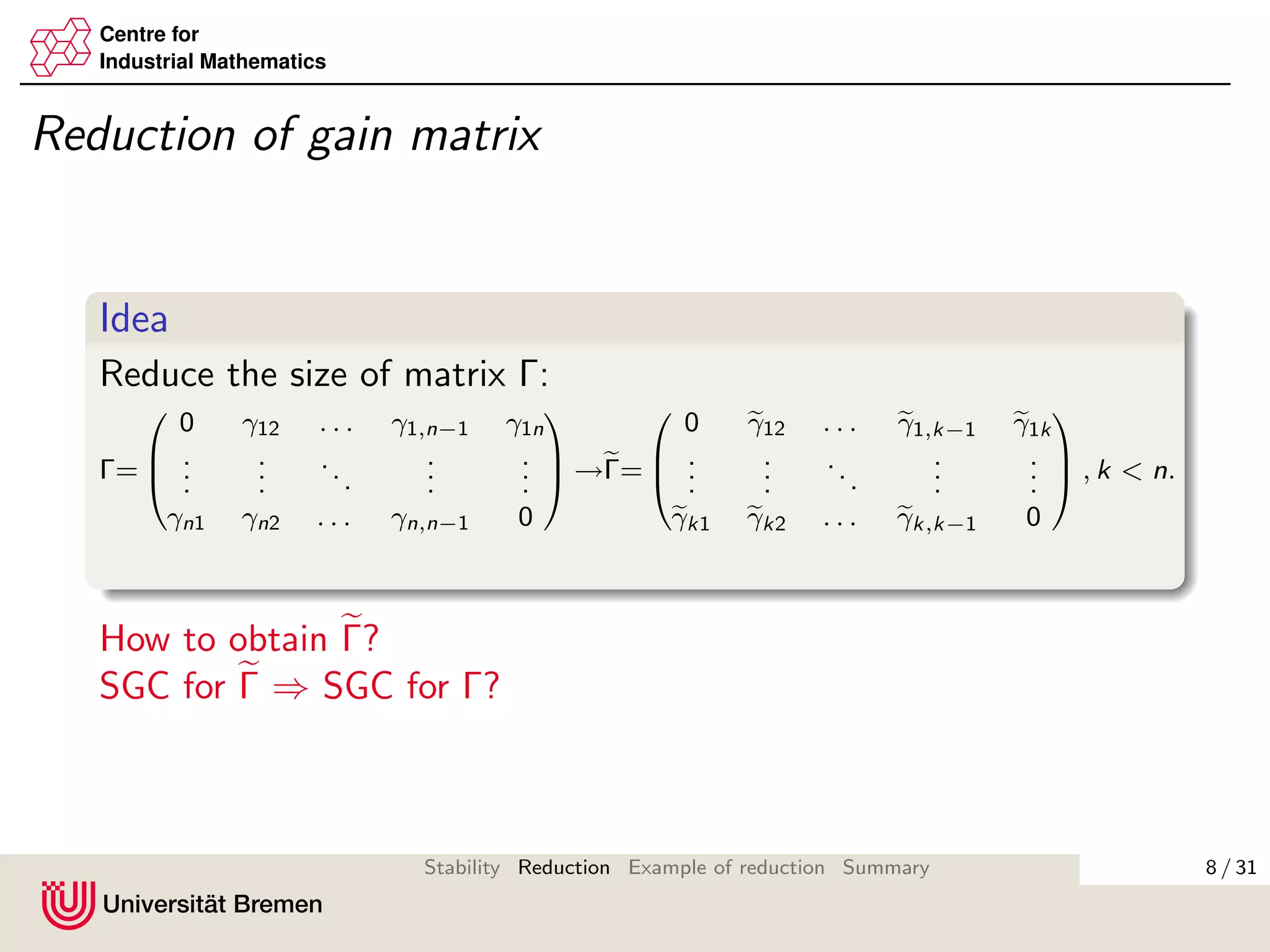
Reduction of gain matrix
Idea
Reduce the size of matrix Γ:
Γ=



0 γ12 . . . γ1,n−1 γ1n
...
...
...
...
...
γn1 γn2 . . . γn,n−1 0


 →Γ=



0 γ12 . . . γ1,k−1 γ1k
...
...
...
...
...
γk1 γk2 . . . γk,k−1 0


 , k < n.
How to obtain Γ?
SGC for Γ ⇒ SGC for Γ?
8 / 31Stability Reduction Example of reduction Summary
Centre for
Industrial Mathematics
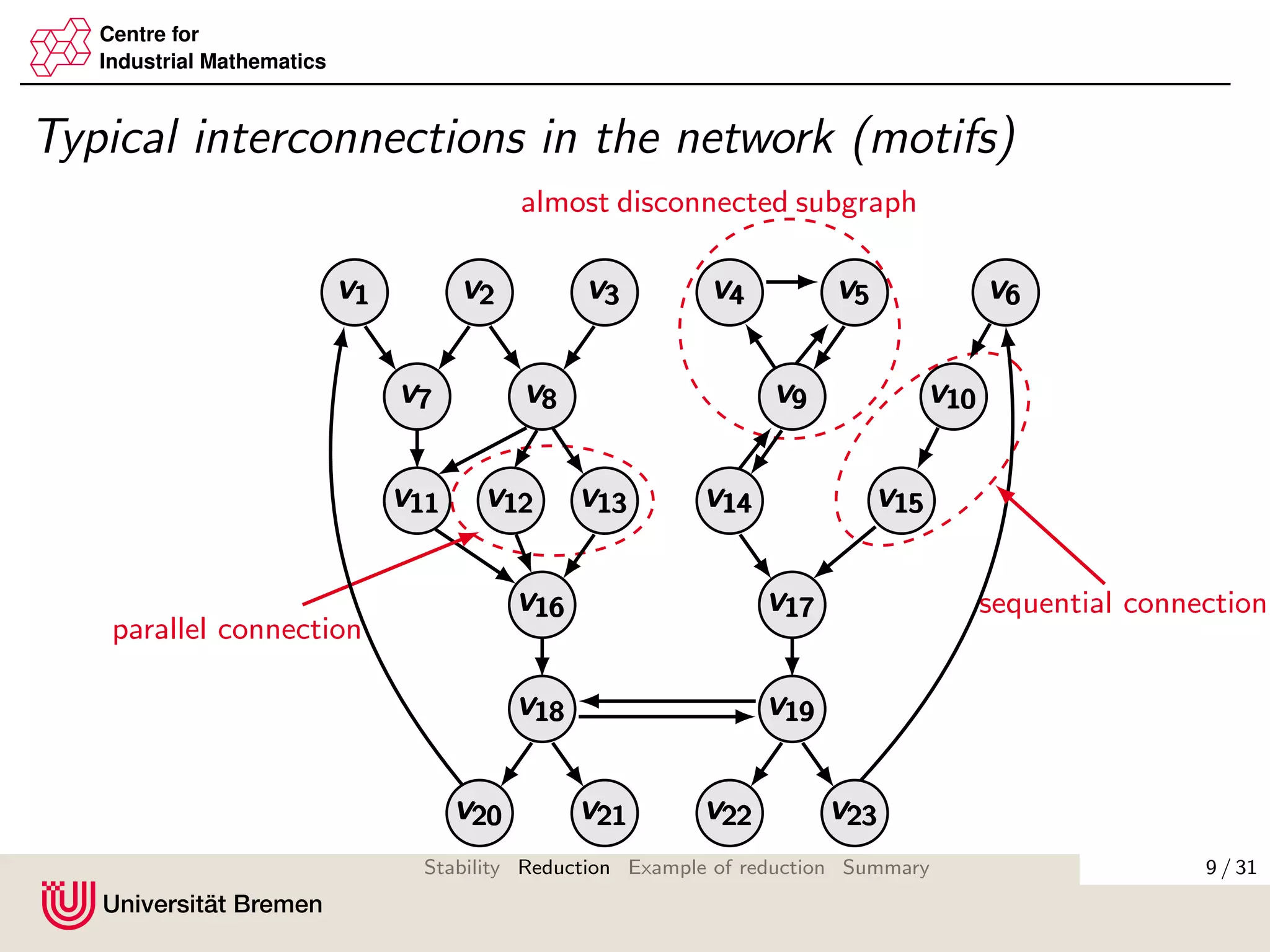
Typical interconnections in the network (motifs)
almost disconnected subgraph
v1v1v1 v2v2v2 v3v3v3 v4v4v4 v5v5v5 v6v6v6
v7v7v7 v8v8v8 v9v9v9 v10v10v10
v11v11v11 v12v12v12 v13v13v13 v14v14v14 v15v15v15
v16v16v16 v17v17v17
v18v18v18 v19v19v19
sequential connection
parallel connection
v20v20v20 v21v21v21 v22v22v22 v23v23v23
9 / 31Stability Reduction Example of reduction Summary
Centre for
Industrial Mathematics
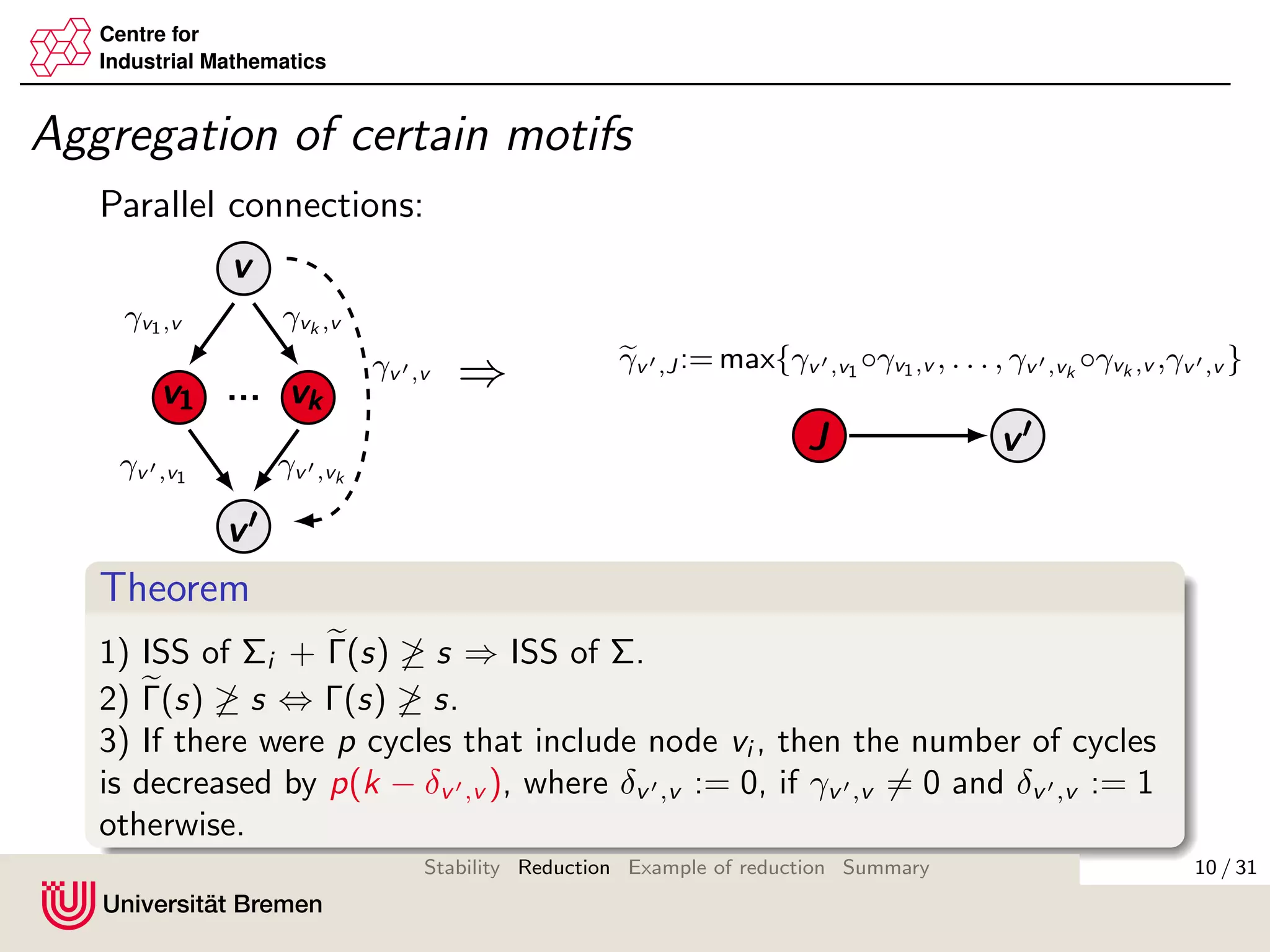
Aggregation of certain motifs
Parallel connections:
vvv
v1v1v1
γv1,v γvk ,v
vkvkvk
vvv
γv ,v1
γv ,vk
...
γv ,v ⇒
JJJ vvv
γv ,J := max{γv ,v1
◦γv1,v , . . . , γv ,vk
◦γvk ,v ,γv ,v }
Theorem
1) ISS of Σi + Γ(s) ≥ s ⇒ ISS of Σ.
2) Γ(s) ≥ s ⇔ Γ(s) ≥ s.
3) If there were p cycles that include node vi , then the number of cycles
is decreased by p(k − δv ,v ), where δv ,v := 0, if γv ,v = 0 and δv ,v := 1
otherwise.
10 / 31Stability Reduction Example of reduction Summary
Centre for
Industrial Mathematics
Aggregation of certain motifs
Parallel connections:
vvv
v1v1v1
γv1,v γvk ,v
vkvkvk
vvv
γv ,v1
γv ,vk
...
γv ,v ⇒
JJJ vvv
γv ,J := max{γv ,v1
◦γv1,v , . . . , γv ,vk
◦γvk ,v ,γv ,v }
Proof.
Γ(s) ≥ s ⇒ cycle condition with gain γv ,J hold:
. . . ◦ γv ,J ◦ . . . < id
⇒ . . . ◦ max{γv ,v1
◦ γv1,v , . . . , γv ,vk
◦ γvk ,v , γv ,v } ◦ . . . < id ⇒ Γ(s) ≥ s.
11 / 31Stability Reduction Example of reduction Summary
Centre for
Industrial Mathematics
Aggregation of certain motifs
Parallel connections:
vvv
v1v1v1
γv1,v γvk ,v
vkvkvk
vvv
γv ,v1
γv ,vk
...
γv ,v ⇒
JJJ vvv
γv ,J := max{γv ,v1
◦γv1,v , . . . , γv ,vk
◦γvk ,v ,γv ,v }
Proof.
p cycles with vi ⇒ p · k cycles with a node from {v1, . . . , vk }.
If γv ,v = 0 ⇒ p · (k + 1) cycles with nodes {v1, . . . , vk } and gain γv ,v .
After the aggregation these cycles will ”coincide” ⇒ the number of the
cycles is decreased by p(k − δv ,v ). 2
12 / 31Stability Reduction Example of reduction Summary
Centre for
Industrial Mathematics
Aggregation of certain motifs
Parallel connections:
vvv
v1v1v1
γv1,v γvk ,v
vkvkvk
vvv
γv ,v1
γv ,vk
...
γv ,v ⇒
JJJ vvv
γv ,J := max{γv ,v1
◦γv1,v , . . . , γv ,vk
◦γvk ,v ,γv ,v }
Theorem (in terms of Lyapunov functions)
ISS-Lyapunov function for Σi + Γ(s) ≥ s ⇒ ISS-Lyapunov function for Σ
can be constructed as V (x) = max
i=1,...,n
σ−1
i (Vi (xi )) with σ defined by
σw :=
γw,v ◦ σJ , if w ∈ {v1, . . . , vk },
σw , otherwise .
13 / 31Stability Reduction Example of reduction Summary
Centre for
Industrial Mathematics
Aggregation of certain motifs
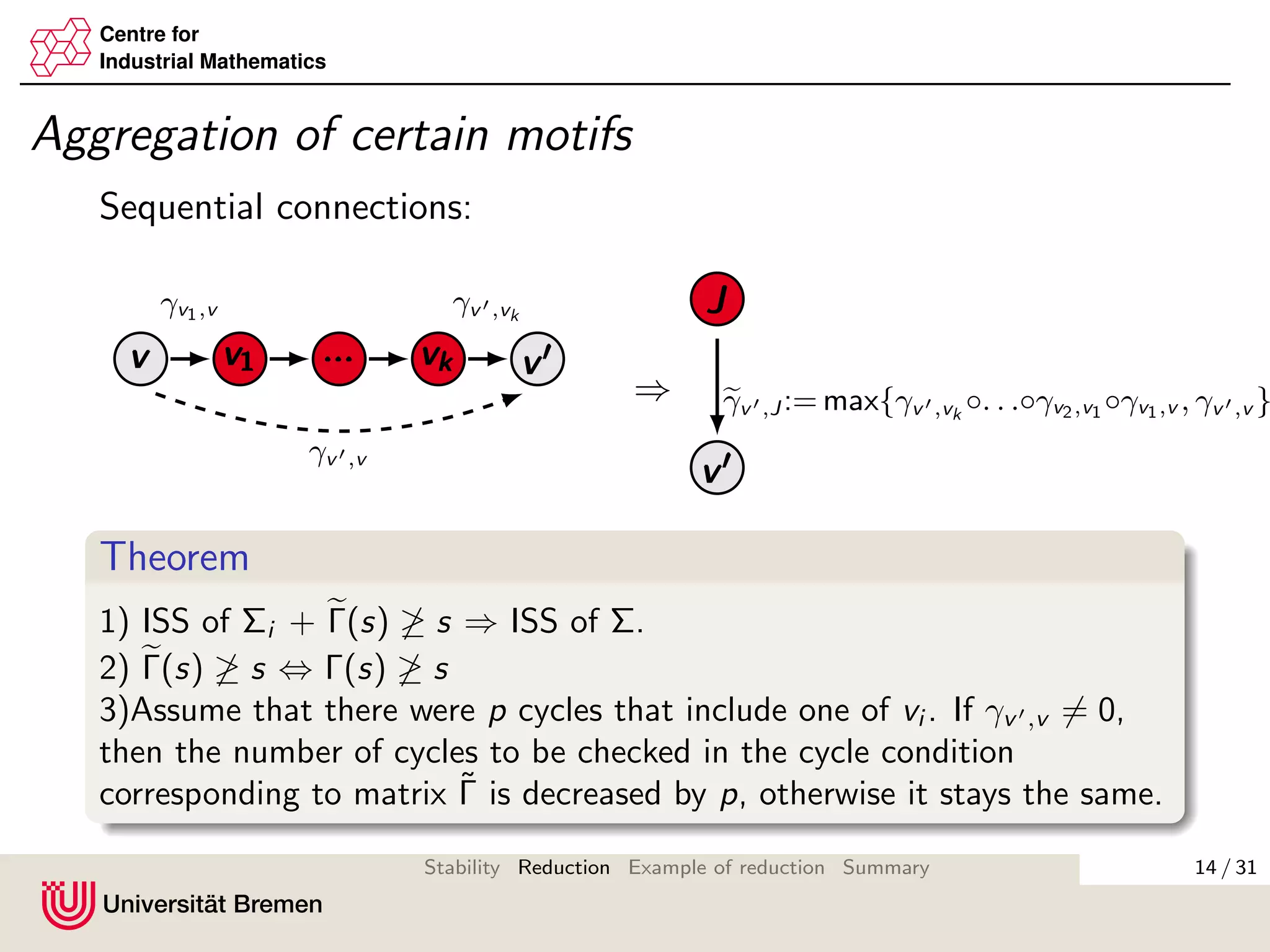
Sequential connections:
vvv v1v1v1
γv1,v
......... vkvkvk vvv
γv ,vk
γv ,v
JJJ
vvv
⇒ γv ,J := max{γv ,vk
◦. . .◦γv2,v1 ◦γv1,v , γv ,v }
Theorem
1) ISS of Σi + Γ(s) ≥ s ⇒ ISS of Σ.
2) Γ(s) ≥ s ⇔ Γ(s) ≥ s
3)Assume that there were p cycles that include one of vi . If γv ,v = 0,
then the number of cycles to be checked in the cycle condition
corresponding to matrix ˜Γ is decreased by p, otherwise it stays the same.
14 / 31Stability Reduction Example of reduction Summary
Centre for
Industrial Mathematics
Aggregation of certain motifs
Sequential connections:
vvv v1v1v1
γv1,v
......... vkvkvk vvv
γv ,vk
γv ,v
JJJ
vvv
⇒ γv ,J := max{γv ,vk
◦. . .◦γv2,v1 ◦γv1,v , γv ,v }
Proof.
Γ(s) ≥ s ⇒ cycle condition with gain γv ,J hold:
. . . ◦ γv ,J ◦ . . . < id
⇒ . . . ◦ max{γv ,vk
◦. . .◦γv2,v1
◦γv1,v , γv ,v } ◦ . . . < id ⇒ Γ(s) ≥ s.
15 / 31Stability Reduction Example of reduction Summary
Centre for
Industrial Mathematics
Aggregation of certain motifs
Sequential connections:
vvv v1v1v1
γv1,v
......... vkvkvk vvv
γv ,vk
γv ,v
JJJ
vvv
⇒ γv ,J := max{γv ,vk
◦. . .◦γv2,v1 ◦γv1,v , γv ,v }
Proof.
Cycle containing one of the nodes {v1, . . . , vl } ⇒ cycle contains
necessarily all other nodes from {v1, . . . , vl }
If γv ,v = 0 ⇒ the number of cycles stays the same.
Otherwise, the cycles with vi will ”coincide” with the cycles with γv ,v ⇒
the overall number of the cycles will decrease by p. 2
16 / 31Stability Reduction Example of reduction Summary
Centre for
Industrial Mathematics
Aggregation of certain motifs
Sequential connections:
vvv v1v1v1
γv1,v
......... vkvkvk vvv
γv ,vk
γv ,v
JJJ
vvv
⇒ γv ,J := max{γv ,vk
◦. . .◦γv2,v1 ◦γv1,v , γv ,v }
Theorem (in terms of Lyaunov functions)
ISS-Lyapunov function for Σi + Γ(s) ≥ s ⇒ ISS-Lyapunov
function for Σ can be constructed as V (x) = max
i=1,...,n
σ−1
i (Vi (xi ))
with σ defined by
σw :=
γvi ,vi−1
◦γvi−1,vi−2
◦. . .◦γv2,v1
◦γv1,v ◦σJ , if w=vi , i∈{1, . . . , k},
σw , otherwise .
17 / 31Stability Reduction Example of reduction Summary
Centre for
Industrial Mathematics
Aggregation of certain motifs
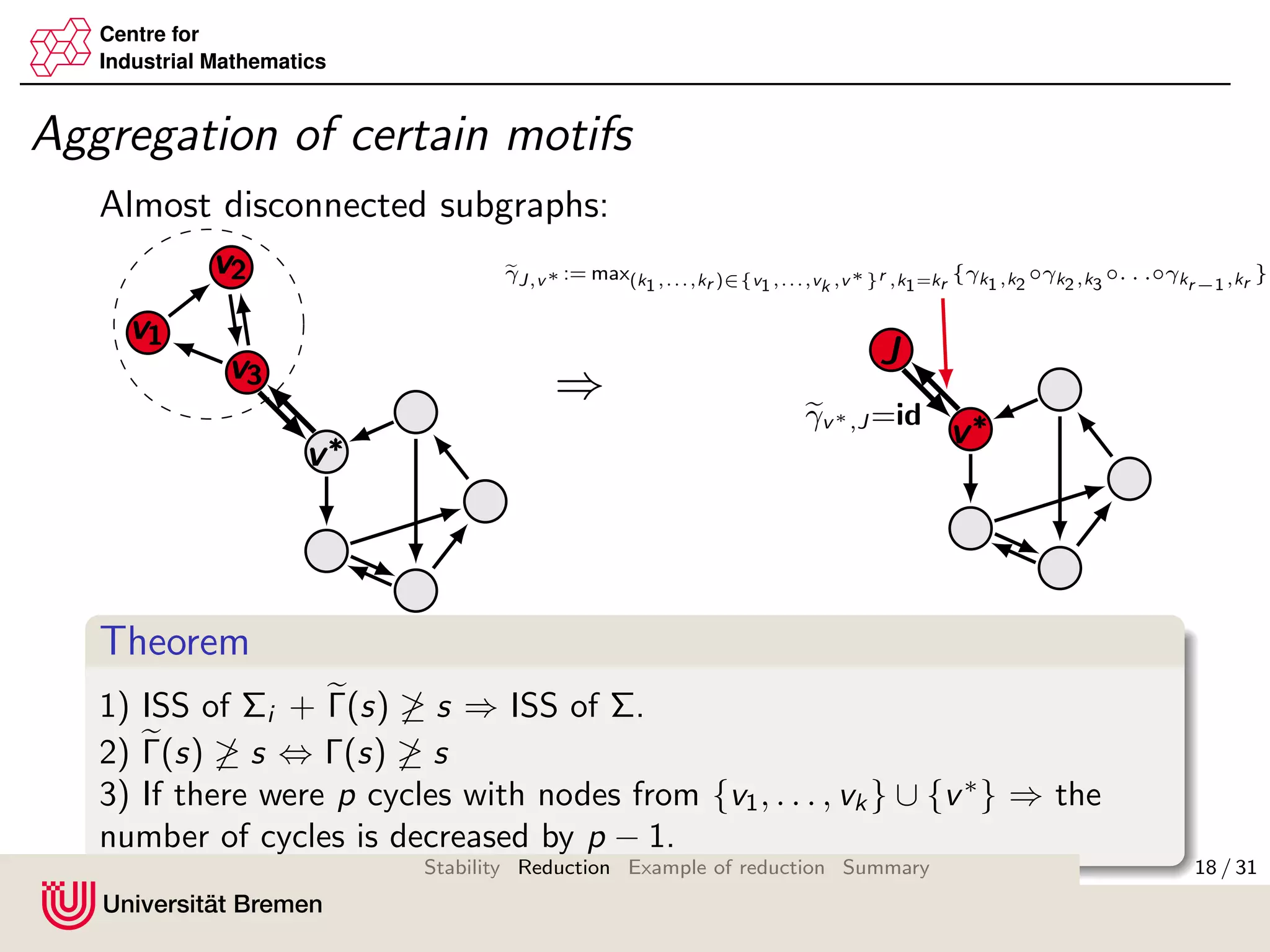
Almost disconnected subgraphs:
v1v1v1
v2v2v2
v3v3v3
v∗v∗
v∗
⇒
v∗v∗
v∗
JJJ
γJ,v∗ := max(k1,...,kr )∈{v1,...,vk ,v∗}r ,k1=kr
{γk1,k2
◦γk2,k3
◦. . .◦γkr−1,kr }
γv∗,J =id
Theorem
1) ISS of Σi + Γ(s) ≥ s ⇒ ISS of Σ.
2) Γ(s) ≥ s ⇔ Γ(s) ≥ s
3) If there were p cycles with nodes from {v1, . . . , vk } ∪ {v∗
} ⇒ the
number of cycles is decreased by p − 1.
18 / 31Stability Reduction Example of reduction Summary
Centre for
Industrial Mathematics
Aggregation of certain motifs
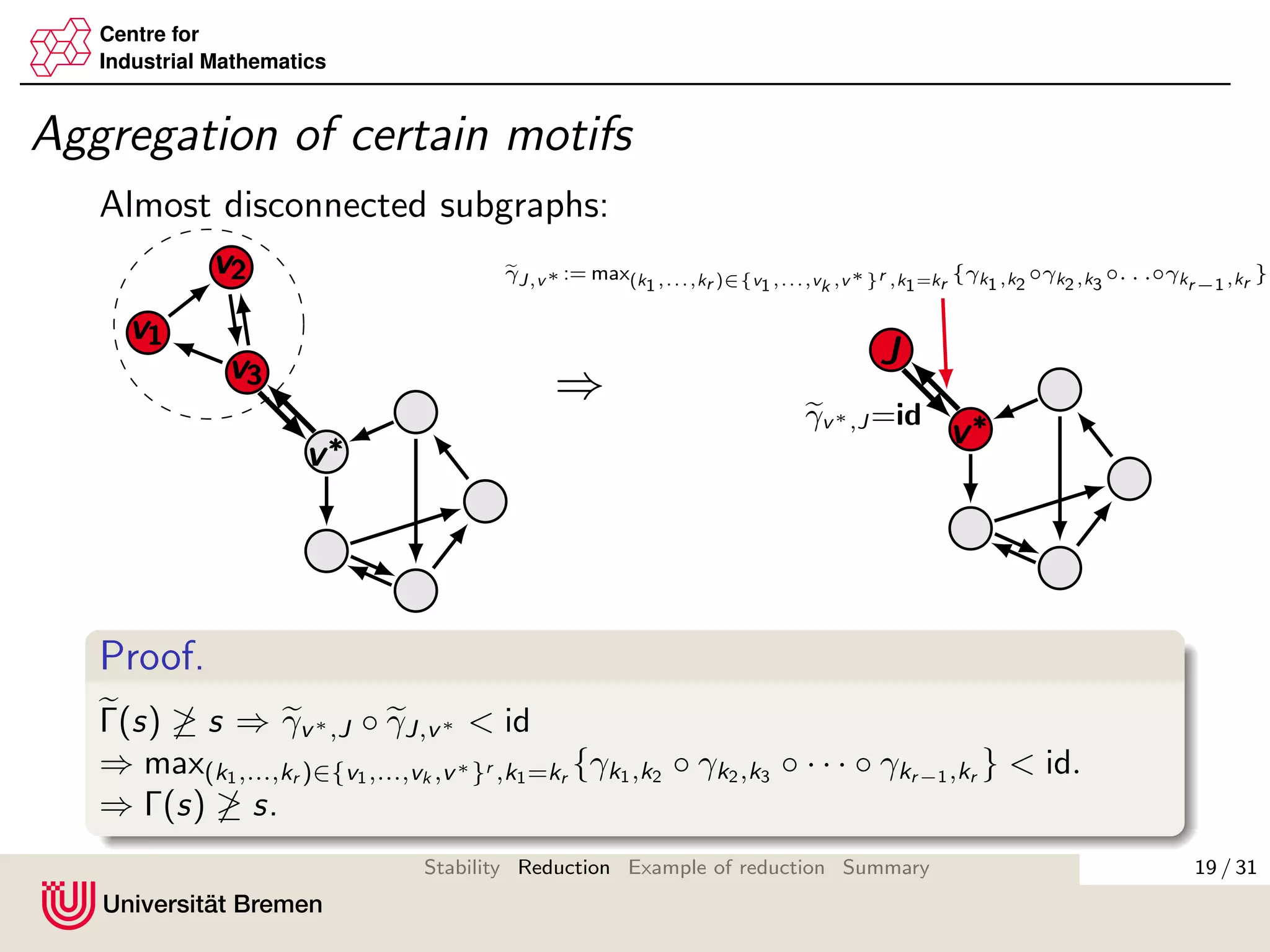
Almost disconnected subgraphs:
v1v1v1
v2v2v2
v3v3v3
v∗v∗
v∗
⇒
v∗v∗
v∗
JJJ
γJ,v∗ := max(k1,...,kr )∈{v1,...,vk ,v∗}r ,k1=kr
{γk1,k2
◦γk2,k3
◦. . .◦γkr−1,kr }
γv∗,J =id
Proof.
Γ(s) ≥ s ⇒ γv∗,J ◦ γJ,v∗ < id
⇒ max(k1,...,kr )∈{v1,...,vk ,v∗}r ,k1=kr
{γk1,k2
◦ γk2,k3
◦ · · · ◦ γkr−1,kr
} < id.
⇒ Γ(s) ≥ s.
19 / 31Stability Reduction Example of reduction Summary
Centre for
Industrial Mathematics
Aggregation of certain motifs
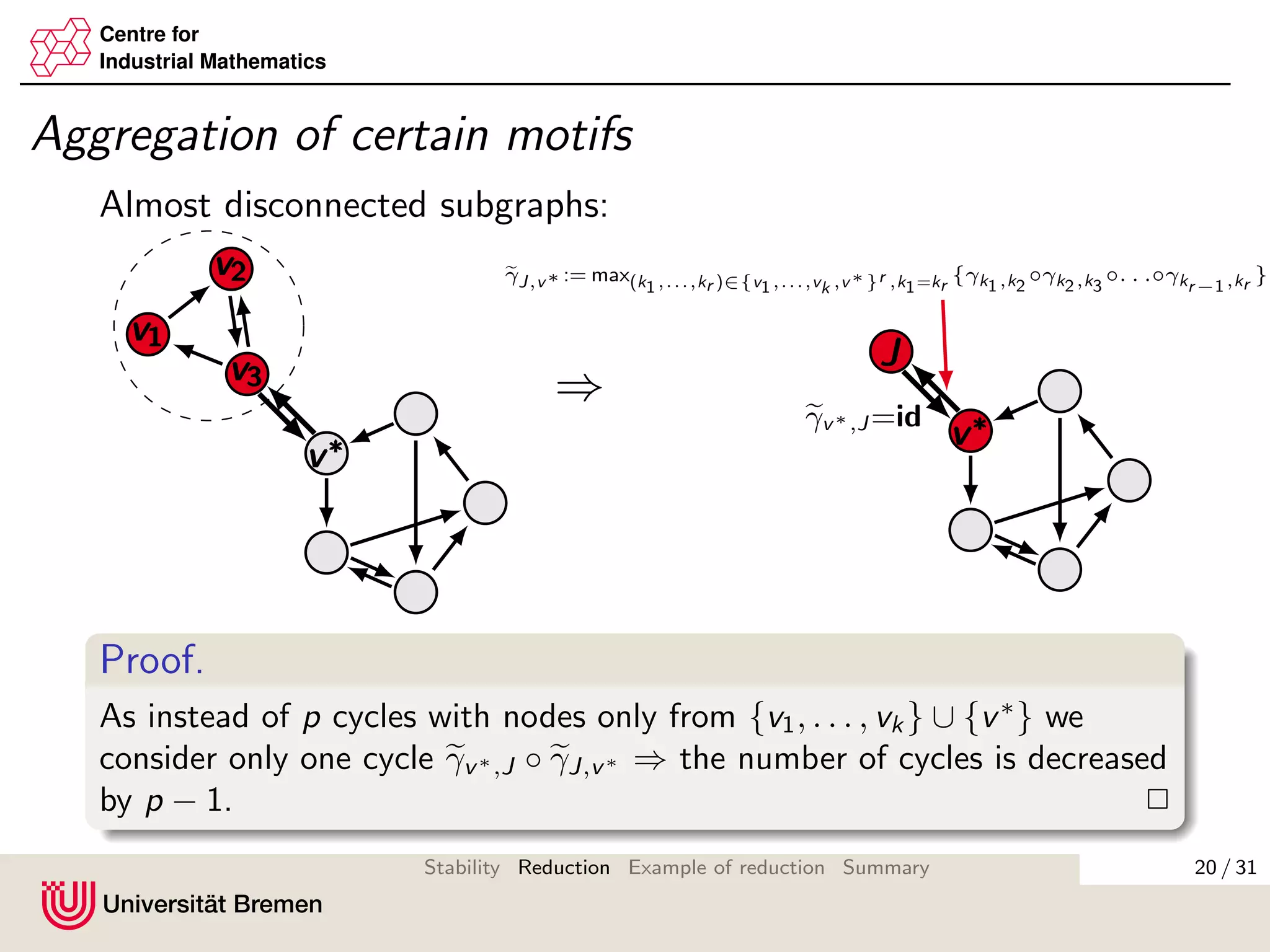
Almost disconnected subgraphs:
v1v1v1
v2v2v2
v3v3v3
v∗v∗
v∗
⇒
v∗v∗
v∗
JJJ
γJ,v∗ := max(k1,...,kr )∈{v1,...,vk ,v∗}r ,k1=kr
{γk1,k2
◦γk2,k3
◦. . .◦γkr−1,kr }
γv∗,J =id
Proof.
As instead of p cycles with nodes only from {v1, . . . , vk } ∪ {v∗
} we
consider only one cycle γv∗,J ◦ γJ,v∗ ⇒ the number of cycles is decreased
by p − 1. 2
20 / 31Stability Reduction Example of reduction Summary
Centre for
Industrial Mathematics
Aggregation of certain motifs
v1v1v1
v2v2v2
v3v3v3
v∗v∗
v∗
⇒
v∗v∗
v∗
JJJ
γJ,v∗ := max(k1,...,kr )∈{v1,...,vk ,v∗}r ,k1=kr
{γk1,k2
◦γk2,k3
◦. . .◦γkr−1,kr }
γv∗,J =id
Theorem (in terms of Lyapunov functions)
ISS-Lyapunov function for Σi + Γ(s) ≥ s ⇒ ISS-Lyapunov function for Σ
can be constructed as V (x) = max
i=1,...,n
σ−1
i (Vi (xi )), where σ is given by
¯σw :=
ˆγw,J ◦σJ , if w∈{v1, . . ., vk },
σw , otherwise ,
ˆγw,J := max
(k1,...,kr )∈{v1,...,vk }r ,ki =kj
{γw,vk1
◦γvk1
,vk2
◦. . .◦γvkr ,J},
21 / 31Stability Reduction Example of reduction Summary
Centre for
Industrial Mathematics
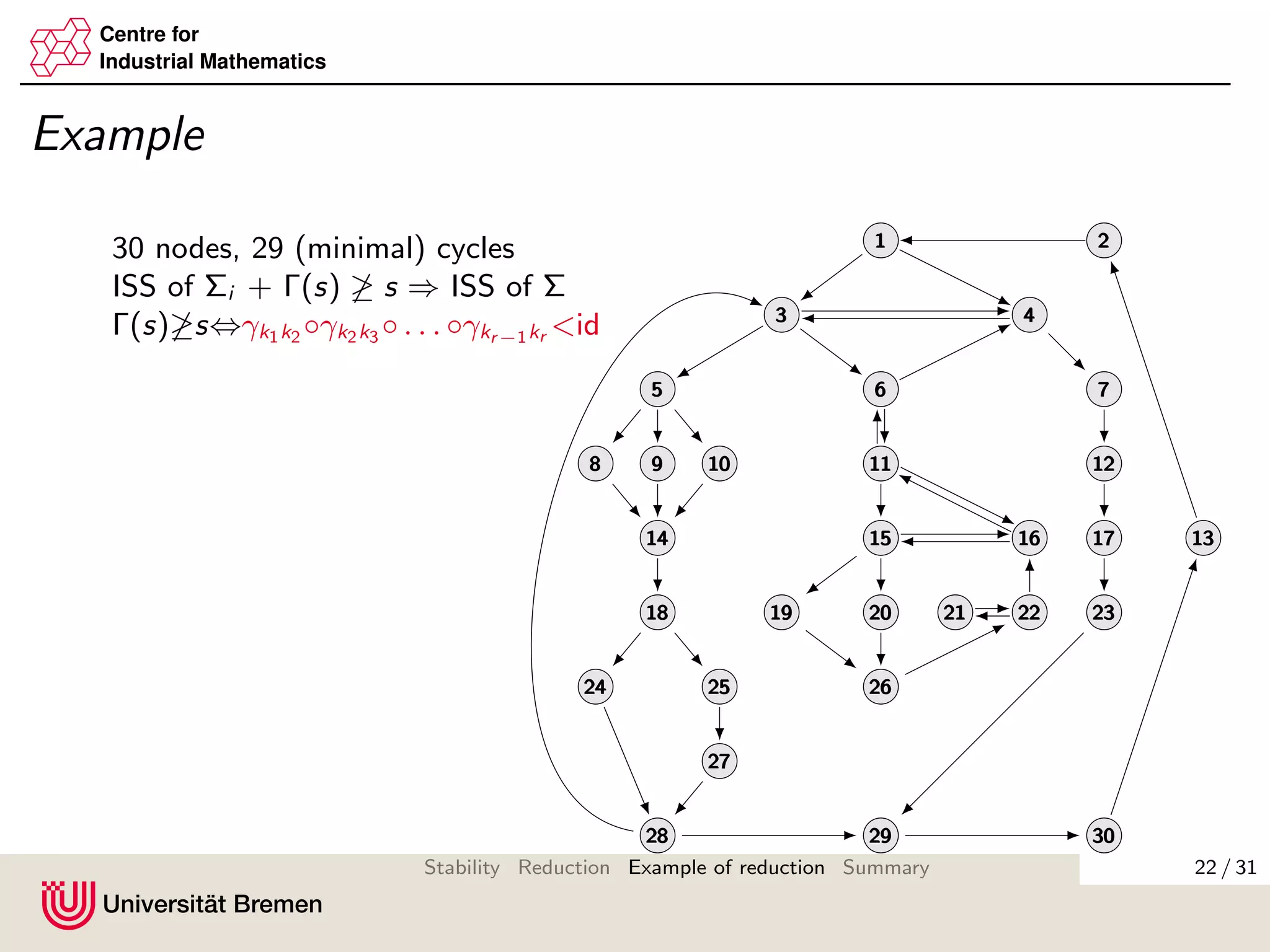
Example
111 222
333 444
555 666 777
888 999 101010 111111 121212
131313141414 151515 161616 171717
181818 191919 202020 212121 222222 232323
242424 252525 262626
272727
282828 292929 303030
30 nodes, 29 (minimal) cycles
ISS of Σi + Γ(s) ≥ s ⇒ ISS of Σ
Γ(s)≥s⇔γk1k2 ◦γk2k3 ◦ . . . ◦γkr−1kr <id
22 / 31Stability Reduction Example of reduction Summary
Centre for
Industrial Mathematics
Example
111 222
333 444
555 666 777
888 999 101010 111111 121212
131313141414 151515 161616 171717
181818 191919 202020 212121 222222 232323
242424 252525 262626
272727
282828 292929 303030
maximal cycle
length = 14 nodes
22 / 31Stability Reduction Example of reduction Summary
Centre for
Industrial Mathematics
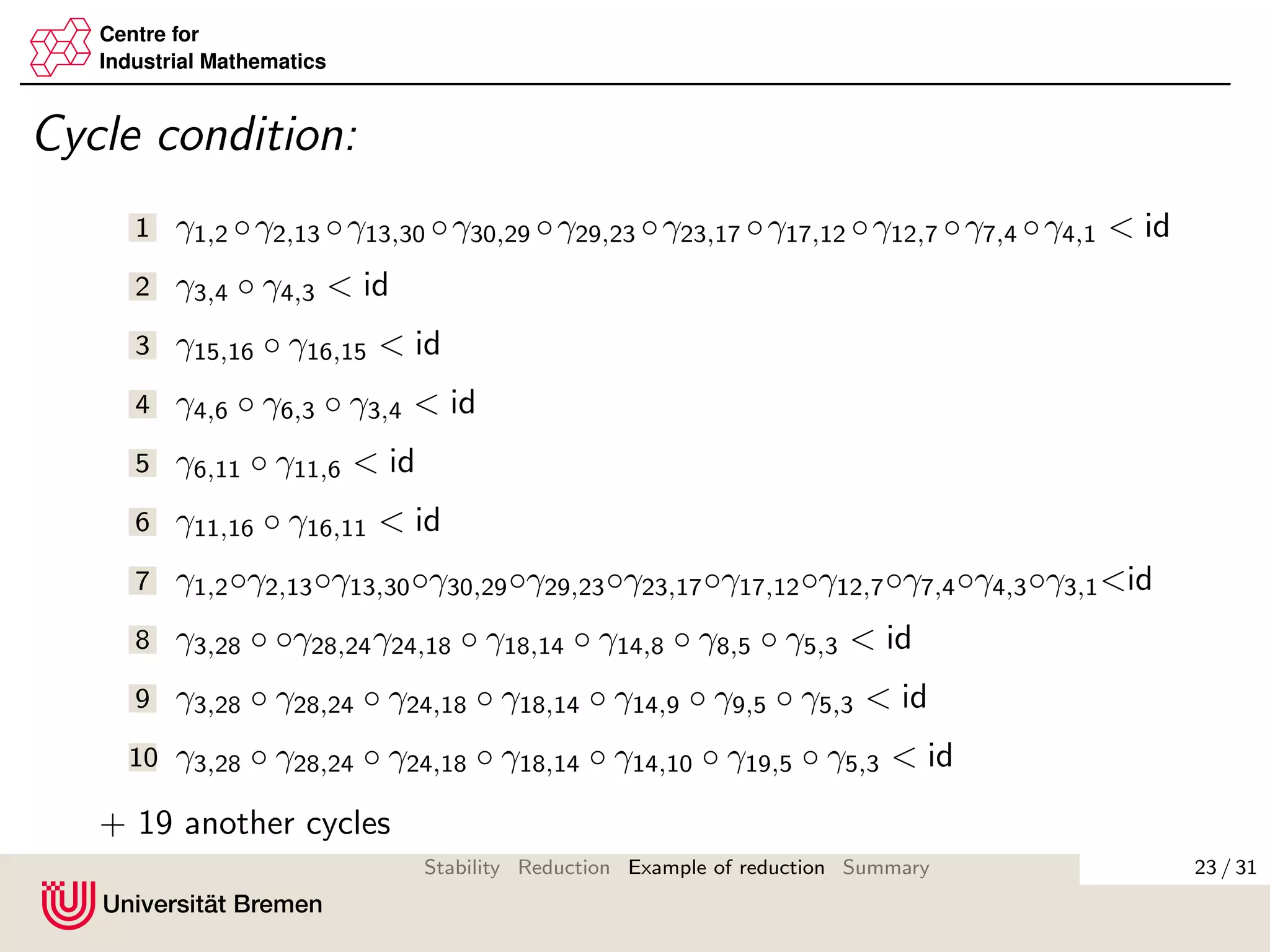
Cycle condition:
1 γ1,2 ◦γ2,13 ◦γ13,30 ◦γ30,29 ◦γ29,23 ◦γ23,17 ◦γ17,12 ◦γ12,7 ◦γ7,4 ◦γ4,1 < id
2 γ3,4 ◦ γ4,3 < id
3 γ15,16 ◦ γ16,15 < id
4 γ4,6 ◦ γ6,3 ◦ γ3,4 < id
5 γ6,11 ◦ γ11,6 < id
6 γ11,16 ◦ γ16,11 < id
7 γ1,2◦γ2,13◦γ13,30◦γ30,29◦γ29,23◦γ23,17◦γ17,12◦γ12,7◦γ7,4◦γ4,3◦γ3,1<id
8 γ3,28 ◦ ◦γ28,24γ24,18 ◦ γ18,14 ◦ γ14,8 ◦ γ8,5 ◦ γ5,3 < id
9 γ3,28 ◦ γ28,24 ◦ γ24,18 ◦ γ18,14 ◦ γ14,9 ◦ γ9,5 ◦ γ5,3 < id
10 γ3,28 ◦ γ28,24 ◦ γ24,18 ◦ γ18,14 ◦ γ14,10 ◦ γ19,5 ◦ γ5,3 < id
+ 19 another cycles
23 / 31Stability Reduction Example of reduction Summary
Centre for
Industrial Mathematics
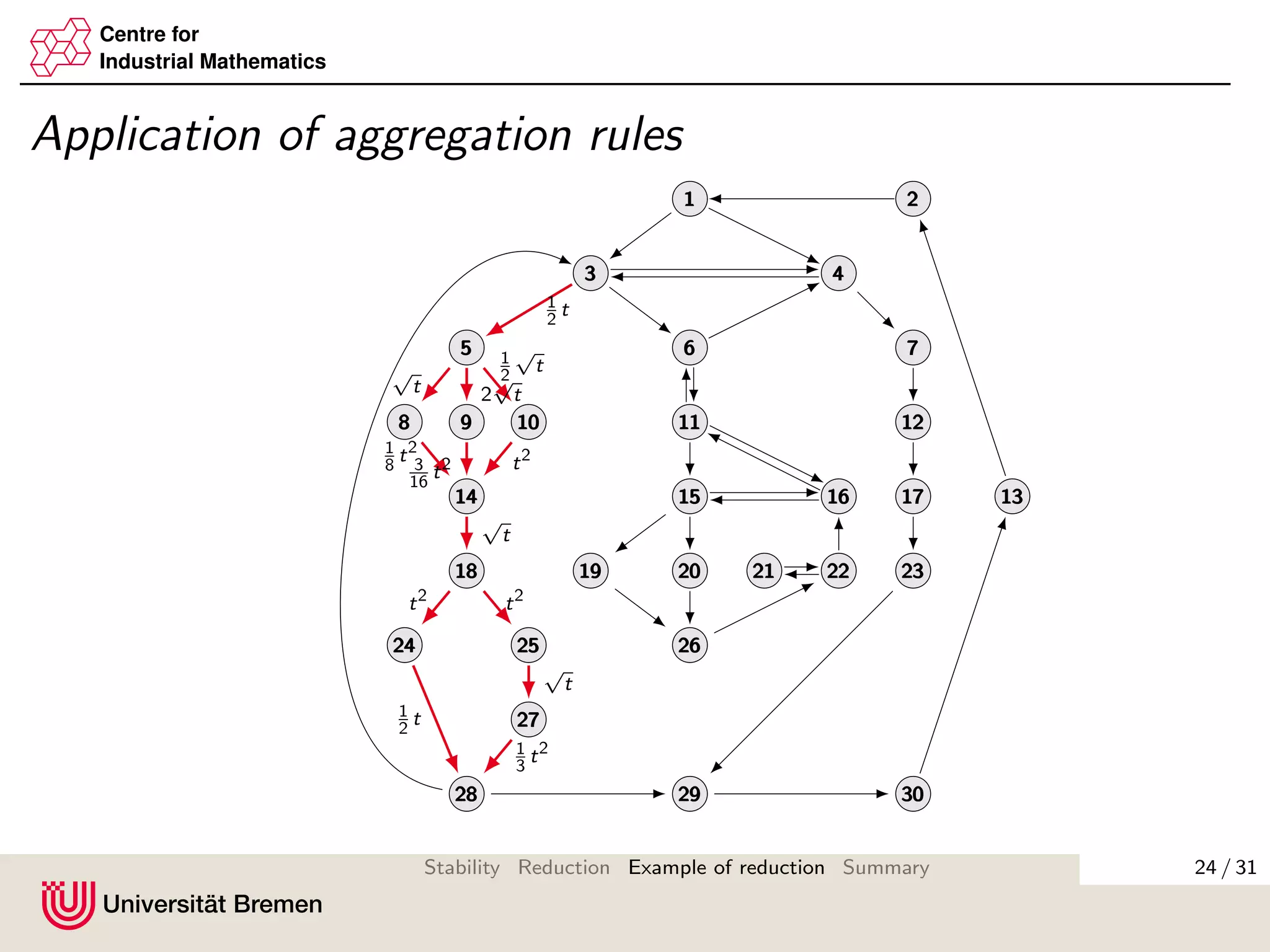
Application of aggregation rules
111 222
333 444
555 666 777
888 999 101010 111111 121212
131313141414 151515 161616 171717
181818 191919 202020 212121 222222 232323
242424 252525 262626
272727
282828 292929 303030
1
2
t
√
t
1
2
√
t
2
√
t
1
8
t2
3
16
t2 t2
√
t
t2
t2
√
t
1
3
t2
1
2
t
24 / 31Stability Reduction Example of reduction Summary
Centre for
Industrial Mathematics
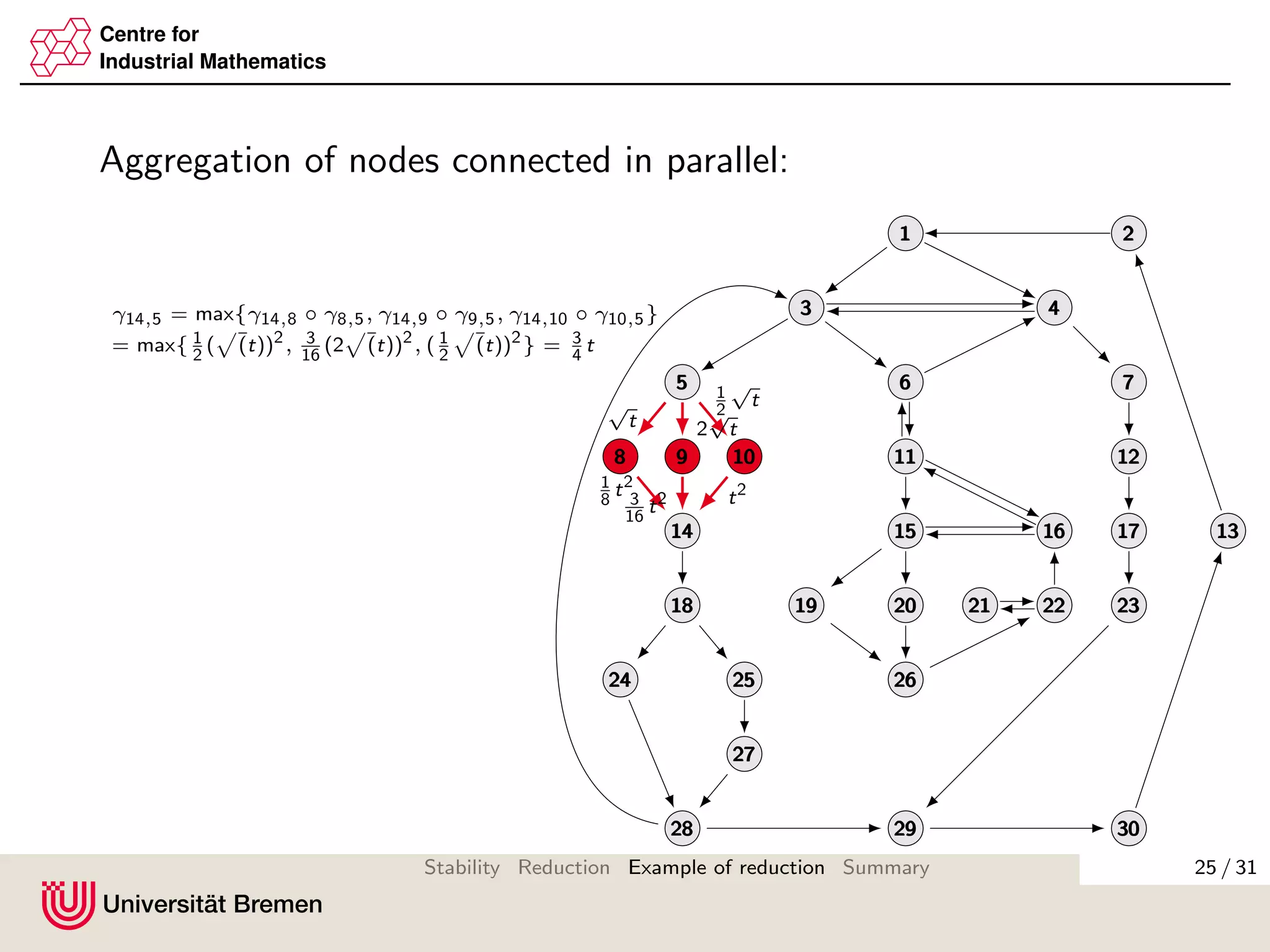
Aggregation of nodes connected in parallel:
111 222
333 444
555 666 777
888 999 101010 111111 121212
131313141414 151515 161616 171717
181818 191919 202020 212121 222222 232323
242424 252525 262626
272727
282828 292929 303030
√
t
1
2
√
t
2
√
t
1
8
t2
3
16
t2 t2
γ14,5 = max{γ14,8 ◦ γ8,5, γ14,9 ◦ γ9,5, γ14,10 ◦ γ10,5}
= max{ 1
2
( (t))2
, 3
16
(2 (t))2
, ( 1
2
(t))2
} = 3
4
t
25 / 31Stability Reduction Example of reduction Summary
Centre for
Industrial Mathematics
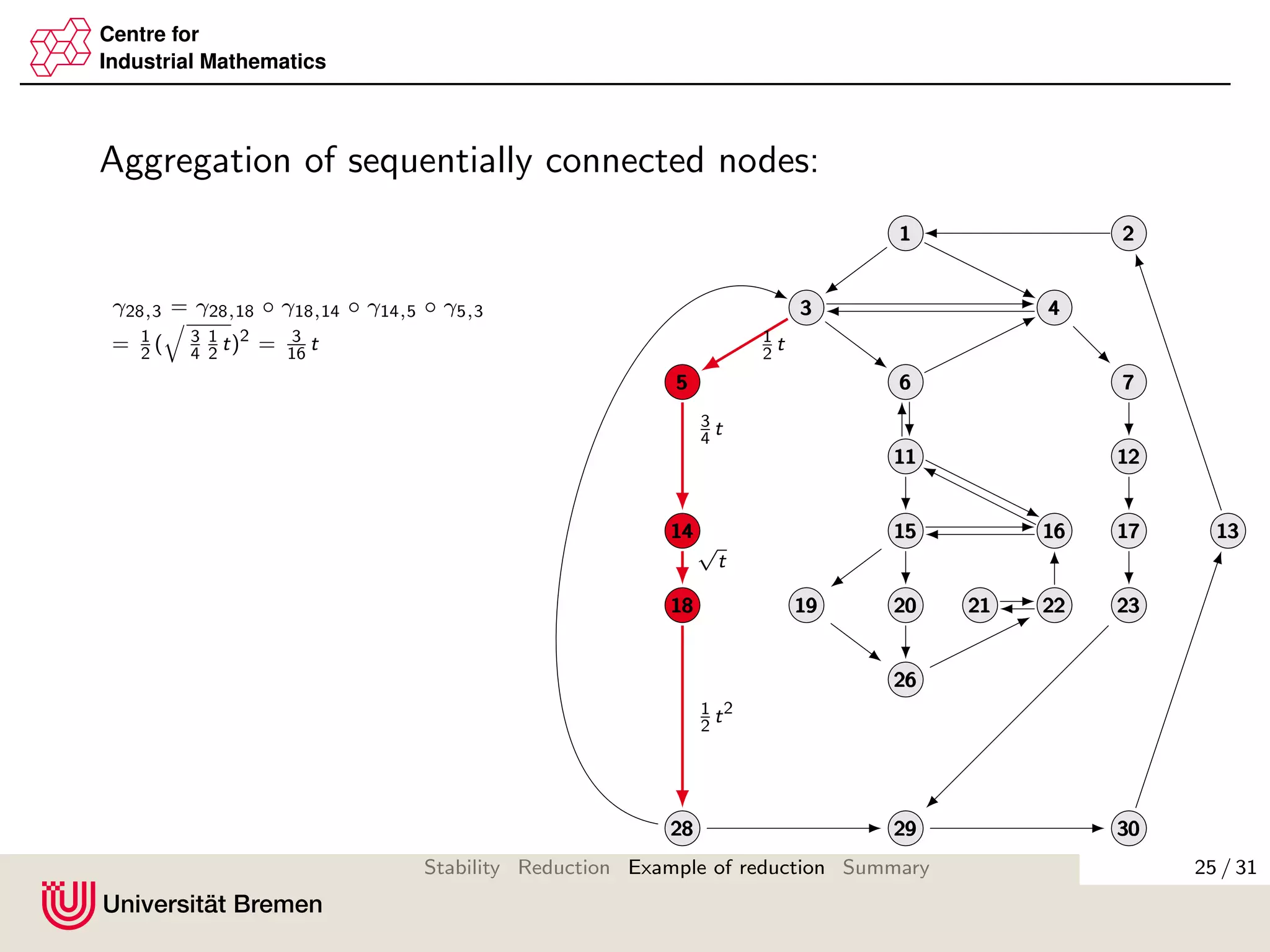
Aggregation of sequentially connected nodes:
111 222
333 444
555 666 777
111111 121212
131313141414 151515 161616 171717
181818 191919 202020 212121 222222 232323
242424 252525 262626
272727
282828 292929 303030
3
4
t
√
t
1
3
t2
γ28,25 = γ28,27 ◦ γ27,25 = 1
3
( (t))2
= 1
3
t
25 / 31Stability Reduction Example of reduction Summary
Centre for
Industrial Mathematics
Aggregation of nodes connected in parallel:
111 222
333 444
555 666 777
111111 121212
131313141414 151515 161616 171717
181818 191919 202020 212121 222222 232323
242424 252525 262626
282828 292929 303030
t2
t2
1
3
t1
2
t
γ28,18 = max{γ28,24 ◦ γ24,18, γ28,25 ◦ γ25,18}
= max{ 1
2
t2
, 1
3
t2
} = 1
2
t2
25 / 31Stability Reduction Example of reduction Summary
Centre for
Industrial Mathematics
Aggregation of sequentially connected nodes:
111 222
333 444
555 666 777
111111 121212
131313141414 151515 161616 171717
181818 191919 202020 212121 222222 232323
262626
282828 292929 303030
1
2
t
3
4
t
√
t
1
2
t2
γ28,3 = γ28,18 ◦ γ18,14 ◦ γ14,5 ◦ γ5,3
= 1
2
( 3
4
1
2
t)2
= 3
16
t
25 / 31Stability Reduction Example of reduction Summary
Centre for
Industrial Mathematics
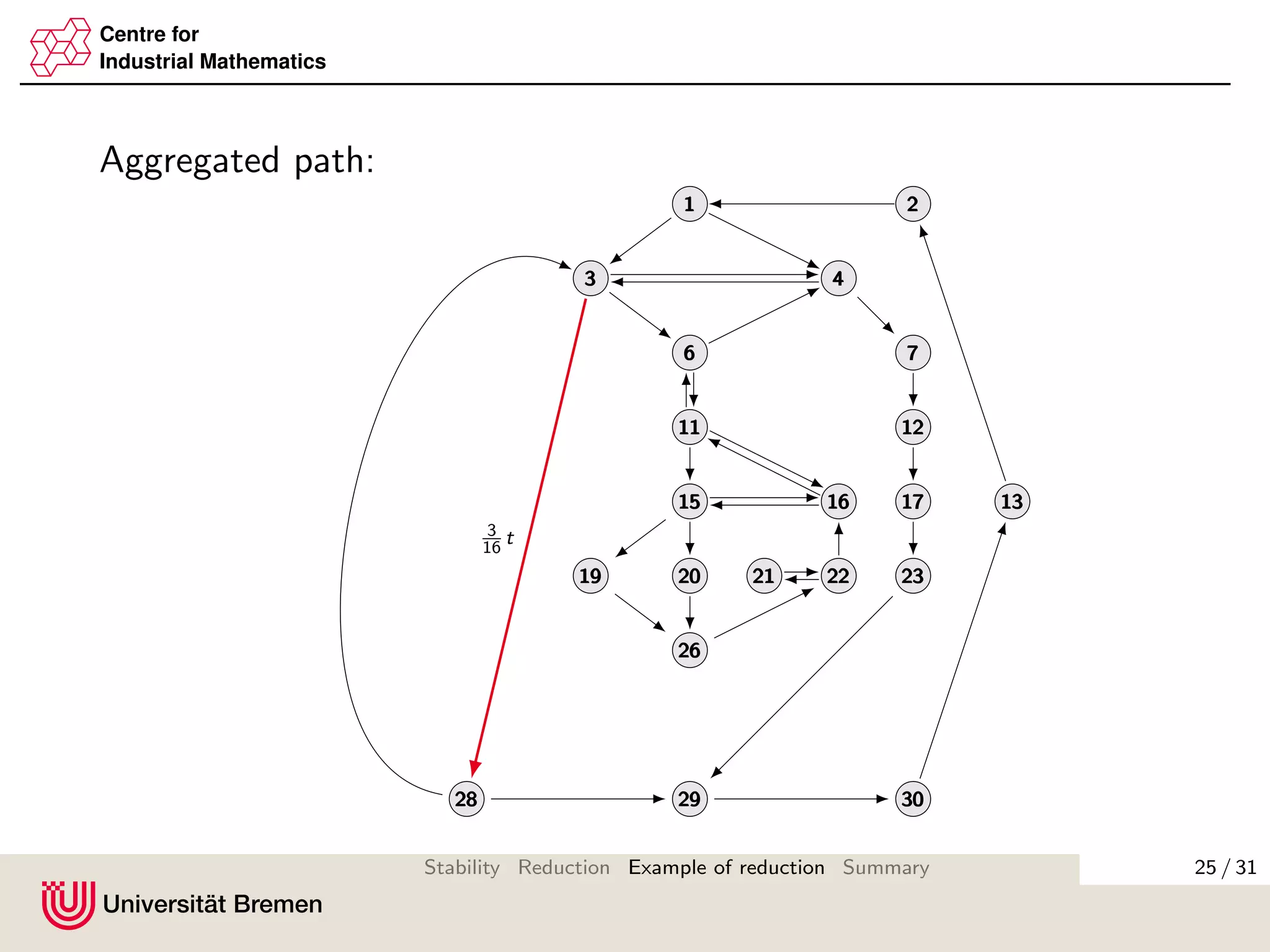
Aggregated path:
111 222
333 444
666 777
111111 121212
131313151515 161616 171717
191919 202020 212121 222222 232323
262626
282828 292929 303030
3
16
t
25 / 31Stability Reduction Example of reduction Summary
Centre for
Industrial Mathematics
Reduced network
111
333 444
666
111111
282828 292929
5
6
t2
t
√
t
4
5
t2
√
t
t
2
3
tt
√
t
13
16
t
2
3
t
4
5
t
9
10
t
7 nodes
8 (minimal) cycles
maximal length 5 nodes
26 / 31Stability Reduction Example of reduction Summary
Centre for
Industrial Mathematics
Cycle condition for the reduced gain matrix:
If the following holds:
1 γ3,4 ◦ γ4,3 < id
2 γ3,4 ◦ γ4,6 ◦ γ6,3 < id
3 γ6,11 ◦ γ11,6 < id
4 γ28,3 ◦ γ3,28 < id
5 γ4,1 ◦ γ1,29 ◦ γ29,4 < id
6 γ4,3 ◦ γ3,1 ◦ γ1,29 ◦ γ29,4 < id
7 γ3,1 ◦ γ1,29 ◦ γ29,28 ◦ γ28,3 < id
8 γ3,4 ◦ γ4,1 ◦ γ1,29 ◦ γ29,28 ◦ γ28,3 < id
then the network is ISS.
27 / 31Stability Reduction Example of reduction Summary
Centre for
Industrial Mathematics
Verification of the cycle condition:
1 γ3,4 ◦ γ4,3(t) = 4
5
(γ4,3(t))2 = 4
5
√
t
2
= 4
5
t < t
2 γ3,4 ◦ γ4,6 ◦ γ6,3(t) = 4
5
(γ4,6 ◦ γ6,3(t))2 = 4
5
(γ6,3(t))2 = 4
5
(
√
t)2 = 4
5
t < t
3 γ6,11 ◦ γ11,6(t) = γ11,6(t) = 2
3
t < t
4 γ28,3 ◦ γ3,28 = 13
16
γ3,28(t) = 13
24
t < t
5 γ4,1 ◦ γ1,29 ◦ γ29,4(t) = γ1,29 ◦ γ29,4(t) = 4
5
· 1 · 9
10
t = 18
25
t < t
6 γ4,3 ◦ γ3,1 ◦ γ1,29 ◦ γ29,4(t) = γ3,1 ◦ γ1,29 ◦ γ29,4(t) =
5
6
(γ1,29 ◦ γ29,4)2 = 54
125
t < t;
7 γ3,1 ◦ γ1,29 ◦ γ29,28 ◦ γ28,3(t) = 5
6
(γ1,29 ◦ γ29,28 ◦ γ28,3((t))2 =
5
6
( 4
5
γ29,28 ◦ γ28,3(t))2 = 5
6
( 4
5
13
16
t)2 = 13
30
t < t;
8 γ3,4 ◦ γ4,1 ◦ γ1,29 ◦ γ29,28 ◦ γ28,3(t) = 4
5
(γ4,1 ◦ 4
5
13
16
t)2 = 52
125
t < t
28 / 31Stability Reduction Example of reduction Summary
Centre for
Industrial Mathematics
Construction of ISS-Lyapunov function:
Taking σi (t) =
t, i = 3, 28
t2
, i = 3, 28
we obtain
˜γ1,29(σ29(t)) = 2
3
t ≤ t = σ1(t)
max{˜γ31(σ1(t)), ˜γ34(σ4(t)), ˜γ3,28(σ28(t))} = max{1
2
t2
, 1
2
t2
, 1
2
t2
} ≤ t2
= σ3(t)
max{˜γ41(σ1(t)), ˜γ43(σ2(t)), ˜γ46(σ6(t))} = max{t, t, t} ≤ t = σ4(t)
max{˜γ63(σ3(t)), ˜γ6,11(σ11(t))} = max{t, t} ≤ t = σ6(t)
˜γ11,6(σ6(t)) = 2
3
t ≤ t = σ11(t)
˜γ28,3(σ3(t)) = 3
16
t2
≤ t2
= σ28(t)
max{˜γ29,4(σ4(t)), ˜γ29,28(σ28(t))} = max{1
2
t, t} ≤ t = σ29(t)
Thus Γ(σ) ≤ σ and σ such that Γ(σ) ≤ σ can be constructed applying rules for
sequentially connected nodes, nodes connected in parallel and almost
disconnected subgraphs. Then V (x) = max
i=1,...,n
σ−1
i (Vi (xi )).
29 / 31Stability Reduction Example of reduction Summary
Centre for
Industrial Mathematics
Conclusion and Outlook
Conclusion:
The presented results
1 are published in Kosmykov, PhD Thesis, 2011
2 submitted to CDC 2012
Size of Γ can be reduced by aggregating certain motifs that
preserves the structure of the network:
1 nodes connected in parallel
2 sequentially connected nodes
3 almost disconnected subgraphs
Outlook:
Extension of reduction rules to other motifs
30 / 31Stability Reduction Example of reduction Summary
Centre for
Industrial Mathematics
Thank you for your attention!
31 / 31Stability Reduction Example of reduction Summary
Centre for
Industrial Mathematics
Thank you for your attention!
Today is 11.11.11 11:11:11
31 / 31Stability Reduction Example of reduction Summary

Reduction of the small gain condition

  • 1.
    Reduction of thesmall gain condition Michael Kosmykov
  • 2.
    Centre for Industrial Mathematics Outline 1Stability conditions for interconnected systems 2 Structure-preserving model reduction 3 Example 4 Conclusion and outlook 2 / 31Stability Reduction Example of reduction Summary
  • 3.
    Centre for Industrial Mathematics Smallgain condition Consider Γ=(γij )n×n with γii ≡ 0, i = 1, . . . , n. Operator Γ : Rn + → Rn + is defined by: Γ(s) :=    max{γ1,2(s2), . . . , γ1,n(sn)} ... max{γn1(s1), . . . , γn,n−1(sn−1)}    , s ∈ Rn +. Small gain theorem (Dashkovskiy, R¨uffer, Wirth 2007). Assume that each subsystem Σi is ISS. If Γ(s) ≥ s, ∀s ∈ Rn +{0}, then Σ is ISS. a ≥ b, a, b ∈ Rn ⇒ ∃ i ∈ {1, . . . , n} : ai < bi . 3 / 31Stability Reduction Example of reduction Summary
  • 4.
    Centre for Industrial Mathematics ISS-Lyapunovfunction Definition Continuous function V : Rn → R+ is called an ISS Lyapunov function for Σ, if it is loc. Lip. cont. on Rn{0} and ∃ψ1, ψ2 ∈ K∞ such that ψ1( x ) ≤ V (x) ≤ ψ2( x ), ∀x ∈ Rn . ∃γ ∈ K, and p.d.f. α such that in all points of dif. of V V (x) ≥ γ( u ) ⇒ V (x)f (x, u) ≤ −α( x ). Theorem (Dashkovskiy, R¨uffer, Wirth 2010) Σ is ISS ⇔ Σ has (not necessarily smooth) ISS Lyapunov function. 4 / 31Stability Reduction Example of reduction Summary
  • 5.
    Centre for Industrial Mathematics ISS-Lyapunovfunction for subsystems ∃ψ1, ψ2∈K∞ : ψi1( xi )≤Vi (xi )≤ψ2i ( xi ), ∀xi ∈Rni . ∃γij ∈K∞ ∪ {0}, j=i, ∃γi ∈K: in all points of dif. of Vi Vi (xi ) ≥ max{max j,j=i γij (Vj (xj )), γi ( u )} ⇒ Vi (xi )fi (x, u) ≤ −αi ( xi ). Small gain theorem (in terms of Lyapunov functions) Assume ∃ ISS-Lyapunov functions Vi for Σi . If Γ(s) ≥ s for all s = 0, s ≥ 0 is satisfied, then ∃ ISS-Lyapunov function V for Σ: V (x) = max i=1,...,n σ−1 i (Vi (xi )), where σ := (σ1, . . . , σn)T , σi ∈ K∞, satisfies: Γ(σ(r)) ≤ σ(r), ∀ r > 0. 5 / 31Stability Reduction Example of reduction Summary
  • 6.
    Centre for Industrial Mathematics Caseof large network Sufficient condition for ISS of interconnected system ISS (ISS-Lyapunov function) of Σi + Small gain condition Γ(s) ≥ s ⇒ ISS of Σ Γ = interconnection structure of the network Cycle condition Γ(s) ≥ s ⇔ ”cycle condition” γk1k2 ◦ γk2k3 ◦ · · · ◦ γkr−1kr < id, for all (k1, ..., kr ) ∈ {1, ..., n}r with k1 = kr . Largest possible number of cycles = n k=2 n k k! Ho to verify this condition if the size of the network is large? Answer: Model reduction. 6 / 31Stability Reduction Example of reduction Summary
  • 7.
    Centre for Industrial Mathematics Mainmethods of model reduction 1 Linear systems: Balancing methods Krylov methods 2 Nonlinear systems: Balancing methods Krylov methods Proper orthogonal decomposition (POD) Singular perturbations theory Trajectory piecewise linear approach Volterra methods Theory of global attractors ... Drawback of application to logistics networks: the interconnection structure of the network is destroyed 7 / 31Stability Reduction Example of reduction Summary
  • 8.
    Centre for Industrial Mathematics Reductionof gain matrix Idea Reduce the size of matrix Γ: Γ=    0 γ12 . . . γ1,n−1 γ1n ... ... ... ... ... γn1 γn2 . . . γn,n−1 0    →Γ=    0 γ12 . . . γ1,k−1 γ1k ... ... ... ... ... γk1 γk2 . . . γk,k−1 0    , k < n. How to obtain Γ? SGC for Γ ⇒ SGC for Γ? 8 / 31Stability Reduction Example of reduction Summary
  • 9.
    Centre for Industrial Mathematics Typicalinterconnections in the network (motifs) almost disconnected subgraph v1v1v1 v2v2v2 v3v3v3 v4v4v4 v5v5v5 v6v6v6 v7v7v7 v8v8v8 v9v9v9 v10v10v10 v11v11v11 v12v12v12 v13v13v13 v14v14v14 v15v15v15 v16v16v16 v17v17v17 v18v18v18 v19v19v19 sequential connection parallel connection v20v20v20 v21v21v21 v22v22v22 v23v23v23 9 / 31Stability Reduction Example of reduction Summary
  • 10.
    Centre for Industrial Mathematics Aggregationof certain motifs Parallel connections: vvv v1v1v1 γv1,v γvk ,v vkvkvk vvv γv ,v1 γv ,vk ... γv ,v ⇒ JJJ vvv γv ,J := max{γv ,v1 ◦γv1,v , . . . , γv ,vk ◦γvk ,v ,γv ,v } Theorem 1) ISS of Σi + Γ(s) ≥ s ⇒ ISS of Σ. 2) Γ(s) ≥ s ⇔ Γ(s) ≥ s. 3) If there were p cycles that include node vi , then the number of cycles is decreased by p(k − δv ,v ), where δv ,v := 0, if γv ,v = 0 and δv ,v := 1 otherwise. 10 / 31Stability Reduction Example of reduction Summary
  • 11.
    Centre for Industrial Mathematics Aggregationof certain motifs Parallel connections: vvv v1v1v1 γv1,v γvk ,v vkvkvk vvv γv ,v1 γv ,vk ... γv ,v ⇒ JJJ vvv γv ,J := max{γv ,v1 ◦γv1,v , . . . , γv ,vk ◦γvk ,v ,γv ,v } Proof. Γ(s) ≥ s ⇒ cycle condition with gain γv ,J hold: . . . ◦ γv ,J ◦ . . . < id ⇒ . . . ◦ max{γv ,v1 ◦ γv1,v , . . . , γv ,vk ◦ γvk ,v , γv ,v } ◦ . . . < id ⇒ Γ(s) ≥ s. 11 / 31Stability Reduction Example of reduction Summary
  • 12.
    Centre for Industrial Mathematics Aggregationof certain motifs Parallel connections: vvv v1v1v1 γv1,v γvk ,v vkvkvk vvv γv ,v1 γv ,vk ... γv ,v ⇒ JJJ vvv γv ,J := max{γv ,v1 ◦γv1,v , . . . , γv ,vk ◦γvk ,v ,γv ,v } Proof. p cycles with vi ⇒ p · k cycles with a node from {v1, . . . , vk }. If γv ,v = 0 ⇒ p · (k + 1) cycles with nodes {v1, . . . , vk } and gain γv ,v . After the aggregation these cycles will ”coincide” ⇒ the number of the cycles is decreased by p(k − δv ,v ). 2 12 / 31Stability Reduction Example of reduction Summary
  • 13.
    Centre for Industrial Mathematics Aggregationof certain motifs Parallel connections: vvv v1v1v1 γv1,v γvk ,v vkvkvk vvv γv ,v1 γv ,vk ... γv ,v ⇒ JJJ vvv γv ,J := max{γv ,v1 ◦γv1,v , . . . , γv ,vk ◦γvk ,v ,γv ,v } Theorem (in terms of Lyapunov functions) ISS-Lyapunov function for Σi + Γ(s) ≥ s ⇒ ISS-Lyapunov function for Σ can be constructed as V (x) = max i=1,...,n σ−1 i (Vi (xi )) with σ defined by σw := γw,v ◦ σJ , if w ∈ {v1, . . . , vk }, σw , otherwise . 13 / 31Stability Reduction Example of reduction Summary
  • 14.
    Centre for Industrial Mathematics Aggregationof certain motifs Sequential connections: vvv v1v1v1 γv1,v ......... vkvkvk vvv γv ,vk γv ,v JJJ vvv ⇒ γv ,J := max{γv ,vk ◦. . .◦γv2,v1 ◦γv1,v , γv ,v } Theorem 1) ISS of Σi + Γ(s) ≥ s ⇒ ISS of Σ. 2) Γ(s) ≥ s ⇔ Γ(s) ≥ s 3)Assume that there were p cycles that include one of vi . If γv ,v = 0, then the number of cycles to be checked in the cycle condition corresponding to matrix ˜Γ is decreased by p, otherwise it stays the same. 14 / 31Stability Reduction Example of reduction Summary
  • 15.
    Centre for Industrial Mathematics Aggregationof certain motifs Sequential connections: vvv v1v1v1 γv1,v ......... vkvkvk vvv γv ,vk γv ,v JJJ vvv ⇒ γv ,J := max{γv ,vk ◦. . .◦γv2,v1 ◦γv1,v , γv ,v } Proof. Γ(s) ≥ s ⇒ cycle condition with gain γv ,J hold: . . . ◦ γv ,J ◦ . . . < id ⇒ . . . ◦ max{γv ,vk ◦. . .◦γv2,v1 ◦γv1,v , γv ,v } ◦ . . . < id ⇒ Γ(s) ≥ s. 15 / 31Stability Reduction Example of reduction Summary
  • 16.
    Centre for Industrial Mathematics Aggregationof certain motifs Sequential connections: vvv v1v1v1 γv1,v ......... vkvkvk vvv γv ,vk γv ,v JJJ vvv ⇒ γv ,J := max{γv ,vk ◦. . .◦γv2,v1 ◦γv1,v , γv ,v } Proof. Cycle containing one of the nodes {v1, . . . , vl } ⇒ cycle contains necessarily all other nodes from {v1, . . . , vl } If γv ,v = 0 ⇒ the number of cycles stays the same. Otherwise, the cycles with vi will ”coincide” with the cycles with γv ,v ⇒ the overall number of the cycles will decrease by p. 2 16 / 31Stability Reduction Example of reduction Summary
  • 17.
    Centre for Industrial Mathematics Aggregationof certain motifs Sequential connections: vvv v1v1v1 γv1,v ......... vkvkvk vvv γv ,vk γv ,v JJJ vvv ⇒ γv ,J := max{γv ,vk ◦. . .◦γv2,v1 ◦γv1,v , γv ,v } Theorem (in terms of Lyaunov functions) ISS-Lyapunov function for Σi + Γ(s) ≥ s ⇒ ISS-Lyapunov function for Σ can be constructed as V (x) = max i=1,...,n σ−1 i (Vi (xi )) with σ defined by σw := γvi ,vi−1 ◦γvi−1,vi−2 ◦. . .◦γv2,v1 ◦γv1,v ◦σJ , if w=vi , i∈{1, . . . , k}, σw , otherwise . 17 / 31Stability Reduction Example of reduction Summary
  • 18.
    Centre for Industrial Mathematics Aggregationof certain motifs Almost disconnected subgraphs: v1v1v1 v2v2v2 v3v3v3 v∗v∗ v∗ ⇒ v∗v∗ v∗ JJJ γJ,v∗ := max(k1,...,kr )∈{v1,...,vk ,v∗}r ,k1=kr {γk1,k2 ◦γk2,k3 ◦. . .◦γkr−1,kr } γv∗,J =id Theorem 1) ISS of Σi + Γ(s) ≥ s ⇒ ISS of Σ. 2) Γ(s) ≥ s ⇔ Γ(s) ≥ s 3) If there were p cycles with nodes from {v1, . . . , vk } ∪ {v∗ } ⇒ the number of cycles is decreased by p − 1. 18 / 31Stability Reduction Example of reduction Summary
  • 19.
    Centre for Industrial Mathematics Aggregationof certain motifs Almost disconnected subgraphs: v1v1v1 v2v2v2 v3v3v3 v∗v∗ v∗ ⇒ v∗v∗ v∗ JJJ γJ,v∗ := max(k1,...,kr )∈{v1,...,vk ,v∗}r ,k1=kr {γk1,k2 ◦γk2,k3 ◦. . .◦γkr−1,kr } γv∗,J =id Proof. Γ(s) ≥ s ⇒ γv∗,J ◦ γJ,v∗ < id ⇒ max(k1,...,kr )∈{v1,...,vk ,v∗}r ,k1=kr {γk1,k2 ◦ γk2,k3 ◦ · · · ◦ γkr−1,kr } < id. ⇒ Γ(s) ≥ s. 19 / 31Stability Reduction Example of reduction Summary
  • 20.
    Centre for Industrial Mathematics Aggregationof certain motifs Almost disconnected subgraphs: v1v1v1 v2v2v2 v3v3v3 v∗v∗ v∗ ⇒ v∗v∗ v∗ JJJ γJ,v∗ := max(k1,...,kr )∈{v1,...,vk ,v∗}r ,k1=kr {γk1,k2 ◦γk2,k3 ◦. . .◦γkr−1,kr } γv∗,J =id Proof. As instead of p cycles with nodes only from {v1, . . . , vk } ∪ {v∗ } we consider only one cycle γv∗,J ◦ γJ,v∗ ⇒ the number of cycles is decreased by p − 1. 2 20 / 31Stability Reduction Example of reduction Summary
  • 21.
    Centre for Industrial Mathematics Aggregationof certain motifs v1v1v1 v2v2v2 v3v3v3 v∗v∗ v∗ ⇒ v∗v∗ v∗ JJJ γJ,v∗ := max(k1,...,kr )∈{v1,...,vk ,v∗}r ,k1=kr {γk1,k2 ◦γk2,k3 ◦. . .◦γkr−1,kr } γv∗,J =id Theorem (in terms of Lyapunov functions) ISS-Lyapunov function for Σi + Γ(s) ≥ s ⇒ ISS-Lyapunov function for Σ can be constructed as V (x) = max i=1,...,n σ−1 i (Vi (xi )), where σ is given by ¯σw := ˆγw,J ◦σJ , if w∈{v1, . . ., vk }, σw , otherwise , ˆγw,J := max (k1,...,kr )∈{v1,...,vk }r ,ki =kj {γw,vk1 ◦γvk1 ,vk2 ◦. . .◦γvkr ,J}, 21 / 31Stability Reduction Example of reduction Summary
  • 22.
    Centre for Industrial Mathematics Example 111222 333 444 555 666 777 888 999 101010 111111 121212 131313141414 151515 161616 171717 181818 191919 202020 212121 222222 232323 242424 252525 262626 272727 282828 292929 303030 30 nodes, 29 (minimal) cycles ISS of Σi + Γ(s) ≥ s ⇒ ISS of Σ Γ(s)≥s⇔γk1k2 ◦γk2k3 ◦ . . . ◦γkr−1kr <id 22 / 31Stability Reduction Example of reduction Summary
  • 23.
    Centre for Industrial Mathematics Example 111222 333 444 555 666 777 888 999 101010 111111 121212 131313141414 151515 161616 171717 181818 191919 202020 212121 222222 232323 242424 252525 262626 272727 282828 292929 303030 maximal cycle length = 14 nodes 22 / 31Stability Reduction Example of reduction Summary
  • 24.
    Centre for Industrial Mathematics Cyclecondition: 1 γ1,2 ◦γ2,13 ◦γ13,30 ◦γ30,29 ◦γ29,23 ◦γ23,17 ◦γ17,12 ◦γ12,7 ◦γ7,4 ◦γ4,1 < id 2 γ3,4 ◦ γ4,3 < id 3 γ15,16 ◦ γ16,15 < id 4 γ4,6 ◦ γ6,3 ◦ γ3,4 < id 5 γ6,11 ◦ γ11,6 < id 6 γ11,16 ◦ γ16,11 < id 7 γ1,2◦γ2,13◦γ13,30◦γ30,29◦γ29,23◦γ23,17◦γ17,12◦γ12,7◦γ7,4◦γ4,3◦γ3,1<id 8 γ3,28 ◦ ◦γ28,24γ24,18 ◦ γ18,14 ◦ γ14,8 ◦ γ8,5 ◦ γ5,3 < id 9 γ3,28 ◦ γ28,24 ◦ γ24,18 ◦ γ18,14 ◦ γ14,9 ◦ γ9,5 ◦ γ5,3 < id 10 γ3,28 ◦ γ28,24 ◦ γ24,18 ◦ γ18,14 ◦ γ14,10 ◦ γ19,5 ◦ γ5,3 < id + 19 another cycles 23 / 31Stability Reduction Example of reduction Summary
  • 25.
    Centre for Industrial Mathematics Applicationof aggregation rules 111 222 333 444 555 666 777 888 999 101010 111111 121212 131313141414 151515 161616 171717 181818 191919 202020 212121 222222 232323 242424 252525 262626 272727 282828 292929 303030 1 2 t √ t 1 2 √ t 2 √ t 1 8 t2 3 16 t2 t2 √ t t2 t2 √ t 1 3 t2 1 2 t 24 / 31Stability Reduction Example of reduction Summary
  • 26.
    Centre for Industrial Mathematics Aggregationof nodes connected in parallel: 111 222 333 444 555 666 777 888 999 101010 111111 121212 131313141414 151515 161616 171717 181818 191919 202020 212121 222222 232323 242424 252525 262626 272727 282828 292929 303030 √ t 1 2 √ t 2 √ t 1 8 t2 3 16 t2 t2 γ14,5 = max{γ14,8 ◦ γ8,5, γ14,9 ◦ γ9,5, γ14,10 ◦ γ10,5} = max{ 1 2 ( (t))2 , 3 16 (2 (t))2 , ( 1 2 (t))2 } = 3 4 t 25 / 31Stability Reduction Example of reduction Summary
  • 27.
    Centre for Industrial Mathematics Aggregationof sequentially connected nodes: 111 222 333 444 555 666 777 111111 121212 131313141414 151515 161616 171717 181818 191919 202020 212121 222222 232323 242424 252525 262626 272727 282828 292929 303030 3 4 t √ t 1 3 t2 γ28,25 = γ28,27 ◦ γ27,25 = 1 3 ( (t))2 = 1 3 t 25 / 31Stability Reduction Example of reduction Summary
  • 28.
    Centre for Industrial Mathematics Aggregationof nodes connected in parallel: 111 222 333 444 555 666 777 111111 121212 131313141414 151515 161616 171717 181818 191919 202020 212121 222222 232323 242424 252525 262626 282828 292929 303030 t2 t2 1 3 t1 2 t γ28,18 = max{γ28,24 ◦ γ24,18, γ28,25 ◦ γ25,18} = max{ 1 2 t2 , 1 3 t2 } = 1 2 t2 25 / 31Stability Reduction Example of reduction Summary
  • 29.
    Centre for Industrial Mathematics Aggregationof sequentially connected nodes: 111 222 333 444 555 666 777 111111 121212 131313141414 151515 161616 171717 181818 191919 202020 212121 222222 232323 262626 282828 292929 303030 1 2 t 3 4 t √ t 1 2 t2 γ28,3 = γ28,18 ◦ γ18,14 ◦ γ14,5 ◦ γ5,3 = 1 2 ( 3 4 1 2 t)2 = 3 16 t 25 / 31Stability Reduction Example of reduction Summary
  • 30.
    Centre for Industrial Mathematics Aggregatedpath: 111 222 333 444 666 777 111111 121212 131313151515 161616 171717 191919 202020 212121 222222 232323 262626 282828 292929 303030 3 16 t 25 / 31Stability Reduction Example of reduction Summary
  • 31.
    Centre for Industrial Mathematics Reducednetwork 111 333 444 666 111111 282828 292929 5 6 t2 t √ t 4 5 t2 √ t t 2 3 tt √ t 13 16 t 2 3 t 4 5 t 9 10 t 7 nodes 8 (minimal) cycles maximal length 5 nodes 26 / 31Stability Reduction Example of reduction Summary
  • 32.
    Centre for Industrial Mathematics Cyclecondition for the reduced gain matrix: If the following holds: 1 γ3,4 ◦ γ4,3 < id 2 γ3,4 ◦ γ4,6 ◦ γ6,3 < id 3 γ6,11 ◦ γ11,6 < id 4 γ28,3 ◦ γ3,28 < id 5 γ4,1 ◦ γ1,29 ◦ γ29,4 < id 6 γ4,3 ◦ γ3,1 ◦ γ1,29 ◦ γ29,4 < id 7 γ3,1 ◦ γ1,29 ◦ γ29,28 ◦ γ28,3 < id 8 γ3,4 ◦ γ4,1 ◦ γ1,29 ◦ γ29,28 ◦ γ28,3 < id then the network is ISS. 27 / 31Stability Reduction Example of reduction Summary
  • 33.
    Centre for Industrial Mathematics Verificationof the cycle condition: 1 γ3,4 ◦ γ4,3(t) = 4 5 (γ4,3(t))2 = 4 5 √ t 2 = 4 5 t < t 2 γ3,4 ◦ γ4,6 ◦ γ6,3(t) = 4 5 (γ4,6 ◦ γ6,3(t))2 = 4 5 (γ6,3(t))2 = 4 5 ( √ t)2 = 4 5 t < t 3 γ6,11 ◦ γ11,6(t) = γ11,6(t) = 2 3 t < t 4 γ28,3 ◦ γ3,28 = 13 16 γ3,28(t) = 13 24 t < t 5 γ4,1 ◦ γ1,29 ◦ γ29,4(t) = γ1,29 ◦ γ29,4(t) = 4 5 · 1 · 9 10 t = 18 25 t < t 6 γ4,3 ◦ γ3,1 ◦ γ1,29 ◦ γ29,4(t) = γ3,1 ◦ γ1,29 ◦ γ29,4(t) = 5 6 (γ1,29 ◦ γ29,4)2 = 54 125 t < t; 7 γ3,1 ◦ γ1,29 ◦ γ29,28 ◦ γ28,3(t) = 5 6 (γ1,29 ◦ γ29,28 ◦ γ28,3((t))2 = 5 6 ( 4 5 γ29,28 ◦ γ28,3(t))2 = 5 6 ( 4 5 13 16 t)2 = 13 30 t < t; 8 γ3,4 ◦ γ4,1 ◦ γ1,29 ◦ γ29,28 ◦ γ28,3(t) = 4 5 (γ4,1 ◦ 4 5 13 16 t)2 = 52 125 t < t 28 / 31Stability Reduction Example of reduction Summary
  • 34.
    Centre for Industrial Mathematics Constructionof ISS-Lyapunov function: Taking σi (t) = t, i = 3, 28 t2 , i = 3, 28 we obtain ˜γ1,29(σ29(t)) = 2 3 t ≤ t = σ1(t) max{˜γ31(σ1(t)), ˜γ34(σ4(t)), ˜γ3,28(σ28(t))} = max{1 2 t2 , 1 2 t2 , 1 2 t2 } ≤ t2 = σ3(t) max{˜γ41(σ1(t)), ˜γ43(σ2(t)), ˜γ46(σ6(t))} = max{t, t, t} ≤ t = σ4(t) max{˜γ63(σ3(t)), ˜γ6,11(σ11(t))} = max{t, t} ≤ t = σ6(t) ˜γ11,6(σ6(t)) = 2 3 t ≤ t = σ11(t) ˜γ28,3(σ3(t)) = 3 16 t2 ≤ t2 = σ28(t) max{˜γ29,4(σ4(t)), ˜γ29,28(σ28(t))} = max{1 2 t, t} ≤ t = σ29(t) Thus Γ(σ) ≤ σ and σ such that Γ(σ) ≤ σ can be constructed applying rules for sequentially connected nodes, nodes connected in parallel and almost disconnected subgraphs. Then V (x) = max i=1,...,n σ−1 i (Vi (xi )). 29 / 31Stability Reduction Example of reduction Summary
  • 35.
    Centre for Industrial Mathematics Conclusionand Outlook Conclusion: The presented results 1 are published in Kosmykov, PhD Thesis, 2011 2 submitted to CDC 2012 Size of Γ can be reduced by aggregating certain motifs that preserves the structure of the network: 1 nodes connected in parallel 2 sequentially connected nodes 3 almost disconnected subgraphs Outlook: Extension of reduction rules to other motifs 30 / 31Stability Reduction Example of reduction Summary
  • 36.
    Centre for Industrial Mathematics Thankyou for your attention! 31 / 31Stability Reduction Example of reduction Summary
  • 37.
    Centre for Industrial Mathematics Thankyou for your attention! Today is 11.11.11 11:11:11 31 / 31Stability Reduction Example of reduction Summary