QUICK
REVIEW
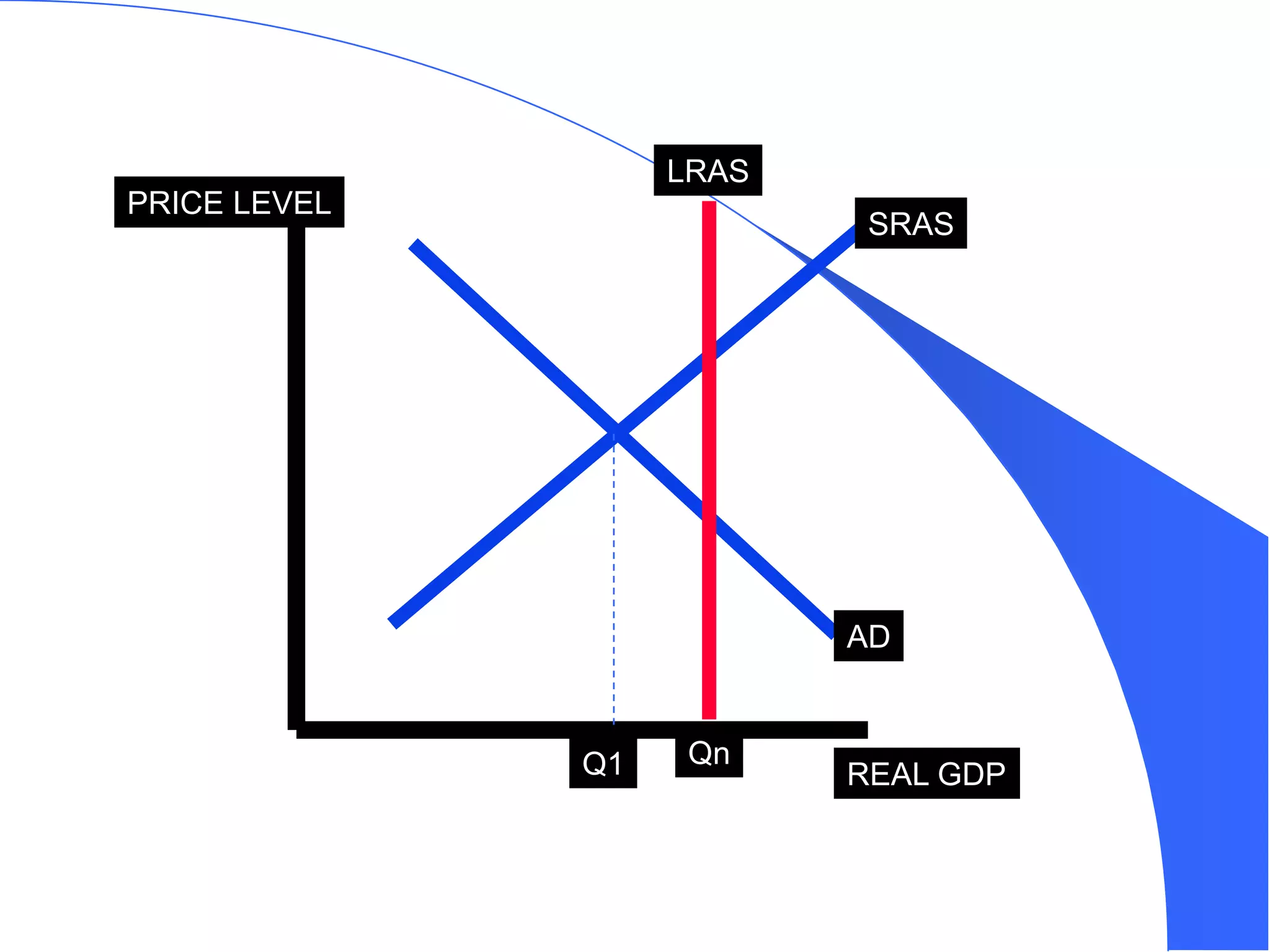
PRICE LEVEL
REAL GDP
AD
SRAS
LRAS
Qn
Q1
PRICE LEVEL
REAL GDP
AD
SRAS
LRAS
Qn
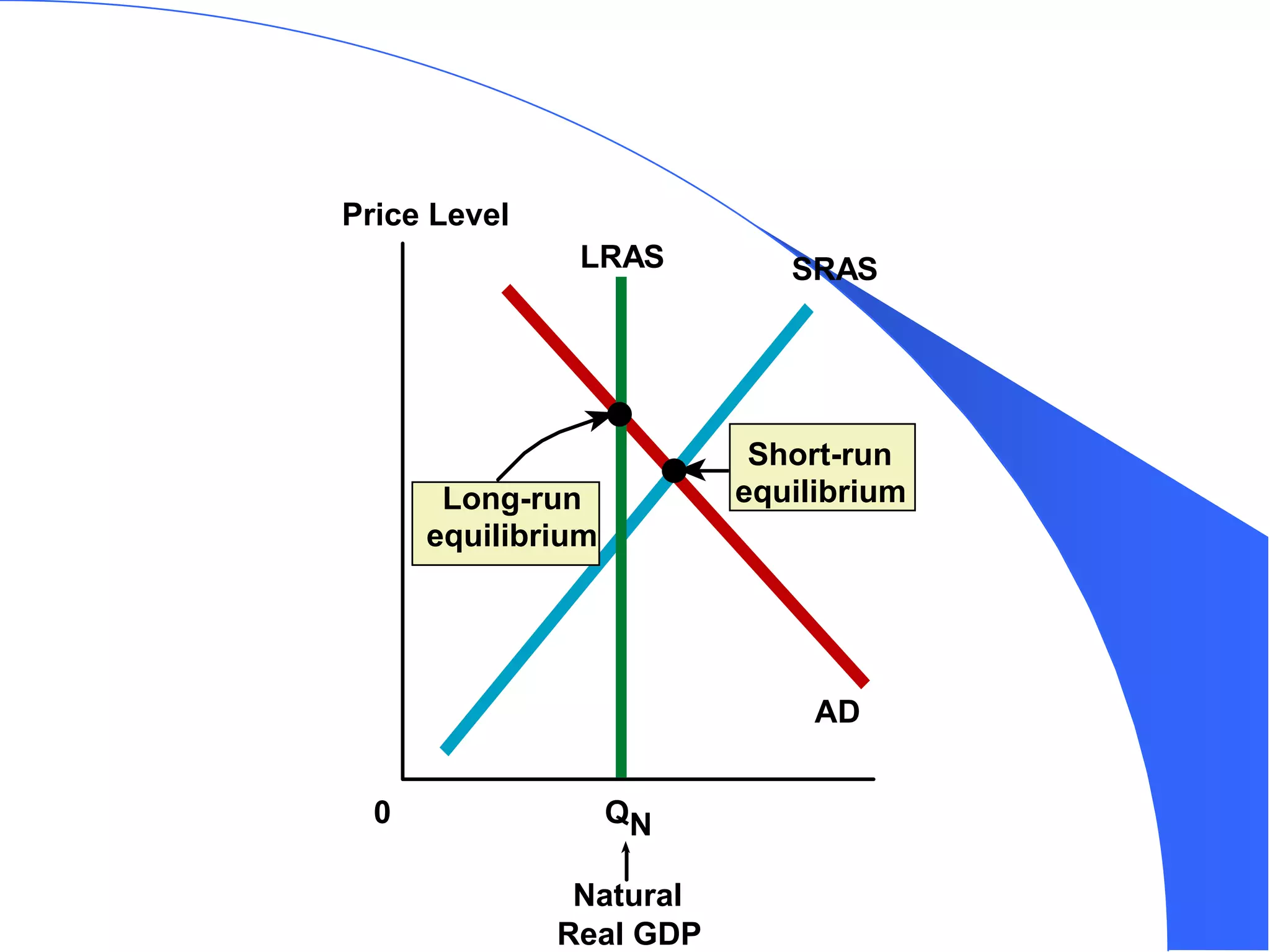
Price Level
Natural
Real GDP
SRAS
0
AD
QN
LRAS
Long-run
equilibrium
Short-run
equilibrium
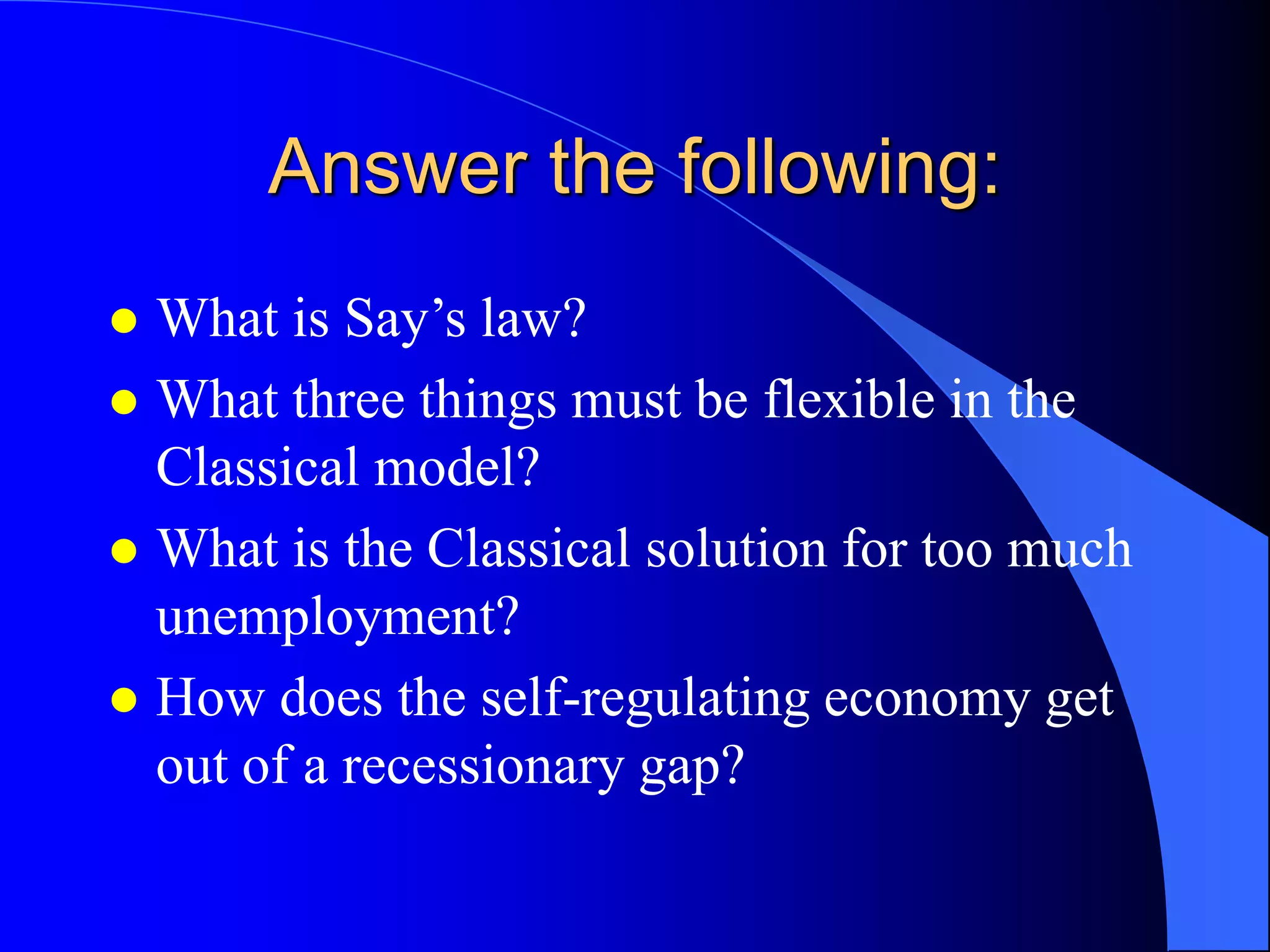
Answer the following:
 What is Say’s law?
 What three things must be flexible in the
Classical model?
 What is the Classical solution for too much
unemployment?
 How does the self-regulating economy get
out of a recessionary gap?
Self-Regulating Economy
KEYNESIAN ECONOMICS
 J. M. Keynes wrote during the Great
Depression
 Keynes focused on the demand side of the
economy
 Keynes did not believe that the economy
was necessarily self-correcting
KEYNES ON WAGES AND PRICES
 Keynes believed that wages and prices were
STICKY DOWNWARD
 The lack of wage and price flexibility
suggested that the economy might get
STUCK in a recessionary gap.
 Keynes tended to focus on the short run
because
 “IN THE LONG RUN WE ARE ALL
DEAD”
KEYNES AND INCOME
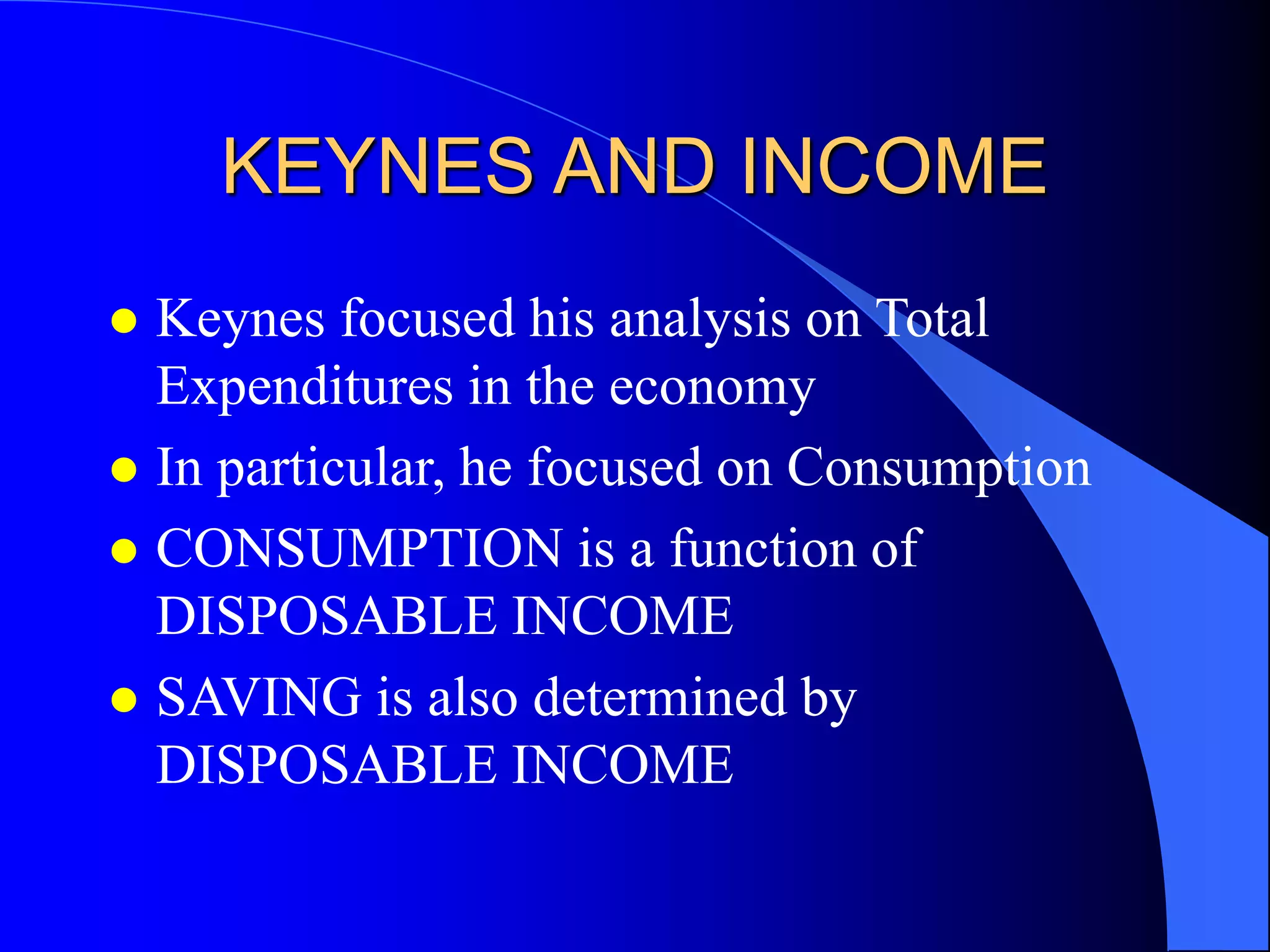
 Keynes focused his analysis on Total
Expenditures in the economy
 In particular, he focused on Consumption
 CONSUMPTION is a function of
DISPOSABLE INCOME
 SAVING is also determined by
DISPOSABLE INCOME
CONSUMPTION AND
SAVING TERMS
 Autonomous Consumption - the portion of
consumption that is not related to income (it
is the amount of Cons. when income is 0).
 MPC - marginal propensity to consume (it
is change in C / change in Y)
 MPS - marginal propensity to save (it is the
change in saving / change in Y)
CONSUMPTION AND
SAVING TERMS
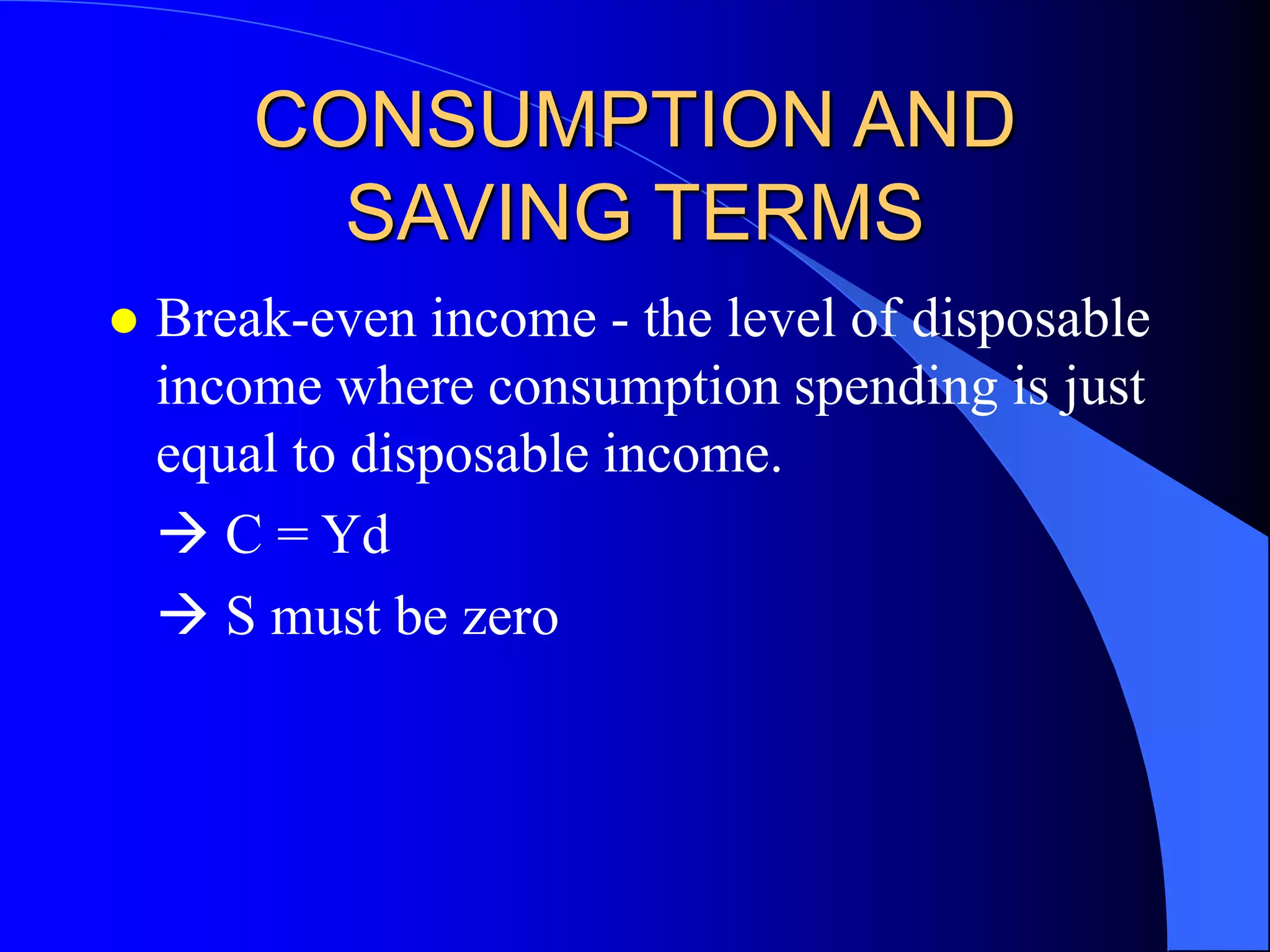
 Break-even income - the level of disposable
income where consumption spending is just
equal to disposable income.
 C = Yd
 S must be zero
EQUATION FOR C AND S
 C = a + b(Yd)
 Consumption = autonomous consumption +
the MPC * (disposable income)
 S = -a + (1-b)(Yd)
 Saving = negative autonomous consumption
+ MPS * ( disposable income)
EXAMPLE
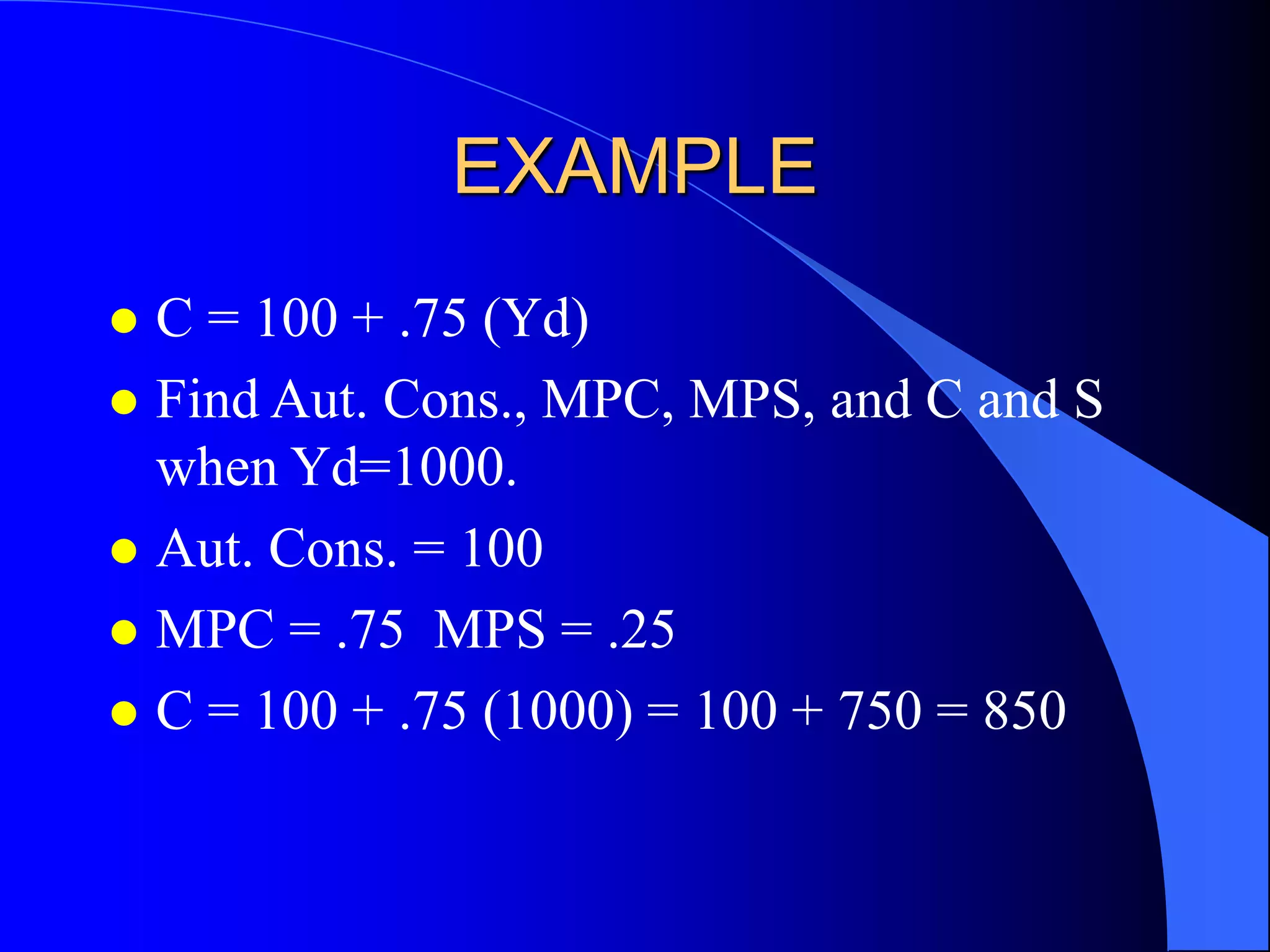
 C = 100 + .75 (Yd)
 Find Aut. Cons., MPC, MPS, and C and S
when Yd=1000.
 Aut. Cons. = 100
 MPC = .75 MPS = .25
 C = 100 + .75 (1000) = 100 + 750 = 850
CONSUMPTION FUNCTION
INCOME CONS. SAVING
0 100 -100
100 180 -80
200 260 -60
300 340 -40
500 500 0
600 580 20
 Find MPC
 Find MPS
 Find Autonomous Consumption
 Give the equation for consumption
 Give the equation for saving
 Find breakeven income
 Find C and S when income is 700
CONSUMPTION FUNCTION
 A change in Disposable Income causes a
MOVEMENT ALONG the Consumption
Function
 A change in Autonomous Consumption
causes a SHIFT of the Consumption
Function
SAVING
 SAVING is the unspent portion of a
consumer’s income.
 SAVING = Income - Consumption Exp.
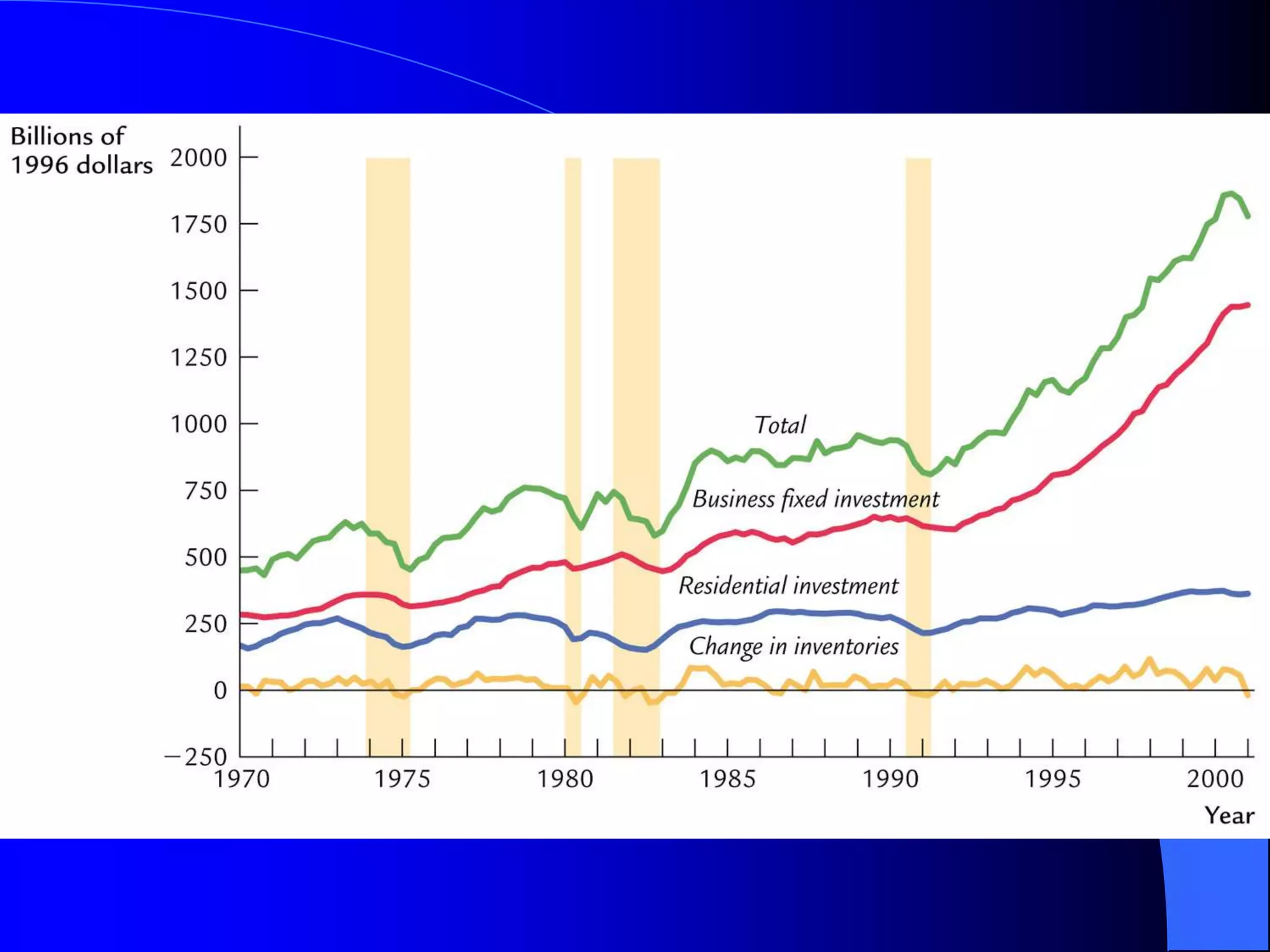
INVESTMENT
2 components
 Capital goods (producer durables) - goods
used by businesses to produce other goods
and services. They have an expected
service life of more than one year.
 Inventory investment - changes in the
stocks of finished goods, goods in process,
and in raw materials a firm keeps on hand.
TOTAL EXPENDITURES
 Total Expenditures = C + I + G + (X-M)
 C depends on Disp. Y
 S depends on Disp. Y
 Disp. Y = C + S
 I depends on the interest rate ( not Y )
 G is assumed to be autonomous
EQUILIBRIUM
 TOTAL EXPENDITURES
 are equal to
 TOTAL PRODUCTION
 is equal to
 INCOME
DISEQUILIBRIUM
TOTAL OUTPUT < TOTAL EXPENDITURES
 unplanned inventories
 production
 employment
 Real GDP
 income
DISEQUILIBRIUM
TOTAL OUTPUT > TOTAL EXPENDITURES
 unplanned inventories
 production
 employment
 Real GDP
 income
C = 200 + .80(Yd)
I = 300
 Find Autonomous Cons., MPC, and MPS
 Find breakeven income
 Find equilibrium income
 In Qn=3000, identify the following: type of
gap, size.
THE MULTIPLIER
A dollar injected into the economy
(i.e. investment) has an impact
beyond the initial expenditures. The
dollar continues to be spent
multiplying its impact on the
economy. The number of times it
circulates through the economy is
known as THE MULTIPLIER.
THE MULTIPLIER cont.
The rate of circulation is related to
the MPC and MPS. The larger the
MPC, the more consumption rises as
a result of an increase in income.
This will result in a larger
MULTIPLIER.
Autonomous Government
Spending & the Multiplier
Exhibit 12
(1)
EXPENDITURE
ROUND
(2)
CHANGE IN
AUTONOMOUS
GOVERNMENT
SPENDING
(3)
CHANGE IN REAL
NATIONAL INCOME
OR REAL GDP
($ millions)
(4)
MPC
(5)
CHANGE IN
CONSUMPTION
($ millions)
Round 1
Round 2
Round 3
Round 4
$60.00 $ 60.00
48.00
38.40
30.72
.80
.80
.80
.80
$ 48.00
38.40
30.72
24.57
.
.
.
.
.
.
.
.
.
.
.
.
.
.
.
.
.
.
.
.
.
.
.
.
.
.
.
.
.
.
.
.
All other 122.88 .80 98.88
TOTAL $300.00 $240.00
(Approx.
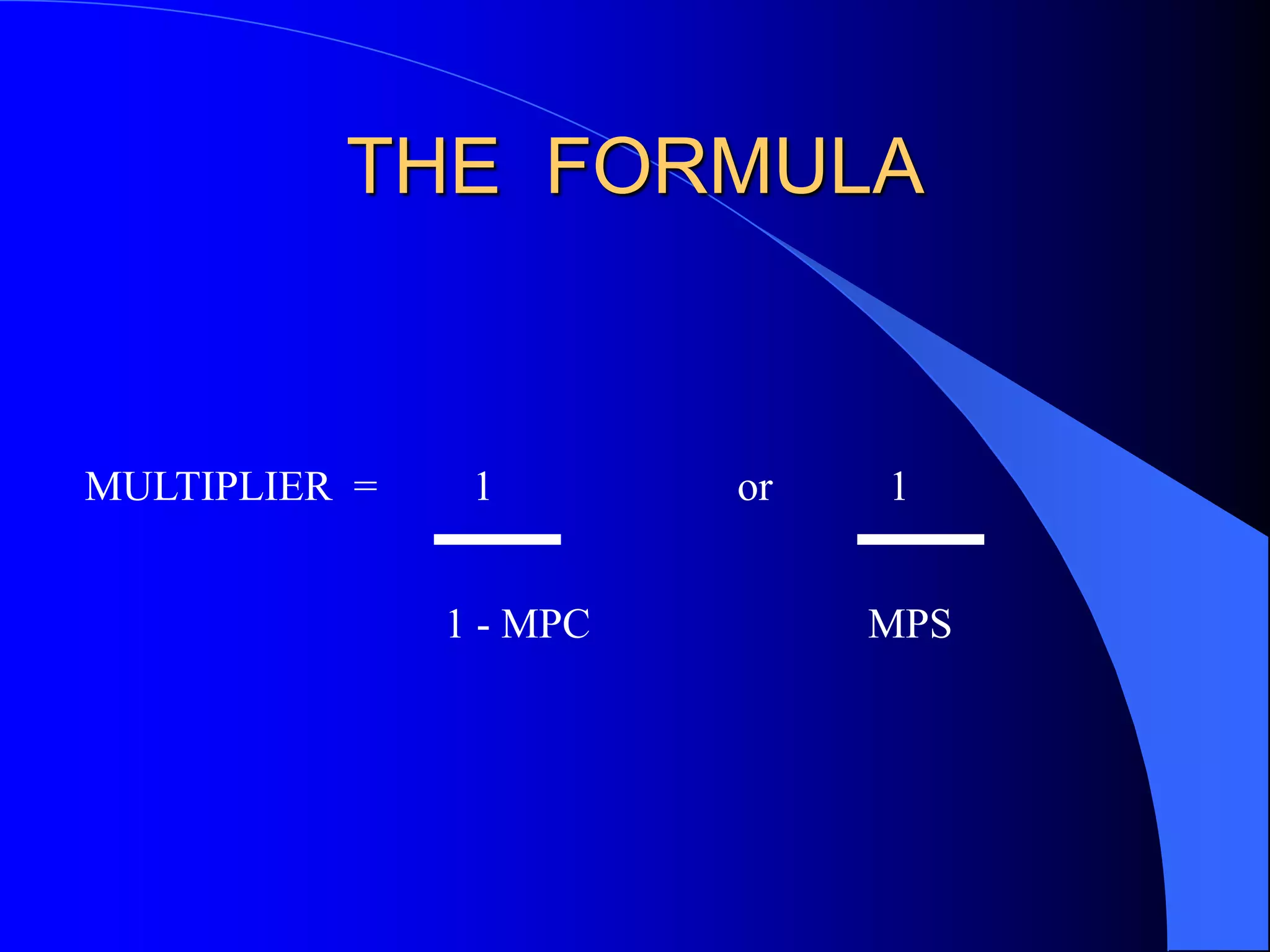
THE FORMULA
MULTIPLIER = 1 or 1
1 - MPC MPS
EXPANSIONARY FISCAL
POLICY
TO ADDRESS A RECESSIONARY GAP
policy aimed at increasing economic
activity through increasing G &/or
decreasing T to increase AD or
increase SRAS
CONTRACTIONARY FISCAL
POLICY
TO ADDRESS AN INFLATIONARY GAP
policy aimed at decreasing economic
activity through decreasing G &/or
increasing T to decrease AD or
decrease SRAS
Fiscal Policy in Keynesian Theory: Ridding the
Economy of Recessionary Gaps
Fiscal Policy in Keynesian Theory: Ridding the
Economy of Inflationary Gaps
Exhibit 2 (2 of 2)
THE MULTIPLIER EFFECT
both G and T are subject to the
multiplier effect SO a change in
either will lead to an even greater
change in equilibrium real output
(which is equilibrium Y)
THE EXPENDITURE
MULTIPLIER
 1 / 1- MPC or 1 / MPS
 Change in Real GDP =
multiplier x (change in G)
COMMON MULTIPLIERS
MPC .9 .8 .75 .66 .5
EXP
MULT
10 5 4 3 2
EXAMPLE
 Qe = 800 while Qn = 1000
 MPC = .75
 find the G necessary to bring the economy
to natural real GDP
THE TAX MULTIPLIER
 - MPC / MPS or ( 1 - exp. mult.)
 Change in Real GDP
= tax multiplier x (change in T)
EXAMPLE
 Qe = 1200 while Qn = 800
 MPC = .66
 find the T necessary to bring the economy
to full employment GDP
BALANCED BUDGET
MULTIPLIER
if both G & T increase (or decrease)
by the same amount, then equilibrium
real GDP will increase by the amount
of the increase (or decrease) in G
C = 200 + .80(Yd)
I = 300
 Find equilibrium income
 In Qn=3000, identify the following: type of
gap, size, fiscal policy options to close it.
Should Fiscal Policy be Used?
NOT NECESSARILY
 Crowding Out
 Lags
CROWDING OUT
increases in G may lead to decreases
in private sector spending ( C or I )
CROWDING OUT
may occur due to:
 direct substitution
more on public libraries  fewer books at
bookstores
 interest rate effects
more on social programs and defense budget
deficit increases  government’s demand for
credit rises  interest rate rises  investment
drops
Lags and Discretionary Fiscal
Policy
 The data lag: not aware of changes in the economy
as soon as they happened
 The wait-and-see lag: adopt a more cautious
attitude
 The legislative lag
 The transmission lag: take time to be put into
effect
 The effectiveness lag: take time to affect the
economy
KEYNESIAN PERSPECTIVE
 fiscal policy is effective
 crowding out is relatively small
 lags are short
CLASSICAL PERSPECTIVE
 fiscal policy is ineffective
 crowding out is significant
 lags are long
FISCAL POLICY
 Discretionary Fiscal Policy
DISCRETIONARY FISCAL
POLICY
 deliberate changes in G and/or T to achieve
particular objectives
 requires new action by Congress
FISCAL POLICY
 Discretionary Fiscal Policy
 Automatic Stabilizers
AUTOMATIC STABILIZERS
 changes in G and/or T that occur
automatically as economic conditions
change
 these changes do not require new action by
Congress
Four Types of Fiscal Policy
Automatic
Discretionary
Expansionary Contractionary
Policy Makers G
or T
or both
Policy Makers G
or T
or both
Unemployment
Compensation
Welfare Payments
Unemployment
Compensation
Welfare Payments
(1) (2)
(3) (4)
The New Classical View Of
Fiscal Policy
 crowding out does occur as people save
more in anticipation of higher taxes
 these adjustments cause expansionary fiscal
policy to be ineffective.
SUPPLY SIDE POLICY
 dislike demand side policies because
increases in AD means growth comes with
higher prices
 prefer to focus on tax issues which alter
incentives to work, save, and invest
What Are the Major Federal
Taxes?
 Personal income tax
 Corporate income tax
 Social security tax
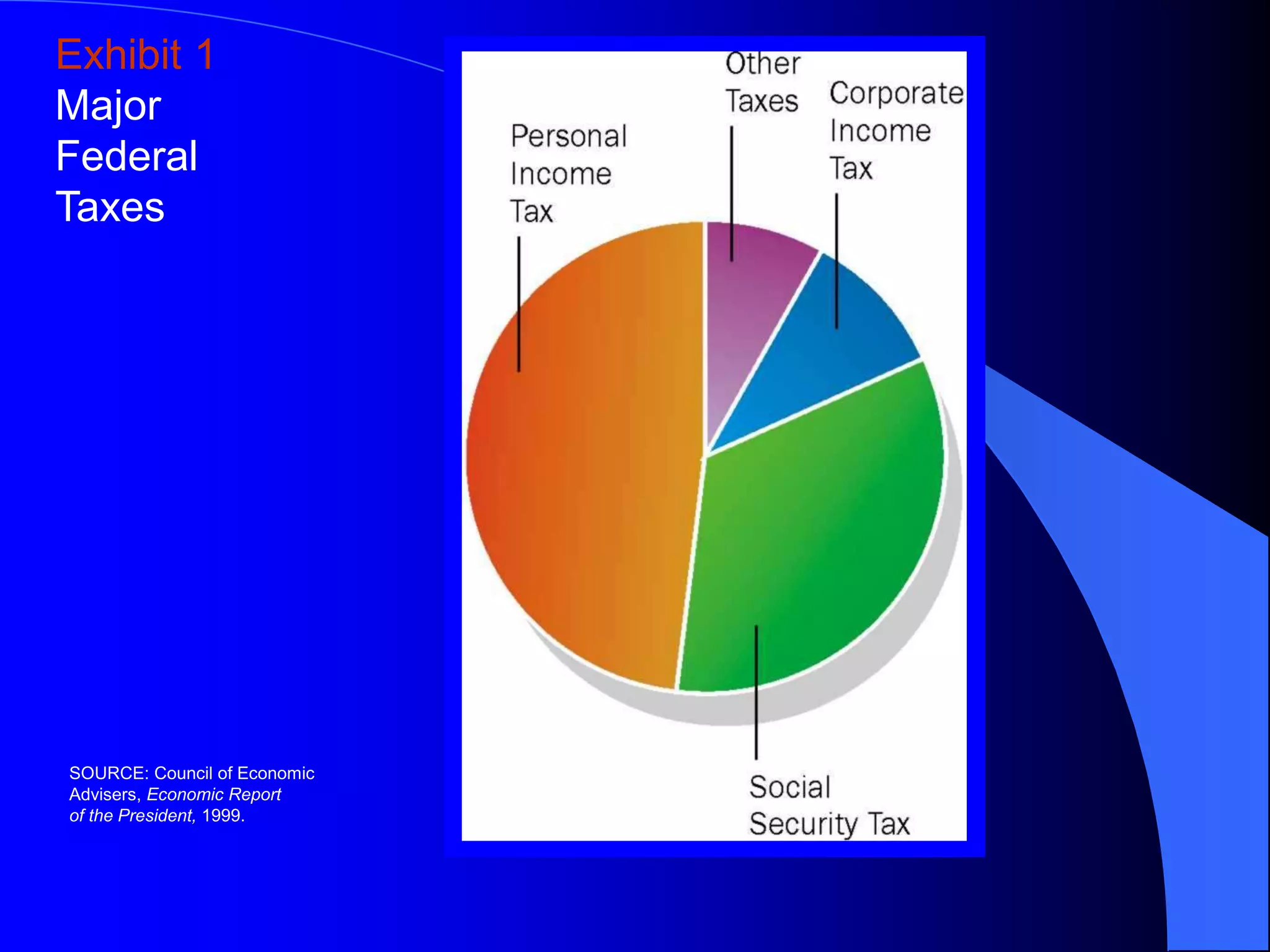
Exhibit 1
Major
Federal
Taxes
SOURCE: Council of Economic
Advisers, Economic Report
of the President, 1999.
MARGINAL TAX RATE
 tax rate applied to additional income
 change in tax payment divided by the
change in taxable income
Three
Income
Tax
Structures
MARGINAL TAX RATES AND
FISCAL POLICY
 decreasing marginal tax rates leads to an
increase in SRAS
b/c increases the incentive to work
 if the tax change is permanent, then the
change in AS is too
 the LRAS will shift to the right
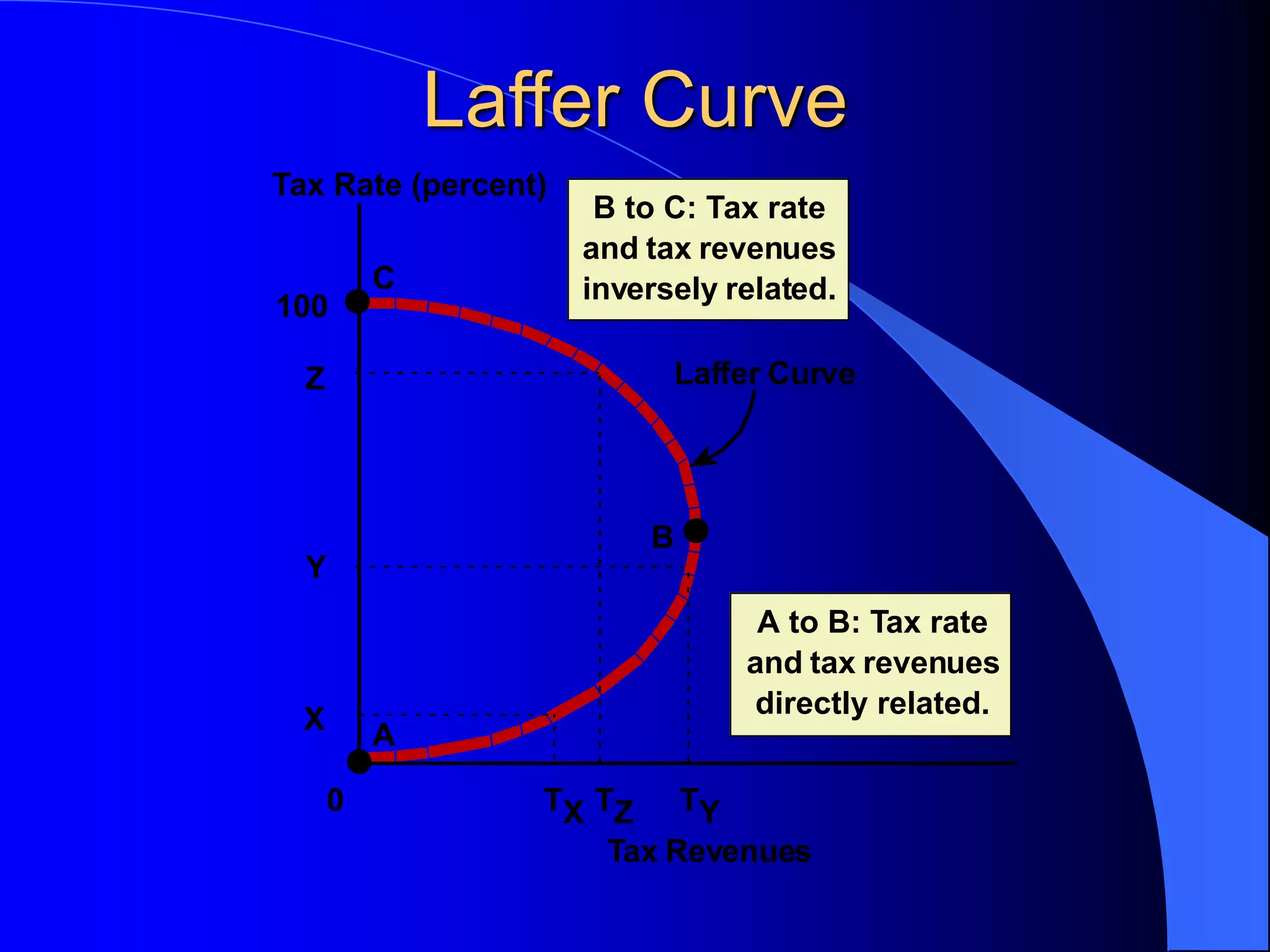
Laffer Curve
TX
Tax Rate (percent)
Tax Revenues
0
A
Laffer Curve
C
X
B
TZ TY
Y
Z
100
B to C: Tax rate
and tax revenues
inversely related.
A to B: Tax rate
and tax revenues
directly related.
What are the Major Federal
Government Spending
Programs?
 National defense
 Income security
 Health
 Medicare
 Social security
 Net interest on the National Debt
Exhibit 3
Major Federal
Spending
Programs
SOURCE: Council of Economic
Advisers, Economic Report
of the President, 1999.
DEBT AND DEFICITS
 BUDGET DEFICITS occur when
government expenditures exceed tax
receipts
 A BUDGET SURPLUS occurs when tax
receipts exceed government expenditures
CYCLICAL DEFICITS
 The portion of the deficit that is a result of
an economic downturn
 many economists (Keynes) believe that
deficits are natural and necessary during
recessions because tax revenues fall and
benefit payments rise
 Our problem is that we have continued to
run deficits in expansionary periods
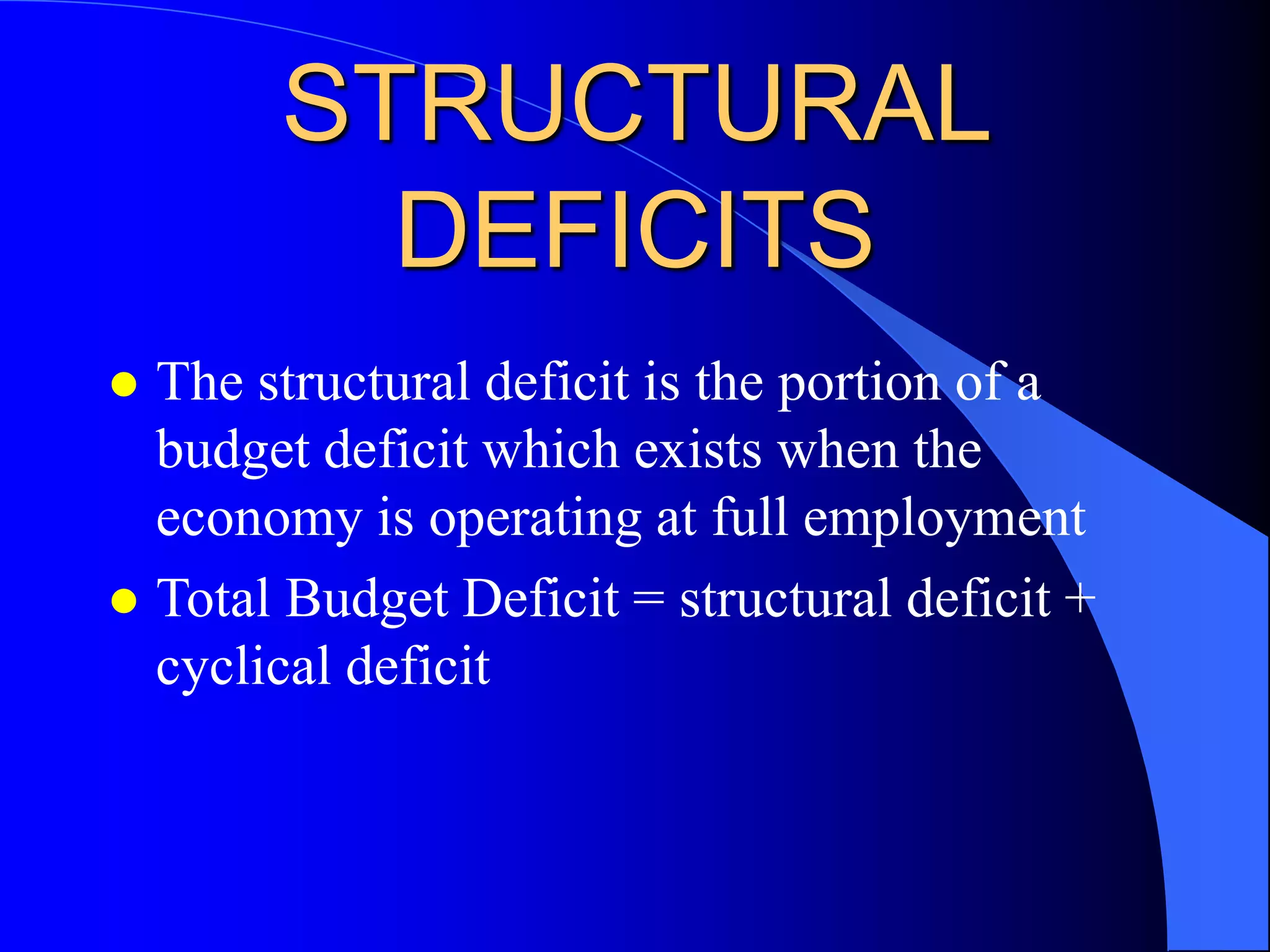
STRUCTURAL
DEFICITS
 The structural deficit is the portion of a
budget deficit which exists when the
economy is operating at full employment
 Total Budget Deficit = structural deficit +
cyclical deficit
National Debt
 NATIONAL DEBT is the total sum of what
the federal government owes its creditors
(the sum of past deficits)
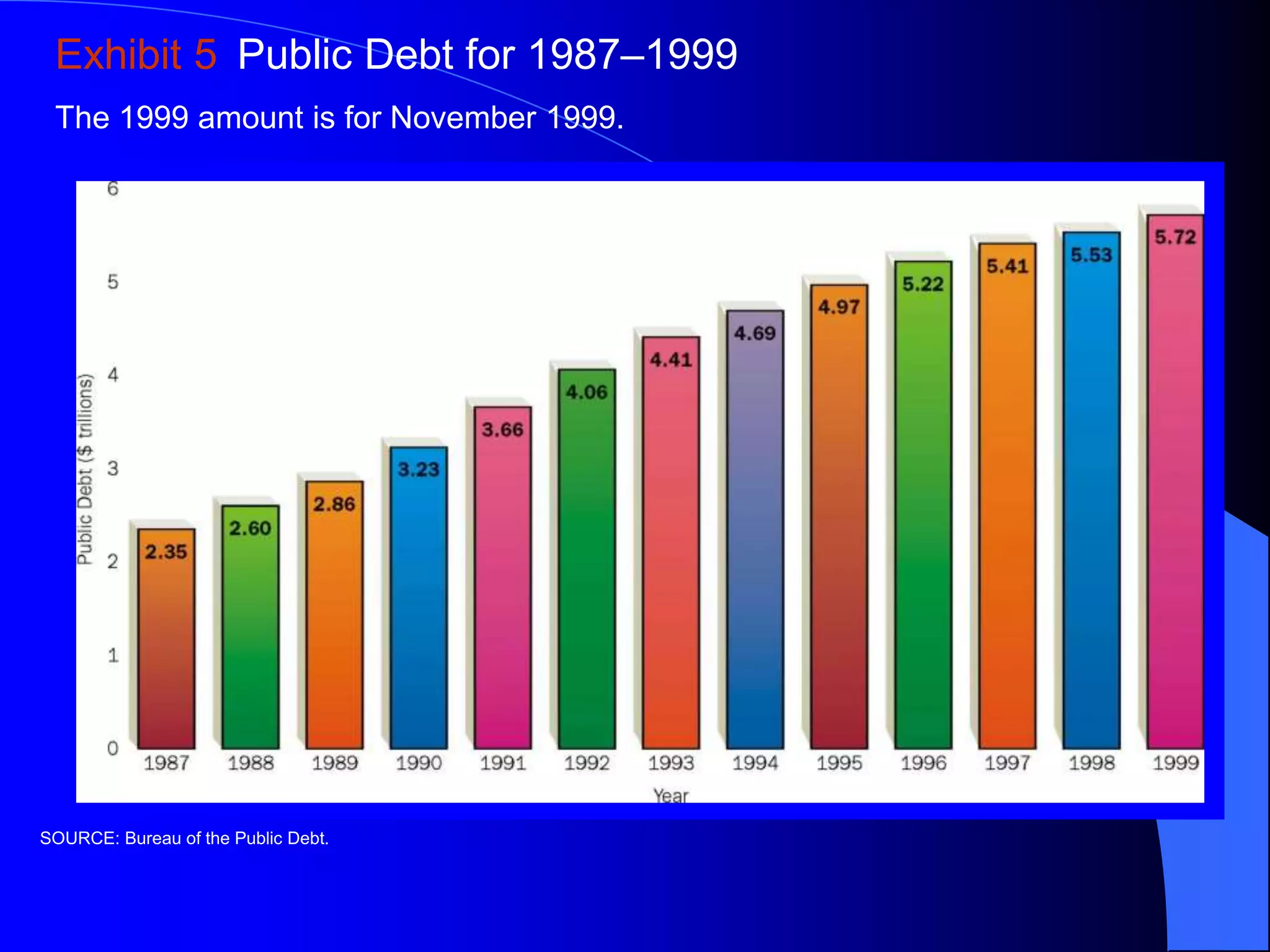
Exhibit 5 Public Debt for 1987–1999
The 1999 amount is for November 1999.
SOURCE: Bureau of the Public Debt.
NATIONAL DEBT
 As the debt grows, interest on the debt
grows in its share of the budget.
 The portion of the budget that can be cut in
order to balance the budget is SHRINKING
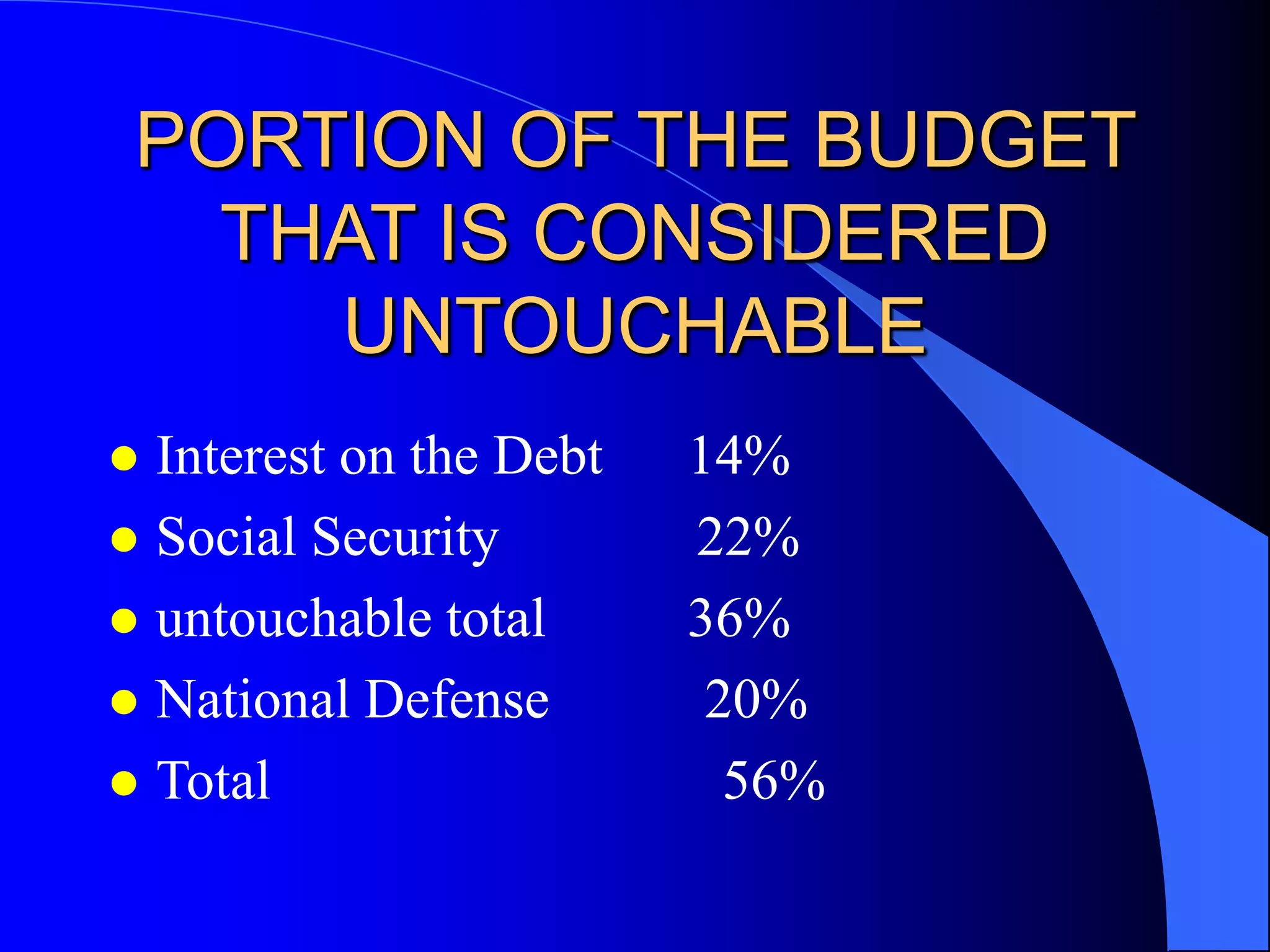
PORTION OF THE BUDGET
THAT IS CONSIDERED
UNTOUCHABLE
 Interest on the Debt 14%
 Social Security 22%
 untouchable total 36%
 National Defense 20%
 Total 56%
WHO BEARS THE BURDEN
OF THE DEBT?
 CURRENT GENERATION - if crowding
out occurs then households are giving up
consumption to pay for increases
government spending
 FUTURE GENERATIONS - will have to
pay higher taxes to pay off the bonds when
they come due. They bear the cost while
the bondholders receive the payoffs.
COUNTERPOINT
 WE-OWE-IT-TO -OURSELVES - if
American taxpayers make payments to
American bondholders, money is simply
shifted from one pocket to another.
 Only works if debt is held domestically
(currently 14-18% is held by foreigners)

Keynes_Fiscal.PPT

  • 1.
  • 2.
  • 3.
  • 4.
  • 5.
    Answer the following: What is Say’s law?  What three things must be flexible in the Classical model?  What is the Classical solution for too much unemployment?  How does the self-regulating economy get out of a recessionary gap?
  • 6.
  • 7.
    KEYNESIAN ECONOMICS  J.M. Keynes wrote during the Great Depression  Keynes focused on the demand side of the economy  Keynes did not believe that the economy was necessarily self-correcting
  • 8.
    KEYNES ON WAGESAND PRICES  Keynes believed that wages and prices were STICKY DOWNWARD  The lack of wage and price flexibility suggested that the economy might get STUCK in a recessionary gap.  Keynes tended to focus on the short run because  “IN THE LONG RUN WE ARE ALL DEAD”
  • 9.
    KEYNES AND INCOME Keynes focused his analysis on Total Expenditures in the economy  In particular, he focused on Consumption  CONSUMPTION is a function of DISPOSABLE INCOME  SAVING is also determined by DISPOSABLE INCOME
  • 10.
    CONSUMPTION AND SAVING TERMS Autonomous Consumption - the portion of consumption that is not related to income (it is the amount of Cons. when income is 0).  MPC - marginal propensity to consume (it is change in C / change in Y)  MPS - marginal propensity to save (it is the change in saving / change in Y)
  • 11.
    CONSUMPTION AND SAVING TERMS Break-even income - the level of disposable income where consumption spending is just equal to disposable income.  C = Yd  S must be zero
  • 12.
    EQUATION FOR CAND S  C = a + b(Yd)  Consumption = autonomous consumption + the MPC * (disposable income)  S = -a + (1-b)(Yd)  Saving = negative autonomous consumption + MPS * ( disposable income)
  • 13.
    EXAMPLE  C =100 + .75 (Yd)  Find Aut. Cons., MPC, MPS, and C and S when Yd=1000.  Aut. Cons. = 100  MPC = .75 MPS = .25  C = 100 + .75 (1000) = 100 + 750 = 850
  • 14.
    CONSUMPTION FUNCTION INCOME CONS.SAVING 0 100 -100 100 180 -80 200 260 -60 300 340 -40 500 500 0 600 580 20
  • 15.
     Find MPC Find MPS  Find Autonomous Consumption  Give the equation for consumption  Give the equation for saving  Find breakeven income  Find C and S when income is 700
  • 16.
    CONSUMPTION FUNCTION  Achange in Disposable Income causes a MOVEMENT ALONG the Consumption Function  A change in Autonomous Consumption causes a SHIFT of the Consumption Function
  • 17.
    SAVING  SAVING isthe unspent portion of a consumer’s income.  SAVING = Income - Consumption Exp.
  • 18.
    INVESTMENT 2 components  Capitalgoods (producer durables) - goods used by businesses to produce other goods and services. They have an expected service life of more than one year.  Inventory investment - changes in the stocks of finished goods, goods in process, and in raw materials a firm keeps on hand.
  • 20.
    TOTAL EXPENDITURES  TotalExpenditures = C + I + G + (X-M)  C depends on Disp. Y  S depends on Disp. Y  Disp. Y = C + S  I depends on the interest rate ( not Y )  G is assumed to be autonomous
  • 21.
    EQUILIBRIUM  TOTAL EXPENDITURES are equal to  TOTAL PRODUCTION  is equal to  INCOME
  • 22.
    DISEQUILIBRIUM TOTAL OUTPUT <TOTAL EXPENDITURES  unplanned inventories  production  employment  Real GDP  income
  • 23.
    DISEQUILIBRIUM TOTAL OUTPUT >TOTAL EXPENDITURES  unplanned inventories  production  employment  Real GDP  income
  • 24.
    C = 200+ .80(Yd) I = 300  Find Autonomous Cons., MPC, and MPS  Find breakeven income  Find equilibrium income  In Qn=3000, identify the following: type of gap, size.
  • 25.
    THE MULTIPLIER A dollarinjected into the economy (i.e. investment) has an impact beyond the initial expenditures. The dollar continues to be spent multiplying its impact on the economy. The number of times it circulates through the economy is known as THE MULTIPLIER.
  • 26.
    THE MULTIPLIER cont. Therate of circulation is related to the MPC and MPS. The larger the MPC, the more consumption rises as a result of an increase in income. This will result in a larger MULTIPLIER.
  • 27.
    Autonomous Government Spending &the Multiplier Exhibit 12 (1) EXPENDITURE ROUND (2) CHANGE IN AUTONOMOUS GOVERNMENT SPENDING (3) CHANGE IN REAL NATIONAL INCOME OR REAL GDP ($ millions) (4) MPC (5) CHANGE IN CONSUMPTION ($ millions) Round 1 Round 2 Round 3 Round 4 $60.00 $ 60.00 48.00 38.40 30.72 .80 .80 .80 .80 $ 48.00 38.40 30.72 24.57 . . . . . . . . . . . . . . . . . . . . . . . . . . . . . . . . All other 122.88 .80 98.88 TOTAL $300.00 $240.00 (Approx.
  • 28.
    THE FORMULA MULTIPLIER =1 or 1 1 - MPC MPS
  • 29.
    EXPANSIONARY FISCAL POLICY TO ADDRESSA RECESSIONARY GAP policy aimed at increasing economic activity through increasing G &/or decreasing T to increase AD or increase SRAS
  • 30.
    CONTRACTIONARY FISCAL POLICY TO ADDRESSAN INFLATIONARY GAP policy aimed at decreasing economic activity through decreasing G &/or increasing T to decrease AD or decrease SRAS
  • 31.
    Fiscal Policy inKeynesian Theory: Ridding the Economy of Recessionary Gaps
  • 32.
    Fiscal Policy inKeynesian Theory: Ridding the Economy of Inflationary Gaps Exhibit 2 (2 of 2)
  • 33.
    THE MULTIPLIER EFFECT bothG and T are subject to the multiplier effect SO a change in either will lead to an even greater change in equilibrium real output (which is equilibrium Y)
  • 34.
    THE EXPENDITURE MULTIPLIER  1/ 1- MPC or 1 / MPS  Change in Real GDP = multiplier x (change in G)
  • 35.
    COMMON MULTIPLIERS MPC .9.8 .75 .66 .5 EXP MULT 10 5 4 3 2
  • 36.
    EXAMPLE  Qe =800 while Qn = 1000  MPC = .75  find the G necessary to bring the economy to natural real GDP
  • 37.
    THE TAX MULTIPLIER - MPC / MPS or ( 1 - exp. mult.)  Change in Real GDP = tax multiplier x (change in T)
  • 38.
    EXAMPLE  Qe =1200 while Qn = 800  MPC = .66  find the T necessary to bring the economy to full employment GDP
  • 39.
    BALANCED BUDGET MULTIPLIER if bothG & T increase (or decrease) by the same amount, then equilibrium real GDP will increase by the amount of the increase (or decrease) in G
  • 40.
    C = 200+ .80(Yd) I = 300  Find equilibrium income  In Qn=3000, identify the following: type of gap, size, fiscal policy options to close it.
  • 41.
    Should Fiscal Policybe Used? NOT NECESSARILY  Crowding Out  Lags
  • 42.
    CROWDING OUT increases inG may lead to decreases in private sector spending ( C or I )
  • 43.
    CROWDING OUT may occurdue to:  direct substitution more on public libraries  fewer books at bookstores  interest rate effects more on social programs and defense budget deficit increases  government’s demand for credit rises  interest rate rises  investment drops
  • 44.
    Lags and DiscretionaryFiscal Policy  The data lag: not aware of changes in the economy as soon as they happened  The wait-and-see lag: adopt a more cautious attitude  The legislative lag  The transmission lag: take time to be put into effect  The effectiveness lag: take time to affect the economy
  • 45.
    KEYNESIAN PERSPECTIVE  fiscalpolicy is effective  crowding out is relatively small  lags are short
  • 46.
    CLASSICAL PERSPECTIVE  fiscalpolicy is ineffective  crowding out is significant  lags are long
  • 47.
  • 48.
    DISCRETIONARY FISCAL POLICY  deliberatechanges in G and/or T to achieve particular objectives  requires new action by Congress
  • 49.
    FISCAL POLICY  DiscretionaryFiscal Policy  Automatic Stabilizers
  • 50.
    AUTOMATIC STABILIZERS  changesin G and/or T that occur automatically as economic conditions change  these changes do not require new action by Congress
  • 51.
    Four Types ofFiscal Policy Automatic Discretionary Expansionary Contractionary Policy Makers G or T or both Policy Makers G or T or both Unemployment Compensation Welfare Payments Unemployment Compensation Welfare Payments (1) (2) (3) (4)
  • 52.
    The New ClassicalView Of Fiscal Policy  crowding out does occur as people save more in anticipation of higher taxes  these adjustments cause expansionary fiscal policy to be ineffective.
  • 53.
    SUPPLY SIDE POLICY dislike demand side policies because increases in AD means growth comes with higher prices  prefer to focus on tax issues which alter incentives to work, save, and invest
  • 54.
    What Are theMajor Federal Taxes?  Personal income tax  Corporate income tax  Social security tax
  • 55.
    Exhibit 1 Major Federal Taxes SOURCE: Councilof Economic Advisers, Economic Report of the President, 1999.
  • 56.
    MARGINAL TAX RATE tax rate applied to additional income  change in tax payment divided by the change in taxable income
  • 57.
  • 58.
    MARGINAL TAX RATESAND FISCAL POLICY  decreasing marginal tax rates leads to an increase in SRAS b/c increases the incentive to work  if the tax change is permanent, then the change in AS is too  the LRAS will shift to the right
  • 59.
    Laffer Curve TX Tax Rate(percent) Tax Revenues 0 A Laffer Curve C X B TZ TY Y Z 100 B to C: Tax rate and tax revenues inversely related. A to B: Tax rate and tax revenues directly related.
  • 60.
    What are theMajor Federal Government Spending Programs?  National defense  Income security  Health  Medicare  Social security  Net interest on the National Debt
  • 61.
    Exhibit 3 Major Federal Spending Programs SOURCE:Council of Economic Advisers, Economic Report of the President, 1999.
  • 62.
    DEBT AND DEFICITS BUDGET DEFICITS occur when government expenditures exceed tax receipts  A BUDGET SURPLUS occurs when tax receipts exceed government expenditures
  • 63.
    CYCLICAL DEFICITS  Theportion of the deficit that is a result of an economic downturn  many economists (Keynes) believe that deficits are natural and necessary during recessions because tax revenues fall and benefit payments rise  Our problem is that we have continued to run deficits in expansionary periods
  • 64.
    STRUCTURAL DEFICITS  The structuraldeficit is the portion of a budget deficit which exists when the economy is operating at full employment  Total Budget Deficit = structural deficit + cyclical deficit
  • 65.
    National Debt  NATIONALDEBT is the total sum of what the federal government owes its creditors (the sum of past deficits)
  • 66.
    Exhibit 5 PublicDebt for 1987–1999 The 1999 amount is for November 1999. SOURCE: Bureau of the Public Debt.
  • 67.
    NATIONAL DEBT  Asthe debt grows, interest on the debt grows in its share of the budget.  The portion of the budget that can be cut in order to balance the budget is SHRINKING
  • 68.
    PORTION OF THEBUDGET THAT IS CONSIDERED UNTOUCHABLE  Interest on the Debt 14%  Social Security 22%  untouchable total 36%  National Defense 20%  Total 56%
  • 69.
    WHO BEARS THEBURDEN OF THE DEBT?  CURRENT GENERATION - if crowding out occurs then households are giving up consumption to pay for increases government spending  FUTURE GENERATIONS - will have to pay higher taxes to pay off the bonds when they come due. They bear the cost while the bondholders receive the payoffs.
  • 70.
    COUNTERPOINT  WE-OWE-IT-TO -OURSELVES- if American taxpayers make payments to American bondholders, money is simply shifted from one pocket to another.  Only works if debt is held domestically (currently 14-18% is held by foreigners)