Multiple Sclerosis,pathogenesis
M. MAHDY
WE SHOULD CATCH UPTHESE POINTS
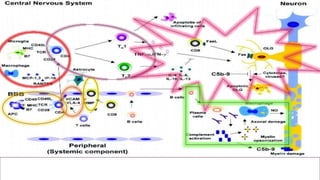
• Pathogenesis of MS (IMMUNO-PATHOGENESIS)
WE SHOULD CATCH UPTHESE POINTS
• Pathogenesis of MS (IMMUNO-PATHOGENESIS)
• Pathophysiology of MS symptoms
WE SHOULD CATCH UPTHESE POINTS
• Pathogenesis of MS (IMMUNO-PATHOGENESIS)
• Pathophysiology of MS symptoms
• Enigmatic aspects of pathogenesis
WE SHOULD CATCH UPTHESE POINTS
• Pathogenesis of MS (IMMUNO-PATHOGENESIS)
• Pathophysiology of MS symptoms
• Enigmatic aspects of pathogenesis
• Remyelination
Senior must help
junior
LIFE OFT
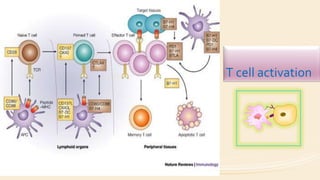
T cell activation
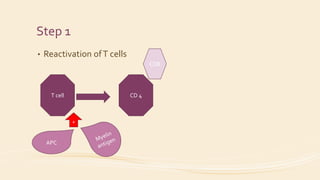
Step 1
• Reactivation ofT cells
T cell
+
APC
CD 4
CD8
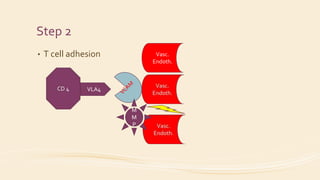
Step 2
• T cell adhesion
VLA4
Vasc.
Endoth.
M
M
P
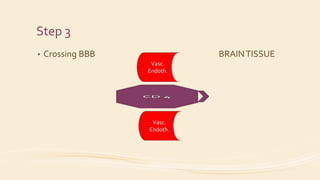
Step 3
• Crossing BBB BRAINTISSUE
Step 4
• CNS reactivation
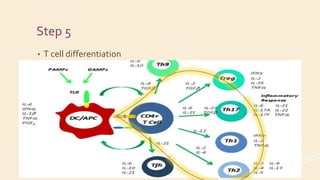
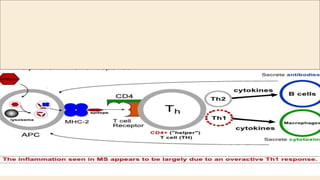
Step 5
• T cell differentiation
Step 6
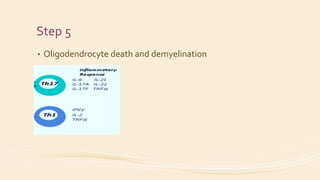
• Oligodendrocyte death and demyelination
Step 5
• Oligodendrocyte death and demyelination
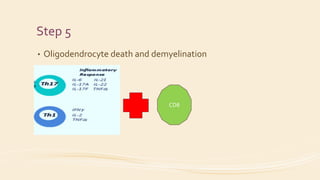
Step 5
• Oligodendrocyte death and demyelination
CD8
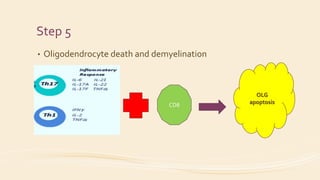
Step 5
• Oligodendrocyte death and demyelination
CD8
OLG
apoptosis
Step 7
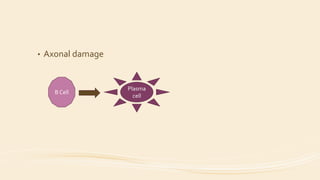
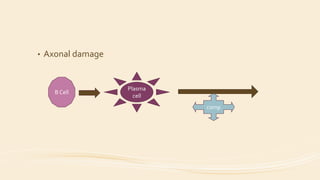
• Axonal damage
• Axonal damage
B Cell
• Axonal damage
B Cell
Plasma
cell
• Axonal damage
B Cell
Plasma
cell
comp
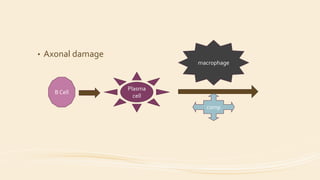
• Axonal damage
B Cell
Plasma
cell
comp
macrophage
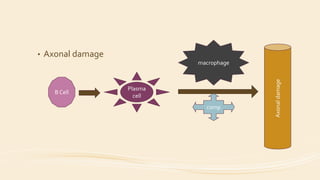
• Axonal damage
B Cell
Plasma
cell
comp
macrophage
Axonaldamage
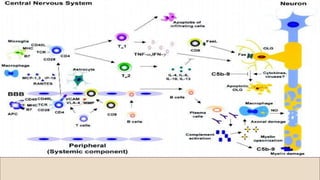
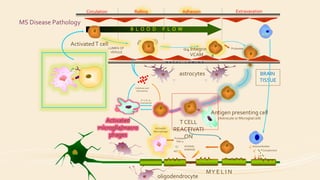
Extravasation
astrocytes BRAIN
TISSUE
MY E L I N
oligodendrocyte
B cell
Rolling Adhesion
a4 Integrin
VCAM
B L O O D F L O W
LUMEN OF
VENULE
B A S A L L A M I N A
Circulation
ActivatedT cell
Proteases
Antigen presenting cell
(Astrocyte or Microglial cell)
Activated
microglia/macro
phages
T CELL
REACTIVATI
ON
Activated
Macrophage
Autoantibodies
Complement
IL-1, IL-12,
chemokines
Cytokines and
chemokines
Proteases
TNF-a
O2
•-
NO•
AXONAL
DAMAGE
MS Disease Pathology
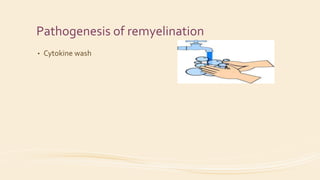
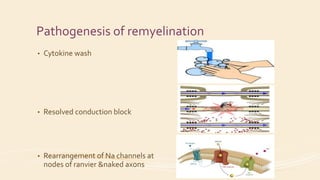
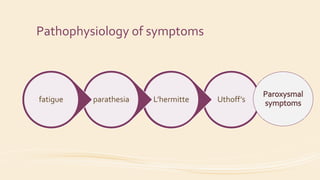
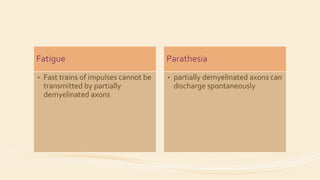
Pathogenesis of remyelination
• Cytokine wash

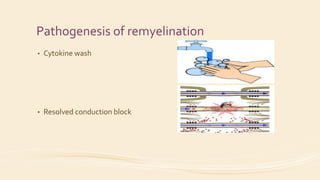
Pathogenesis of remyelination
• Cytokine wash

• Resolved conduction block
Pathogenesis of remyelination
• Cytokine wash
• Resolved conduction block
• Rearrangement of Na channels at
nodes of ranvier &naked axons
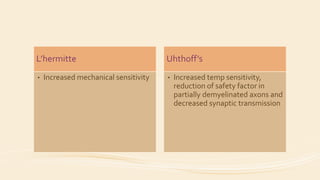
Pathophysiology of symptoms
Uthoff’sL’hermitteparathesiafatigue
Fatigue
• Fast trains of impulses cannot be
transmitted by partially
demyelinated axons
Parathesia
• partially demyelinated axons can
discharge spontaneously
L’hermitte
• Increased mechanical sensitivity
Uhthoff’s
• Increased temp sensitivity,
reduction of safety factor in
partially demyelinated axons and
decreased synaptic transmission
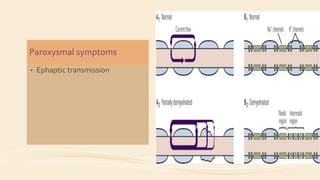
Paroxysmal symptoms
• Ephaptic transmission
Enigmatic aspects
• Areas of demyelination can be clinically
silent.
• Areas without demyelination can produce
symptoms
• Discrepancy between :
• anatomical correlation of symptoms
and signs analysis and radiological findings
Multiple sclerosis, pathogenesis

Multiple sclerosis, pathogenesis