The Multiple Intelligences
&
Memorizing Vocabulary
When we teach, we should do our best to
cater for all our students' needs by providing
necessary materials and activities to suit their
different intelligences.
A blend of activities which cater for all
students' intelligences is the best strategy,
technique, teaching practice.
Teachers need to know how to create interest
and awareness among students and plan
activities or materials that cater for students'
intelligences and needs.
Verbal-Linguistic
Intelligence
 Using the words they have learned in dialogues
they create
Repeating the words over and over and over again
Creating poems
Creating and telling stories
Highlighting words
Rewriting
Logical-Mathematical
Intelligence
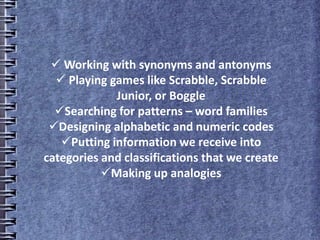
 Working with synonyms and antonyms
 Playing games like Scrabble, Scrabble
Junior, or Boggle
Searching for patterns – word families
Designing alphabetic and numeric codes
Putting information we receive into
categories and classifications that we create
Making up analogies
Visual-Spatial
Intelligence
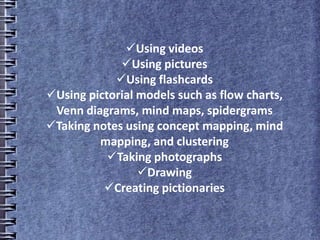
Using videos
Using pictures
Using flashcards
Using pictorial models such as flow charts,
Venn diagrams, mind maps, spidergrams
Taking notes using concept mapping, mind
mapping, and clustering
Taking photographs
Drawing
Creating pictionaries
Musical
Intelligence
 Using songs
Working with jazz chants
Writing songs
Using rhythm and clapping
Remembering vocabulary words
by linking them to similar-sounding
words in our mind
Creating rhythms out of words
Bodily-Kinesthetic
Intelligence
Playing games such as hot seat
Building objects using blocks, cubes, or
Legos to represent words
Creating games to learn information
Interpersonal
Intelligence
Working in cooperative groups
Working in pairs
Interviewing people
Tutoring younger students or classmates
Discussing what we learn with a friend
or family member
Having someone quiz us before an exam
Creating or joining a study group
Intrapersonal
Intelligence
Writing reflective papers on
content-area topics.
 Keeping journals
Finding a place to study where we
won’t be interrupted
Keeping ourselves involved in
assignments by individualizing each
project
Naturalistic
Intelligence
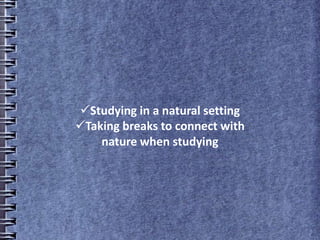
Studying in a natural setting
Taking breaks to connect with
nature when studying
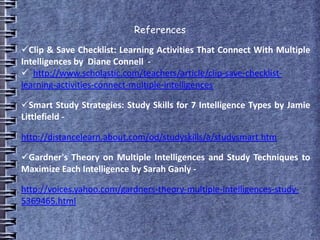
References
Clip & Save Checklist: Learning Activities That Connect With Multiple
Intelligences by Diane Connell -
 http://www.scholastic.com/teachers/article/clip-save-checklist-
learning-activities-connect-multiple-intelligences
Smart Study Strategies: Study Skills for 7 Intelligence Types by Jamie
Littlefield -
http://distancelearn.about.com/od/studyskills/a/studysmart.htm
Gardner's Theory on Multiple Intelligences and Study Techniques to
Maximize Each Intelligence by Sarah Ganly -
http://voices.yahoo.com/gardners-theory-multiple-intelligences-study-
5369465.html

Multiple Intelligences and Memorizing Vocabulary - British Council Malaysia - PDP 4 ELT - Selangor 14

  • 1.
  • 2.
    When we teach,we should do our best to cater for all our students' needs by providing necessary materials and activities to suit their different intelligences. A blend of activities which cater for all students' intelligences is the best strategy, technique, teaching practice. Teachers need to know how to create interest and awareness among students and plan activities or materials that cater for students' intelligences and needs.
  • 3.
  • 4.
     Using thewords they have learned in dialogues they create Repeating the words over and over and over again Creating poems Creating and telling stories Highlighting words Rewriting
  • 5.
  • 6.
     Working withsynonyms and antonyms  Playing games like Scrabble, Scrabble Junior, or Boggle Searching for patterns – word families Designing alphabetic and numeric codes Putting information we receive into categories and classifications that we create Making up analogies
  • 7.
  • 8.
    Using videos Using pictures Usingflashcards Using pictorial models such as flow charts, Venn diagrams, mind maps, spidergrams Taking notes using concept mapping, mind mapping, and clustering Taking photographs Drawing Creating pictionaries
  • 9.
  • 10.
     Using songs Workingwith jazz chants Writing songs Using rhythm and clapping Remembering vocabulary words by linking them to similar-sounding words in our mind Creating rhythms out of words
  • 11.
  • 12.
    Playing games suchas hot seat Building objects using blocks, cubes, or Legos to represent words Creating games to learn information
  • 13.
  • 14.
    Working in cooperativegroups Working in pairs Interviewing people Tutoring younger students or classmates Discussing what we learn with a friend or family member Having someone quiz us before an exam Creating or joining a study group
  • 15.
  • 16.
    Writing reflective paperson content-area topics.  Keeping journals Finding a place to study where we won’t be interrupted Keeping ourselves involved in assignments by individualizing each project
  • 17.
  • 18.
    Studying in anatural setting Taking breaks to connect with nature when studying
  • 19.
    References Clip & SaveChecklist: Learning Activities That Connect With Multiple Intelligences by Diane Connell -  http://www.scholastic.com/teachers/article/clip-save-checklist- learning-activities-connect-multiple-intelligences Smart Study Strategies: Study Skills for 7 Intelligence Types by Jamie Littlefield - http://distancelearn.about.com/od/studyskills/a/studysmart.htm Gardner's Theory on Multiple Intelligences and Study Techniques to Maximize Each Intelligence by Sarah Ganly - http://voices.yahoo.com/gardners-theory-multiple-intelligences-study- 5369465.html