






D
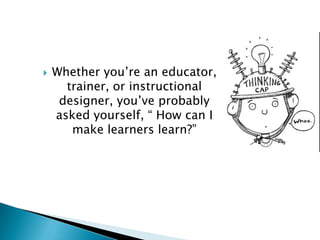
   Whether you‟re an educator,
      trainer, or instructional
     designer, you‟ve probably
    asked yourself, “ How can I
       make learners learn?”
Where to find it?
The Creator gathered all of creation and said, „ I want to hide
something form the humans until they are READY for it! It is
the realization that that create their Own Reality‟

The eagle said ,‟Give it to me, I will take it to the moon,‟ The
creator said, „NO. One day they will go there and find it.‟
The salmon said, „ I will hide it on the bottom of the ocean.‟
the buffalo said, „ I will bury it on the great Plains.‟ The Creator
said, „No. They will go there too.‟

The Grand-Mother Mole, who lives in the breast of Mother
earth, and who has no physical eyes but sees with spiritual
eyes, said, „Put it Inside them.‟ And the creator said, “It is
done.‟


                                                  Sioux Legend
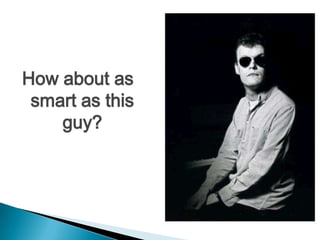
How about as
 smart as this
    guy?
Who is this guy?
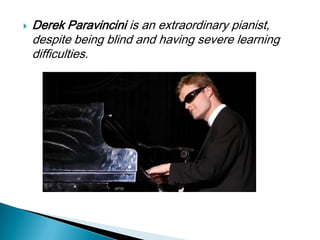
   Derek Paravincini is an extraordinary pianist,
    despite being blind and having severe learning
    difficulties.
Being Derek Paravincini………
   Paravicini was born extremely prematurely, at 25
    weeks. His blindness was caused by oxygen
    therapy given during his time in a neonatal
    intensive care unit. This also affected his
    developing brain, resulting in his severe learning
    disability.He also has autism.
   At the age of nine, Paravicini had his first major
    public concert at the Barbican Hall in London

   PRETTY IMPRESSIVE!!!
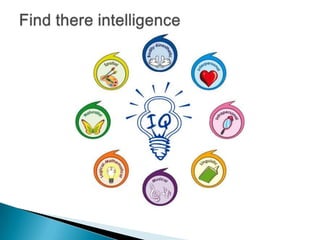
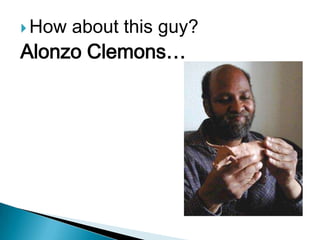
 How   about this guy?
Alonzo Clemons…
   Alonzo Clemons is an American animal sculptor
   Clemons suffered a severe brain injury as a child
    that left him developmentally disabled (with an IQ
    in the 40-50 range), but able to create very
    accurate animal sculptures out of clay only by
    glimpsing it.
   He is most well known for his life-size renderings
    of a horse, but most of his works are smaller, and
    accomplished in less than an hour.
   Derek and Alonzo are unable to
    accomplish the simplest reading,
    writing, or mathematical tasks. But both
    possess incredible skills that surpass
    those with the highest IQ’s.
   Both of these men are savants . Although
    they both have severe mental disabilities,
    they also have extraordinary mental abilities
    not found in most of the people.


                  How can we explain
                  something like this?
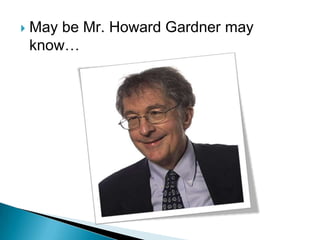
   May be Mr. Howard Gardner may
    know…
   He Studied situations like these to help him
    develop his “ Theory of Multiple Intelligences”.
   He looks outside the traditional definition of
    intelligence to see what really makes people tick.
   A learner who excels in an area is not more
    intelligent overall than one who struggles.
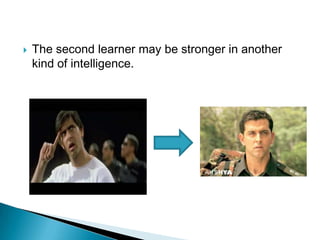
   The second learner may be stronger in another
    kind of intelligence.
   We have probably all heard some one say
    something like “I’m a math person.” This person is
    identifying the type of intelligence at which they’re
    strongest

   So are non-math people unable to succeed in
    mathematical subjects?
   Absolutely not!
   The beauty of Dr. Gardner’s theory is that it guides
    us to alternatives in teaching!

   The second learner may best learn the material
       through a different approach .
   We all have potential to be intelligent in any type
    of intelligence.

   However, we may be stronger in some more than
    others.
   Our cultures focuses most of its attention on
    linguistic and logical- mathematical intelligence.
   Dr. Gardner suggests we place equal attention on
    other types of intelligence which give the world…
   Musicians
   Architects
   Naturalists
   Artists
   Designers
   Dancers
   Artisans
   To name a few……
   Ok.. So we know that his theory says there are
    different intelligences.

   And we know that the degree of our intelligences
    varies between each type of intelligence.
   So what are they already!?
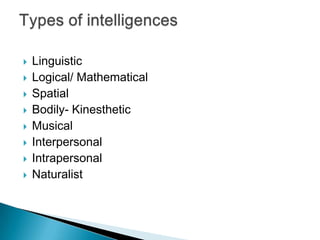
   Linguistic
   Logical/ Mathematical
   Spatial
   Bodily- Kinesthetic
   Musical
   Interpersonal
   Intrapersonal
   Naturalist
   Whoa….


   Now let’s break that down.
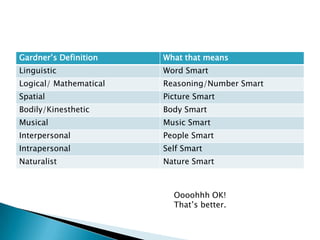
Gardner‟s Definition    What that means
Linguistic              Word Smart
Logical/ Mathematical   Reasoning/Number Smart
Spatial                 Picture Smart
Bodily/Kinesthetic      Body Smart
Musical                 Music Smart
Interpersonal           People Smart
Intrapersonal           Self Smart
Naturalist              Nature Smart


                          Oooohhh OK!
                          That‟s better.
   But how do you teach to these types of
    intelligences?
   Regardless of the topic, you can appeal to each
    type of intelligence.

   Simply find what matters to them!

   But remember, teach to all these styles, not just
    the dominant style of your classroom!
                Let’s see what matters….
   Words matter!
   Spoke or written, words help these learners think
    and remember.
   Poets, lawyers, and speakers are likely to be word
    smart.
   Todd learns best when he reads about a new
    subject and has a chance to think about the words
    he just read. It also helps him to speak about
    topics and teach others.
   Numbers matter!
   These learners analyze problems logically and
    investigate issues scientifically.
   Jason likes to solve problems through using
    logical processes. He can connect concepts to
    one another easily and with little guidance. To
    satisfy his learning needs, all he needs is a
    process and problem. His analytical thinking will
    help him do the rest!
   Recognizing patterns and relationships in space is
    easy for these learners.

   Sketching, painting and multi-media activities keep
    them interested and involved.
   Rajesh is studying to be a photographer. She
    connects the dots between most concepts just like
    she does between spatial relationships!
   To challenge her , ask her to map stories or solve
    visual puzzles. She typically uses organizers and
    charts to help her accomplish her tasks.
   Get these learners moving!
   They want to use their whole bodies to solve
    problems!
   It’s hard for Ravi to sit still for long periods of time.
    To get him involved in his English class (His least
    favorite subject ), his professor asked him to act
    out the most significant act of Hamlet. Ravi read
    and watched videos of the play to help him select
    the best act to perform!
   These learners excel at performance, composition
    and appreciation of musical patterns.
   Sapna gets bored easily. Her advisor
    recommended creating songs to help her
    internalize concepts! She is using this advice and
    also links concepts top thought provoking music
    to help her remember new information. Her
    boredom has decreased, and her grades have
    improved!
   People matter!
   Interpersonal intelligence helps people work well
    with one another because they have the ability to
    relate and understand others.
   Laila can’t wait to talk to her friends after class. To
    keep her attention, her professor built more group
    activities in to class lessons. Most of the class is
    benefiting; Laila especially!
   Intrapersonal learners reflect and relate
    themselves to the greater state of the world.
   Raghav is quiet in class and tends to drift off
    easily. To find out what he is thinking, his
    professor asked him to write short reflections on
    class topics. She discovered Raghav’s exceptional
    skills at theorizing, philosophizing, and evaluating
    his own thinking patterns.
   Some learners naturally recognize, categorize,
    and draw upon certain features of their
    environment.
   Tousif notices things in his environment that
    others tend to miss. To help him learn new
    concepts, his professor draws connection between
    the topic and Tousif’s environment. He is now
    more in tune with his school work just as he’s in
    tune with nature.
   Word Smart
   Reasoning/Number smart
   Picture Smart
   Body Smart
   Music Smart
   People Smart
   Self Smart
   Nature Smart
So what?

-Mindy   L. Kornhaber sums that up for us quite
                                    nicely……
“…… the theory validates educators everyday
  experience: students think and learn in many different
ways….In turn, this reflection has lead many educators
 to devlope new approaches that might better meat the
    needs of the range of learners in their classrooms.”
                                    -Mindy L.K ornhaber
         -Project Zero research team on arts education.
However, some state that Gardners theories are
intuitions rather than the result of empirical research.
True. Tests to measure these intelligences do not
                                   currently exist.
This could be accomalished with several measures or
                          tests for each intelligence.
Gardener himself has not explored this approach to
              prevent labeling and stigmatization.
However , research around the functioning of the brain
  generally continues to support the notion of multiple
                                         intelligences.
Derek Paravicini and Alonzo Clemons are prime
                                          examples.

 Both suffered damage to the brain but still exhibit extra
ordinary intelligences: Derek in musical intelligence and
       Alonzo in kinesthetic and naturalist intelligences.
In fact, Schools using multiple intelligences theory
(SUMIT) have reported higher academic achievements,
                  parental participation, and discipline.
There may be still questions about the theory of
                              multiple intelligences.

    But it has encouraged a singnificant number of
educators to look beyond the narrow confines of the
                                 traditional system.
Dr. Gardner may use fair objective judgment but this
theory helps us broaden our focus and help people live
                                        their lives well.
Traditional methods restrict creativity and don’t reach all
                                                  learners.
Remember, it’s a bout finding what motivates learners
                                so they want to learn.
We are all different…..
And that’s ok ………

But we need to recognize and account for that
There are more than just a few types of learners. We
                         must appeal to all learners.
The multiple intelligences theory motivates educators,
      trainers and instructional designers to improve
                             curriculum and education.
It gives us a broad vision of education.
All intelligences are needed to live .
All intelligences are needed to learn well.


              Give them to your learners.
This theory gives learners more
opportunities to learn about a
topic.
Traditional curriculum with a single
form of assessment does not
accommodate exploration and
creativity.
But YOU can !
Ultimately, the theory of multiple
intelligences is a useful addition if
used to promote high quality
learning , rather than as an end in
and of itself.
Instead of onw way to teach, think,
dream, and live…we now have
atleast EIGHT!
“I want my children to understand the
world but not just because the world is
facinating and the human mind is
curious. I want them to understand it so
that they will be positioned to make it a
better place”
By Howard Gardner

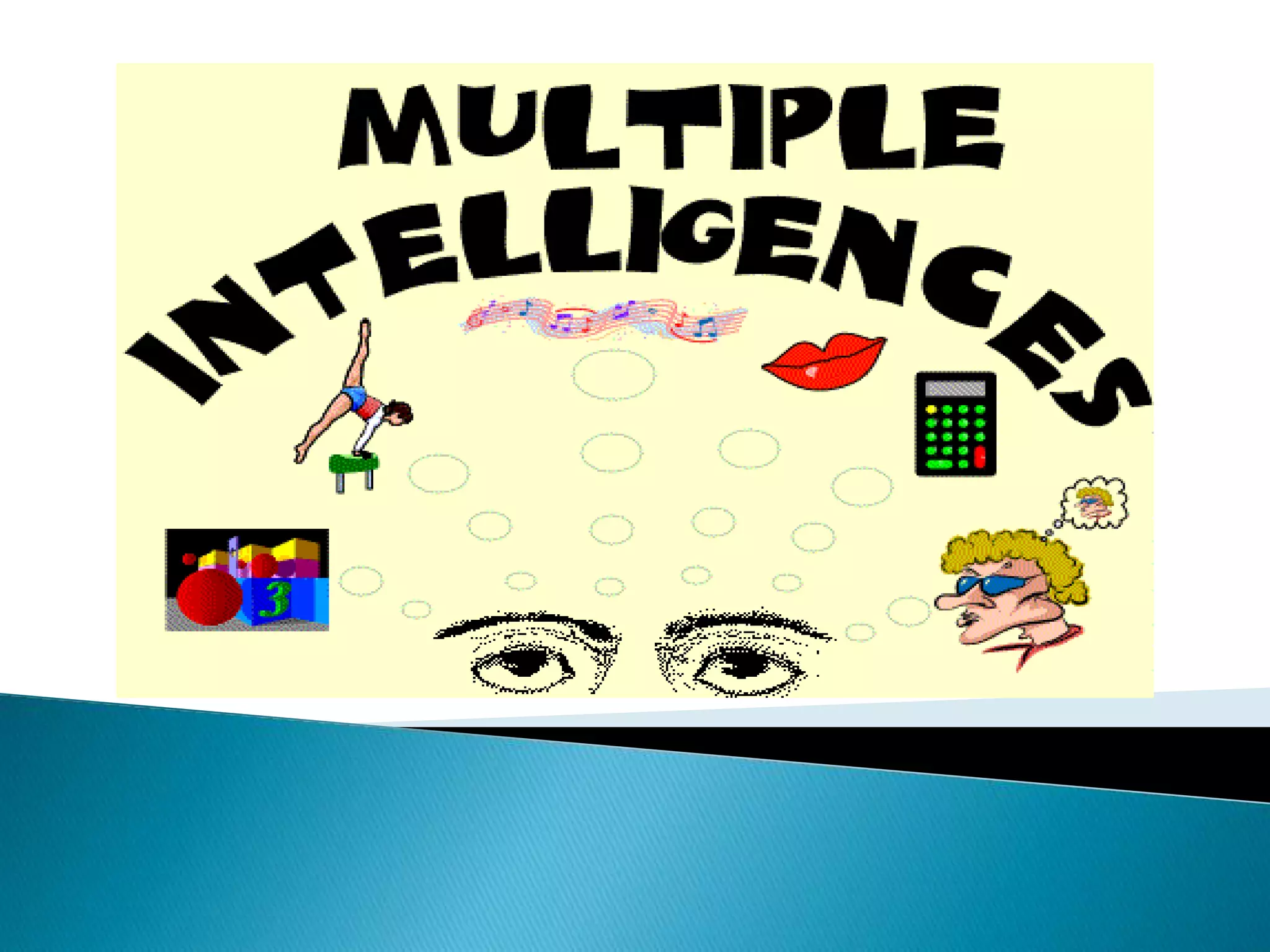
Multiple intelligence

  • 2.
  • 3.
    Whether you‟re an educator, trainer, or instructional designer, you‟ve probably asked yourself, “ How can I make learners learn?”
  • 6.
    Where to findit? The Creator gathered all of creation and said, „ I want to hide something form the humans until they are READY for it! It is the realization that that create their Own Reality‟ The eagle said ,‟Give it to me, I will take it to the moon,‟ The creator said, „NO. One day they will go there and find it.‟ The salmon said, „ I will hide it on the bottom of the ocean.‟ the buffalo said, „ I will bury it on the great Plains.‟ The Creator said, „No. They will go there too.‟ The Grand-Mother Mole, who lives in the breast of Mother earth, and who has no physical eyes but sees with spiritual eyes, said, „Put it Inside them.‟ And the creator said, “It is done.‟ Sioux Legend
  • 9.
    How about as smart as this guy?
  • 10.
  • 11.
    Derek Paravincini is an extraordinary pianist, despite being blind and having severe learning difficulties.
  • 12.
    Being Derek Paravincini………  Paravicini was born extremely prematurely, at 25 weeks. His blindness was caused by oxygen therapy given during his time in a neonatal intensive care unit. This also affected his developing brain, resulting in his severe learning disability.He also has autism.  At the age of nine, Paravicini had his first major public concert at the Barbican Hall in London  PRETTY IMPRESSIVE!!!
  • 13.
     How about this guy? Alonzo Clemons…
  • 14.
    Alonzo Clemons is an American animal sculptor  Clemons suffered a severe brain injury as a child that left him developmentally disabled (with an IQ in the 40-50 range), but able to create very accurate animal sculptures out of clay only by glimpsing it.  He is most well known for his life-size renderings of a horse, but most of his works are smaller, and accomplished in less than an hour.
  • 15.
    Derek and Alonzo are unable to accomplish the simplest reading, writing, or mathematical tasks. But both possess incredible skills that surpass those with the highest IQ’s.
  • 16.
    Both of these men are savants . Although they both have severe mental disabilities, they also have extraordinary mental abilities not found in most of the people. How can we explain something like this?
  • 17.
    May be Mr. Howard Gardner may know…
  • 18.
    He Studied situations like these to help him develop his “ Theory of Multiple Intelligences”.  He looks outside the traditional definition of intelligence to see what really makes people tick.
  • 19.
    A learner who excels in an area is not more intelligent overall than one who struggles.
  • 20.
    The second learner may be stronger in another kind of intelligence.
  • 21.
    We have probably all heard some one say something like “I’m a math person.” This person is identifying the type of intelligence at which they’re strongest  So are non-math people unable to succeed in mathematical subjects?
  • 22.
    Absolutely not!
  • 23.
    The beauty of Dr. Gardner’s theory is that it guides us to alternatives in teaching!  The second learner may best learn the material through a different approach .
  • 24.
    We all have potential to be intelligent in any type of intelligence.  However, we may be stronger in some more than others.
  • 25.
    Our cultures focuses most of its attention on linguistic and logical- mathematical intelligence.
  • 26.
    Dr. Gardner suggests we place equal attention on other types of intelligence which give the world…
  • 27.
    Musicians
  • 28.
    Architects
  • 29.
    Naturalists
  • 30.
    Artists
  • 31.
    Designers
  • 32.
    Dancers
  • 33.
    Artisans
  • 34.
    To name a few……
  • 35.
    Ok.. So we know that his theory says there are different intelligences.  And we know that the degree of our intelligences varies between each type of intelligence.
  • 36.
    So what are they already!?
  • 37.
    Linguistic  Logical/ Mathematical  Spatial  Bodily- Kinesthetic  Musical  Interpersonal  Intrapersonal  Naturalist
  • 38.
    Whoa….  Now let’s break that down.
  • 39.
    Gardner‟s Definition What that means Linguistic Word Smart Logical/ Mathematical Reasoning/Number Smart Spatial Picture Smart Bodily/Kinesthetic Body Smart Musical Music Smart Interpersonal People Smart Intrapersonal Self Smart Naturalist Nature Smart Oooohhh OK! That‟s better.
  • 40.
    But how do you teach to these types of intelligences?
  • 41.
    Regardless of the topic, you can appeal to each type of intelligence.  Simply find what matters to them!  But remember, teach to all these styles, not just the dominant style of your classroom!  Let’s see what matters….
  • 42.
    Words matter!  Spoke or written, words help these learners think and remember.  Poets, lawyers, and speakers are likely to be word smart.
  • 43.
    Todd learns best when he reads about a new subject and has a chance to think about the words he just read. It also helps him to speak about topics and teach others.
  • 44.
    Numbers matter!  These learners analyze problems logically and investigate issues scientifically.
  • 45.
    Jason likes to solve problems through using logical processes. He can connect concepts to one another easily and with little guidance. To satisfy his learning needs, all he needs is a process and problem. His analytical thinking will help him do the rest!
  • 46.
    Recognizing patterns and relationships in space is easy for these learners.  Sketching, painting and multi-media activities keep them interested and involved.
  • 47.
    Rajesh is studying to be a photographer. She connects the dots between most concepts just like she does between spatial relationships!  To challenge her , ask her to map stories or solve visual puzzles. She typically uses organizers and charts to help her accomplish her tasks.
  • 48.
    Get these learners moving!  They want to use their whole bodies to solve problems!
  • 49.
    It’s hard for Ravi to sit still for long periods of time. To get him involved in his English class (His least favorite subject ), his professor asked him to act out the most significant act of Hamlet. Ravi read and watched videos of the play to help him select the best act to perform!
  • 50.
    These learners excel at performance, composition and appreciation of musical patterns.
  • 51.
    Sapna gets bored easily. Her advisor recommended creating songs to help her internalize concepts! She is using this advice and also links concepts top thought provoking music to help her remember new information. Her boredom has decreased, and her grades have improved!
  • 52.
    People matter!  Interpersonal intelligence helps people work well with one another because they have the ability to relate and understand others.
  • 53.
    Laila can’t wait to talk to her friends after class. To keep her attention, her professor built more group activities in to class lessons. Most of the class is benefiting; Laila especially!
  • 54.
    Intrapersonal learners reflect and relate themselves to the greater state of the world.
  • 55.
    Raghav is quiet in class and tends to drift off easily. To find out what he is thinking, his professor asked him to write short reflections on class topics. She discovered Raghav’s exceptional skills at theorizing, philosophizing, and evaluating his own thinking patterns.
  • 56.
    Some learners naturally recognize, categorize, and draw upon certain features of their environment.
  • 57.
    Tousif notices things in his environment that others tend to miss. To help him learn new concepts, his professor draws connection between the topic and Tousif’s environment. He is now more in tune with his school work just as he’s in tune with nature.
  • 58.
    Word Smart  Reasoning/Number smart  Picture Smart  Body Smart  Music Smart  People Smart  Self Smart  Nature Smart
  • 59.
    So what? -Mindy L. Kornhaber sums that up for us quite nicely……
  • 60.
    “…… the theoryvalidates educators everyday experience: students think and learn in many different ways….In turn, this reflection has lead many educators to devlope new approaches that might better meat the needs of the range of learners in their classrooms.” -Mindy L.K ornhaber -Project Zero research team on arts education.
  • 61.
    However, some statethat Gardners theories are intuitions rather than the result of empirical research.
  • 62.
    True. Tests tomeasure these intelligences do not currently exist.
  • 63.
    This could beaccomalished with several measures or tests for each intelligence.
  • 64.
    Gardener himself hasnot explored this approach to prevent labeling and stigmatization.
  • 65.
    However , researcharound the functioning of the brain generally continues to support the notion of multiple intelligences.
  • 66.
    Derek Paravicini andAlonzo Clemons are prime examples. Both suffered damage to the brain but still exhibit extra ordinary intelligences: Derek in musical intelligence and Alonzo in kinesthetic and naturalist intelligences.
  • 67.
    In fact, Schoolsusing multiple intelligences theory (SUMIT) have reported higher academic achievements, parental participation, and discipline.
  • 68.
    There may bestill questions about the theory of multiple intelligences. But it has encouraged a singnificant number of educators to look beyond the narrow confines of the traditional system.
  • 69.
    Dr. Gardner mayuse fair objective judgment but this theory helps us broaden our focus and help people live their lives well.
  • 70.
    Traditional methods restrictcreativity and don’t reach all learners.
  • 71.
    Remember, it’s about finding what motivates learners so they want to learn.
  • 72.
    We are alldifferent…..
  • 73.
    And that’s ok……… But we need to recognize and account for that
  • 74.
    There are morethan just a few types of learners. We must appeal to all learners.
  • 75.
    The multiple intelligencestheory motivates educators, trainers and instructional designers to improve curriculum and education.
  • 76.
    It gives usa broad vision of education.
  • 77.
    All intelligences areneeded to live .
  • 78.
    All intelligences areneeded to learn well. Give them to your learners.
  • 79.
    This theory giveslearners more opportunities to learn about a topic.
  • 80.
    Traditional curriculum witha single form of assessment does not accommodate exploration and creativity.
  • 81.
  • 82.
    Ultimately, the theoryof multiple intelligences is a useful addition if used to promote high quality learning , rather than as an end in and of itself.
  • 83.
    Instead of onwway to teach, think, dream, and live…we now have atleast EIGHT!
  • 84.
    “I want mychildren to understand the world but not just because the world is facinating and the human mind is curious. I want them to understand it so that they will be positioned to make it a better place” By Howard Gardner