Strong Baselines for Neural
Semi-supervised Learning
under Domain Shift
Sebastian Ruder Barbara Plank
‣ State-of-the-art domain adaptation approaches
‣ leverage task-specific features
‣ evaluate on proprietary datasets or on a single
benchmark
‣ Only compare against weak baselines
‣ Almost none evaluate against approaches from the
extensive semi-supervised learning (SSL) literature
2
Learning under Domain Shift
‣ How do classics in SSL compare to recent advances?
‣ Can we combine the best of both worlds?
‣ How well do these approaches work on out-of-distribution
data?
3
Revisiting Semi-Supervised Learning
Classics in a Neural World
• Self-training
• (Co-training)
• Tri-training
• Tri-training with disagreement
Bootstrapping algorithms
1. Train model on labeled data.
2. Use confident predictions on unlabeled data
as training examples. Repeat.
5
Self-training
- Error amplification
‣ Calibration
‣ Output probabilities in neural networks are poorly
calibrated.
‣ Throttling (Abney, 2007), i.e. selecting the top n highest
confidence unlabeled examples works best.
‣ Online learning
‣ Training until convergence on labeled data and then on
unlabeled data works best.
6
Self-training variants
7
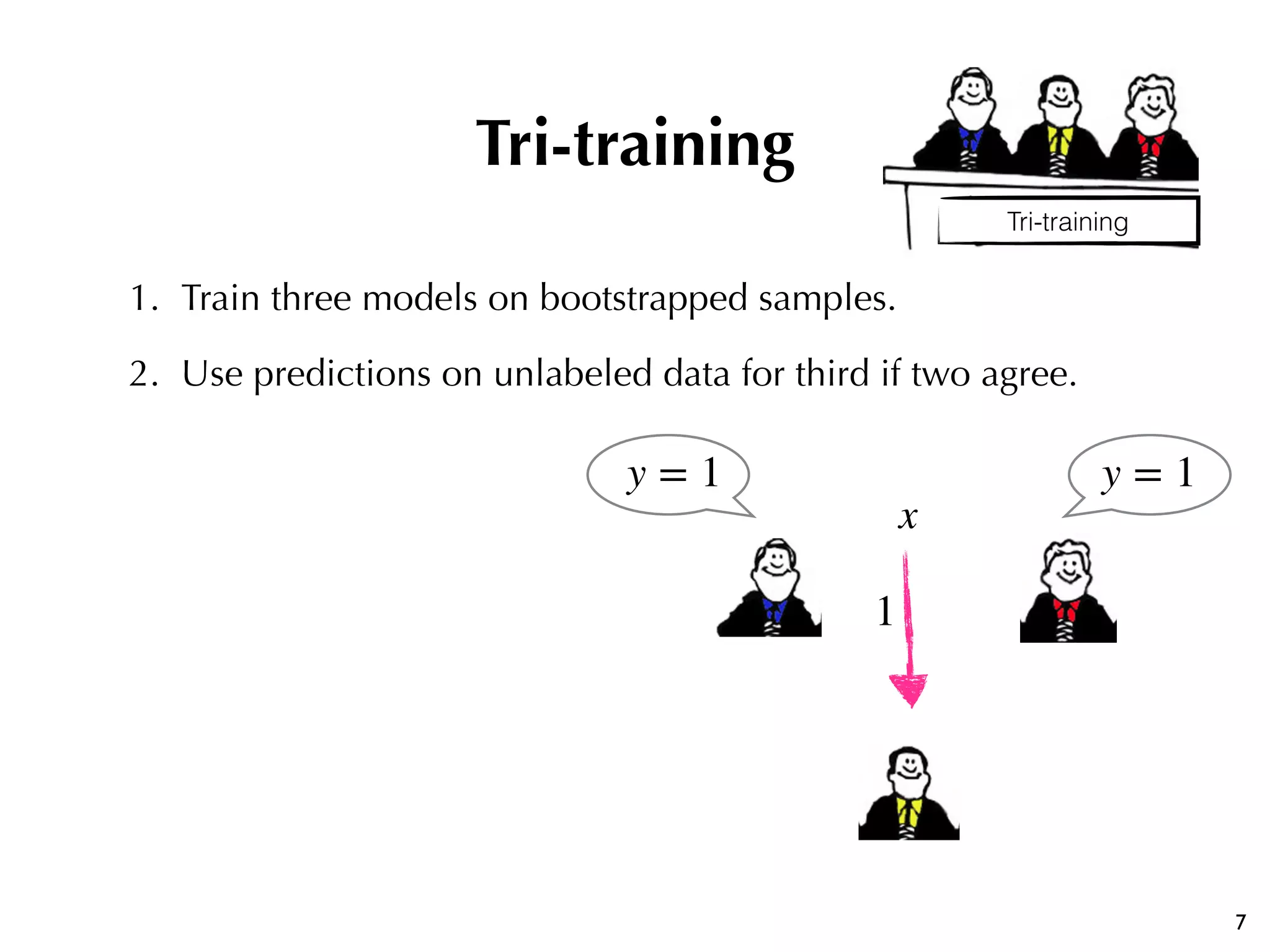
1. Train three models on bootstrapped samples.
2. Use predictions on unlabeled data for third if two agree.
y = 1
x
y = 1
1
Tri-training
Tri-training
8
Tri-training
Tri-training
1. Train three models on bootstrapped samples.
2. Use predictions on unlabeled data for third if two agree.
3. Final prediction: majority voting
Tri-training
y = 1y = 1 y = 0
1
x
Tri-training

with disagreement
9
Tri-training with
disagreement
1. Train three models on bootstrapped samples.
2. Use predictions on unlabeled data for third if two agree
and prediction differs.
y = 1
x
y = 1
1
y = 0
- 3 independent models
‣ Sampling unlabeled data
‣ Producing predictions for all unlabeled examples is
expensive
‣ Sample number of unlabeled examples
‣ Confidence thresholding
‣ Not effective for classic approaches, but essential for
our method
10
Tri-training hyper-parameters
11
y = 1
x
y = 1
1
Multi-task tri-training
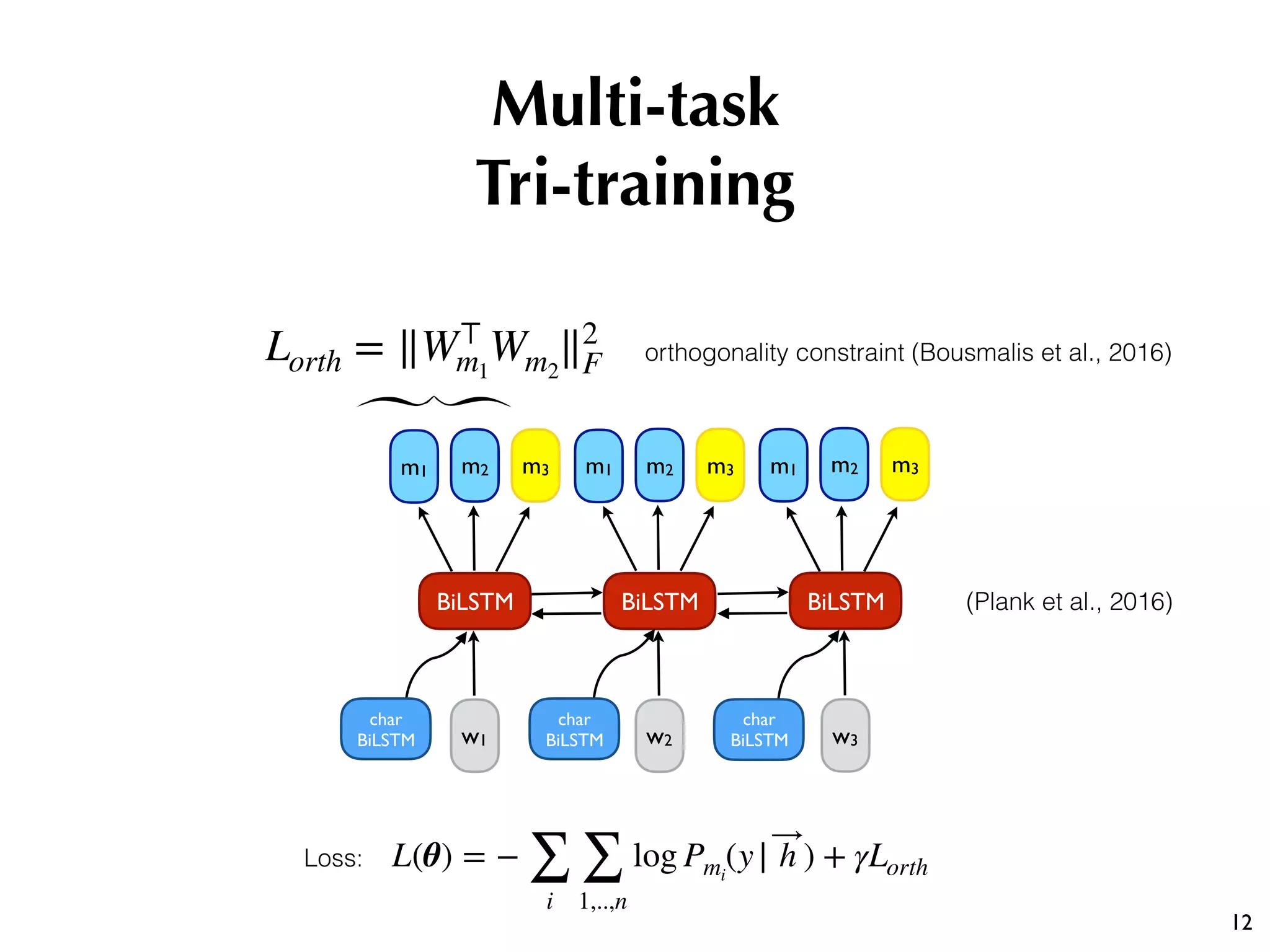
1. Train one model with 3 objective functions.
2. Use predictions on unlabeled data for third if two agree.
Multi-task

Tri-training
3. Restrict final layers to 

use different 

representations.
4. Train third objective 

function only on 

pseudo labeled to 

bridge domain shift.
12
BiLSTM
w2
char
BiLSTM
BiLSTM
w1
char
BiLSTM
BiLSTM
w3
char
BiLSTM
m1 m2 m3 m1 m2 m3 m1 m2 m3
orthogonality constraint (Bousmalis et al., 2016)
Multi-task

Tri-training
Lorth = ∥W⊤
m1
Wm2
∥2
F
L(θ) = −
∑
i
∑
1,..,n
log Pmi
(y| ⃗h ) + γLorthLoss:
(Plank et al., 2016)
13
Data & Tasks
Two tasks: Domains:
Sentiment analysis on Amazon reviews dataset (Blitzer et al, 2006)
POS tagging on SANCL 2012 dataset (Petrov and McDonald, 2012)
Sentiment Analysis Results
Accuracy
75
76.75
78.5
80.25
82
Avg over 4 target domains
VFAE* DANN* Asym* Source only
Self-training Tri-training Tri-training-Disagr. MT-Tri
* result from Saito et al., (2017)
14
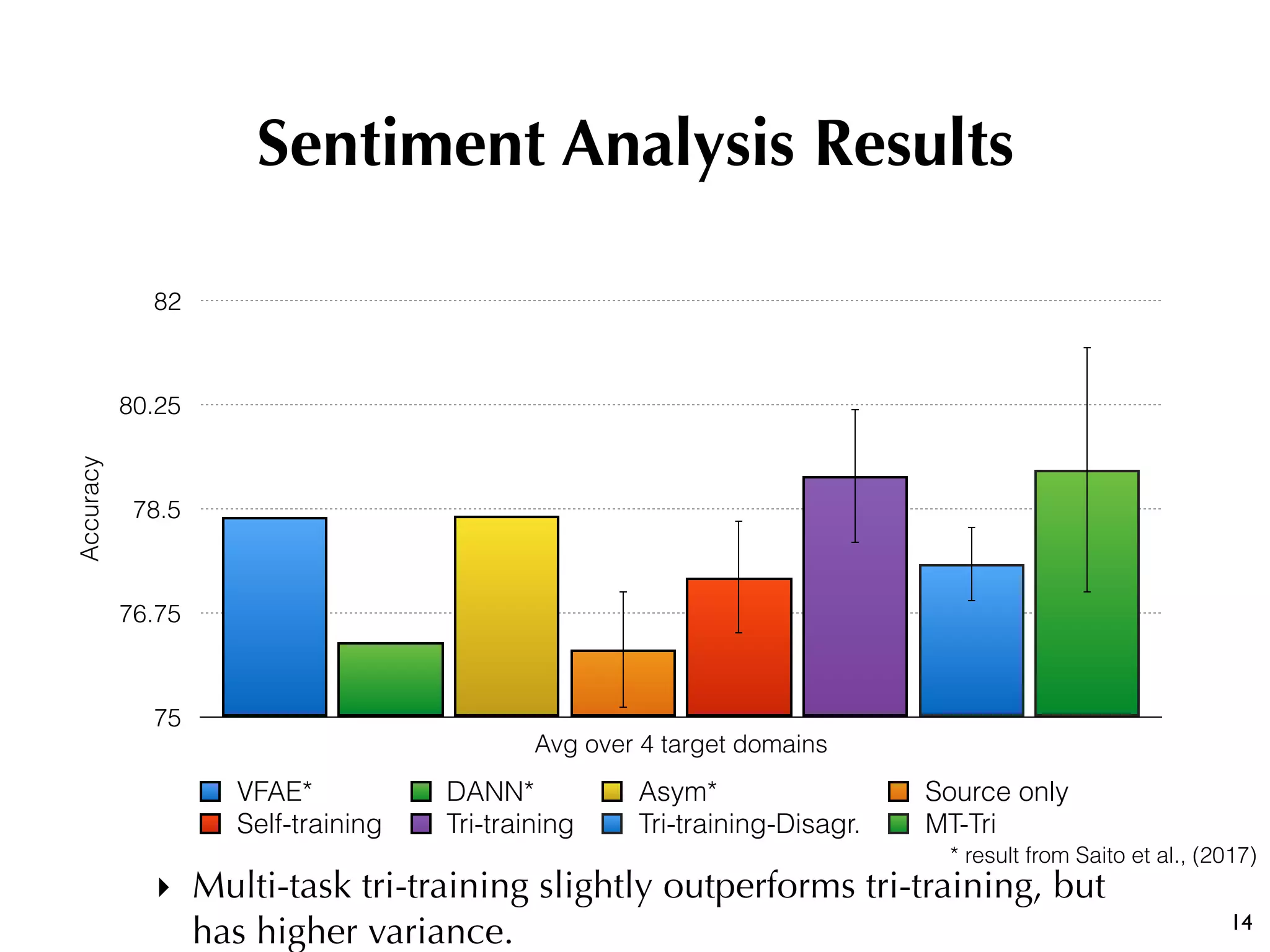
‣ Multi-task tri-training slightly outperforms tri-training, but
has higher variance.
15
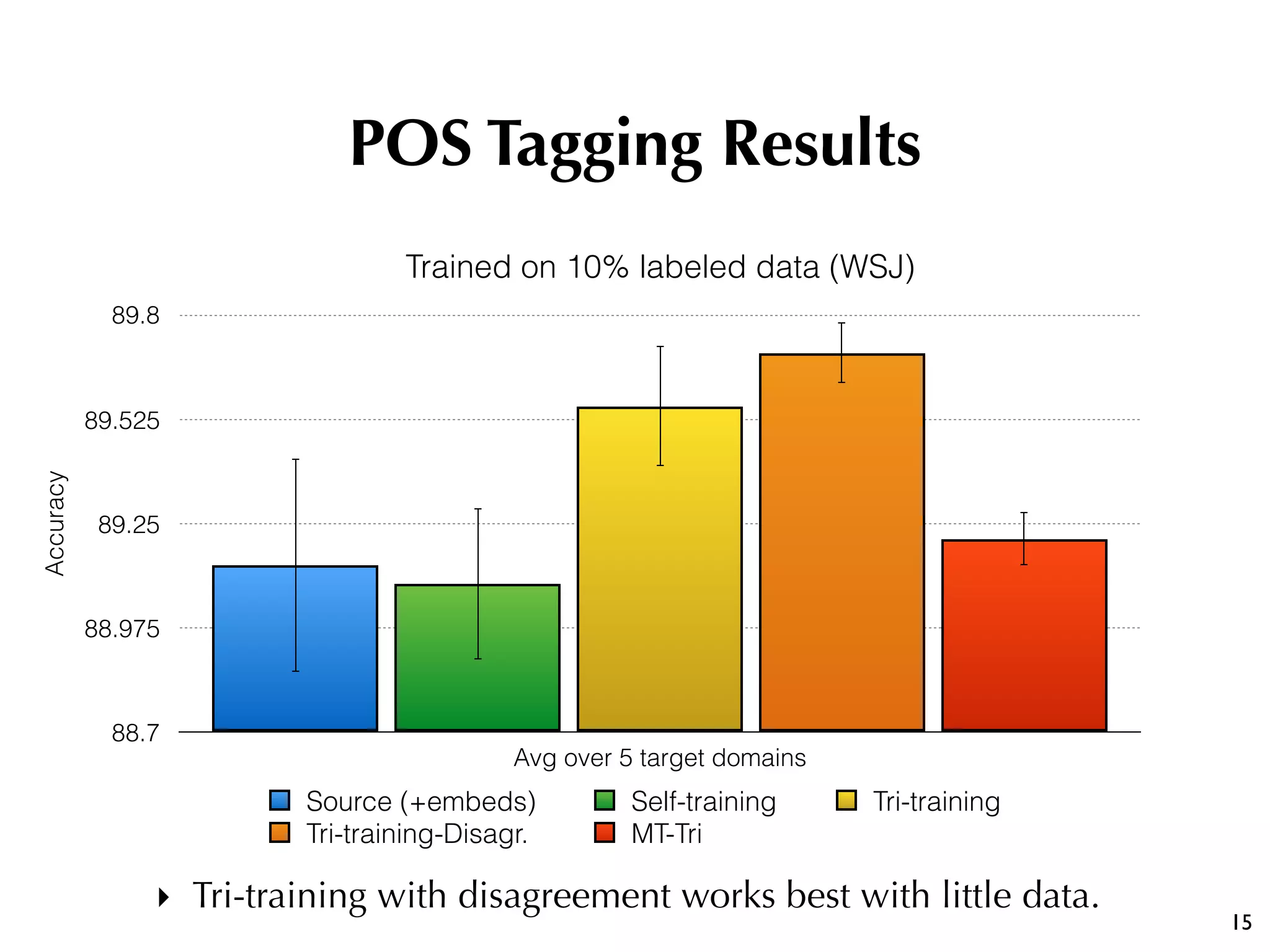
POS Tagging Results
Trained on 10% labeled data (WSJ)
Accuracy
88.7
88.975
89.25
89.525
89.8
Avg over 5 target domains
Source (+embeds) Self-training Tri-training
Tri-training-Disagr. MT-Tri
‣ Tri-training with disagreement works best with little data.
16
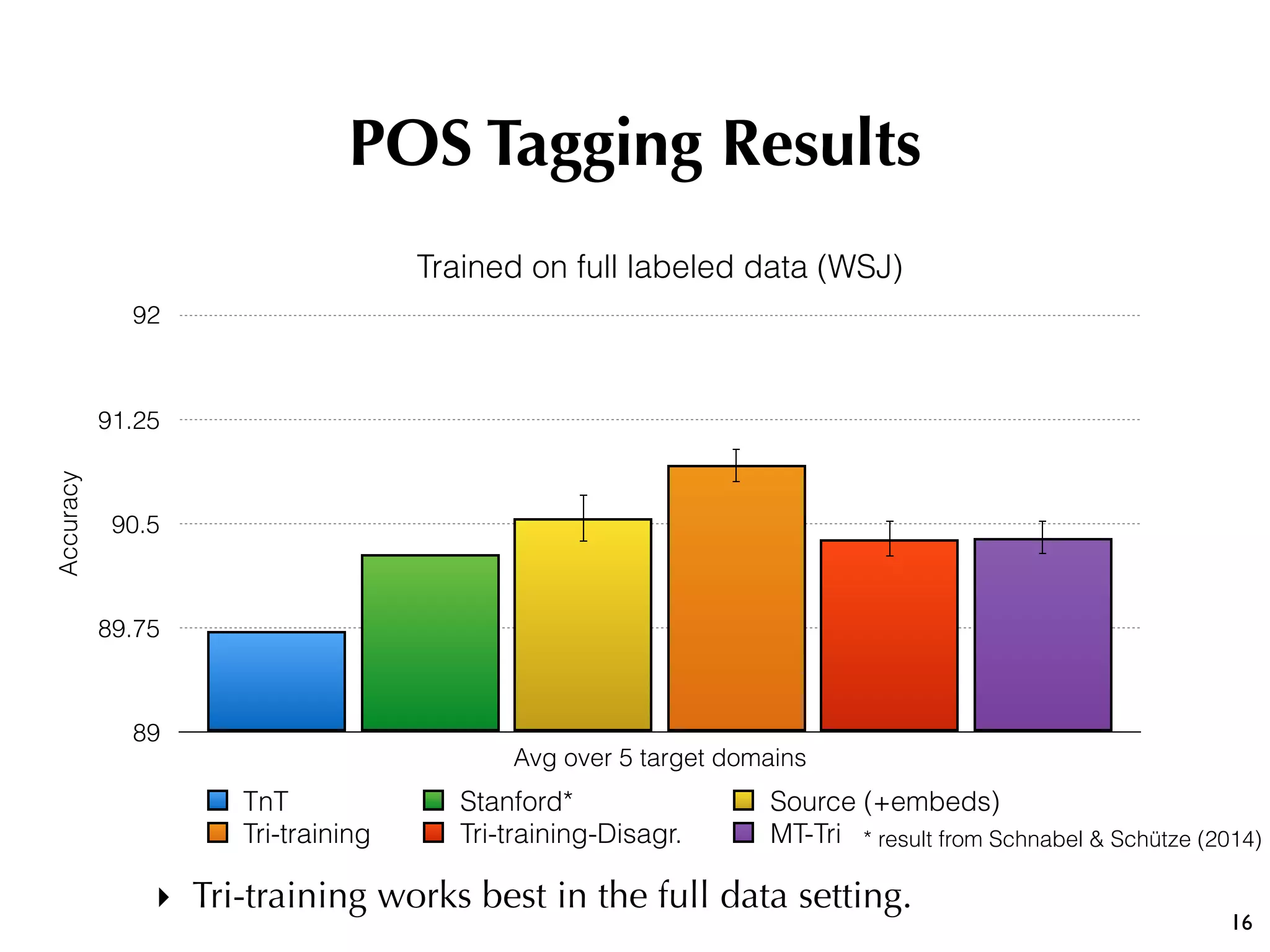
POS Tagging Results
* result from Schnabel & Schütze (2014)
Trained on full labeled data (WSJ)
Accuracy
89
89.75
90.5
91.25
92
Avg over 5 target domains
TnT Stanford* Source (+embeds)
Tri-training Tri-training-Disagr. MT-Tri
‣ Tri-training works best in the full data setting.
17
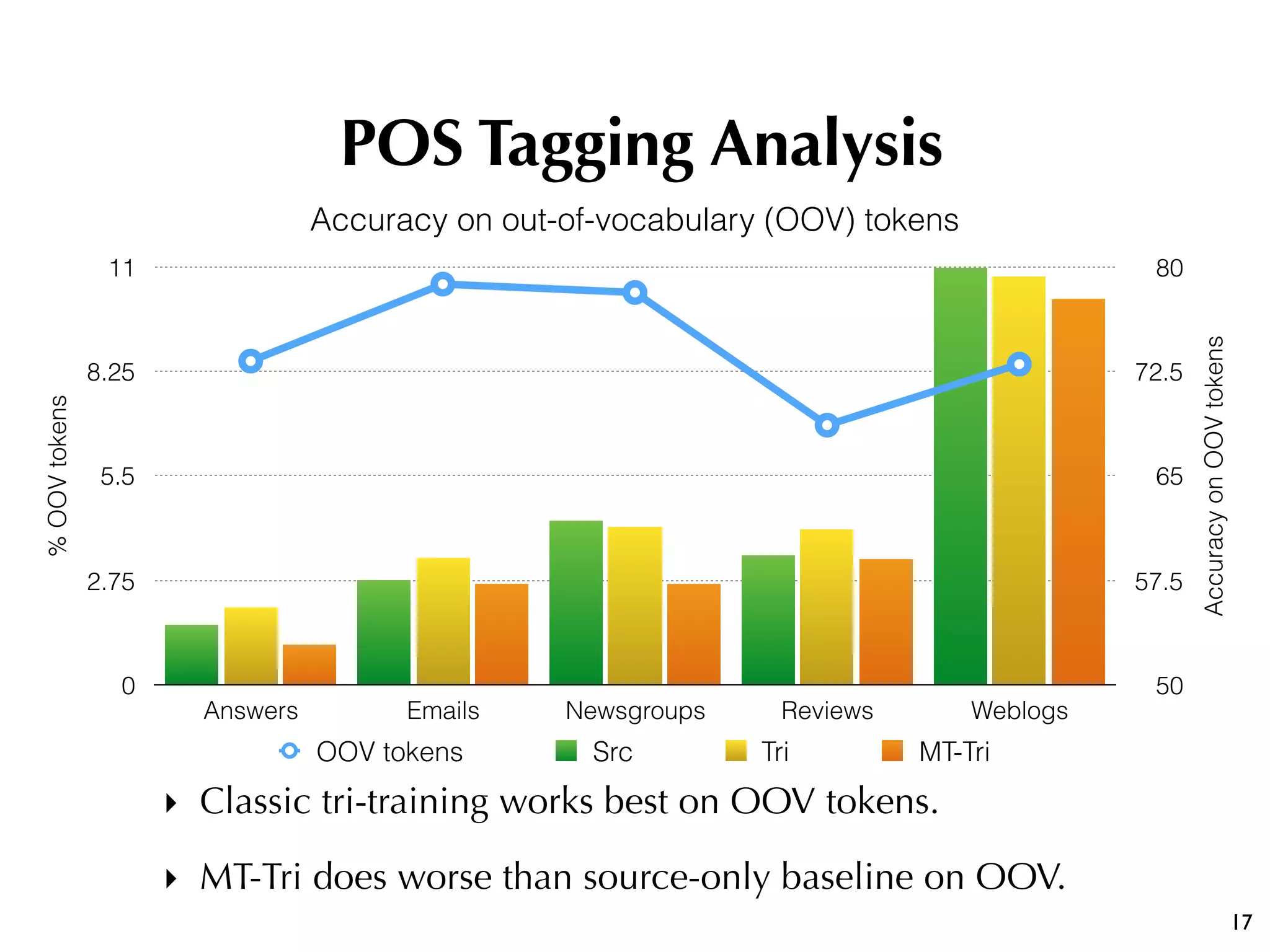
POS Tagging Analysis
Accuracy on out-of-vocabulary (OOV) tokens
AccuracyonOOVtokens
50
57.5
65
72.5
80
%OOVtokens
0
2.75
5.5
8.25
11
Answers Emails Newsgroups Reviews Weblogs
OOV tokens Src Tri MT-Tri
‣ Classic tri-training works best on OOV tokens.
‣ MT-Tri does worse than source-only baseline on OOV.
18
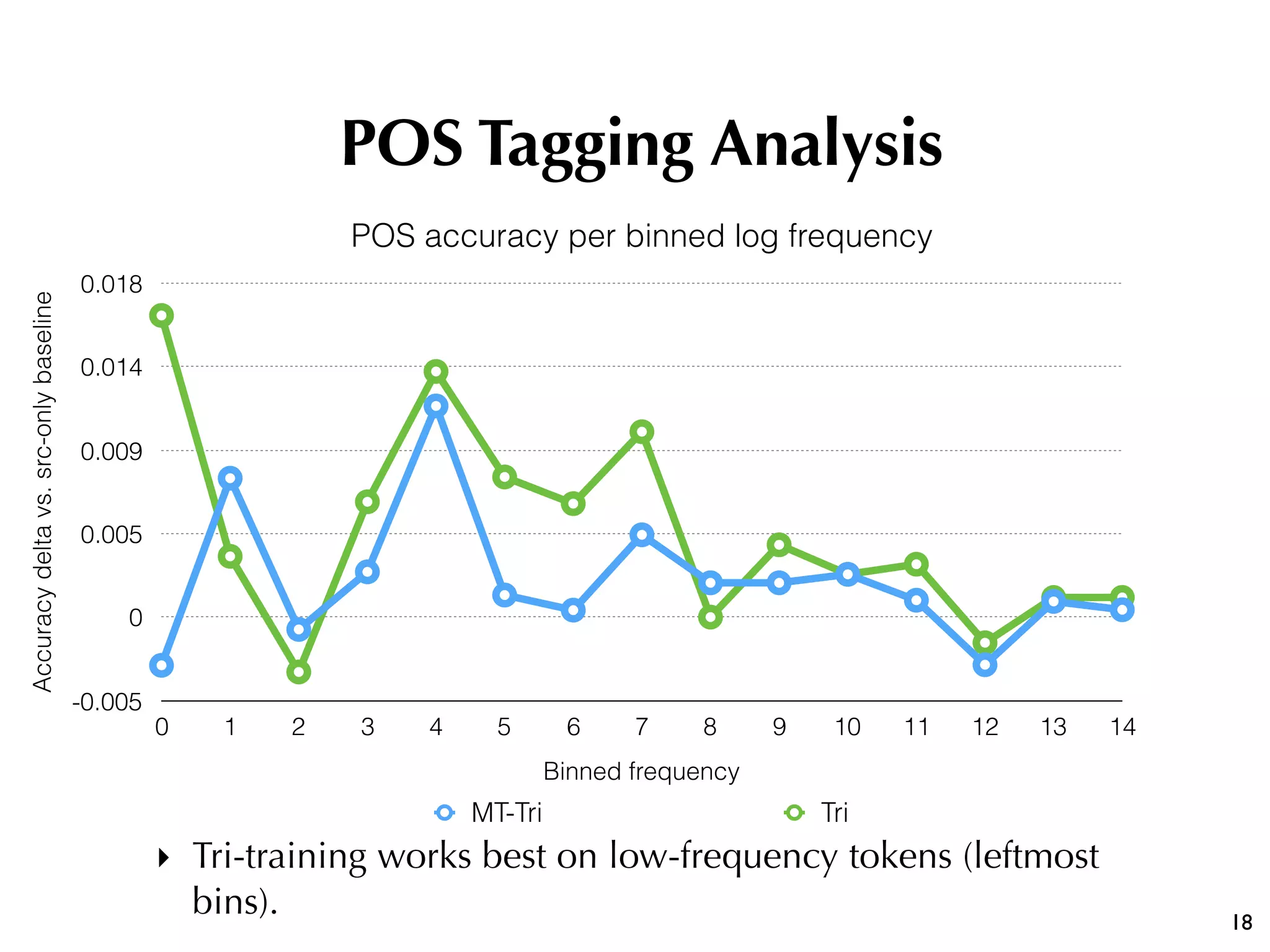
POS accuracy per binned log frequency
Accuracydeltavs.src-onlybaseline
-0.005
0
0.005
0.009
0.014
0.018
Binned frequency
0 1 2 3 4 5 6 7 8 9 10 11 12 13 14
MT-Tri Tri
‣ Tri-training works best on low-frequency tokens (leftmost
bins).
POS Tagging Analysis
19
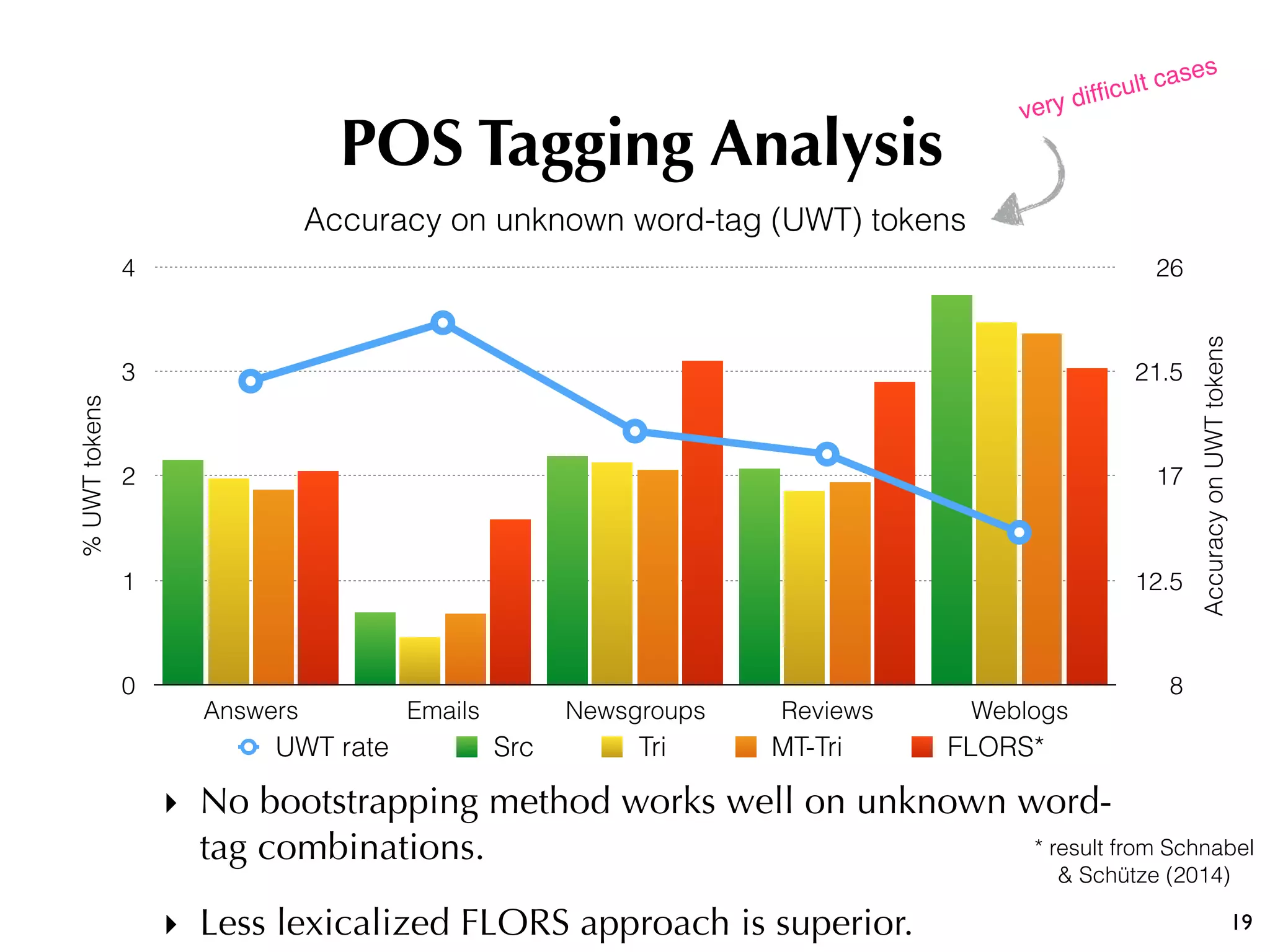
POS Tagging Analysis
Accuracy on unknown word-tag (UWT) tokens
AccuracyonUWTtokens
8
12.5
17
21.5
26
%UWTtokens
0
1
2
3
4
Answers Emails Newsgroups Reviews Weblogs
UWT rate Src Tri MT-Tri FLORS*
‣ No bootstrapping method works well on unknown word-
tag combinations.
‣ Less lexicalized FLORS approach is superior.
very difficult cases
* result from Schnabel
& Schütze (2014)
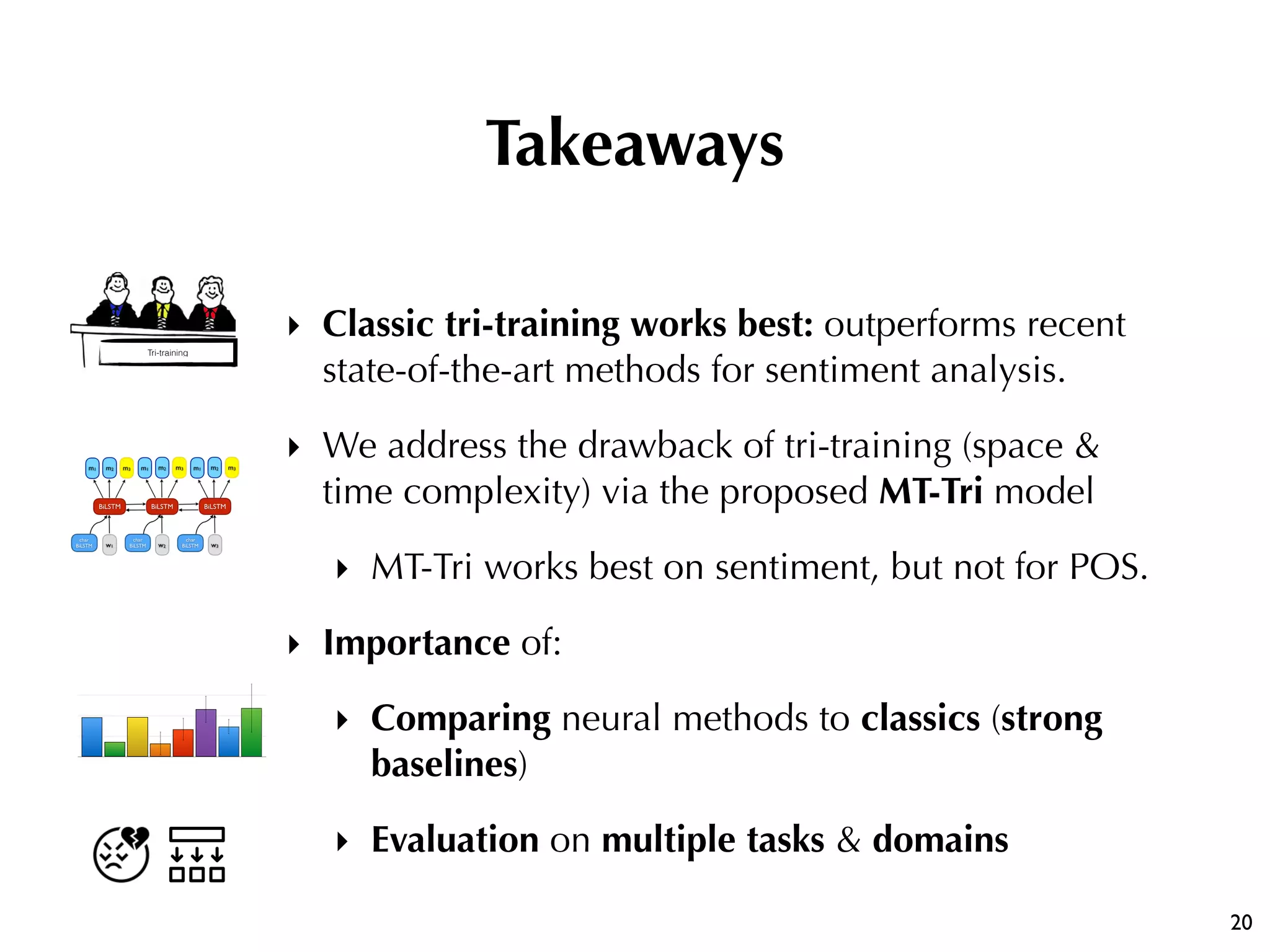
‣ Classic tri-training works best: outperforms recent
state-of-the-art methods for sentiment analysis.
‣ We address the drawback of tri-training (space &
time complexity) via the proposed MT-Tri model
‣ MT-Tri works best on sentiment, but not for POS.
‣ Importance of:
‣ Comparing neural methods to classics (strong
baselines)
‣ Evaluation on multiple tasks & domains
20
Takeaways
Tri-training

Strong Baselines for Neural Semi-supervised Learning under Domain Shift

  • 1.
    Strong Baselines forNeural Semi-supervised Learning under Domain Shift Sebastian Ruder Barbara Plank
  • 2.
    ‣ State-of-the-art domainadaptation approaches ‣ leverage task-specific features ‣ evaluate on proprietary datasets or on a single benchmark ‣ Only compare against weak baselines ‣ Almost none evaluate against approaches from the extensive semi-supervised learning (SSL) literature 2 Learning under Domain Shift
  • 3.
    ‣ How doclassics in SSL compare to recent advances? ‣ Can we combine the best of both worlds? ‣ How well do these approaches work on out-of-distribution data? 3 Revisiting Semi-Supervised Learning Classics in a Neural World
  • 4.
    • Self-training • (Co-training) •Tri-training • Tri-training with disagreement Bootstrapping algorithms
  • 5.
    1. Train modelon labeled data. 2. Use confident predictions on unlabeled data as training examples. Repeat. 5 Self-training - Error amplification
  • 6.
    ‣ Calibration ‣ Outputprobabilities in neural networks are poorly calibrated. ‣ Throttling (Abney, 2007), i.e. selecting the top n highest confidence unlabeled examples works best. ‣ Online learning ‣ Training until convergence on labeled data and then on unlabeled data works best. 6 Self-training variants
  • 7.
    7 1. Train threemodels on bootstrapped samples. 2. Use predictions on unlabeled data for third if two agree. y = 1 x y = 1 1 Tri-training Tri-training
  • 8.
    8 Tri-training Tri-training 1. Train threemodels on bootstrapped samples. 2. Use predictions on unlabeled data for third if two agree. 3. Final prediction: majority voting Tri-training y = 1y = 1 y = 0 1 x
  • 9.
    Tri-training
 with disagreement 9 Tri-training with disagreement 1.Train three models on bootstrapped samples. 2. Use predictions on unlabeled data for third if two agree and prediction differs. y = 1 x y = 1 1 y = 0 - 3 independent models
  • 10.
    ‣ Sampling unlabeleddata ‣ Producing predictions for all unlabeled examples is expensive ‣ Sample number of unlabeled examples ‣ Confidence thresholding ‣ Not effective for classic approaches, but essential for our method 10 Tri-training hyper-parameters
  • 11.
    11 y = 1 x y= 1 1 Multi-task tri-training 1. Train one model with 3 objective functions. 2. Use predictions on unlabeled data for third if two agree. Multi-task
 Tri-training 3. Restrict final layers to 
 use different 
 representations. 4. Train third objective 
 function only on 
 pseudo labeled to 
 bridge domain shift.
  • 12.
    12 BiLSTM w2 char BiLSTM BiLSTM w1 char BiLSTM BiLSTM w3 char BiLSTM m1 m2 m3m1 m2 m3 m1 m2 m3 orthogonality constraint (Bousmalis et al., 2016) Multi-task
 Tri-training Lorth = ∥W⊤ m1 Wm2 ∥2 F L(θ) = − ∑ i ∑ 1,..,n log Pmi (y| ⃗h ) + γLorthLoss: (Plank et al., 2016)
  • 13.
    13 Data & Tasks Twotasks: Domains: Sentiment analysis on Amazon reviews dataset (Blitzer et al, 2006) POS tagging on SANCL 2012 dataset (Petrov and McDonald, 2012)
  • 14.
    Sentiment Analysis Results Accuracy 75 76.75 78.5 80.25 82 Avgover 4 target domains VFAE* DANN* Asym* Source only Self-training Tri-training Tri-training-Disagr. MT-Tri * result from Saito et al., (2017) 14 ‣ Multi-task tri-training slightly outperforms tri-training, but has higher variance.
  • 15.
    15 POS Tagging Results Trainedon 10% labeled data (WSJ) Accuracy 88.7 88.975 89.25 89.525 89.8 Avg over 5 target domains Source (+embeds) Self-training Tri-training Tri-training-Disagr. MT-Tri ‣ Tri-training with disagreement works best with little data.
  • 16.
    16 POS Tagging Results *result from Schnabel & Schütze (2014) Trained on full labeled data (WSJ) Accuracy 89 89.75 90.5 91.25 92 Avg over 5 target domains TnT Stanford* Source (+embeds) Tri-training Tri-training-Disagr. MT-Tri ‣ Tri-training works best in the full data setting.
  • 17.
    17 POS Tagging Analysis Accuracyon out-of-vocabulary (OOV) tokens AccuracyonOOVtokens 50 57.5 65 72.5 80 %OOVtokens 0 2.75 5.5 8.25 11 Answers Emails Newsgroups Reviews Weblogs OOV tokens Src Tri MT-Tri ‣ Classic tri-training works best on OOV tokens. ‣ MT-Tri does worse than source-only baseline on OOV.
  • 18.
    18 POS accuracy perbinned log frequency Accuracydeltavs.src-onlybaseline -0.005 0 0.005 0.009 0.014 0.018 Binned frequency 0 1 2 3 4 5 6 7 8 9 10 11 12 13 14 MT-Tri Tri ‣ Tri-training works best on low-frequency tokens (leftmost bins). POS Tagging Analysis
  • 19.
    19 POS Tagging Analysis Accuracyon unknown word-tag (UWT) tokens AccuracyonUWTtokens 8 12.5 17 21.5 26 %UWTtokens 0 1 2 3 4 Answers Emails Newsgroups Reviews Weblogs UWT rate Src Tri MT-Tri FLORS* ‣ No bootstrapping method works well on unknown word- tag combinations. ‣ Less lexicalized FLORS approach is superior. very difficult cases * result from Schnabel & Schütze (2014)
  • 20.
    ‣ Classic tri-trainingworks best: outperforms recent state-of-the-art methods for sentiment analysis. ‣ We address the drawback of tri-training (space & time complexity) via the proposed MT-Tri model ‣ MT-Tri works best on sentiment, but not for POS. ‣ Importance of: ‣ Comparing neural methods to classics (strong baselines) ‣ Evaluation on multiple tasks & domains 20 Takeaways Tri-training