1
Unit 4: Authoring tools and multimedia projects

2
Introduction to Multimedia
2
3
Objectives
 How multimedia products are created and
authored.
 What kinds of multimedia authoring tools you
have to choose from to suit your project
needs.
 How various multimedia authoring tools work.
4
What is an Authoring Tools
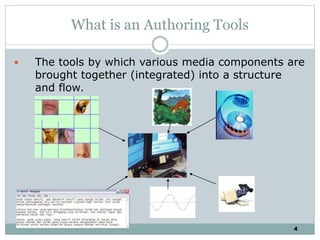
 The tools by which various media components are
brought together (integrated) into a structure
and flow.
5
Authoring Metaphors
 Most media integration tools will take or use
one of the following metaphors:
a) Movie screen metaphor
b) Slide show metaphor
c) Linked screens
6
Authoring Metaphors
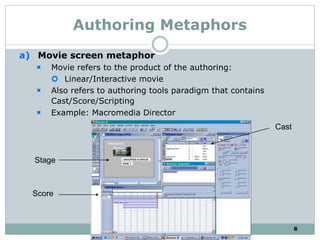
a) Movie screen metaphor
 Movie refers to the product of the authoring:
 Linear/Interactive movie
 Also refers to authoring tools paradigm that contains
Cast/Score/Scripting
 Example: Macromedia Director
Stage
Cast
Score
7
Authoring Metaphors
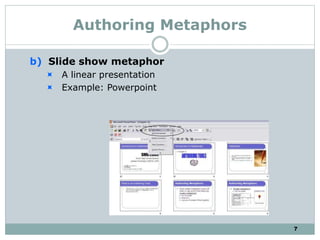
b) Slide show metaphor
 A linear presentation
 Example: Powerpoint
8
Authoring Metaphors
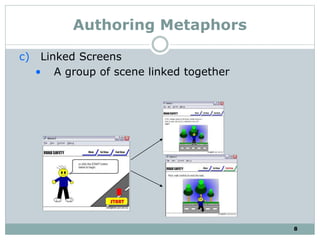
c) Linked Screens
• A group of scene linked together
9
Features of Authoring Tools
 Most Authoring tool have the following features in
their development interface:
1. A list of media events
2. Iconic flowchart / timeline
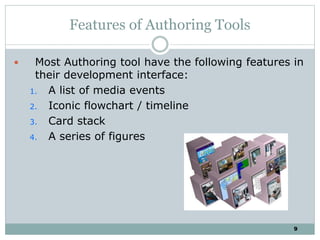
3. Card stack
4. A series of figures
10
Features of Authoring Tools
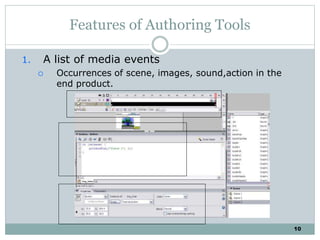
1. A list of media events
 Occurrences of scene, images, sound,action in the
end product.
11
Features of Authoring Tools
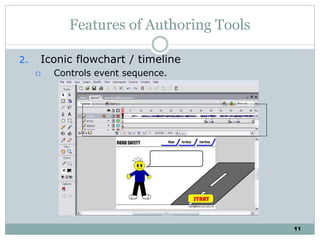
2. Iconic flowchart / timeline
 Controls event sequence.
12
Features of Authoring Tools
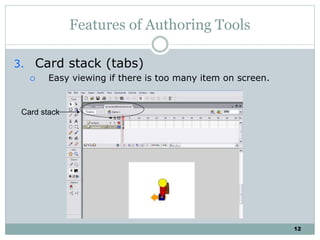
3. Card stack (tabs)
 Easy viewing if there is too many item on screen.
Card stack
13
Features of Authoring Tools
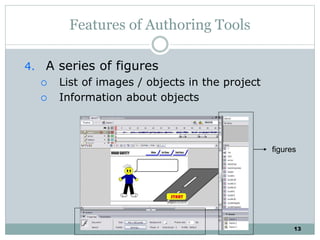
4. A series of figures
 List of images / objects in the project
 Information about objects
figures
14
Categories of Authoring Tools
 Can be categorized into
1. Presentation software
2. Tools for creating production
3. Interactive training and education
 Some authoring tools
can fit into more than
one category.
15
1. Presentation software
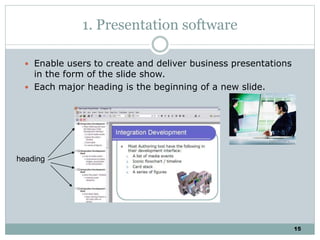
 Enable users to create and deliver business presentations
in the form of the slide show.
 Each major heading is the beginning of a new slide.
heading
16
1. Presentation software
 Templates are used to determine how the
heads and subheads are formatted and
displayed over backgrounds, including: (etc
PowerPoint)
 position
 size
 font
 style
 color
17
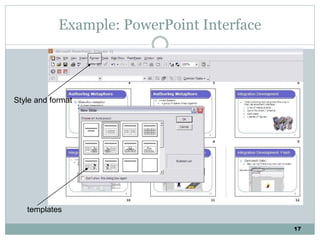
Example: PowerPoint Interface
templates
Style and format
18
2. Tools for creating production
 Typically oriented toward producing content that is more ambitious than
the slide-show level
 (more interactive & dynamic)
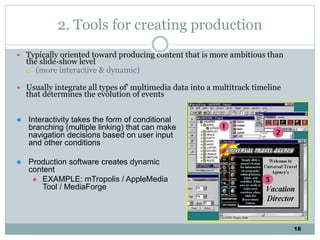
 Usually integrate all types of' multimedia data into a multitrack timeline
that determines the evolution of events
 Interactivity takes the form of conditional
branching (multiple linking) that can make
navigation decisions based on user input
and other conditions
 Production software creates dynamic
content
 EXAMPLE: mTropolis / AppleMedia
Tool / MediaForge
19
3. Interactive training and education tools
 To create education or training content.
 Designed primarily to present information in an Interactive
book.
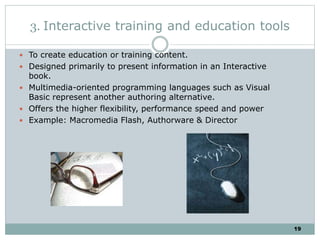
 Multimedia-oriented programming languages such as Visual
Basic represent another authoring alternative.
 Offers the higher flexibility, performance speed and power
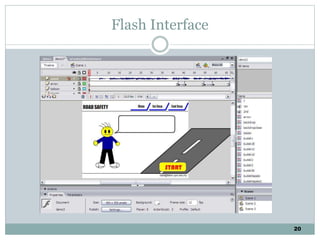
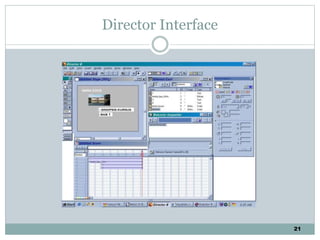
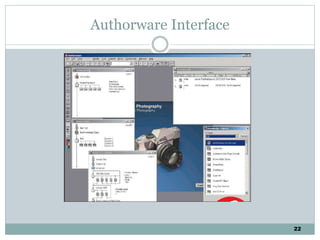
 Example: Macromedia Flash, Authorware & Director
20
Flash Interface
21
Director Interface
22
Authorware Interface
23
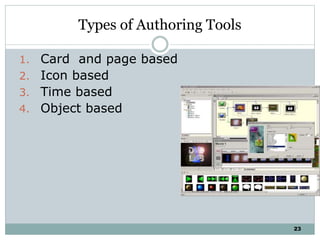
Types of Authoring Tools
1. Card and page based
2. Icon based
3. Time based
4. Object based
24
1. Card and page Based
 Cards are developed that have different
elements associated with them.
 Cards are put in stack.
 Cards or pages combine to make up a book.
 example of authoring tools
 HyperCard (Mac)
 ToolBook (Mac / Windows)
25
2. Icon Based
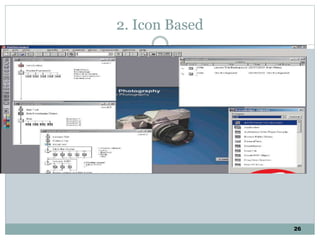
 Icons are gathered along the line.
 Provide visual development.
 Flow chart is created to show the organisation of
icons or elements:
 including activity list, results and done with dragging the
icon/elements along the lines
 each Icon represents a particular event – button,
graphics, text, video
 examples of authoring tools
 Authorware(Mac/Windows)
 IconAuthor (Windows)
26
2. Icon Based
27
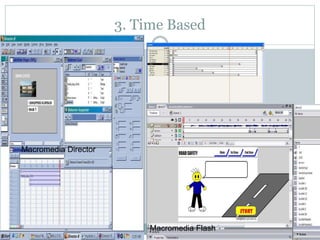
3. Time Based
 The most popular used.
 Using “timeline” for organizing activities
 Also using “framing” – timely adjusted depending
on the frame size
 Example:- Macromedia Director / Flash
(Mac/Windows)
28
3. Time Based
Macromedia Director
Macromedia Flash
29
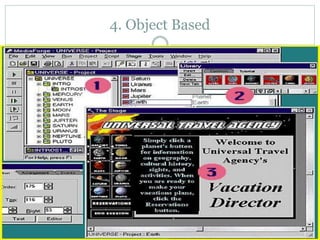
4. Object Based
 Support environment based on object.
 Every object is modified using properties &
modifiers
 The environment is based on ‘Hierarchy’ (section
and sub-section).
 Examples of the tools :
 mTropolis (Mac/Windows)
 AppleMedia Tool (Mac/Windows)
 MediaForge (Windows)
30
4. Object Based
31
Authoring tools capability
• Authoring tools should possess the following
capabilities:
1. Interactivity
2. Playback
3. Editing
4. Programming / Scripting
5. Cross Platform
6. Internet Playability
7. Delivery/Distribution
8. Project organization
32
Authoring Capabilities
1. Interactivity
 Simple Branching
 Ability to jump to any part of the product
 Eg:- by mouse click, keyboard input
 Conditional Branching
 Ability to jump to any part of products if agreed to certain
condition (statement IF-THEN)
 Structured Language
 complex programming to enable the interactivity and
navigation
33
Authoring Capabilities
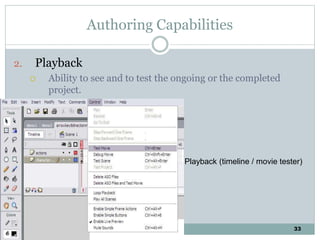
2. Playback
 Ability to see and to test the ongoing or the completed
project.
Playback (timeline / movie tester)
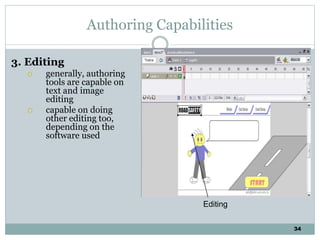
34
Authoring Capabilities
3. Editing
 generally, authoring
tools are capable on
text and image
editing
 capable on doing
other editing too,
depending on the
software used
Editing
35
Authoring Capabilities
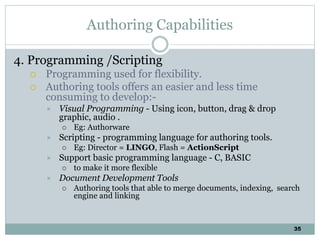
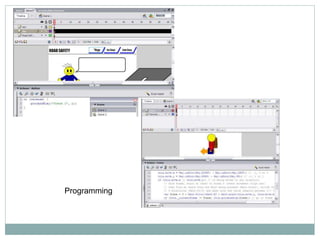
4. Programming /Scripting
 Programming used for flexibility.
 Authoring tools offers an easier and less time
consuming to develop:-
 Visual Programming - Using icon, button, drag & drop
graphic, audio .
 Eg: Authorware
 Scripting - programming language for authoring tools.
 Eg: Director = LINGO, Flash = ActionScript
 Support basic programming language - C, BASIC
 to make it more flexible
 Document Development Tools
 Authoring tools that able to merge documents, indexing, search
engine and linking
36
Authoring Capabilities
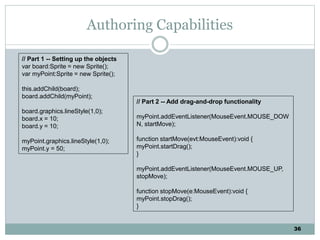
// Part 1 -- Setting up the objects
var board:Sprite = new Sprite();
var myPoint:Sprite = new Sprite();
this.addChild(board);
board.addChild(myPoint);
board.graphics.lineStyle(1,0);
board.x = 10;
board.y = 10;
myPoint.graphics.lineStyle(1,0);
myPoint.y = 50;
// Part 2 -- Add drag-and-drop functionality
myPoint.addEventListener(MouseEvent.MOUSE_DOW
N, startMove);
function startMove(evt:MouseEvent):void {
myPoint.startDrag();
}
myPoint.addEventListener(MouseEvent.MOUSE_UP,
stopMove);
function stopMove(e:MouseEvent):void {
myPoint.stopDrag();
}
Programming
38
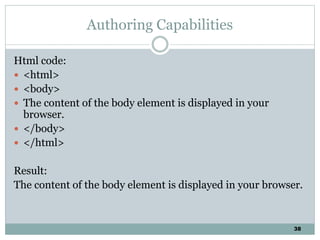
Authoring Capabilities
Html code:
 <html>
 <body>
 The content of the body element is displayed in your
browser.
 </body>
 </html>
Result:
The content of the body element is displayed in your browser.
39
Authoring capabilities
5. Cross platform
Able to connect with other tools and work efficiently
Ability to perform on all platforms including MAC and Windows.
40
Authoring capabilities
6. Internet Playability
• using plug-ins
• Add-on Tools
• Browser enable
Distribution / Delivery
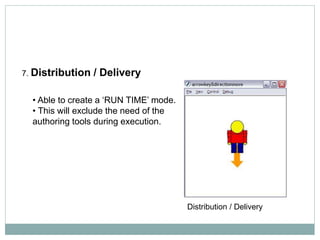
7. Distribution / Delivery
• Able to create a ‘RUN TIME’ mode.
• This will exclude the need of the
authoring tools during execution.
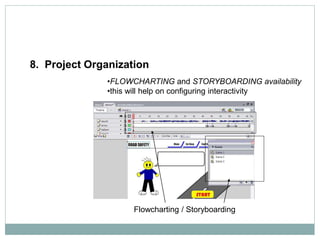
Flowcharting / Storyboarding
8. Project Organization
•FLOWCHARTING and STORYBOARDING availability
•this will help on configuring interactivity
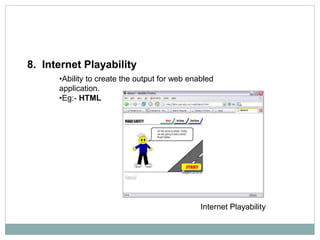
Internet Playability
8. Internet Playability
•Ability to create the output for web enabled
application.
•Eg:- HTML
44
Editing and organizing features
• Authoring systems include editing tools to
create, edit, and convert multimedia
elements such as animation and video clips.
• The organization, design, and production
process for multimedia involves involves
storyboarding and flowcharting.
• Visual flowcharting or overview facility
illustrates project structure at a macro level.
45
Authoring techniques
1.Multimedia Metaphors.
2. Multimedia Production
3. Multimedia Presentation
4. Automatic Authoring.
46
Multimedia Authoring Metaphors
 Authoring is the process of creating multimedia
applications. Most authoring programs use one of
several authoring metaphors, also known as
authoring paradigm.
47
a. Scripting Language metaphor:
The idea here is to use a special language to enable
interactivity and allow conditional, jumps, loops,
functions macros e g. . open script language
b. Slide Show metaphor:
Slide shows are by default a linear presentation. Although
tools exist to perform jumps in slide shows, very few
practitioners use them. e.g. Power Point, Image Q.
48
C. Hierarchical Metaphor:
Here user controllable elements are organized
into a tree structure. Such a metaphor is
often used in menu driven programs.
d. Iconic/Flow control metaphor:
Graphical icons are available in toolbox, and
authoring proceeds a flowchart with icons
attached. e.g. Authorware by Macromedia.

Multimedia Authoring Tools.ppt

  • 1.
    1 Unit 4: Authoringtools and multimedia projects 
  • 2.
  • 3.
    3 Objectives  How multimediaproducts are created and authored.  What kinds of multimedia authoring tools you have to choose from to suit your project needs.  How various multimedia authoring tools work.
  • 4.
    4 What is anAuthoring Tools  The tools by which various media components are brought together (integrated) into a structure and flow.
  • 5.
    5 Authoring Metaphors  Mostmedia integration tools will take or use one of the following metaphors: a) Movie screen metaphor b) Slide show metaphor c) Linked screens
  • 6.
    6 Authoring Metaphors a) Moviescreen metaphor  Movie refers to the product of the authoring:  Linear/Interactive movie  Also refers to authoring tools paradigm that contains Cast/Score/Scripting  Example: Macromedia Director Stage Cast Score
  • 7.
    7 Authoring Metaphors b) Slideshow metaphor  A linear presentation  Example: Powerpoint
  • 8.
    8 Authoring Metaphors c) LinkedScreens • A group of scene linked together
  • 9.
    9 Features of AuthoringTools  Most Authoring tool have the following features in their development interface: 1. A list of media events 2. Iconic flowchart / timeline 3. Card stack 4. A series of figures
  • 10.
    10 Features of AuthoringTools 1. A list of media events  Occurrences of scene, images, sound,action in the end product.
  • 11.
    11 Features of AuthoringTools 2. Iconic flowchart / timeline  Controls event sequence.
  • 12.
    12 Features of AuthoringTools 3. Card stack (tabs)  Easy viewing if there is too many item on screen. Card stack
  • 13.
    13 Features of AuthoringTools 4. A series of figures  List of images / objects in the project  Information about objects figures
  • 14.
    14 Categories of AuthoringTools  Can be categorized into 1. Presentation software 2. Tools for creating production 3. Interactive training and education  Some authoring tools can fit into more than one category.
  • 15.
    15 1. Presentation software Enable users to create and deliver business presentations in the form of the slide show.  Each major heading is the beginning of a new slide. heading
  • 16.
    16 1. Presentation software Templates are used to determine how the heads and subheads are formatted and displayed over backgrounds, including: (etc PowerPoint)  position  size  font  style  color
  • 17.
  • 18.
    18 2. Tools forcreating production  Typically oriented toward producing content that is more ambitious than the slide-show level  (more interactive & dynamic)  Usually integrate all types of' multimedia data into a multitrack timeline that determines the evolution of events  Interactivity takes the form of conditional branching (multiple linking) that can make navigation decisions based on user input and other conditions  Production software creates dynamic content  EXAMPLE: mTropolis / AppleMedia Tool / MediaForge
  • 19.
    19 3. Interactive trainingand education tools  To create education or training content.  Designed primarily to present information in an Interactive book.  Multimedia-oriented programming languages such as Visual Basic represent another authoring alternative.  Offers the higher flexibility, performance speed and power  Example: Macromedia Flash, Authorware & Director
  • 20.
  • 21.
  • 22.
  • 23.
    23 Types of AuthoringTools 1. Card and page based 2. Icon based 3. Time based 4. Object based
  • 24.
    24 1. Card andpage Based  Cards are developed that have different elements associated with them.  Cards are put in stack.  Cards or pages combine to make up a book.  example of authoring tools  HyperCard (Mac)  ToolBook (Mac / Windows)
  • 25.
    25 2. Icon Based Icons are gathered along the line.  Provide visual development.  Flow chart is created to show the organisation of icons or elements:  including activity list, results and done with dragging the icon/elements along the lines  each Icon represents a particular event – button, graphics, text, video  examples of authoring tools  Authorware(Mac/Windows)  IconAuthor (Windows)
  • 26.
  • 27.
    27 3. Time Based The most popular used.  Using “timeline” for organizing activities  Also using “framing” – timely adjusted depending on the frame size  Example:- Macromedia Director / Flash (Mac/Windows)
  • 28.
    28 3. Time Based MacromediaDirector Macromedia Flash
  • 29.
    29 4. Object Based Support environment based on object.  Every object is modified using properties & modifiers  The environment is based on ‘Hierarchy’ (section and sub-section).  Examples of the tools :  mTropolis (Mac/Windows)  AppleMedia Tool (Mac/Windows)  MediaForge (Windows)
  • 30.
  • 31.
    31 Authoring tools capability •Authoring tools should possess the following capabilities: 1. Interactivity 2. Playback 3. Editing 4. Programming / Scripting 5. Cross Platform 6. Internet Playability 7. Delivery/Distribution 8. Project organization
  • 32.
    32 Authoring Capabilities 1. Interactivity Simple Branching  Ability to jump to any part of the product  Eg:- by mouse click, keyboard input  Conditional Branching  Ability to jump to any part of products if agreed to certain condition (statement IF-THEN)  Structured Language  complex programming to enable the interactivity and navigation
  • 33.
    33 Authoring Capabilities 2. Playback Ability to see and to test the ongoing or the completed project. Playback (timeline / movie tester)
  • 34.
    34 Authoring Capabilities 3. Editing generally, authoring tools are capable on text and image editing  capable on doing other editing too, depending on the software used Editing
  • 35.
    35 Authoring Capabilities 4. Programming/Scripting  Programming used for flexibility.  Authoring tools offers an easier and less time consuming to develop:-  Visual Programming - Using icon, button, drag & drop graphic, audio .  Eg: Authorware  Scripting - programming language for authoring tools.  Eg: Director = LINGO, Flash = ActionScript  Support basic programming language - C, BASIC  to make it more flexible  Document Development Tools  Authoring tools that able to merge documents, indexing, search engine and linking
  • 36.
    36 Authoring Capabilities // Part1 -- Setting up the objects var board:Sprite = new Sprite(); var myPoint:Sprite = new Sprite(); this.addChild(board); board.addChild(myPoint); board.graphics.lineStyle(1,0); board.x = 10; board.y = 10; myPoint.graphics.lineStyle(1,0); myPoint.y = 50; // Part 2 -- Add drag-and-drop functionality myPoint.addEventListener(MouseEvent.MOUSE_DOW N, startMove); function startMove(evt:MouseEvent):void { myPoint.startDrag(); } myPoint.addEventListener(MouseEvent.MOUSE_UP, stopMove); function stopMove(e:MouseEvent):void { myPoint.stopDrag(); }
  • 37.
  • 38.
    38 Authoring Capabilities Html code: <html>  <body>  The content of the body element is displayed in your browser.  </body>  </html> Result: The content of the body element is displayed in your browser.
  • 39.
    39 Authoring capabilities 5. Crossplatform Able to connect with other tools and work efficiently Ability to perform on all platforms including MAC and Windows.
  • 40.
    40 Authoring capabilities 6. InternetPlayability • using plug-ins • Add-on Tools • Browser enable
  • 41.
    Distribution / Delivery 7.Distribution / Delivery • Able to create a ‘RUN TIME’ mode. • This will exclude the need of the authoring tools during execution.
  • 42.
    Flowcharting / Storyboarding 8.Project Organization •FLOWCHARTING and STORYBOARDING availability •this will help on configuring interactivity
  • 43.
    Internet Playability 8. InternetPlayability •Ability to create the output for web enabled application. •Eg:- HTML
  • 44.
    44 Editing and organizingfeatures • Authoring systems include editing tools to create, edit, and convert multimedia elements such as animation and video clips. • The organization, design, and production process for multimedia involves involves storyboarding and flowcharting. • Visual flowcharting or overview facility illustrates project structure at a macro level.
  • 45.
    45 Authoring techniques 1.Multimedia Metaphors. 2.Multimedia Production 3. Multimedia Presentation 4. Automatic Authoring.
  • 46.
    46 Multimedia Authoring Metaphors Authoring is the process of creating multimedia applications. Most authoring programs use one of several authoring metaphors, also known as authoring paradigm.
  • 47.
    47 a. Scripting Languagemetaphor: The idea here is to use a special language to enable interactivity and allow conditional, jumps, loops, functions macros e g. . open script language b. Slide Show metaphor: Slide shows are by default a linear presentation. Although tools exist to perform jumps in slide shows, very few practitioners use them. e.g. Power Point, Image Q.
  • 48.
    48 C. Hierarchical Metaphor: Hereuser controllable elements are organized into a tree structure. Such a metaphor is often used in menu driven programs. d. Iconic/Flow control metaphor: Graphical icons are available in toolbox, and authoring proceeds a flowchart with icons attached. e.g. Authorware by Macromedia.