Artificial Intelligence
Dr.K.Kalaiselvi
Dept of Computer Science
Kristu Jayanti college
Bangalore
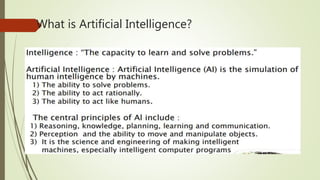
What is Artificial Intelligence?
 AI programming focuses on three cognitive skills: learning,
reasoning and self-correction.
 Learning processes. This aspect of AI programming
focuses on acquiring data and creating rules for how to turn
the data into actionable information. The rules, which are
called algorithms, provide computing devices with step-by-
step instructions for how to complete a specific task.
 Reasoning processes. This aspect of AI programming
focuses on choosing the right algorithm to reach a desired
outcome.
 Self-correction processes. This aspect of AI programming
is designed to continually fine-tune algorithms and ensure
they provide the most accurate results possible.
How does Artificial Intelligence work?
Computers are good at following processes, i.e.,
sequences of steps to execute a task. If we give a
computer steps to execute a task, it should easily be
able to complete it. The steps are nothing but
algorithms. An algorithm can be as simple as printing
two numbers or as difficult as predicting who will win
elections in the coming year!
 Let’s take an example of predicting the weather forecast for 2020.
 First of all, what we need is a lot of data! Let’s take the data from
2006 to 2019.
 Now, we will divide this data in an 80:20 ratio. 80 percent of the
data is going to be our labeled data, and the rest 20 percent will be
our test data. Thus, we have the output for the entire 100 percent
of the data that has been acquired from 2006 to 2019.
 What happens once we collect the data? We will feed the labeled
data, i.e., 80 percent of train data, into the machine. Here, the
algorithm is learning from the data which has been fed into it.
 Next, we need to test the algorithm. Here, we feed the test data,
i.e., the remaining 20 percent of the data, to the machine. The
machine gives us the output. Now, we cross verify the output given
by the machine with the actual output of the data and check for its
accuracy. While checking for accuracy if we are not satisfied with
the model, we tweak the algorithm to give us the precise output or
at least somewhere close to the actual output. Once we are
satisfied with the model, we then feed the data to the model so
that it can predict the weather forecast for the year 2020.
Goals of Artificial Intelligence
• To Create Expert Systems − The systems which exhibit intelligent behavior,
learn, demonstrate, explain, and advice its users.
• To Implement Human Intelligence in Machines − Creating systems that
understand, think, learn, and behave like humans.
 Building a machine which can perform tasks that requires human intelligence
such as:
Proving a theorem
Playing chess
Plan some surgical operation
Driving a car in traffic
 In early days Artificial intelligence was used to develop reasoning and problem-
solving skills.
 With Artificial intelligence knowledge representation has become easy. Knowledge
representation is representing information that machine or computer can
understand.
 Artificial planning helps agents sequence of actions to perform to achieve goals.
 Artificial intelligence main goal is develop intelligent machines that could learn on
their own. No more human intervention for feeding data to machines.
 With artificial intelligence one can develop machines that can read and understand
human languages are known as Natural learning processing.
 Artificial Intelligence helps to develop that could act on sensors (take input from
sensors) and react accordingly.
 Robotics has transformed thanks to artificial intelligence, that help robots acquire
intelligence and perform task smartly.
 Develop systems that can recognize, interpret, process and simulate human effects.
All these can be achieved when intelligent systems can predict their motive and
emotions. Quality of interpreting human affect could help in better decision making

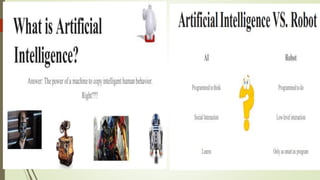
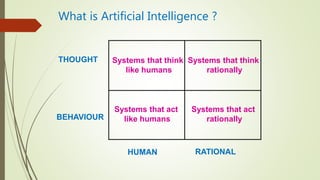
What is Artificial Intelligence ?
Systems that act
rationally
Systems that think
like humans
Systems that think
rationally
Systems that act
like humans
THOUGHT
BEHAVIOUR
HUMAN RATIONAL
Term coined by John McCarthy, 1956
Definition: “Developing Computer programs to
solve complex problems by applications of
processes that are analogous to human reasoning
processes”.
Has two parts 1. Computer solutions for complex
problems can be done by conventional
programs
2. Process that is analogous to human reasoning
processes can be done by AI programs
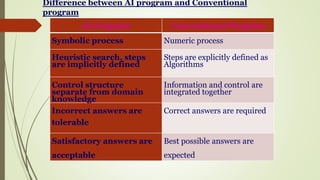
AI Program Conventional Program
Symbolic process Numeric process
Heuristic search, steps
are implicitly defined
Steps are explicitly defined as
Algorithms
Control structure
separate from domain
knowledge
Information and control are
integrated together
Incorrect answers are
tolerable
Correct answers are required
Satisfactory answers are
acceptable
Best possible answers are
expected
Difference between AI program and Conventional
program
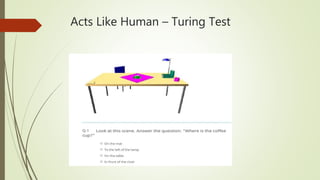
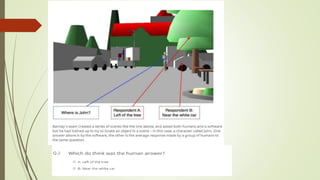
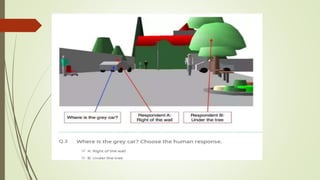
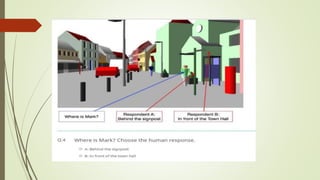
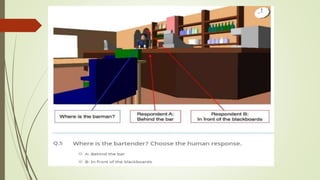
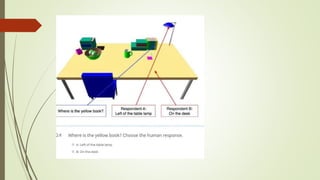
Acts Like Human – Turing Test
Thinks like Human – human like patterns of
thinking steps
Sophia is a social humanoid robot developed by Hong
Kong based company Hanson Robotics. Sophia was
activated on February 14, 2016, and made her first
public appearance at South by Southwest
Festival (SXSW) in mid-March 2016 in Austin, Texas,
United States.
She is able to display more than 50 facial expressions.
Robot Sophia was given Saudia citizenship in 2017
'Sophia' the robot tells UN_ 'I am here to help humanity
create the future' - YouTube (720p).mp4
Advantages
Sophia can be used for health care sectors
Sophia can solve CBI and FBI cases very easily
Sophia can be a good friend to those children and adults
who feel lonely.
She can be a good teacher in villages and city colleges.
She can be a business robot.
As she has artificial intelligence she can generates for
million of years
Disadvantages
People worry that they will replace jobs.
If they take over middle class citizens jobs our economy
will be negatively affected.
It makes people to become lazy.

Introduction to Artificial Intelligence

  • 1.
    Artificial Intelligence Dr.K.Kalaiselvi Dept ofComputer Science Kristu Jayanti college Bangalore
  • 3.
    What is ArtificialIntelligence?
  • 4.
     AI programmingfocuses on three cognitive skills: learning, reasoning and self-correction.  Learning processes. This aspect of AI programming focuses on acquiring data and creating rules for how to turn the data into actionable information. The rules, which are called algorithms, provide computing devices with step-by- step instructions for how to complete a specific task.  Reasoning processes. This aspect of AI programming focuses on choosing the right algorithm to reach a desired outcome.  Self-correction processes. This aspect of AI programming is designed to continually fine-tune algorithms and ensure they provide the most accurate results possible.
  • 5.
    How does ArtificialIntelligence work? Computers are good at following processes, i.e., sequences of steps to execute a task. If we give a computer steps to execute a task, it should easily be able to complete it. The steps are nothing but algorithms. An algorithm can be as simple as printing two numbers or as difficult as predicting who will win elections in the coming year!
  • 6.
     Let’s takean example of predicting the weather forecast for 2020.  First of all, what we need is a lot of data! Let’s take the data from 2006 to 2019.  Now, we will divide this data in an 80:20 ratio. 80 percent of the data is going to be our labeled data, and the rest 20 percent will be our test data. Thus, we have the output for the entire 100 percent of the data that has been acquired from 2006 to 2019.  What happens once we collect the data? We will feed the labeled data, i.e., 80 percent of train data, into the machine. Here, the algorithm is learning from the data which has been fed into it.  Next, we need to test the algorithm. Here, we feed the test data, i.e., the remaining 20 percent of the data, to the machine. The machine gives us the output. Now, we cross verify the output given by the machine with the actual output of the data and check for its accuracy. While checking for accuracy if we are not satisfied with the model, we tweak the algorithm to give us the precise output or at least somewhere close to the actual output. Once we are satisfied with the model, we then feed the data to the model so that it can predict the weather forecast for the year 2020.
  • 7.
    Goals of ArtificialIntelligence • To Create Expert Systems − The systems which exhibit intelligent behavior, learn, demonstrate, explain, and advice its users. • To Implement Human Intelligence in Machines − Creating systems that understand, think, learn, and behave like humans.  Building a machine which can perform tasks that requires human intelligence such as: Proving a theorem Playing chess Plan some surgical operation Driving a car in traffic
  • 8.
     In earlydays Artificial intelligence was used to develop reasoning and problem- solving skills.  With Artificial intelligence knowledge representation has become easy. Knowledge representation is representing information that machine or computer can understand.  Artificial planning helps agents sequence of actions to perform to achieve goals.  Artificial intelligence main goal is develop intelligent machines that could learn on their own. No more human intervention for feeding data to machines.  With artificial intelligence one can develop machines that can read and understand human languages are known as Natural learning processing.  Artificial Intelligence helps to develop that could act on sensors (take input from sensors) and react accordingly.  Robotics has transformed thanks to artificial intelligence, that help robots acquire intelligence and perform task smartly.  Develop systems that can recognize, interpret, process and simulate human effects. All these can be achieved when intelligent systems can predict their motive and emotions. Quality of interpreting human affect could help in better decision making 
  • 9.
    What is ArtificialIntelligence ? Systems that act rationally Systems that think like humans Systems that think rationally Systems that act like humans THOUGHT BEHAVIOUR HUMAN RATIONAL
  • 10.
    Term coined byJohn McCarthy, 1956 Definition: “Developing Computer programs to solve complex problems by applications of processes that are analogous to human reasoning processes”. Has two parts 1. Computer solutions for complex problems can be done by conventional programs 2. Process that is analogous to human reasoning processes can be done by AI programs
  • 11.
    AI Program ConventionalProgram Symbolic process Numeric process Heuristic search, steps are implicitly defined Steps are explicitly defined as Algorithms Control structure separate from domain knowledge Information and control are integrated together Incorrect answers are tolerable Correct answers are required Satisfactory answers are acceptable Best possible answers are expected Difference between AI program and Conventional program
  • 12.
    Acts Like Human– Turing Test
  • 18.
    Thinks like Human– human like patterns of thinking steps Sophia is a social humanoid robot developed by Hong Kong based company Hanson Robotics. Sophia was activated on February 14, 2016, and made her first public appearance at South by Southwest Festival (SXSW) in mid-March 2016 in Austin, Texas, United States. She is able to display more than 50 facial expressions. Robot Sophia was given Saudia citizenship in 2017 'Sophia' the robot tells UN_ 'I am here to help humanity create the future' - YouTube (720p).mp4
  • 20.
    Advantages Sophia can beused for health care sectors Sophia can solve CBI and FBI cases very easily Sophia can be a good friend to those children and adults who feel lonely. She can be a good teacher in villages and city colleges. She can be a business robot. As she has artificial intelligence she can generates for million of years Disadvantages People worry that they will replace jobs. If they take over middle class citizens jobs our economy will be negatively affected. It makes people to become lazy.