Mule requester
Presented By
Sindhu VL
What is mule requester?
• As its name may hint, its goal is to allow the
request of a resource at any point in a flow.
• This resource can be a file, a message (from
VM, JMS, AMQP, etc.), an e-mail, etc.
• It’s intended for resources that originally could
only be requested by message sources.
• If we want to consume messages from a queue on demand,
i.e. not consuming the message as soon as it’s put on the
queue but at a later stage, when a user calls an HTTP
inbound endpoint, for example.
• We cannot achieve this by using a JMS inbound endpoint,
since it will consume the message as soon as it’s put on the
queue.
• Thinking about a way of doing this, we could have a
stopped flow and activate it on demand but this would
cause the consumption of more than one message or a
clumsy implementation that would pick a message and stop
the flow again.
• Another option would be to use a component but this
would have to deal with the specifics of the transport,
leading to either one implementation per transport type or
a big component handling all the transports.
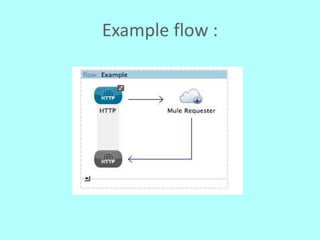
Example flow :
Some of its more common use cases
are :
• Load a file in the middle of a flow for
processing.
• Consume messages (one, N, all) from a queue
in the middle of a flow.
• Pull messages from a mail server on demand,
to use its data in an enricher for example.
Why releasing it as a Mule module?
• It’s reusable
• It’s simple
• It can be easily installed in MuleStudio
• It can be used with Maven
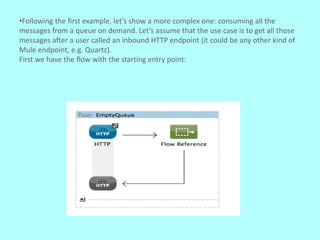
•Following the first example, let’s show a more complex one: consuming all the
messages from a queue on demand. Let’s assume that the use case is to get all those
messages after a user called an inbound HTTP endpoint (it could be any other kind of
Mule endpoint, e.g. Quartz).
First we have the flow with the starting entry point:
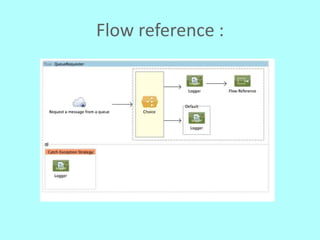
Flow reference :
This flow does all the magic:
• First it requests a message from the queue ‘input’.
• If there is a message, it processes it (just logs the
payload in the example) and calls the same flow again,
to allow the processing of the next messages in queue.
• Otherwise, if there is no pending message in the
queue, it just logs the queue has been emptied and
finishes.
• This configuration also contains another example that
shows how to consume a file based on an expression
after calling an HTTP inbound endpoint.
Key feature of the module :
• Expressions support
• Possibility of throwing an exception if the
requested resource is null
• Automatic transformer: the return type of the
requester resource can be set to any type and
Mule will automatically try to transform it
ThankYou!!!!!!!!!!!!!

Mule requester

  • 1.
  • 2.
    What is mulerequester? • As its name may hint, its goal is to allow the request of a resource at any point in a flow. • This resource can be a file, a message (from VM, JMS, AMQP, etc.), an e-mail, etc. • It’s intended for resources that originally could only be requested by message sources.
  • 3.
    • If wewant to consume messages from a queue on demand, i.e. not consuming the message as soon as it’s put on the queue but at a later stage, when a user calls an HTTP inbound endpoint, for example. • We cannot achieve this by using a JMS inbound endpoint, since it will consume the message as soon as it’s put on the queue. • Thinking about a way of doing this, we could have a stopped flow and activate it on demand but this would cause the consumption of more than one message or a clumsy implementation that would pick a message and stop the flow again. • Another option would be to use a component but this would have to deal with the specifics of the transport, leading to either one implementation per transport type or a big component handling all the transports.
  • 4.
  • 5.
    Some of itsmore common use cases are : • Load a file in the middle of a flow for processing. • Consume messages (one, N, all) from a queue in the middle of a flow. • Pull messages from a mail server on demand, to use its data in an enricher for example.
  • 6.
    Why releasing itas a Mule module? • It’s reusable • It’s simple • It can be easily installed in MuleStudio • It can be used with Maven
  • 7.
    •Following the firstexample, let’s show a more complex one: consuming all the messages from a queue on demand. Let’s assume that the use case is to get all those messages after a user called an inbound HTTP endpoint (it could be any other kind of Mule endpoint, e.g. Quartz). First we have the flow with the starting entry point:
  • 8.
  • 9.
    This flow doesall the magic: • First it requests a message from the queue ‘input’. • If there is a message, it processes it (just logs the payload in the example) and calls the same flow again, to allow the processing of the next messages in queue. • Otherwise, if there is no pending message in the queue, it just logs the queue has been emptied and finishes. • This configuration also contains another example that shows how to consume a file based on an expression after calling an HTTP inbound endpoint.
  • 10.
    Key feature ofthe module : • Expressions support • Possibility of throwing an exception if the requested resource is null • Automatic transformer: the return type of the requester resource can be set to any type and Mule will automatically try to transform it
  • 11.