BY
ARUSH KASHYAP
MRIDUL KUMAR JHA
DIGANTH GOWDA
SUNAY SHET
THE MUGHAL EMPERORS
 Babur [14 February 1483 – 26
December 1530] born Zahīr ud-Dīn
Muhammad, was the founder of
the Mughal Empire and first
Emperor of the Mughal Dynasty
(1526–1530) in the Indian
Subcontinent. He was a descendant
of Timur and Genghis Khan
through his father and mother
respectively.
 Nasir-ud-Din Muḥammad, better
known by his regnal name,
Humayun, was the second emperor
of the Mughal Empire, who ruled
over territory in what is now
Afghanistan, Pakistan, Northern
India, and Bangladesh from 1530–
1540 and again from 1555–1556.
THE MUGHAL EMPERORS
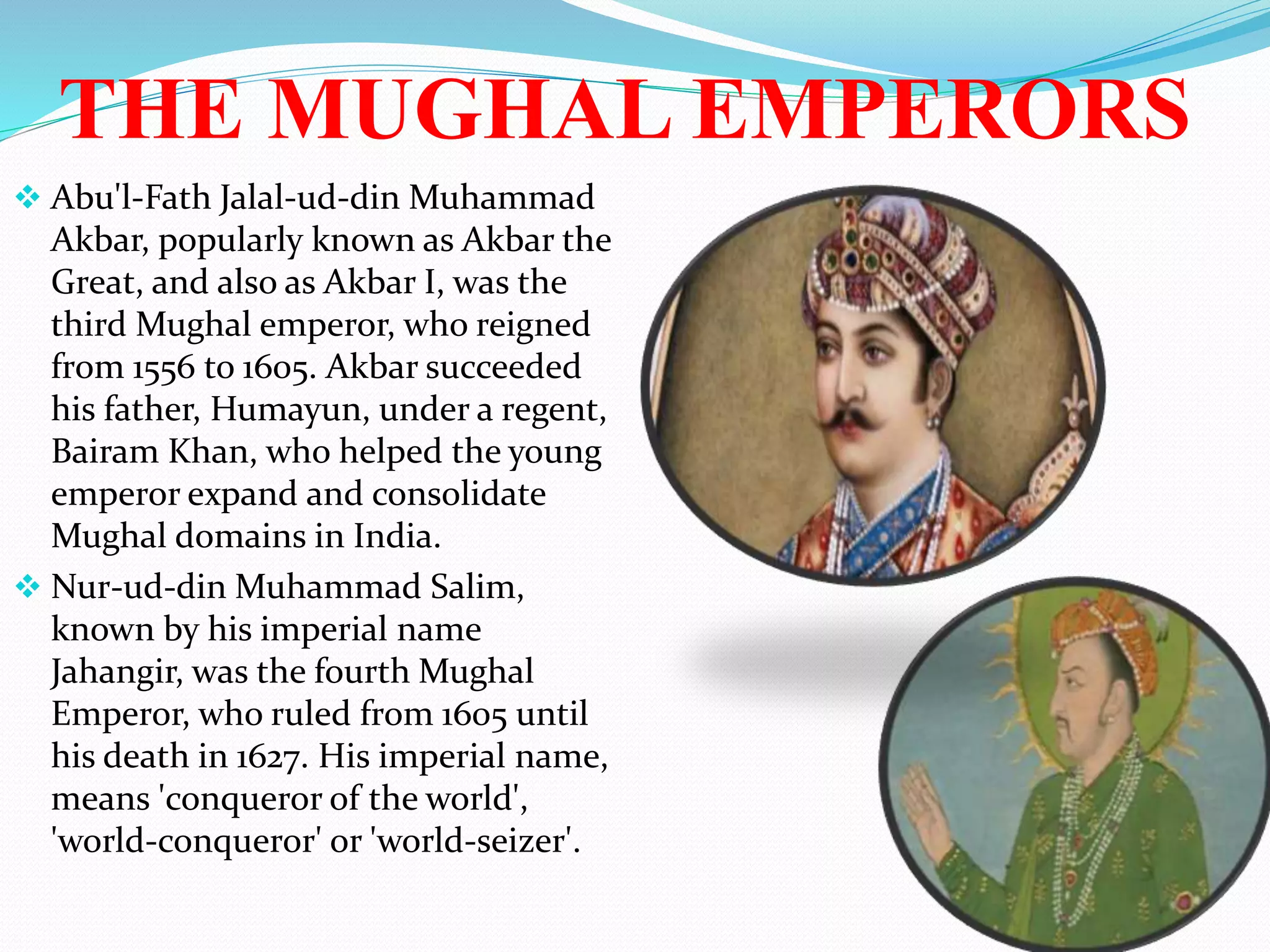
 Abu'l-Fath Jalal-ud-din Muhammad
Akbar, popularly known as Akbar the
Great, and also as Akbar I, was the
third Mughal emperor, who reigned
from 1556 to 1605. Akbar succeeded
his father, Humayun, under a regent,
Bairam Khan, who helped the young
emperor expand and consolidate
Mughal domains in India.
 Nur-ud-din Muhammad Salim,
known by his imperial name
Jahangir, was the fourth Mughal
Emperor, who ruled from 1605 until
his death in 1627. His imperial name,
means 'conqueror of the world',
'world-conqueror' or 'world-seizer'.
THE MUGHAL EMPERORS
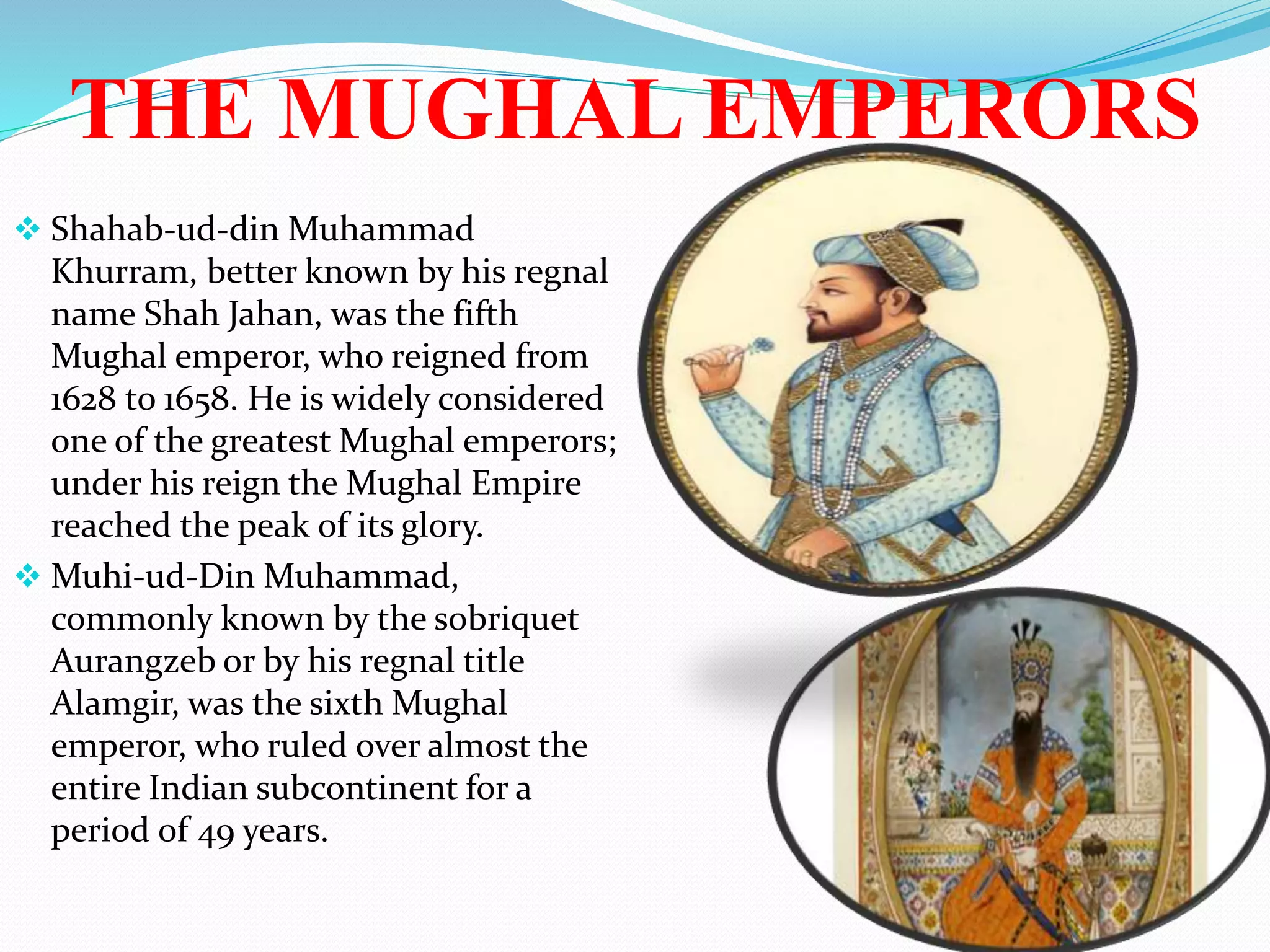
 Shahab-ud-din Muhammad
Khurram, better known by his regnal
name Shah Jahan, was the fifth
Mughal emperor, who reigned from
1628 to 1658. He is widely considered
one of the greatest Mughal emperors;
under his reign the Mughal Empire
reached the peak of its glory.
 Muhi-ud-Din Muhammad,
commonly known by the sobriquet
Aurangzeb or by his regnal title
Alamgir, was the sixth Mughal
emperor, who ruled over almost the
entire Indian subcontinent for a
period of 49 years.
MONUMENTS
MADE BY
MUGHAL EMPERORS
There Are Many Beautiful,
Architectural Monuments Made
By The Mughal Emperors. Some
Of These Are:-
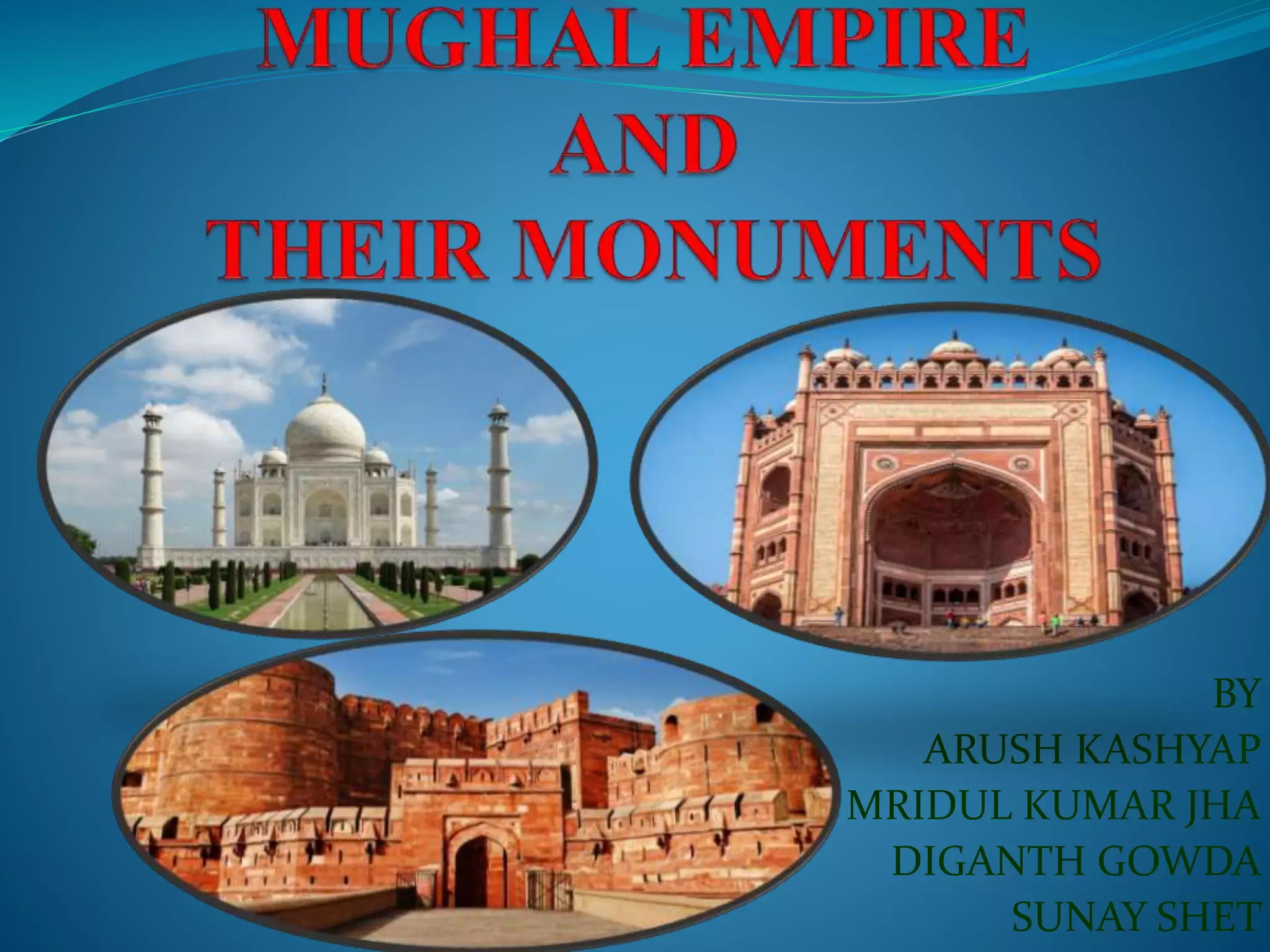
THE TAJ MAHAL[AGRA]
THE FATEHPUR SIKRI [AGRA]
THE RED FORT [DELHI]
THE AGRA FORT [AGRA]
AKBAR’S TOMB [AGRA]
 ALLAHBAD FORT
[PRAYAGRAJ]
TAJ MAHAL
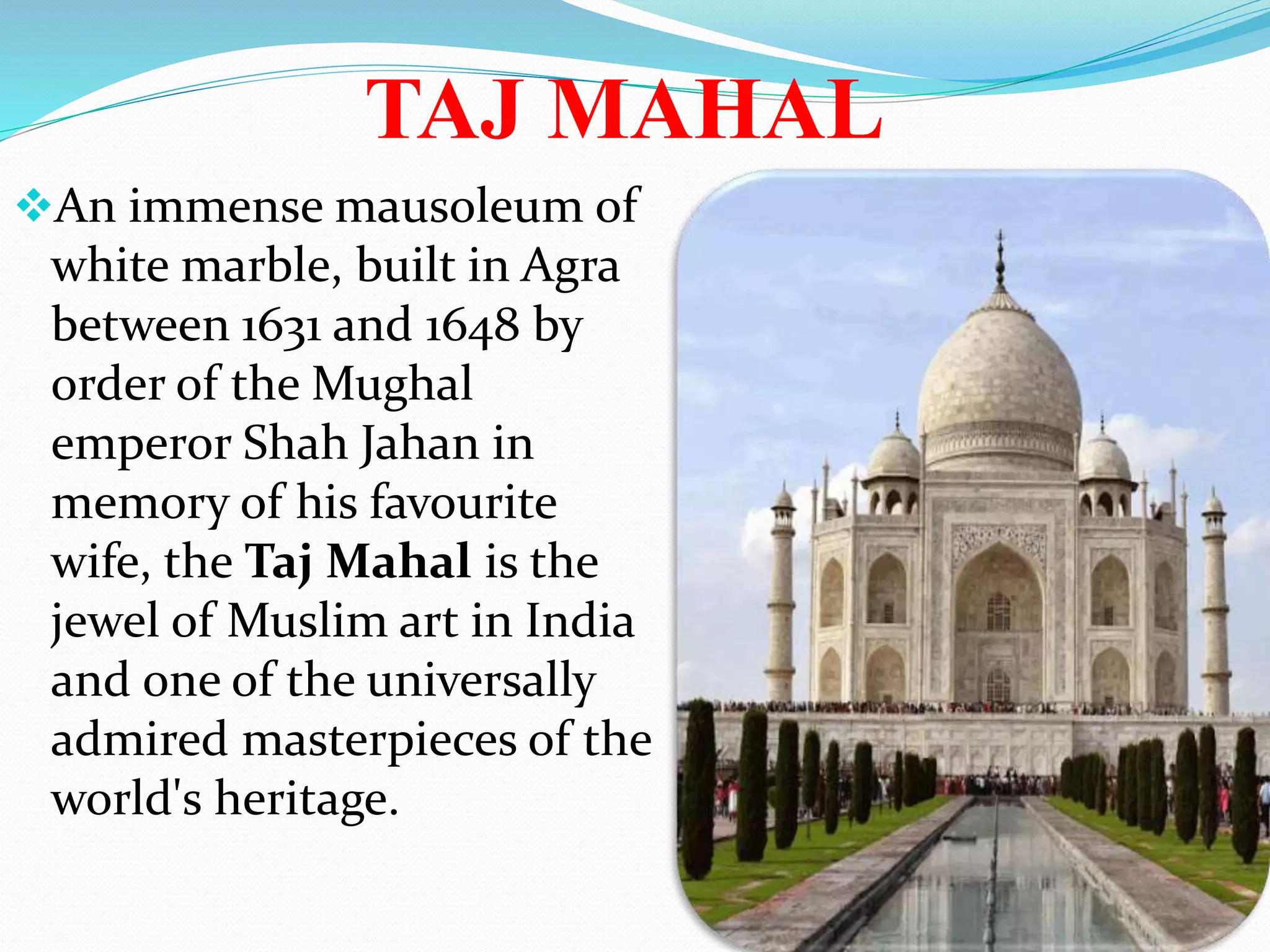
An immense mausoleum of
white marble, built in Agra
between 1631 and 1648 by
order of the Mughal
emperor Shah Jahan in
memory of his favourite
wife, the Taj Mahal is the
jewel of Muslim art in India
and one of the universally
admired masterpieces of the
world's heritage.
AKBAR’S TOMB
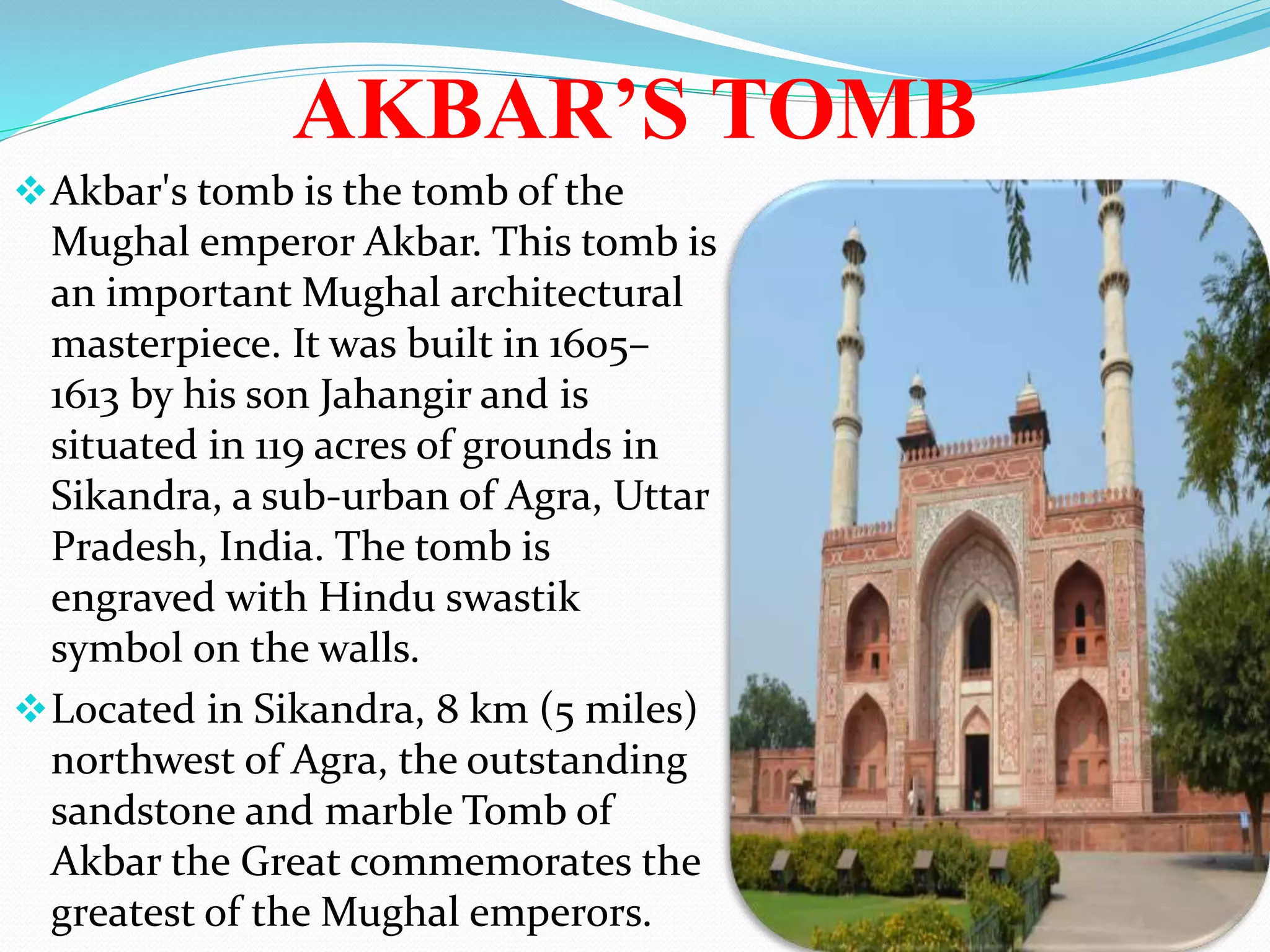
Akbar's tomb is the tomb of the
Mughal emperor Akbar. This tomb is
an important Mughal architectural
masterpiece. It was built in 1605–
1613 by his son Jahangir and is
situated in 119 acres of grounds in
Sikandra, a sub-urban of Agra, Uttar
Pradesh, India. The tomb is
engraved with Hindu swastik
symbol on the walls.
Located in Sikandra, 8 km (5 miles)
northwest of Agra, the outstanding
sandstone and marble Tomb of
Akbar the Great commemorates the
greatest of the Mughal emperors.
FATEHPUR SIKRI
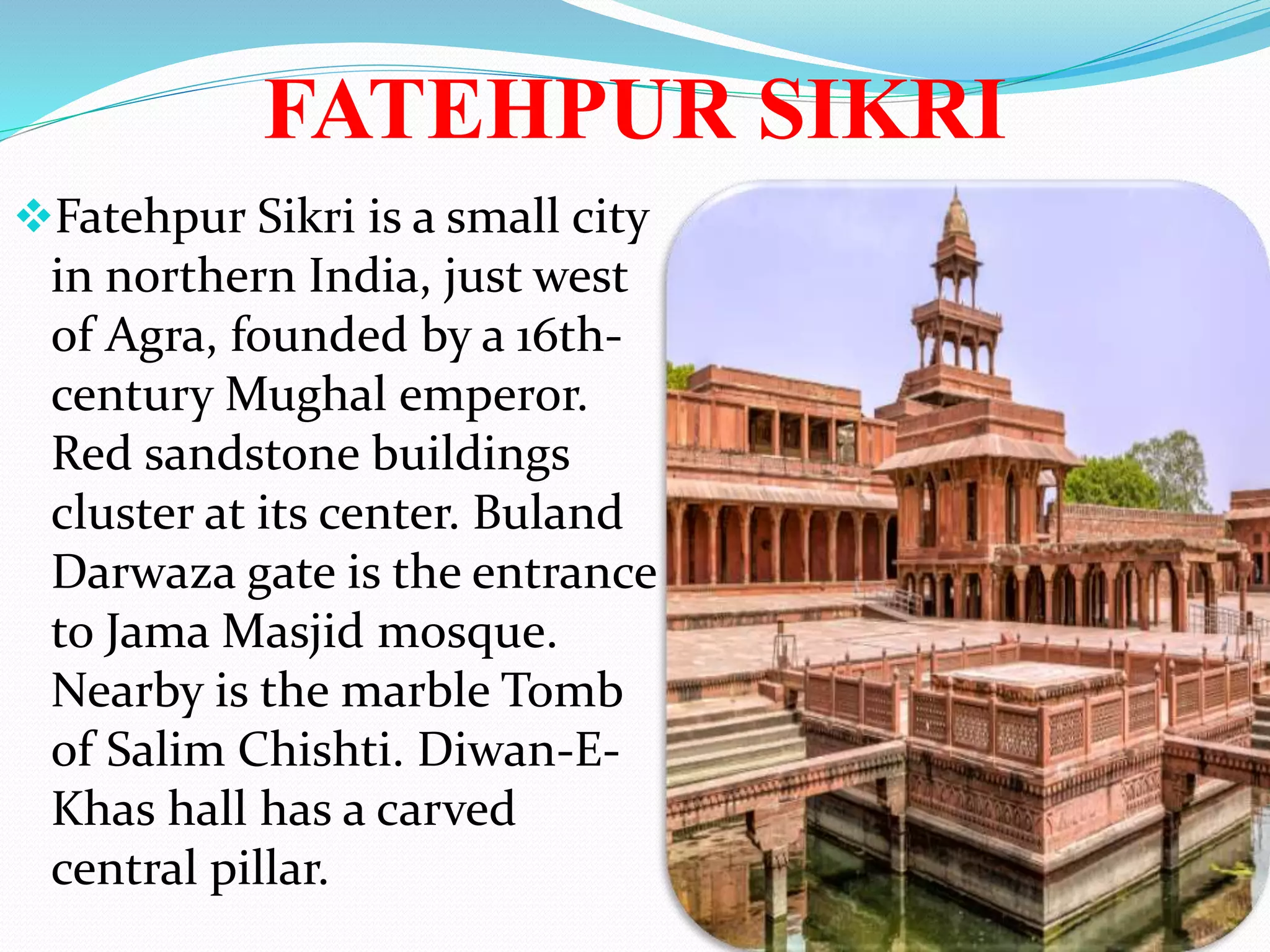
Fatehpur Sikri is a small city
in northern India, just west
of Agra, founded by a 16th-
century Mughal emperor.
Red sandstone buildings
cluster at its center. Buland
Darwaza gate is the entrance
to Jama Masjid mosque.
Nearby is the marble Tomb
of Salim Chishti. Diwan-E-
Khas hall has a carved
central pillar.
RED FORT
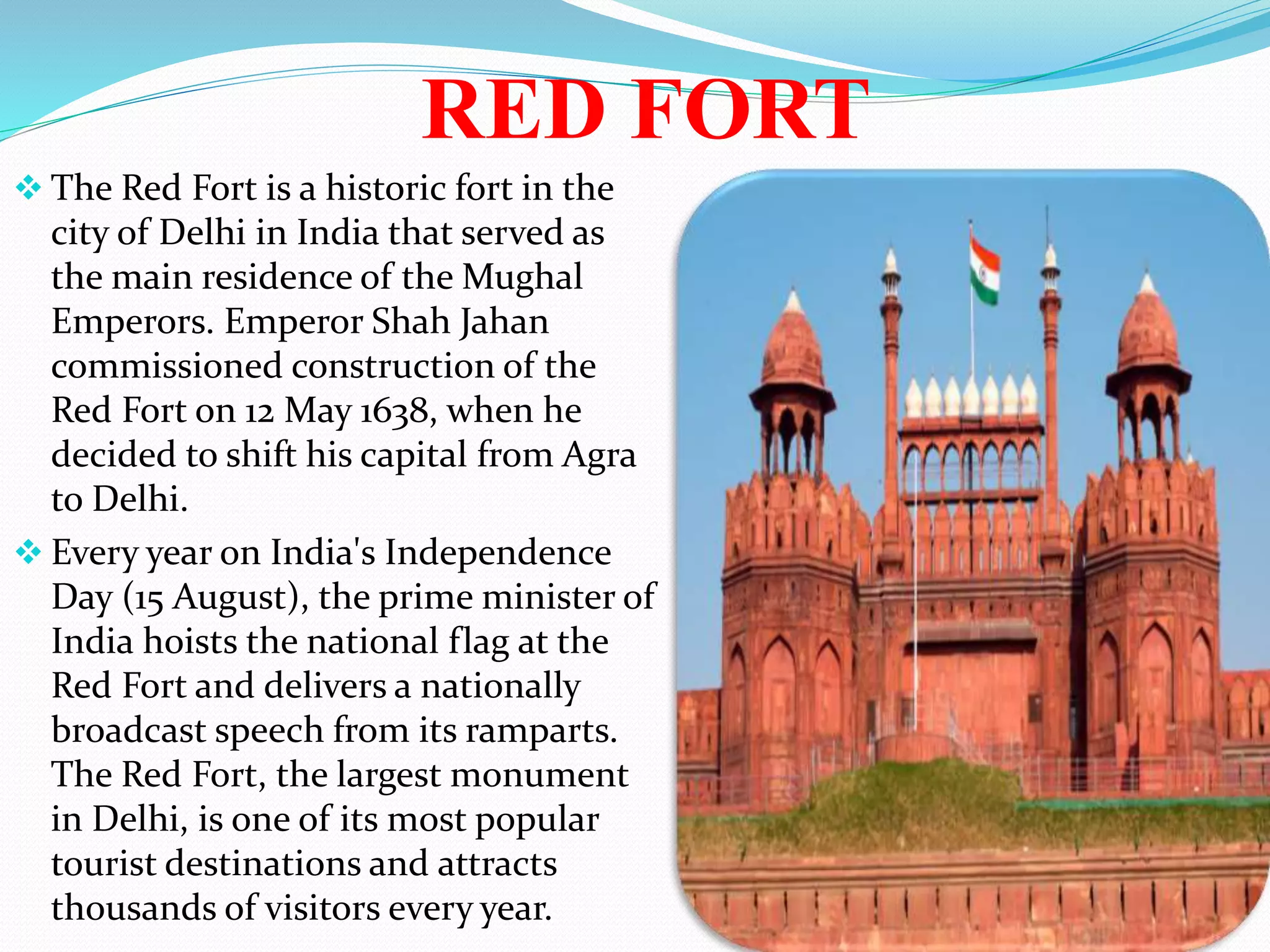
 The Red Fort is a historic fort in the
city of Delhi in India that served as
the main residence of the Mughal
Emperors. Emperor Shah Jahan
commissioned construction of the
Red Fort on 12 May 1638, when he
decided to shift his capital from Agra
to Delhi.
 Every year on India's Independence
Day (15 August), the prime minister of
India hoists the national flag at the
Red Fort and delivers a nationally
broadcast speech from its ramparts.
The Red Fort, the largest monument
in Delhi, is one of its most popular
tourist destinations and attracts
thousands of visitors every year.
AGRA FORT
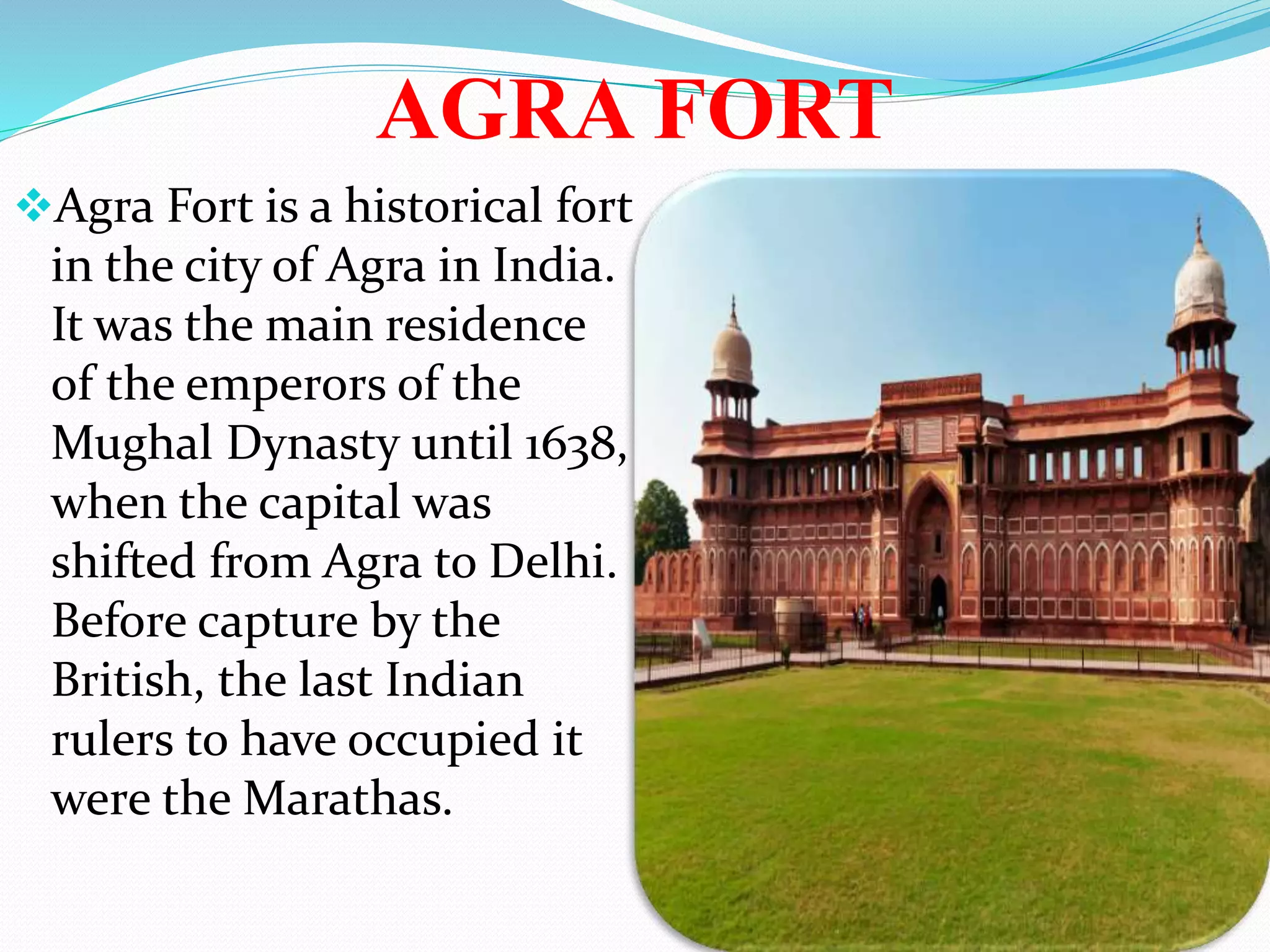
Agra Fort is a historical fort
in the city of Agra in India.
It was the main residence
of the emperors of the
Mughal Dynasty until 1638,
when the capital was
shifted from Agra to Delhi.
Before capture by the
British, the last Indian
rulers to have occupied it
were the Marathas.
ALLAHBAD FORT
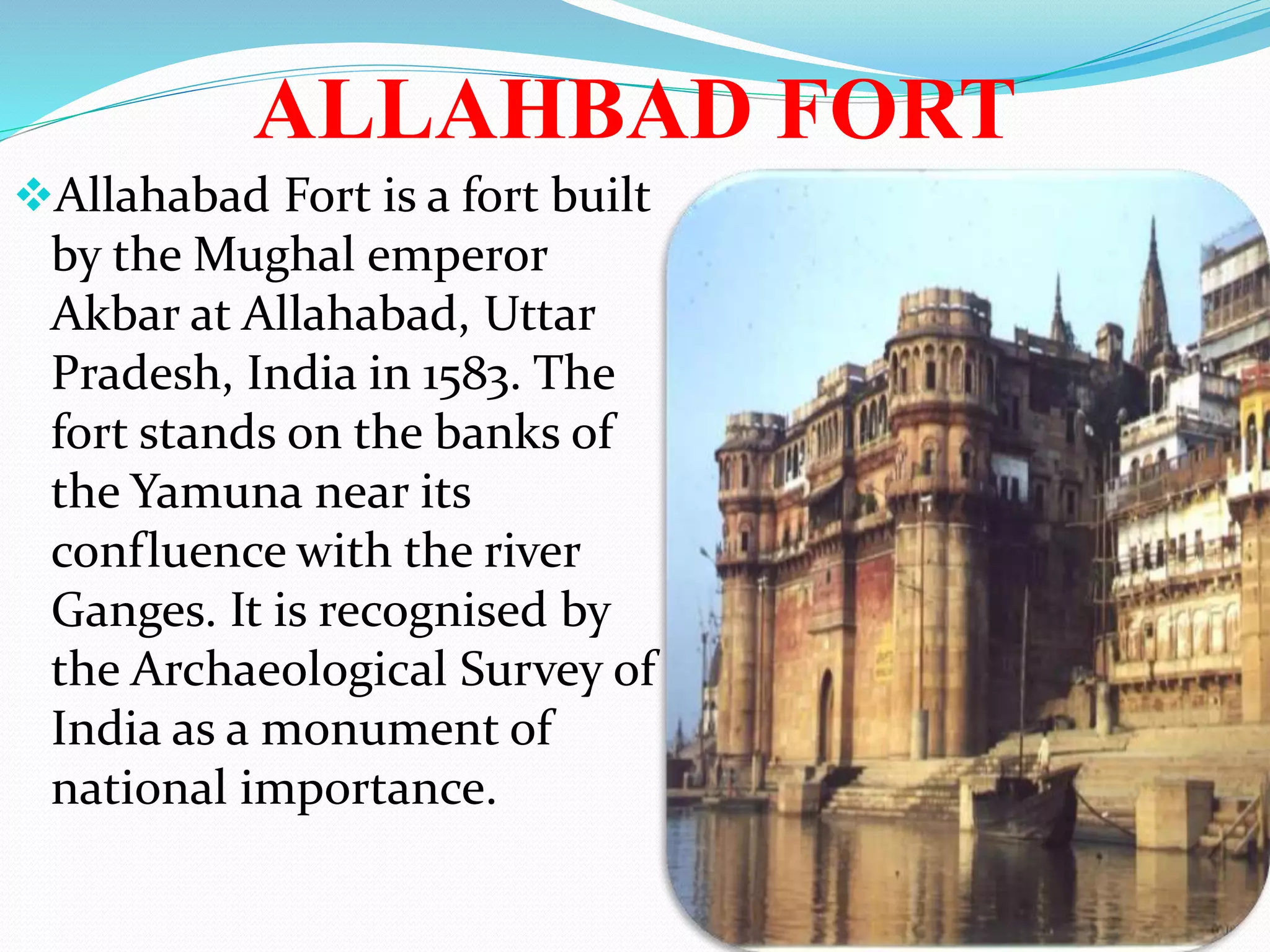
Allahabad Fort is a fort built
by the Mughal emperor
Akbar at Allahabad, Uttar
Pradesh, India in 1583. The
fort stands on the banks of
the Yamuna near its
confluence with the river
Ganges. It is recognised by
the Archaeological Survey of
India as a monument of
national importance.
MUGHAL EMPIRE AND THEIR MONUMENTS

MUGHAL EMPIRE AND THEIR MONUMENTS

  • 1.
    BY ARUSH KASHYAP MRIDUL KUMARJHA DIGANTH GOWDA SUNAY SHET
  • 2.
    THE MUGHAL EMPERORS Babur [14 February 1483 – 26 December 1530] born Zahīr ud-Dīn Muhammad, was the founder of the Mughal Empire and first Emperor of the Mughal Dynasty (1526–1530) in the Indian Subcontinent. He was a descendant of Timur and Genghis Khan through his father and mother respectively.  Nasir-ud-Din Muḥammad, better known by his regnal name, Humayun, was the second emperor of the Mughal Empire, who ruled over territory in what is now Afghanistan, Pakistan, Northern India, and Bangladesh from 1530– 1540 and again from 1555–1556.
  • 3.
    THE MUGHAL EMPERORS Abu'l-Fath Jalal-ud-din Muhammad Akbar, popularly known as Akbar the Great, and also as Akbar I, was the third Mughal emperor, who reigned from 1556 to 1605. Akbar succeeded his father, Humayun, under a regent, Bairam Khan, who helped the young emperor expand and consolidate Mughal domains in India.  Nur-ud-din Muhammad Salim, known by his imperial name Jahangir, was the fourth Mughal Emperor, who ruled from 1605 until his death in 1627. His imperial name, means 'conqueror of the world', 'world-conqueror' or 'world-seizer'.
  • 4.
    THE MUGHAL EMPERORS Shahab-ud-din Muhammad Khurram, better known by his regnal name Shah Jahan, was the fifth Mughal emperor, who reigned from 1628 to 1658. He is widely considered one of the greatest Mughal emperors; under his reign the Mughal Empire reached the peak of its glory.  Muhi-ud-Din Muhammad, commonly known by the sobriquet Aurangzeb or by his regnal title Alamgir, was the sixth Mughal emperor, who ruled over almost the entire Indian subcontinent for a period of 49 years.
  • 5.
    MONUMENTS MADE BY MUGHAL EMPERORS ThereAre Many Beautiful, Architectural Monuments Made By The Mughal Emperors. Some Of These Are:- THE TAJ MAHAL[AGRA] THE FATEHPUR SIKRI [AGRA] THE RED FORT [DELHI] THE AGRA FORT [AGRA] AKBAR’S TOMB [AGRA]  ALLAHBAD FORT [PRAYAGRAJ]
  • 6.
    TAJ MAHAL An immensemausoleum of white marble, built in Agra between 1631 and 1648 by order of the Mughal emperor Shah Jahan in memory of his favourite wife, the Taj Mahal is the jewel of Muslim art in India and one of the universally admired masterpieces of the world's heritage.
  • 7.
    AKBAR’S TOMB Akbar's tombis the tomb of the Mughal emperor Akbar. This tomb is an important Mughal architectural masterpiece. It was built in 1605– 1613 by his son Jahangir and is situated in 119 acres of grounds in Sikandra, a sub-urban of Agra, Uttar Pradesh, India. The tomb is engraved with Hindu swastik symbol on the walls. Located in Sikandra, 8 km (5 miles) northwest of Agra, the outstanding sandstone and marble Tomb of Akbar the Great commemorates the greatest of the Mughal emperors.
  • 8.
    FATEHPUR SIKRI Fatehpur Sikriis a small city in northern India, just west of Agra, founded by a 16th- century Mughal emperor. Red sandstone buildings cluster at its center. Buland Darwaza gate is the entrance to Jama Masjid mosque. Nearby is the marble Tomb of Salim Chishti. Diwan-E- Khas hall has a carved central pillar.
  • 9.
    RED FORT  TheRed Fort is a historic fort in the city of Delhi in India that served as the main residence of the Mughal Emperors. Emperor Shah Jahan commissioned construction of the Red Fort on 12 May 1638, when he decided to shift his capital from Agra to Delhi.  Every year on India's Independence Day (15 August), the prime minister of India hoists the national flag at the Red Fort and delivers a nationally broadcast speech from its ramparts. The Red Fort, the largest monument in Delhi, is one of its most popular tourist destinations and attracts thousands of visitors every year.
  • 10.
    AGRA FORT Agra Fortis a historical fort in the city of Agra in India. It was the main residence of the emperors of the Mughal Dynasty until 1638, when the capital was shifted from Agra to Delhi. Before capture by the British, the last Indian rulers to have occupied it were the Marathas.
  • 11.
    ALLAHBAD FORT Allahabad Fortis a fort built by the Mughal emperor Akbar at Allahabad, Uttar Pradesh, India in 1583. The fort stands on the banks of the Yamuna near its confluence with the river Ganges. It is recognised by the Archaeological Survey of India as a monument of national importance.