MTH-4108 A
                              Quadratic Functions
                             ANSWER KEY
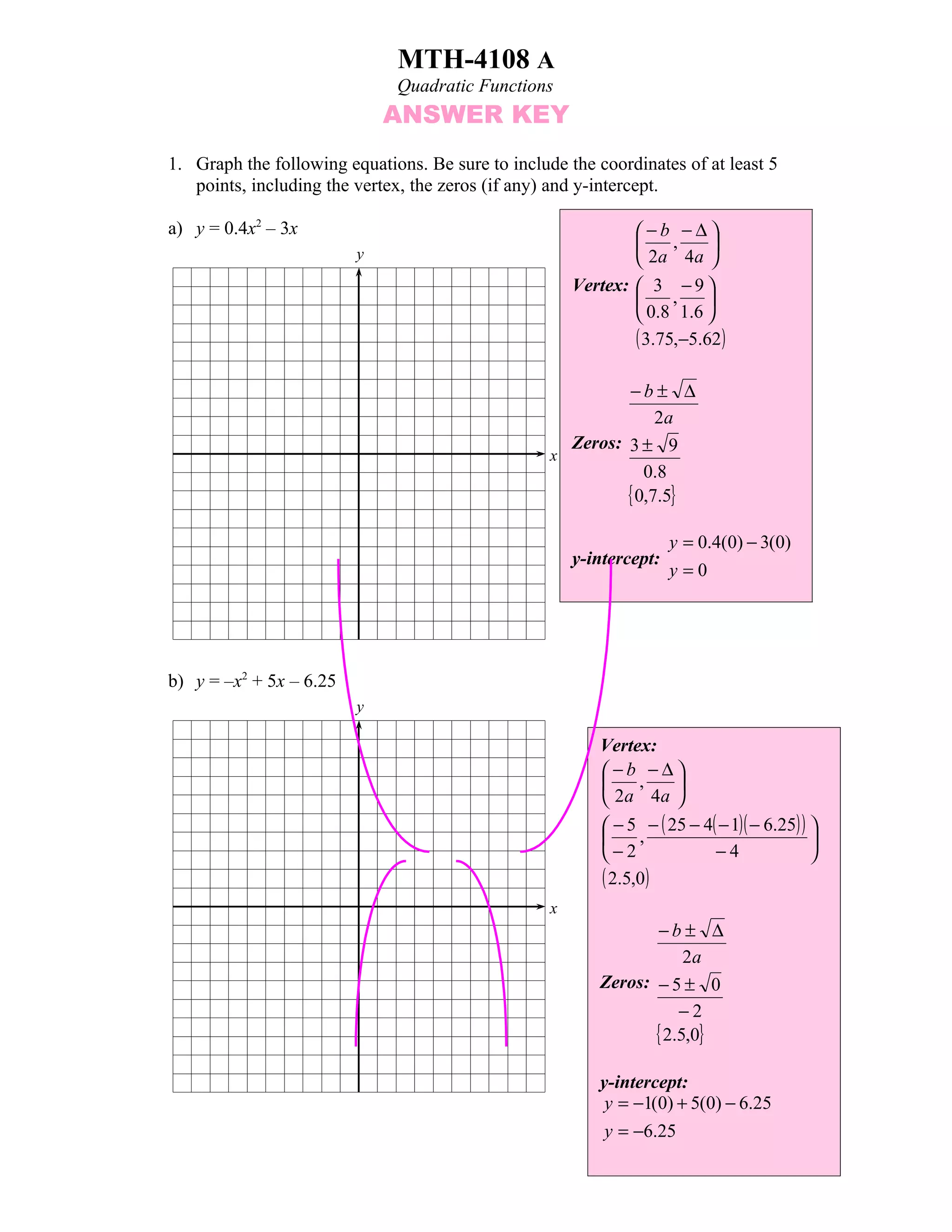
1. Graph the following equations. Be sure to include the coordinates of at least 5
   points, including the vertex, the zeros (if any) and y-intercept.

a) y = 0.4x2 – 3x                                              −b −∆
                                                                    ,    
                         y                                      2a 4 a 
                                                       Vertex:  3 − 9 
                                                                    ,   
                                                                0.8 1.6 
                                                               ( 3.75,−5.62)

                                                            −b± ∆
                                                                 2a
                                                     Zeros: 3 ± 9
                                                   x
                                                               0.8
                                                            { 0,7.5}
                                                                      y = 0.4(0) − 3(0)
                                                       y-intercept:
                                                                      y=0


b) y = –x2 + 5x – 6.25
                         y

                                                          Vertex:
                                                          −b −∆
                                                              ,  
                                                           2a 4a 
                                                            − 5 − ( 25 − 4( − 1)( − 6.25) ) 
                                                                ,                           
                                                           −2              −4               
                                                           ( 2.5,0)
                                                   x
                                                                 −b± ∆
                                                                      2a
                                                          Zeros: − 5 ± 0
                                                                     −2
                                                                 { 2.5,0}
                                                          y-intercept:
                                                           y = −1(0) + 5(0) − 6.25
                                                           y = −6.25
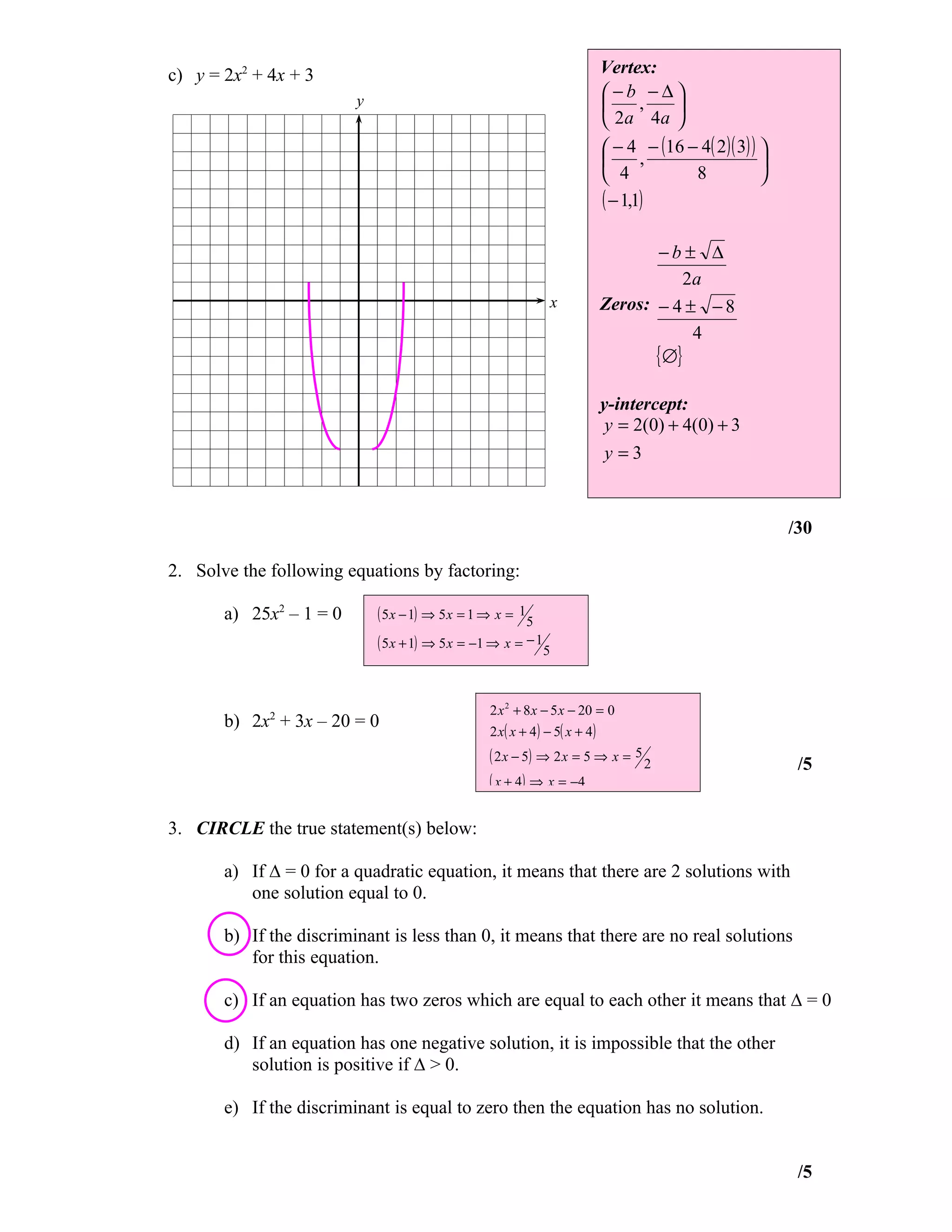
c) y = 2x2 + 4x + 3                                                         Vertex:
                         y                                                  −b −∆
                                                                                ,  
                                                                             2a 4a 
                                                                             − 4 − (16 − 4( 2)( 3) ) 
                                                                                  ,                  
                                                                             4          8            
                                                                            ( − 1,1)

                                                                                   −b± ∆
                                                                                       2a
                                                              x             Zeros: − 4 ± − 8
                                                                                        4
                                                                                   { ∅}
                                                                            y-intercept:
                                                                             y = 2(0) + 4(0) + 3
                                                                             y =3


                                                                                                          /30

2. Solve the following equations by factoring:

       a) 25x2 – 1 = 0       ( 5x − 1) ⇒ 5 x = 1 ⇒ x =  5
                                                         1

                             ( 5x + 1) ⇒ 5 x = −1 ⇒ x = − 1   5


                                                 2 x 2 + 8 x − 5 x − 20 = 0
       b) 2x2 + 3x – 20 = 0                      2 x( x + 4 ) − 5( x + 4)
                                                 ( 2 x − 5) ⇒ 2 x = 5 ⇒ x = 5 2                            /5
                                                 ( x + 4 ) ⇒ x = −4

3. CIRCLE the true statement(s) below:

       a) If ∆ = 0 for a quadratic equation, it means that there are 2 solutions with
          one solution equal to 0.

       b) If the discriminant is less than 0, it means that there are no real solutions
          for this equation.

       c) If an equation has two zeros which are equal to each other it means that ∆ = 0

       d) If an equation has one negative solution, it is impossible that the other
          solution is positive if ∆ > 0.

       e) If the discriminant is equal to zero then the equation has no solution.


                                                                                                           /5
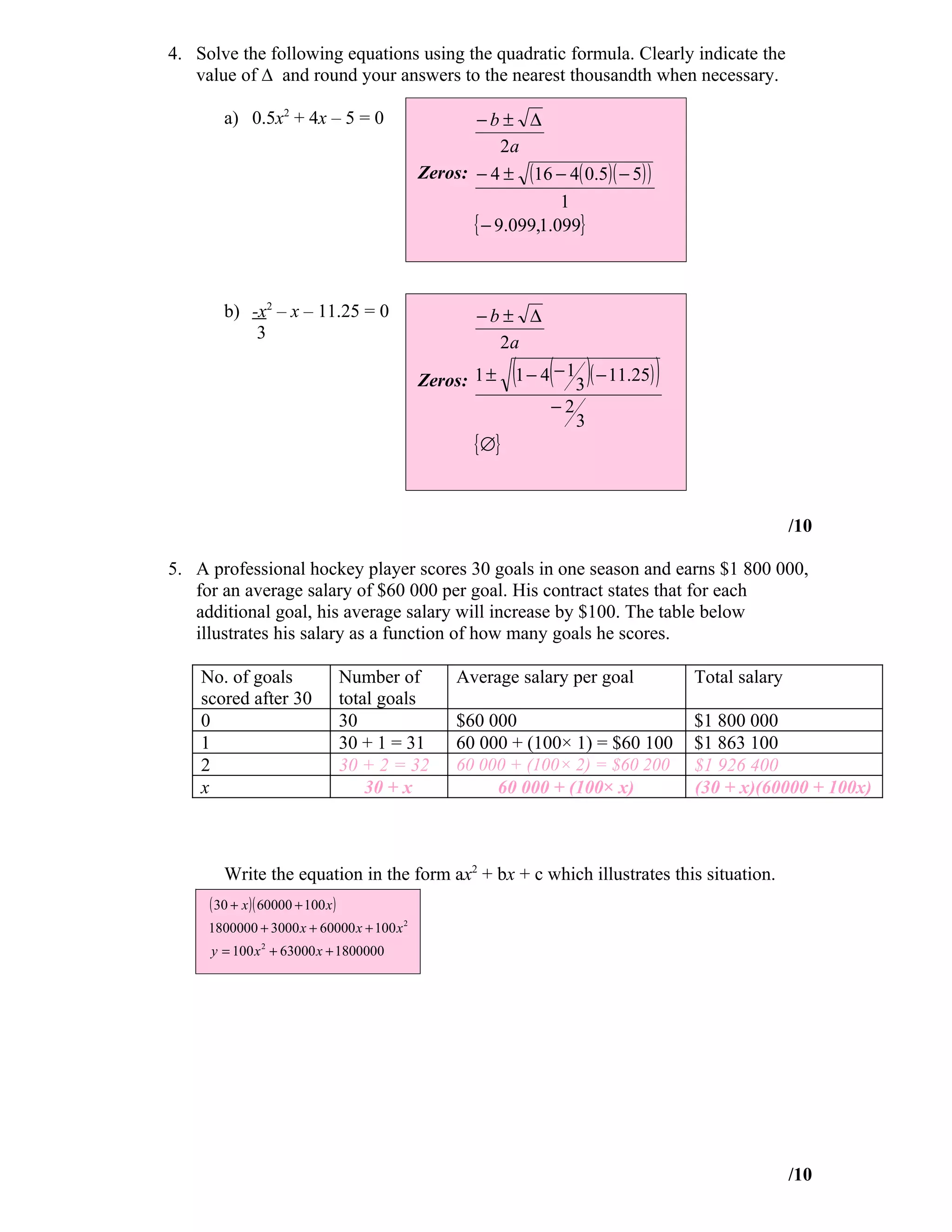
4. Solve the following equations using the quadratic formula. Clearly indicate the
   value of ∆ and round your answers to the nearest thousandth when necessary.

        a) 0.5x2 + 4x – 5 = 0                      −b± ∆
                                                        2a
                                            Zeros: − 4 ± (16 − 4( 0.5)( − 5) )
                                                                1
                                                   { − 9.099,1.099}


        b) -x2 – x – 11.25 = 0                      −b± ∆
            3
                                                      2a

                                            Zeros: 1 ±     (1 − 4(− 13 )( − 11.25) )
                                                                 −2
                                                                      3
                                                    { ∅}


                                                                                                      /10

5. A professional hockey player scores 30 goals in one season and earns $1 800 000,
   for an average salary of $60 000 per goal. His contract states that for each
   additional goal, his average salary will increase by $100. The table below
   illustrates his salary as a function of how many goals he scores.

    No. of goals                   Number of     Average salary per goal               Total salary
    scored after 30                total goals
    0                              30            $60 000                               $1 800 000
    1                              30 + 1 = 31   60 000 + (100× 1) = $60 100           $1 863 100
    2                              30 + 2 = 32   60 000 + (100× 2) = $60 200           $1 926 400
    x                                  30 + x         60 000 + (100× x)                (30 + x)(60000 + 100x)


        Write the equation in the form ax2 + bx + c which illustrates this situation.
     ( 30 + x )( 60000 + 100 x )
     1800000 + 3000 x + 60000 x + 100 x 2
     y = 100 x 2 + 63000 x + 1800000


                                                                                                      /10
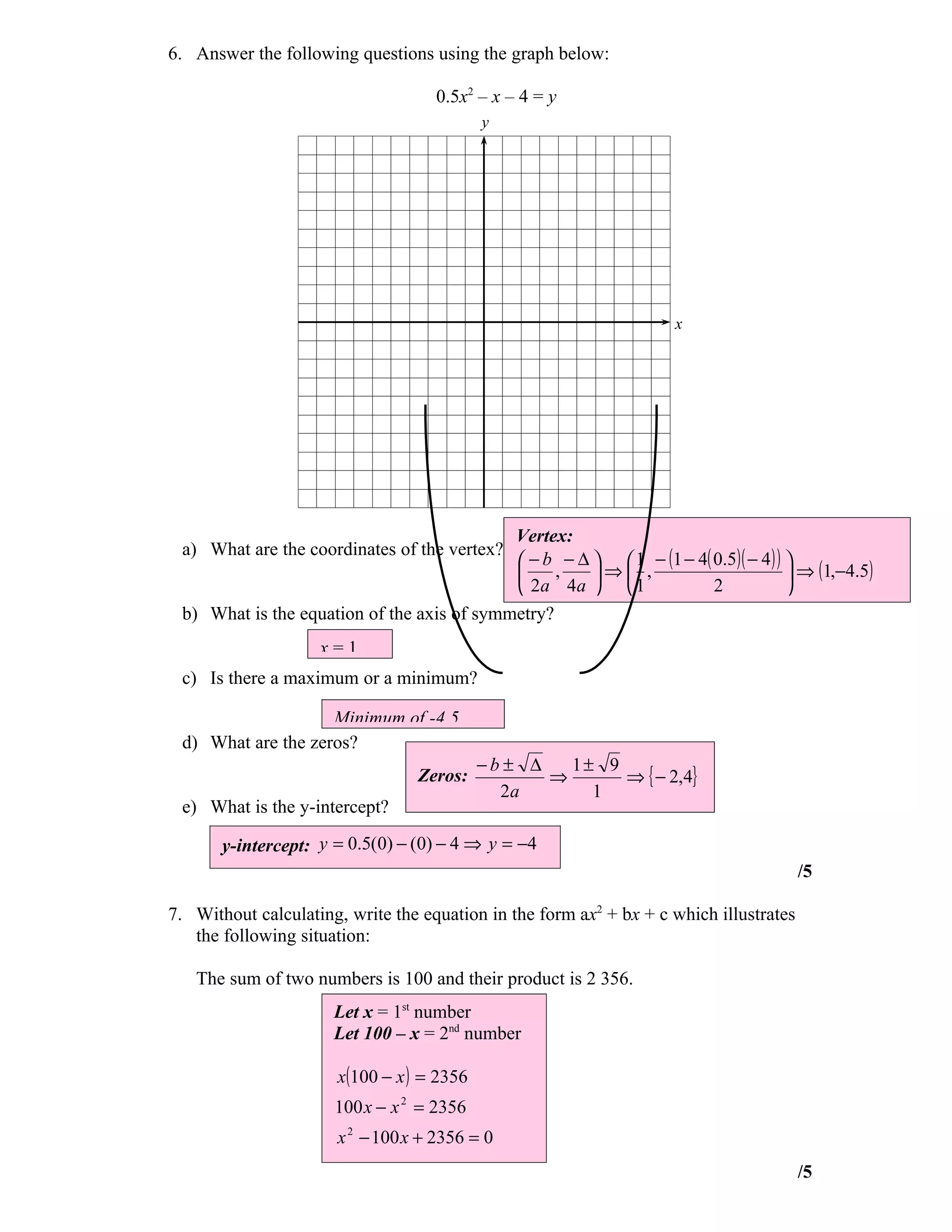
6. Answer the following questions using the graph below:

                                    0.5x2 – x – 4 = y
                                           y


                                                                    x


                                            Vertex:
 a) What are the coordinates of the vertex?
                                             − b − ∆   1 − (1 − 4( 0.5)( − 4 ) ) 
                                                 ,   ⇒ ,                          ⇒ (1,−4.5)
                                             2a 4a   1             2             
 b) What is the equation of the axis of symmetry?
                    x=1
 c) Is there a maximum or a minimum?

                    Minimum of -4.5
 d) What are the zeros?
                                           −b± ∆   1± 9
                                 Zeros:          ⇒      ⇒ { − 2,4}
                                             2a      1
 e) What is the y-intercept?

       y-intercept: y = 0.5(0) − (0) − 4 ⇒ y = −4
                                                                                        /5

7. Without calculating, write the equation in the form ax2 + bx + c which illustrates
   the following situation:

   The sum of two numbers is 100 and their product is 2 356.
                      Let x = 1st number
                      Let 100 – x = 2nd number

                      x(100 − x ) = 2356
                      100 x − x 2 = 2356
                      x 2 − 100 x + 2356 = 0
                                                                                        /5
8. The small base of a trapezoid measures double the height. The large base
   measures 3 metres more than the small base and the area of the trapezoid is equal
   to 123.75 metres squared. What are the measurements of the small base, large
   base and height of this trapezoid?

     Let x = height
     Let 2x = small base
     Let 2x + 3 = large base

     x[ 2 x + ( 2 x + 3) ]
                           = 123.75          −b± ∆
              2
                                                  2a
     x[ 4 x + 3]
                  = 123.75                   − 3 ± 9 − 4( 4 )( − 247.5)
           2
                                      Zeros:               8
     4 x 2 + 3 x 123.75
                  =                          − 3 ± 3969
           2             1
     4 x + 3 x = 247.5
         2                                          8
                                             { − 8.25,7.5}
     4 x 2 + 3 x − 247.5 = 0

                                                                                         /5

9. A sports store sells a certain number of bicycles at the regular price and receives
   $17 500 profit. The following week the bikes go on sale for $150 less each
   bicycle, and the store sells 15 more bicycles for the same total profit as the
   previous week. What is the regular price of one bicycle?

     Let x = price of one bicycle

     17500         17500
            + 15 =                                                  −b± ∆
       x           x − 150
     17500 + 15 x 17500                                                  2a
                  =
          x         x − 150                                         150 ± 22500 − 4(1)( − 175000 )
     17500 x − 2625000 + 15 x 2 − 2250 x = 17500 x           Zeros:              2
                                                                    150 ± 850
     15 x 2 − 2250 x − 2625000 = 0
                                                                          2
                                                                    { − 350,500}
     x 2 − 150 x − 175000 = 0


                                                                                     /10
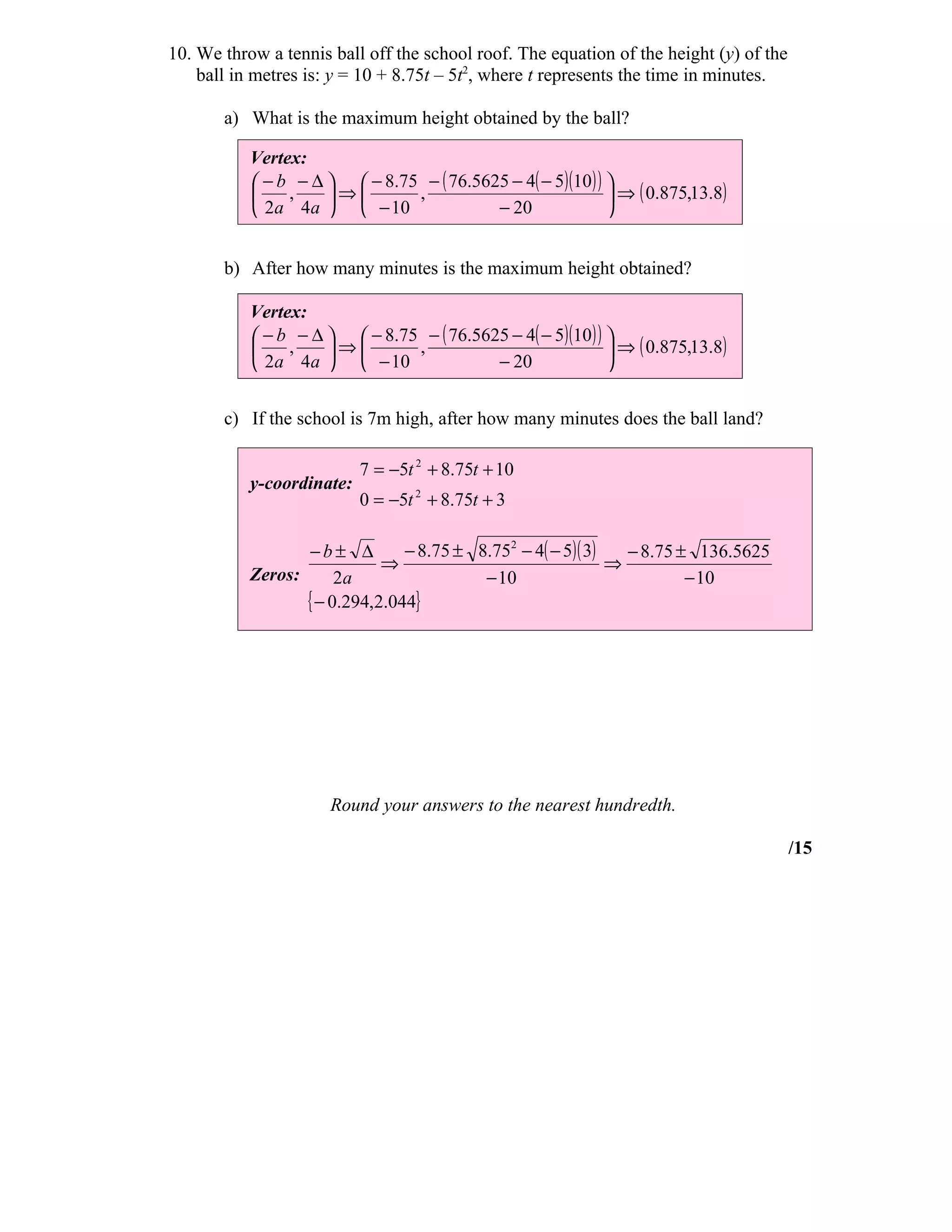
10. We throw a tennis ball off the school roof. The equation of the height (y) of the
    ball in metres is: y = 10 + 8.75t – 5t2, where t represents the time in minutes.

       a) What is the maximum height obtained by the ball?

           Vertex:
            − b − ∆   − 8.75 − ( 76.5625 − 4( − 5)(10 ) ) 
               ,    ⇒       ,                              ⇒ ( 0.875,13.8)
            2a 4a   − 10               − 20               


       b) After how many minutes is the maximum height obtained?

           Vertex:
            − b − ∆   − 8.75 − ( 76.5625 − 4( − 5)(10 ) ) 
               ,    ⇒       ,                              ⇒ ( 0.875,13.8)
            2a 4a   − 10               − 20               

       c) If the school is 7m high, after how many minutes does the ball land?

                           7 = −5t 2 + 8.75t + 10
           y-coordinate:
                           0 = −5t 2 + 8.75t + 3

                  −b± ∆         − 8.75 ± 8.752 − 4( − 5)( 3)   − 8.75 ± 136.5625
                             ⇒                               ⇒
           Zeros:      2a                 − 10                         − 10
                  { − 0.294,2.044}


                      Round your answers to the nearest hundredth.

                                                                                        /15

Mth 4108-1 a (ans)

  • 1.
    MTH-4108 A Quadratic Functions ANSWER KEY 1. Graph the following equations. Be sure to include the coordinates of at least 5 points, including the vertex, the zeros (if any) and y-intercept. a) y = 0.4x2 – 3x −b −∆  ,  y  2a 4 a  Vertex:  3 − 9   ,   0.8 1.6  ( 3.75,−5.62) −b± ∆ 2a Zeros: 3 ± 9 x 0.8 { 0,7.5} y = 0.4(0) − 3(0) y-intercept: y=0 b) y = –x2 + 5x – 6.25 y Vertex: −b −∆  ,   2a 4a   − 5 − ( 25 − 4( − 1)( − 6.25) )   ,  −2 −4  ( 2.5,0) x −b± ∆ 2a Zeros: − 5 ± 0 −2 { 2.5,0} y-intercept: y = −1(0) + 5(0) − 6.25 y = −6.25
  • 2.
    c) y =2x2 + 4x + 3 Vertex: y −b −∆  ,   2a 4a   − 4 − (16 − 4( 2)( 3) )   ,   4 8  ( − 1,1) −b± ∆ 2a x Zeros: − 4 ± − 8 4 { ∅} y-intercept: y = 2(0) + 4(0) + 3 y =3 /30 2. Solve the following equations by factoring: a) 25x2 – 1 = 0 ( 5x − 1) ⇒ 5 x = 1 ⇒ x = 5 1 ( 5x + 1) ⇒ 5 x = −1 ⇒ x = − 1 5 2 x 2 + 8 x − 5 x − 20 = 0 b) 2x2 + 3x – 20 = 0 2 x( x + 4 ) − 5( x + 4) ( 2 x − 5) ⇒ 2 x = 5 ⇒ x = 5 2 /5 ( x + 4 ) ⇒ x = −4 3. CIRCLE the true statement(s) below: a) If ∆ = 0 for a quadratic equation, it means that there are 2 solutions with one solution equal to 0. b) If the discriminant is less than 0, it means that there are no real solutions for this equation. c) If an equation has two zeros which are equal to each other it means that ∆ = 0 d) If an equation has one negative solution, it is impossible that the other solution is positive if ∆ > 0. e) If the discriminant is equal to zero then the equation has no solution. /5
  • 3.
    4. Solve thefollowing equations using the quadratic formula. Clearly indicate the value of ∆ and round your answers to the nearest thousandth when necessary. a) 0.5x2 + 4x – 5 = 0 −b± ∆ 2a Zeros: − 4 ± (16 − 4( 0.5)( − 5) ) 1 { − 9.099,1.099} b) -x2 – x – 11.25 = 0 −b± ∆ 3 2a Zeros: 1 ± (1 − 4(− 13 )( − 11.25) ) −2 3 { ∅} /10 5. A professional hockey player scores 30 goals in one season and earns $1 800 000, for an average salary of $60 000 per goal. His contract states that for each additional goal, his average salary will increase by $100. The table below illustrates his salary as a function of how many goals he scores. No. of goals Number of Average salary per goal Total salary scored after 30 total goals 0 30 $60 000 $1 800 000 1 30 + 1 = 31 60 000 + (100× 1) = $60 100 $1 863 100 2 30 + 2 = 32 60 000 + (100× 2) = $60 200 $1 926 400 x 30 + x 60 000 + (100× x) (30 + x)(60000 + 100x) Write the equation in the form ax2 + bx + c which illustrates this situation. ( 30 + x )( 60000 + 100 x ) 1800000 + 3000 x + 60000 x + 100 x 2 y = 100 x 2 + 63000 x + 1800000 /10
  • 4.
    6. Answer thefollowing questions using the graph below: 0.5x2 – x – 4 = y y x Vertex: a) What are the coordinates of the vertex?  − b − ∆   1 − (1 − 4( 0.5)( − 4 ) )   , ⇒ ,  ⇒ (1,−4.5)  2a 4a   1 2  b) What is the equation of the axis of symmetry? x=1 c) Is there a maximum or a minimum? Minimum of -4.5 d) What are the zeros? −b± ∆ 1± 9 Zeros: ⇒ ⇒ { − 2,4} 2a 1 e) What is the y-intercept? y-intercept: y = 0.5(0) − (0) − 4 ⇒ y = −4 /5 7. Without calculating, write the equation in the form ax2 + bx + c which illustrates the following situation: The sum of two numbers is 100 and their product is 2 356. Let x = 1st number Let 100 – x = 2nd number x(100 − x ) = 2356 100 x − x 2 = 2356 x 2 − 100 x + 2356 = 0 /5
  • 5.
    8. The smallbase of a trapezoid measures double the height. The large base measures 3 metres more than the small base and the area of the trapezoid is equal to 123.75 metres squared. What are the measurements of the small base, large base and height of this trapezoid? Let x = height Let 2x = small base Let 2x + 3 = large base x[ 2 x + ( 2 x + 3) ] = 123.75 −b± ∆ 2 2a x[ 4 x + 3] = 123.75 − 3 ± 9 − 4( 4 )( − 247.5) 2 Zeros: 8 4 x 2 + 3 x 123.75 = − 3 ± 3969 2 1 4 x + 3 x = 247.5 2 8 { − 8.25,7.5} 4 x 2 + 3 x − 247.5 = 0 /5 9. A sports store sells a certain number of bicycles at the regular price and receives $17 500 profit. The following week the bikes go on sale for $150 less each bicycle, and the store sells 15 more bicycles for the same total profit as the previous week. What is the regular price of one bicycle? Let x = price of one bicycle 17500 17500 + 15 = −b± ∆ x x − 150 17500 + 15 x 17500 2a = x x − 150 150 ± 22500 − 4(1)( − 175000 ) 17500 x − 2625000 + 15 x 2 − 2250 x = 17500 x Zeros: 2 150 ± 850 15 x 2 − 2250 x − 2625000 = 0 2 { − 350,500} x 2 − 150 x − 175000 = 0 /10
  • 6.
    10. We throwa tennis ball off the school roof. The equation of the height (y) of the ball in metres is: y = 10 + 8.75t – 5t2, where t represents the time in minutes. a) What is the maximum height obtained by the ball? Vertex:  − b − ∆   − 8.75 − ( 76.5625 − 4( − 5)(10 ) )   , ⇒ ,  ⇒ ( 0.875,13.8)  2a 4a   − 10 − 20  b) After how many minutes is the maximum height obtained? Vertex:  − b − ∆   − 8.75 − ( 76.5625 − 4( − 5)(10 ) )   , ⇒ ,  ⇒ ( 0.875,13.8)  2a 4a   − 10 − 20  c) If the school is 7m high, after how many minutes does the ball land? 7 = −5t 2 + 8.75t + 10 y-coordinate: 0 = −5t 2 + 8.75t + 3 −b± ∆ − 8.75 ± 8.752 − 4( − 5)( 3) − 8.75 ± 136.5625 ⇒ ⇒ Zeros: 2a − 10 − 10 { − 0.294,2.044} Round your answers to the nearest hundredth. /15