https://abdallamallabda.wixsite.com/zprofessor
Overview of Microcontrollers
Asst. Prof. (Dr. Eng.)
Abdalla Mohamed Abdalla
Lecture 2
MTE1 04
Introduction to Mechatronics
Outline
Microcontrollers, Microprocessors & Embedded Computers
1
Microcontroller Specifications
2
MSP432 Microcontroller
3
Microcontrollers, Microprocessors
& Embedded Computers
1
Microcontroller
zProfessor© – ABDALLA M. ABDALLA ©
24/10/2021 4
 A miniaturized computer containing a processor core, memory & input-output
peripherals in a single integrated circuit.
 Designed for embedded applications, unlike microprocessors which are designed
for computers.
 Abbreviated MCU.
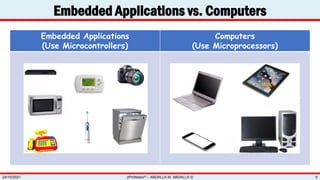
Embedded Applications
(Use Microcontrollers)
Computers
(Use Microprocessors)
Embedded Applications vs. Computers
zProfessor© – ABDALLA M. ABDALLA ©
24/10/2021 5
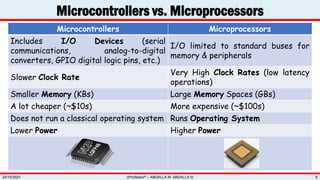
Microcontrollers Microprocessors
Includes I/O Devices (serial
communications, analog-to-digital
converters, GPIO digital logic pins, etc.)
I/O limited to standard buses for
memory & peripherals
Slower Clock Rate
Very High Clock Rates (low latency
operations)
Smaller Memory (KBs) Large Memory Spaces (GBs)
A lot cheaper (~$10s) More expensive (~$100s)
Does not run a classical operating system Runs Operating System
Lower Power Higher Power
Microcontrollers vs. Microprocessors
zProfessor© – ABDALLA M. ABDALLA ©
24/10/2021 6
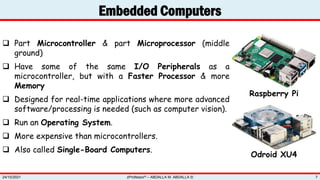
Embedded Computers
zProfessor© – ABDALLA M. ABDALLA ©
24/10/2021 7
 Part Microcontroller & part Microprocessor (middle
ground)
 Have some of the same I/O Peripherals as a
microcontroller, but with a Faster Processor & more
Memory
 Designed for real-time applications where more advanced
software/processing is needed (such as computer vision).
 Run an Operating System.
 More expensive than microcontrollers.
 Also called Single-Board Computers.
Raspberry Pi
Odroid XU4
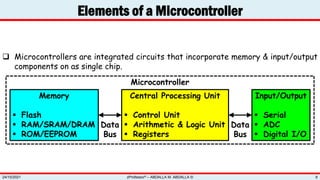
Microcontroller
Elements of a Microcontroller
zProfessor© – ABDALLA M. ABDALLA ©
24/10/2021 8
 Microcontrollers are integrated circuits that incorporate memory & input/output
components on as single chip.
Memory
 Flash
 RAM/SRAM/DRAM
 ROM/EEPROM
Central Processing Unit
 Control Unit
 Arithmetic & Logic Unit
 Registers
Input/Output
 Serial
 ADC
 Digital I/O
Data
Bus
Data
Bus
Elements of Microcontroller
zProfessor© – ABDALLA M. ABDALLA ©
24/10/2021 9
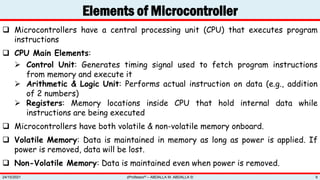
 Microcontrollers have a central processing unit (CPU) that executes program
instructions
 CPU Main Elements:
 Control Unit: Generates timing signal used to fetch program instructions
from memory and execute it
 Arithmetic & Logic Unit: Performs actual instruction on data (e.g., addition
of 2 numbers)
 Registers: Memory locations inside CPU that hold internal data while
instructions are being executed
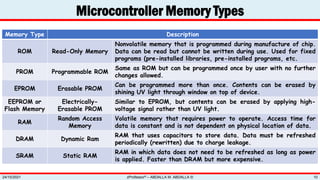
 Microcontrollers have both volatile & non-volatile memory onboard.
 Volatile Memory: Data is maintained in memory as long as power is applied. If
power is removed, data will be lost.
 Non-Volatile Memory: Data is maintained even when power is removed.
Microcontroller Memory Types
zProfessor© – ABDALLA M. ABDALLA ©
24/10/2021 10
Memory Type Description
ROM Read-Only Memory
Nonvolatile memory that is programmed during manufacture of chip.
Data can be read but cannot be written during use. Used for fixed
programs (pre-installed libraries, pre-installed programs, etc.
PROM Programmable ROM
Same as ROM but can be programmed once by user with no further
changes allowed.
EPROM Erasable PROM
Can be programmed more than once. Contents can be erased by
shining UV light through window on top of device.
EEPROM or
Flash Memory
Electrically-
Erasable PROM
Similar to EPROM, but contents can be erased by applying high-
voltage signal rather than UV light.
RAM
Random Access
Memory
Volatile memory that requires power to operate. Access time for
data is constant and is not dependent on physical location of data.
DRAM Dynamic Ram
RAM that uses capacitors to store data. Data must be refreshed
periodically (rewritten) due to charge leakage.
SRAM Static RAM
RAM in which data does not need to be refreshed as long as power
is applied. Faster than DRAM but more expensive.
General Purpose I/O (GPIO) Pins
zProfessor© – ABDALLA M. ABDALLA ©
24/10/2021 11
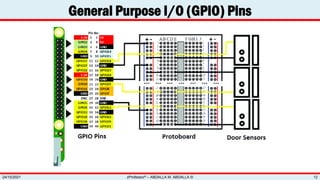
 Microcontrollers have General Purpose
Input-output (GPIO) Pins that enable
interfacing with onboard peripherals.
 GPIO pins are a unique feature of MCUs
which allow data to be sent between the
processor & external devices.

General Purpose I/O (GPIO) Pins
zProfessor© – ABDALLA M. ABDALLA ©
24/10/2021 12
Microcontroller Specifications
2
MCU Register Size
zProfessor© – ABDALLA M. ABDALLA ©
24/10/2021 14
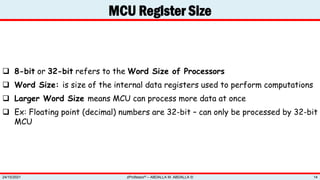
 8-bit or 32-bit refers to the Word Size of Processors
 Word Size: is size of the internal data registers used to perform computations
 Larger Word Size means MCU can process more data at once
 Ex: Floating point (decimal) numbers are 32-bit – can only be processed by 32-bit
MCU
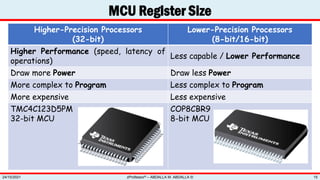
Higher-Precision Processors
(32-bit)
Lower-Precision Processors
(8-bit/16-bit)
Higher Performance (speed, latency of
operations)
Less capable / Lower Performance
Draw more Power Draw less Power
More complex to Program Less complex to Program
More expensive Less expensive
TMC4C123D5PM
32-bit MCU
COP8CBR9
8-bit MCU
MCU Register Size
zProfessor© – ABDALLA M. ABDALLA ©
24/10/2021 15
MCU Register Size
zProfessor© – ABDALLA M. ABDALLA ©
24/10/2021 16
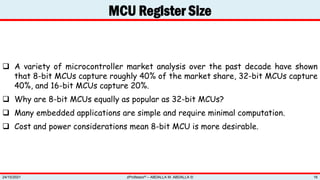
 A variety of microcontroller market analysis over the past decade have shown
that 8-bit MCUs capture roughly 40% of the market share, 32-bit MCUs capture
40%, and 16-bit MCUs capture 20%.
 Why are 8-bit MCUs equally as popular as 32-bit MCUs?
 Many embedded applications are simple and require minimal computation.
 Cost and power considerations mean 8-bit MCU is more desirable.
MCU Development Kits
zProfessor© – ABDALLA M. ABDALLA ©
24/10/2021 17
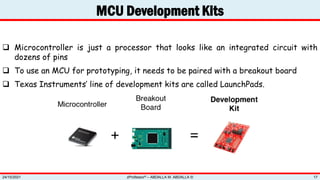
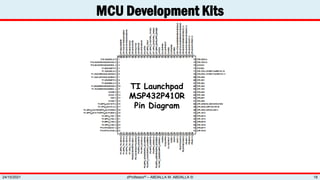
 Microcontroller is just a processor that looks like an integrated circuit with
dozens of pins
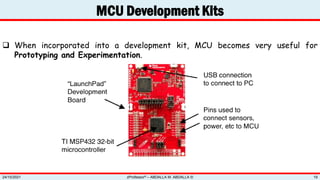
 To use an MCU for prototyping, it needs to be paired with a breakout board
 Texas Instruments’ line of development kits are called LaunchPads.
MCU Development Kits
zProfessor© – ABDALLA M. ABDALLA ©
24/10/2021 18
TI Launchpad
MSP432P410R
Pin Diagram
MCU Development Kits
zProfessor© – ABDALLA M. ABDALLA ©
24/10/2021 19
 When incorporated into a development kit, MCU becomes very useful for
Prototyping and Experimentation.
Example MCU Development Kit Specifications
zProfessor© – ABDALLA M. ABDALLA ©
24/10/2021 20
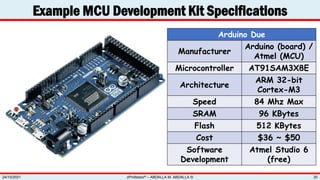
Arduino Due
Manufacturer
Arduino (board) /
Atmel (MCU)
Microcontroller AT91SAM3X8E
Architecture
ARM 32-bit
Cortex-M3
Speed 84 Mhz Max
SRAM 96 KBytes
Flash 512 KBytes
Cost $36 ~ $50
Software
Development
Atmel Studio 6
(free)
Example MCU Development Kit Specifications
zProfessor© – ABDALLA M. ABDALLA ©
24/10/2021 21
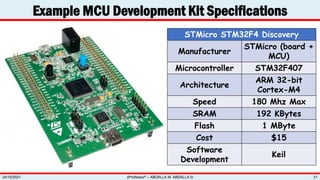
STMicro STM32F4 Discovery
Manufacturer
STMicro (board +
MCU)
Microcontroller STM32F407
Architecture
ARM 32-bit
Cortex-M4
Speed 180 Mhz Max
SRAM 192 KBytes
Flash 1 MByte
Cost $15
Software
Development
Keil
Example MCU Development Kit Specifications
zProfessor© – ABDALLA M. ABDALLA ©
24/10/2021 22
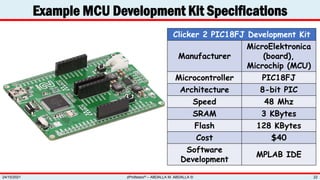
Clicker 2 PIC18FJ Development Kit
Manufacturer
MicroElektronica
(board),
Microchip (MCU)
Microcontroller PIC18FJ
Architecture 8-bit PIC
Speed 48 Mhz
SRAM 3 KBytes
Flash 128 KBytes
Cost $40
Software
Development
MPLAB IDE
Example MCU Development Kit Specifications
zProfessor© – ABDALLA M. ABDALLA ©
24/10/2021 23
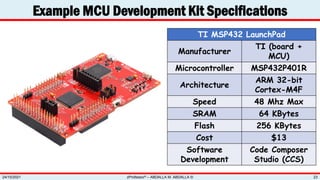
TI MSP432 LaunchPad
Manufacturer
TI (board +
MCU)
Microcontroller MSP432P401R
Architecture
ARM 32-bit
Cortex-M4F
Speed 48 Mhz Max
SRAM 64 KBytes
Flash 256 KBytes
Cost $13
Software
Development
Code Composer
Studio (CCS)
Example MCU Development Kit Specifications
zProfessor© – ABDALLA M. ABDALLA ©
24/10/2021 24
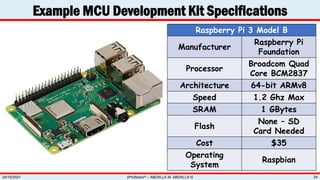
Raspberry Pi 3 Model B
Manufacturer
Raspberry Pi
Foundation
Processor
Broadcom Quad
Core BCM2837
Architecture 64-bit ARMv8
Speed 1.2 Ghz Max
SRAM 1 GBytes
Flash
None – SD
Card Needed
Cost $35
Operating
System
Raspbian
MSP432 Microcontroller
3
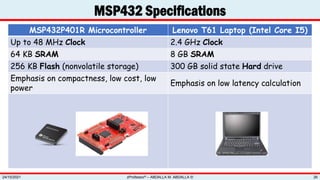
MSP432P401R Microcontroller Lenovo T61 Laptop (Intel Core I5)
Up to 48 MHz Clock 2.4 GHz Clock
64 KB SRAM 8 GB SRAM
256 KB Flash (nonvolatile storage) 300 GB solid state Hard drive
Emphasis on compactness, low cost, low
power
Emphasis on low latency calculation
MSP432 Specifications
zProfessor© – ABDALLA M. ABDALLA ©
24/10/2021 26
General Purpose Input-Output
zProfessor© – ABDALLA M. ABDALLA ©
24/10/2021 27
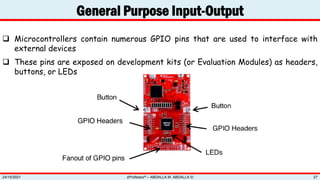
 Microcontrollers contain numerous GPIO pins that are used to interface with
external devices
 These pins are exposed on development kits (or Evaluation Modules) as headers,
buttons, or LEDs
General Purpose Input-Output
zProfessor© – ABDALLA M. ABDALLA ©
24/10/2021 28
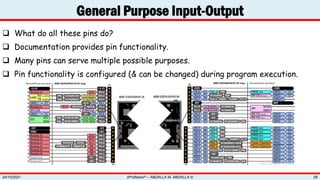
 What do all these pins do?
 Documentation provides pin functionality.
 Many pins can serve multiple possible purposes.
 Pin functionality is configured (& can be changed) during program execution.
Shields & BoosterPacks
zProfessor© – ABDALLA M. ABDALLA ©
24/10/2021 29
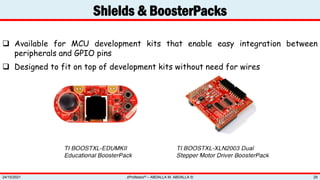
 Available for MCU development kits that enable easy integration between
peripherals and GPIO pins
 Designed to fit on top of development kits without need for wires
Programming & Executing Code
zProfessor© – ABDALLA M. ABDALLA ©
24/10/2021 30
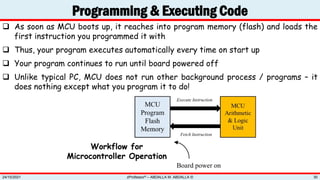
 As soon as MCU boots up, it reaches into program memory (flash) and loads the
first instruction you programmed it with
 Thus, your program executes automatically every time on start up
 Your program continues to run until board powered off
 Unlike typical PC, MCU does not run other background process / programs – it
does nothing except what you program it to do!
Workflow for
Microcontroller Operation
Programming a Microcontroller
zProfessor© – ABDALLA M. ABDALLA ©
24/10/2021 31
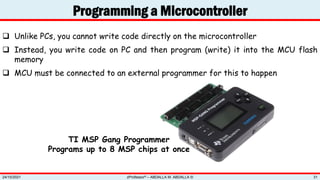
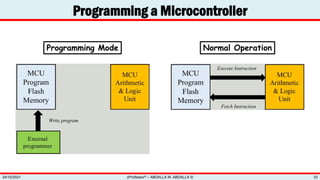
 Unlike PCs, you cannot write code directly on the microcontroller
 Instead, you write code on PC and then program (write) it into the MCU flash
memory
 MCU must be connected to an external programmer for this to happen
TI MSP Gang Programmer
Programs up to 8 MSP chips at once
Programming a Microcontroller
zProfessor© – ABDALLA M. ABDALLA ©
24/10/2021 32
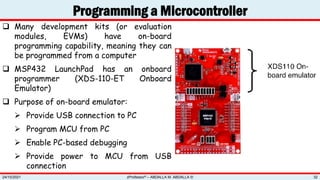
 Many development kits (or evaluation
modules, EVMs) have on-board
programming capability, meaning they can
be programmed from a computer
 MSP432 LaunchPad has an onboard
programmer (XDS-110-ET Onboard
Emulator)
 Purpose of on-board emulator:
 Provide USB connection to PC
 Program MCU from PC
 Enable PC-based debugging
 Provide power to MCU from USB
connection
Programming a Microcontroller
zProfessor© – ABDALLA M. ABDALLA ©
24/10/2021 33
Programming Mode Normal Operation
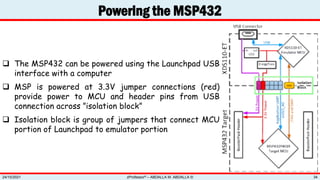
 The MSP432 can be powered using the Launchpad USB
interface with a computer
 MSP is powered at 3.3V jumper connections (red)
provide power to MCU and header pins from USB
connection across ”isolation block”
 Isolation block is group of jumpers that connect MCU
portion of Launchpad to emulator portion
Powering the MSP432
zProfessor© – ABDALLA M. ABDALLA ©
24/10/2021 34
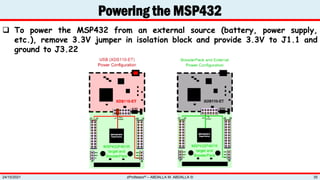
 To power the MSP432 from an external source (battery, power supply,
etc.), remove 3.3V jumper in isolation block and provide 3.3V to J1.1 and
ground to J3.22
Powering the MSP432
zProfessor© – ABDALLA M. ABDALLA ©
24/10/2021 35
Documentation for the MSP432 LaunchPad
zProfessor© – ABDALLA M. ABDALLA ©
24/10/2021 36
MTE305
Computer-Aided Design
https://abdallamallabda.wixsite.com/zprofessor

MTE104-L2: Overview of Microcontrollers

  • 1.
    https://abdallamallabda.wixsite.com/zprofessor Overview of Microcontrollers Asst.Prof. (Dr. Eng.) Abdalla Mohamed Abdalla Lecture 2 MTE1 04 Introduction to Mechatronics
  • 2.
    Outline Microcontrollers, Microprocessors &Embedded Computers 1 Microcontroller Specifications 2 MSP432 Microcontroller 3
  • 3.
  • 4.
    Microcontroller zProfessor© – ABDALLAM. ABDALLA © 24/10/2021 4  A miniaturized computer containing a processor core, memory & input-output peripherals in a single integrated circuit.  Designed for embedded applications, unlike microprocessors which are designed for computers.  Abbreviated MCU.
  • 5.
    Embedded Applications (Use Microcontrollers) Computers (UseMicroprocessors) Embedded Applications vs. Computers zProfessor© – ABDALLA M. ABDALLA © 24/10/2021 5
  • 6.
    Microcontrollers Microprocessors Includes I/ODevices (serial communications, analog-to-digital converters, GPIO digital logic pins, etc.) I/O limited to standard buses for memory & peripherals Slower Clock Rate Very High Clock Rates (low latency operations) Smaller Memory (KBs) Large Memory Spaces (GBs) A lot cheaper (~$10s) More expensive (~$100s) Does not run a classical operating system Runs Operating System Lower Power Higher Power Microcontrollers vs. Microprocessors zProfessor© – ABDALLA M. ABDALLA © 24/10/2021 6
  • 7.
    Embedded Computers zProfessor© –ABDALLA M. ABDALLA © 24/10/2021 7  Part Microcontroller & part Microprocessor (middle ground)  Have some of the same I/O Peripherals as a microcontroller, but with a Faster Processor & more Memory  Designed for real-time applications where more advanced software/processing is needed (such as computer vision).  Run an Operating System.  More expensive than microcontrollers.  Also called Single-Board Computers. Raspberry Pi Odroid XU4
  • 8.
    Microcontroller Elements of aMicrocontroller zProfessor© – ABDALLA M. ABDALLA © 24/10/2021 8  Microcontrollers are integrated circuits that incorporate memory & input/output components on as single chip. Memory  Flash  RAM/SRAM/DRAM  ROM/EEPROM Central Processing Unit  Control Unit  Arithmetic & Logic Unit  Registers Input/Output  Serial  ADC  Digital I/O Data Bus Data Bus
  • 9.
    Elements of Microcontroller zProfessor©– ABDALLA M. ABDALLA © 24/10/2021 9  Microcontrollers have a central processing unit (CPU) that executes program instructions  CPU Main Elements:  Control Unit: Generates timing signal used to fetch program instructions from memory and execute it  Arithmetic & Logic Unit: Performs actual instruction on data (e.g., addition of 2 numbers)  Registers: Memory locations inside CPU that hold internal data while instructions are being executed  Microcontrollers have both volatile & non-volatile memory onboard.  Volatile Memory: Data is maintained in memory as long as power is applied. If power is removed, data will be lost.  Non-Volatile Memory: Data is maintained even when power is removed.
  • 10.
    Microcontroller Memory Types zProfessor©– ABDALLA M. ABDALLA © 24/10/2021 10 Memory Type Description ROM Read-Only Memory Nonvolatile memory that is programmed during manufacture of chip. Data can be read but cannot be written during use. Used for fixed programs (pre-installed libraries, pre-installed programs, etc. PROM Programmable ROM Same as ROM but can be programmed once by user with no further changes allowed. EPROM Erasable PROM Can be programmed more than once. Contents can be erased by shining UV light through window on top of device. EEPROM or Flash Memory Electrically- Erasable PROM Similar to EPROM, but contents can be erased by applying high- voltage signal rather than UV light. RAM Random Access Memory Volatile memory that requires power to operate. Access time for data is constant and is not dependent on physical location of data. DRAM Dynamic Ram RAM that uses capacitors to store data. Data must be refreshed periodically (rewritten) due to charge leakage. SRAM Static RAM RAM in which data does not need to be refreshed as long as power is applied. Faster than DRAM but more expensive.
  • 11.
    General Purpose I/O(GPIO) Pins zProfessor© – ABDALLA M. ABDALLA © 24/10/2021 11  Microcontrollers have General Purpose Input-output (GPIO) Pins that enable interfacing with onboard peripherals.  GPIO pins are a unique feature of MCUs which allow data to be sent between the processor & external devices.
  • 12.
    General Purpose I/O(GPIO) Pins zProfessor© – ABDALLA M. ABDALLA © 24/10/2021 12
  • 13.
  • 14.
    MCU Register Size zProfessor©– ABDALLA M. ABDALLA © 24/10/2021 14  8-bit or 32-bit refers to the Word Size of Processors  Word Size: is size of the internal data registers used to perform computations  Larger Word Size means MCU can process more data at once  Ex: Floating point (decimal) numbers are 32-bit – can only be processed by 32-bit MCU
  • 15.
    Higher-Precision Processors (32-bit) Lower-Precision Processors (8-bit/16-bit) HigherPerformance (speed, latency of operations) Less capable / Lower Performance Draw more Power Draw less Power More complex to Program Less complex to Program More expensive Less expensive TMC4C123D5PM 32-bit MCU COP8CBR9 8-bit MCU MCU Register Size zProfessor© – ABDALLA M. ABDALLA © 24/10/2021 15
  • 16.
    MCU Register Size zProfessor©– ABDALLA M. ABDALLA © 24/10/2021 16  A variety of microcontroller market analysis over the past decade have shown that 8-bit MCUs capture roughly 40% of the market share, 32-bit MCUs capture 40%, and 16-bit MCUs capture 20%.  Why are 8-bit MCUs equally as popular as 32-bit MCUs?  Many embedded applications are simple and require minimal computation.  Cost and power considerations mean 8-bit MCU is more desirable.
  • 17.
    MCU Development Kits zProfessor©– ABDALLA M. ABDALLA © 24/10/2021 17  Microcontroller is just a processor that looks like an integrated circuit with dozens of pins  To use an MCU for prototyping, it needs to be paired with a breakout board  Texas Instruments’ line of development kits are called LaunchPads.
  • 18.
    MCU Development Kits zProfessor©– ABDALLA M. ABDALLA © 24/10/2021 18 TI Launchpad MSP432P410R Pin Diagram
  • 19.
    MCU Development Kits zProfessor©– ABDALLA M. ABDALLA © 24/10/2021 19  When incorporated into a development kit, MCU becomes very useful for Prototyping and Experimentation.
  • 20.
    Example MCU DevelopmentKit Specifications zProfessor© – ABDALLA M. ABDALLA © 24/10/2021 20 Arduino Due Manufacturer Arduino (board) / Atmel (MCU) Microcontroller AT91SAM3X8E Architecture ARM 32-bit Cortex-M3 Speed 84 Mhz Max SRAM 96 KBytes Flash 512 KBytes Cost $36 ~ $50 Software Development Atmel Studio 6 (free)
  • 21.
    Example MCU DevelopmentKit Specifications zProfessor© – ABDALLA M. ABDALLA © 24/10/2021 21 STMicro STM32F4 Discovery Manufacturer STMicro (board + MCU) Microcontroller STM32F407 Architecture ARM 32-bit Cortex-M4 Speed 180 Mhz Max SRAM 192 KBytes Flash 1 MByte Cost $15 Software Development Keil
  • 22.
    Example MCU DevelopmentKit Specifications zProfessor© – ABDALLA M. ABDALLA © 24/10/2021 22 Clicker 2 PIC18FJ Development Kit Manufacturer MicroElektronica (board), Microchip (MCU) Microcontroller PIC18FJ Architecture 8-bit PIC Speed 48 Mhz SRAM 3 KBytes Flash 128 KBytes Cost $40 Software Development MPLAB IDE
  • 23.
    Example MCU DevelopmentKit Specifications zProfessor© – ABDALLA M. ABDALLA © 24/10/2021 23 TI MSP432 LaunchPad Manufacturer TI (board + MCU) Microcontroller MSP432P401R Architecture ARM 32-bit Cortex-M4F Speed 48 Mhz Max SRAM 64 KBytes Flash 256 KBytes Cost $13 Software Development Code Composer Studio (CCS)
  • 24.
    Example MCU DevelopmentKit Specifications zProfessor© – ABDALLA M. ABDALLA © 24/10/2021 24 Raspberry Pi 3 Model B Manufacturer Raspberry Pi Foundation Processor Broadcom Quad Core BCM2837 Architecture 64-bit ARMv8 Speed 1.2 Ghz Max SRAM 1 GBytes Flash None – SD Card Needed Cost $35 Operating System Raspbian
  • 25.
  • 26.
    MSP432P401R Microcontroller LenovoT61 Laptop (Intel Core I5) Up to 48 MHz Clock 2.4 GHz Clock 64 KB SRAM 8 GB SRAM 256 KB Flash (nonvolatile storage) 300 GB solid state Hard drive Emphasis on compactness, low cost, low power Emphasis on low latency calculation MSP432 Specifications zProfessor© – ABDALLA M. ABDALLA © 24/10/2021 26
  • 27.
    General Purpose Input-Output zProfessor©– ABDALLA M. ABDALLA © 24/10/2021 27  Microcontrollers contain numerous GPIO pins that are used to interface with external devices  These pins are exposed on development kits (or Evaluation Modules) as headers, buttons, or LEDs
  • 28.
    General Purpose Input-Output zProfessor©– ABDALLA M. ABDALLA © 24/10/2021 28  What do all these pins do?  Documentation provides pin functionality.  Many pins can serve multiple possible purposes.  Pin functionality is configured (& can be changed) during program execution.
  • 29.
    Shields & BoosterPacks zProfessor©– ABDALLA M. ABDALLA © 24/10/2021 29  Available for MCU development kits that enable easy integration between peripherals and GPIO pins  Designed to fit on top of development kits without need for wires
  • 30.
    Programming & ExecutingCode zProfessor© – ABDALLA M. ABDALLA © 24/10/2021 30  As soon as MCU boots up, it reaches into program memory (flash) and loads the first instruction you programmed it with  Thus, your program executes automatically every time on start up  Your program continues to run until board powered off  Unlike typical PC, MCU does not run other background process / programs – it does nothing except what you program it to do! Workflow for Microcontroller Operation
  • 31.
    Programming a Microcontroller zProfessor©– ABDALLA M. ABDALLA © 24/10/2021 31  Unlike PCs, you cannot write code directly on the microcontroller  Instead, you write code on PC and then program (write) it into the MCU flash memory  MCU must be connected to an external programmer for this to happen TI MSP Gang Programmer Programs up to 8 MSP chips at once
  • 32.
    Programming a Microcontroller zProfessor©– ABDALLA M. ABDALLA © 24/10/2021 32  Many development kits (or evaluation modules, EVMs) have on-board programming capability, meaning they can be programmed from a computer  MSP432 LaunchPad has an onboard programmer (XDS-110-ET Onboard Emulator)  Purpose of on-board emulator:  Provide USB connection to PC  Program MCU from PC  Enable PC-based debugging  Provide power to MCU from USB connection
  • 33.
    Programming a Microcontroller zProfessor©– ABDALLA M. ABDALLA © 24/10/2021 33 Programming Mode Normal Operation
  • 34.
     The MSP432can be powered using the Launchpad USB interface with a computer  MSP is powered at 3.3V jumper connections (red) provide power to MCU and header pins from USB connection across ”isolation block”  Isolation block is group of jumpers that connect MCU portion of Launchpad to emulator portion Powering the MSP432 zProfessor© – ABDALLA M. ABDALLA © 24/10/2021 34
  • 35.
     To powerthe MSP432 from an external source (battery, power supply, etc.), remove 3.3V jumper in isolation block and provide 3.3V to J1.1 and ground to J3.22 Powering the MSP432 zProfessor© – ABDALLA M. ABDALLA © 24/10/2021 35
  • 36.
    Documentation for theMSP432 LaunchPad zProfessor© – ABDALLA M. ABDALLA © 24/10/2021 36
  • 37.