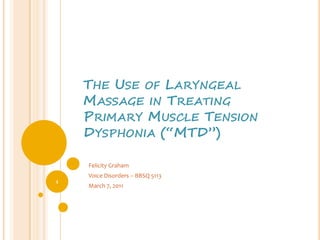
The Use of Laryngeal Massage in Treating Primary Muscle Tension Dysphonia (“MTD”)Felicity GrahamVoice Disorders – BBSQ 5113March 7, 20111
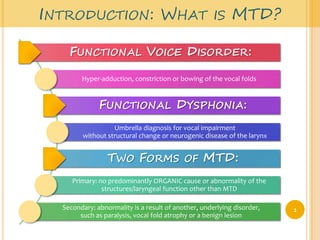
Introduction: What is MTD?2
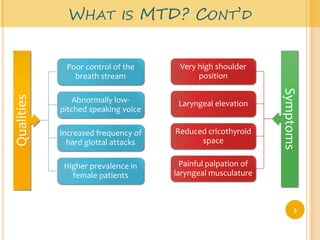
What is MTD? Cont’d3
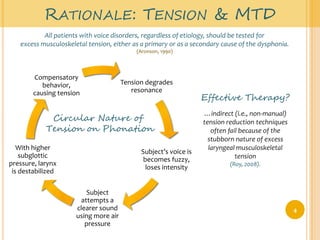
Rationale: Tension & MTDAll patients with voice disorders, regardless of etiology, should be tested for excess musculoskeletal tension, either as a primary or as a secondary cause of the dysphonia.(Aronson, 1990)Effective Therapy?…indirect (i.e., non-manual) tension reduction techniques often fail because of the stubborn nature of excess laryngeal musculoskeletal tension (Roy, 2008).Circular Nature of Tension on Phonation4
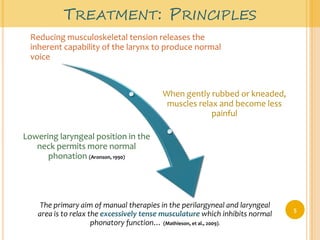
Treatment: Principles5
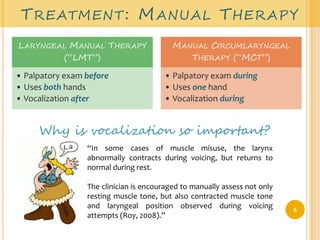
Treatment: Manual TherapyWhy is vocalization so important?“In some cases of muscle misuse, the larynx abnormally contracts during voicing, but returns to normal during rest.The clinician is encouraged to manually assess not only resting muscle tone, but also contracted muscle tone and laryngeal position observed during voicing attempts (Roy, 2008).”6
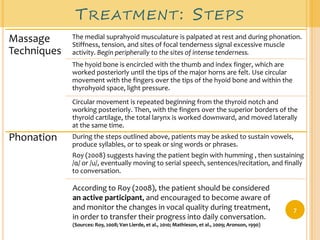
Treatment: Steps7According to Roy (2008), the patient should be considered an active participant, and encouraged to become aware of and monitor the changes in vocal quality during treatment, in order to transfer their progress into daily conversation.(Sources: Roy, 2008; Van Lierde, et al., 2010; Mathieson, et al., 2009; Aronson, 1990)
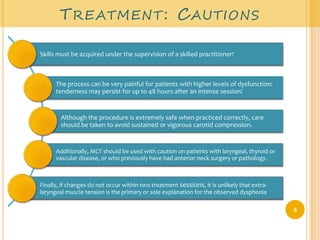
Treatment: Cautions8
…perhaps the most important step in preventing muscle tension is becoming conscious of the sensory […] experience (Deeter, 2005).9Summary
(See handout for notes and bibliography)10

MTD & Laryngeal Massage

  • 1.
    The Use ofLaryngeal Massage in Treating Primary Muscle Tension Dysphonia (“MTD”)Felicity GrahamVoice Disorders – BBSQ 5113March 7, 20111
  • 2.
  • 3.
    What is MTD?Cont’d3
  • 4.
    Rationale: Tension &MTDAll patients with voice disorders, regardless of etiology, should be tested for excess musculoskeletal tension, either as a primary or as a secondary cause of the dysphonia.(Aronson, 1990)Effective Therapy?…indirect (i.e., non-manual) tension reduction techniques often fail because of the stubborn nature of excess laryngeal musculoskeletal tension (Roy, 2008).Circular Nature of Tension on Phonation4
  • 5.
  • 6.
    Treatment: Manual TherapyWhyis vocalization so important?“In some cases of muscle misuse, the larynx abnormally contracts during voicing, but returns to normal during rest.The clinician is encouraged to manually assess not only resting muscle tone, but also contracted muscle tone and laryngeal position observed during voicing attempts (Roy, 2008).”6
  • 7.
    Treatment: Steps7According toRoy (2008), the patient should be considered an active participant, and encouraged to become aware of and monitor the changes in vocal quality during treatment, in order to transfer their progress into daily conversation.(Sources: Roy, 2008; Van Lierde, et al., 2010; Mathieson, et al., 2009; Aronson, 1990)
  • 8.
  • 9.
    …perhaps the mostimportant step in preventing muscle tension is becoming conscious of the sensory […] experience (Deeter, 2005).9Summary
  • 10.
    (See handout fornotes and bibliography)10