Chapter 10 - 1
Chapter 10 -
Introduction
2
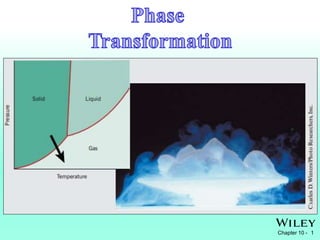
Phase transformations occur when
phase boundaries (red curves) on
these pressure-temperature diagrams
are crossed as temperature and/or
pressure is changed.
 Ice melts
H2O
CO2
 Dry ice (solid CO2) sublimes
Chapter 10 -
Basic Concepts
3
 Why study phase transformations?
-- Phase transformation  alteration in the number and/or
character of the phases (change in microstructure)  affect
the (mechanical) properties of materials
 Classification of phase transformations
(1) diffusional transformations:
(a) no change in either the number or composition of the phases
present. e.g., solidification of a pure metal, allotropic
transformations, and recrystallization and grain growth.
(b) some alteration in phase compositions and often in the
number of phases present. e.g., eutectoid reaction.
(2) diffusionless transformation: no change in composition, a
metastable phase is produced. e.g., martensitic transformation.
Chapter 10 -
The Kinetics of Phase Transformations
4
 Nucleation (成核) and growth (成長)
-- The progress of a phase transformation may be broken down
into two distinct stages: nucleation and growth.
 Nucleation involves the appearance of very small particles, or
nuclei (核) of the new phase (often consisting of only a few
hundred atoms), which are capable of growing.
 During the growth stage these nuclei increase in size, which
results in the disappearance of some (or all) of the parent phase.
Nucleation will continue to occur simultaneously with growth of
the new phase particles. The transformation reaches completion if
the growth of these new phase particles is allowed to proceed
until the equilibrium fraction is attained.
Chapter 10 -
The Kinetics of Phase Transformations
5
 Nucleation
(a) Homogeneous nucleation (均質成核): nuclei of the new phase
form uniformly throughout the parent phase.
(b) Heterogeneous nucleation (異質成核): nuclei form preferentially
at structural inhomogeneities, such as container surfaces,
insoluble impurities, grain boundaries, dislocations, and so on.
 Free energy (or Gibbs free energy, 自由能 G)
-- A thermodynamic quantity that is a function of both the
internal energy and entropy (or randomness) of a system.
 At equilibrium, the free energy is at a minimum.
-- Free energy change (G): a transformation will occur
spontaneously only when G < 0.
Chapter 10 -
Chem. Commun.,
2018,54, 5976-5979
Chapter 10 -
The Kinetics of Phase Transformations
7
4 3 2
 Homogeneous nucleation
-- Total ΔG that accompany a solidification transformation.
∆𝐺 = 𝜋𝑟 ∆𝐺𝑣 + 4𝜋𝑟 𝛾
3
ΔGυ: free energy difference between the solid and liquid phases
per unit volume, a negative value (at T < Tm)
 : surface free energy of the solid-liquid interface, positive.
Fig. 12.2 (a) Schematic
curves for volume free
energy and surface free
energy contributions to
the total free energy
change attending the
formation of a spherical
embryo/nucleus during
solidification.
Fig. 12.1 Schematic diagram showing the
nucleation of a spherical solid particle in a liquid.
 atoms in the liquid cluster together to form a solid particle
Chapter 10 -
The Kinetics of Phase Transformations
8
4 3 2
∆𝐺 = 𝜋𝑟 ∆𝐺𝑣 + 4𝜋𝑟 𝛾
3
 Homogeneous nucleation (Cont.)
-- r*: critical radius of atom cluster
 nuclei (核): cluster size r > r* (stable), growth will continue
with the accompaniment of a decrease in free energy.
 embryo (胚): r < r* (unstable), may grow into a stable
nucleus or shrink and redissolve. The formation of embryos
is a statistical process.
-- ΔG*: critical free energy (at r = r*),
corresponds to an activation free energy.
 free energy required for the formation
of a stable nucleus.
 energy barrier to the nucleation process.
Fig. 12.2 (b) Schematic plot of free energy versus embryo/nucleus radius, on which
is shown the critical free energy change (G*) and the critical nucleus radius (r*).
Chapter 10 -
The Kinetics of Phase Transformations
9
 Homogeneous nucleation (Cont.)
-- Find r* and ΔG*:
4 3 2
∆𝐺 = 𝜋𝑟 ∆𝐺𝑣 + 4𝜋𝑟 𝛾
3
 ΔGυ (volume free energy change) is the
driving force for the solidification transformation.
υ
ΔG = f (T) ∆𝐺𝑣
∆𝐻𝑓 𝑇𝑚−𝑇
= 𝑇𝑚
ΔHf : latent heat of fusion (heat given up during solidification)
(a) at equilibrium temperature (T = Tm ), ΔGυ = 0,
(b) at T < Tm, ΔGυ < 0. (ΔHf = negative value)
Chapter 10 -
The Kinetics of Phase Transformations
10
 Homogeneous nucleation (Cont.)
 T , r*  and ΔG*  ( and ΔHf are insensitive to T changes)
 at T < Tm, as T , nucleation
occurs more readily.
Fig. 12.3 Schematic free energy-versus-
embryo/nucleus radius curves for two different
temperatures. The critical free energy change
(G*) and critical nucleus radius (r*) are
indicated for each temperature.
Chapter 10 -
The Kinetics of Phase Transformations
11
 Homogeneous nucleation (Cont.)
-- Number of stable nuclei n* (having r > r*) = f (T)
1
𝑛∗ = 𝐾 𝑒𝑥𝑝
∗
− ∆𝐺
𝑘T
K1: constant (related to the total number of nuclei of the solid phase)
 changes in T (or ΔT) have a greater effect
on the magnitude of the term ΔG* [
1/(Tm-T)2] in the numerator than the T
term in the denominator.
at T < Tm, T , ΔG* ,
∴ (ΔG*/kT) , n* 
Fig. 12.4 For solidification, schematic plots of
(a) number of stable nuclei versus temperature.
Chapter 10 -
The Kinetics of Phase Transformations
12
 Homogeneous nucleation (Cont.)
-- Another important T-dependent step: the clustering of atoms
by short-range diffusion during the formation of nuclei.
 related to the frequency (d) at which atoms from the liquid
attach themselves to the solid nucleus.
𝑑 = 𝐾2 𝑒𝑥𝑝 − 𝑄𝑑
𝑘𝑇
K2: a T-independent constant
Q𝑑: a T-independent parameter, the
activation energy for diffusion.
∴ at T < Tm, T , (Q𝑑 /kT) , d 
Fig. 12.4 For solidification, schematic plots of (b) frequency
of atomic attachment versus temperature.
Chapter 10 -
The Kinetics of Phase Transformations
13
 Homogeneous nucleation (Cont.)
-- Nucleation rate Ń (proportional to the product of n* and νd)
Ń = 𝐾3 n* νd = 𝐾1𝐾2𝐾3 𝑒𝑥𝑝 𝑒𝑥𝑝
∗
− ∆𝐺
− 𝑄𝑑
𝑘𝑇 𝑘𝑇
K3: the number of atoms on a nucleus surface
 unit: nuclei per unit volume per second
 at T < Tm, T , the nucleation rate first
increases, achieves a maximum, and
subsequently diminishes.
Fig. 12.4 For solidification, schematic plots of (c) nucleation rate
versus temperature (also shown are curves for parts a and b).
Chapter 10 -
The Kinetics of Phase Transformations
14
 Homogeneous nucleation (Cont.)
-- The shape of this curve is explained as follows:
(1) Upper region: a sudden and dramatic increase in Ń with T .
∵ ΔG* > Qd, ∴ exp(-ΔG*/kT) << exp(-Qd /kT)
 The nucleation rate (Ń) is suppressed at high temperatures
due to a small activation driving force.
(2) With continued reduction of T, there comes a point at which
ΔG* < Qd (T-independent), exp(-Qd /kT) < exp(-ΔG*/kT)
 at lower T, a low atomic mobility suppresses the Ń.
(lower curve segment, T , Ń )
(3) The Ń curve passes through a maximum over the intermediateT
range where values for ΔG* and Qd are of approximately the
same magnitude.
Chapter 10 -
The Kinetics of Phase Transformations
15
 Homogeneous nucleation (Cont.)
-- Supercooling (undercooling, 過冷): ΔT = Tm - T
During the solidification, an appreciable nucleation rate will
begin only after the temperature has been lowered to below the
equilibrium solidification (or melting) temperature (Tm).
 The degree of supercooling for homogeneous
nucleation may be significant (several hundred
Celsius degrees) for
some systems.
Table 12.1 Degree of Supercooling
(T) Values (Homogeneous
Nucleation) for Several Metals
Chapter 10 -
The Kinetics of Phase Transformations
16
 Homogeneous nucleation (Cont.)
-- Several qualifying comments:
(1) Although we assumed a spherical shape for nuclei, this method
may be applied to any shape with the same final result.
(2) This treatment may be utilized for types of transformations
other than solidification (i.e., liquid–solid), e.g., solid–vapor
and solid–solid.
(3) For solid–solid transformations, there may be volume changes
attendant to the formation of new phases.  introduction of
microscopic strains (account in ΔG)  affect the magnitudes
of r* and ΔG*.
Chapter 10 -
Example: (a) For the solidification of pure gold (Tm=1064oC), calculate the
critical radius r* and the activation free energy ΔG* if nucleation is
homogeneous. latent heat of fusion= -1.16109 J/m3, surface free energy=
0.132 J/m2, ΔT =230 K
17
(b) Now calculate the number of atoms found in a nucleus of critical size. Assume
a lattice parameter of 0.413 nm for solid gold at its melting temperature.
(a)
(b)
Chapter 10 -
The Kinetics of Phase Transformations
18
 Heterogeneous nucleation
-- homogeneous nucleation: ΔT  several hundred degrees Celsius
heterogeneous nucleation (practical situations): ΔT  often
only several degrees Celsius.
∵ the activation energy (i.e., energy barrier) for nucleation (ΔG*)
is lowered when nuclei form on preexisting surfaces or
interfaces, because the surface free energy () is reduced.
 total interfacial energy of the system is minimized if the surface
tensions balance in the plane of flat surface.
𝛾𝐼𝐿 = 𝛾𝑆𝐼 + 𝛾𝑆𝐿𝑐𝑜𝑠𝜃
: contact (wetting) angle
Fig. 12.5 Heterogeneous nucleation of a solid from a
liquid. The solid–surface (SI), solid– liquid (SL), and
liquid–surface (IL), interfacial energies are represented
by vectors. The wetting angle () is also shown.
Chapter 10 -
The Kinetics of Phase Transformations
19
 Heterogeneous nucleation (Cont.)
-- Derive equations for r* and ΔG*
S(): a function only of  (i.e., shape of the nucleus).
 critical radius: r* (heterogeneous) = r* (homogeneous)
 activation energy barrier:
ΔG* (hetero.) < ΔG* (homo.)
ℎ𝑒𝑡 ℎ𝑜
𝑚
∆𝐺∗ = ∆𝐺∗ 𝑆(𝜃)
∴ heterogeneous nucleation
occurs more readily.
Fig. 12.6 Schematic free energy-versus-embryo/nucleus
radius plot on which are presented curves for both
homogeneous and heterogeneous nucleation. Critical
free energies and the critical radius are also shown.
S() = 0 ~1
 = 30o, S()  0.01
 = 90o, S()  0.5
𝑆 𝜃 = 2 + 𝑐𝑜𝑠𝜃 1 − 𝑐𝑜𝑠𝜃 2/4
Chapter 10 -
The Kinetics of Phase Transformations
20
 Heterogeneous nucleation (Cont.)
-- In terms of the nucleation rate:
(1) Ń -T curve is shifted to higher T for hetero.
(2) A much smaller ΔT is required for hetero.
Fig. 12.7 Nucleation rate versus temperature for both homogeneous and
heterogeneous nucleation. Degree of supercooling (T) for each is also shown.
 Growth
-- Particle growth occurs by long-range atomic diffusion, e.g.,
diffusion through the parent phase, across a phase boundary,
and then into the nucleus.
-- Growth rate Ġ is determined by the rate of diffusion, and its
temperature dependence is the same as for the diffusion
coefficient.
Chapter 10 -
The Kinetics of Phase Transformations
Thermally activated transformation: a rate equation having the
exponential T dependence is termed an Arrhenius rate equation.
• -- At a specific T, the overall transformation rate = Ń  Ġ  The
curve shape is the same as for the Ń, it has a peak that has been
shifted upward relative to the Ń curve.
• -- (a) transformations at T near Tm :
low Ń and high Ġ  few nuclei formthat
grow rapidly  few large particles (e.g.,
coarse grains)
21
 Growth (Cont.)
-- Growth rate Ġ = 𝐶𝑒𝑥𝑝 − 𝑄
𝑘𝑇
(b) at lower T: high Ń and low Ġ 
many small particles (e.g., fine grains) Fig. 12.8 Schematic plot showing curves
for nucleation rate, growth rate, and
overall transformation rate versus
temperature..
Q: activation energy,
C: a preexponential, independent of T
Chapter 10 -
The Kinetics of Phase Transformations
22
 Growth (Cont.)
-- The rate of transformation and the time required for the
transformation to proceed to some degree of completion (e.g.,
time to 50% reaction completion, t0.5) are inversely proportional
to one another.
 log t0.5 is plotted versus T: a “C-shaped” curve results and
is a virtual mirror image of the transformation rate curve.
Fig. 12.9 Schematic plots of (a) transformation
rate versus temperature, and (b) logarithm
time [to some degree (e.g., 0.5 fraction) of
transformation] versus temperature. The
curves in both (a) and (b) are generated from
the same set of data—i.e., for horizontal axes,
the time [scaled logarithmically in the (b) plot]
is just the reciprocal of the rate from plot (a).is
also shown.
Chapter 10 -
The Kinetics of Phase Transformations
23
 Kinetic considerations of solid-state transformations
-- Kinetics of a transformation: the time dependence of rate
 fraction of reaction = f (time), at constant temperature
(by microscopic examination or physical property measurement)
-- Plot of fraction of transformed material (y) vs. logarithm of time
 an S-shaped curve (typical kinetic behavior for most solid-
state reactions)
-- Describe by Avrami equation:
𝑦 = 1 − exp −𝑘𝑡𝑛
k, n: time-independent constants
-- Transformation rate = 1/ t0.5
Fig. 12.10 Plot of fraction reacted versus the logarithm of
time typical of many solid-state transformations in which
temperature is held constant.
Chapter 10 -
The Kinetics of Phase Transformations
24
 Kinetic considerations of solid-state transformations (Cont.)
-- Effect of temperature
Temperature , rate of transformation (recrystallization) 
Fig. 12.11 Percent recrystallization as a function of time and at constant temperature for pure copper.
Chapter 10 -
Example: Kinetics of recrystallization for some alloy obeys the Avrami
equation and n = 3.1. If the fraction recrystallized is 0.30 after 20 min,
determine the rate of recrystallization.
rate = 1/ t0.5 , 𝑦 = 1 − exp −𝑘𝑡𝑛
compute constant k : exp −𝑘𝑡𝑛 = 1 − 𝑦 , −𝑘𝑡𝑛 = ln(1 − 𝑦)
𝑡𝑛
𝑘 = − ln 1−𝑦
= − ln 1−0.3
(20𝑚𝑖𝑛)3.1
= 3.30 × 10⁻⁵
compute t0.5 :
𝑡𝑛 = −
ln 1−𝑦
𝑘
, 𝑡 = −
ln 1−𝑦
𝑘
1/𝑛
𝑡0.5 = −
ln 1−0.5
𝑘
1/𝑛 ln 1−0.5
= −
3.30×10⁻⁵
1/3.1
= 24.8 𝑚𝑖𝑛
1
𝑡0.5
𝑟𝑎𝑡𝑒 = =
1
24.8 𝑚𝑖𝑛
= 4.0 × 10⁻² 𝑚𝑖𝑛
25
−1
Chapter 10 -
The Kinetics of Phase Transformations
26
 Metastable versus equilibrium states
-- During a phase transformation, an alloy proceeds toward an
equilibrium state that is characterized by the phase diagram in
terms of the product phases, their compositions, and relative
amounts. One limitation of phase diagrams is their inability to
indicate the time period required for the attainment of equilibrium.
-- For other than equilibrium cooling, transformations are
shifted to lower temperatures than indicated by the phase
diagram ( metastable microstructure); for heating, the shift
is to higher temperatures. These phenomena are termed
supercooling and superheating, respectively. The degree of
each depends on the rate of temperature change; the more
rapid the cooling or heating, the greater the supercooling or
superheating.
Chapter 10 -
Microstructural and Property Changes
in Fe-C Alloys
27
 Isothermal transformation diagram
-- Pearlite: Fe–Fe3C eutectoid reaction
-- The rate of the austenite-to-pearlite depends on temperature.
 S-shaped curves (percentage transformation vs. log t)
Fig. 12.12 For an iron–carbon alloy of
eutectoid composition (0.76 wt% C),
isothermal fraction reacted versus the
logarithm of time for the austenite-to-pearlite
transformation.
Chapter 10 -
Microstructural and Property Changes
in Fe-C Alloys
28
 Isothermal transformation diagram (Cont.)
-- Isothermal transformation (IT) diagram also called time-
temperature-transformation (TTT)
diagram. Transformation = f (t, T)
 describes the time required at
any temperature for a phase
transformation to begin and end.
-- T , nucleation rate , growth rate .
 Transformation rate, Max. rate
of eutectoid steel at  540oC
Fig. 12.13 Demonstration of how an isothermal
transformation diagram (bottom) is generated from
percentage transformation-versus logarithm of time
measurements (top).
Chapter 10 -
Microstructural and Property Changes in
Fe-C Alloys
29
 Isothermal transformation diagram (Cont.)
-- The thickness ratio of the ferrite and cementite layers in pearlite
is approximately 8 to 1.
Absolute layer thickness
depends on the T of
isothermal transformation.
 coarse pearlite: at T just
below the eutectoid, thick
layers of  and Fe3C phases
are produced. ∵ diffusion
rates are relatively high, C
atoms can diffuse relatively
Fig. 12.14 Isothermal transformation diagram for a
eutectoid iron–carbon alloy, with superimposed
isothermal heat treatment curve (ABCD).
Microstructures before, during, and after the
long distances  thick lamellae austenite-to-pearlite transformation are shown.
Chapter 10 -
Microstructural and Property Changes in Fe-C
Alloys
30
 Isothermal transformation diagram (Cont.)
 Fine pearlite: The thin-layered ( + Fe3C) structure produced in
the vicinity of 540oC. ∵ with decreasing T, the carbon diffusion
rate decreases, and the layers become progressively thinner.
-- For other compositions, a
proeutectoid phase ( or Fe3C)
will coexist with pearlite 
a curve for proeutectoid is added
Fig. 12.15
Photomicrographs of
(a) coarse pearlite
and (b) fine pearlite.
3000
Fig. 12.16 Isothermal transformation diagram for
a 1.13 wt% C iron–carbon alloy: A, austenite; C,
proeutectoid cementite; P, pearlite.
Chapter 10 -
Microstructural and Property Changes in Fe-C Alloys
31
 Isothermal transformation diagram (Cont.)
-- Bainite (變韌體): At lower transformation temperature < 540oC,
the lamellae in pearlite would have to be extremely thin and the
boundary area between the ferrite and Fe3C lamellae would be
very large (ferrite-Fe3C interface energy ). The steel can reduce
its internal energy by permitting
the Fe3C to precipitate as discrete,
round particles in a ferrite matrix.
This microconstituent of ferrite
and cementite is called bainite.
Fig. 12.17 Transmission electron micrograph showing the
structure of bainite.Agrain of bainite passes from lower left
to upper right-hand corners, which consists of elongated and
needle-shaped particles of Fe3C within a ferrite matrix. The
phase surrounding the bainite is martensite.
Chapter 10 -
Microstructural and Property Changes in Fe-C Alloys
32
 Isothermal transformation diagram (Cont.)
-- All three begin-, end-, and half-reaction curves are C-shaped.
a “nose” at point N, where
transformation rate = maximum.
 Pearlite forms above the
nose [i.e., 540oC ~ 727oC ]
Bainite forms below the nose
[i.e., 215oC ~ 540oC ]
Fig. 12.18 Isothermal transformation diagram for an
iron–carbon alloy of eutectoid composition, including
austenite-to-pearlite (A–P) and austeniteto-bainite
(A–B) transformations.
Chapter 10 -
Microstructural and Property Changes in Fe-C
Alloys
33
 Isothermal transformation diagram (Cont.)
-- Bainite forms as needles or plates, depending on the temperature
of the transformation.
 Upper (coarse of feathery) bainite: form just below the nose of
the C-curve.
 Lower (fine or acicular) bainite: form at lower temperatures.
Figure 12.22 (a) Upper bainite (gray, feathery plates) ( 600). (b) Lower
bainite (dark needles) ( 400). (From ASM Handbook, Vol. 8, (1973).)
Inside the feathery plate
or needle:  + Fe3C
Chapter 10 -
Microstructural and Property Changes in Fe-C Alloys
34
 Isothermal transformation diagram (Cont.)
-- Spheroidite (球化鐵): A microstructure consisting of sphere-like
cementite particles within an -ferrite matrix.
 produced by an appropriate elevated-T (just below the eutectoid)
heat treatment of pearlite, bainite, or
martensite, and is relatively soft.
e.g., at about 700oC for 18 ~ 24 h
 occurred by additional carbon diffusion
with no change in the compositions or
relative amounts of  and Fe3C phases.
 driving force: reduction in
3
–Fe C phase boundary area.
Fig. 12.19 Photomicrograph of a steel having a
spheroidite microstructure. The small particles are
cementite; the continuous phase is -ferrite. 1000
(Copyright 1971 by United States Steel Corporation.)
Chapter 10 -
Microstructural and Property Changes in Fe-C Alloys
35
 Isothermal transformation diagram (Cont.)
-- Martensite (麻田散體): A metastable iron phase supersaturated
in carbon that is the product of a diffusionless (非擴散),
athermal (滯溫) transformation from austenite. [by rapidly
cooled (or quenched, 淬火) to a relatively low temperature]
 Diffusionless: by cooperative movement of atoms.
 Athermal: depend only on the temperature, not on the time.
-- Martensite grains nucleate and grow at a very rapid rate (
sound velocity), ∴ transformation rate is time independent.
-- Martensitic transformation can be driven by the application of
mechanical stress.
Chapter 10 -
Microstructural and Property Changes in Fe-C Alloys
36
are the same.
 Isothermal transformation diagram (Cont.)
-- Martensite is a nonequilibrium
phase, does not appear on the
Fe–Fe3C phase diagram.
-- T , amount of martensite .
-- Quench to a T between Ms (start)
and Mf (finish), the amount of
martensite does not change as
the time at that T increases.
 Ms, Mf : vary with composition
-- The martensite composition and
the initial austenite composition
Fig. 12.22 The complete isothermal transformation diagram for an iron–carbon alloy
of eutectoid composition:A, austenite; B, bainite; M, martensite; P, pearlite.
Chapter 10 -
Microstructural and Property Changes in Fe-C Alloys
37
 Isothermal transformation diagram (Cont.)
-- Austenite (FCC)  martensite (BCT, body-centered tetragonal)
Fig. 12.20 The body-centered
tetragonal unit cell for martensitic
steel showing iron atoms (circles)
and sites that may be occupied by
carbon atoms (crosses). For this
tetragonal unit cell, c > a.
Figure 12.24 (a) The unit cell of BCT martensite is related to the FCC austenite unit
cell. (b) As the percentage of carbon increases, more interstitial sites are filled by the
carbon atoms and the tetragonal structure of the martensite becomes more pronounced.
Chapter 10 -
Microstructural and Property Changes in Fe-C Alloys
38
 Isothermal transformation diagram (Cont.)
-- Martensite grains: plate-like or needle-like appearance
-- Retained austenite: austenite that is unable to transform into
martensite during quenching. ∵ volume expansion associated
with the reaction.
-- High carbon steels must be refrigerated to produce all martensite.
Fig. 12.21 Photomicrograph showing the
martensitic microstructure. The needle
shaped grains are the martensite phase, and
the white regions are austenite that failed to
transform during the rapid quench. 1220.
Figure 13.11 Increasing carbon reduces the
Ms and Mf temperatures in plain-carbon steels.
white phase: retained austenite
 C% , Ms and Mf 
Chapter 10 -
Microstructural and Property Changes in Fe-C Alloys
39
 Isothermal transformation diagram (Cont.)
-- The presence of alloying elements other than carbon (e.g., Cr,
Ni, Mo, and W) may cause significant changes in the positions
and shapes of the IT curves.
(1) shifting to longer times the nose
of the austenite-to-pearlite
transformation (and also a
proeutectoid phase nose, if
such exists)
(2) formation of a separate bainite nose
Fig. 12.23 Isothermal transformation diagram for an
alloy steel (type 4340):A, austenite; B, bainite; P
,
pearlite; M, martensite; F, proeutectoid ferrite.
Chapter 10 -
Microstructural and Property Changes in Fe-C Alloys
40
Example: Microstructural Determinations
for Three Isothermal Heat Treatments.
The specimen begins at 760oC and have
achieved a complete austenitic structure.
(a) Rapidly cool to 350oC, hold for 104 s,
and quench to room temperature.
(b) Rapidly cool to 250oC, hold for 100 s,
and quench to room temperature.
(c) Rapidly cool to 650oC, hold for 20 s,
rapidly cool to 400oC, hold for 103 s,
and quench to room temperature.
(a) 100% of the specimen is bainite
(b) 100% martensite
(c) 50% pearlite and 50% bainite
Chapter 10 -
Microstructural and Property Changes in Fe-C Alloys
41
 Continuous-cooling transformation (CCT) diagram
-- Most heat treatments for steels involve the continuous cooling
of a specimen to room temperature.
-- For continuous cooling, the time
required for a reaction to begin and
end is delayed.
∴ Isothermal curves are shifted to
longer times and lower temperatures.
Fig. 12.25 Superimposition of isothermal and
continuous cooling transformation diagrams for
a eutectoid iron–carbon alloy.
Chapter 10 -
Microstructural and Property Changes in Fe-C Alloys
42
 Continuous-cooling transformation diagram (Cont.)
-- Annealing (退火): A heat treatment used to produce a soft, coarse
pearlite in steel by austenitizing
(沃斯田鐵化), then furnace cooling.
 Process annealing (製程退火):
A low-T heat treatment used to
eliminate all or part of the effect
of cold working in low-C steels.
-- Normalizing (正常化):
By austenitizing and air cooling to
produce a fine pearlitic structure.
Fig. 12.26 Moderately rapid and slow cooling curves
superimposed on a continuous cooling Transformation
diagram for a eutectoid iron–carbon alloy.
Chapter 10 -
Microstructural and Property Changes in Fe-C Alloys
43
 Continuous-cooling transformation diagram (Cont.)
-- Normally, bainite will not form for eutectoid alloy, or for any
plain carbon steel is continuously cooled to room temperature.
∵ all the austenite will have transformed to pearlite.
 AB curve: indicate the end of
austenite–pearlite transformation.
∴ For any cooling curve passing
through AB, the transformation
ceases at the point of intersection;
with continued cooling, the unreacted
austenite begins transforming to
martensite upon crossing the M(start)
line.
Chapter 10 -
Microstructural and Property Changes in Fe-C Alloys
44
 Continuous-cooling transformation diagram (Cont.)
-- For both TTT and CCT diagrams, M(start), M(50%), and M(90%)
lines occur at identical temperatures.
-- Critical quenching rate: minimum
rate of quenching that will produce
a totally martensitic structure.
 (a) high cooling rate > critical rate:
only martensite
(b) a range of rates for pearlite
and martensite
(c) low rate: totally pearlite
Fig. 12.27 Continuous cooling transformation diagram for a
eutectoid iron–carbon alloy and superimposed cooling curves,
demonstrating the dependence of the final microstructure on the
transformations that occur during cooling.
Chapter 10 -
Microstructural and Property Changes in Fe-C Alloys
45
 Continuous-cooling transformation diagram (Cont.)
-- Carbon and other alloying elements shift the pearlite (as well as
proeutectoid phase) and bainite noses to longer times, thus
decreasing the critical cooling rate.
 Totally martensitic structures can
develop in relatively thick cross
sections.
 Presence of the bainite nose
accounts for the possibility of
formation of bainite for a
continuous cooling heat treatment.
Fig. 12.28 Continuous cooling transformation diagram for an
alloy steel (type 4340) and several superimposed cooling curves
demonstrating dependence of the final microstructure of this
alloy on the transformations that occur during cooling.
Chapter 10 -
Microstructural and Property Changes in Fe-C Alloys
46
 Continuous-cooling transformation diagram (Cont.)
-- Of interest, the critical cooling rate is decreased even by the
presence of carbon.
In fact, iron–carbon alloys containing less than about 0.25 wt%
carbon are not normally heat treated to form martensite because
quenching rates too rapid to be practical are required.
Other alloying elements that are particularly effective in
rendering steels heat treatable are Cr, Ni, Mo, Mn, Si, and W;
however, these elements must be in solid solution with the
austenite at the time of quenching.
Chapter 10 -
Microstructural and Property Changes in Fe-C Alloys
47
 Mechanical behavior of iron-carbon alloys
-- Pearlite: cementite is much harder but more brittle than ferrite
 fraction of Fe3C , strengths and hardness , ductility and
toughness  (Cementite may be said to reinforce the ferrite)
Fig. 12.29 (a) Yield strength,
tensile strength, and Brinell
hardness versus carbon
concentration for plain carbon
steels having microstructures
consisting of fine pearlite. (b)
Ductility (%EL and %RA) and
Izod impact energy versus carbon
concentration for plain carbon
steels having microstructures
consisting of fine pearlite.
Chapter 10 -
Microstructural and Property Changes in Fe-C Alloys
48
 Mechanical behavior of iron-carbon alloys (Cont.)
-- Fine pearlite is harder and stronger than coarse pearlite.
Coarse pearlite is more ductile than fine pearlite.
 Fine pearlite: greater -Fe3C phase boundary area per unit
volume of material.
∵ phase boundaries
serve as barriers to
dislocation motion
Fig. 12.30 (a) Brinell and Rockwell
hardness as a function of carbon
concentration for plain carbon steels
having fine and coarse pearlite as well as
spheroidite microstructures. (b) Ductility
(%RA) as a function of carbon
concentration for plain carbon steels
having fine and coarse pearlite as well as
spheroidite microstructures.
Chapter 10 -
Microstructural and Property Changes in Fe-C Alloys
49
 Mechanical behavior of iron-carbon alloys (Cont.)
-- Spheroidite:
 alloys containing pearlite (lamellate Fe3C) have greater strength
and hardness than do those with spheroidite (spherelike Fe3C ).
∵ less -Fe3C boundary area per unit volume
in spheroidite
microstructure.
 Spheroidized steels
are more ductile and
tough than either fine
or coarse pearlite.
Chapter 10 -
Microstructural and Property Changes in Fe-C Alloys
50
 Mechanical behavior of iron-carbon alloys (Cont.)
-- Bainite: stronger and harder than pearlitic ones; yet they exhibit
a desirable combination of strength and ductility.
∵ have a finer structure (i.e., smaller -ferrite and Fe3C particles)
Fig. 12.31 (a) Brinell hardness and tensile strength (at room temperature) and (b) ductility (%RA) (at room
temperature) as a function of isothermal transformation temperature for an iron–carbon alloy of eutectoid
composition, taken over the temperature range at which bainitic and pearlitic microstructures form.
Chapter 10 -
Microstructural and Property Changes in Fe-C Alloys
51
 Mechanical behavior of iron-carbon alloys (Cont.)
-- Martensite: the hardest and strongest and, the most brittle;
(in fact, negligible ductility).
 These properties are attributed to
(1) effectiveness of the interstitial
carbon atoms in hindering
dislocation motion,
(as a solid-solution effect)
(2) relatively few slip systems for
the BCT structure.
 Its hardness is dependent on the
carbon content, up to about
0.6 wt%.
Fig. 12.32 Hardness (at room temperature) as
a function of carbon concentration for plain
carbon martensitic, tempered martensitic
(tempered at 371oC), and pearlitic steels.
Chapter 10 -
Microstructural and Property Changes in Fe-C Alloys
52
 Mechanical behavior of iron-carbon alloys (Cont.)
-- Austenite is slightly denser than martensite. ∴ upon quenching,
net volume   large pieces are rapidly quenched may crack as
a result of internal stresses. (when C% > about 0.5 wt%)
-- Residual stresses: because of volume (phase) change, cold
working or thermal expansion and contraction.
-- Quench cracks: form at the surface of a steel during quenching
due to tensile residual stresses.
Figure 13.12 Formation of quench cracks
caused by residual stresses produced during
quenching. The figure illustrates the
development of stresses as the austenite
transforms to martensite during cooling.
Chapter 10 -
Microstructural and Property Changes in Fe-C Alloys
53
 Tempered martensite (回火麻田散鐵)
-- Formed by heating a martensitic steel to a temperature below the
eutectoid for a specified time period (tempering, 250oC ~ 650oC).
 martensite decomposes to the equilibrium phases ( + Fe3C)
 consists of extremely small and uniformly dispersed
cementite particles embedded within a continuous -ferrite
matrix (internal stresses relieved)
Fig. 12.33 Electron micrograph of tempered martensite.
Tempering was carried out at 594oC. The small particles are
the cementite phase; the matrix phase is -ferrite. 9300.
Chapter 10 -
Microstructural and Property Changes in Fe-C Alloys
54
 Tempered martensite (Cont.)
-- Tempered martensite may be nearly as hard and strong (lower
than) as martensite, but ductility and toughness are enhanced .
∵ large ferrite–cementite phase boundary area per unit volume
-- Tempering temperature ,
(carbon diffusion rate ,
size of cementite particle )
Hardness and strength ,
Toughness and ductility .
Fig. 12.34 Tensile and yield strengths and ductility
(%RA) (at room temperature) versus tempering
temperature for an oil-quenched alloy steel (type 4340).
Chapter 10 -
Microstructural and Property Changes in Fe-C Alloys
55
 Tempered martensite (Cont.)
-- At fixed tempering temperature, time , hardness .
∵ growth and coalescence of the cementite particles
-- At temperatures approaching the eutectoid (700oC) and after
several hours, the microstructure will have become spheroiditic.
 overtempered martensite
is relatively soft and
ductile.
Fig. 12.35 Hardness (at room temperature)
versus tempering time for a water-quenched
eutectoid plain carbon (1080) steel.
Chapter 10 -
Microstructural and Property Changes in Fe-C Alloys
56
 Tempered martensite (Cont.)
-- Temper embrittlement (回火脆性):
Tempering of some steels may result in a reduction of toughness
as measured by impact tests.
 by (1) tempered at a T above about 575oC followed by slow
cooling to room T, or
(2) tempered at T between 375oC ~ 575oC.
∵ Contain appreciable concentrations of the alloying elements
Mn, Ni, or Cr and, in addition, one or more of Sb, P, As, and
Sn as impurities in relatively low concentrations  shifts the
ductile-to-brittle transition to significantly higher T; the
ambient T thus lies below this transition in the brittle regime.
Chapter 10 -
Microstructural and Property Changes in Fe-C Alloys
57
 Tempered martensite (Cont.)
-- Crack propagation of these embrittled materials is intergranular.
 fracture path is along the GBs of the precursor austenite phase.
∵ alloy and impurity elements segregate in these regions.
-- Temper embrittlement may be avoided by
(1) compositional control, and/or
(2) tempering above 575oC or below 375oC, followed by
quenching to room temperature.
-- The toughness of steels that have been embrittled may be
improved significantly by heating to about 600oC and then
rapidly cooling to below 300oC.
Chapter 10 -
Microstructural and Property Changes in Fe-C Alloys
58
 Review of phase transformations and mechanical properties for
iron-carbon alloys
-- It is assumed that pearlite, bainite, and martensite result from
continuous cooling treatments; furthermore, the formation of
bainite is only possible
for alloy steels
(not plain carbon ones).
Fig. 12.21 Possible transformations involving the decomposition
of austenite. Solid arrows, transformations involving diffusion;
dashed arrow, diffusionless transformation.
Chapter 10 -
Microstructural and Property Changes in Fe-C Alloys
59
Chapter 10 -
 Martensite in other system
-- In high-Mn steels and stainless steels, austenite (FCC)
transforms to HCP martensite.
-- Martensitic reaction occurs during the transformation of
many polymorphic ceramic materials, including ZrO2, and
even in some crystalline polymers.
-- The properties of martensite in other alloys are also different
from the properties of steel martensite.
e.g., In Ti alloys, BCC titanium transforms to a HCP martensite
during quenching. However, the martensite is softer and
weaker than the original structure.
Microstructural and Property Changes in Fe-C Alloys
60
Chapter 10 -
The Shape-Memory Alloys (SMAs)
61
 Smart materials
-- Definition: Materials are able to sense changes in their
environments (temperature, electric field, magnetic field,
etc.) and then respond to these changes in predetermined
manners (e.g., shape change).
-- Characteristics: Have both sensing and actuation functions.
-- Examples: Shape memory alloys,
Piezoelectric (壓電) ceramics,
Magnetostrictive (磁伸縮) materials.
 Shape memory alloys
-- Ti-Ni alloys, Cu-based alloys, Ferrous alloys.
-- Undergo reversible martensitic transformation.
Chapter 10 -
The Shape-Memory Alloys (SMAs)
62
 Shape memory effect
--The ability of certain materials to develop microstructures
(martensite) that, after being deformed, can return the
material to its initial shape when heated.
-- Triggered by temperature
change.
Fig. 12.37 Diagram illustrating the shape
memory effect. The insets are schematic
representations of the crystal structure at the
four stages. Ms and Mf denote temperatures at
which the martensitic transformation begins and
ends. Likewise for the austenite transformation,
As and Af represent beginning and end
transformation temperatures.
Chapter 10 -
The Shape-Memory Alloys (SMAs)
63
 Superelastic behavior
-- SMAs deformed above a critical temperature show a large
reversible elastic deformation (~ 10%) as a result of stress-
induced martensitic transformation.
-- Triggered by stress.
Fig. 12.38 Typical stress–strain behavior of a shape-memory alloy, demonstrating its
thermoelastic behavior. Specimen deformation, corresponding to the curve from A to
B, is carried out at a temperature below that at which the martensitic transformation
is complete (i.e., Mf of Figure 10.37). Release of the applied stress (also at Mf) is
respresented by the curve BC. Subsequent heating to above the austenite–completion
transformation temperature (Af), causes the deformed piece to resume its original
shape (along the curve from point C to point D).

MS-II(Phase_transformation)(chapter 5).pptx

  • 1.
  • 2.
    Chapter 10 - Introduction 2 Phasetransformations occur when phase boundaries (red curves) on these pressure-temperature diagrams are crossed as temperature and/or pressure is changed.  Ice melts H2O CO2  Dry ice (solid CO2) sublimes
  • 3.
    Chapter 10 - BasicConcepts 3  Why study phase transformations? -- Phase transformation  alteration in the number and/or character of the phases (change in microstructure)  affect the (mechanical) properties of materials  Classification of phase transformations (1) diffusional transformations: (a) no change in either the number or composition of the phases present. e.g., solidification of a pure metal, allotropic transformations, and recrystallization and grain growth. (b) some alteration in phase compositions and often in the number of phases present. e.g., eutectoid reaction. (2) diffusionless transformation: no change in composition, a metastable phase is produced. e.g., martensitic transformation.
  • 4.
    Chapter 10 - TheKinetics of Phase Transformations 4  Nucleation (成核) and growth (成長) -- The progress of a phase transformation may be broken down into two distinct stages: nucleation and growth.  Nucleation involves the appearance of very small particles, or nuclei (核) of the new phase (often consisting of only a few hundred atoms), which are capable of growing.  During the growth stage these nuclei increase in size, which results in the disappearance of some (or all) of the parent phase. Nucleation will continue to occur simultaneously with growth of the new phase particles. The transformation reaches completion if the growth of these new phase particles is allowed to proceed until the equilibrium fraction is attained.
  • 5.
    Chapter 10 - TheKinetics of Phase Transformations 5  Nucleation (a) Homogeneous nucleation (均質成核): nuclei of the new phase form uniformly throughout the parent phase. (b) Heterogeneous nucleation (異質成核): nuclei form preferentially at structural inhomogeneities, such as container surfaces, insoluble impurities, grain boundaries, dislocations, and so on.  Free energy (or Gibbs free energy, 自由能 G) -- A thermodynamic quantity that is a function of both the internal energy and entropy (or randomness) of a system.  At equilibrium, the free energy is at a minimum. -- Free energy change (G): a transformation will occur spontaneously only when G < 0.
  • 6.
    Chapter 10 - Chem.Commun., 2018,54, 5976-5979
  • 7.
    Chapter 10 - TheKinetics of Phase Transformations 7 4 3 2  Homogeneous nucleation -- Total ΔG that accompany a solidification transformation. ∆𝐺 = 𝜋𝑟 ∆𝐺𝑣 + 4𝜋𝑟 𝛾 3 ΔGυ: free energy difference between the solid and liquid phases per unit volume, a negative value (at T < Tm)  : surface free energy of the solid-liquid interface, positive. Fig. 12.2 (a) Schematic curves for volume free energy and surface free energy contributions to the total free energy change attending the formation of a spherical embryo/nucleus during solidification. Fig. 12.1 Schematic diagram showing the nucleation of a spherical solid particle in a liquid.  atoms in the liquid cluster together to form a solid particle
  • 8.
    Chapter 10 - TheKinetics of Phase Transformations 8 4 3 2 ∆𝐺 = 𝜋𝑟 ∆𝐺𝑣 + 4𝜋𝑟 𝛾 3  Homogeneous nucleation (Cont.) -- r*: critical radius of atom cluster  nuclei (核): cluster size r > r* (stable), growth will continue with the accompaniment of a decrease in free energy.  embryo (胚): r < r* (unstable), may grow into a stable nucleus or shrink and redissolve. The formation of embryos is a statistical process. -- ΔG*: critical free energy (at r = r*), corresponds to an activation free energy.  free energy required for the formation of a stable nucleus.  energy barrier to the nucleation process. Fig. 12.2 (b) Schematic plot of free energy versus embryo/nucleus radius, on which is shown the critical free energy change (G*) and the critical nucleus radius (r*).
  • 9.
    Chapter 10 - TheKinetics of Phase Transformations 9  Homogeneous nucleation (Cont.) -- Find r* and ΔG*: 4 3 2 ∆𝐺 = 𝜋𝑟 ∆𝐺𝑣 + 4𝜋𝑟 𝛾 3  ΔGυ (volume free energy change) is the driving force for the solidification transformation. υ ΔG = f (T) ∆𝐺𝑣 ∆𝐻𝑓 𝑇𝑚−𝑇 = 𝑇𝑚 ΔHf : latent heat of fusion (heat given up during solidification) (a) at equilibrium temperature (T = Tm ), ΔGυ = 0, (b) at T < Tm, ΔGυ < 0. (ΔHf = negative value)
  • 10.
    Chapter 10 - TheKinetics of Phase Transformations 10  Homogeneous nucleation (Cont.)  T , r*  and ΔG*  ( and ΔHf are insensitive to T changes)  at T < Tm, as T , nucleation occurs more readily. Fig. 12.3 Schematic free energy-versus- embryo/nucleus radius curves for two different temperatures. The critical free energy change (G*) and critical nucleus radius (r*) are indicated for each temperature.
  • 11.
    Chapter 10 - TheKinetics of Phase Transformations 11  Homogeneous nucleation (Cont.) -- Number of stable nuclei n* (having r > r*) = f (T) 1 𝑛∗ = 𝐾 𝑒𝑥𝑝 ∗ − ∆𝐺 𝑘T K1: constant (related to the total number of nuclei of the solid phase)  changes in T (or ΔT) have a greater effect on the magnitude of the term ΔG* [ 1/(Tm-T)2] in the numerator than the T term in the denominator. at T < Tm, T , ΔG* , ∴ (ΔG*/kT) , n*  Fig. 12.4 For solidification, schematic plots of (a) number of stable nuclei versus temperature.
  • 12.
    Chapter 10 - TheKinetics of Phase Transformations 12  Homogeneous nucleation (Cont.) -- Another important T-dependent step: the clustering of atoms by short-range diffusion during the formation of nuclei.  related to the frequency (d) at which atoms from the liquid attach themselves to the solid nucleus. 𝑑 = 𝐾2 𝑒𝑥𝑝 − 𝑄𝑑 𝑘𝑇 K2: a T-independent constant Q𝑑: a T-independent parameter, the activation energy for diffusion. ∴ at T < Tm, T , (Q𝑑 /kT) , d  Fig. 12.4 For solidification, schematic plots of (b) frequency of atomic attachment versus temperature.
  • 13.
    Chapter 10 - TheKinetics of Phase Transformations 13  Homogeneous nucleation (Cont.) -- Nucleation rate Ń (proportional to the product of n* and νd) Ń = 𝐾3 n* νd = 𝐾1𝐾2𝐾3 𝑒𝑥𝑝 𝑒𝑥𝑝 ∗ − ∆𝐺 − 𝑄𝑑 𝑘𝑇 𝑘𝑇 K3: the number of atoms on a nucleus surface  unit: nuclei per unit volume per second  at T < Tm, T , the nucleation rate first increases, achieves a maximum, and subsequently diminishes. Fig. 12.4 For solidification, schematic plots of (c) nucleation rate versus temperature (also shown are curves for parts a and b).
  • 14.
    Chapter 10 - TheKinetics of Phase Transformations 14  Homogeneous nucleation (Cont.) -- The shape of this curve is explained as follows: (1) Upper region: a sudden and dramatic increase in Ń with T . ∵ ΔG* > Qd, ∴ exp(-ΔG*/kT) << exp(-Qd /kT)  The nucleation rate (Ń) is suppressed at high temperatures due to a small activation driving force. (2) With continued reduction of T, there comes a point at which ΔG* < Qd (T-independent), exp(-Qd /kT) < exp(-ΔG*/kT)  at lower T, a low atomic mobility suppresses the Ń. (lower curve segment, T , Ń ) (3) The Ń curve passes through a maximum over the intermediateT range where values for ΔG* and Qd are of approximately the same magnitude.
  • 15.
    Chapter 10 - TheKinetics of Phase Transformations 15  Homogeneous nucleation (Cont.) -- Supercooling (undercooling, 過冷): ΔT = Tm - T During the solidification, an appreciable nucleation rate will begin only after the temperature has been lowered to below the equilibrium solidification (or melting) temperature (Tm).  The degree of supercooling for homogeneous nucleation may be significant (several hundred Celsius degrees) for some systems. Table 12.1 Degree of Supercooling (T) Values (Homogeneous Nucleation) for Several Metals
  • 16.
    Chapter 10 - TheKinetics of Phase Transformations 16  Homogeneous nucleation (Cont.) -- Several qualifying comments: (1) Although we assumed a spherical shape for nuclei, this method may be applied to any shape with the same final result. (2) This treatment may be utilized for types of transformations other than solidification (i.e., liquid–solid), e.g., solid–vapor and solid–solid. (3) For solid–solid transformations, there may be volume changes attendant to the formation of new phases.  introduction of microscopic strains (account in ΔG)  affect the magnitudes of r* and ΔG*.
  • 17.
    Chapter 10 - Example:(a) For the solidification of pure gold (Tm=1064oC), calculate the critical radius r* and the activation free energy ΔG* if nucleation is homogeneous. latent heat of fusion= -1.16109 J/m3, surface free energy= 0.132 J/m2, ΔT =230 K 17 (b) Now calculate the number of atoms found in a nucleus of critical size. Assume a lattice parameter of 0.413 nm for solid gold at its melting temperature. (a) (b)
  • 18.
    Chapter 10 - TheKinetics of Phase Transformations 18  Heterogeneous nucleation -- homogeneous nucleation: ΔT  several hundred degrees Celsius heterogeneous nucleation (practical situations): ΔT  often only several degrees Celsius. ∵ the activation energy (i.e., energy barrier) for nucleation (ΔG*) is lowered when nuclei form on preexisting surfaces or interfaces, because the surface free energy () is reduced.  total interfacial energy of the system is minimized if the surface tensions balance in the plane of flat surface. 𝛾𝐼𝐿 = 𝛾𝑆𝐼 + 𝛾𝑆𝐿𝑐𝑜𝑠𝜃 : contact (wetting) angle Fig. 12.5 Heterogeneous nucleation of a solid from a liquid. The solid–surface (SI), solid– liquid (SL), and liquid–surface (IL), interfacial energies are represented by vectors. The wetting angle () is also shown.
  • 19.
    Chapter 10 - TheKinetics of Phase Transformations 19  Heterogeneous nucleation (Cont.) -- Derive equations for r* and ΔG* S(): a function only of  (i.e., shape of the nucleus).  critical radius: r* (heterogeneous) = r* (homogeneous)  activation energy barrier: ΔG* (hetero.) < ΔG* (homo.) ℎ𝑒𝑡 ℎ𝑜 𝑚 ∆𝐺∗ = ∆𝐺∗ 𝑆(𝜃) ∴ heterogeneous nucleation occurs more readily. Fig. 12.6 Schematic free energy-versus-embryo/nucleus radius plot on which are presented curves for both homogeneous and heterogeneous nucleation. Critical free energies and the critical radius are also shown. S() = 0 ~1  = 30o, S()  0.01  = 90o, S()  0.5 𝑆 𝜃 = 2 + 𝑐𝑜𝑠𝜃 1 − 𝑐𝑜𝑠𝜃 2/4
  • 20.
    Chapter 10 - TheKinetics of Phase Transformations 20  Heterogeneous nucleation (Cont.) -- In terms of the nucleation rate: (1) Ń -T curve is shifted to higher T for hetero. (2) A much smaller ΔT is required for hetero. Fig. 12.7 Nucleation rate versus temperature for both homogeneous and heterogeneous nucleation. Degree of supercooling (T) for each is also shown.  Growth -- Particle growth occurs by long-range atomic diffusion, e.g., diffusion through the parent phase, across a phase boundary, and then into the nucleus. -- Growth rate Ġ is determined by the rate of diffusion, and its temperature dependence is the same as for the diffusion coefficient.
  • 21.
    Chapter 10 - TheKinetics of Phase Transformations Thermally activated transformation: a rate equation having the exponential T dependence is termed an Arrhenius rate equation. • -- At a specific T, the overall transformation rate = Ń  Ġ  The curve shape is the same as for the Ń, it has a peak that has been shifted upward relative to the Ń curve. • -- (a) transformations at T near Tm : low Ń and high Ġ  few nuclei formthat grow rapidly  few large particles (e.g., coarse grains) 21  Growth (Cont.) -- Growth rate Ġ = 𝐶𝑒𝑥𝑝 − 𝑄 𝑘𝑇 (b) at lower T: high Ń and low Ġ  many small particles (e.g., fine grains) Fig. 12.8 Schematic plot showing curves for nucleation rate, growth rate, and overall transformation rate versus temperature.. Q: activation energy, C: a preexponential, independent of T
  • 22.
    Chapter 10 - TheKinetics of Phase Transformations 22  Growth (Cont.) -- The rate of transformation and the time required for the transformation to proceed to some degree of completion (e.g., time to 50% reaction completion, t0.5) are inversely proportional to one another.  log t0.5 is plotted versus T: a “C-shaped” curve results and is a virtual mirror image of the transformation rate curve. Fig. 12.9 Schematic plots of (a) transformation rate versus temperature, and (b) logarithm time [to some degree (e.g., 0.5 fraction) of transformation] versus temperature. The curves in both (a) and (b) are generated from the same set of data—i.e., for horizontal axes, the time [scaled logarithmically in the (b) plot] is just the reciprocal of the rate from plot (a).is also shown.
  • 23.
    Chapter 10 - TheKinetics of Phase Transformations 23  Kinetic considerations of solid-state transformations -- Kinetics of a transformation: the time dependence of rate  fraction of reaction = f (time), at constant temperature (by microscopic examination or physical property measurement) -- Plot of fraction of transformed material (y) vs. logarithm of time  an S-shaped curve (typical kinetic behavior for most solid- state reactions) -- Describe by Avrami equation: 𝑦 = 1 − exp −𝑘𝑡𝑛 k, n: time-independent constants -- Transformation rate = 1/ t0.5 Fig. 12.10 Plot of fraction reacted versus the logarithm of time typical of many solid-state transformations in which temperature is held constant.
  • 24.
    Chapter 10 - TheKinetics of Phase Transformations 24  Kinetic considerations of solid-state transformations (Cont.) -- Effect of temperature Temperature , rate of transformation (recrystallization)  Fig. 12.11 Percent recrystallization as a function of time and at constant temperature for pure copper.
  • 25.
    Chapter 10 - Example:Kinetics of recrystallization for some alloy obeys the Avrami equation and n = 3.1. If the fraction recrystallized is 0.30 after 20 min, determine the rate of recrystallization. rate = 1/ t0.5 , 𝑦 = 1 − exp −𝑘𝑡𝑛 compute constant k : exp −𝑘𝑡𝑛 = 1 − 𝑦 , −𝑘𝑡𝑛 = ln(1 − 𝑦) 𝑡𝑛 𝑘 = − ln 1−𝑦 = − ln 1−0.3 (20𝑚𝑖𝑛)3.1 = 3.30 × 10⁻⁵ compute t0.5 : 𝑡𝑛 = − ln 1−𝑦 𝑘 , 𝑡 = − ln 1−𝑦 𝑘 1/𝑛 𝑡0.5 = − ln 1−0.5 𝑘 1/𝑛 ln 1−0.5 = − 3.30×10⁻⁵ 1/3.1 = 24.8 𝑚𝑖𝑛 1 𝑡0.5 𝑟𝑎𝑡𝑒 = = 1 24.8 𝑚𝑖𝑛 = 4.0 × 10⁻² 𝑚𝑖𝑛 25 −1
  • 26.
    Chapter 10 - TheKinetics of Phase Transformations 26  Metastable versus equilibrium states -- During a phase transformation, an alloy proceeds toward an equilibrium state that is characterized by the phase diagram in terms of the product phases, their compositions, and relative amounts. One limitation of phase diagrams is their inability to indicate the time period required for the attainment of equilibrium. -- For other than equilibrium cooling, transformations are shifted to lower temperatures than indicated by the phase diagram ( metastable microstructure); for heating, the shift is to higher temperatures. These phenomena are termed supercooling and superheating, respectively. The degree of each depends on the rate of temperature change; the more rapid the cooling or heating, the greater the supercooling or superheating.
  • 27.
    Chapter 10 - Microstructuraland Property Changes in Fe-C Alloys 27  Isothermal transformation diagram -- Pearlite: Fe–Fe3C eutectoid reaction -- The rate of the austenite-to-pearlite depends on temperature.  S-shaped curves (percentage transformation vs. log t) Fig. 12.12 For an iron–carbon alloy of eutectoid composition (0.76 wt% C), isothermal fraction reacted versus the logarithm of time for the austenite-to-pearlite transformation.
  • 28.
    Chapter 10 - Microstructuraland Property Changes in Fe-C Alloys 28  Isothermal transformation diagram (Cont.) -- Isothermal transformation (IT) diagram also called time- temperature-transformation (TTT) diagram. Transformation = f (t, T)  describes the time required at any temperature for a phase transformation to begin and end. -- T , nucleation rate , growth rate .  Transformation rate, Max. rate of eutectoid steel at  540oC Fig. 12.13 Demonstration of how an isothermal transformation diagram (bottom) is generated from percentage transformation-versus logarithm of time measurements (top).
  • 29.
    Chapter 10 - Microstructuraland Property Changes in Fe-C Alloys 29  Isothermal transformation diagram (Cont.) -- The thickness ratio of the ferrite and cementite layers in pearlite is approximately 8 to 1. Absolute layer thickness depends on the T of isothermal transformation.  coarse pearlite: at T just below the eutectoid, thick layers of  and Fe3C phases are produced. ∵ diffusion rates are relatively high, C atoms can diffuse relatively Fig. 12.14 Isothermal transformation diagram for a eutectoid iron–carbon alloy, with superimposed isothermal heat treatment curve (ABCD). Microstructures before, during, and after the long distances  thick lamellae austenite-to-pearlite transformation are shown.
  • 30.
    Chapter 10 - Microstructuraland Property Changes in Fe-C Alloys 30  Isothermal transformation diagram (Cont.)  Fine pearlite: The thin-layered ( + Fe3C) structure produced in the vicinity of 540oC. ∵ with decreasing T, the carbon diffusion rate decreases, and the layers become progressively thinner. -- For other compositions, a proeutectoid phase ( or Fe3C) will coexist with pearlite  a curve for proeutectoid is added Fig. 12.15 Photomicrographs of (a) coarse pearlite and (b) fine pearlite. 3000 Fig. 12.16 Isothermal transformation diagram for a 1.13 wt% C iron–carbon alloy: A, austenite; C, proeutectoid cementite; P, pearlite.
  • 31.
    Chapter 10 - Microstructuraland Property Changes in Fe-C Alloys 31  Isothermal transformation diagram (Cont.) -- Bainite (變韌體): At lower transformation temperature < 540oC, the lamellae in pearlite would have to be extremely thin and the boundary area between the ferrite and Fe3C lamellae would be very large (ferrite-Fe3C interface energy ). The steel can reduce its internal energy by permitting the Fe3C to precipitate as discrete, round particles in a ferrite matrix. This microconstituent of ferrite and cementite is called bainite. Fig. 12.17 Transmission electron micrograph showing the structure of bainite.Agrain of bainite passes from lower left to upper right-hand corners, which consists of elongated and needle-shaped particles of Fe3C within a ferrite matrix. The phase surrounding the bainite is martensite.
  • 32.
    Chapter 10 - Microstructuraland Property Changes in Fe-C Alloys 32  Isothermal transformation diagram (Cont.) -- All three begin-, end-, and half-reaction curves are C-shaped. a “nose” at point N, where transformation rate = maximum.  Pearlite forms above the nose [i.e., 540oC ~ 727oC ] Bainite forms below the nose [i.e., 215oC ~ 540oC ] Fig. 12.18 Isothermal transformation diagram for an iron–carbon alloy of eutectoid composition, including austenite-to-pearlite (A–P) and austeniteto-bainite (A–B) transformations.
  • 33.
    Chapter 10 - Microstructuraland Property Changes in Fe-C Alloys 33  Isothermal transformation diagram (Cont.) -- Bainite forms as needles or plates, depending on the temperature of the transformation.  Upper (coarse of feathery) bainite: form just below the nose of the C-curve.  Lower (fine or acicular) bainite: form at lower temperatures. Figure 12.22 (a) Upper bainite (gray, feathery plates) ( 600). (b) Lower bainite (dark needles) ( 400). (From ASM Handbook, Vol. 8, (1973).) Inside the feathery plate or needle:  + Fe3C
  • 34.
    Chapter 10 - Microstructuraland Property Changes in Fe-C Alloys 34  Isothermal transformation diagram (Cont.) -- Spheroidite (球化鐵): A microstructure consisting of sphere-like cementite particles within an -ferrite matrix.  produced by an appropriate elevated-T (just below the eutectoid) heat treatment of pearlite, bainite, or martensite, and is relatively soft. e.g., at about 700oC for 18 ~ 24 h  occurred by additional carbon diffusion with no change in the compositions or relative amounts of  and Fe3C phases.  driving force: reduction in 3 –Fe C phase boundary area. Fig. 12.19 Photomicrograph of a steel having a spheroidite microstructure. The small particles are cementite; the continuous phase is -ferrite. 1000 (Copyright 1971 by United States Steel Corporation.)
  • 35.
    Chapter 10 - Microstructuraland Property Changes in Fe-C Alloys 35  Isothermal transformation diagram (Cont.) -- Martensite (麻田散體): A metastable iron phase supersaturated in carbon that is the product of a diffusionless (非擴散), athermal (滯溫) transformation from austenite. [by rapidly cooled (or quenched, 淬火) to a relatively low temperature]  Diffusionless: by cooperative movement of atoms.  Athermal: depend only on the temperature, not on the time. -- Martensite grains nucleate and grow at a very rapid rate ( sound velocity), ∴ transformation rate is time independent. -- Martensitic transformation can be driven by the application of mechanical stress.
  • 36.
    Chapter 10 - Microstructuraland Property Changes in Fe-C Alloys 36 are the same.  Isothermal transformation diagram (Cont.) -- Martensite is a nonequilibrium phase, does not appear on the Fe–Fe3C phase diagram. -- T , amount of martensite . -- Quench to a T between Ms (start) and Mf (finish), the amount of martensite does not change as the time at that T increases.  Ms, Mf : vary with composition -- The martensite composition and the initial austenite composition Fig. 12.22 The complete isothermal transformation diagram for an iron–carbon alloy of eutectoid composition:A, austenite; B, bainite; M, martensite; P, pearlite.
  • 37.
    Chapter 10 - Microstructuraland Property Changes in Fe-C Alloys 37  Isothermal transformation diagram (Cont.) -- Austenite (FCC)  martensite (BCT, body-centered tetragonal) Fig. 12.20 The body-centered tetragonal unit cell for martensitic steel showing iron atoms (circles) and sites that may be occupied by carbon atoms (crosses). For this tetragonal unit cell, c > a. Figure 12.24 (a) The unit cell of BCT martensite is related to the FCC austenite unit cell. (b) As the percentage of carbon increases, more interstitial sites are filled by the carbon atoms and the tetragonal structure of the martensite becomes more pronounced.
  • 38.
    Chapter 10 - Microstructuraland Property Changes in Fe-C Alloys 38  Isothermal transformation diagram (Cont.) -- Martensite grains: plate-like or needle-like appearance -- Retained austenite: austenite that is unable to transform into martensite during quenching. ∵ volume expansion associated with the reaction. -- High carbon steels must be refrigerated to produce all martensite. Fig. 12.21 Photomicrograph showing the martensitic microstructure. The needle shaped grains are the martensite phase, and the white regions are austenite that failed to transform during the rapid quench. 1220. Figure 13.11 Increasing carbon reduces the Ms and Mf temperatures in plain-carbon steels. white phase: retained austenite  C% , Ms and Mf 
  • 39.
    Chapter 10 - Microstructuraland Property Changes in Fe-C Alloys 39  Isothermal transformation diagram (Cont.) -- The presence of alloying elements other than carbon (e.g., Cr, Ni, Mo, and W) may cause significant changes in the positions and shapes of the IT curves. (1) shifting to longer times the nose of the austenite-to-pearlite transformation (and also a proeutectoid phase nose, if such exists) (2) formation of a separate bainite nose Fig. 12.23 Isothermal transformation diagram for an alloy steel (type 4340):A, austenite; B, bainite; P , pearlite; M, martensite; F, proeutectoid ferrite.
  • 40.
    Chapter 10 - Microstructuraland Property Changes in Fe-C Alloys 40 Example: Microstructural Determinations for Three Isothermal Heat Treatments. The specimen begins at 760oC and have achieved a complete austenitic structure. (a) Rapidly cool to 350oC, hold for 104 s, and quench to room temperature. (b) Rapidly cool to 250oC, hold for 100 s, and quench to room temperature. (c) Rapidly cool to 650oC, hold for 20 s, rapidly cool to 400oC, hold for 103 s, and quench to room temperature. (a) 100% of the specimen is bainite (b) 100% martensite (c) 50% pearlite and 50% bainite
  • 41.
    Chapter 10 - Microstructuraland Property Changes in Fe-C Alloys 41  Continuous-cooling transformation (CCT) diagram -- Most heat treatments for steels involve the continuous cooling of a specimen to room temperature. -- For continuous cooling, the time required for a reaction to begin and end is delayed. ∴ Isothermal curves are shifted to longer times and lower temperatures. Fig. 12.25 Superimposition of isothermal and continuous cooling transformation diagrams for a eutectoid iron–carbon alloy.
  • 42.
    Chapter 10 - Microstructuraland Property Changes in Fe-C Alloys 42  Continuous-cooling transformation diagram (Cont.) -- Annealing (退火): A heat treatment used to produce a soft, coarse pearlite in steel by austenitizing (沃斯田鐵化), then furnace cooling.  Process annealing (製程退火): A low-T heat treatment used to eliminate all or part of the effect of cold working in low-C steels. -- Normalizing (正常化): By austenitizing and air cooling to produce a fine pearlitic structure. Fig. 12.26 Moderately rapid and slow cooling curves superimposed on a continuous cooling Transformation diagram for a eutectoid iron–carbon alloy.
  • 43.
    Chapter 10 - Microstructuraland Property Changes in Fe-C Alloys 43  Continuous-cooling transformation diagram (Cont.) -- Normally, bainite will not form for eutectoid alloy, or for any plain carbon steel is continuously cooled to room temperature. ∵ all the austenite will have transformed to pearlite.  AB curve: indicate the end of austenite–pearlite transformation. ∴ For any cooling curve passing through AB, the transformation ceases at the point of intersection; with continued cooling, the unreacted austenite begins transforming to martensite upon crossing the M(start) line.
  • 44.
    Chapter 10 - Microstructuraland Property Changes in Fe-C Alloys 44  Continuous-cooling transformation diagram (Cont.) -- For both TTT and CCT diagrams, M(start), M(50%), and M(90%) lines occur at identical temperatures. -- Critical quenching rate: minimum rate of quenching that will produce a totally martensitic structure.  (a) high cooling rate > critical rate: only martensite (b) a range of rates for pearlite and martensite (c) low rate: totally pearlite Fig. 12.27 Continuous cooling transformation diagram for a eutectoid iron–carbon alloy and superimposed cooling curves, demonstrating the dependence of the final microstructure on the transformations that occur during cooling.
  • 45.
    Chapter 10 - Microstructuraland Property Changes in Fe-C Alloys 45  Continuous-cooling transformation diagram (Cont.) -- Carbon and other alloying elements shift the pearlite (as well as proeutectoid phase) and bainite noses to longer times, thus decreasing the critical cooling rate.  Totally martensitic structures can develop in relatively thick cross sections.  Presence of the bainite nose accounts for the possibility of formation of bainite for a continuous cooling heat treatment. Fig. 12.28 Continuous cooling transformation diagram for an alloy steel (type 4340) and several superimposed cooling curves demonstrating dependence of the final microstructure of this alloy on the transformations that occur during cooling.
  • 46.
    Chapter 10 - Microstructuraland Property Changes in Fe-C Alloys 46  Continuous-cooling transformation diagram (Cont.) -- Of interest, the critical cooling rate is decreased even by the presence of carbon. In fact, iron–carbon alloys containing less than about 0.25 wt% carbon are not normally heat treated to form martensite because quenching rates too rapid to be practical are required. Other alloying elements that are particularly effective in rendering steels heat treatable are Cr, Ni, Mo, Mn, Si, and W; however, these elements must be in solid solution with the austenite at the time of quenching.
  • 47.
    Chapter 10 - Microstructuraland Property Changes in Fe-C Alloys 47  Mechanical behavior of iron-carbon alloys -- Pearlite: cementite is much harder but more brittle than ferrite  fraction of Fe3C , strengths and hardness , ductility and toughness  (Cementite may be said to reinforce the ferrite) Fig. 12.29 (a) Yield strength, tensile strength, and Brinell hardness versus carbon concentration for plain carbon steels having microstructures consisting of fine pearlite. (b) Ductility (%EL and %RA) and Izod impact energy versus carbon concentration for plain carbon steels having microstructures consisting of fine pearlite.
  • 48.
    Chapter 10 - Microstructuraland Property Changes in Fe-C Alloys 48  Mechanical behavior of iron-carbon alloys (Cont.) -- Fine pearlite is harder and stronger than coarse pearlite. Coarse pearlite is more ductile than fine pearlite.  Fine pearlite: greater -Fe3C phase boundary area per unit volume of material. ∵ phase boundaries serve as barriers to dislocation motion Fig. 12.30 (a) Brinell and Rockwell hardness as a function of carbon concentration for plain carbon steels having fine and coarse pearlite as well as spheroidite microstructures. (b) Ductility (%RA) as a function of carbon concentration for plain carbon steels having fine and coarse pearlite as well as spheroidite microstructures.
  • 49.
    Chapter 10 - Microstructuraland Property Changes in Fe-C Alloys 49  Mechanical behavior of iron-carbon alloys (Cont.) -- Spheroidite:  alloys containing pearlite (lamellate Fe3C) have greater strength and hardness than do those with spheroidite (spherelike Fe3C ). ∵ less -Fe3C boundary area per unit volume in spheroidite microstructure.  Spheroidized steels are more ductile and tough than either fine or coarse pearlite.
  • 50.
    Chapter 10 - Microstructuraland Property Changes in Fe-C Alloys 50  Mechanical behavior of iron-carbon alloys (Cont.) -- Bainite: stronger and harder than pearlitic ones; yet they exhibit a desirable combination of strength and ductility. ∵ have a finer structure (i.e., smaller -ferrite and Fe3C particles) Fig. 12.31 (a) Brinell hardness and tensile strength (at room temperature) and (b) ductility (%RA) (at room temperature) as a function of isothermal transformation temperature for an iron–carbon alloy of eutectoid composition, taken over the temperature range at which bainitic and pearlitic microstructures form.
  • 51.
    Chapter 10 - Microstructuraland Property Changes in Fe-C Alloys 51  Mechanical behavior of iron-carbon alloys (Cont.) -- Martensite: the hardest and strongest and, the most brittle; (in fact, negligible ductility).  These properties are attributed to (1) effectiveness of the interstitial carbon atoms in hindering dislocation motion, (as a solid-solution effect) (2) relatively few slip systems for the BCT structure.  Its hardness is dependent on the carbon content, up to about 0.6 wt%. Fig. 12.32 Hardness (at room temperature) as a function of carbon concentration for plain carbon martensitic, tempered martensitic (tempered at 371oC), and pearlitic steels.
  • 52.
    Chapter 10 - Microstructuraland Property Changes in Fe-C Alloys 52  Mechanical behavior of iron-carbon alloys (Cont.) -- Austenite is slightly denser than martensite. ∴ upon quenching, net volume   large pieces are rapidly quenched may crack as a result of internal stresses. (when C% > about 0.5 wt%) -- Residual stresses: because of volume (phase) change, cold working or thermal expansion and contraction. -- Quench cracks: form at the surface of a steel during quenching due to tensile residual stresses. Figure 13.12 Formation of quench cracks caused by residual stresses produced during quenching. The figure illustrates the development of stresses as the austenite transforms to martensite during cooling.
  • 53.
    Chapter 10 - Microstructuraland Property Changes in Fe-C Alloys 53  Tempered martensite (回火麻田散鐵) -- Formed by heating a martensitic steel to a temperature below the eutectoid for a specified time period (tempering, 250oC ~ 650oC).  martensite decomposes to the equilibrium phases ( + Fe3C)  consists of extremely small and uniformly dispersed cementite particles embedded within a continuous -ferrite matrix (internal stresses relieved) Fig. 12.33 Electron micrograph of tempered martensite. Tempering was carried out at 594oC. The small particles are the cementite phase; the matrix phase is -ferrite. 9300.
  • 54.
    Chapter 10 - Microstructuraland Property Changes in Fe-C Alloys 54  Tempered martensite (Cont.) -- Tempered martensite may be nearly as hard and strong (lower than) as martensite, but ductility and toughness are enhanced . ∵ large ferrite–cementite phase boundary area per unit volume -- Tempering temperature , (carbon diffusion rate , size of cementite particle ) Hardness and strength , Toughness and ductility . Fig. 12.34 Tensile and yield strengths and ductility (%RA) (at room temperature) versus tempering temperature for an oil-quenched alloy steel (type 4340).
  • 55.
    Chapter 10 - Microstructuraland Property Changes in Fe-C Alloys 55  Tempered martensite (Cont.) -- At fixed tempering temperature, time , hardness . ∵ growth and coalescence of the cementite particles -- At temperatures approaching the eutectoid (700oC) and after several hours, the microstructure will have become spheroiditic.  overtempered martensite is relatively soft and ductile. Fig. 12.35 Hardness (at room temperature) versus tempering time for a water-quenched eutectoid plain carbon (1080) steel.
  • 56.
    Chapter 10 - Microstructuraland Property Changes in Fe-C Alloys 56  Tempered martensite (Cont.) -- Temper embrittlement (回火脆性): Tempering of some steels may result in a reduction of toughness as measured by impact tests.  by (1) tempered at a T above about 575oC followed by slow cooling to room T, or (2) tempered at T between 375oC ~ 575oC. ∵ Contain appreciable concentrations of the alloying elements Mn, Ni, or Cr and, in addition, one or more of Sb, P, As, and Sn as impurities in relatively low concentrations  shifts the ductile-to-brittle transition to significantly higher T; the ambient T thus lies below this transition in the brittle regime.
  • 57.
    Chapter 10 - Microstructuraland Property Changes in Fe-C Alloys 57  Tempered martensite (Cont.) -- Crack propagation of these embrittled materials is intergranular.  fracture path is along the GBs of the precursor austenite phase. ∵ alloy and impurity elements segregate in these regions. -- Temper embrittlement may be avoided by (1) compositional control, and/or (2) tempering above 575oC or below 375oC, followed by quenching to room temperature. -- The toughness of steels that have been embrittled may be improved significantly by heating to about 600oC and then rapidly cooling to below 300oC.
  • 58.
    Chapter 10 - Microstructuraland Property Changes in Fe-C Alloys 58  Review of phase transformations and mechanical properties for iron-carbon alloys -- It is assumed that pearlite, bainite, and martensite result from continuous cooling treatments; furthermore, the formation of bainite is only possible for alloy steels (not plain carbon ones). Fig. 12.21 Possible transformations involving the decomposition of austenite. Solid arrows, transformations involving diffusion; dashed arrow, diffusionless transformation.
  • 59.
    Chapter 10 - Microstructuraland Property Changes in Fe-C Alloys 59
  • 60.
    Chapter 10 - Martensite in other system -- In high-Mn steels and stainless steels, austenite (FCC) transforms to HCP martensite. -- Martensitic reaction occurs during the transformation of many polymorphic ceramic materials, including ZrO2, and even in some crystalline polymers. -- The properties of martensite in other alloys are also different from the properties of steel martensite. e.g., In Ti alloys, BCC titanium transforms to a HCP martensite during quenching. However, the martensite is softer and weaker than the original structure. Microstructural and Property Changes in Fe-C Alloys 60
  • 61.
    Chapter 10 - TheShape-Memory Alloys (SMAs) 61  Smart materials -- Definition: Materials are able to sense changes in their environments (temperature, electric field, magnetic field, etc.) and then respond to these changes in predetermined manners (e.g., shape change). -- Characteristics: Have both sensing and actuation functions. -- Examples: Shape memory alloys, Piezoelectric (壓電) ceramics, Magnetostrictive (磁伸縮) materials.  Shape memory alloys -- Ti-Ni alloys, Cu-based alloys, Ferrous alloys. -- Undergo reversible martensitic transformation.
  • 62.
    Chapter 10 - TheShape-Memory Alloys (SMAs) 62  Shape memory effect --The ability of certain materials to develop microstructures (martensite) that, after being deformed, can return the material to its initial shape when heated. -- Triggered by temperature change. Fig. 12.37 Diagram illustrating the shape memory effect. The insets are schematic representations of the crystal structure at the four stages. Ms and Mf denote temperatures at which the martensitic transformation begins and ends. Likewise for the austenite transformation, As and Af represent beginning and end transformation temperatures.
  • 63.
    Chapter 10 - TheShape-Memory Alloys (SMAs) 63  Superelastic behavior -- SMAs deformed above a critical temperature show a large reversible elastic deformation (~ 10%) as a result of stress- induced martensitic transformation. -- Triggered by stress. Fig. 12.38 Typical stress–strain behavior of a shape-memory alloy, demonstrating its thermoelastic behavior. Specimen deformation, corresponding to the curve from A to B, is carried out at a temperature below that at which the martensitic transformation is complete (i.e., Mf of Figure 10.37). Release of the applied stress (also at Mf) is respresented by the curve BC. Subsequent heating to above the austenite–completion transformation temperature (Af), causes the deformed piece to resume its original shape (along the curve from point C to point D).