PAARL NATIONAL SUMMER CONFERENCE 
PLANNING, DEVELOPING AND MANAGING DIGITIZATION & RESEARCH PROJECTS FOR LIBRARIES AND INFORMATION CENTERS 
18-20 April 2012 
Coron, Palawan 
DIGITIZATION FOR ACCESS AND PRESERVATION: Role of Academic and Research Librarians 
Marian S. Ramos 
msramos@up.edu.ph
OUTLINE 
•Introduction 
•Digitization Process 
•Digitization for Preservation 
•Digitization for Access 
•Librarians in Digitization Project 
•Challenges and Issues of Library Digitization 
•Conclusion 
2
3 
Introduction
4 
Introduction 
“The conversion of all sorts of cultural contents into bits and bytes opens up a completely new dimensions of reaching traditional and new audiences by providing access to cultural heritage resources in ways unimaginable a decade ago.” 
-- Mulrenin and Geser, 2001
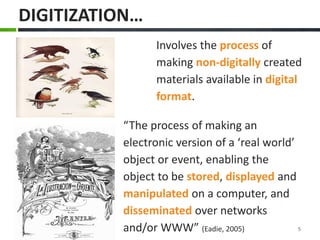
“The process of making an electronic version of a ‘real world’ object or event, enabling the object to be stored, displayed and manipulated on a computer, and disseminated over networks and/or WWW” (Eadie, 2005) 
Involves the process of making non-digitally created materials available in digital format. 
DIGITIZATION… 
5
DIGITIZATION 
Digitization does not always mean scanning. 
Digitization can involve simple data conversion from catalog cards or paper to digital form, video and audio migration to digital form, and so on. 
6
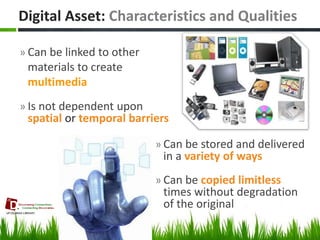
»Can be linked to other materials to create multimedia 
»Is not dependent upon spatial or temporal barriers 
Digital Asset: Characteristics and Qualities 
»Can be stored and delivered in a variety of ways 
»Can be copied limitless times without degradation of the original 
7
8 Is there a need to convert analogue to digital? Why convert or digitize? What can be converted?
DIGITIZATION PROCESS 
9
10 
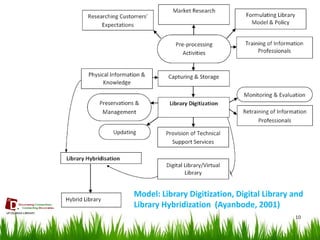
Model: Library Digitization, Digital Library and Library Hybridization (Ayanbode, 2001)
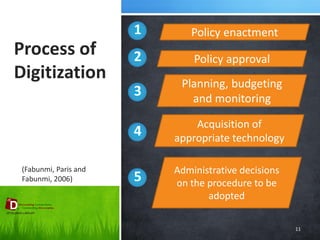
Process of Digitization 
11 
Policy enactment 
Policy approval 
Planning, budgeting and monitoring 
Acquisition of appropriate technology 
Administrative decisions on the procedure to be adopted 
1 
2 
3 
4 
5 
(Fabunmi, Paris and Fabunmi, 2006)
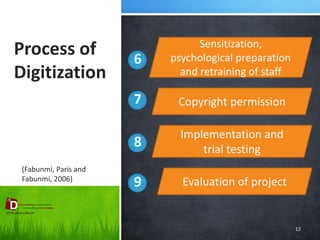
Process of Digitization 
12 
Sensitization, psychological preparation and retraining of staff 
Copyright permission 
Implementation and trial testing 
Evaluation of project 
6 
7 
8 
9 
(Fabunmi, Paris and Fabunmi, 2006)
Process of Digitization 
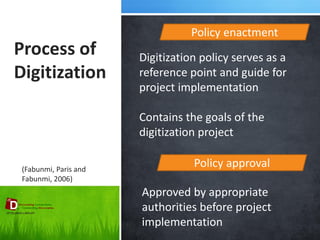
Policy enactment 
Policy approval 
Digitization policy serves as a reference point and guide for project implementation 
Contains the goals of the digitization project 
Approved by appropriate authorities before project implementation 
(Fabunmi, Paris and Fabunmi, 2006)
Process of Digitization 
14 
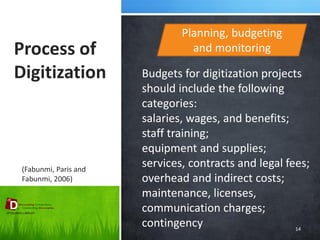
Planning, budgeting and monitoring 
Budgets for digitization projects should include the following categories: 
salaries, wages, and benefits; 
staff training; 
equipment and supplies; 
services, contracts and legal fees; overhead and indirect costs; maintenance, licenses, communication charges; contingency 
(Fabunmi, Paris and Fabunmi, 2006)
Process of Digitization 
15 
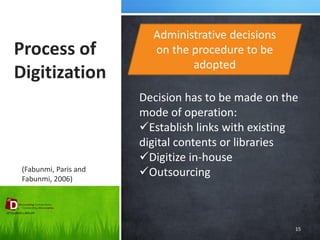
Administrative decisions on the procedure to be adopted 
Decision has to be made on the mode of operation: 
Establish links with existing digital contents or libraries 
Digitize in-house 
Outsourcing 
(Fabunmi, Paris and Fabunmi, 2006)
Process of Digitization 
16 
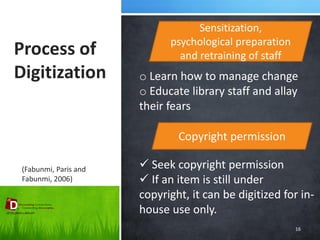
Sensitization, psychological preparation and retraining of staff 
(Fabunmi, Paris and Fabunmi, 2006) 
o Learn how to manage change 
o Educate library staff and allay their fears 
Copyright permission 
 Seek copyright permission 
 If an item is still under copyright, it can be digitized for in- house use only.
Process of Digitization 
17 
Evaluation of project 
(Fabunmi, Paris and Fabunmi, 2006) 
 Make periodic evaluation of the project 
Based on the set goals 
Number of digitized items 
Quality of digital content 
Use of digital contents by users
Benefits of Digitization 
•Broader and enhanced access, to a wider community 
•Preservation endangered library resources 
•Increase usage of library materials especially those are special collections and records with archival value 
•Improvement of the efficiency of information search mechanisms 
•Generate new and exciting research opportunities 
18
19 
Wrong Motives for Digitization 
•Substitute for microfilming 
•To save space 
•To save money 
•“Because we can” 
•Substitute for collection development
20 
Guidelines for Digitization Projects 
UNESCO, IFLA and ICA suggest that digitization projects should be: 
oUser driven, based on a high demand for enhanced access to content 
oOpportunity driven, when money is available for a particular initiative 
oPreservation driven, when there is a need to protect fragile materials from handling 
oRevenue driven, where there is an opportunity to generate income from digital resources 
(Hughes, 2004)
21 
Before you start, 
ask yourself 
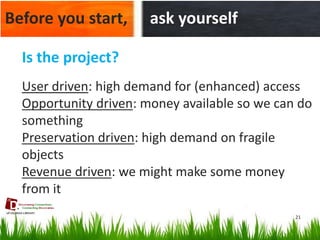
Is the project? 
User driven: high demand for (enhanced) access 
Opportunity driven: money available so we can do something 
Preservation driven: high demand on fragile objects 
Revenue driven: we might make some money from it
22 
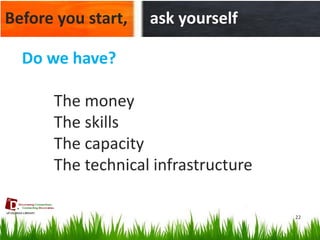
Before you start, 
ask yourself Do we have? The money The skills The capacity The technical infrastructure
23 
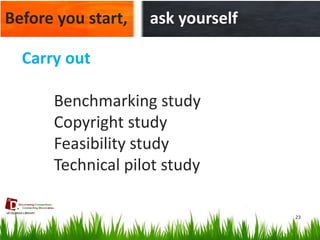
Before you start, 
ask yourself 
Carry out 
Benchmarking study 
Copyright study 
Feasibility study 
Technical pilot study
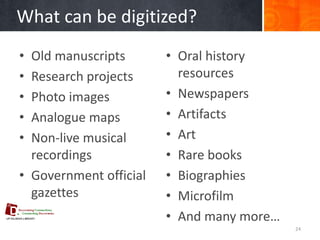
What can be digitized? 
•Old manuscripts 
•Research projects 
•Photo images 
•Analogue maps 
•Non-live musical recordings 
•Government official gazettes 
•Oral history resources 
•Newspapers 
•Artifacts 
•Art 
•Rare books 
•Biographies 
•Microfilm 
•And many more… 
24
Value 
Does the material have sufficient intrinsic value? 
Condition 
Are digital format needed because the original materials are unserviceable? 
Use 
Are materials in demand? How are they used, and with what frequency, by which users? 
Characteristics 
Do the physical formats of the materials lend themselves to digitization at an acceptable high level of reproduction? 
Criteria for Selection 
(Beagrie, 2004; Rosenthal: 2005; Hughes, 2004) 
25
Digitization for PRESERVATION 
26
Digitization for Preservation 
•It creates valuable new digital asset worthy of long-term preservation. 
•Association for Research Libraries (2004) endorsed digitization as an acceptable preservation strategy. 
27 
(Conway, 2010)
Digitization for PRESERVATION 
28 
•Lessens use of originals? 
•Long-term commitment to maintain files 
–Technology, funding, equipment, personnel needs to maintain accessibility to files 
•Serious concerns re: fragile materials as demands increase to have them in digital format 
–Need to consider preservation/conservation requirements of originals prior to digitization 
(Trinkaus-Randall, 2010)
Digitization for PRESERVATION 
There is considerable unease within the library sector at the prospect of relying on a digital copy as a substitution for other formats. Many librarians felt that film still provided the best preservation medium. 
29 
(Scoping the Future of the University of oxford’s Digital Library Collections)
30 Digitization for PRESERVATION 
There was a general acceptance among librarians that “digital surrogates could assist in deflecting demand away from handling originals.” 
“… digitization should not be allowed to detract from traditional conservation efforts to preserve the original.” 
(Scoping the Future of the University of oxford’s Digital Library Collections)
“combines policies, strategies and actions to ensure access to reformatted and born digital content regardless of the challenges of media failure and technological change. The goal of digital preservation is the accurate rendering of authenticated content over time.” --Association for Library Collections and Technical Services (ALCTS) Preservation and Reformatting Section 
31 
Long term institutional commitment:
32 
Digital PRESERVATION 
“Digital preservation protects the value of digital assets, regardless of whether the original source is a tangible artifact or data that were born and live digitally.” 
(Conway, 2010)
Digitization for ACCESS 
33
Primary purpose of DIGITIZATION 
Improve Access 
Valuable information 34
Digitization for ACCESS 
 Simultaneous access to digital asset by multiple users 
 Efficient comprehensive search to digitized library resources from anywhere at any time 
35
DIGITIZATION FOR ACCESS 
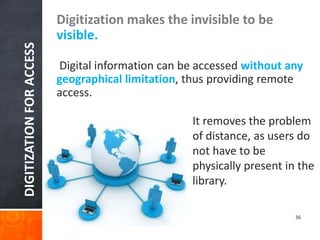
Digitization makes the invisible to be visible. 
Digital information can be accessed without any geographical limitation, thus providing remote access. 
It removes the problem of distance, as users do not have to be physically present in the library. 
36
Digitization for Access 
37 
Clearer image than microfilm and easier to read 
Provides excellent surrogates of originals 
Exhibitions, research, publicity, etc. 
Easily retrieved and manipulated, transmittable, and transportable from a repository to the sites of research, presentation, and teaching. 
 Increasing researcher’s expectations on availability of materials in digital format 
(Trinkaus-Randall, 2010)
LIBRARIANS in Digitization Project 
38
DIGITIZATION PROJECT 
39 
Responsibilities of Librarians 
Managing digitization projects and staff 
Fundraising and grant writing 
Managing budgets 
Writing job descriptions, hiring staff 
Setting goals and targets 
Writing documentation and reports
DIGITIZATION PROJECT 
40 
Responsibilities of Librarians 
Selecting materials, in cooperation with subject specialists 
Conservation assessment of originals 
Preservation handling or treatment where necessary 
Creating basic catalog records or tracking lists where necessary 
Evaluating copyright status of originals
DIGITIZATION PROJECT 
41 
Responsibilities of Librarians 
Cataloging and indexing digital objects 
Monitoring of digitization procedures and performing of quality assessment 
Developing delivery mechanisms and finding aids 
Preservation and archiving of digital objects 
Instruction and end-user support
Challenges and Issues of Library Digitization 
42
Challenges and Issues of Library Digitization 
43 
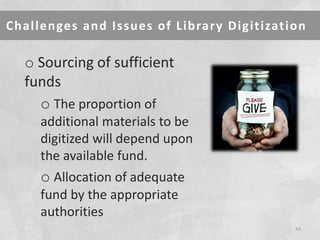
o Sourcing of sufficient funds 
o The proportion of additional materials to be digitized will depend upon the available fund. 
o Allocation of adequate fund by the appropriate authorities
Challenges and Issues of Library Digitization 
44 
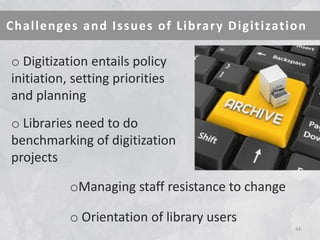
o Digitization entails policy initiation, setting priorities and planning 
o Libraries need to do benchmarking of digitization projects 
oManaging staff resistance to change 
o Orientation of library users
Challenges and Issues of Library Digitization 
45 
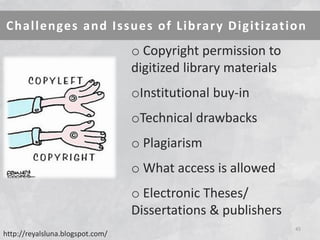
o Copyright permission to digitized library materials 
oInstitutional buy-in 
oTechnical drawbacks 
o Plagiarism 
o What access is allowed 
o Electronic Theses/ Dissertations & publishers http://reyalsluna.blogspot.com/
46 
Threats to Digital Assets (Beagrie, 2004; Rosenthal: 2005) Storage medium deteriorate overtime 
Obsolescence of the carrier 
File format obsolescence 
Older versions of software may not work on new hardware or operating system
Threats to Digital Assets 
•Valuable digital assets of institutions are at risk of being inaccessible. 
•The success of preserving digital materials requires standards for file formats. 
47
48 
Conclusion 
Digitization of library resources “is changing the ways in which collections are used and accessed.” 
(Hughes, 2004, pp.29-30)
Conclusion 
49 
“It is important to evaluate whether or not digitization is truly worthwhile before undertaking a digitization initiative.” 
(Hughes, 2004, pp.29-30)
Conclusion 
50 
“Valuable digital resources, which will bring prestige to the institutions that create and maintain them, will be those that can support scholarship without any loss of the benefits of working with the originals.” 
(Hughes, 2004, pp.29-30)
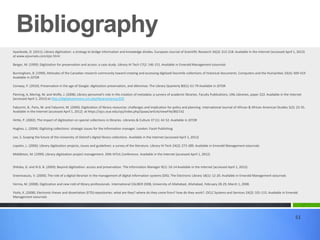
Ayanbode, O. (2011). Library digitization: a strategy to bridge information and knowledge divides. European Journal of Scientific Research 56(2): 212-218. Available in the Internet (accessed April 1, 2012) at www.ejournals.com/ejsr.html 
Berger, M. (1999). Digitization for preservation and access: a case study. Library Hi Tech 17(2: 146-151. Available in Emerald Management eJournals 
Burningham, B. (1999). Attitudes of the Canadian research community toward creating and accessing digitized fascimile collections of historical documents. Computers and the Humanities 33(4): 409-419 Available in JSTOR 
Conway, P. (2010). Preservation in the age of Google: digitization preservation, and dilemmas. The Library Quarterly 80(1): 61-79 Available in JSTOR 
Fleming, A, Mering, M. and Wofle, J. (2008). Library personnel's role in the creation of metadata: a survery of academic libraries. Faculty Publications, UNL Libraries, paper 222. Available in the Internet (accessed April 1, 2012) at http://digitalcommons.unl.edu/libraryscience/222 
Fabunmi, B., Paris, M. and Fabunmi, M. (2006). Digitization of library resources: challenges and implication for policy and planning. International Journal of African & African American Studies 5(2): 23-35. Available in the Internet (accessed April 1, 2012) at https://ojcs.siue.edu/ojs/index.php/ijaaas/article/viewFile/80/142 
Hirtle, P. (2002). The impact of digitization on special collections in libraries. Libraries & Culture 37 (1): 42-52. Available in JSTOR 
Hughes, L. (2004). Digitizing collections: strategic issues for the information manager. London: Facet Publishing 
Lee, S. Scoping the future of the University of Oxford's digital library collections. Available in the Internet (accessed April 1, 2012) 
Lopatin, L. (2006). Library digitization projects, issues and guidelines: a survey of the literature. Library Hi Tech 24(2): 273-289. Available in Emerald Management eJournals 
Middleton, M. (1999). Library digitization project management. 20th IATUL Conference. Available in the Internet (accessed April 1, 2012) 
Shiloba, G. and N.G. B. (2009). Beyond digitization: access and preservation. The Information Manager 9(1): 10-14 Available in the Internet (accessed April 1, 2012) 
Sreenivasulu, V. (2000). The role of a digital librarian in the management of digital information systems (DIS). The Electronic Library 18(1): 12-20. Available in Emerald Management eJournals 
Verma, M. (2008). Digitization and new rold of library professionals. International CALIBER 2008, University of Allahabad, Allahabad, February 28-29, March 1, 2008. 
Yiotis, K. (2008). Electronic theses and dissertation (ETD) repositories: what are they? where do they come from? how do they work?. OCLC Systems and Services 24(2): 101-115. Available in Emerald Management eJournals 
Bibliography 
51
? 
Thank you! Questions? 
Marian S. Ramos 
msramos@up.edu.ph 
www.mainlib.upd.edu.ph 
52

Ms. marian s. ramos

  • 1.
    PAARL NATIONAL SUMMERCONFERENCE PLANNING, DEVELOPING AND MANAGING DIGITIZATION & RESEARCH PROJECTS FOR LIBRARIES AND INFORMATION CENTERS 18-20 April 2012 Coron, Palawan DIGITIZATION FOR ACCESS AND PRESERVATION: Role of Academic and Research Librarians Marian S. Ramos msramos@up.edu.ph
  • 2.
    OUTLINE •Introduction •DigitizationProcess •Digitization for Preservation •Digitization for Access •Librarians in Digitization Project •Challenges and Issues of Library Digitization •Conclusion 2
  • 3.
  • 4.
    4 Introduction “Theconversion of all sorts of cultural contents into bits and bytes opens up a completely new dimensions of reaching traditional and new audiences by providing access to cultural heritage resources in ways unimaginable a decade ago.” -- Mulrenin and Geser, 2001
  • 5.
    “The process ofmaking an electronic version of a ‘real world’ object or event, enabling the object to be stored, displayed and manipulated on a computer, and disseminated over networks and/or WWW” (Eadie, 2005) Involves the process of making non-digitally created materials available in digital format. DIGITIZATION… 5
  • 6.
    DIGITIZATION Digitization doesnot always mean scanning. Digitization can involve simple data conversion from catalog cards or paper to digital form, video and audio migration to digital form, and so on. 6
  • 7.
    »Can be linkedto other materials to create multimedia »Is not dependent upon spatial or temporal barriers Digital Asset: Characteristics and Qualities »Can be stored and delivered in a variety of ways »Can be copied limitless times without degradation of the original 7
  • 8.
    8 Is therea need to convert analogue to digital? Why convert or digitize? What can be converted?
  • 9.
  • 10.
    10 Model: LibraryDigitization, Digital Library and Library Hybridization (Ayanbode, 2001)
  • 11.
    Process of Digitization 11 Policy enactment Policy approval Planning, budgeting and monitoring Acquisition of appropriate technology Administrative decisions on the procedure to be adopted 1 2 3 4 5 (Fabunmi, Paris and Fabunmi, 2006)
  • 12.
    Process of Digitization 12 Sensitization, psychological preparation and retraining of staff Copyright permission Implementation and trial testing Evaluation of project 6 7 8 9 (Fabunmi, Paris and Fabunmi, 2006)
  • 13.
    Process of Digitization Policy enactment Policy approval Digitization policy serves as a reference point and guide for project implementation Contains the goals of the digitization project Approved by appropriate authorities before project implementation (Fabunmi, Paris and Fabunmi, 2006)
  • 14.
    Process of Digitization 14 Planning, budgeting and monitoring Budgets for digitization projects should include the following categories: salaries, wages, and benefits; staff training; equipment and supplies; services, contracts and legal fees; overhead and indirect costs; maintenance, licenses, communication charges; contingency (Fabunmi, Paris and Fabunmi, 2006)
  • 15.
    Process of Digitization 15 Administrative decisions on the procedure to be adopted Decision has to be made on the mode of operation: Establish links with existing digital contents or libraries Digitize in-house Outsourcing (Fabunmi, Paris and Fabunmi, 2006)
  • 16.
    Process of Digitization 16 Sensitization, psychological preparation and retraining of staff (Fabunmi, Paris and Fabunmi, 2006) o Learn how to manage change o Educate library staff and allay their fears Copyright permission  Seek copyright permission  If an item is still under copyright, it can be digitized for in- house use only.
  • 17.
    Process of Digitization 17 Evaluation of project (Fabunmi, Paris and Fabunmi, 2006)  Make periodic evaluation of the project Based on the set goals Number of digitized items Quality of digital content Use of digital contents by users
  • 18.
    Benefits of Digitization •Broader and enhanced access, to a wider community •Preservation endangered library resources •Increase usage of library materials especially those are special collections and records with archival value •Improvement of the efficiency of information search mechanisms •Generate new and exciting research opportunities 18
  • 19.
    19 Wrong Motivesfor Digitization •Substitute for microfilming •To save space •To save money •“Because we can” •Substitute for collection development
  • 20.
    20 Guidelines forDigitization Projects UNESCO, IFLA and ICA suggest that digitization projects should be: oUser driven, based on a high demand for enhanced access to content oOpportunity driven, when money is available for a particular initiative oPreservation driven, when there is a need to protect fragile materials from handling oRevenue driven, where there is an opportunity to generate income from digital resources (Hughes, 2004)
  • 21.
    21 Before youstart, ask yourself Is the project? User driven: high demand for (enhanced) access Opportunity driven: money available so we can do something Preservation driven: high demand on fragile objects Revenue driven: we might make some money from it
  • 22.
    22 Before youstart, ask yourself Do we have? The money The skills The capacity The technical infrastructure
  • 23.
    23 Before youstart, ask yourself Carry out Benchmarking study Copyright study Feasibility study Technical pilot study
  • 24.
    What can bedigitized? •Old manuscripts •Research projects •Photo images •Analogue maps •Non-live musical recordings •Government official gazettes •Oral history resources •Newspapers •Artifacts •Art •Rare books •Biographies •Microfilm •And many more… 24
  • 25.
    Value Does thematerial have sufficient intrinsic value? Condition Are digital format needed because the original materials are unserviceable? Use Are materials in demand? How are they used, and with what frequency, by which users? Characteristics Do the physical formats of the materials lend themselves to digitization at an acceptable high level of reproduction? Criteria for Selection (Beagrie, 2004; Rosenthal: 2005; Hughes, 2004) 25
  • 26.
  • 27.
    Digitization for Preservation •It creates valuable new digital asset worthy of long-term preservation. •Association for Research Libraries (2004) endorsed digitization as an acceptable preservation strategy. 27 (Conway, 2010)
  • 28.
    Digitization for PRESERVATION 28 •Lessens use of originals? •Long-term commitment to maintain files –Technology, funding, equipment, personnel needs to maintain accessibility to files •Serious concerns re: fragile materials as demands increase to have them in digital format –Need to consider preservation/conservation requirements of originals prior to digitization (Trinkaus-Randall, 2010)
  • 29.
    Digitization for PRESERVATION There is considerable unease within the library sector at the prospect of relying on a digital copy as a substitution for other formats. Many librarians felt that film still provided the best preservation medium. 29 (Scoping the Future of the University of oxford’s Digital Library Collections)
  • 30.
    30 Digitization forPRESERVATION There was a general acceptance among librarians that “digital surrogates could assist in deflecting demand away from handling originals.” “… digitization should not be allowed to detract from traditional conservation efforts to preserve the original.” (Scoping the Future of the University of oxford’s Digital Library Collections)
  • 31.
    “combines policies, strategiesand actions to ensure access to reformatted and born digital content regardless of the challenges of media failure and technological change. The goal of digital preservation is the accurate rendering of authenticated content over time.” --Association for Library Collections and Technical Services (ALCTS) Preservation and Reformatting Section 31 Long term institutional commitment:
  • 32.
    32 Digital PRESERVATION “Digital preservation protects the value of digital assets, regardless of whether the original source is a tangible artifact or data that were born and live digitally.” (Conway, 2010)
  • 33.
  • 34.
    Primary purpose ofDIGITIZATION Improve Access Valuable information 34
  • 35.
    Digitization for ACCESS  Simultaneous access to digital asset by multiple users  Efficient comprehensive search to digitized library resources from anywhere at any time 35
  • 36.
    DIGITIZATION FOR ACCESS Digitization makes the invisible to be visible. Digital information can be accessed without any geographical limitation, thus providing remote access. It removes the problem of distance, as users do not have to be physically present in the library. 36
  • 37.
    Digitization for Access 37 Clearer image than microfilm and easier to read Provides excellent surrogates of originals Exhibitions, research, publicity, etc. Easily retrieved and manipulated, transmittable, and transportable from a repository to the sites of research, presentation, and teaching.  Increasing researcher’s expectations on availability of materials in digital format (Trinkaus-Randall, 2010)
  • 38.
  • 39.
    DIGITIZATION PROJECT 39 Responsibilities of Librarians Managing digitization projects and staff Fundraising and grant writing Managing budgets Writing job descriptions, hiring staff Setting goals and targets Writing documentation and reports
  • 40.
    DIGITIZATION PROJECT 40 Responsibilities of Librarians Selecting materials, in cooperation with subject specialists Conservation assessment of originals Preservation handling or treatment where necessary Creating basic catalog records or tracking lists where necessary Evaluating copyright status of originals
  • 41.
    DIGITIZATION PROJECT 41 Responsibilities of Librarians Cataloging and indexing digital objects Monitoring of digitization procedures and performing of quality assessment Developing delivery mechanisms and finding aids Preservation and archiving of digital objects Instruction and end-user support
  • 42.
    Challenges and Issuesof Library Digitization 42
  • 43.
    Challenges and Issuesof Library Digitization 43 o Sourcing of sufficient funds o The proportion of additional materials to be digitized will depend upon the available fund. o Allocation of adequate fund by the appropriate authorities
  • 44.
    Challenges and Issuesof Library Digitization 44 o Digitization entails policy initiation, setting priorities and planning o Libraries need to do benchmarking of digitization projects oManaging staff resistance to change o Orientation of library users
  • 45.
    Challenges and Issuesof Library Digitization 45 o Copyright permission to digitized library materials oInstitutional buy-in oTechnical drawbacks o Plagiarism o What access is allowed o Electronic Theses/ Dissertations & publishers http://reyalsluna.blogspot.com/
  • 46.
    46 Threats toDigital Assets (Beagrie, 2004; Rosenthal: 2005) Storage medium deteriorate overtime Obsolescence of the carrier File format obsolescence Older versions of software may not work on new hardware or operating system
  • 47.
    Threats to DigitalAssets •Valuable digital assets of institutions are at risk of being inaccessible. •The success of preserving digital materials requires standards for file formats. 47
  • 48.
    48 Conclusion Digitizationof library resources “is changing the ways in which collections are used and accessed.” (Hughes, 2004, pp.29-30)
  • 49.
    Conclusion 49 “Itis important to evaluate whether or not digitization is truly worthwhile before undertaking a digitization initiative.” (Hughes, 2004, pp.29-30)
  • 50.
    Conclusion 50 “Valuabledigital resources, which will bring prestige to the institutions that create and maintain them, will be those that can support scholarship without any loss of the benefits of working with the originals.” (Hughes, 2004, pp.29-30)
  • 51.
    Ayanbode, O. (2011).Library digitization: a strategy to bridge information and knowledge divides. European Journal of Scientific Research 56(2): 212-218. Available in the Internet (accessed April 1, 2012) at www.ejournals.com/ejsr.html Berger, M. (1999). Digitization for preservation and access: a case study. Library Hi Tech 17(2: 146-151. Available in Emerald Management eJournals Burningham, B. (1999). Attitudes of the Canadian research community toward creating and accessing digitized fascimile collections of historical documents. Computers and the Humanities 33(4): 409-419 Available in JSTOR Conway, P. (2010). Preservation in the age of Google: digitization preservation, and dilemmas. The Library Quarterly 80(1): 61-79 Available in JSTOR Fleming, A, Mering, M. and Wofle, J. (2008). Library personnel's role in the creation of metadata: a survery of academic libraries. Faculty Publications, UNL Libraries, paper 222. Available in the Internet (accessed April 1, 2012) at http://digitalcommons.unl.edu/libraryscience/222 Fabunmi, B., Paris, M. and Fabunmi, M. (2006). Digitization of library resources: challenges and implication for policy and planning. International Journal of African & African American Studies 5(2): 23-35. Available in the Internet (accessed April 1, 2012) at https://ojcs.siue.edu/ojs/index.php/ijaaas/article/viewFile/80/142 Hirtle, P. (2002). The impact of digitization on special collections in libraries. Libraries & Culture 37 (1): 42-52. Available in JSTOR Hughes, L. (2004). Digitizing collections: strategic issues for the information manager. London: Facet Publishing Lee, S. Scoping the future of the University of Oxford's digital library collections. Available in the Internet (accessed April 1, 2012) Lopatin, L. (2006). Library digitization projects, issues and guidelines: a survey of the literature. Library Hi Tech 24(2): 273-289. Available in Emerald Management eJournals Middleton, M. (1999). Library digitization project management. 20th IATUL Conference. Available in the Internet (accessed April 1, 2012) Shiloba, G. and N.G. B. (2009). Beyond digitization: access and preservation. The Information Manager 9(1): 10-14 Available in the Internet (accessed April 1, 2012) Sreenivasulu, V. (2000). The role of a digital librarian in the management of digital information systems (DIS). The Electronic Library 18(1): 12-20. Available in Emerald Management eJournals Verma, M. (2008). Digitization and new rold of library professionals. International CALIBER 2008, University of Allahabad, Allahabad, February 28-29, March 1, 2008. Yiotis, K. (2008). Electronic theses and dissertation (ETD) repositories: what are they? where do they come from? how do they work?. OCLC Systems and Services 24(2): 101-115. Available in Emerald Management eJournals Bibliography 51
  • 52.
    ? Thank you!Questions? Marian S. Ramos msramos@up.edu.ph www.mainlib.upd.edu.ph 52