SCHOLARLY PUBLISHING
          25 YEARS FROM NOW

  A LIBRARIAN’S PERSPECTIVE


                James G. Neal
       Society for Scholarly Publishing
                 29 May 2003

                                          1
Scholarly Activity
• Creation of knowledge and evaluation
     of its validity
• Preservation of information

• Transmission of information to others
          • Technologies
          • Economics
          • Institutions
                                 2
The Urge To Publish

• Communication
• Academic Culture
• Preservation of Ideas
• Prestige and Recognition
• Profit

                          3
Expectations For Technology
    •   Content
    •   Access
    •   Convenience
    •   New Capabilities
    •   Cost Reduction
    •   Productivity

                           4
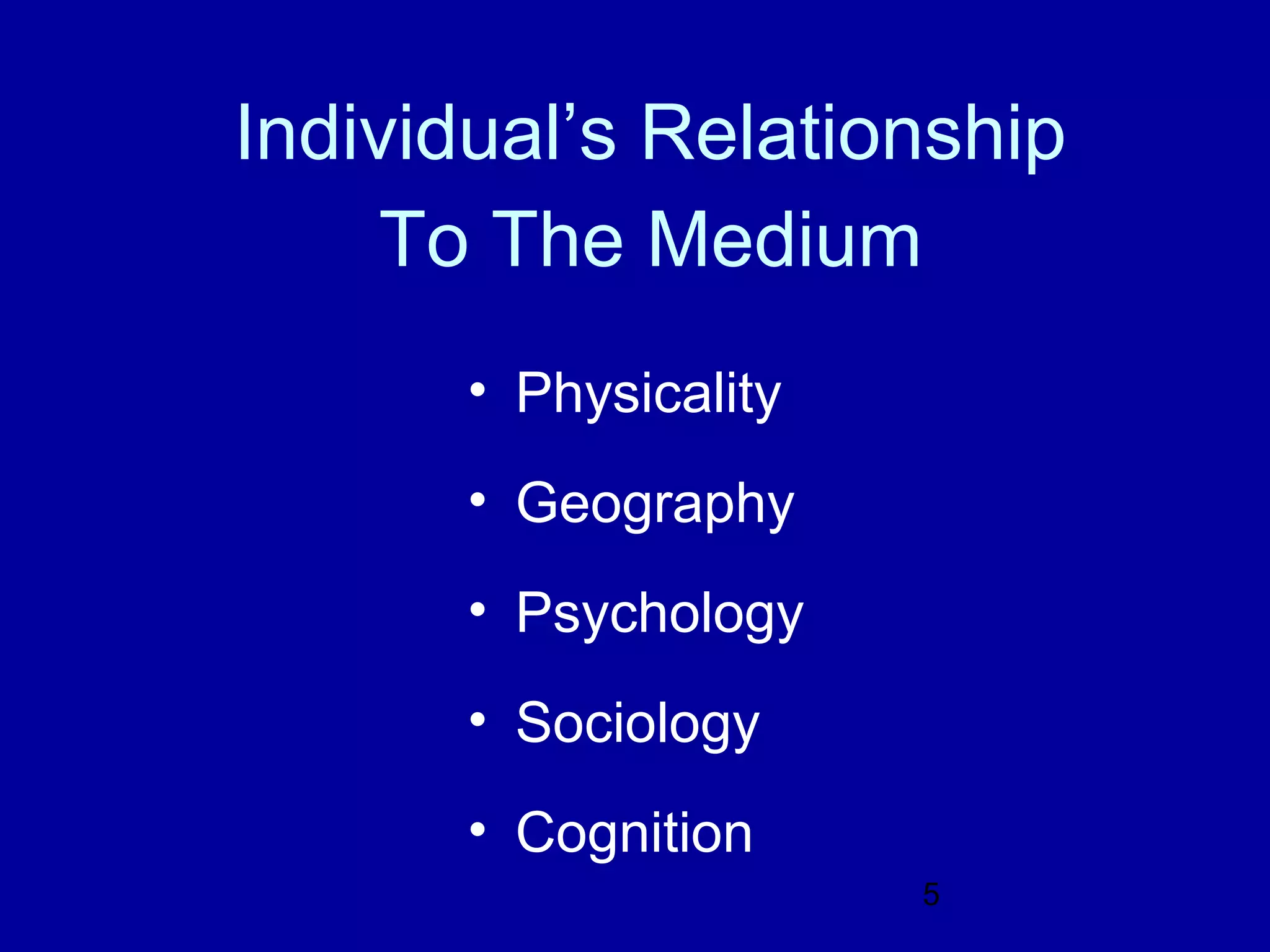
Individual’s Relationship
     To The Medium
       • Physicality
       • Geography
       • Psychology
       • Sociology
       • Cognition
                       5
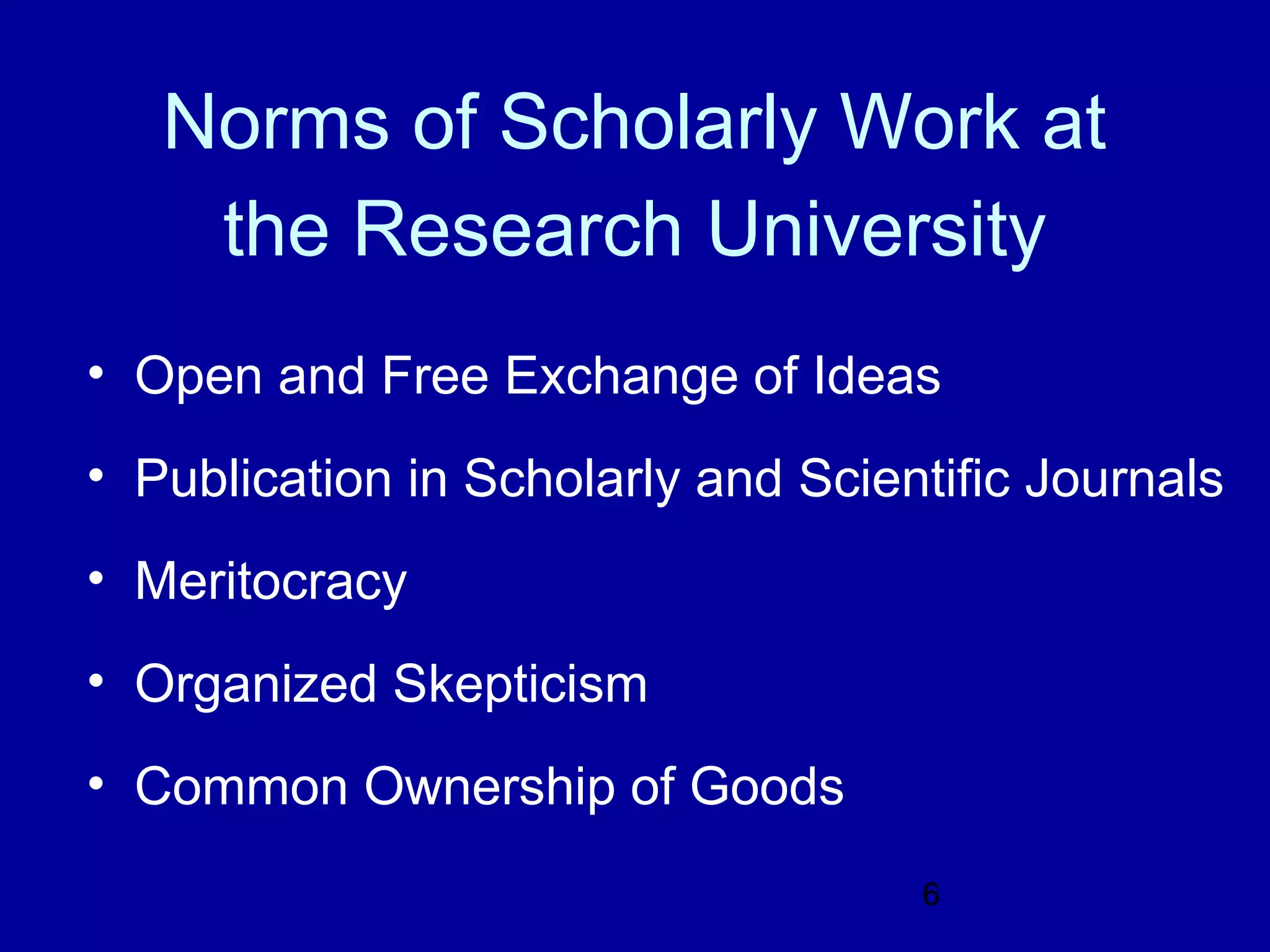
Norms of Scholarly Work at
    the Research University
• Open and Free Exchange of Ideas
• Publication in Scholarly and Scientific Journals
• Meritocracy
• Organized Skepticism
• Common Ownership of Goods
                                    6
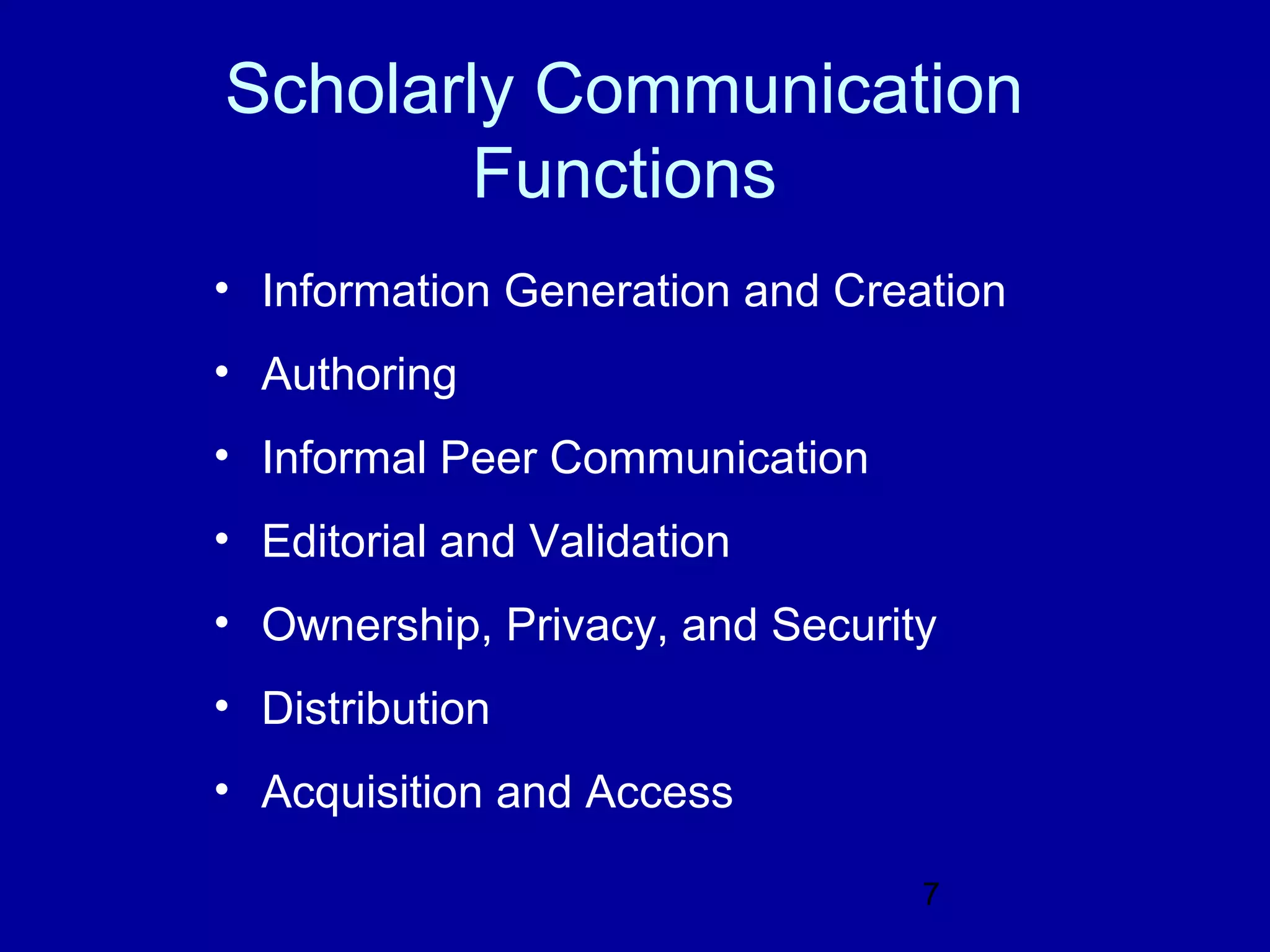
Scholarly Communication
        Functions
• Information Generation and Creation
• Authoring
• Informal Peer Communication
• Editorial and Validation
• Ownership, Privacy, and Security
• Distribution
• Acquisition and Access

                                 7
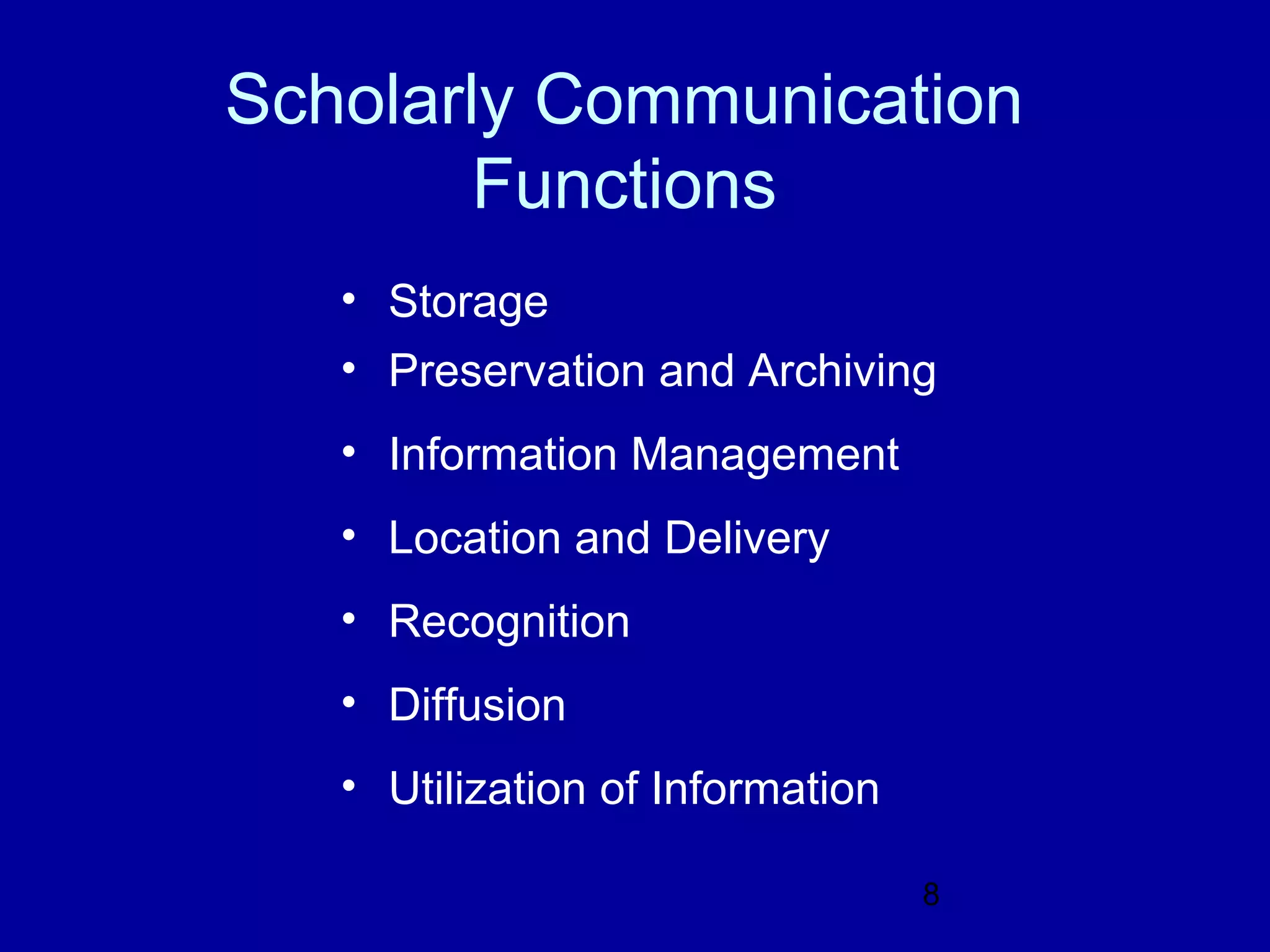
Scholarly Communication
        Functions
   • Storage
   • Preservation and Archiving
   • Information Management
   • Location and Delivery
   • Recognition
   • Diffusion
   • Utilization of Information

                                  8
Electronic Scholarly Publishing
         Some Models
• Commercial Publishing Model

• Academic Server Model

• Prestigious Publishing Model

• University Publishing Cooperative

• Public Domain Model

• Government Server Model
                                      9
Electronic Scholarly Publishing
        Some Models
• Digital Library Model

• Electronic Book Model

• Electronic Collection Model

• Retrospective Model

• Preprint Server Model

• Peer Review Lite Model
                                10
Advantages of Digital Information

        • Accessibility

        • Availability

        • Searchability

        • Currency

        • Researchability
                            11
Advantages of Digital Information

      • Dynamism/Fluidity

      • Interdisciplinarity

      • Collaborative Nature

      • Multimedia Aspects

      • Linkability
                              12
Advantages of Digital Information

    • Interactivity

    • Procedural Qualities

    • Spatial Capabilities

    • Encyclopedic Potential

                             13
Advantages of Print
   • Portability

   • Durability

   • Markupability

   • Readability

                     14
Advantage of Print

  • Archivability

  • Ownability

  • Affordability

  • Aesthetic Quality

                        15
Electronic Scholarly Publishing
     Cronin Observations
       • Discipline Diversity
       • Importance of Trust
       • Importance of Credibility
       • Velocity of Communication
       • Expanded Readership


                                     16
Electronic Scholarly Publishing
     Cronin Observations

       • New Economics
       • Vertical Integration
       • New Modes of Discourse
       • Democratization

                                17
Electronic Scholarly Publishing
         Some Issues
 • Current and Historical Coverage

 • Affordability
 • Interactive Development/Usability
       Assessment
 • Author Use of Medium

 • Shifting Technology
                               18
Electronic Scholarly Publishing
          Some Issues
• Cross Publisher Integration

• Researcher Understanding and Support

• New Packaging/Integrity of the Work

• Research and Development

                                19
Scholarly Communication
         Concerns
• Choking on the Proliferation
• Location of Quality Marking
• Corporate Economy Overtakes Guild Economy
• Dysfunctional Market
• Intellectual Property Ownership
• Darwinian/Capitalistic/Socialist Solutions
• New Models of Digital Scholarship
                                 20
Digital Book Futures
   Lessons From American History

• Land Rush/E-Book Rush

• Economics of Railroad/Electronic Book
    Publishing

• Utility Industry Fragmentation and
    Consolidation/E-Book Entrepreneurs
                            21
Electronic Books
         Random Future Issues
• Purchase vs. Lease
• Free vs. Sold
• Self Published vs. Commercially Published
• Retrospective Works vs. New Works
• Text vs. Multimedia
• Proprietary vs. Open Formats/Readers
                                  22
Electronic Books
        Random Future Issues
• Offline vs. Online Access
• Offline vs. Online Use
• Individual Works vs. Searchable Database
• Print vs. Non-Print
• Consultation vs. Circulation
• Archived vs. Fluid Content

                                 23
Research Community
        Strategies

• Market Conforming

• Market Distorting

• System Transforming

• System Busting

                        24
SPARC Messages
• Barrier-Free Access to Research
• Risks of Industry Consolidation
• Protect/Expand Author Rights
• Community Control of Scholarly Communication
• Incubation of Alternative Channels
• Hope/Power/Action through Collaboration


                                    25
SPARC Programs

 Publishing Partnerships    Gaining Independence
 Create Change              Consulting Group/
 Leading Edge                  Legal Services
 Scientific Communities     Institutional Repository
 Declaring Independence     Open Access
                             Next Step


                                          26
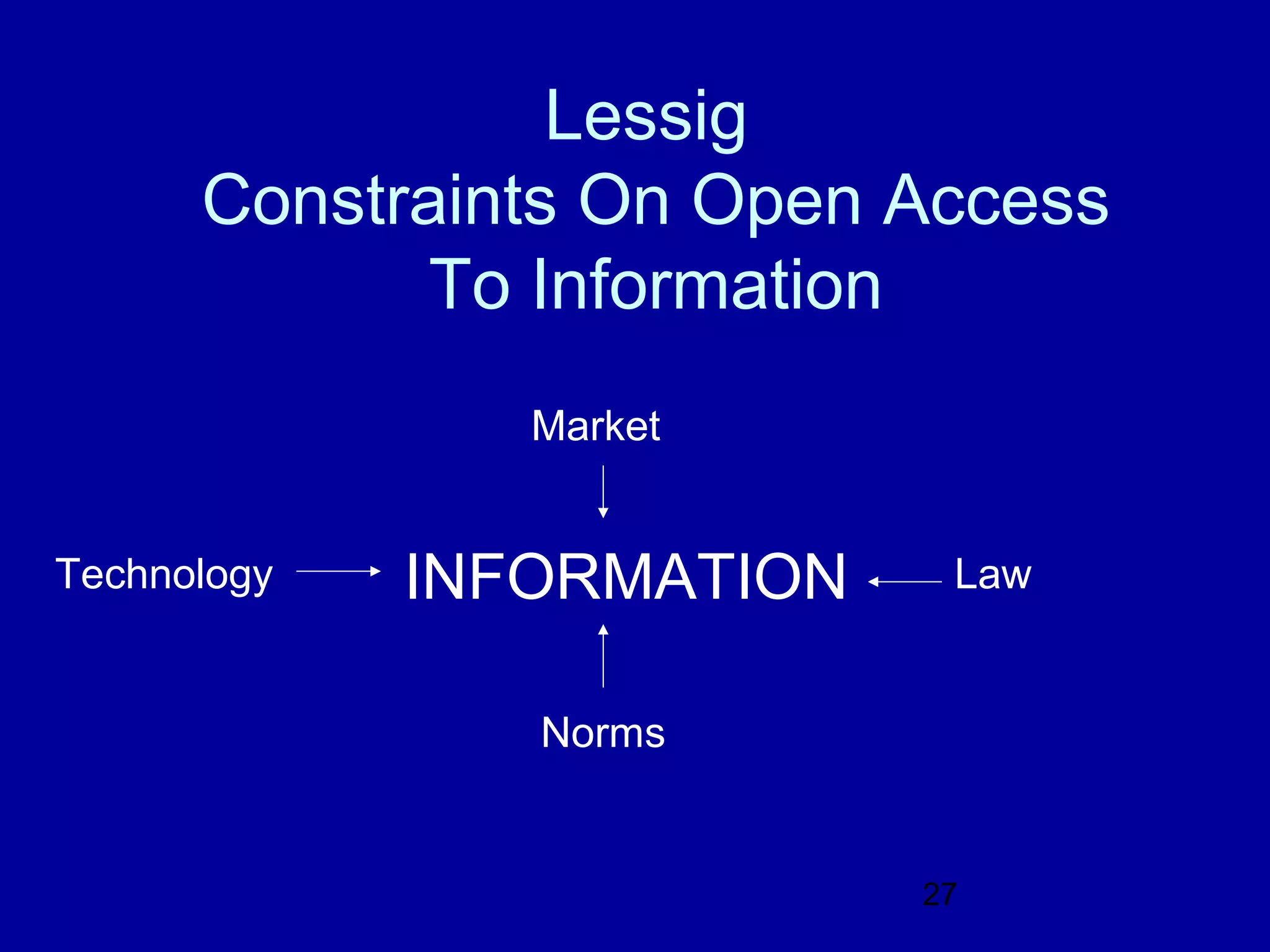
Lessig
      Constraints On Open Access
             To Information
                Market


Technology   INFORMATION    Law


                Norms


                           27
ARL Open Access Agenda
Open Access: works created with no expectation of
  financial remuneration and made available at no cost to
  reader on the public Internet for purposes of education
  and research.

Readers of open access works could read, download, copy,
  distribute, print, search, or link for any lawful purpose,
  without financial, legal or technical barriers.

Budapest Open Access Initiative
Open Archives Initiative
Keystone and Tempe Principles
Public Library of Science
                                            28
ARL Open Access Agenda
• Society benefits from the open exchange of ideas.

• Limitations on access to copyrighted materials
  negatively impact the creation, dissemination
  and use of intellectual property.

• Copyright exists for the public good.

• Federal investment in R&D is leveraged by access
     to research results.

                                          29
Knowledge Conservancy

• Property in Trust for Public Purpose

• Easements Restricting Future Uses of Private
     Property

• Public Benefit within System of Private Property
     Ownership

• Application to Intellectual Property
                                         30
Knowledge Conservancy
•   Content Donations
•   Financial Contributions
•   Usable Digital Assets
•   Metadata to Support Discovery, Rights
       Management, Preservation
• Access Provisions for Global
  Readership
• Long-Term/Perpetual Persistence

                                 31
Repository Movement

 Discipline Repositories
 Institutional Repositories
 Consortium Repositories
 Departmental/School Repositories
 Individual Repositories
 Referatories/Virtual Repositories

                                      32
Institutional Repository
• a set of services offered to a community for the
  organization, dissemination, and preservation
      of digital materials created by the members
      of the community

• digital archives of intellectual products created by
  members of a community and accessible to both
  users within and without with few if any barriers
       to access

          system of:    architecture
                        policy
                        tools
                        standards
                                               33
                        content
Core Library Services to Users
•   Information Acquisition
•   Information Synthesis
•   Information Navigation
•   Information Dissemination
•   Information Interpretation
•   Information Understanding
•   Information Archiving

                                 34
Core Interests Of Libraries

•   Competitive Market
•   Easy Distribution and Reuse
•   Innovative Applications of Technology
•   Quality Assurance
•   Permanent Archiving


                                35
Open Virtual Electronic Library

• Shared Content, Tools and Services
• Collaboration Among Stakeholders
• Extensible Architecture
• Test Bed for Assessment and Innovation
• New Digital Content Rights

                               36
Advancing Publisher/Library Relationship
Through Electronic Scholarly Communication
 •   Regular consultation to develop priorities and strategies for
     collaboration.

 •   Joint innovative electronic publishing projects.

 •   Shared information policy agenda/advocacy strategy.

 •   Forums for communication with researchers and authors.
 •   Shared continuing professional development and training
         programs for staff.
 •   Agreement on principles for licensing/model contract.


                                                        37
Advancing Publisher/Library Relationship
Through Electronic Scholarly Communication
  •   Identification, development, adoption of standards.

  •   Usability research and testing.

  •   Research and development agenda/Impact assessment.

  •   Venture capital for joint activities.

  •   Integrate and share expertise.
  •   Joint programs for preservation and archiving of digital content.


                                                       38
Advancing Publisher/Library Relationship
Through Electronic Scholarly Communication
 • Content and information services for distance learning community.

 • Focus on new scholarly work: courseware, software, datafiles
       and simulations.

 • National document delivery program.

 • Print on demand service.

 • PDA delivery service

 • Development and implementation of scholars portal.

                                                    39
Scholarly Publishing
            The Past Look Forward
• Technology Impact on Business Areas
       (production, editing, marketing)
• Quantitative and Qualitative Change
       (1979 National Enquiry)
•   Small Computer Networks Replace Journal Functions
•   Expanding Audiences
•   Discourse Model of Communication
•   Publishing on Demand
•   New Business Models
•   New Intellectual Property Environment

                                          40
SCHOLARLY PUBLISHING
         2028

• Chaos Breeds Life
• Information Anarchy
• Information Fascism
• Information Utopia
• Information Theology

                         41

95 plenary 1_j-neal

  • 1.
    SCHOLARLY PUBLISHING 25 YEARS FROM NOW A LIBRARIAN’S PERSPECTIVE James G. Neal Society for Scholarly Publishing 29 May 2003 1
  • 2.
    Scholarly Activity • Creationof knowledge and evaluation of its validity • Preservation of information • Transmission of information to others • Technologies • Economics • Institutions 2
  • 3.
    The Urge ToPublish • Communication • Academic Culture • Preservation of Ideas • Prestige and Recognition • Profit 3
  • 4.
    Expectations For Technology • Content • Access • Convenience • New Capabilities • Cost Reduction • Productivity 4
  • 5.
    Individual’s Relationship To The Medium • Physicality • Geography • Psychology • Sociology • Cognition 5
  • 6.
    Norms of ScholarlyWork at the Research University • Open and Free Exchange of Ideas • Publication in Scholarly and Scientific Journals • Meritocracy • Organized Skepticism • Common Ownership of Goods 6
  • 7.
    Scholarly Communication Functions • Information Generation and Creation • Authoring • Informal Peer Communication • Editorial and Validation • Ownership, Privacy, and Security • Distribution • Acquisition and Access 7
  • 8.
    Scholarly Communication Functions • Storage • Preservation and Archiving • Information Management • Location and Delivery • Recognition • Diffusion • Utilization of Information 8
  • 9.
    Electronic Scholarly Publishing Some Models • Commercial Publishing Model • Academic Server Model • Prestigious Publishing Model • University Publishing Cooperative • Public Domain Model • Government Server Model 9
  • 10.
    Electronic Scholarly Publishing Some Models • Digital Library Model • Electronic Book Model • Electronic Collection Model • Retrospective Model • Preprint Server Model • Peer Review Lite Model 10
  • 11.
    Advantages of DigitalInformation • Accessibility • Availability • Searchability • Currency • Researchability 11
  • 12.
    Advantages of DigitalInformation • Dynamism/Fluidity • Interdisciplinarity • Collaborative Nature • Multimedia Aspects • Linkability 12
  • 13.
    Advantages of DigitalInformation • Interactivity • Procedural Qualities • Spatial Capabilities • Encyclopedic Potential 13
  • 14.
    Advantages of Print • Portability • Durability • Markupability • Readability 14
  • 15.
    Advantage of Print • Archivability • Ownability • Affordability • Aesthetic Quality 15
  • 16.
    Electronic Scholarly Publishing Cronin Observations • Discipline Diversity • Importance of Trust • Importance of Credibility • Velocity of Communication • Expanded Readership 16
  • 17.
    Electronic Scholarly Publishing Cronin Observations • New Economics • Vertical Integration • New Modes of Discourse • Democratization 17
  • 18.
    Electronic Scholarly Publishing Some Issues • Current and Historical Coverage • Affordability • Interactive Development/Usability Assessment • Author Use of Medium • Shifting Technology 18
  • 19.
    Electronic Scholarly Publishing Some Issues • Cross Publisher Integration • Researcher Understanding and Support • New Packaging/Integrity of the Work • Research and Development 19
  • 20.
    Scholarly Communication Concerns • Choking on the Proliferation • Location of Quality Marking • Corporate Economy Overtakes Guild Economy • Dysfunctional Market • Intellectual Property Ownership • Darwinian/Capitalistic/Socialist Solutions • New Models of Digital Scholarship 20
  • 21.
    Digital Book Futures Lessons From American History • Land Rush/E-Book Rush • Economics of Railroad/Electronic Book Publishing • Utility Industry Fragmentation and Consolidation/E-Book Entrepreneurs 21
  • 22.
    Electronic Books Random Future Issues • Purchase vs. Lease • Free vs. Sold • Self Published vs. Commercially Published • Retrospective Works vs. New Works • Text vs. Multimedia • Proprietary vs. Open Formats/Readers 22
  • 23.
    Electronic Books Random Future Issues • Offline vs. Online Access • Offline vs. Online Use • Individual Works vs. Searchable Database • Print vs. Non-Print • Consultation vs. Circulation • Archived vs. Fluid Content 23
  • 24.
    Research Community Strategies • Market Conforming • Market Distorting • System Transforming • System Busting 24
  • 25.
    SPARC Messages • Barrier-FreeAccess to Research • Risks of Industry Consolidation • Protect/Expand Author Rights • Community Control of Scholarly Communication • Incubation of Alternative Channels • Hope/Power/Action through Collaboration 25
  • 26.
    SPARC Programs  PublishingPartnerships  Gaining Independence  Create Change  Consulting Group/  Leading Edge Legal Services  Scientific Communities  Institutional Repository  Declaring Independence  Open Access  Next Step 26
  • 27.
    Lessig Constraints On Open Access To Information Market Technology INFORMATION Law Norms 27
  • 28.
    ARL Open AccessAgenda Open Access: works created with no expectation of financial remuneration and made available at no cost to reader on the public Internet for purposes of education and research. Readers of open access works could read, download, copy, distribute, print, search, or link for any lawful purpose, without financial, legal or technical barriers. Budapest Open Access Initiative Open Archives Initiative Keystone and Tempe Principles Public Library of Science 28
  • 29.
    ARL Open AccessAgenda • Society benefits from the open exchange of ideas. • Limitations on access to copyrighted materials negatively impact the creation, dissemination and use of intellectual property. • Copyright exists for the public good. • Federal investment in R&D is leveraged by access to research results. 29
  • 30.
    Knowledge Conservancy • Propertyin Trust for Public Purpose • Easements Restricting Future Uses of Private Property • Public Benefit within System of Private Property Ownership • Application to Intellectual Property 30
  • 31.
    Knowledge Conservancy • Content Donations • Financial Contributions • Usable Digital Assets • Metadata to Support Discovery, Rights Management, Preservation • Access Provisions for Global Readership • Long-Term/Perpetual Persistence 31
  • 32.
    Repository Movement  DisciplineRepositories  Institutional Repositories  Consortium Repositories  Departmental/School Repositories  Individual Repositories  Referatories/Virtual Repositories 32
  • 33.
    Institutional Repository • aset of services offered to a community for the organization, dissemination, and preservation of digital materials created by the members of the community • digital archives of intellectual products created by members of a community and accessible to both users within and without with few if any barriers to access system of: architecture policy tools standards 33 content
  • 34.
    Core Library Servicesto Users • Information Acquisition • Information Synthesis • Information Navigation • Information Dissemination • Information Interpretation • Information Understanding • Information Archiving 34
  • 35.
    Core Interests OfLibraries • Competitive Market • Easy Distribution and Reuse • Innovative Applications of Technology • Quality Assurance • Permanent Archiving 35
  • 36.
    Open Virtual ElectronicLibrary • Shared Content, Tools and Services • Collaboration Among Stakeholders • Extensible Architecture • Test Bed for Assessment and Innovation • New Digital Content Rights 36
  • 37.
    Advancing Publisher/Library Relationship ThroughElectronic Scholarly Communication • Regular consultation to develop priorities and strategies for collaboration. • Joint innovative electronic publishing projects. • Shared information policy agenda/advocacy strategy. • Forums for communication with researchers and authors. • Shared continuing professional development and training programs for staff. • Agreement on principles for licensing/model contract. 37
  • 38.
    Advancing Publisher/Library Relationship ThroughElectronic Scholarly Communication • Identification, development, adoption of standards. • Usability research and testing. • Research and development agenda/Impact assessment. • Venture capital for joint activities. • Integrate and share expertise. • Joint programs for preservation and archiving of digital content. 38
  • 39.
    Advancing Publisher/Library Relationship ThroughElectronic Scholarly Communication • Content and information services for distance learning community. • Focus on new scholarly work: courseware, software, datafiles and simulations. • National document delivery program. • Print on demand service. • PDA delivery service • Development and implementation of scholars portal. 39
  • 40.
    Scholarly Publishing The Past Look Forward • Technology Impact on Business Areas (production, editing, marketing) • Quantitative and Qualitative Change (1979 National Enquiry) • Small Computer Networks Replace Journal Functions • Expanding Audiences • Discourse Model of Communication • Publishing on Demand • New Business Models • New Intellectual Property Environment 40
  • 41.
    SCHOLARLY PUBLISHING 2028 • Chaos Breeds Life • Information Anarchy • Information Fascism • Information Utopia • Information Theology 41