Mr. Ben Wekalao Namande
Principal Librarian, Kenya National Archives and
            Documentation Service.
Ag. Deputy Director Department of Government
                 Library Services
 Lecturer at Government Training Institutes &
              Kenyatta University.
Holds BA (Languages and Linguistics), Kiswahili
              (Egerton University)
 Master of Education (Library and Information
         Science) (Kenyatta University)
Currently a PhD candidate, Kenyatta University,
Abstract
Background
• The Kenya National Archives was established in
  1965 by an Act of Parliament to provide custody to
  public and private records of enduring value
  among other functions.
• Some information resources at the Kenya National
  Archives were created as early as the 17th century.
• Some of which have deteriorated due to
  environmental, biological, human among other
  hazards.
• This undermines the need for long-term
  availability of such resources.
• This paper is a sojourn in the digitization
  endeavors at the Kenya National Archives.
  Showing;
   •    What has been done, in the four- phased
       attempt to digitize over 680 million pages of
       records
   •   Challenges       experienced      particularly
       inadequate human capital and financial
       resource among others.
Digital Information Centres:
             An overview
• A digital information centre is an information
  facility in which collections are managed and
  accessed electronically.
• The digital content may be stored and accessed
  locally or remotely via computer networks
• Digital resources have drastically changed the mode
  of information management and access.
Requirements for a digital information
                 service
• Technical infrastructure
  High-speed local networks and fast connections to
   the internet
  Relational databases that support a variety of digital
   formats
  Electronic document management functions that
   will aid in the overall management of digital
   resources.
  Hardware:            desk          tops,         hard
   discs, UPS, printers, scanners etc
  A variety of servers, such as Web and FTP servers
• Trained staff
   Tennant (2006) asserts,
  “…….We need people who are not afraid of
 jettisoning traditional activities in favor of
 new ones. We must have people who can
 learn constantly, foster change, and create
 new kinds of collections and services……we
 must train, support and encourage them.”
• Digital Software
 Acquire software that can meet requirements, If
 not,
    customize the software to meet your needs,

    find a different piece of software
Building a digital collection
 This entails
   Digitization i.e. converting paper and other
    media in existing collections to digital form.
   Acquisition of born digital i.e. original digital
    works created by publishers and scholars such
    as electronic books, journals, and data sets.
   Access to external materials through the
    internet (libraries without walls).
Why digital Information
              centres?
 Multiple access to information
 Resource sharing
 Access
 Storage/ space
 Enhanced Information retrieval among other
 benefits
 Note: KNA&ADS cannot be measured against
 these advantages.
Digitizing Records at KNA&DS

 Goal: To digitally preserve content and context of
  archival   records    and     other   endangered
  publications for purposes of preservation, access
  and dissemination.
 Objectives:
   Develop     institutional digital information
    infrastructure to ensure preservation and
    longevity of archival information resources
…….objectives
  Develop online Record Search databases where
   researchers are able to submit requests for
   records.
  Offer multiple, faster and cheaper access to
   resources, reference processes, and resource
   sharing.
Justification for the project:
 The core function of any archival institution is to
  ensure long-term preservation of valuable records
  for posterity and avail them for use.
 However, the KNA&DS has been limited and users
  have had to:
    Visit the Searchroom at the Kenya National
     Archives
    Hire Research Assistants to do research on their
     behalf
    Request and pay for reprographic services and
     postage
 Wait patiently until information is retrieved and
  delivered
 The aim of this digitization project is therefore to
 primarily offer users faster and cheaper access.
Methodology
 Pre-digitization, digitization, metadata capture, post-digitization and finally M
 & E.
At KNA&DS, the following issues were considered:

 Adequate Staff

 Acquisition of equipment for digitization;
    Computer hardware and software
    Storage facilities
    Scanners (50)


 Selection of information materials

 Baseline Survey (Pre-digitization stage)
       The following is the summary of the state of records:
         Fragile pages   30%
         Normal          70%
         A4 pages        90%
  Non A4          10%
   Legibility     Good
   Yellowing     97%
 According to KNA&DS Digitization proposal
  2005, the following was the status of Africana
  publications
   Total number of publications- 6,884

   Total number of pages- 2,180,367

   Average number of pages per publication – 314

   Mean year of publication – 1945

   Oldest publication – 1673
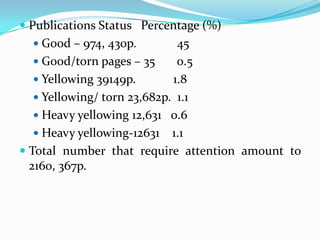
 Publications Status Percentage (%)
   Good – 974, 430p.         45
    Good/torn pages – 35     0.5
    Yellowing 39149p.       1.8
    Yellowing/ torn 23,682p. 1.1
    Heavy yellowing 12,631 0.6
    Heavy yellowing-12631 1.1
 Total number that require attention amount to
  2160, 367p.
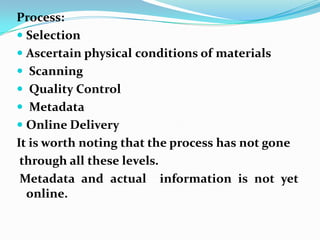
Process:
 Selection
 Ascertain physical conditions of materials
 Scanning
 Quality Control
 Metadata
 Online Delivery
It is worth noting that the process has not gone
 through all these levels.
 Metadata and actual information is not yet
  online.
Cooperative digitization venture
 KNA&DS partnered with other government
  organizations in digitization ventures:
   National Council for Law Reporting (KLR)
   National Assembly
   The     Kenya    National   Dialogue       and
   Reconciliation Archives (KNDRA).
Challenges of digitization at KNA&DS
   Low internet connectivity
   Low levels of ICT literacy/e-resource use among users
   Information security
   Copyright management
   Preservation
   Metadata

Way forward:
Exporting the digital contents online for access. The KNADS is
in the process of building its capacity. This will make it realize
the objectives for which the project was initiated and ensure
sustainability. Once access to digitized information is
achieved, then we will be there
Bibliography
 Chepsuik (1997). The future is here: America's libraries go digital.
    American Libraries. USA.
    Greenstein, D. (2002). The Digital Library: A Biography. Digital
    Library Federation (2002)
   Gary Cleveland (1998): Digital Libraries, Definitions, Issues and
    Challenges. Occasional paper NO 8. IFLA
   Graham, P.S. (1995a). Requirements for the digital research library.
    URL: http://aultnis.rutgers.edu/texts/DRC.html
   Kenya National Archives (2008, 2009, 2010): Departmental
    quarterly Reports (1st, 2nd, 3rd and 4th quarters)
   Kenya National Archives (2008, 2009, 2010): Departmental annual
    reports. Nairobi.
   Kenya Law Reporting, (2008) Document imaging partnership
    proposal. Nairobi.
   Kumar (2004) Information Security and Disaster Recovery. India.
   Tennant, R (2004): Managing the Digital Library. OCLC. USA.
Thank you.
Welcome to Nairobi for SCECSAL
           2012.

Namande

  • 1.
    Mr. Ben WekalaoNamande Principal Librarian, Kenya National Archives and Documentation Service. Ag. Deputy Director Department of Government Library Services Lecturer at Government Training Institutes & Kenyatta University. Holds BA (Languages and Linguistics), Kiswahili (Egerton University) Master of Education (Library and Information Science) (Kenyatta University) Currently a PhD candidate, Kenyatta University,
  • 2.
    Abstract Background • The KenyaNational Archives was established in 1965 by an Act of Parliament to provide custody to public and private records of enduring value among other functions. • Some information resources at the Kenya National Archives were created as early as the 17th century. • Some of which have deteriorated due to environmental, biological, human among other hazards. • This undermines the need for long-term availability of such resources.
  • 3.
    • This paperis a sojourn in the digitization endeavors at the Kenya National Archives. Showing; • What has been done, in the four- phased attempt to digitize over 680 million pages of records • Challenges experienced particularly inadequate human capital and financial resource among others.
  • 4.
    Digital Information Centres: An overview • A digital information centre is an information facility in which collections are managed and accessed electronically. • The digital content may be stored and accessed locally or remotely via computer networks • Digital resources have drastically changed the mode of information management and access.
  • 5.
    Requirements for adigital information service • Technical infrastructure High-speed local networks and fast connections to the internet Relational databases that support a variety of digital formats Electronic document management functions that will aid in the overall management of digital resources. Hardware: desk tops, hard discs, UPS, printers, scanners etc A variety of servers, such as Web and FTP servers
  • 6.
    • Trained staff Tennant (2006) asserts, “…….We need people who are not afraid of jettisoning traditional activities in favor of new ones. We must have people who can learn constantly, foster change, and create new kinds of collections and services……we must train, support and encourage them.”
  • 7.
    • Digital Software Acquire software that can meet requirements, If not,  customize the software to meet your needs,  find a different piece of software
  • 8.
    Building a digitalcollection  This entails  Digitization i.e. converting paper and other media in existing collections to digital form.  Acquisition of born digital i.e. original digital works created by publishers and scholars such as electronic books, journals, and data sets.  Access to external materials through the internet (libraries without walls).
  • 9.
    Why digital Information centres?  Multiple access to information  Resource sharing  Access  Storage/ space  Enhanced Information retrieval among other benefits Note: KNA&ADS cannot be measured against these advantages.
  • 10.
    Digitizing Records atKNA&DS  Goal: To digitally preserve content and context of archival records and other endangered publications for purposes of preservation, access and dissemination.  Objectives:  Develop institutional digital information infrastructure to ensure preservation and longevity of archival information resources
  • 11.
    …….objectives  Developonline Record Search databases where researchers are able to submit requests for records.  Offer multiple, faster and cheaper access to resources, reference processes, and resource sharing.
  • 12.
    Justification for theproject:  The core function of any archival institution is to ensure long-term preservation of valuable records for posterity and avail them for use.  However, the KNA&DS has been limited and users have had to:  Visit the Searchroom at the Kenya National Archives  Hire Research Assistants to do research on their behalf  Request and pay for reprographic services and postage
  • 13.
     Wait patientlyuntil information is retrieved and delivered  The aim of this digitization project is therefore to primarily offer users faster and cheaper access.
  • 14.
    Methodology  Pre-digitization, digitization,metadata capture, post-digitization and finally M & E. At KNA&DS, the following issues were considered:  Adequate Staff  Acquisition of equipment for digitization;  Computer hardware and software  Storage facilities  Scanners (50)  Selection of information materials  Baseline Survey (Pre-digitization stage) The following is the summary of the state of records:  Fragile pages 30%  Normal 70%  A4 pages 90%
  • 15.
     NonA4 10%  Legibility Good  Yellowing 97%  According to KNA&DS Digitization proposal 2005, the following was the status of Africana publications  Total number of publications- 6,884  Total number of pages- 2,180,367  Average number of pages per publication – 314  Mean year of publication – 1945  Oldest publication – 1673
  • 16.
     Publications StatusPercentage (%)  Good – 974, 430p. 45  Good/torn pages – 35 0.5  Yellowing 39149p. 1.8  Yellowing/ torn 23,682p. 1.1  Heavy yellowing 12,631 0.6  Heavy yellowing-12631 1.1  Total number that require attention amount to 2160, 367p.
  • 17.
    Process:  Selection  Ascertainphysical conditions of materials  Scanning  Quality Control  Metadata  Online Delivery It is worth noting that the process has not gone through all these levels. Metadata and actual information is not yet online.
  • 18.
    Cooperative digitization venture KNA&DS partnered with other government organizations in digitization ventures:  National Council for Law Reporting (KLR)  National Assembly  The Kenya National Dialogue and Reconciliation Archives (KNDRA).
  • 19.
    Challenges of digitizationat KNA&DS  Low internet connectivity  Low levels of ICT literacy/e-resource use among users  Information security  Copyright management  Preservation  Metadata Way forward: Exporting the digital contents online for access. The KNADS is in the process of building its capacity. This will make it realize the objectives for which the project was initiated and ensure sustainability. Once access to digitized information is achieved, then we will be there
  • 20.
    Bibliography  Chepsuik (1997).The future is here: America's libraries go digital. American Libraries. USA.  Greenstein, D. (2002). The Digital Library: A Biography. Digital Library Federation (2002)  Gary Cleveland (1998): Digital Libraries, Definitions, Issues and Challenges. Occasional paper NO 8. IFLA  Graham, P.S. (1995a). Requirements for the digital research library. URL: http://aultnis.rutgers.edu/texts/DRC.html  Kenya National Archives (2008, 2009, 2010): Departmental quarterly Reports (1st, 2nd, 3rd and 4th quarters)  Kenya National Archives (2008, 2009, 2010): Departmental annual reports. Nairobi.  Kenya Law Reporting, (2008) Document imaging partnership proposal. Nairobi.  Kumar (2004) Information Security and Disaster Recovery. India.  Tennant, R (2004): Managing the Digital Library. OCLC. USA.
  • 21.
    Thank you. Welcome toNairobi for SCECSAL 2012.