More than hype – understanding
heritage in 3D
Nick Poole, CEO, Collections Trust
February 2015
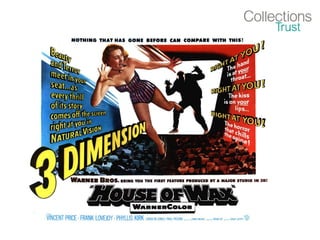
We’ve been here before…
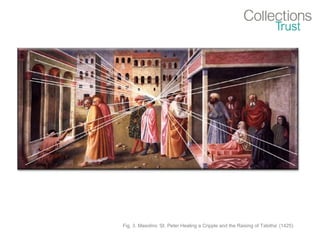
Fig. 3. Masolino ‘St. Peter Healing a Cripple and the Raising of Tabitha’ (1425)
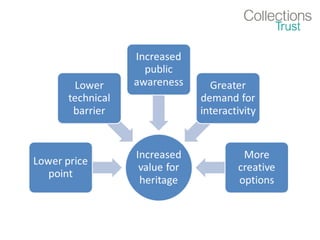
So why now…?
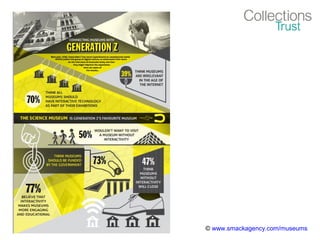
© www.smackagency.com/museums
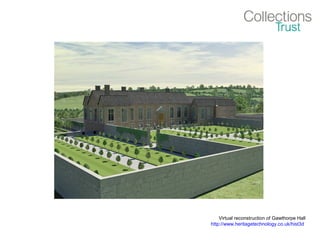
Virtual reconstruction of Gawthorpe Hall
http://www.heritagetechnology.co.uk/hist3d
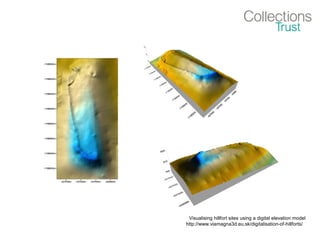
Visualising hillfort sites using a digital elevation model
http://www.viamagna3d.eu.sk/digitalisation-of-hillforts/
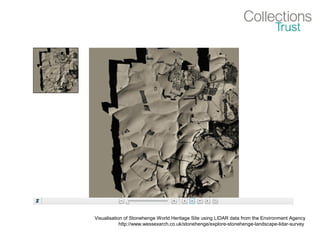
Visualisation of Stonehenge World Heritage Site using LIDAR data from the Environment Agency
http://www.wessexarch.co.uk/stonehenge/explore-stonehenge-landscape-lidar-survey
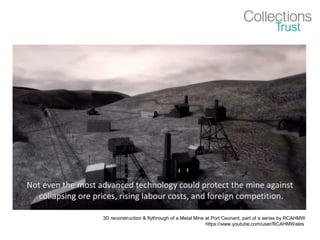
3D reconstruction & flythrough of a Metal Mine at Port Ceunant, part of a series by RCAHMW
https://www.youtube.com/user/RCAHMWales
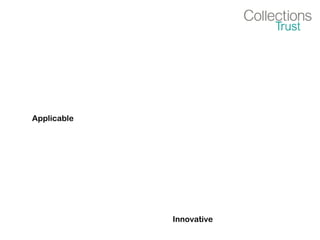
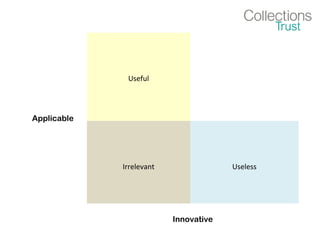
Applicable
Innovative
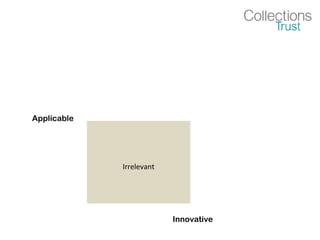
Applicable
Irrelevant
Innovative
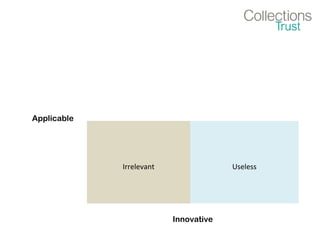
Applicable
Irrelevant Useless
Innovative
Applicable
Useful
Irrelevant Useless
Innovative
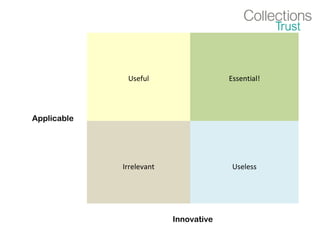
Applicable
Useful Essential!
Irrelevant Useless
Innovative
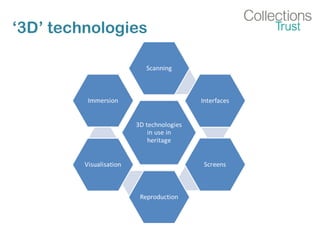
‘3D’ technologies
Tactile applications
• The combination of 3D printing, tactile objects and technology is opening up
new approaches to audience engagement, bridging the physical and virtual.
Haptics at Manchester Museum
• 3D scans of collections items
• Combined with AV and interpretive material
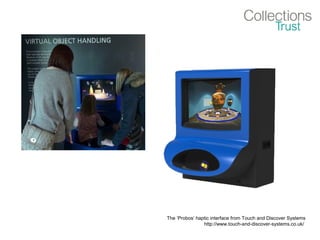
• Explored in-gallery using the ‘Probos’ haptic interface
• Supporting the needs of blind and visually-impaired users
The ‘Probos’ haptic interface from Touch and Discover Systems
http://www.touch-and-discover-systems.co.uk/
Exploring the Ara Pacis
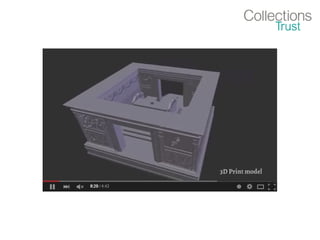
• 3D rendered model of the Ara Pacis in Rome
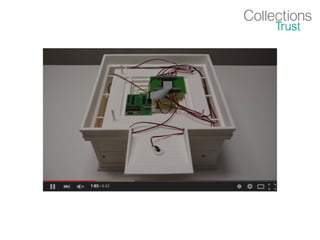
• 3D printed reconstruction of the building
• Using embedded circuitry to make the model interactive
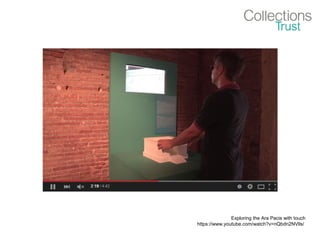
• The gestures of the user on the model enable onscreen exploration
• A more natural interface
Exploring the Ara Pacis with touch
https://www.youtube.com/watch?v=nQbdn2NVlls/
Immersive experiences
• Gesture-based and motion-controlled interfaces enable audiences to
interact with virtual environments in a more natural way, creating richer,
more immersive experiences.
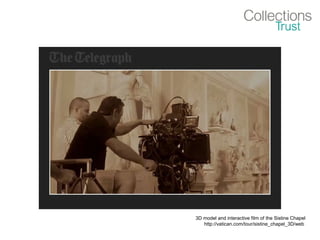
3D model and interactive film of the Sistine Chapel
http://vatican.com/tour/sistine_chapel_3D/web
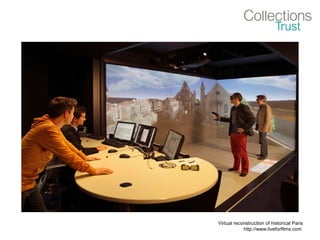
Virtual reconstruction of historical Paris
http://www.liveforfilms.com
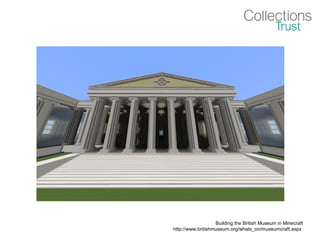
Building the British Museum in Minecraft
http://www.britishmuseum.org/whats_on/museumcraft.aspx
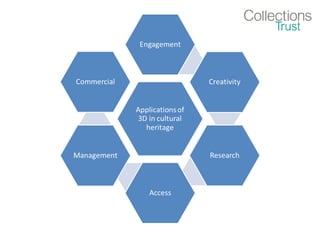
Creative applications
• The increasing simplicity and natural interactivity of 3D interfaces
provides new tools for creativity and discovery.
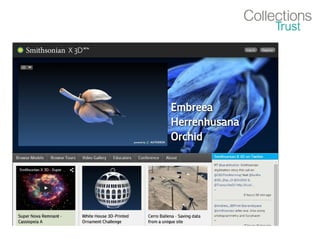
Research & understanding
• Very high-resolution 3D models and scans provide a rich resource to
support scientific research and improved understanding of heritage
landscapes, sites and collections.
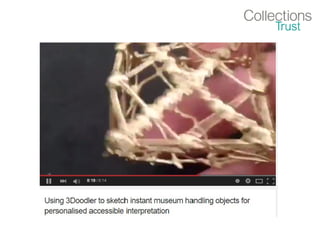
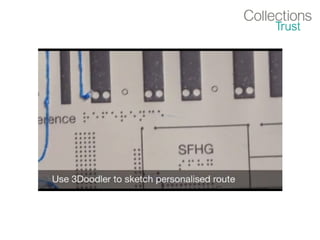
Access
• The tactile and reproducible nature of 3D printed objects makes them
useful to extend accessibility for people with different needs and abilities.
Heritage Management
• 3D scanning and reproduction open up new approaches and
methodologies for conservation and collections management.
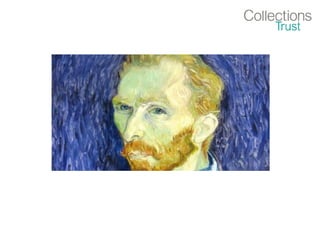
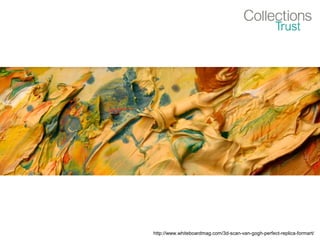
High resolution scanning for conservation
• Well-established practice of very high-resolution white light scanning
• Helps to understand technique and materials
• Informs decisions about conservation treatments
• Helps with security, provenance etc
http://www.whiteboardmag.com/3d-scan-van-gogh-perfect-replica-formart/
3D location control
• Use of Collections Management Systems for location & movement
• Dynamically populates 3D model of galleries
• Provides up-to-date information for the public
• Avoids duplication of effort
• Eg. Zetcom’s ‘eMuseumPlus’ virtual tours module
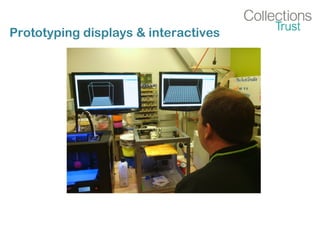
Prototyping displays & interactives
Commercial opportunities
• 3D scanning and reproduction open up new commercial opportunities for
heritage attractions, venues and sites.
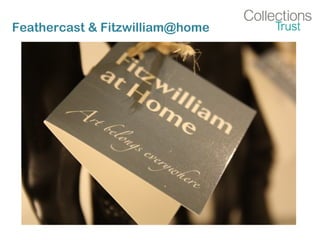
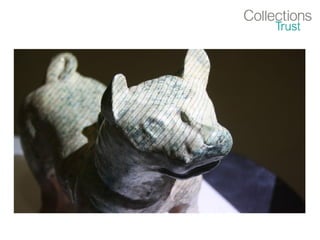
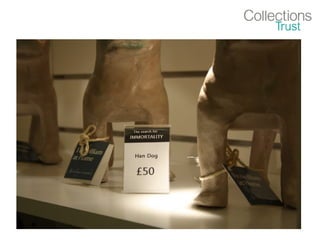
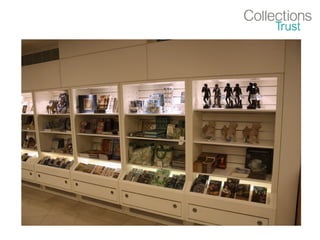
Feathercast & Fitzwilliam@home
• Developing high-quality reproductions of key collections items
• Aligning retail offer to public/exhibition programming
• Rich 3D scans by Inition support a variety of activities
• Retail at £50 per item
• Estimated to breakeven (all costs) within 18 months
Feathercast & Fitzwilliam@home
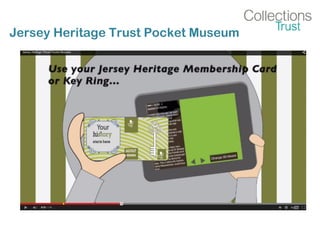
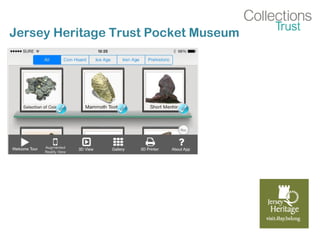
Jersey Heritage Trust Pocket Museum
• Augmented Reality app featuring 3D models of items from the collections
• AR functionality triggered by the Jersey Heritage Trust Membership Card
• Providing added value for membership through 3D interactivity
• Extending the visitor experience
• Grown from 1000 to 10,000 members
Jersey Heritage Trust Pocket Museum
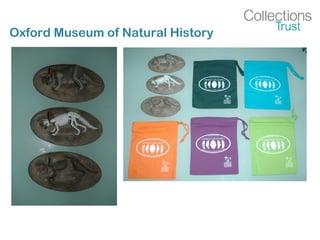
Oxford Museum of Natural History
• Collaboration with commercial partner (Crawley Creatures)
• Developed a 3D-printed dinosaur puzzle
• Available for retail
• Used in educational tours and interactives
• Rapid prototyping
Oxford Museum of Natural History
Challenges
• Integrating 3D technologies and approaches into your existing strategy
• Choosing the right formats, platforms and interfaces for the job
• Digital preservation (and ensuring that content is updated and added to)
• Digital rights in 3D materials
• Documenting and managing 3D assets as part of the collection
• Avoiding ‘because it’s there’…
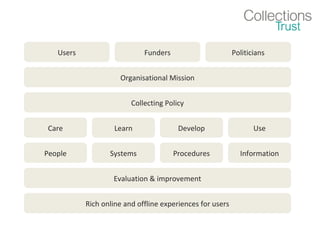
Users Funders Politicians
Organisational Mission
Collecting Policy
UseDevelopLearnCare
InformationProceduresSystemsPeople
Evaluation & improvement
Rich online and offline experiences for users
Conclusions
• We’re beyond ‘hype’ and into the everyday application of different 3D
technologies and methods, depending on our aims
• As with any technology, the focus should always be the message and the
audience, not the medium
• The financial and technical barriers to entry are coming down all the time
• 3D technologies provide an opportunity to enrich both our management of
heritage collections & landscapes and the visitor experience
Keep in touch
• Collections Management LinkedIn community (8,200 members)
• Fortnightly email newsletter (sign up at www.collectionstrust.org.uk)
• www.twitter.com/collectiontrust
• www.facebook.com/collectionstrust
• www.slideshare.net/collectionstrust
• www.collectionstrust.org.uk/consultancy

Understanding Heritage in 3D

  • 1.
    More than hype– understanding heritage in 3D Nick Poole, CEO, Collections Trust February 2015
  • 3.
  • 5.
    Fig. 3. Masolino‘St. Peter Healing a Cripple and the Raising of Tabitha’ (1425)
  • 6.
  • 8.
  • 9.
    Virtual reconstruction ofGawthorpe Hall http://www.heritagetechnology.co.uk/hist3d
  • 10.
    Visualising hillfort sitesusing a digital elevation model http://www.viamagna3d.eu.sk/digitalisation-of-hillforts/
  • 11.
    Visualisation of StonehengeWorld Heritage Site using LIDAR data from the Environment Agency http://www.wessexarch.co.uk/stonehenge/explore-stonehenge-landscape-lidar-survey
  • 12.
    3D reconstruction &flythrough of a Metal Mine at Port Ceunant, part of a series by RCAHMW https://www.youtube.com/user/RCAHMWales
  • 13.
  • 14.
  • 15.
  • 16.
  • 17.
  • 18.
  • 20.
    Tactile applications • Thecombination of 3D printing, tactile objects and technology is opening up new approaches to audience engagement, bridging the physical and virtual.
  • 21.
    Haptics at ManchesterMuseum • 3D scans of collections items • Combined with AV and interpretive material • Explored in-gallery using the ‘Probos’ haptic interface • Supporting the needs of blind and visually-impaired users
  • 22.
    The ‘Probos’ hapticinterface from Touch and Discover Systems http://www.touch-and-discover-systems.co.uk/
  • 23.
    Exploring the AraPacis • 3D rendered model of the Ara Pacis in Rome • 3D printed reconstruction of the building • Using embedded circuitry to make the model interactive • The gestures of the user on the model enable onscreen exploration • A more natural interface
  • 26.
    Exploring the AraPacis with touch https://www.youtube.com/watch?v=nQbdn2NVlls/
  • 27.
    Immersive experiences • Gesture-basedand motion-controlled interfaces enable audiences to interact with virtual environments in a more natural way, creating richer, more immersive experiences.
  • 28.
    3D model andinteractive film of the Sistine Chapel http://vatican.com/tour/sistine_chapel_3D/web
  • 29.
    Virtual reconstruction ofhistorical Paris http://www.liveforfilms.com
  • 30.
    Building the BritishMuseum in Minecraft http://www.britishmuseum.org/whats_on/museumcraft.aspx
  • 31.
    Creative applications • Theincreasing simplicity and natural interactivity of 3D interfaces provides new tools for creativity and discovery.
  • 34.
    Research & understanding •Very high-resolution 3D models and scans provide a rich resource to support scientific research and improved understanding of heritage landscapes, sites and collections.
  • 37.
    Access • The tactileand reproducible nature of 3D printed objects makes them useful to extend accessibility for people with different needs and abilities.
  • 40.
    Heritage Management • 3Dscanning and reproduction open up new approaches and methodologies for conservation and collections management.
  • 41.
    High resolution scanningfor conservation • Well-established practice of very high-resolution white light scanning • Helps to understand technique and materials • Informs decisions about conservation treatments • Helps with security, provenance etc
  • 43.
  • 44.
    3D location control •Use of Collections Management Systems for location & movement • Dynamically populates 3D model of galleries • Provides up-to-date information for the public • Avoids duplication of effort • Eg. Zetcom’s ‘eMuseumPlus’ virtual tours module
  • 45.
  • 46.
    Commercial opportunities • 3Dscanning and reproduction open up new commercial opportunities for heritage attractions, venues and sites.
  • 47.
    Feathercast & Fitzwilliam@home •Developing high-quality reproductions of key collections items • Aligning retail offer to public/exhibition programming • Rich 3D scans by Inition support a variety of activities • Retail at £50 per item • Estimated to breakeven (all costs) within 18 months
  • 48.
  • 52.
    Jersey Heritage TrustPocket Museum • Augmented Reality app featuring 3D models of items from the collections • AR functionality triggered by the Jersey Heritage Trust Membership Card • Providing added value for membership through 3D interactivity • Extending the visitor experience • Grown from 1000 to 10,000 members
  • 53.
    Jersey Heritage TrustPocket Museum
  • 54.
    Jersey Heritage TrustPocket Museum
  • 55.
    Oxford Museum ofNatural History • Collaboration with commercial partner (Crawley Creatures) • Developed a 3D-printed dinosaur puzzle • Available for retail • Used in educational tours and interactives • Rapid prototyping
  • 56.
    Oxford Museum ofNatural History
  • 57.
    Challenges • Integrating 3Dtechnologies and approaches into your existing strategy • Choosing the right formats, platforms and interfaces for the job • Digital preservation (and ensuring that content is updated and added to) • Digital rights in 3D materials • Documenting and managing 3D assets as part of the collection • Avoiding ‘because it’s there’…
  • 58.
    Users Funders Politicians OrganisationalMission Collecting Policy UseDevelopLearnCare InformationProceduresSystemsPeople Evaluation & improvement Rich online and offline experiences for users
  • 59.
    Conclusions • We’re beyond‘hype’ and into the everyday application of different 3D technologies and methods, depending on our aims • As with any technology, the focus should always be the message and the audience, not the medium • The financial and technical barriers to entry are coming down all the time • 3D technologies provide an opportunity to enrich both our management of heritage collections & landscapes and the visitor experience
  • 60.
    Keep in touch •Collections Management LinkedIn community (8,200 members) • Fortnightly email newsletter (sign up at www.collectionstrust.org.uk) • www.twitter.com/collectiontrust • www.facebook.com/collectionstrust • www.slideshare.net/collectionstrust • www.collectionstrust.org.uk/consultancy