 At present, organizations are focusing increasingly on
people-centric approaches that can help increase
employee performance and decrease attrition rates. The
department which manages and maintains this approach
within the organization is Human Resource Management
or HRM.
 This department plays an important role as the liaison between the
organization and the employees. They also promote growth for both
and help them reach their objectives.
 The importance of this job role has also increased the demand for
skilled employees in this field.
 It won’t be wrong to point out that in the modern world,
it is one of the most promising careers that one can
choose. Are you wondering about the functions of HRM?
We will take you through them in detail in this article.
Also, a certification course can help an HRM aspirant
know how to motivate employees.
What is HRM?
 Management of human resources is an essential part of
an organization. The HR managers are involved in a series
of tasks through which they assist other departments of
the organization on personnel matters. For example, HRM
involves recruitment, hiring, and managing employees. It
is also the job of the HR department to form all the
policies related to the work, besides determining the
salary or other benefits of employees. That, however, is
not all. Here is a quick look at some of the tasks handled
by the HR department of an established organization.
Human Resource Management
 The process of planning, organizing, directing
(motivating), and controlling the procurement,
development, compensation, integration, maintenance,
and separation of organizational human resources to the
end that organizational, individual, and societal needs are
satisfied.
Human Resource Management
Human Resource Management includes all activities used to attract & retain
employees and to ensure they perform at a high level in meeting
organizational goals.
These activities are made up of
1. Recruitment & selection.
2. Training and development.
3. Performance appraisal and feedback.
4. Pay and benefits.
5. Labor relations.
Job analysis
Human resource
planning
Conducting job
interviews
Training of recruits and
induction
Payroll management
Appraisals
• DISPUTE RESOLUTION
• EMPLOYEE
COUNSELING
• CAREER PLANNING
• EMPLOYEE BENEFIT
MANAGEMENT
• MAINTAINING
WORKPLACE SAFETY
Job design and job analysis
 One of human resource management's main functions is
to deal with job analysis and design aspects. Wondering
what they are all about? Let us take you through a quick
session to clarify the functions and how an HR manager
can fulfill them.
 Job design is a process that involves several aspects.
Some of them are describing duties to employees, taking
them through the responsibilities, and of course,
educating them about the operations of the job. It is thus
essential to select such employees who are suitable for
the required job. This process starts with creating a
checklist while searching for candidates.
Job design and job analysis
 Then, the potential employees should fulfill the
requirements. One of the ways to create the checklist is by
observing the duties and responsibilities fulfilled by the
organization's top-performing employees.

 The next part is job analysis which involves identifying the
day-to-day functions required for smooth functioning.
 This is done to determine a future course of action for the
organization's recruitment process. This process is essential
to ensure that the organization goes through proper growth.
Human Resource Planning
 HR Planning includes all activities managers do to forecast current and future
HR needs.
 Must be done prior to recruitment and selection
 Demand forecasts made by managers estimate the number & qualifications the firm
will need.
 Supply forecasts estimate the availability and qualifications of current workers
and those in the labor market.
HRM Components
 Component should be consistent with the others, organization
structure, and strategy.
 Recruitment: develop a pool of qualified applicants.
 Selection: determine relative qualifications & potential for a job.
 Training & Development: ongoing process to develop worker’s
abilities and skills.
 Performance appraisal & feedback: provides information about
how to train, motivate, and reward workers.
 Managers can evaluate and then give feedback to enhance
worker performance.
HRM Components
 Pay and Benefits: high performing employees should be rewarded with
raises, bonuses.
 Increased pay provides additional incentive.
 Benefits, such as health insurance, reward membership in firm.
 Labor relations: managers need an effective relationship with labor
unions that represent workers.
 Unions help establish pay, and working conditions.
If management moves to a decentralized structure, HRM should be adjusted as
well.
Recruitment
 External recruiting: managers look outside the firm for people
 who have not worked at the firm before.
 Managers advertise in newspapers, hold open houses, recruit at universities,
and on the Internet.
 External recruitment is difficult since many new jobs have specific skill
needs.
 A multi-prong approach to external recruiting works best.
 Internal Recruiting: positions filled within the firm.
 Internal recruiting has several benefits:
 Workers know the firm’s culture, may not have new ideas.
 Managers likely already know the candidates.
 Internal advancement can motivate employees.
Planning
 Proper planning of the available human resources is an essential part of
the HRM job profile.
 Each organization has certain available human resources.
 It is the job of the HR managers to train and distribute the resources in a
way that helps the organization reach its potential in the best way. This
step of planning involves creating an effective process that is purposeful.
 Through this process, the HRM department also aims at creating a
balanced environment within the organization.
Planning
 This is one of the basic functions of HRM that requires knowledge about the
number of employees required in the organization and also the type. Furthermore,
an HR manager needs to determine the goals and tasks the employees must fulfill
while working for the organization. This way, they can also design an effective hiring
process.
 Finally, the HRM also has to understand the requirements of individual departments
regarding the candidates they are looking for. It is necessary as the needs of
different departments could be drastically different from one another.
 The HRM department makes sure that the company is not understaffed or
overstaffed. Hence, they carefully consider the demand of each department.
HRM Planning: Outsourcing
 Outsourcing: managers can decide to contract with outside
workers rather than hiring them.
 Outsourcing is more flexible for the firm.
 Outsourcing often provides human capital at a lower cost.
 Outsource problems: managers lose control over output.
 Outsource contractors are not committed to the firm.
 Unions typically are against outsourcing that has potential to
eliminate member’s jobs.
Employee hiring and selection
 It is already established that finding a suitable human resource for the
organization is one of the primary functions of the HR department.
 In other words, hiring or recruitment is a primary function that an HR
manager has to fulfill.
 It is their responsibility to spot an efficient and qualified candidate
who can help in achieving the objectives and goals of the organization
as an employee. So, naturally, that all begins with hiring candidates
from a list of suitable applicants.

Employee hiring and selection
 The HR manager identifies suitable candidates for the organization and begins
the selection process. First, the favorable candidates go through a
comprehensive screening process which the HRM handles.
 This is done to ensure the potential candidate is a good fit for the company.
Besides screening, the candidates also go through different rounds of interviews
that test their skills and knowledge about the required position.

 Once a candidate is selected, the HRM department also handles the aspect of the
job offer. They also take the newly recruited employee through the different
goals and objectives they must fulfill while working with the organization.
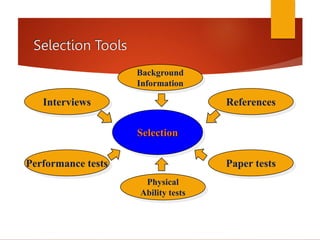
Selection Tools
Background
Information
Interviews References
Paper tests
Physical
Ability tests
Performance tests
Selection
Selection Process
After a pool of applicants are identified, qualifications related to the job
requirements are determined:
 Background Information: includes education, prior employment,
college major, etc.
 Interview: almost all firms use one of two types:
 Structured interview: managers ask each person the same job-
related questions.
 Unstructured interview: held like a normal conversation.
 Usually structured interviews preferred; bias is possible.
 Physical Ability Test: measure strength & endurance.
 Good for physically demanding jobs.
Selection Process
 Paper & Pencil Tests: Either an ability and personality test.
 Ability test: assess if applicant has right skills for the job.
 Personality test: seek traits relevant to job performance.
 Be sure test is a good predictor of job performance.
 Performance Tests: measure job performance.
 Typing speed test is one example.
 Assessment Center: candidates assessed on job-related activities over a
period of a few days.
 References: outside people provide candid information about candidate.
 Can be hard to get accurate information.
Reliability & Validity
Selection tools must be reliable and valid.
 Reliability: the degree to which the tool measures the same thing each
time it is used.
 Scores should be close for the same person taking the same test over
time.
 Validity: Does the test measure what it is supposed to measure?
 Example: does a physical ability test really predict the job
performance of a firefighter?
 Managers have an ethical and legal duty to develop good selection
tools.
Terms
 Labor Union-an organization with legal authority to
negotiate with the employer on behalf of employees
 Bonafide Occupational Qualification (BOQ)-individual
characteristics necessary for performance of job
requirements
 Employees Vs Independent Contractors
 Union Shop - must be in the union
Employee training and
development
 Does the job of the HRM department end with the selection and hiring of
the right candidate? No. On the contrary, it is just the beginning.
 Once a person is selected, the HR department will take them through the
necessary training procedures.
 These procedures are designed in a way that not only helps the
candidates settle in the organization and learn more about the
opportunities that can help them understand the growth opportunities.
 This step is essential because it is a way that helps a newly joined
employee to be a part of the organization.
 An employee needs to have company-specific knowledge that can help them
perform their tasks efficiently. Alongside this, it is also a way to increase the
overall efficiency and productivity of the employee and the overall workforce.
 Furthermore, having a knowledgeable and capable workforce only helps the
organization's overall development.
 Once an employee knows how an organization operates, they will be much
more prepared to carry out their regular work in a way that ultimately proves
fruitful for the organizational goals and their personal career growth.
 In other words, without training by the HRM department, an employee will
lack the tools to function properly within the organization.
Training & Development
 Training: teach organizational members how to perform current
jobs.
 Help worker’s acquire skills to perform effectively.
 Development: build worker’s skills to enable them to take on new
duties.
 Training used more often at lower levels of firm, development is
common with managers.
 A Needs Assessment should be taken first to determine who needs
which program and what topics should be stressed.
Types of Development
 Varied Work Experiences: Top managers must build expertise in
many areas.
 Workers identified as possible top managers given many
different tasks.
 Formal Education: tuition reimbursement is common for
managers taking classes for MBA or similar.
 Long-distance learning can also be used to reduce travel.
Whatever training and development efforts used, results must be
transferred to the workplace.
Job Analysis
 Job Analysis-the act of examining positions within an
organization
 Job Description-narrative explaining the scope of a
position
 Job Characteristics-tasks involved in a position
 Job Requirements-personal characteristics necessary to
fill a position
Performance Appraisal
 Process of evaluating employee performance
 job related strengths
 development needs
 progress toward goals
 determine ways to improve performance
 Pay an promotion decisions
 More systematic is better, for the most part
Performance Appraisal (cont)
 Self Appraisal
 Peer Appraisal
 360 Degree appraisal
 Central Tendency Error-everyone ranked as average
 Leniency-individuals are ranked higher than they deserve
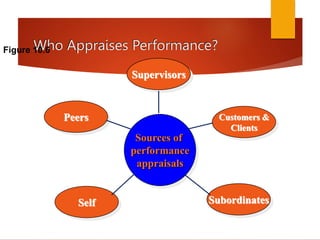
Who Appraises Performance?
Supervisors
Peers Customers &
Clients
Subordinates
Self
Sources of
performance
appraisals
Figure 10.6
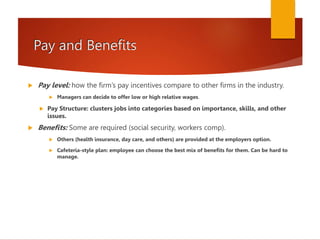
Pay and Benefits
 Pay level: how the firm’s pay incentives compare to other firms in the industry.
 Managers can decide to offer low or high relative wages.
 Pay Structure: clusters jobs into categories based on importance, skills, and other
issues.
 Benefits: Some are required (social security, workers comp).
 Others (health insurance, day care, and others) are provided at the employers option.
 Cafeteria-style plan: employee can choose the best mix of benefits for them. Can be hard to
manage.
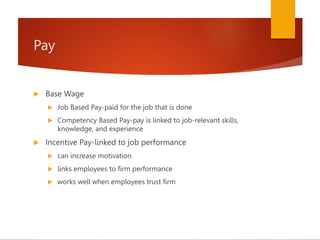
Pay
 Base Wage
 Job Based Pay-paid for the job that is done
 Competency Based Pay-pay is linked to job-relevant skills,
knowledge, and experience
 Incentive Pay-linked to job performance
 can increase motivation
 links employees to firm performance
 works well when employees trust firm
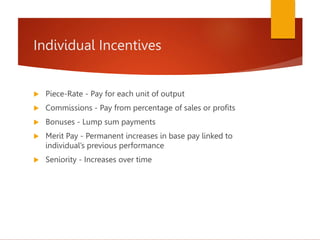
Individual Incentives
 Piece-Rate - Pay for each unit of output
 Commissions - Pay from percentage of sales or profits
 Bonuses - Lump sum payments
 Merit Pay - Permanent increases in base pay linked to
individual’s previous performance
 Seniority - Increases over time
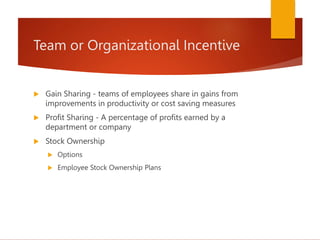
Team or Organizational Incentive
 Gain Sharing - teams of employees share in gains from
improvements in productivity or cost saving measures
 Profit Sharing - A percentage of profits earned by a
department or company
 Stock Ownership
 Options
 Employee Stock Ownership Plans
Managerial relations
 It is usually divided into two parts about relationships in employment.
 If we u pick up any credible book on HRM, be it functions of human
resource management, we will see that they are labor relations and
managerial relations. Labor relations a way that defines the relationship of
a company with its workforce.
 On the other hand, managerial relations deal with the connections within
the various processes that exist within an organization. The HRM
department handles all the aspects related to the processes.
Labor relations
 Why is it essential to maintain a harmonious relationship between the
employees and the organization?
 First, it is important to ensure that the employees collectively work toward
the company's overall goal. Hence, it is the job of HR to spot the
communication gaps between two employees or an employee and the
organization.
 It is risky to keep those events unattended as that may lead to conflict and
chaos within the organization. Also, the HRM needs to create policies that
are fair and transparent.
Employee engagement and
communication
 Encouraging the employees to engage and communicate is an essential part
of any organization. Increased communication and engagement are the ways
to ensure employee satisfaction.
 It is the responsibility of the HRM department to create an environment that
helps the employees get motivated and more committed to working towards
a common goal besides personal career development.
 This is done through regular communication and events that can help the
employees to engage. This process is also required for the overall
development of the organization.
Health and safety regulations
 An employee working at an organization doesn’t just require proper
remuneration.
 They also need an environment that takes care of the different health and
safety regulations that are prescribed by the authorities. It is the
responsibility of the human resources personnel to ensure that the rules
and regulations are mandatorily followed.
 This also includes conducting regular sessions to inform the employees
about their part in ensuring safety and health regulations within the
organization.
 This is a way to create a workspace where employees feel safe to work.
Employees' support
 Everyone talks about keeping their personal and professional lives
separate. However, if an employee faces an issue in their personal life, it
will interfere with their workflow too.
 Hence, there is a need for a space where the employees can discuss how
to approach their work while dealing with personal issues.
 The HRM department is responsible for providing that space to help the
employees in need. This has become increasingly important following the
pandemic.
 The department can also help the employees know more about the
insurance policies in place or leaves they can take in their time of need.
Conclusion
 Human resource is a field that is power-packed and dynamic.
 Major functions of HRM are in place to ensure employee satisfaction and
organizational growth.
 An HR professional has several duties and responsibilities while liaising
between the employees and the government.
 It won't be wrong to say that this life-changing role will take your career to
new heights.

chapter 1 Introduction to HRM-1 lecture.ppt

  • 1.
     At present,organizations are focusing increasingly on people-centric approaches that can help increase employee performance and decrease attrition rates. The department which manages and maintains this approach within the organization is Human Resource Management or HRM.
  • 2.
     This departmentplays an important role as the liaison between the organization and the employees. They also promote growth for both and help them reach their objectives.  The importance of this job role has also increased the demand for skilled employees in this field.
  • 3.
     It won’tbe wrong to point out that in the modern world, it is one of the most promising careers that one can choose. Are you wondering about the functions of HRM? We will take you through them in detail in this article. Also, a certification course can help an HRM aspirant know how to motivate employees.
  • 4.
    What is HRM? Management of human resources is an essential part of an organization. The HR managers are involved in a series of tasks through which they assist other departments of the organization on personnel matters. For example, HRM involves recruitment, hiring, and managing employees. It is also the job of the HR department to form all the policies related to the work, besides determining the salary or other benefits of employees. That, however, is not all. Here is a quick look at some of the tasks handled by the HR department of an established organization.
  • 5.
    Human Resource Management The process of planning, organizing, directing (motivating), and controlling the procurement, development, compensation, integration, maintenance, and separation of organizational human resources to the end that organizational, individual, and societal needs are satisfied.
  • 6.
    Human Resource Management HumanResource Management includes all activities used to attract & retain employees and to ensure they perform at a high level in meeting organizational goals. These activities are made up of 1. Recruitment & selection. 2. Training and development. 3. Performance appraisal and feedback. 4. Pay and benefits. 5. Labor relations.
  • 7.
    Job analysis Human resource planning Conductingjob interviews Training of recruits and induction Payroll management Appraisals • DISPUTE RESOLUTION • EMPLOYEE COUNSELING • CAREER PLANNING • EMPLOYEE BENEFIT MANAGEMENT • MAINTAINING WORKPLACE SAFETY
  • 8.
    Job design andjob analysis  One of human resource management's main functions is to deal with job analysis and design aspects. Wondering what they are all about? Let us take you through a quick session to clarify the functions and how an HR manager can fulfill them.  Job design is a process that involves several aspects. Some of them are describing duties to employees, taking them through the responsibilities, and of course, educating them about the operations of the job. It is thus essential to select such employees who are suitable for the required job. This process starts with creating a checklist while searching for candidates.
  • 9.
    Job design andjob analysis  Then, the potential employees should fulfill the requirements. One of the ways to create the checklist is by observing the duties and responsibilities fulfilled by the organization's top-performing employees.   The next part is job analysis which involves identifying the day-to-day functions required for smooth functioning.  This is done to determine a future course of action for the organization's recruitment process. This process is essential to ensure that the organization goes through proper growth.
  • 10.
    Human Resource Planning HR Planning includes all activities managers do to forecast current and future HR needs.  Must be done prior to recruitment and selection  Demand forecasts made by managers estimate the number & qualifications the firm will need.  Supply forecasts estimate the availability and qualifications of current workers and those in the labor market.
  • 11.
    HRM Components  Componentshould be consistent with the others, organization structure, and strategy.  Recruitment: develop a pool of qualified applicants.  Selection: determine relative qualifications & potential for a job.  Training & Development: ongoing process to develop worker’s abilities and skills.  Performance appraisal & feedback: provides information about how to train, motivate, and reward workers.  Managers can evaluate and then give feedback to enhance worker performance.
  • 12.
    HRM Components  Payand Benefits: high performing employees should be rewarded with raises, bonuses.  Increased pay provides additional incentive.  Benefits, such as health insurance, reward membership in firm.  Labor relations: managers need an effective relationship with labor unions that represent workers.  Unions help establish pay, and working conditions. If management moves to a decentralized structure, HRM should be adjusted as well.
  • 13.
    Recruitment  External recruiting:managers look outside the firm for people  who have not worked at the firm before.  Managers advertise in newspapers, hold open houses, recruit at universities, and on the Internet.  External recruitment is difficult since many new jobs have specific skill needs.  A multi-prong approach to external recruiting works best.  Internal Recruiting: positions filled within the firm.  Internal recruiting has several benefits:  Workers know the firm’s culture, may not have new ideas.  Managers likely already know the candidates.  Internal advancement can motivate employees.
  • 14.
    Planning  Proper planningof the available human resources is an essential part of the HRM job profile.  Each organization has certain available human resources.  It is the job of the HR managers to train and distribute the resources in a way that helps the organization reach its potential in the best way. This step of planning involves creating an effective process that is purposeful.  Through this process, the HRM department also aims at creating a balanced environment within the organization.
  • 15.
    Planning  This isone of the basic functions of HRM that requires knowledge about the number of employees required in the organization and also the type. Furthermore, an HR manager needs to determine the goals and tasks the employees must fulfill while working for the organization. This way, they can also design an effective hiring process.  Finally, the HRM also has to understand the requirements of individual departments regarding the candidates they are looking for. It is necessary as the needs of different departments could be drastically different from one another.  The HRM department makes sure that the company is not understaffed or overstaffed. Hence, they carefully consider the demand of each department.
  • 16.
    HRM Planning: Outsourcing Outsourcing: managers can decide to contract with outside workers rather than hiring them.  Outsourcing is more flexible for the firm.  Outsourcing often provides human capital at a lower cost.  Outsource problems: managers lose control over output.  Outsource contractors are not committed to the firm.  Unions typically are against outsourcing that has potential to eliminate member’s jobs.
  • 17.
    Employee hiring andselection  It is already established that finding a suitable human resource for the organization is one of the primary functions of the HR department.  In other words, hiring or recruitment is a primary function that an HR manager has to fulfill.  It is their responsibility to spot an efficient and qualified candidate who can help in achieving the objectives and goals of the organization as an employee. So, naturally, that all begins with hiring candidates from a list of suitable applicants. 
  • 18.
    Employee hiring andselection  The HR manager identifies suitable candidates for the organization and begins the selection process. First, the favorable candidates go through a comprehensive screening process which the HRM handles.  This is done to ensure the potential candidate is a good fit for the company. Besides screening, the candidates also go through different rounds of interviews that test their skills and knowledge about the required position.   Once a candidate is selected, the HRM department also handles the aspect of the job offer. They also take the newly recruited employee through the different goals and objectives they must fulfill while working with the organization.
  • 19.
    Selection Tools Background Information Interviews References Papertests Physical Ability tests Performance tests Selection
  • 20.
    Selection Process After apool of applicants are identified, qualifications related to the job requirements are determined:  Background Information: includes education, prior employment, college major, etc.  Interview: almost all firms use one of two types:  Structured interview: managers ask each person the same job- related questions.  Unstructured interview: held like a normal conversation.  Usually structured interviews preferred; bias is possible.  Physical Ability Test: measure strength & endurance.  Good for physically demanding jobs.
  • 21.
    Selection Process  Paper& Pencil Tests: Either an ability and personality test.  Ability test: assess if applicant has right skills for the job.  Personality test: seek traits relevant to job performance.  Be sure test is a good predictor of job performance.  Performance Tests: measure job performance.  Typing speed test is one example.  Assessment Center: candidates assessed on job-related activities over a period of a few days.  References: outside people provide candid information about candidate.  Can be hard to get accurate information.
  • 22.
    Reliability & Validity Selectiontools must be reliable and valid.  Reliability: the degree to which the tool measures the same thing each time it is used.  Scores should be close for the same person taking the same test over time.  Validity: Does the test measure what it is supposed to measure?  Example: does a physical ability test really predict the job performance of a firefighter?  Managers have an ethical and legal duty to develop good selection tools.
  • 23.
    Terms  Labor Union-anorganization with legal authority to negotiate with the employer on behalf of employees  Bonafide Occupational Qualification (BOQ)-individual characteristics necessary for performance of job requirements  Employees Vs Independent Contractors  Union Shop - must be in the union
  • 24.
    Employee training and development Does the job of the HRM department end with the selection and hiring of the right candidate? No. On the contrary, it is just the beginning.  Once a person is selected, the HR department will take them through the necessary training procedures.  These procedures are designed in a way that not only helps the candidates settle in the organization and learn more about the opportunities that can help them understand the growth opportunities.  This step is essential because it is a way that helps a newly joined employee to be a part of the organization.
  • 25.
     An employeeneeds to have company-specific knowledge that can help them perform their tasks efficiently. Alongside this, it is also a way to increase the overall efficiency and productivity of the employee and the overall workforce.  Furthermore, having a knowledgeable and capable workforce only helps the organization's overall development.  Once an employee knows how an organization operates, they will be much more prepared to carry out their regular work in a way that ultimately proves fruitful for the organizational goals and their personal career growth.  In other words, without training by the HRM department, an employee will lack the tools to function properly within the organization.
  • 26.
    Training & Development Training: teach organizational members how to perform current jobs.  Help worker’s acquire skills to perform effectively.  Development: build worker’s skills to enable them to take on new duties.  Training used more often at lower levels of firm, development is common with managers.  A Needs Assessment should be taken first to determine who needs which program and what topics should be stressed.
  • 27.
    Types of Development Varied Work Experiences: Top managers must build expertise in many areas.  Workers identified as possible top managers given many different tasks.  Formal Education: tuition reimbursement is common for managers taking classes for MBA or similar.  Long-distance learning can also be used to reduce travel. Whatever training and development efforts used, results must be transferred to the workplace.
  • 28.
    Job Analysis  JobAnalysis-the act of examining positions within an organization  Job Description-narrative explaining the scope of a position  Job Characteristics-tasks involved in a position  Job Requirements-personal characteristics necessary to fill a position
  • 29.
    Performance Appraisal  Processof evaluating employee performance  job related strengths  development needs  progress toward goals  determine ways to improve performance  Pay an promotion decisions  More systematic is better, for the most part
  • 30.
    Performance Appraisal (cont) Self Appraisal  Peer Appraisal  360 Degree appraisal  Central Tendency Error-everyone ranked as average  Leniency-individuals are ranked higher than they deserve
  • 31.
    Who Appraises Performance? Supervisors PeersCustomers & Clients Subordinates Self Sources of performance appraisals Figure 10.6
  • 32.
    Pay and Benefits Pay level: how the firm’s pay incentives compare to other firms in the industry.  Managers can decide to offer low or high relative wages.  Pay Structure: clusters jobs into categories based on importance, skills, and other issues.  Benefits: Some are required (social security, workers comp).  Others (health insurance, day care, and others) are provided at the employers option.  Cafeteria-style plan: employee can choose the best mix of benefits for them. Can be hard to manage.
  • 33.
    Pay  Base Wage Job Based Pay-paid for the job that is done  Competency Based Pay-pay is linked to job-relevant skills, knowledge, and experience  Incentive Pay-linked to job performance  can increase motivation  links employees to firm performance  works well when employees trust firm
  • 34.
    Individual Incentives  Piece-Rate- Pay for each unit of output  Commissions - Pay from percentage of sales or profits  Bonuses - Lump sum payments  Merit Pay - Permanent increases in base pay linked to individual’s previous performance  Seniority - Increases over time
  • 35.
    Team or OrganizationalIncentive  Gain Sharing - teams of employees share in gains from improvements in productivity or cost saving measures  Profit Sharing - A percentage of profits earned by a department or company  Stock Ownership  Options  Employee Stock Ownership Plans
  • 36.
    Managerial relations  Itis usually divided into two parts about relationships in employment.  If we u pick up any credible book on HRM, be it functions of human resource management, we will see that they are labor relations and managerial relations. Labor relations a way that defines the relationship of a company with its workforce.  On the other hand, managerial relations deal with the connections within the various processes that exist within an organization. The HRM department handles all the aspects related to the processes.
  • 37.
    Labor relations  Whyis it essential to maintain a harmonious relationship between the employees and the organization?  First, it is important to ensure that the employees collectively work toward the company's overall goal. Hence, it is the job of HR to spot the communication gaps between two employees or an employee and the organization.  It is risky to keep those events unattended as that may lead to conflict and chaos within the organization. Also, the HRM needs to create policies that are fair and transparent.
  • 38.
    Employee engagement and communication Encouraging the employees to engage and communicate is an essential part of any organization. Increased communication and engagement are the ways to ensure employee satisfaction.  It is the responsibility of the HRM department to create an environment that helps the employees get motivated and more committed to working towards a common goal besides personal career development.  This is done through regular communication and events that can help the employees to engage. This process is also required for the overall development of the organization.
  • 39.
    Health and safetyregulations  An employee working at an organization doesn’t just require proper remuneration.  They also need an environment that takes care of the different health and safety regulations that are prescribed by the authorities. It is the responsibility of the human resources personnel to ensure that the rules and regulations are mandatorily followed.  This also includes conducting regular sessions to inform the employees about their part in ensuring safety and health regulations within the organization.  This is a way to create a workspace where employees feel safe to work.
  • 40.
    Employees' support  Everyonetalks about keeping their personal and professional lives separate. However, if an employee faces an issue in their personal life, it will interfere with their workflow too.  Hence, there is a need for a space where the employees can discuss how to approach their work while dealing with personal issues.  The HRM department is responsible for providing that space to help the employees in need. This has become increasingly important following the pandemic.  The department can also help the employees know more about the insurance policies in place or leaves they can take in their time of need.
  • 41.
    Conclusion  Human resourceis a field that is power-packed and dynamic.  Major functions of HRM are in place to ensure employee satisfaction and organizational growth.  An HR professional has several duties and responsibilities while liaising between the employees and the government.  It won't be wrong to say that this life-changing role will take your career to new heights.