Data.dcs: Converting Legacy Data into Linked DataMatthew RoweOrganisations, Information and Knowledge GroupUniversity of Sheffield
OutlineProblemLegacy data contained within the Department of Computer ScienceMotivationWhy produce linked data?Converting Legacy Data into Linked Data:Triplification of Legacy DataCoreference  ResolutionLinking into the Web of Linked DataDeploymentConclusions
ProblemThe Department of Computer Science (http://www.dcs.shef.ac.uk) provides a web site containing important legacy data describingPeopleResearch groupsPublicationsLegacy data is defined as important information which is stored in proprietary formats Each member of the DCS maintains his/her own web pageHeterogeneous formattingDifferent presentation of contentDevoid of any semantic markupHard to find information due to its distribution and heterogeneityE.g. cannot query for all publications which two given people have worked on in the past yearMust manually search and filter through a lot of informationThe department also provides a publication database (http://pub.dcs.shef.ac.uk)Rarely updated Contains duplicates and errorsNot machine-readable
MotivationLeveraging legacy data from the DCS in a machine-readable and consistent form would allow related information to be linked togetherPeople would be linked with their publicationsResearch groups would be linked to their membersCo-authors of papers could be foundLinking DCS data into the Web of Linked Data would allow additional information to be provided:Listing conferences which DCS members have attendedProvide up-to-date publication listingsVia external linked datasetsThe DCS web site use case is indicative of the makeup of the WWW overall:Organisations provide legacy data which is intended for human consumptionHTML documents are provided which lack any explicit machine-readable semantics(Mika et al, 2009) presented crawling logs from 2008-2009 where only 0.6% of web documents contained RDFa and 2% contained the hCardmicroformat
Converting Legacy Data into Linked DataThe approach is divided into 3 different stages:TriplificationConverting legacy data into RDF triplesCoreference ResolutionIdentifying coreferring entities into the RDF datasetLinked to the Web of Linked DataQuerying and discovering links into the Linked Data cloud
Triplification of Legacy DataThe DCS publication database provides publication listings as XMLHowever, all publication information is contained within the same <description> element (title, author, year, book title):<description>  <![CDATA[Rowe, M. (2009). Interlinking Distributed Social Graphs.   In <i>Proceedings of Linked Data on the Web Workshop, WWW 2009,   Madrid, Spain. (2009)</i>. Madrid, Madrid, Spain.<br>  <br>Edited by Sarah Duffy on Tue, 08 Dec 2009 09:31:30 +0000.]]></description>DCS web site provides person information and research group listings in HTML documentsInformation is devoid of markup and is provided in a heterogeneous formatsExtracting person information from HTML documents requires the derivation of context windowsPortions of a given HTML document which contain person information (e.g. a person’s name together with their email address and homepage)
Triplification of Legacy Data
Triplification of Legacy DataContext windows are generated by identifying portions of a HTML document which contain a person’s nameThe structure of the HTML DOM is then used to partition the window such that it contains information about a single personHTML markup provides clues as to the segmentation of legacy data within the documentOnce a name is identified a set of algorithms moves up the DOM tree until a layout element is discovered (e.g. <div>, <li>, <tr>)Provided with a set of context windows, legacy data is then extracted from the window using Hidden Markov Models (HMMs)Context windows are extracted from HTML documents for DCS members and are provided from the publication listings XMLHMMs: Input: sequence of tokens from the context windowOutput: most likely state labels for each of the tokensStates correspond to information which is to be extracted
Triplification of Legacy DataAn RDF dataset is built from the extracted legacy dataThis provides the sourcedataset from which a linked dataset is builtFor person information triples are formed as follows:<http://data.dcs.shef.ac.uk/person/12025> rdf:typefoaf:Person ;foaf:name "Matthew Rowe" .<http://www.dcs.shef.ac.uk/~mrowe/publications.html> foaf:topic <http://data.dcs.shef.ac.uk/person/12025>For publication information triples are formed as follows:<http://data.dcs.shef.ac.uk/paper/239> rdf:typebib:Entry ;bib:title "Interlinking Distributed Social Graphs." ;bib:hasYear "2009" ;	bib:hasBookTitle "Proceedings of Linked Data on the Web Workshop, WWW, Madrid, Spain." ;foaf:maker _:a1 ._:a1rdf:typefoaf:Person ; foaf:name "Matthew Rowe"
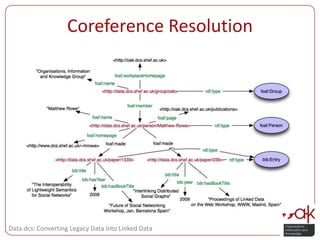
Coreference ResolutionThe triplification of legacy data contained within the DCS web sites (from ~12,000 HTML documents)  produced 17,896 instances of foaf:Person and 1,088 instances of bib:EntryContains many equivalent foaf:Person instancesMust also assign people to their publicationsWe create information about each research group manually to relate DCS members with their research groups:<http://data.dcs.shef.ac.uk/group/oak>	rdf:typefoaf:Group ;foaf:name  "Organisations, Information and Knowledge Group" ;foaf:workplaceHomepage  <http://oak.dcs.shef.ac.uk>Querying the source dataset for all the people to appear on each of the group personnel listings pages provides the members of each groupThis provides a list of people who are members of the DCSFor each person equivalent instances are found byGraph smushing: detecting equivalent instances which have the same email address or homepageCo-occurrence queries: detecting equivalent instances by matching coworkers who appear in the same pagePeople are assigned to their publications using queries containing an abbreviated form of their nameApplicable in this context due to the localised nature of the dataset
Coreference Resolution
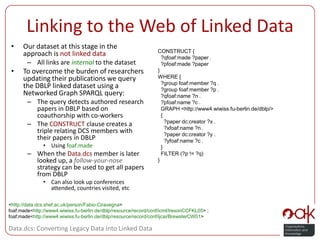
Linking to the Web of Linked DataOur dataset at this stage in the approach is not linked dataAll links are internal to the datasetTo overcome the burden of researchers updating their publications we query the DBLP linked dataset using a Networked Graph SPARQL query:The query detects authored research papers in DBLP based on coauthorship with co-workersThe CONSTRUCT clause creates a triple relating DCS members with their papers in DBLPUsing foaf:madeWhen the Data.dcs member is later looked up, a follow-your-nose strategy can be used to get all papers from DBLPCan also look up conferences attended, countries visited, etcCONSTRUCT {  ?qfoaf:made ?paper .  ?pfoaf:made ?paper }WHERE {  ?group foaf:member ?q .  ?group foaf:member ?p .  ?qfoaf:name ?n .  ?pfoaf:name ?c .   GRAPH <http://www4.wiwiss.fu-berlin.de/dblp/>   {    ?paper dc:creator ?x .    ?xfoaf:name ?n .    ?paper dc:creator ?y .    ?yfoaf:name ?c .  }  FILTER (?p != ?q)}<http://data.dcs.shef.ac.uk/person/Fabio-Ciravegna>foaf:made  <http://www4.wiwiss.fu-berlin.de/dblp/resource/record/conf/icml/IresonCCFKL05> ;foaf:made  <http://www4.wiwiss.fu-berlin.de/dblp/resource/record/conf/ijcai/BrewsterCW01>
DeploymentData.dcs is now up and running and can be accessed at the following URL:http://data.dcs.shef.ac.uk (please try it!)The data is deployed usingRecipe 1 from “How to Publish Linked Data”http://www4.wiwiss.fu-berlin.de/bizer/pub/LinkedDataTutorial/Recipe 2 for Slash Namespaces from “Best Practices for Publishing RDF Vocabularies”http://www.w3.org/TR/swbp-vocab-pub/Viewing <http://data.dcs.shef.ac.uk/group/oak> using OpenLinks’sURIBurner
ConclusionsLeveraging legacy data requires information extraction components able to handle heterogeneous formatsHidden Markov Models provide a single solution to this problem, however other methods exist which could be exploredPresented methods are applicable to other domains, simply requires a different topology and training  Current methods for Linked DCS Data into the Web of Linked Data are conservative: Bespoke SPARQL queriesFuture work will include the exploration of machine learning classification techniques to perform URI disambiguationThis work is now being used as a blueprint for producing linked data from the entire University of SheffieldCovering different faculties and departmentsIntended to foster and identify possible collaborations across work areas
Twitter: @mattroweshowWeb: http://www.dcs.shef.ac.uk/~mroweEmail: m.rowe@dcs.shef.ac.ukQuestions?(Mika et al, 2009) - Peter Mika, Edgar Meij, and Hugo Zaragoza. Investigating the semantic gap through query log analysis. In 8th International Semantic Web Conference (ISWC2009), October 2009.

Data.dcs: Converting Legacy Data into Linked Data

  • 1.
    Data.dcs: Converting LegacyData into Linked DataMatthew RoweOrganisations, Information and Knowledge GroupUniversity of Sheffield
  • 2.
    OutlineProblemLegacy data containedwithin the Department of Computer ScienceMotivationWhy produce linked data?Converting Legacy Data into Linked Data:Triplification of Legacy DataCoreference ResolutionLinking into the Web of Linked DataDeploymentConclusions
  • 3.
    ProblemThe Department ofComputer Science (http://www.dcs.shef.ac.uk) provides a web site containing important legacy data describingPeopleResearch groupsPublicationsLegacy data is defined as important information which is stored in proprietary formats Each member of the DCS maintains his/her own web pageHeterogeneous formattingDifferent presentation of contentDevoid of any semantic markupHard to find information due to its distribution and heterogeneityE.g. cannot query for all publications which two given people have worked on in the past yearMust manually search and filter through a lot of informationThe department also provides a publication database (http://pub.dcs.shef.ac.uk)Rarely updated Contains duplicates and errorsNot machine-readable
  • 4.
    MotivationLeveraging legacy datafrom the DCS in a machine-readable and consistent form would allow related information to be linked togetherPeople would be linked with their publicationsResearch groups would be linked to their membersCo-authors of papers could be foundLinking DCS data into the Web of Linked Data would allow additional information to be provided:Listing conferences which DCS members have attendedProvide up-to-date publication listingsVia external linked datasetsThe DCS web site use case is indicative of the makeup of the WWW overall:Organisations provide legacy data which is intended for human consumptionHTML documents are provided which lack any explicit machine-readable semantics(Mika et al, 2009) presented crawling logs from 2008-2009 where only 0.6% of web documents contained RDFa and 2% contained the hCardmicroformat
  • 5.
    Converting Legacy Datainto Linked DataThe approach is divided into 3 different stages:TriplificationConverting legacy data into RDF triplesCoreference ResolutionIdentifying coreferring entities into the RDF datasetLinked to the Web of Linked DataQuerying and discovering links into the Linked Data cloud
  • 6.
    Triplification of LegacyDataThe DCS publication database provides publication listings as XMLHowever, all publication information is contained within the same <description> element (title, author, year, book title):<description> <![CDATA[Rowe, M. (2009). Interlinking Distributed Social Graphs. In <i>Proceedings of Linked Data on the Web Workshop, WWW 2009, Madrid, Spain. (2009)</i>. Madrid, Madrid, Spain.<br> <br>Edited by Sarah Duffy on Tue, 08 Dec 2009 09:31:30 +0000.]]></description>DCS web site provides person information and research group listings in HTML documentsInformation is devoid of markup and is provided in a heterogeneous formatsExtracting person information from HTML documents requires the derivation of context windowsPortions of a given HTML document which contain person information (e.g. a person’s name together with their email address and homepage)
  • 7.
  • 8.
    Triplification of LegacyDataContext windows are generated by identifying portions of a HTML document which contain a person’s nameThe structure of the HTML DOM is then used to partition the window such that it contains information about a single personHTML markup provides clues as to the segmentation of legacy data within the documentOnce a name is identified a set of algorithms moves up the DOM tree until a layout element is discovered (e.g. <div>, <li>, <tr>)Provided with a set of context windows, legacy data is then extracted from the window using Hidden Markov Models (HMMs)Context windows are extracted from HTML documents for DCS members and are provided from the publication listings XMLHMMs: Input: sequence of tokens from the context windowOutput: most likely state labels for each of the tokensStates correspond to information which is to be extracted
  • 9.
    Triplification of LegacyDataAn RDF dataset is built from the extracted legacy dataThis provides the sourcedataset from which a linked dataset is builtFor person information triples are formed as follows:<http://data.dcs.shef.ac.uk/person/12025> rdf:typefoaf:Person ;foaf:name "Matthew Rowe" .<http://www.dcs.shef.ac.uk/~mrowe/publications.html> foaf:topic <http://data.dcs.shef.ac.uk/person/12025>For publication information triples are formed as follows:<http://data.dcs.shef.ac.uk/paper/239> rdf:typebib:Entry ;bib:title "Interlinking Distributed Social Graphs." ;bib:hasYear "2009" ; bib:hasBookTitle "Proceedings of Linked Data on the Web Workshop, WWW, Madrid, Spain." ;foaf:maker _:a1 ._:a1rdf:typefoaf:Person ; foaf:name "Matthew Rowe"
  • 10.
    Coreference ResolutionThe triplificationof legacy data contained within the DCS web sites (from ~12,000 HTML documents) produced 17,896 instances of foaf:Person and 1,088 instances of bib:EntryContains many equivalent foaf:Person instancesMust also assign people to their publicationsWe create information about each research group manually to relate DCS members with their research groups:<http://data.dcs.shef.ac.uk/group/oak> rdf:typefoaf:Group ;foaf:name "Organisations, Information and Knowledge Group" ;foaf:workplaceHomepage <http://oak.dcs.shef.ac.uk>Querying the source dataset for all the people to appear on each of the group personnel listings pages provides the members of each groupThis provides a list of people who are members of the DCSFor each person equivalent instances are found byGraph smushing: detecting equivalent instances which have the same email address or homepageCo-occurrence queries: detecting equivalent instances by matching coworkers who appear in the same pagePeople are assigned to their publications using queries containing an abbreviated form of their nameApplicable in this context due to the localised nature of the dataset
  • 11.
  • 12.
    Linking to theWeb of Linked DataOur dataset at this stage in the approach is not linked dataAll links are internal to the datasetTo overcome the burden of researchers updating their publications we query the DBLP linked dataset using a Networked Graph SPARQL query:The query detects authored research papers in DBLP based on coauthorship with co-workersThe CONSTRUCT clause creates a triple relating DCS members with their papers in DBLPUsing foaf:madeWhen the Data.dcs member is later looked up, a follow-your-nose strategy can be used to get all papers from DBLPCan also look up conferences attended, countries visited, etcCONSTRUCT { ?qfoaf:made ?paper . ?pfoaf:made ?paper }WHERE { ?group foaf:member ?q . ?group foaf:member ?p . ?qfoaf:name ?n . ?pfoaf:name ?c . GRAPH <http://www4.wiwiss.fu-berlin.de/dblp/> { ?paper dc:creator ?x . ?xfoaf:name ?n . ?paper dc:creator ?y . ?yfoaf:name ?c . } FILTER (?p != ?q)}<http://data.dcs.shef.ac.uk/person/Fabio-Ciravegna>foaf:made <http://www4.wiwiss.fu-berlin.de/dblp/resource/record/conf/icml/IresonCCFKL05> ;foaf:made <http://www4.wiwiss.fu-berlin.de/dblp/resource/record/conf/ijcai/BrewsterCW01>
  • 13.
    DeploymentData.dcs is nowup and running and can be accessed at the following URL:http://data.dcs.shef.ac.uk (please try it!)The data is deployed usingRecipe 1 from “How to Publish Linked Data”http://www4.wiwiss.fu-berlin.de/bizer/pub/LinkedDataTutorial/Recipe 2 for Slash Namespaces from “Best Practices for Publishing RDF Vocabularies”http://www.w3.org/TR/swbp-vocab-pub/Viewing <http://data.dcs.shef.ac.uk/group/oak> using OpenLinks’sURIBurner
  • 14.
    ConclusionsLeveraging legacy datarequires information extraction components able to handle heterogeneous formatsHidden Markov Models provide a single solution to this problem, however other methods exist which could be exploredPresented methods are applicable to other domains, simply requires a different topology and training Current methods for Linked DCS Data into the Web of Linked Data are conservative: Bespoke SPARQL queriesFuture work will include the exploration of machine learning classification techniques to perform URI disambiguationThis work is now being used as a blueprint for producing linked data from the entire University of SheffieldCovering different faculties and departmentsIntended to foster and identify possible collaborations across work areas
  • 15.
    Twitter: @mattroweshowWeb: http://www.dcs.shef.ac.uk/~mroweEmail:m.rowe@dcs.shef.ac.ukQuestions?(Mika et al, 2009) - Peter Mika, Edgar Meij, and Hugo Zaragoza. Investigating the semantic gap through query log analysis. In 8th International Semantic Web Conference (ISWC2009), October 2009.