Mustafa Jarrar
Lecture Notes, Web Data Management (MCOM7348)
University of Birzeit, Palestine
1st Semester, 2013

Introduction to

Linked Data
Dr. Mustafa Jarrar
University of Birzeit
mjarrar@birzeit.edu
www.jarrar.info
Jarrar © 2013

1
Watch this lecture and download the slides from
http://jarrar-courses.blogspot.com/2013/11/web-data-management.html

Jarrar © 2013

2
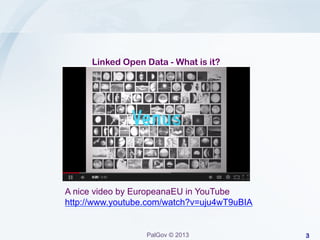
Linked Open Data - What is it?

A nice video by EuropeanaEU in YouTube
http://www.youtube.com/watch?v=uju4wT9uBIA

PalGov © 2013

3
Semantic/ Data Web/ Web 3.0?

“The goal of the Semantic Web is
to create a universal medium for the
exchange of DATA”, W3C.

“The Semantic Web is a web of data, in
some ways like a global database”,
Tim Berners-Lee – Inventor of the WWW.

PalGov © 2013

4
Web of Data
The Data Web envisions the web as a world-wide interlinked
structured data.
The Web as we know it today is a global information space of
linked documents.
The same vision is applied to data: publishing and connecting
structured data on the web.

PalGov © 2013

5
Classical Web

Diagram Source: Christian Bizer

The classical web a global
information space of linked
documents.
Primary Units of the hypertext Web
are:
–  HTML Documents,
–  Connected by Hyperlinks

PalGov © 2013

6
The challenge
The problem is that the information on the classical
web is not structured.
–  Programs cannot use such information in a useful way.

The solution is to increase the structure of published
information.

PalGov © 2013

7
Web APIs and Mashups

Diagram Source: Christian Bizer

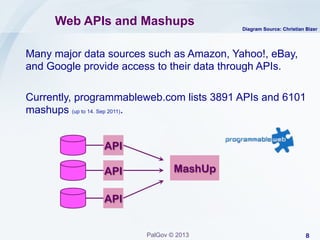
Many major data sources such as Amazon, Yahoo!, eBay,
and Google provide access to their data through APIs.
Currently, programmableweb.com lists 3891 APIs and 6101
mashups (up to 14. Sep 2011).
API
API

MashUp

API

PalGov © 2013

8
Web APIs and Mashups

Picture Source: Christian Bizer

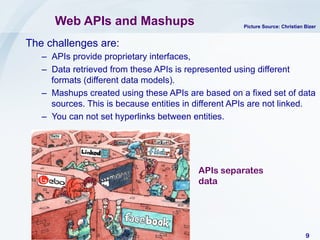
The challenges are:
–  APIs provide proprietary interfaces,
–  Data retrieved from these APIs is represented using different
formats (different data models).
–  Mashups created using these APIs are based on a fixed set of data
sources. This is because entities in different APIs are not linked.
–  You can not set hyperlinks between entities.

APIs separates
data

PalGov © 2013

9
Beyond Web APIs and Mashups:
The Data Web and Linked Data
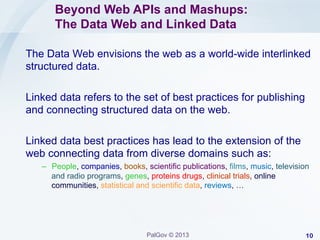
The Data Web envisions the web as a world-wide interlinked
structured data.
Linked data refers to the set of best practices for publishing
and connecting structured data on the web.
Linked data best practices has lead to the extension of the
web connecting data from diverse domains such as:
–  People, companies, books, scientific publications, films, music, television
and radio programs, genes, proteins drugs, clinical trials, online
communities, statistical and scientific data, reviews, …

PalGov © 2013

10
The Data Web and Linked Data

Diagram Source: Christian Bizer

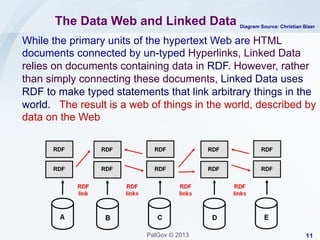
While the primary units of the hypertext Web are HTML
documents connected by un-typed Hyperlinks, Linked Data
relies on documents containing data in RDF. However, rather
than simply connecting these documents, Linked Data uses
RDF to make typed statements that link arbitrary things in the
world. The result is a web of things in the world, described by
data on the Web

PalGov © 2013

11
How to create linked-data?
The four principles (By Tim Berners-Lee)
Berners-Lee (2006) outlined a set of 'rules' for publishing data on the Web in a
way that all published data becomes part of a single global data space:

1.  Use URIs to denote things. Most things are referenced
by unique URIs.
2.  Use HTTP URIs so that these things can be referred to
and looked up ("dereferenced") by people and user
agents.
3.  Provide useful information about the thing when its URI
is dereferenced, leveraging standards such as RDF,
SPARQL.
4.  Include links to other related things (using their URIs)
when publishing data on the Web.
Jarrar © 2013

12
Properties of the Web of Linked Data
Anyone can publish data to the Web of Linked Data
Entities are connected by links
–  creating a global data graph that spans data sources and enables
the discovery of new data sources.

Data is self-describing
–  If an application encounters data represented using an unfamiliar
vocabulary, the application can resolve the URIs that identify
vocabulary terms in order to find their RDFS or OWL definition.

The Web of Data is open
–  meaning that applications can discover new data sources at runtime by following links.
PalGov © 2013

13
Realization: Linking Open Data Project

PalGov © 2013

14
Linked Data
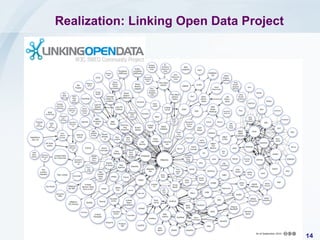
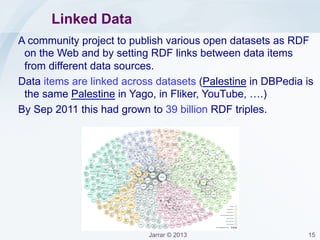
A community project to publish various open datasets as RDF
on the Web and by setting RDF links between data items
from different data sources.
Data items are linked across datasets (Palestine in DBPedia is
the same Palestine in Yago, in Fliker, YouTube, ….)
By Sep 2011 this had grown to 39 billion RDF triples.

Jarrar © 2013

15
Linking Data
How are same entities described in different datasets linked?
AGAIN: By linking the Global Identifier, that is, the URI!
Let’s have a look at real examples from real datasets:
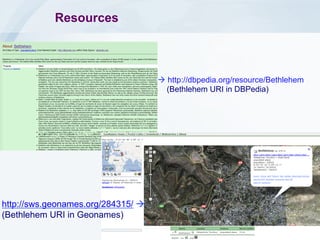
<http://dbpedia.org/resource/Bethlehem> owl:sameAs
<http://sws.geonames.org/284315/>

•  Linking the entity “Bethlehem” between the DBPedia dataset and the
Geonames dataset in the Linking Open Data cloud.
•  This is done by linking the URIs of “Bethlehem” in both datasets using
owl:sameAs.
<http://dbpedia.org/resource/Tim_Berners-Lee> owl:sameAs
<http://www4.wiwiss.fu-berlin.de/dblp/resource/person/100007>

•  Linking the entity “Tim Berners-Lee” between the DBPedia dataset and the
DBLP dataset .
•  This is done by linking the URIs of “Tim Berners-Lee” in both datasets
using owl:sameAs.
Jarrar © 2013

16
Resources

à http://dbpedia.org/resource/Bethlehem
(Bethlehem URI in DBPedia)

http://sws.geonames.org/284315/ à
(Bethlehem URI in Geonames)
Jarrar © 2013

17
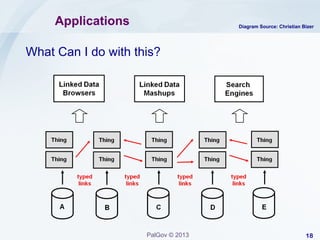
Applications

Diagram Source: Christian Bizer

What Can I do with this?

PalGov © 2013

18

Jarrar: Linked Data

  • 1.
    Mustafa Jarrar Lecture Notes,Web Data Management (MCOM7348) University of Birzeit, Palestine 1st Semester, 2013 Introduction to Linked Data Dr. Mustafa Jarrar University of Birzeit mjarrar@birzeit.edu www.jarrar.info Jarrar © 2013 1
  • 2.
    Watch this lectureand download the slides from http://jarrar-courses.blogspot.com/2013/11/web-data-management.html Jarrar © 2013 2
  • 3.
    Linked Open Data- What is it? A nice video by EuropeanaEU in YouTube http://www.youtube.com/watch?v=uju4wT9uBIA PalGov © 2013 3
  • 4.
    Semantic/ Data Web/Web 3.0? “The goal of the Semantic Web is to create a universal medium for the exchange of DATA”, W3C. “The Semantic Web is a web of data, in some ways like a global database”, Tim Berners-Lee – Inventor of the WWW. PalGov © 2013 4
  • 5.
    Web of Data TheData Web envisions the web as a world-wide interlinked structured data. The Web as we know it today is a global information space of linked documents. The same vision is applied to data: publishing and connecting structured data on the web. PalGov © 2013 5
  • 6.
    Classical Web Diagram Source:Christian Bizer The classical web a global information space of linked documents. Primary Units of the hypertext Web are: –  HTML Documents, –  Connected by Hyperlinks PalGov © 2013 6
  • 7.
    The challenge The problemis that the information on the classical web is not structured. –  Programs cannot use such information in a useful way. The solution is to increase the structure of published information. PalGov © 2013 7
  • 8.
    Web APIs andMashups Diagram Source: Christian Bizer Many major data sources such as Amazon, Yahoo!, eBay, and Google provide access to their data through APIs. Currently, programmableweb.com lists 3891 APIs and 6101 mashups (up to 14. Sep 2011). API API MashUp API PalGov © 2013 8
  • 9.
    Web APIs andMashups Picture Source: Christian Bizer The challenges are: –  APIs provide proprietary interfaces, –  Data retrieved from these APIs is represented using different formats (different data models). –  Mashups created using these APIs are based on a fixed set of data sources. This is because entities in different APIs are not linked. –  You can not set hyperlinks between entities. APIs separates data PalGov © 2013 9
  • 10.
    Beyond Web APIsand Mashups: The Data Web and Linked Data The Data Web envisions the web as a world-wide interlinked structured data. Linked data refers to the set of best practices for publishing and connecting structured data on the web. Linked data best practices has lead to the extension of the web connecting data from diverse domains such as: –  People, companies, books, scientific publications, films, music, television and radio programs, genes, proteins drugs, clinical trials, online communities, statistical and scientific data, reviews, … PalGov © 2013 10
  • 11.
    The Data Weband Linked Data Diagram Source: Christian Bizer While the primary units of the hypertext Web are HTML documents connected by un-typed Hyperlinks, Linked Data relies on documents containing data in RDF. However, rather than simply connecting these documents, Linked Data uses RDF to make typed statements that link arbitrary things in the world. The result is a web of things in the world, described by data on the Web PalGov © 2013 11
  • 12.
    How to createlinked-data? The four principles (By Tim Berners-Lee) Berners-Lee (2006) outlined a set of 'rules' for publishing data on the Web in a way that all published data becomes part of a single global data space: 1.  Use URIs to denote things. Most things are referenced by unique URIs. 2.  Use HTTP URIs so that these things can be referred to and looked up ("dereferenced") by people and user agents. 3.  Provide useful information about the thing when its URI is dereferenced, leveraging standards such as RDF, SPARQL. 4.  Include links to other related things (using their URIs) when publishing data on the Web. Jarrar © 2013 12
  • 13.
    Properties of theWeb of Linked Data Anyone can publish data to the Web of Linked Data Entities are connected by links –  creating a global data graph that spans data sources and enables the discovery of new data sources. Data is self-describing –  If an application encounters data represented using an unfamiliar vocabulary, the application can resolve the URIs that identify vocabulary terms in order to find their RDFS or OWL definition. The Web of Data is open –  meaning that applications can discover new data sources at runtime by following links. PalGov © 2013 13
  • 14.
    Realization: Linking OpenData Project PalGov © 2013 14
  • 15.
    Linked Data A communityproject to publish various open datasets as RDF on the Web and by setting RDF links between data items from different data sources. Data items are linked across datasets (Palestine in DBPedia is the same Palestine in Yago, in Fliker, YouTube, ….) By Sep 2011 this had grown to 39 billion RDF triples. Jarrar © 2013 15
  • 16.
    Linking Data How aresame entities described in different datasets linked? AGAIN: By linking the Global Identifier, that is, the URI! Let’s have a look at real examples from real datasets: <http://dbpedia.org/resource/Bethlehem> owl:sameAs <http://sws.geonames.org/284315/> •  Linking the entity “Bethlehem” between the DBPedia dataset and the Geonames dataset in the Linking Open Data cloud. •  This is done by linking the URIs of “Bethlehem” in both datasets using owl:sameAs. <http://dbpedia.org/resource/Tim_Berners-Lee> owl:sameAs <http://www4.wiwiss.fu-berlin.de/dblp/resource/person/100007> •  Linking the entity “Tim Berners-Lee” between the DBPedia dataset and the DBLP dataset . •  This is done by linking the URIs of “Tim Berners-Lee” in both datasets using owl:sameAs. Jarrar © 2013 16
  • 17.
    Resources à http://dbpedia.org/resource/Bethlehem (Bethlehem URIin DBPedia) http://sws.geonames.org/284315/ à (Bethlehem URI in Geonames) Jarrar © 2013 17
  • 18.
    Applications Diagram Source: ChristianBizer What Can I do with this? PalGov © 2013 18