

When RDFa?
When RDFa, and how much
      Session 4/4
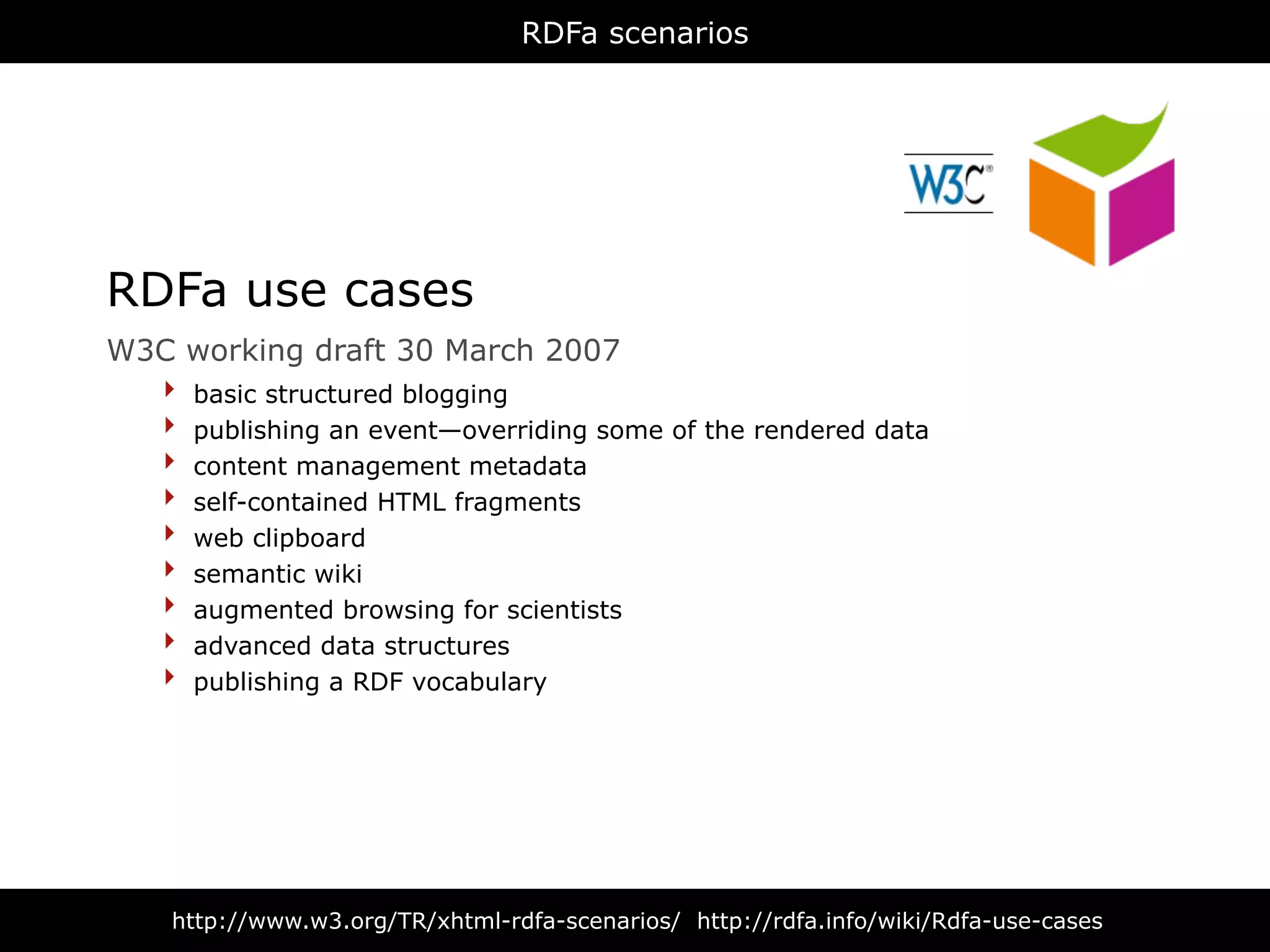
RDFa scenarios


RDFa use cases
W3C   working draft 30 March 2007
  ‣   basic structured blogging
  ‣   publishing an event—overriding some of the rendered data
  ‣   content management metadata
  ‣   self-contained HTML fragments
  ‣   web clipboard
  ‣   semantic wiki
  ‣   augmented browsing for scientists
  ‣   advanced data structures
  ‣   publishing a RDF vocabulary


  http://www.w3.org/TR/xhtml-rdfa-scenarios/ http://rdfa.info/wiki/Rdfa-use-cases
RDFa projects


Examples in-the-wild
Real-world RDFa examples showing how RDFa is used in different
places for different purposes
    ‣ science, law, publications
    ‣ social media: blogs, wikis, mailing lists
    ‣ multimedia
    ‣ government
    ‣ other


                  http://rdfa.info/wiki/Examples-in-the-wild
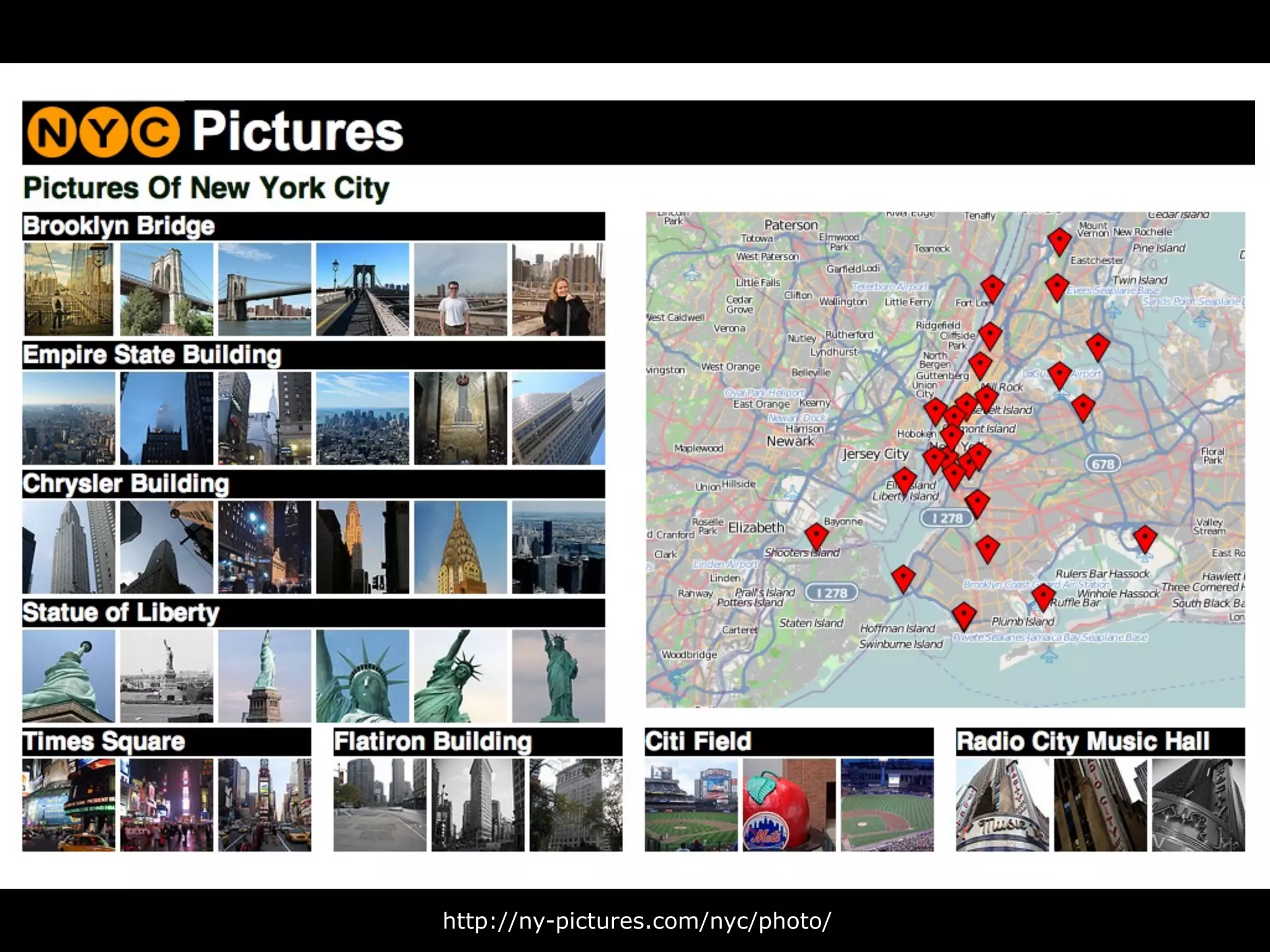
http://ny-pictures.com/nyc/photo/
Big RDFa related projects


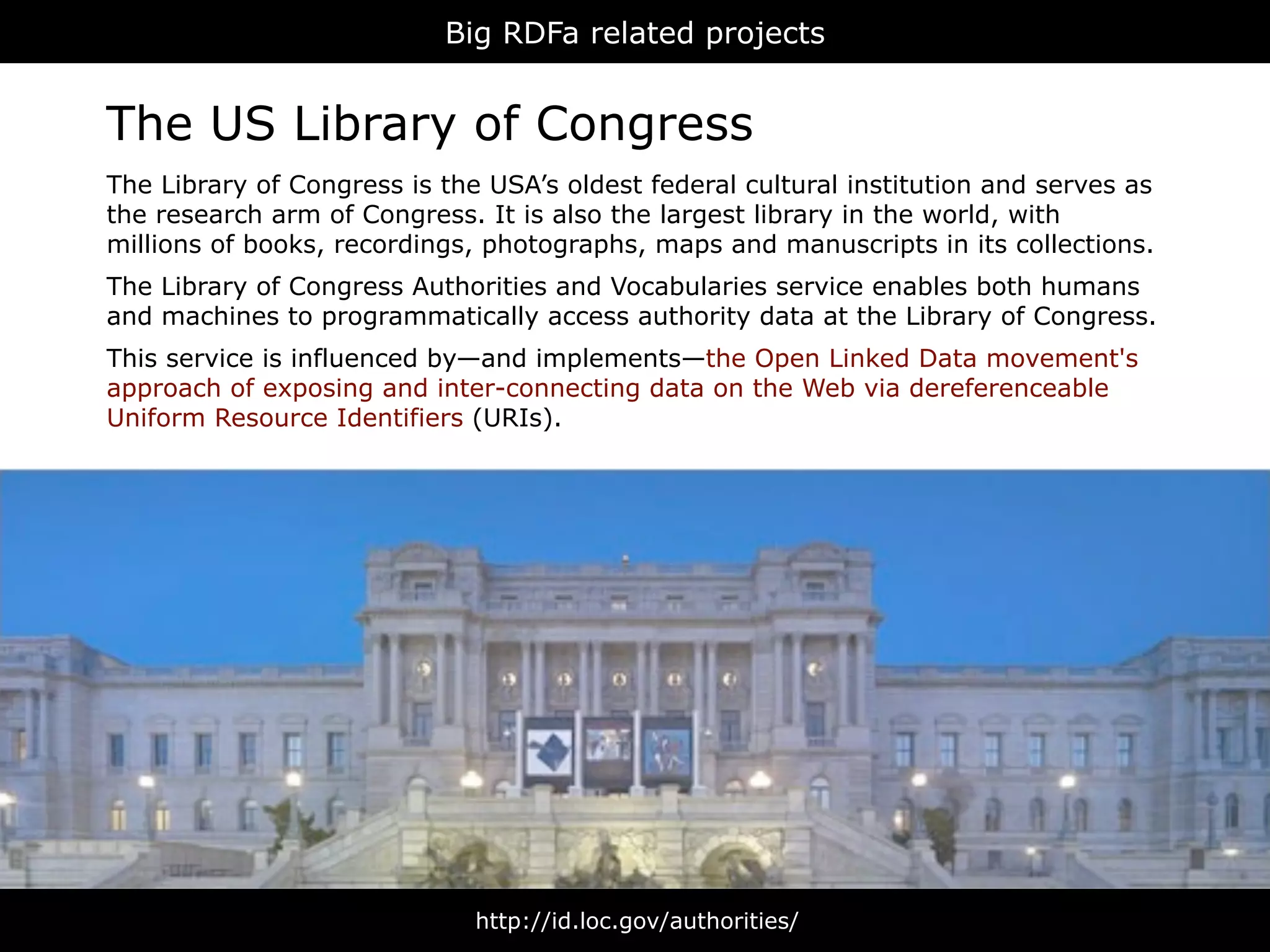
The US Library of Congress
The Library of Congress is the USA’s oldest federal cultural institution and serves as
the research arm of Congress. It is also the largest library in the world, with
millions of books, recordings, photographs, maps and manuscripts in its collections.
The Library of Congress Authorities and Vocabularies service enables both humans
and machines to programmatically access authority data at the Library of Congress.
This service is influenced by—and implements—the Open Linked Data movement's
approach of exposing and inter-connecting data on the Web via dereferenceable
Uniform Resource Identifiers (URIs).


                              http://id.loc.gov/authorities/
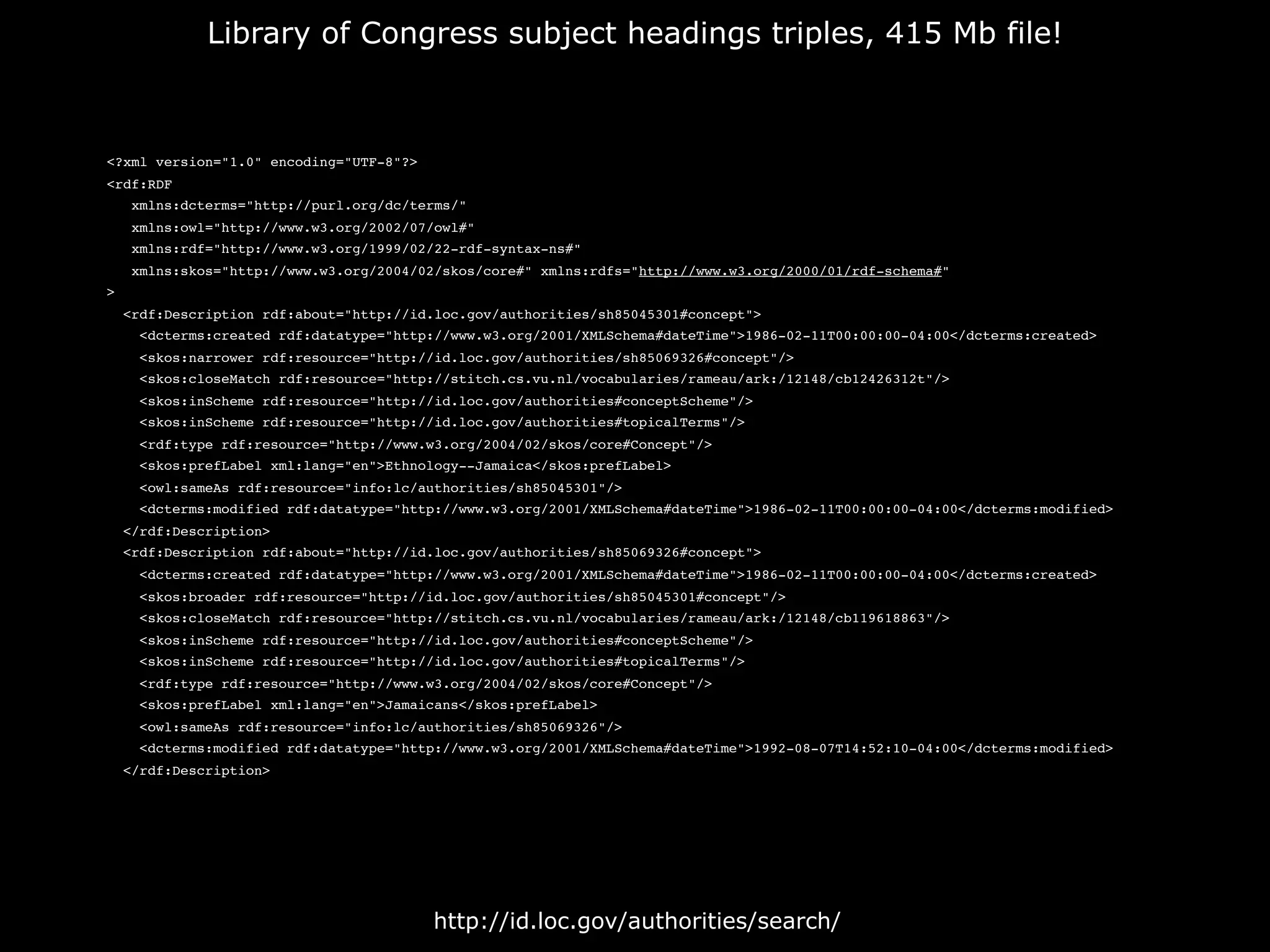
Library of Congress subject headings triples, 415 Mb file!


<?xml version="1.0" encoding="UTF-8"?>
<rdf:RDF
    xmlns:dcterms="http://purl.org/dc/terms/"
    xmlns:owl="http://www.w3.org/2002/07/owl#"
    xmlns:rdf="http://www.w3.org/1999/02/22-rdf-syntax-ns#"
    xmlns:skos="http://www.w3.org/2004/02/skos/core#" xmlns:rdfs="http://www.w3.org/2000/01/rdf-schema#"
>
    <rdf:Description rdf:about="http://id.loc.gov/authorities/sh85045301#concept">
     <dcterms:created rdf:datatype="http://www.w3.org/2001/XMLSchema#dateTime">1986-02-11T00:00:00-04:00</dcterms:created>
     <skos:narrower rdf:resource="http://id.loc.gov/authorities/sh85069326#concept"/>
     <skos:closeMatch rdf:resource="http://stitch.cs.vu.nl/vocabularies/rameau/ark:/12148/cb12426312t"/>
     <skos:inScheme rdf:resource="http://id.loc.gov/authorities#conceptScheme"/>
     <skos:inScheme rdf:resource="http://id.loc.gov/authorities#topicalTerms"/>
     <rdf:type rdf:resource="http://www.w3.org/2004/02/skos/core#Concept"/>
     <skos:prefLabel xml:lang="en">Ethnology--Jamaica</skos:prefLabel>
     <owl:sameAs rdf:resource="info:lc/authorities/sh85045301"/>
     <dcterms:modified rdf:datatype="http://www.w3.org/2001/XMLSchema#dateTime">1986-02-11T00:00:00-04:00</dcterms:modified>
    </rdf:Description>
    <rdf:Description rdf:about="http://id.loc.gov/authorities/sh85069326#concept">
     <dcterms:created rdf:datatype="http://www.w3.org/2001/XMLSchema#dateTime">1986-02-11T00:00:00-04:00</dcterms:created>
     <skos:broader rdf:resource="http://id.loc.gov/authorities/sh85045301#concept"/>
     <skos:closeMatch rdf:resource="http://stitch.cs.vu.nl/vocabularies/rameau/ark:/12148/cb119618863"/>
     <skos:inScheme rdf:resource="http://id.loc.gov/authorities#conceptScheme"/>
     <skos:inScheme rdf:resource="http://id.loc.gov/authorities#topicalTerms"/>
     <rdf:type rdf:resource="http://www.w3.org/2004/02/skos/core#Concept"/>
     <skos:prefLabel xml:lang="en">Jamaicans</skos:prefLabel>
     <owl:sameAs rdf:resource="info:lc/authorities/sh85069326"/>
     <dcterms:modified rdf:datatype="http://www.w3.org/2001/XMLSchema#dateTime">1992-08-07T14:52:10-04:00</dcterms:modified>
    </rdf:Description>


                                         http://id.loc.gov/authorities/search/
Linked data


The New York Times and linked data
As of 13 January 2010, The New York Times has published
approximately 10,000 subject (people, organisations, locations)
headings as linked open data under a CC BY license.
    ‣ This includes both RDF documents and human-friendly HTML versions.
    ‣ Each subject heading published on data.nytimes.com is associated with a
        Uniform Resource Identifier (URI) that is unique to that subject heading.
    ‣   When this URI is dereferenced in a web browser, an HTML document
        describing the subject heading is returned. Appending ".rdf" to the URI
        causes an RDF/XML document to be returned.


                                http://data.nytimes.com/
Linked data


Build your own NYT linked data application
EVAN SANDHAUS, March 30 2010

Now that we’ve published nearly 10,000 of our tags as Linked Open Data, you’re
probably wondering what kind of cool applications you can build with this data. To
help you get started (and since linked data applications are a little different from
your average Web application), we thought we’d provide a sample application and
detailed information about how we built it.


  http://open.blogs.nytimes.com/2010/03/30/build-your-own-nyt-linked-data-application/
Official RDFa deployment in UK


 RDFa and linked data in UK government
 web-sites
 Mark Birbeck, Nodalities Magazine, 29 July 2009

 The UK government’s Central Office of Information had a straightforward problem to
 solve: how could they create a centralised web-site of information that the public
 could search and access, when the source of that information could be any
 government department database or any public sector web-site?
 By using RDFa to address the challenge of making distributed data available in one
 place, the COI avoided having to make changes to each department's systems. But
 once each department is publishing RDFa, it becomes possible for third parties to
 consume that information however they see fit. Such a flexible architecture is
 crucial in the age of open government, and is a cornerstone of linked open data.


http://blogs.talis.com/nodalities/2009/07/rdfa-and-linked-data-in-uk-government-web-sites.php
Official RDFa deployment in UK


TSO announces major new platform to
accelerate open data drive
TSO partners with Garlik on hosted "trillion triple" RDF platform, 18 January 2010

TSO (The Stationery Office), the public sector division of Williams Lea, has today
announced a partnership with Garlik, the leading semantic technology innovator, to
launch what is believed to be the world's most scalable, securely hosted RDF
platform for use by UK Central and Local Government departments. As the largest
publisher in the UK of public sector documents (over 8,000 titles a year), TSO has
taken this proactive step to provide its core public sector customers with the ability
to participate with confidence in the Government's open data initiative.


              http://www.tso.co.uk/press/latestnews/archive/2010/triplestore/
Commercial RDFa deployment in UK


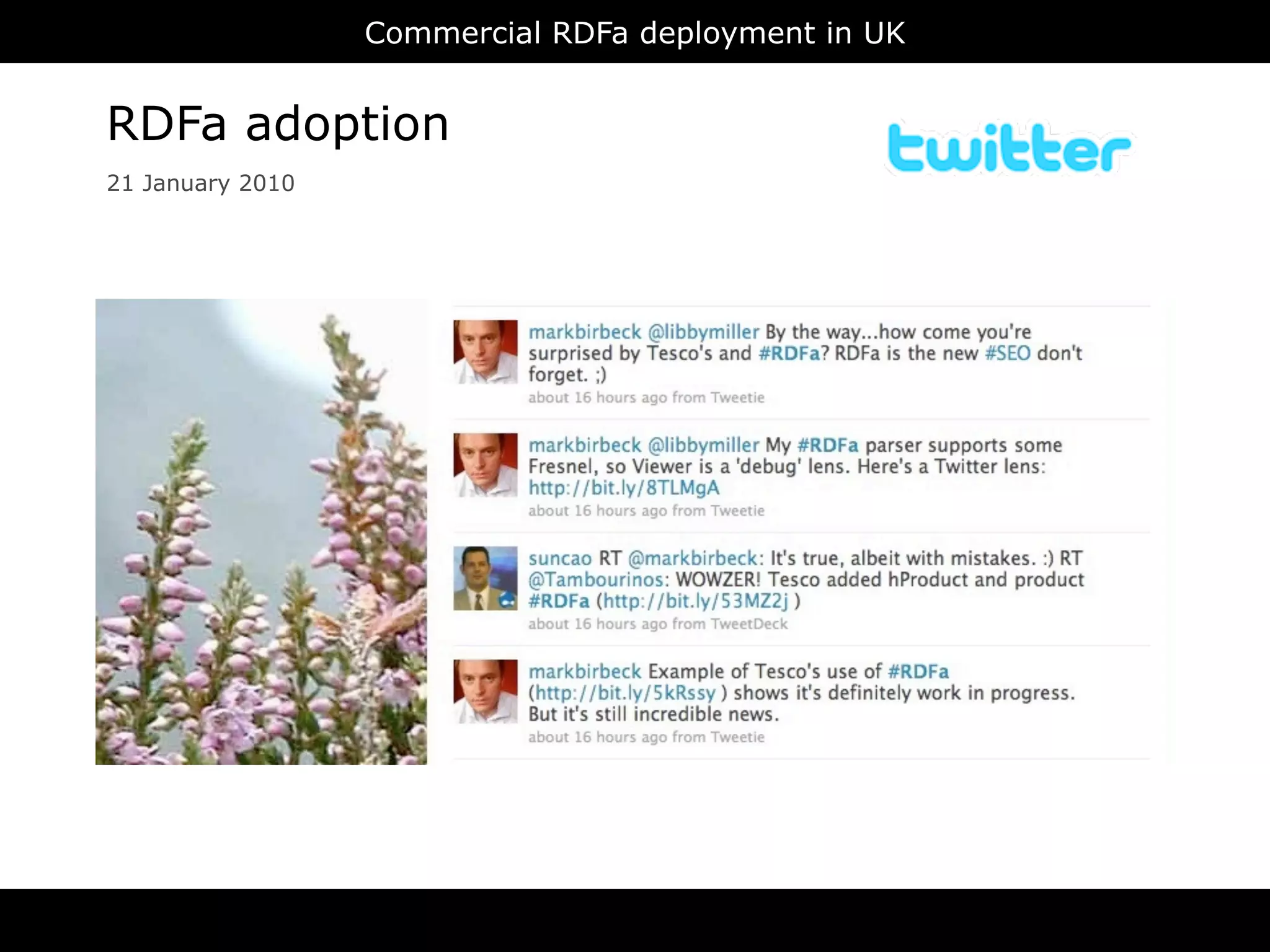
RDFa adoption
21 January 2010


                                RDFa
Important questions


Microformats and RDFa: Adding Richer
Structure To Your HTML Pages
Brian Kelly (UK Web Focus), 25 March 2010

But before investing time and energy into using RDFa the Web manager will need
answers to the following questions.
1.   What benefits can this provide?
2.   What vocabularies do we need to use and how should the data be described?
3.   What tools are available which can process the RDFa which we may chose to
     create?


          http://ukwebfocus.wordpress.com/2010/03/25/microformats-and-rdfa/
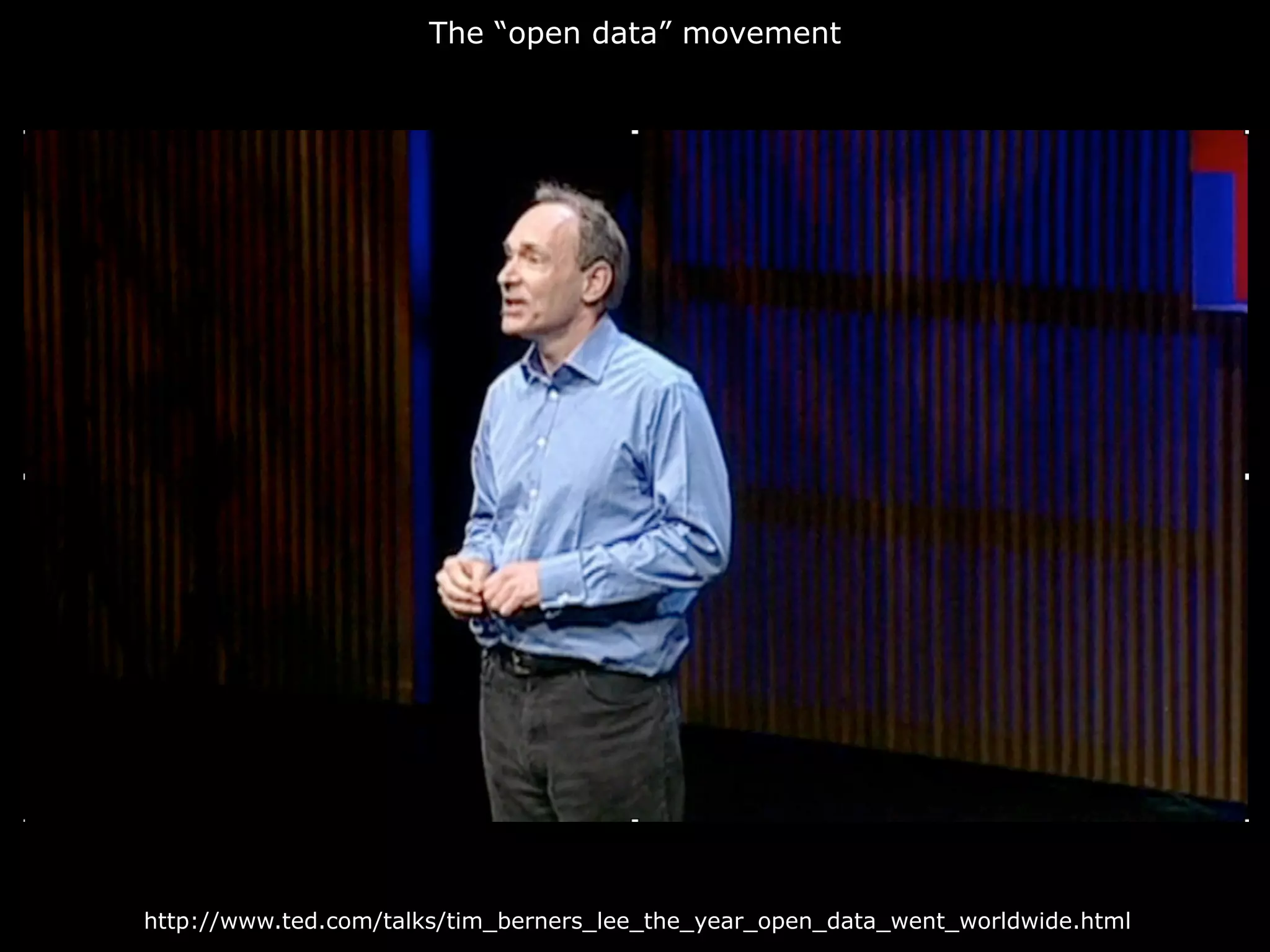
The “open data” movement


http://www.ted.com/talks/tim_berners_lee_the_year_open_data_went_worldwide.html
RDFa Introductory Course Session 4/4 When RDFa

RDFa Introductory Course Session 4/4 When RDFa

  • 1.
  • 2.
    When RDFa, andhow much Session 4/4
  • 3.
    RDFa scenarios RDFa usecases W3C working draft 30 March 2007 ‣ basic structured blogging ‣ publishing an event—overriding some of the rendered data ‣ content management metadata ‣ self-contained HTML fragments ‣ web clipboard ‣ semantic wiki ‣ augmented browsing for scientists ‣ advanced data structures ‣ publishing a RDF vocabulary http://www.w3.org/TR/xhtml-rdfa-scenarios/ http://rdfa.info/wiki/Rdfa-use-cases
  • 4.
    RDFa projects Examples in-the-wild Real-worldRDFa examples showing how RDFa is used in different places for different purposes ‣ science, law, publications ‣ social media: blogs, wikis, mailing lists ‣ multimedia ‣ government ‣ other http://rdfa.info/wiki/Examples-in-the-wild
  • 5.
  • 6.
    Big RDFa relatedprojects The US Library of Congress The Library of Congress is the USA’s oldest federal cultural institution and serves as the research arm of Congress. It is also the largest library in the world, with millions of books, recordings, photographs, maps and manuscripts in its collections. The Library of Congress Authorities and Vocabularies service enables both humans and machines to programmatically access authority data at the Library of Congress. This service is influenced by—and implements—the Open Linked Data movement's approach of exposing and inter-connecting data on the Web via dereferenceable Uniform Resource Identifiers (URIs). http://id.loc.gov/authorities/
  • 7.
    Library of Congresssubject headings triples, 415 Mb file! <?xml version="1.0" encoding="UTF-8"?> <rdf:RDF xmlns:dcterms="http://purl.org/dc/terms/" xmlns:owl="http://www.w3.org/2002/07/owl#" xmlns:rdf="http://www.w3.org/1999/02/22-rdf-syntax-ns#" xmlns:skos="http://www.w3.org/2004/02/skos/core#" xmlns:rdfs="http://www.w3.org/2000/01/rdf-schema#" > <rdf:Description rdf:about="http://id.loc.gov/authorities/sh85045301#concept"> <dcterms:created rdf:datatype="http://www.w3.org/2001/XMLSchema#dateTime">1986-02-11T00:00:00-04:00</dcterms:created> <skos:narrower rdf:resource="http://id.loc.gov/authorities/sh85069326#concept"/> <skos:closeMatch rdf:resource="http://stitch.cs.vu.nl/vocabularies/rameau/ark:/12148/cb12426312t"/> <skos:inScheme rdf:resource="http://id.loc.gov/authorities#conceptScheme"/> <skos:inScheme rdf:resource="http://id.loc.gov/authorities#topicalTerms"/> <rdf:type rdf:resource="http://www.w3.org/2004/02/skos/core#Concept"/> <skos:prefLabel xml:lang="en">Ethnology--Jamaica</skos:prefLabel> <owl:sameAs rdf:resource="info:lc/authorities/sh85045301"/> <dcterms:modified rdf:datatype="http://www.w3.org/2001/XMLSchema#dateTime">1986-02-11T00:00:00-04:00</dcterms:modified> </rdf:Description> <rdf:Description rdf:about="http://id.loc.gov/authorities/sh85069326#concept"> <dcterms:created rdf:datatype="http://www.w3.org/2001/XMLSchema#dateTime">1986-02-11T00:00:00-04:00</dcterms:created> <skos:broader rdf:resource="http://id.loc.gov/authorities/sh85045301#concept"/> <skos:closeMatch rdf:resource="http://stitch.cs.vu.nl/vocabularies/rameau/ark:/12148/cb119618863"/> <skos:inScheme rdf:resource="http://id.loc.gov/authorities#conceptScheme"/> <skos:inScheme rdf:resource="http://id.loc.gov/authorities#topicalTerms"/> <rdf:type rdf:resource="http://www.w3.org/2004/02/skos/core#Concept"/> <skos:prefLabel xml:lang="en">Jamaicans</skos:prefLabel> <owl:sameAs rdf:resource="info:lc/authorities/sh85069326"/> <dcterms:modified rdf:datatype="http://www.w3.org/2001/XMLSchema#dateTime">1992-08-07T14:52:10-04:00</dcterms:modified> </rdf:Description> http://id.loc.gov/authorities/search/
  • 8.
    Linked data The NewYork Times and linked data As of 13 January 2010, The New York Times has published approximately 10,000 subject (people, organisations, locations) headings as linked open data under a CC BY license. ‣ This includes both RDF documents and human-friendly HTML versions. ‣ Each subject heading published on data.nytimes.com is associated with a Uniform Resource Identifier (URI) that is unique to that subject heading. ‣ When this URI is dereferenced in a web browser, an HTML document describing the subject heading is returned. Appending ".rdf" to the URI causes an RDF/XML document to be returned. http://data.nytimes.com/
  • 9.
    Linked data Build yourown NYT linked data application EVAN SANDHAUS, March 30 2010 Now that we’ve published nearly 10,000 of our tags as Linked Open Data, you’re probably wondering what kind of cool applications you can build with this data. To help you get started (and since linked data applications are a little different from your average Web application), we thought we’d provide a sample application and detailed information about how we built it. http://open.blogs.nytimes.com/2010/03/30/build-your-own-nyt-linked-data-application/
  • 10.
    Official RDFa deploymentin UK RDFa and linked data in UK government web-sites Mark Birbeck, Nodalities Magazine, 29 July 2009 The UK government’s Central Office of Information had a straightforward problem to solve: how could they create a centralised web-site of information that the public could search and access, when the source of that information could be any government department database or any public sector web-site? By using RDFa to address the challenge of making distributed data available in one place, the COI avoided having to make changes to each department's systems. But once each department is publishing RDFa, it becomes possible for third parties to consume that information however they see fit. Such a flexible architecture is crucial in the age of open government, and is a cornerstone of linked open data. http://blogs.talis.com/nodalities/2009/07/rdfa-and-linked-data-in-uk-government-web-sites.php
  • 11.
    Official RDFa deploymentin UK TSO announces major new platform to accelerate open data drive TSO partners with Garlik on hosted "trillion triple" RDF platform, 18 January 2010 TSO (The Stationery Office), the public sector division of Williams Lea, has today announced a partnership with Garlik, the leading semantic technology innovator, to launch what is believed to be the world's most scalable, securely hosted RDF platform for use by UK Central and Local Government departments. As the largest publisher in the UK of public sector documents (over 8,000 titles a year), TSO has taken this proactive step to provide its core public sector customers with the ability to participate with confidence in the Government's open data initiative. http://www.tso.co.uk/press/latestnews/archive/2010/triplestore/
  • 12.
    Commercial RDFa deploymentin UK RDFa adoption 21 January 2010 RDFa
  • 13.
    Important questions Microformats andRDFa: Adding Richer Structure To Your HTML Pages Brian Kelly (UK Web Focus), 25 March 2010 But before investing time and energy into using RDFa the Web manager will need answers to the following questions. 1. What benefits can this provide? 2. What vocabularies do we need to use and how should the data be described? 3. What tools are available which can process the RDFa which we may chose to create? http://ukwebfocus.wordpress.com/2010/03/25/microformats-and-rdfa/
  • 14.
    The “open data”movement http://www.ted.com/talks/tim_berners_lee_the_year_open_data_went_worldwide.html