MPLS : Hacking & Security Myth of The Beast In
Core Telecommunication Network
gcsf@nowhere
WHY?
 TELCO Technology? Industry, Community, Academic?
 Ask Others to also share their high quality research
 Taking Indonesian Hacking Scene to The Higher Level
(?)
MPLS?
 MPLS is routing mechanism in high-performance
network backbone
 Route the data traffic from a node to the next node
based on short path labels
 Avoiding complex forwarding mechanism in routing
table
 Operate in between layer 2 and layer 3 (OSI model),
taking advantage on the layer 2 switching performance
and layer 3 routing scalability
 MPLS Architecture is very well written on RFC 3031
MPLS Terminology?
 Label Distribution Protocol (LDP)
 Label Switched Path (LSP)
 Label Switching Router (LSR)
 Label Edge Router (LER) / MPLS Edge Node
 Virtual Routing & Forwarding (VRF)
 CE/PE/P Router
 MORE? (We only describe terminology used in this
document)
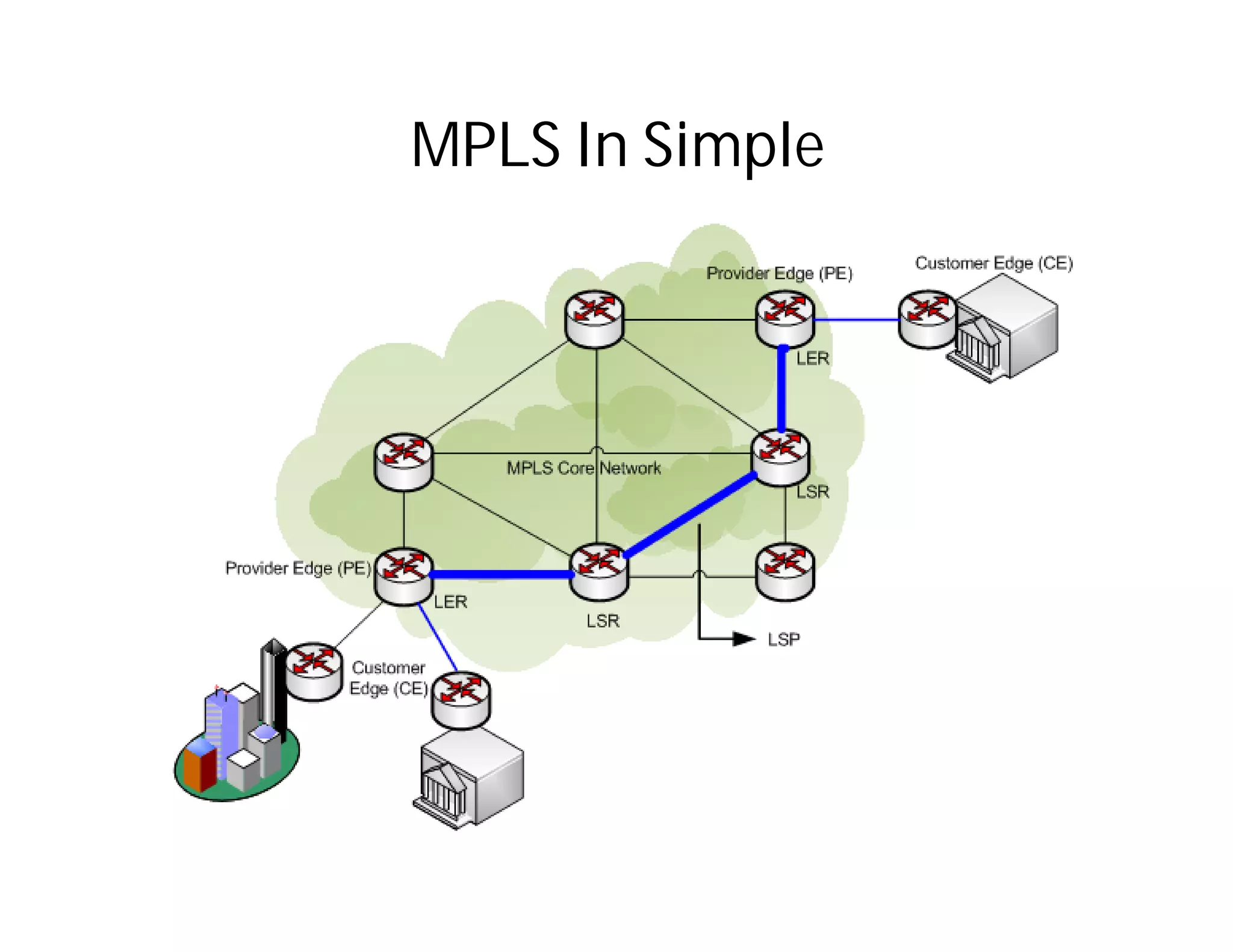
MPLS In Simple
MPLS Usage
 Virtual Private Routed Network (VPRN) – L3VPN
 Virtual Private LAN Service (VPLS) – L2VPN
 Virtual Leased Line (VLL)
 Traffic Engineering
 In order to limit this presentation, we will only discuss
L3VPN
MPLS In Broadband Network
Myth - MPLS Hacking & Security?
 Provider Edge (PE) router
 Encryption support
 Traffic Sniffing
 MPLS Label
 Label Distribution Protocol
 Border Gateway Protocol
REFERENCE : ERNW.DE
PE Router
• Usually to be shared among customers
• Multiple CE router from multiple customers is
connected to the single PE router
• Still, the security relies on the trust model of provider
private network
• Missing configuration of PE router? (E.G: Mgmt Access)
• A customer sending crafted packet to PE to deny
services
Encryption Support
 MPLS doesn’t provide encryption mechanism
 Encryption of traffic in core telco relies on the
encryption mechanism of higher OSI level
 The security relies on the trust model of provider
private network
 There are some appliance that can be used to help the
traffic encryption (Eg: SafeNet, Senetas)
 IPSEC over MPLS?
Traffic Sniffing?
 P/PE Router?
 Remember, by default no encryption support!
 Cisco Embeded Packet Capture (EPC)
 Cisco “debug packet” with hiden option “dump”
 Juniper “set forwarding-options packet-capture”
 Port Mirroring is commonly used
 Appliance is also commonly used (E.g: VSS, NetOptics)
 DPI? LI?
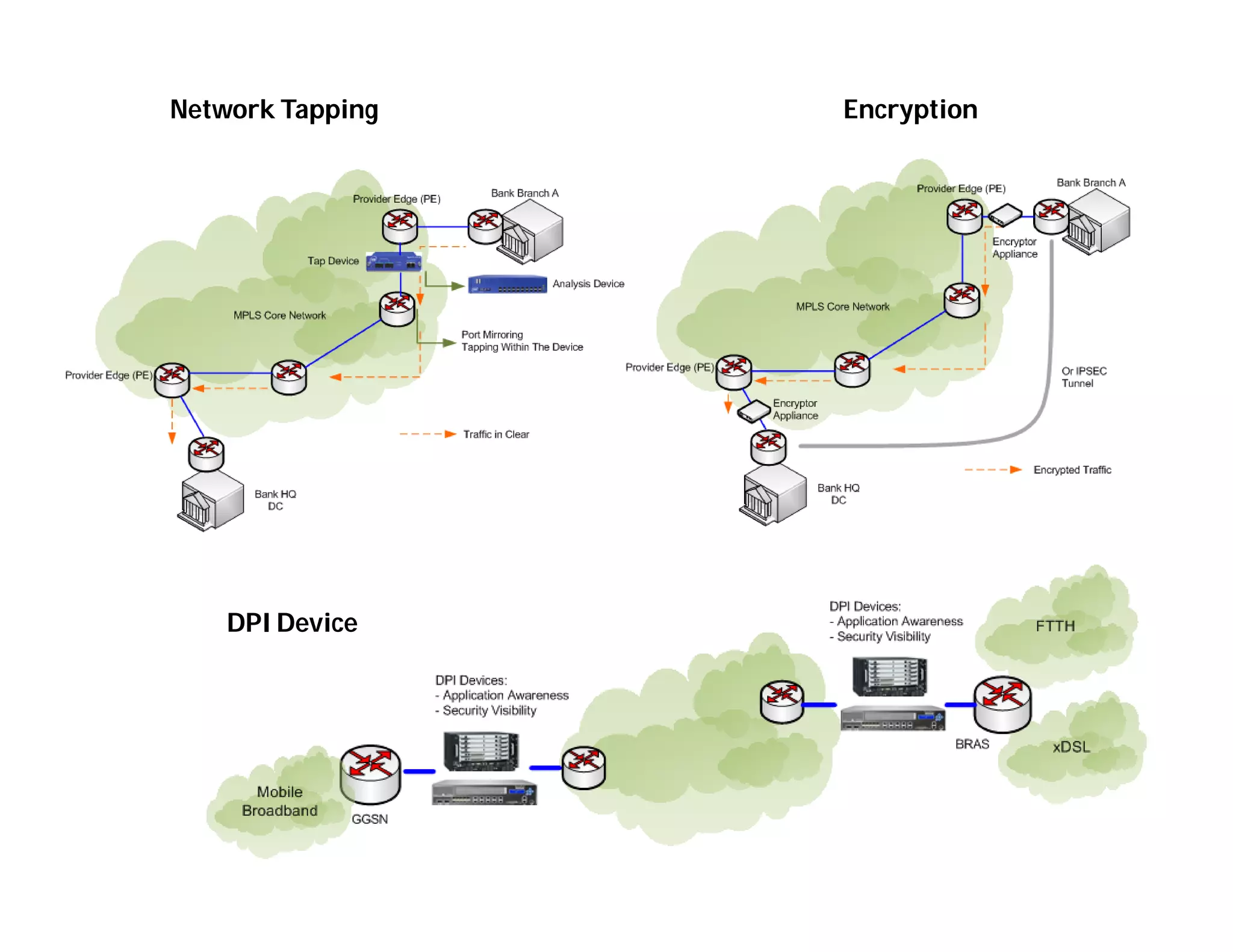
Network Tapping
DPI Device
Encryption
MPLS Label
• Injection of labeled traffic from customer CE router
– RFC 2547, labeled traffic from non trusted sources must be
discarded
• Injection of labeled traffic from Internet
– Again RFC 2547, labeled traffic from non trusted sources must
be discarded
• MPLS label rewriting in MPLS backbone
– Possible, can be reproduced in the Lab, hard (impossible?) to
implement in the real backbone
MPLS Label Rewrite
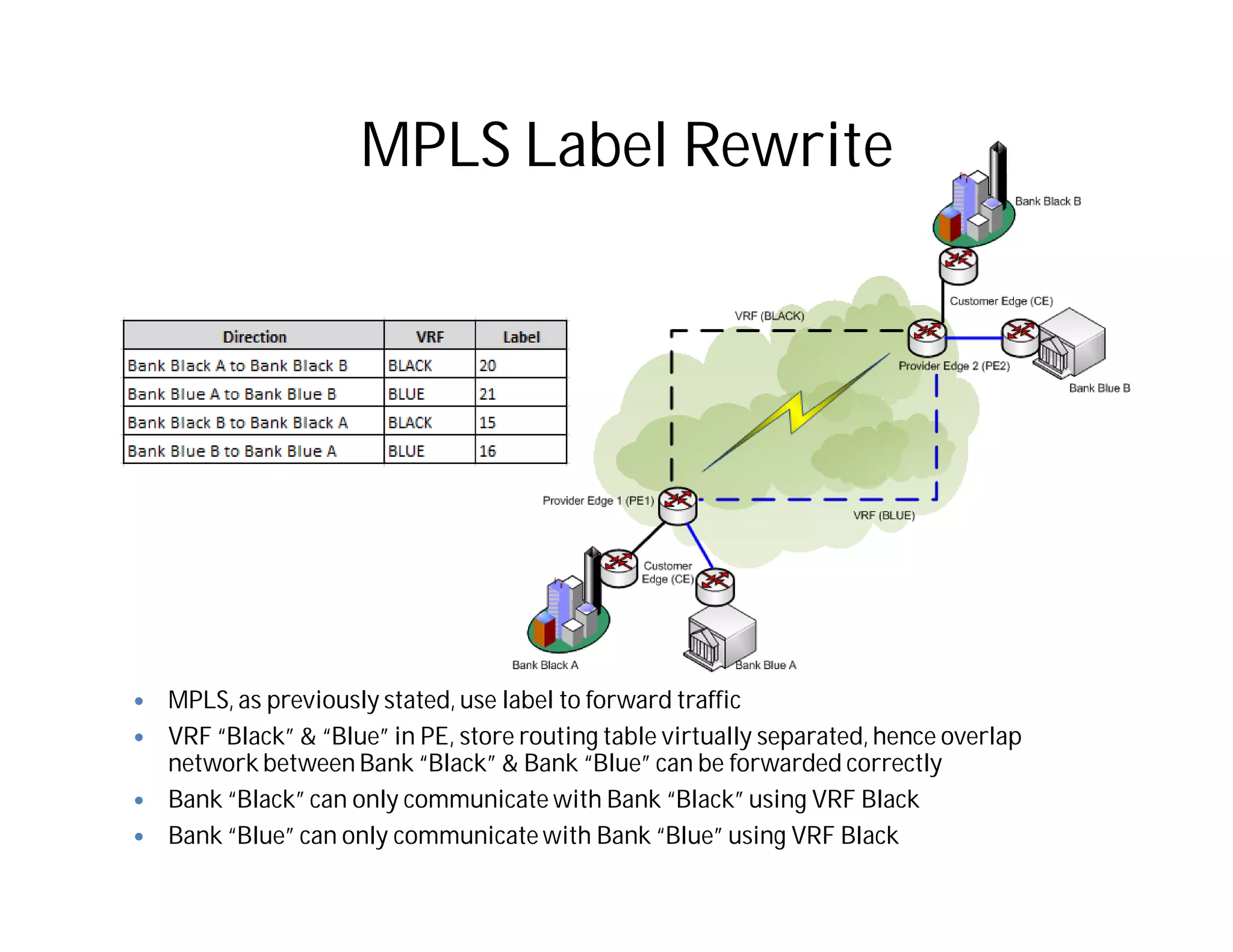
 MPLS, as previously stated, use label to forward traffic
 VRF “Black” & “Blue” in PE, store routing table virtually separated, hence overlap
network between Bank “Black” & Bank “Blue” can be forwarded correctly
 Bank “Black” can only communicate with Bank “Black” using VRF Black
 Bank “Blue” can only communicate with Bank “Blue” using VRF Black
MPLS Label Rewrite
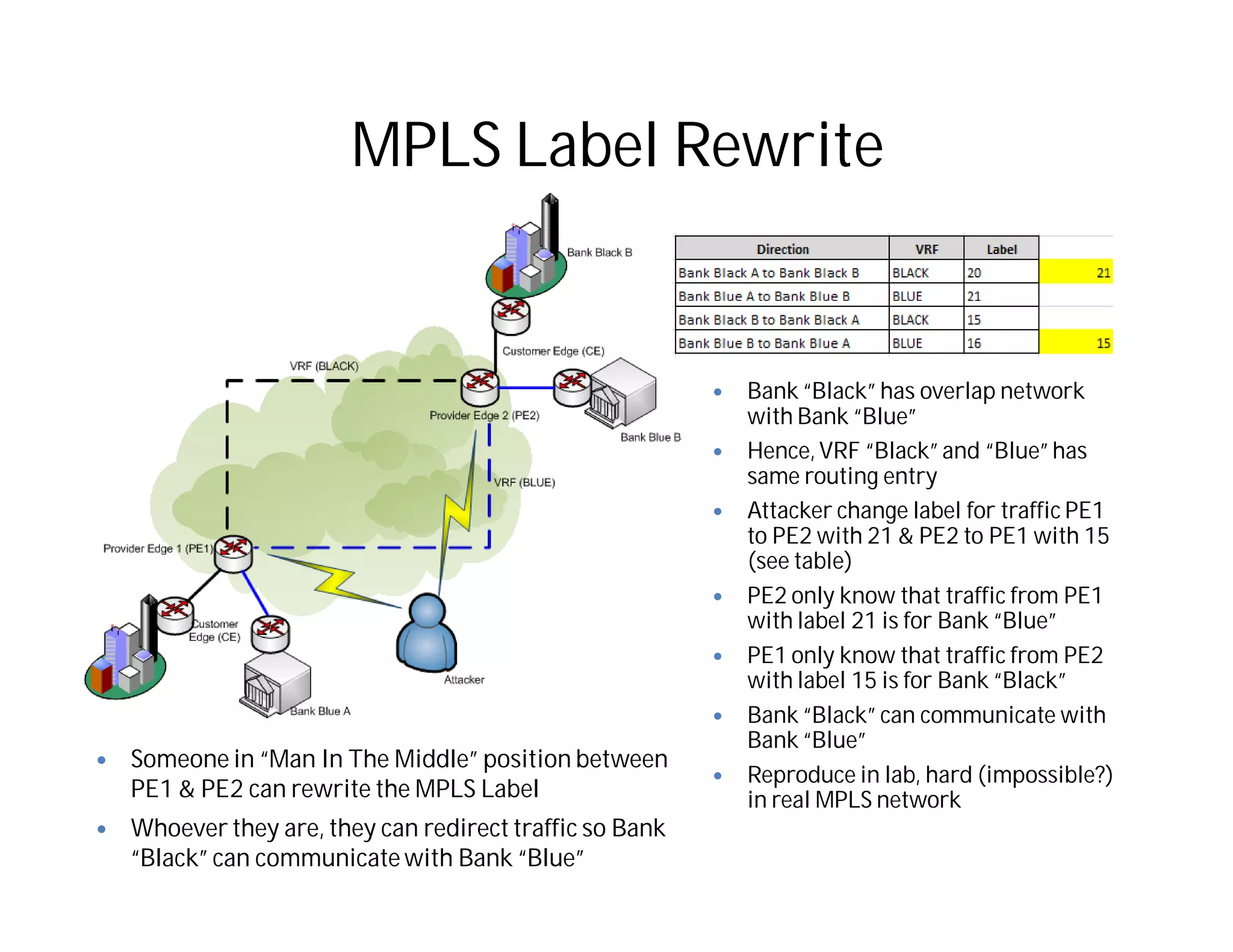
 Someone in “Man In The Middle” position between
PE1 & PE2 can rewrite the MPLS Label
 Whoever they are, they can redirect traffic so Bank
“Black” can communicate with Bank “Blue”
 Bank “Black” has overlap network
with Bank “Blue”
 Hence, VRF “Black” and “Blue” has
same routing entry
 Attacker change label for traffic PE1
to PE2 with 21 & PE2 to PE1 with 15
(see table)
 PE2 only know that traffic from PE1
with label 21 is for Bank “Blue”
 PE1 only know that traffic from PE2
with label 15 is for Bank “Black”
 Bank “Black” can communicate with
Bank “Blue”
 Reproduce in lab, hard (impossible?)
in real MPLS network
Label Distribution Protocol
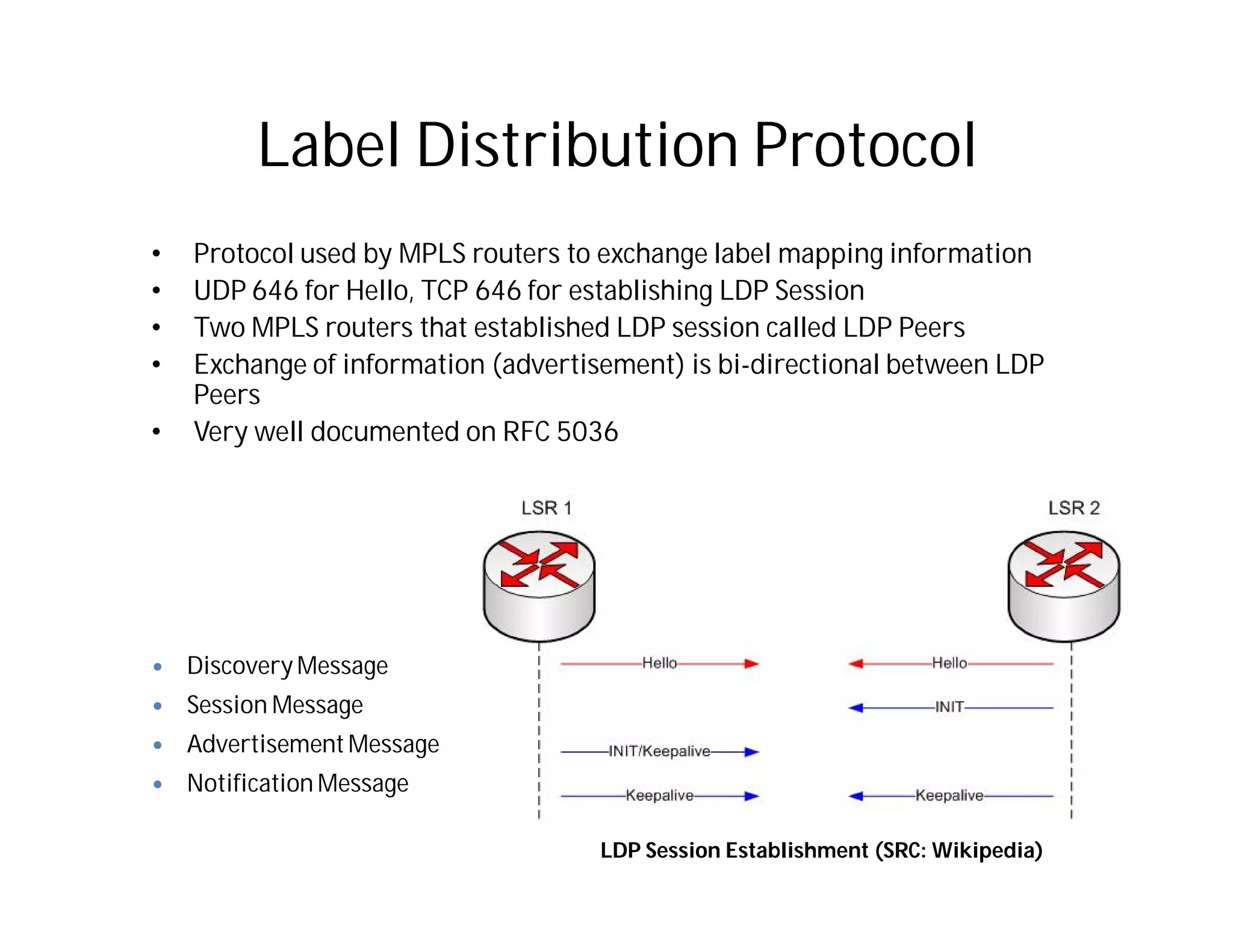
• Protocol used by MPLS routers to exchange label mapping information
• UDP 646 for Hello, TCP 646 for establishing LDP Session
• Two MPLS routers that established LDP session called LDP Peers
• Exchange of information (advertisement) is bi-directional between LDP
Peers
• Very well documented on RFC 5036
LDP Session Establishment (SRC: Wikipedia)
 Discovery Message
 Session Message
 Advertisement Message
 Notification Message
LDP Message Injection
• LDP is used to maintain LSP databases that are used to
forward traffic through MPLS Network
• How if someone can inject label mapping message to LSR?
• Attacker needs access to the MPLS backbone so he can:
1. Announce & maintain the presence of LSR (Hello/Discovery
Message)
2. Establish & maintain LDP session (Session Message)
3. Send advertisement with label mapping message & change label
database to redirect the traffic 
• Again, hard (impossible?) in real MPLS network but can be
reproduced in lab with specific conditions/requirements
Border Gateway Protocol
• MP-BGP, in MPLS network, usually runs between PE router
• It is used to route network which their routing table is in
VRF
• Attacker needs access to MPLS backbone either for:
– Intercept & tamper initial MP-BGP exchange OR
– Withdraw routes & insert new one (BGP Update with spoofed NLRI)
• Again, hard (impossible?) in real MPLS network but can be
reproduced in lab with specific conditions/requirements
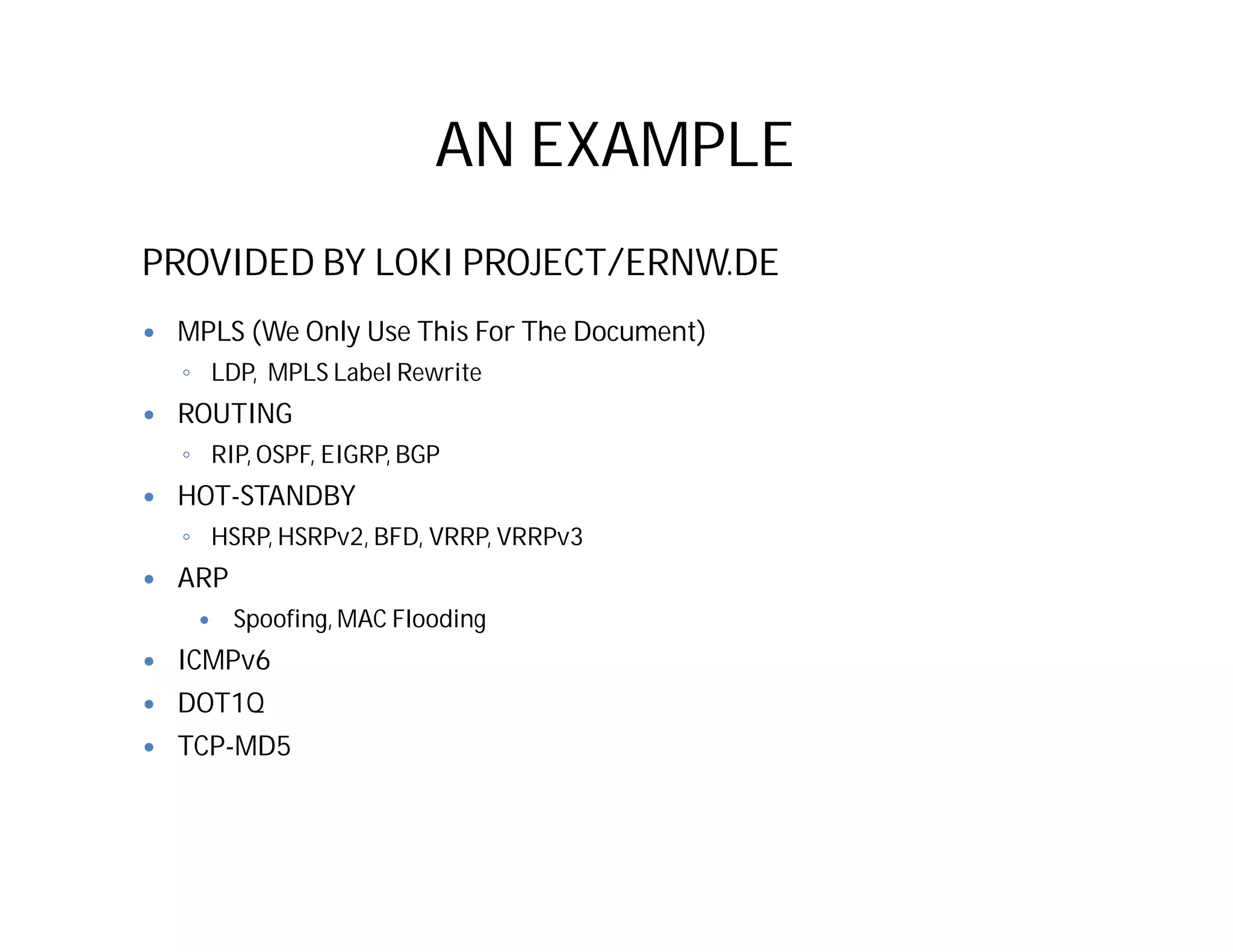
AN EXAMPLE
PROVIDED BY LOKI PROJECT/ERNW.DE
 MPLS (We Only Use This For The Document)
◦ LDP, MPLS Label Rewrite
 ROUTING
◦ RIP, OSPF, EIGRP, BGP
 HOT-STANDBY
◦ HSRP, HSRPv2, BFD, VRRP, VRRPv3
 ARP
 Spoofing, MAC Flooding
 ICMPv6
 DOT1Q
 TCP-MD5
DEMO
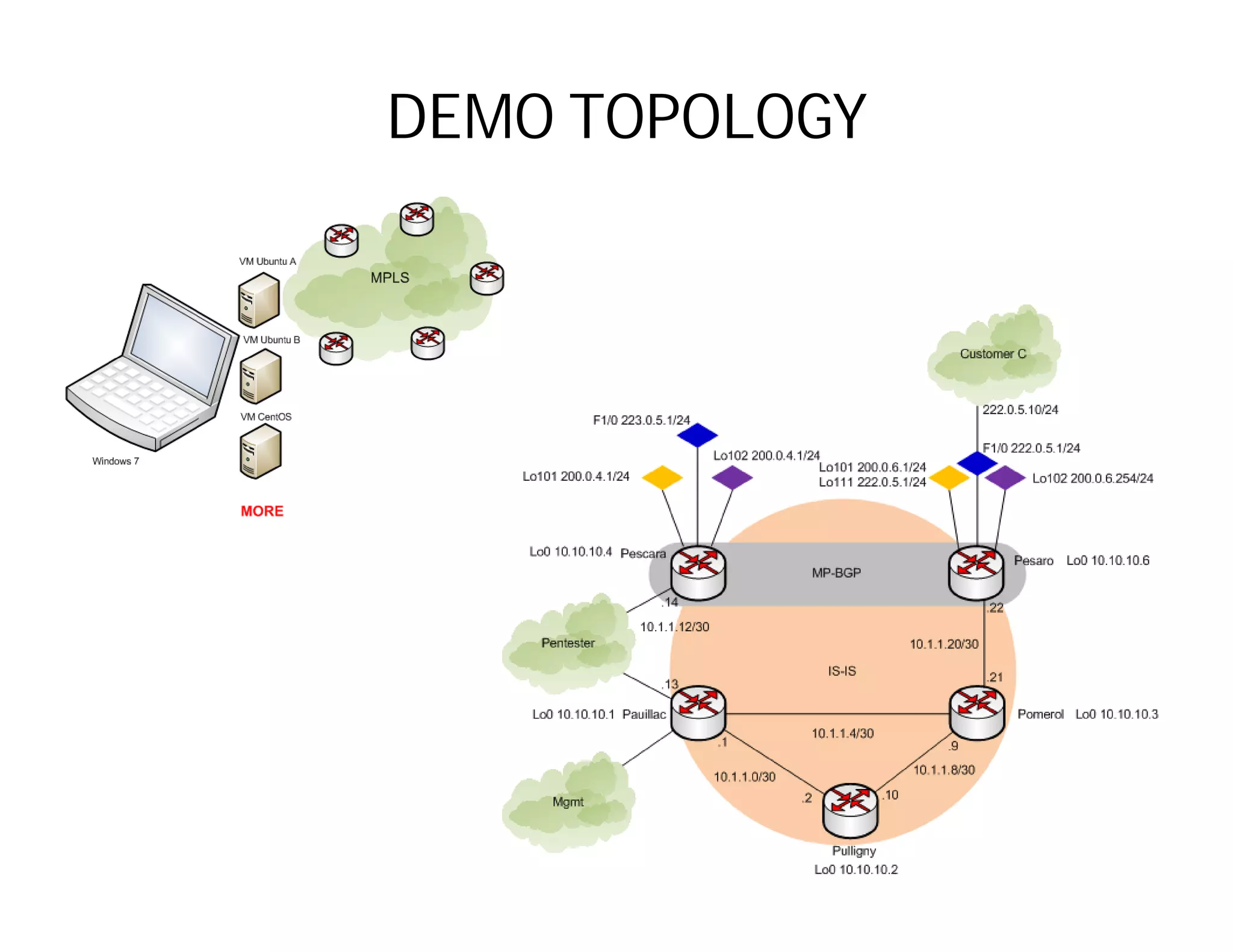
DEMO TOPOLOGY
DISCUSSION?! Q & A
THANK YOU 

Mpls hacking security Myth

  • 1.
    MPLS : Hacking& Security Myth of The Beast In Core Telecommunication Network gcsf@nowhere
  • 2.
    WHY?  TELCO Technology?Industry, Community, Academic?  Ask Others to also share their high quality research  Taking Indonesian Hacking Scene to The Higher Level (?)
  • 3.
    MPLS?  MPLS isrouting mechanism in high-performance network backbone  Route the data traffic from a node to the next node based on short path labels  Avoiding complex forwarding mechanism in routing table  Operate in between layer 2 and layer 3 (OSI model), taking advantage on the layer 2 switching performance and layer 3 routing scalability  MPLS Architecture is very well written on RFC 3031
  • 4.
    MPLS Terminology?  LabelDistribution Protocol (LDP)  Label Switched Path (LSP)  Label Switching Router (LSR)  Label Edge Router (LER) / MPLS Edge Node  Virtual Routing & Forwarding (VRF)  CE/PE/P Router  MORE? (We only describe terminology used in this document)
  • 5.
  • 6.
    MPLS Usage  VirtualPrivate Routed Network (VPRN) – L3VPN  Virtual Private LAN Service (VPLS) – L2VPN  Virtual Leased Line (VLL)  Traffic Engineering  In order to limit this presentation, we will only discuss L3VPN
  • 7.
  • 8.
    Myth - MPLSHacking & Security?  Provider Edge (PE) router  Encryption support  Traffic Sniffing  MPLS Label  Label Distribution Protocol  Border Gateway Protocol REFERENCE : ERNW.DE
  • 9.
    PE Router • Usuallyto be shared among customers • Multiple CE router from multiple customers is connected to the single PE router • Still, the security relies on the trust model of provider private network • Missing configuration of PE router? (E.G: Mgmt Access) • A customer sending crafted packet to PE to deny services
  • 10.
    Encryption Support  MPLSdoesn’t provide encryption mechanism  Encryption of traffic in core telco relies on the encryption mechanism of higher OSI level  The security relies on the trust model of provider private network  There are some appliance that can be used to help the traffic encryption (Eg: SafeNet, Senetas)  IPSEC over MPLS?
  • 11.
    Traffic Sniffing?  P/PERouter?  Remember, by default no encryption support!  Cisco Embeded Packet Capture (EPC)  Cisco “debug packet” with hiden option “dump”  Juniper “set forwarding-options packet-capture”  Port Mirroring is commonly used  Appliance is also commonly used (E.g: VSS, NetOptics)  DPI? LI?
  • 12.
  • 13.
    MPLS Label • Injectionof labeled traffic from customer CE router – RFC 2547, labeled traffic from non trusted sources must be discarded • Injection of labeled traffic from Internet – Again RFC 2547, labeled traffic from non trusted sources must be discarded • MPLS label rewriting in MPLS backbone – Possible, can be reproduced in the Lab, hard (impossible?) to implement in the real backbone
  • 14.
    MPLS Label Rewrite MPLS, as previously stated, use label to forward traffic  VRF “Black” & “Blue” in PE, store routing table virtually separated, hence overlap network between Bank “Black” & Bank “Blue” can be forwarded correctly  Bank “Black” can only communicate with Bank “Black” using VRF Black  Bank “Blue” can only communicate with Bank “Blue” using VRF Black
  • 15.
    MPLS Label Rewrite Someone in “Man In The Middle” position between PE1 & PE2 can rewrite the MPLS Label  Whoever they are, they can redirect traffic so Bank “Black” can communicate with Bank “Blue”  Bank “Black” has overlap network with Bank “Blue”  Hence, VRF “Black” and “Blue” has same routing entry  Attacker change label for traffic PE1 to PE2 with 21 & PE2 to PE1 with 15 (see table)  PE2 only know that traffic from PE1 with label 21 is for Bank “Blue”  PE1 only know that traffic from PE2 with label 15 is for Bank “Black”  Bank “Black” can communicate with Bank “Blue”  Reproduce in lab, hard (impossible?) in real MPLS network
  • 16.
    Label Distribution Protocol •Protocol used by MPLS routers to exchange label mapping information • UDP 646 for Hello, TCP 646 for establishing LDP Session • Two MPLS routers that established LDP session called LDP Peers • Exchange of information (advertisement) is bi-directional between LDP Peers • Very well documented on RFC 5036 LDP Session Establishment (SRC: Wikipedia)  Discovery Message  Session Message  Advertisement Message  Notification Message
  • 17.
    LDP Message Injection •LDP is used to maintain LSP databases that are used to forward traffic through MPLS Network • How if someone can inject label mapping message to LSR? • Attacker needs access to the MPLS backbone so he can: 1. Announce & maintain the presence of LSR (Hello/Discovery Message) 2. Establish & maintain LDP session (Session Message) 3. Send advertisement with label mapping message & change label database to redirect the traffic  • Again, hard (impossible?) in real MPLS network but can be reproduced in lab with specific conditions/requirements
  • 18.
    Border Gateway Protocol •MP-BGP, in MPLS network, usually runs between PE router • It is used to route network which their routing table is in VRF • Attacker needs access to MPLS backbone either for: – Intercept & tamper initial MP-BGP exchange OR – Withdraw routes & insert new one (BGP Update with spoofed NLRI) • Again, hard (impossible?) in real MPLS network but can be reproduced in lab with specific conditions/requirements
  • 19.
    AN EXAMPLE PROVIDED BYLOKI PROJECT/ERNW.DE  MPLS (We Only Use This For The Document) ◦ LDP, MPLS Label Rewrite  ROUTING ◦ RIP, OSPF, EIGRP, BGP  HOT-STANDBY ◦ HSRP, HSRPv2, BFD, VRRP, VRRPv3  ARP  Spoofing, MAC Flooding  ICMPv6  DOT1Q  TCP-MD5
  • 20.
  • 21.
  • 22.
  • 23.