Dr. Mohd. Salleh Punan Malaysian Agricultural Research and Development Institute (MARDI) GOOD MANUFACTURING PRACTICES  IN POSTHARVEST AND  MINIMAL PROCESSING OF  FRUITS AND VEGETABLES Malaysian Agricultural Research and Development Institute Training Course on Product Quality and Safety Management for Fruits and Vegetables, 17 November 2008
Introduction Control of packinghouse Control of raw materials Control of operation  Control of finished-product Traceability Conclusion Content
Liberalization of international trade Domestic and export markets more competitive Increase demand and production Quality and safety awareness Why  post  harvest? Introduction
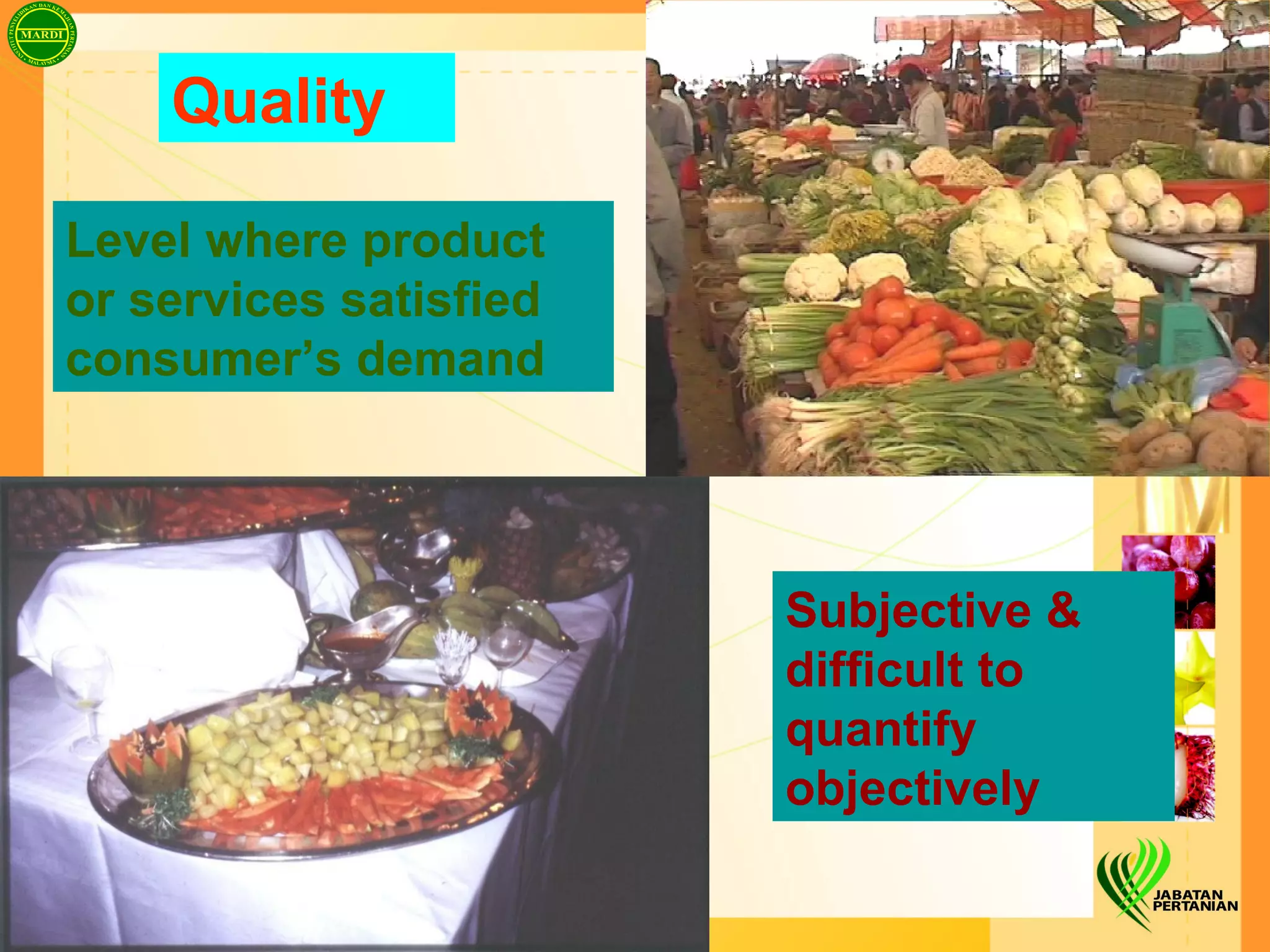
Subjective & difficult to quantify objectively Level where product or services satisfied consumer’s demand Quality
Consistently and reliably delivering products and services that have been predetermined by the markets  Total quality management from production until marketing levels Good Manufacturing Practices
To control variability in: growing techniques seasonal effects postharvest conditions processing techniques facilities human factors market conditions GMP Fruits and Vegetables
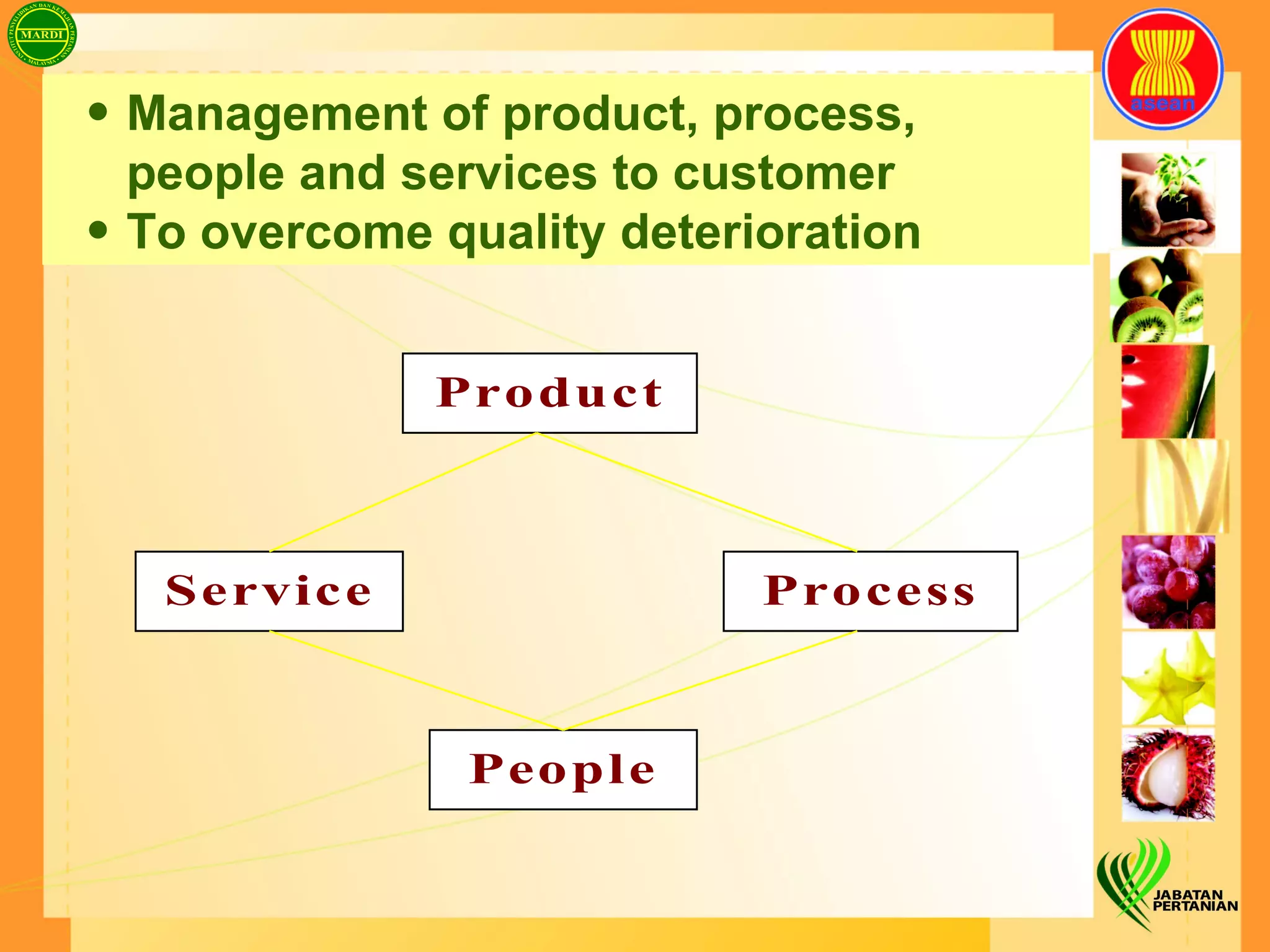
Management of product, process, people and services to customer  To overcome quality deterioration
GAP Requirements (Post harvest) ELEMENTS SALM EUREPGAP HARVESTING Hygiene Farm packing Hygiene Farm packing POST HARVEST Treatment Washing  Treatment Washing
Develop and implement GMP Incorporating GAP, HACCP Use of national and international standards  GMP to Support GAP
Control of packinghouse  Control of raw materials Control of operation  Control of finished-product  Traceability GMP Components
Packinghouse Premises or covered area where most of the preparation and minimal processing activities shall be carried out CONTROL OF PACKINGHOUSE
Location of Packinghouse Packinghouse shall be located away from sources of contamination including environmentally polluted area and area subject to flooding or prone to infestations of pests or where wastes cannot be removed effectively Packinghouse located on farm or in collection/wholesale/distribution centre shall be in a segregated area
Premises Design The premises should be designed in such a way that the raw products from farm enter at one end and the finished products emerge at the other end Unfinished and finished products should be kept separately and never come into contact with each other so as to avoid cross-contamination
Layout Design
Plant hygiene and cleanliness The premises should be well screened with barriers designed to exclude vermin, domestic and wild animals, birds and insects  Pest control and monitoring should be in place Walls, floors and ceilings should be in good condition and easy to clean and sanitize Comprehensive cleaning and sanitation programs should be implemented in the premise, with more emphasis in the minimal processing, packing and storage areas Trash and waste material should be placed in a specific area segregated from the processing and storage areas, and be removed regularly
Facilities Water supply An adequate  supply  of potable water with appropriate facilities for its storage, distribution and temperature control shall be available Potable water shall be used for processing of minimally processed products and washing of food contact surfaces and equipments
Facilities Equipment and Instruments Equipment and utensils used in MP shall be of appropriate design Those surfaces/parts that come into contact with food shall be made of non-toxic, smooth and non-porous materials that can be easily cleaned and sanitized  e.g.  stainless steel
Facilities, equipment, machines and instruments  shall be cleaned and maintained regularly Surface of equipment in contact with food shall be cleaned and sanitized before and after each batch operation All chemical agents such as fuels, additives, fertilizers, pesticides, sanitizers, etc. should be properly labeled and kept separately from food products and packaging material Sanitary Operation
Produce specification from farm Raw material inspection CONTROL OF RAW MATERIALS Raw materials received
Type of produce and variety  Name/code of supplier, farmer, farm Cultural practices  P&D controls Maturity and ripening stage Size & grade of produce Quality, appearance, shape, sweetness, etc. Pesticide and fungicide residual limits Product temperature  Packaging and transportation methods Quantity of supply  Produce specification from farm
Prepared for produce specification from farm Base on National Standards (Malaysian  Standards), Regional Standard (ASEAN Standards) or International Standards (CODEX Standards)  Use specification agreed by both buyer and seller  Raw Material Quality Standards
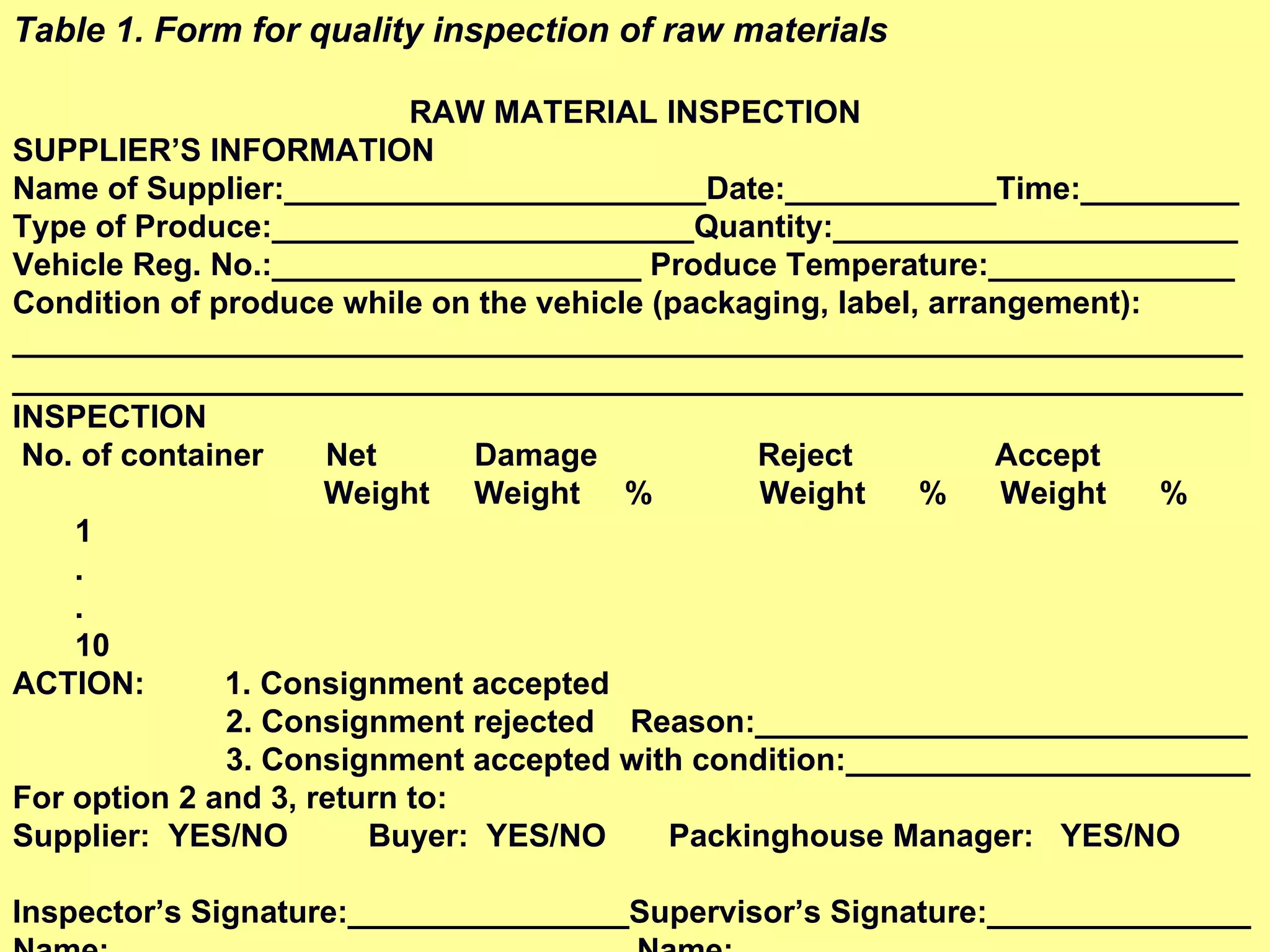
Inspection system conducted consistently Use instruments such as balance, thermometer and caliper  Use Raw Material Specification as reference  Use Quality Form as in  Table 1 Decision to accept or reject consignment based on the inspection Raw Material Inspection
Table 1. Form for quality inspection of raw materials   RAW MATERIAL INSPECTION SUPPLIER’S INFORMATION Name of Supplier:________________________Date:____________Time:_________ Type of Produce:________________________Quantity:_______________________ Vehicle Reg. No.:_____________________ Produce Temperature:______________ Condition of produce while on the vehicle (packaging, label, arrangement): ____________________________________________________________________________________________________________________________________________ INSPECTION No. of container  Net  Damage  Reject  Accept  Weight  Weight  %  Weight  %  Weight  %  1 . . 10 ACTION:  1. Consignment accepted 2. Consignment rejected  Reason:____________________________ 3. Consignment accepted with condition:_______________________ For option 2 and 3, return to: Supplier:  YES/NO  Buyer:  YES/NO  Packinghouse Manager:  YES/NO Inspector’s Signature:________________Supervisor’s Signature:_______________ Name:_____________________________  Name:_____________________________
60-65 days after anthesis 40-45 days after bagging Harvesting &  In-field Handling CONTROL OF OPERATION
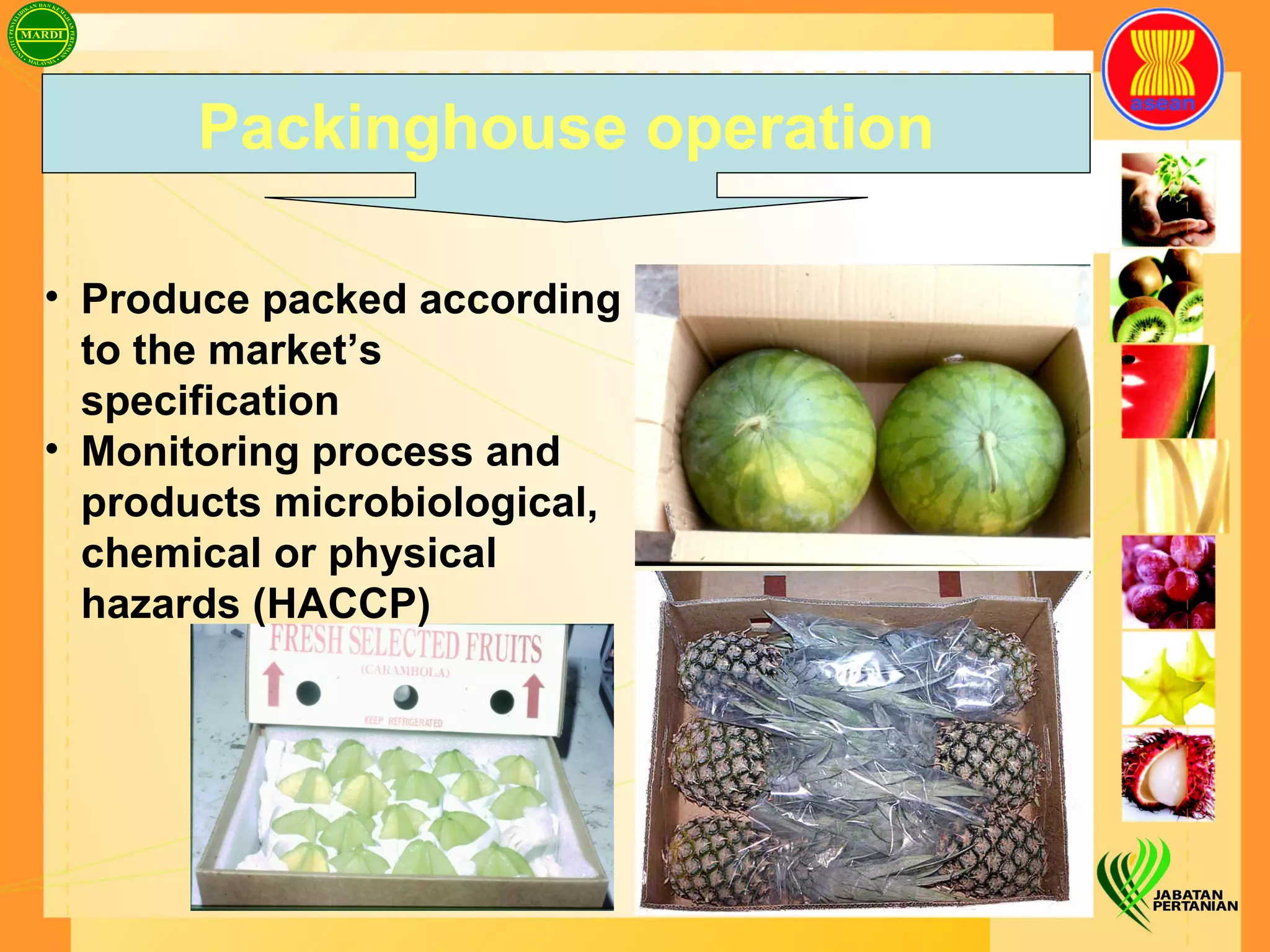
Produce packed according to the market’s specification  Monitoring process and products microbiological, chemical or physical hazards  (HACCP) Packinghouse operation
    Type of Produce and Variety Packer’s Name/Code Size and Grade of Produce Quantity, appearance, shape, sweetness, etc. Packaging and Labelling Storage & Shelf life Tolerance to damage P&D and Quarantine practices  Finished-product Specification
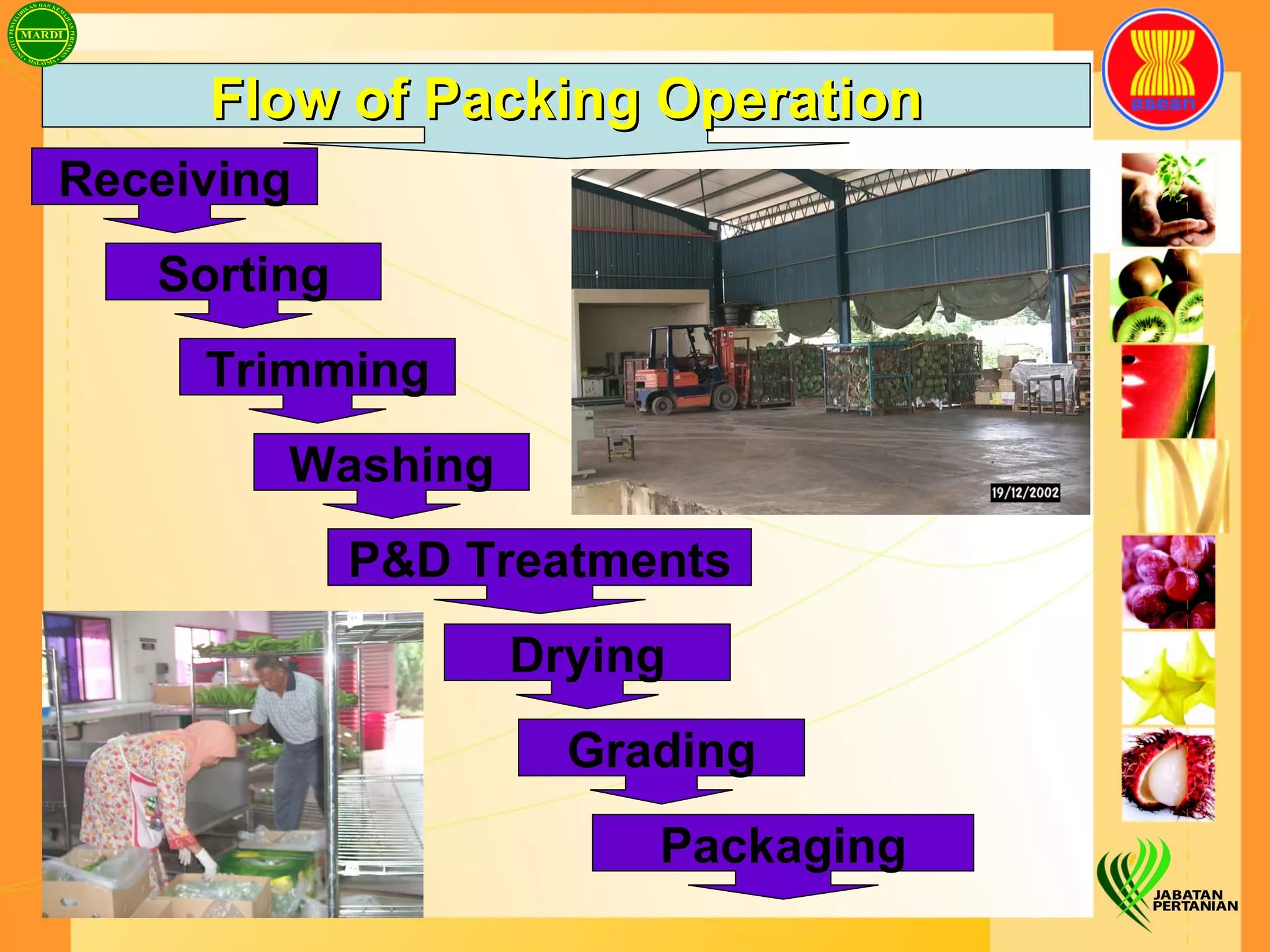
Sorting Trimming Washing Drying Receiving Flow of Packing Operation P&D Treatments Grading Packaging
Produce peel/cut into ready-to-eat portion  Ease in serving portion of large & difficult to peel fruit  Reduce packaging and transportation costs More convenience Maintain freshness Monitoring process and products microbiological, chemical or physical hazards (HACCP) Minimal Processing
Storage Ripening Washing Minimal Processing Packaging Receiving Minimal Processing Unit Operation
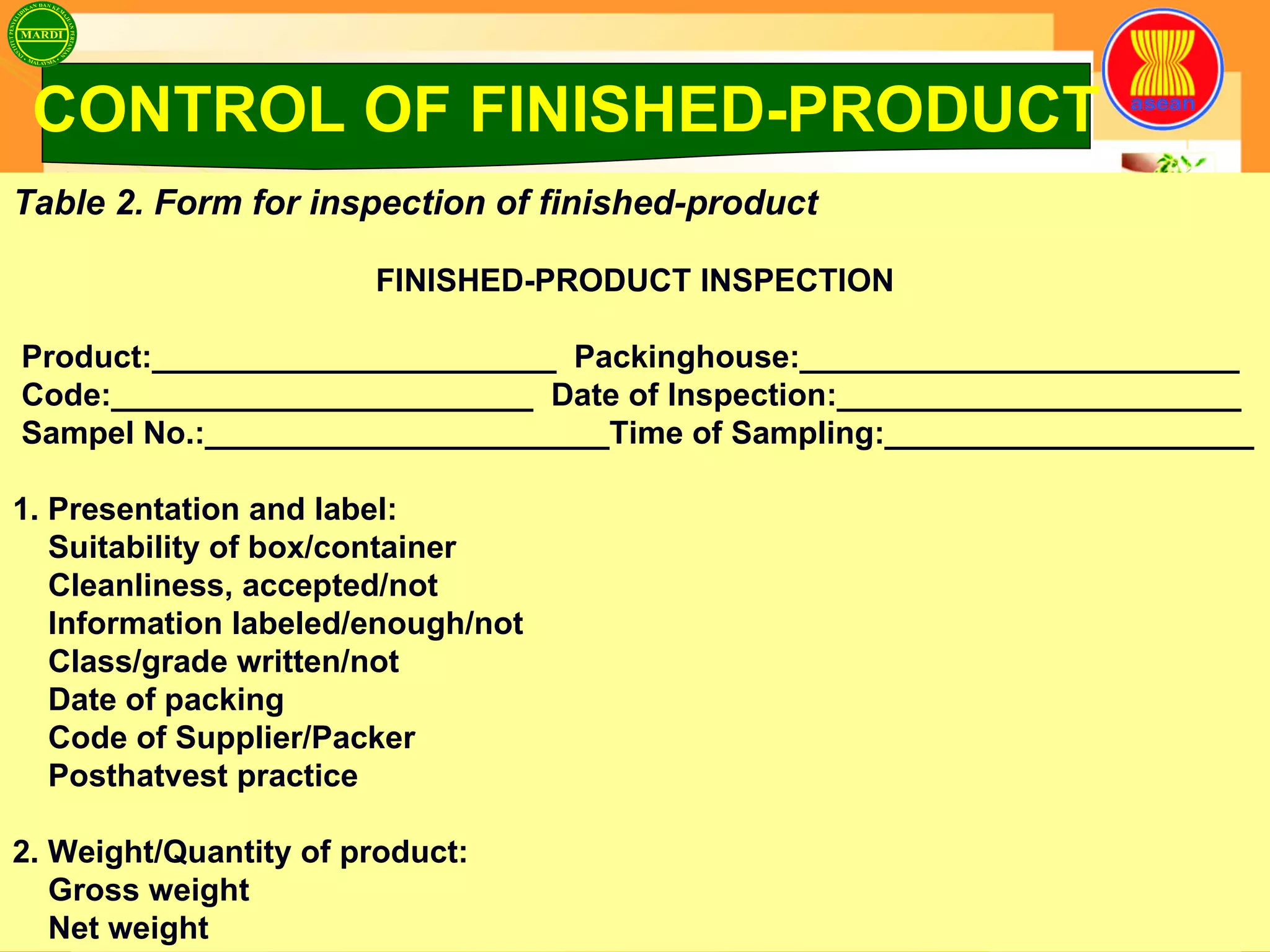
Table 2. Form for inspection of finished-product FINISHED-PRODUCT INSPECTION Product:_______________________  Packinghouse:_________________________ Code:________________________  Date of Inspection:_______________________ Sampel No.:_______________________Time of Sampling:_____________________ 1. Presentation and label: Suitability of box/container Cleanliness, accepted/not Information labeled/enough/not Class/grade written/not  Date of packing  Code of Supplier/Packer Posthatvest practice 2. Weight/Quantity of product: Gross weight Net weight CONTROL OF FINISHED-PRODUCT
3. Product Quality: Total/% comply specification Total/% damage due to: * outside size/weight range * physical /mechanical * rotten/disease  * maturity/ripening  * temperature  * appearance/shape  * others 4. Follow-up handling: Storage/transport temperature Arrangement/palletization ACTION: Product comply all specification:  YES/NO Action taken if not comply specification:__________________________________ Product shelf life could be maintained:  YES/NO  Inspector’s Signature:________________Supervisor’s Signature:_______________ Name:_____________________________  Name:_____________________________
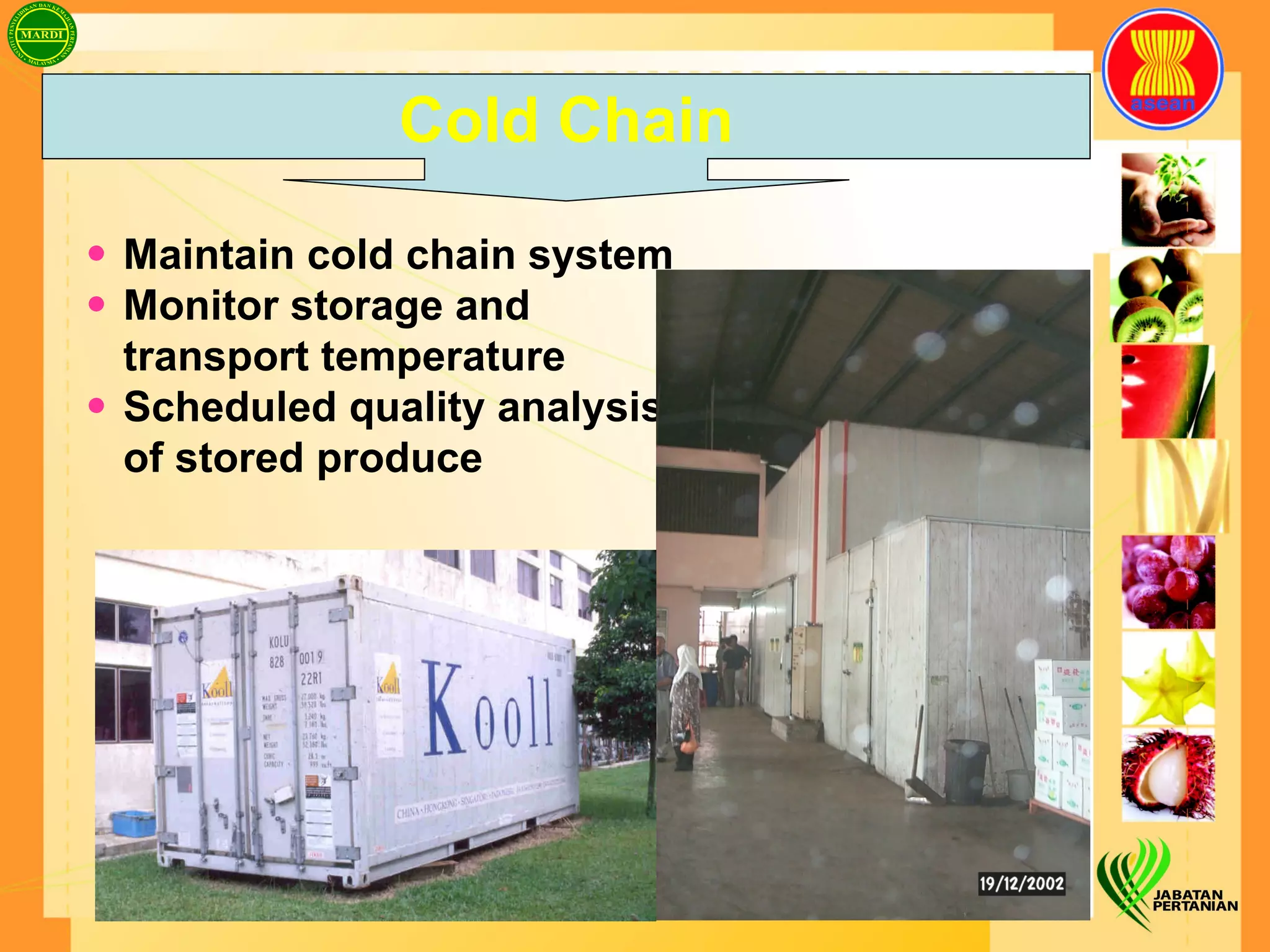
Maintain cold chain system  Monitor storage and transport temperature  Scheduled quality analysis of stored produce Cold Chain
Transportation Domestic Regional Long distance
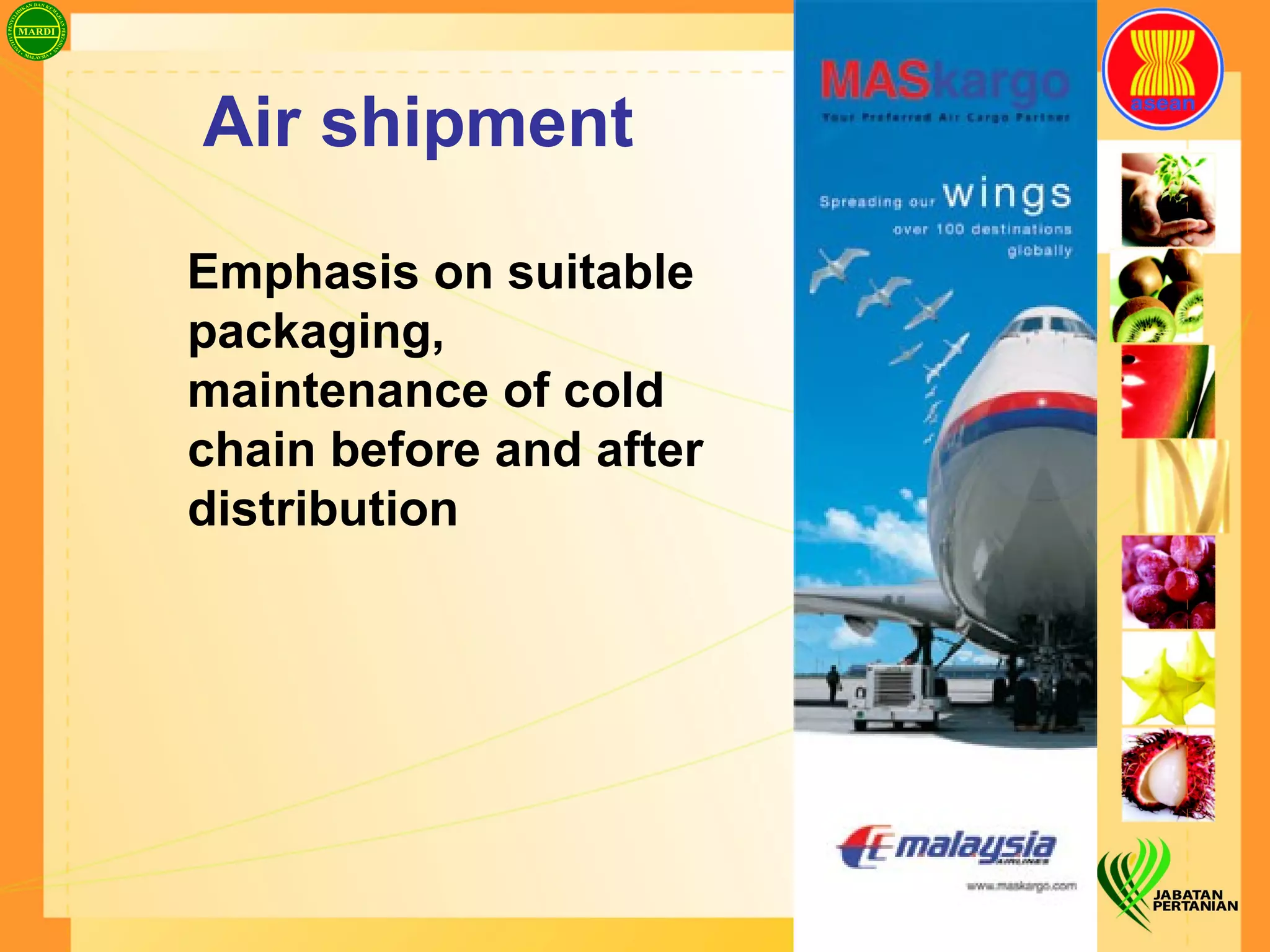
Air shipment Emphasis on suitable packaging, maintenance of cold chain before and after distribution
Sea shipment Refrigeration
Market Display
Quality forms should be prepared and filled by trained inspector All activities, analysis, inspection and quality level of product should be documented Every record should be cleared, dated and signed by supervisor for endorsement  Record & Documentation TRACEABILITY
Specific record book/file should be used for documentation Keep all information systematically for review and auditing from time to time, especially in any dispute on the quality of product supplied by the supplier Record & Documentation
Improvement in quality & safety could be done through the implementation of GMP  High quality and safe produce should be beneficial to all parties Positive measures to improve quality and safety of agricultural produce should be done continuously by all agencies/bodies involve  CONCLUSIONS
Dr. Mohd. Salleh Punan THANK YOU Malaysian Agricultural Research and Development Institute

GMP

  • 1.
    Dr. Mohd. SallehPunan Malaysian Agricultural Research and Development Institute (MARDI) GOOD MANUFACTURING PRACTICES IN POSTHARVEST AND MINIMAL PROCESSING OF FRUITS AND VEGETABLES Malaysian Agricultural Research and Development Institute Training Course on Product Quality and Safety Management for Fruits and Vegetables, 17 November 2008
  • 2.
    Introduction Control ofpackinghouse Control of raw materials Control of operation Control of finished-product Traceability Conclusion Content
  • 3.
    Liberalization of internationaltrade Domestic and export markets more competitive Increase demand and production Quality and safety awareness Why post harvest? Introduction
  • 4.
    Subjective & difficultto quantify objectively Level where product or services satisfied consumer’s demand Quality
  • 5.
    Consistently and reliablydelivering products and services that have been predetermined by the markets Total quality management from production until marketing levels Good Manufacturing Practices
  • 6.
    To control variabilityin: growing techniques seasonal effects postharvest conditions processing techniques facilities human factors market conditions GMP Fruits and Vegetables
  • 7.
    Management of product,process, people and services to customer To overcome quality deterioration
  • 8.
    GAP Requirements (Postharvest) ELEMENTS SALM EUREPGAP HARVESTING Hygiene Farm packing Hygiene Farm packing POST HARVEST Treatment Washing Treatment Washing
  • 9.
    Develop and implementGMP Incorporating GAP, HACCP Use of national and international standards GMP to Support GAP
  • 10.
    Control of packinghouse Control of raw materials Control of operation Control of finished-product Traceability GMP Components
  • 11.
    Packinghouse Premises orcovered area where most of the preparation and minimal processing activities shall be carried out CONTROL OF PACKINGHOUSE
  • 12.
    Location of PackinghousePackinghouse shall be located away from sources of contamination including environmentally polluted area and area subject to flooding or prone to infestations of pests or where wastes cannot be removed effectively Packinghouse located on farm or in collection/wholesale/distribution centre shall be in a segregated area
  • 13.
    Premises Design Thepremises should be designed in such a way that the raw products from farm enter at one end and the finished products emerge at the other end Unfinished and finished products should be kept separately and never come into contact with each other so as to avoid cross-contamination
  • 14.
  • 15.
    Plant hygiene andcleanliness The premises should be well screened with barriers designed to exclude vermin, domestic and wild animals, birds and insects Pest control and monitoring should be in place Walls, floors and ceilings should be in good condition and easy to clean and sanitize Comprehensive cleaning and sanitation programs should be implemented in the premise, with more emphasis in the minimal processing, packing and storage areas Trash and waste material should be placed in a specific area segregated from the processing and storage areas, and be removed regularly
  • 16.
    Facilities Water supplyAn adequate supply of potable water with appropriate facilities for its storage, distribution and temperature control shall be available Potable water shall be used for processing of minimally processed products and washing of food contact surfaces and equipments
  • 17.
    Facilities Equipment andInstruments Equipment and utensils used in MP shall be of appropriate design Those surfaces/parts that come into contact with food shall be made of non-toxic, smooth and non-porous materials that can be easily cleaned and sanitized e.g. stainless steel
  • 18.
    Facilities, equipment, machinesand instruments shall be cleaned and maintained regularly Surface of equipment in contact with food shall be cleaned and sanitized before and after each batch operation All chemical agents such as fuels, additives, fertilizers, pesticides, sanitizers, etc. should be properly labeled and kept separately from food products and packaging material Sanitary Operation
  • 19.
    Produce specification fromfarm Raw material inspection CONTROL OF RAW MATERIALS Raw materials received
  • 20.
    Type of produceand variety Name/code of supplier, farmer, farm Cultural practices P&D controls Maturity and ripening stage Size & grade of produce Quality, appearance, shape, sweetness, etc. Pesticide and fungicide residual limits Product temperature Packaging and transportation methods Quantity of supply Produce specification from farm
  • 21.
    Prepared for producespecification from farm Base on National Standards (Malaysian Standards), Regional Standard (ASEAN Standards) or International Standards (CODEX Standards) Use specification agreed by both buyer and seller Raw Material Quality Standards
  • 22.
    Inspection system conductedconsistently Use instruments such as balance, thermometer and caliper Use Raw Material Specification as reference Use Quality Form as in Table 1 Decision to accept or reject consignment based on the inspection Raw Material Inspection
  • 23.
    Table 1. Formfor quality inspection of raw materials RAW MATERIAL INSPECTION SUPPLIER’S INFORMATION Name of Supplier:________________________Date:____________Time:_________ Type of Produce:________________________Quantity:_______________________ Vehicle Reg. No.:_____________________ Produce Temperature:______________ Condition of produce while on the vehicle (packaging, label, arrangement): ____________________________________________________________________________________________________________________________________________ INSPECTION No. of container Net Damage Reject Accept Weight Weight % Weight % Weight % 1 . . 10 ACTION: 1. Consignment accepted 2. Consignment rejected Reason:____________________________ 3. Consignment accepted with condition:_______________________ For option 2 and 3, return to: Supplier: YES/NO Buyer: YES/NO Packinghouse Manager: YES/NO Inspector’s Signature:________________Supervisor’s Signature:_______________ Name:_____________________________ Name:_____________________________
  • 24.
    60-65 days afteranthesis 40-45 days after bagging Harvesting & In-field Handling CONTROL OF OPERATION
  • 25.
    Produce packed accordingto the market’s specification Monitoring process and products microbiological, chemical or physical hazards (HACCP) Packinghouse operation
  • 26.
      Type of Produce and Variety Packer’s Name/Code Size and Grade of Produce Quantity, appearance, shape, sweetness, etc. Packaging and Labelling Storage & Shelf life Tolerance to damage P&D and Quarantine practices Finished-product Specification
  • 27.
    Sorting Trimming WashingDrying Receiving Flow of Packing Operation P&D Treatments Grading Packaging
  • 28.
    Produce peel/cut intoready-to-eat portion Ease in serving portion of large & difficult to peel fruit Reduce packaging and transportation costs More convenience Maintain freshness Monitoring process and products microbiological, chemical or physical hazards (HACCP) Minimal Processing
  • 29.
    Storage Ripening WashingMinimal Processing Packaging Receiving Minimal Processing Unit Operation
  • 30.
    Table 2. Formfor inspection of finished-product FINISHED-PRODUCT INSPECTION Product:_______________________ Packinghouse:_________________________ Code:________________________ Date of Inspection:_______________________ Sampel No.:_______________________Time of Sampling:_____________________ 1. Presentation and label: Suitability of box/container Cleanliness, accepted/not Information labeled/enough/not Class/grade written/not Date of packing Code of Supplier/Packer Posthatvest practice 2. Weight/Quantity of product: Gross weight Net weight CONTROL OF FINISHED-PRODUCT
  • 31.
    3. Product Quality:Total/% comply specification Total/% damage due to: * outside size/weight range * physical /mechanical * rotten/disease * maturity/ripening * temperature * appearance/shape * others 4. Follow-up handling: Storage/transport temperature Arrangement/palletization ACTION: Product comply all specification: YES/NO Action taken if not comply specification:__________________________________ Product shelf life could be maintained: YES/NO Inspector’s Signature:________________Supervisor’s Signature:_______________ Name:_____________________________ Name:_____________________________
  • 32.
    Maintain cold chainsystem Monitor storage and transport temperature Scheduled quality analysis of stored produce Cold Chain
  • 33.
  • 34.
    Air shipment Emphasison suitable packaging, maintenance of cold chain before and after distribution
  • 35.
  • 36.
  • 37.
    Quality forms shouldbe prepared and filled by trained inspector All activities, analysis, inspection and quality level of product should be documented Every record should be cleared, dated and signed by supervisor for endorsement Record & Documentation TRACEABILITY
  • 38.
    Specific record book/fileshould be used for documentation Keep all information systematically for review and auditing from time to time, especially in any dispute on the quality of product supplied by the supplier Record & Documentation
  • 39.
    Improvement in quality& safety could be done through the implementation of GMP High quality and safe produce should be beneficial to all parties Positive measures to improve quality and safety of agricultural produce should be done continuously by all agencies/bodies involve CONCLUSIONS
  • 40.
    Dr. Mohd. SallehPunan THANK YOU Malaysian Agricultural Research and Development Institute