ATHLETICS
BRENDA E. CACHERO
Kaypian National High School
 Track and field athletics, commonly
known as athletics or track and
field, is a collection of sports events
that involve running, throwing and
jumping. The name "athletics" is
derived from the Greek word "athlos"
meaning "contest".
The Background of Athletics
• Dating back to the Ancient Greeks,
athletics was the only competition
to be held in the first Olympic
Games which took place in Athens

in 776 BC. At that time, the single
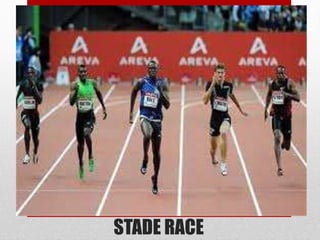
athletic event was known as the
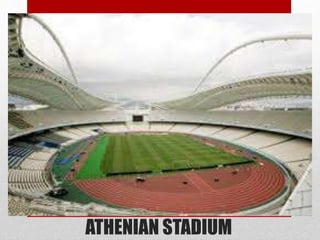
stade, a foot race which covered the
length of the Athenian Olympic
stadium.
STADE RACE
ATHENIAN STADIUM
• In 1896, the first modern Olympic
Games were staged. Although
initially of limited appeal, the
Olympics captured the imagination

of athletes and grew steadily,
making track and field an
international sport for the first time.
• In 1913, the International Amateur
Athletic Federation (IAAF) was
formed by representatives from 16
countries. The IAAF was charged
with establishing standard rules for
the sport, approving world records,
and ensuring that the amateur code
was adhered to; it continues to carry
out these duties today.
TRACK EVENTS
• Track events often involve a field
or a running track, of varying
measurements. These events are
typically held in a 400 meter track.
These include sprints, middle
distance events, long distance
events, hurdles, relays, road running
and race walking.
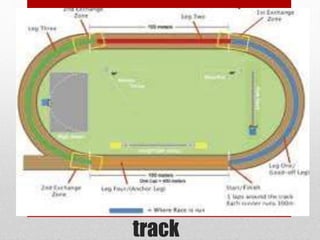
track
The track
• The track consists of eight lanes,
each 1.22 metres (4 feet) wide. The
length of the oval track from end to
end is 157.4 metres (172 yards) in
total. The width of the track oval is
73 metres(80 yards). The radius of
the curve (distance around the
curve) is 36.5 metres (39.9 yards)
Batons
• A baton is a metal cylinder which
weighs about 50 grams (1.76
ounces). It is usually 28-30
centimetres (11-12 inches) in length,
and 12-13 centimetres (4-5 inches)
around.
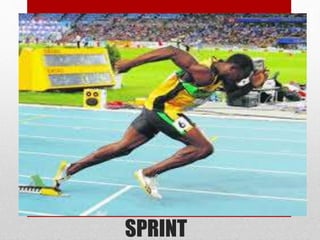
• Sprints are basically racing events
involving distances ranging from 100
meters to 400 meters.
• Middle distance events on the other hand,
range from 800 meters to 3000 meters.
The standard distances are in multiples of
8--> 800 meters, 1600 meters and 3200
meters. A variation of the middle distance
event is the steeplechase which involves
overcoming barriers and water jumps
along a 3,000 m track.
SPRINT
• Long distance 5 events include
marathons, or any event covering
more than 5,000 meters. The standard
distances for long distance sprints are
5000 meters and 10000 meters.
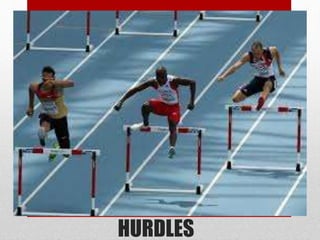
Hurdles
• are track events for the simple reason
that they done in a track field.
• hurdle races are run as sprints, runners
jump over ten hurdles in the specified
distance
• It is an event where participants race
to the finish line while leaping over
obstacles along the way. The standard
distance is 110 meters or 100 meters
for women, and 400 meters for men
HURDLES
Relay
• are track events that involve a team
of performers
• relay racing is run as a sprint, but
instead of one runner completing the
entire distance, there are teams. One
runner will run some of the distance,
passing the baton to the next runner
so that the next runner completes the
next set of the track.
RELAYS
• The standard distance and rounds for
relays are 4 x 100 (in which 4 is the
number of players, and 100 is the
number of meters to be run by each
player).
Two types of relay
• Distance medley relay, which is a
relay consisting of different
distances for each participant in a
team.
• Sprint medley consists of a single
400 m, followed by 2 200 m runs
then ending with an 800m run.
DISTANCE MEDLEY RELAY
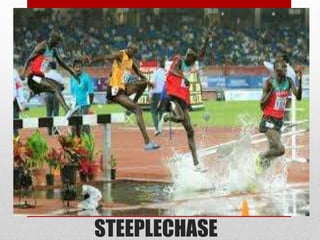
Steeplechase
• The steeplechase is an obstacle race in athletics,
which derives its name from the steeplechase in
horse racing. There are three main distances that
the steeplechase includes.
1500 metres
2000 metres
3000 metres
• The steeplechase is a race run around the track
as a normal long distance race, 21 but there are
barriers and water jumps.
STEEPLECHASE
FIELD EVENTS
• Field events are among the most
exciting sports in the world of
athletics. They combine strength,
technique, speed, grace, power,
flexibility, and of course,
competitiveness.
two major events
• the jumping events
• the throwing events.
These two events not only
differ in skills needed, but also in
the physical demands they put on
the athletes.
• Throwing events are divided into
four categories:
1. Shot Put,
2. Hammer Throw
3. Javelin Throw and
4. Discus Throw
Shot Put
• This event is all about transferring
huge strength through the legs, arms
and fingers to throw the shot. There
are two techniques for delivery.
1. The first is the rotational technique
2. linear method which is more
popular
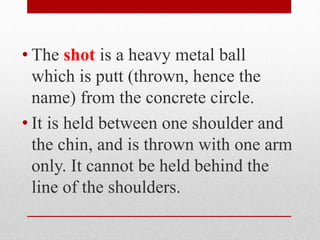
• The shot is a heavy metal ball
which is putt (thrown, hence the
name) from the concrete circle.
• It is held between one shoulder and
the chin, and is thrown with one arm
only. It cannot be held behind the
line of the shoulders.
SHOT PUT
Hammer Throw
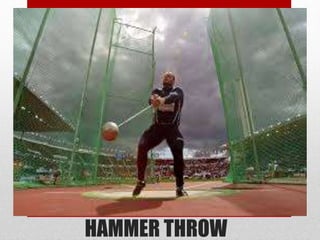
• The hammer is a heavy metal ball,
like the shot, on the end of a wire.
There is a swivel attaching the wire
to the ball, and a triangular handle at
the other end of the wire.
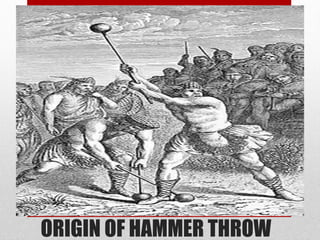
ORIGIN OF HAMMER THROW
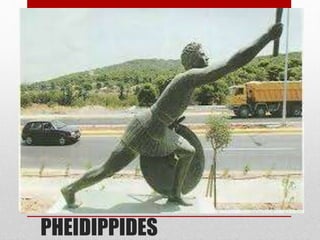
PHEIDIPPIDES
HAMMER THROW
Javelin
• The javelin is about optimum power,
speed and rhythm. And it's a brilliantly
fun event to do too. Among the four
events, the javelin throw is the only
event that requires the competitor to
run in order to build momentum.
• The javelin is a little like a spear. It
made of metal alloy, and has a sharp
point, a shaft, and a cord grip for when
it is held prior to throwing.
JAVELIN THROW
Discus
• The discus requires power, great
speed and lots of spinning.
• A discus is shaped like two plates
put together face to face. It is made
from plastic and wood, and usually
edged with metal
STATUE OF ALKAMENES
DISCUS THROW
• Jumping events are divided into four
categories, excluding the events
which are considered uncommon.
These four events are the:
1. High Jump
2. Long Jump,
3. Triple Jump and
4. Pole Vault
• The high jump resembles the pole vault in
the sense that the athletes compete to
achieve the greatest height, while the long
jump and triple jump both measure the
longest horizontal distance achieved.
Among the four events, the pole vault is
the only one that makes use of an external
instrument (the pole) in order to help the
athlete achieve his goal.
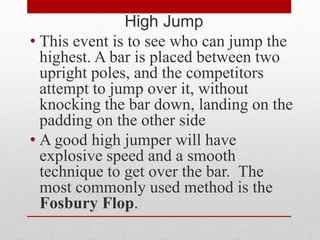
High Jump
• This event is to see who can jump the
highest. A bar is placed between two
upright poles, and the competitors
attempt to jump over it, without
knocking the bar down, landing on the
padding on the other side
• A good high jumper will have
explosive speed and a smooth
technique to get over the bar. The
most commonly used method is the
Fosbury Flop.
HIGH JUMP
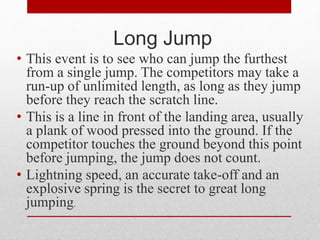
Long Jump
• This event is to see who can jump the furthest
from a single jump. The competitors may take a
run-up of unlimited length, as long as they jump
before they reach the scratch line.
• This is a line in front of the landing area, usually
a plank of wood pressed into the ground. If the
competitor touches the ground beyond this point
before jumping, the jump does not count.
• Lightning speed, an accurate take-off and an
explosive spring is the secret to great long
jumping.
LONG JUMP
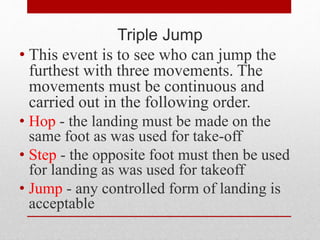
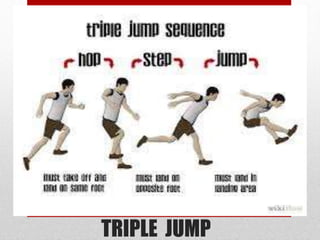
Triple Jump
• This event is to see who can jump the
furthest with three movements. The
movements must be continuous and
carried out in the following order.
• Hop - the landing must be made on the
same foot as was used for take-off
• Step - the opposite foot must then be used
for landing as was used for takeoff
• Jump - any controlled form of landing is
acceptable
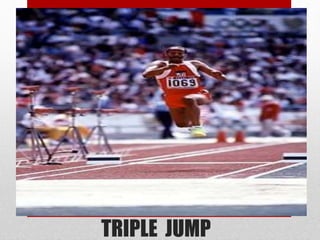
TRIPLE JUMP
TRIPLE JUMP
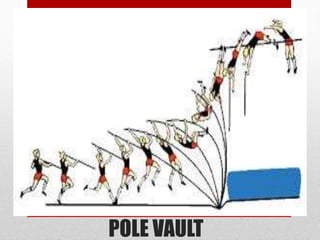
Pole Vaulting
• Pole vaulting is described as an
adrenaline-fuelled extreme sport
and is one of the most exciting
events in athletics.
POLE VAULT
POLE VAULT
Thank You
for Listening!!!!
Activity No. 2 Identification
Below are list of words/choices that you can choose
from to answer the following questions. Please write
your answers in your journal/notebook.
Discus Throw Hurdles Sprints Relay
Track and Field High Jump Javelin Throw
Shot put Athletics
Pole Vault Triple Jump Track
__________1. These are basically
racing events involving distances
ranging from 100 meters to 400
meters.
__________2. Track events that
involve a team of performers Sprints
are basically racing events involving
distances ranging from.
__________3. This event is all about
transferring huge strength through the
legs, arms and fingers to throw the
shot. The implement is like an iron
ball.
__________4. This jump resembles the
pole vault in the sense that the athletes
compete to achieve the greatest height.
__________5. Among the four
jumping events, this is the only one
that makes use of an external
instrument in order to help the athlete
achieve his goal.
__________6. It is an event where
participants race to the finish line
while leaping over obstacles along
the way.
__________7. Among the four
events, this throw is the only event
that requires the competitor to run in
order to build momentum.
__________8. These are events that
are typically held in a 400 meter
track.
__________9. It is an implement
in athletics that resembles a dish.
__________10. It is commonly
known as athletics or track and
field.

ATHLETICS

  • 1.
  • 2.
     Track andfield athletics, commonly known as athletics or track and field, is a collection of sports events that involve running, throwing and jumping. The name "athletics" is derived from the Greek word "athlos" meaning "contest". The Background of Athletics
  • 3.
    • Dating backto the Ancient Greeks, athletics was the only competition to be held in the first Olympic Games which took place in Athens in 776 BC. At that time, the single athletic event was known as the stade, a foot race which covered the length of the Athenian Olympic stadium.
  • 4.
  • 5.
  • 6.
    • In 1896,the first modern Olympic Games were staged. Although initially of limited appeal, the Olympics captured the imagination of athletes and grew steadily, making track and field an international sport for the first time.
  • 7.
    • In 1913,the International Amateur Athletic Federation (IAAF) was formed by representatives from 16 countries. The IAAF was charged with establishing standard rules for the sport, approving world records, and ensuring that the amateur code was adhered to; it continues to carry out these duties today.
  • 8.
  • 9.
    • Track eventsoften involve a field or a running track, of varying measurements. These events are typically held in a 400 meter track. These include sprints, middle distance events, long distance events, hurdles, relays, road running and race walking.
  • 10.
  • 11.
    The track • Thetrack consists of eight lanes, each 1.22 metres (4 feet) wide. The length of the oval track from end to end is 157.4 metres (172 yards) in total. The width of the track oval is 73 metres(80 yards). The radius of the curve (distance around the curve) is 36.5 metres (39.9 yards)
  • 12.
    Batons • A batonis a metal cylinder which weighs about 50 grams (1.76 ounces). It is usually 28-30 centimetres (11-12 inches) in length, and 12-13 centimetres (4-5 inches) around.
  • 13.
    • Sprints arebasically racing events involving distances ranging from 100 meters to 400 meters. • Middle distance events on the other hand, range from 800 meters to 3000 meters. The standard distances are in multiples of 8--> 800 meters, 1600 meters and 3200 meters. A variation of the middle distance event is the steeplechase which involves overcoming barriers and water jumps along a 3,000 m track.
  • 14.
  • 15.
    • Long distance5 events include marathons, or any event covering more than 5,000 meters. The standard distances for long distance sprints are 5000 meters and 10000 meters.
  • 16.
    Hurdles • are trackevents for the simple reason that they done in a track field. • hurdle races are run as sprints, runners jump over ten hurdles in the specified distance • It is an event where participants race to the finish line while leaping over obstacles along the way. The standard distance is 110 meters or 100 meters for women, and 400 meters for men
  • 17.
  • 18.
    Relay • are trackevents that involve a team of performers • relay racing is run as a sprint, but instead of one runner completing the entire distance, there are teams. One runner will run some of the distance, passing the baton to the next runner so that the next runner completes the next set of the track.
  • 19.
  • 20.
    • The standarddistance and rounds for relays are 4 x 100 (in which 4 is the number of players, and 100 is the number of meters to be run by each player).
  • 21.
    Two types ofrelay • Distance medley relay, which is a relay consisting of different distances for each participant in a team. • Sprint medley consists of a single 400 m, followed by 2 200 m runs then ending with an 800m run.
  • 22.
  • 23.
    Steeplechase • The steeplechaseis an obstacle race in athletics, which derives its name from the steeplechase in horse racing. There are three main distances that the steeplechase includes. 1500 metres 2000 metres 3000 metres • The steeplechase is a race run around the track as a normal long distance race, 21 but there are barriers and water jumps.
  • 24.
  • 25.
  • 26.
    • Field eventsare among the most exciting sports in the world of athletics. They combine strength, technique, speed, grace, power, flexibility, and of course, competitiveness.
  • 27.
    two major events •the jumping events • the throwing events. These two events not only differ in skills needed, but also in the physical demands they put on the athletes.
  • 28.
    • Throwing eventsare divided into four categories: 1. Shot Put, 2. Hammer Throw 3. Javelin Throw and 4. Discus Throw
  • 29.
    Shot Put • Thisevent is all about transferring huge strength through the legs, arms and fingers to throw the shot. There are two techniques for delivery. 1. The first is the rotational technique 2. linear method which is more popular
  • 30.
    • The shotis a heavy metal ball which is putt (thrown, hence the name) from the concrete circle. • It is held between one shoulder and the chin, and is thrown with one arm only. It cannot be held behind the line of the shoulders.
  • 31.
  • 32.
    Hammer Throw • Thehammer is a heavy metal ball, like the shot, on the end of a wire. There is a swivel attaching the wire to the ball, and a triangular handle at the other end of the wire.
  • 33.
  • 34.
  • 35.
  • 36.
    Javelin • The javelinis about optimum power, speed and rhythm. And it's a brilliantly fun event to do too. Among the four events, the javelin throw is the only event that requires the competitor to run in order to build momentum. • The javelin is a little like a spear. It made of metal alloy, and has a sharp point, a shaft, and a cord grip for when it is held prior to throwing.
  • 37.
  • 38.
    Discus • The discusrequires power, great speed and lots of spinning. • A discus is shaped like two plates put together face to face. It is made from plastic and wood, and usually edged with metal
  • 39.
  • 40.
  • 41.
    • Jumping eventsare divided into four categories, excluding the events which are considered uncommon. These four events are the: 1. High Jump 2. Long Jump, 3. Triple Jump and 4. Pole Vault
  • 42.
    • The highjump resembles the pole vault in the sense that the athletes compete to achieve the greatest height, while the long jump and triple jump both measure the longest horizontal distance achieved. Among the four events, the pole vault is the only one that makes use of an external instrument (the pole) in order to help the athlete achieve his goal.
  • 43.
    High Jump • Thisevent is to see who can jump the highest. A bar is placed between two upright poles, and the competitors attempt to jump over it, without knocking the bar down, landing on the padding on the other side • A good high jumper will have explosive speed and a smooth technique to get over the bar. The most commonly used method is the Fosbury Flop.
  • 44.
  • 45.
    Long Jump • Thisevent is to see who can jump the furthest from a single jump. The competitors may take a run-up of unlimited length, as long as they jump before they reach the scratch line. • This is a line in front of the landing area, usually a plank of wood pressed into the ground. If the competitor touches the ground beyond this point before jumping, the jump does not count. • Lightning speed, an accurate take-off and an explosive spring is the secret to great long jumping.
  • 46.
  • 47.
    Triple Jump • Thisevent is to see who can jump the furthest with three movements. The movements must be continuous and carried out in the following order. • Hop - the landing must be made on the same foot as was used for take-off • Step - the opposite foot must then be used for landing as was used for takeoff • Jump - any controlled form of landing is acceptable
  • 48.
  • 49.
  • 50.
    Pole Vaulting • Polevaulting is described as an adrenaline-fuelled extreme sport and is one of the most exciting events in athletics.
  • 51.
  • 52.
  • 53.
  • 54.
    Activity No. 2Identification Below are list of words/choices that you can choose from to answer the following questions. Please write your answers in your journal/notebook. Discus Throw Hurdles Sprints Relay Track and Field High Jump Javelin Throw Shot put Athletics Pole Vault Triple Jump Track
  • 55.
    __________1. These arebasically racing events involving distances ranging from 100 meters to 400 meters.
  • 56.
    __________2. Track eventsthat involve a team of performers Sprints are basically racing events involving distances ranging from.
  • 57.
    __________3. This eventis all about transferring huge strength through the legs, arms and fingers to throw the shot. The implement is like an iron ball.
  • 58.
    __________4. This jumpresembles the pole vault in the sense that the athletes compete to achieve the greatest height.
  • 59.
    __________5. Among thefour jumping events, this is the only one that makes use of an external instrument in order to help the athlete achieve his goal.
  • 60.
    __________6. It isan event where participants race to the finish line while leaping over obstacles along the way.
  • 61.
    __________7. Among thefour events, this throw is the only event that requires the competitor to run in order to build momentum.
  • 62.
    __________8. These areevents that are typically held in a 400 meter track.
  • 63.
    __________9. It isan implement in athletics that resembles a dish.
  • 64.
    __________10. It iscommonly known as athletics or track and field.