54
1 2 3
6
Objectives
•define dance;
•identify the different types of dance;
•share the importance of dancing in life; and
•perform a dance routine combining the different
types of dance.
DanceMove rhythmically to music, typically following
a set sequence of steps.
Dance is a performing art form consisting of
purposefully selected sequences of human
movement.
Typesof Dance
•Traditional Dance
•Modern and
Contemporary Dance
•Ballroom Dance
•CheerDance
•Hip-hop/Street Dance
•Festival Dance
Traditional Dance
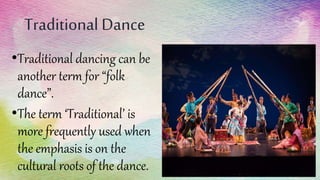
•Traditional dancing can be
another term for “folk
dance”.
•The term ‘Traditional’ is
more frequently used when
the emphasis is on the
cultural roots of the dance.
Modernand Contemporary Dance
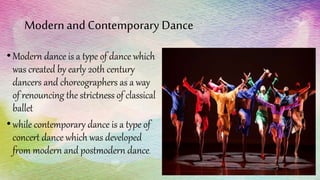
•Modern dance is a type of dance which
was created by early 20th century
dancers and choreographers as a way
of renouncing the strictness of classical
ballet
•while contemporary dance is a type of
concert dance which was developed
from modern and postmodern dance.
Ballroom Dance
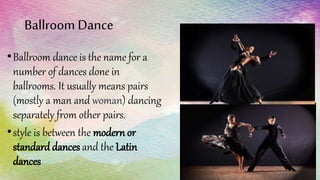
•Ballroom dance is the name for a
number of dances done in
ballrooms. It usually means pairs
(mostly a man and woman) dancing
separately from other pairs.
•style is between the modern or
standard dances and the Latin
dances
Cheer Dance
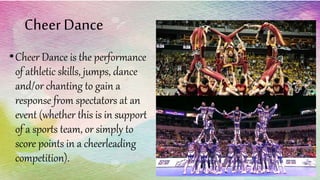
•Cheer Dance is the performance
of athletic skills, jumps, dance
and/or chanting to gain a
response from spectators at an
event (whether this is in support
of a sports team, or simply to
score points in a cheerleading
competition).
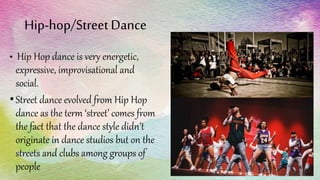
Hip-hop/Street Dance
• Hip Hop dance is very energetic,
expressive, improvisational and
social.
•Street dance evolved from Hip Hop
dance as the term ‘street’ comes from
the fact that the dance style didn’t
originate in dance studios but on the
streets and clubs among groups of
people
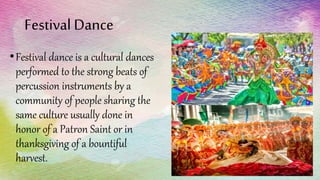
Festival Dance
•Festival dance is a cultural dances
performed to the strong beats of
percussion instruments by a
community of people sharing the
same culture usually done in
honor of a Patron Saint or in
thanksgiving of a bountiful
harvest.
•
Activity
• In a group create a 2 minutes DANCE
ROUTINE showing the different types of
dances.
•
Thank You
•

Dance: Different Types of Dance

  • 1.
  • 3.
    Objectives •define dance; •identify thedifferent types of dance; •share the importance of dancing in life; and •perform a dance routine combining the different types of dance.
  • 4.
    DanceMove rhythmically tomusic, typically following a set sequence of steps. Dance is a performing art form consisting of purposefully selected sequences of human movement.
  • 5.
    Typesof Dance •Traditional Dance •Modernand Contemporary Dance •Ballroom Dance •CheerDance •Hip-hop/Street Dance •Festival Dance
  • 6.
    Traditional Dance •Traditional dancingcan be another term for “folk dance”. •The term ‘Traditional’ is more frequently used when the emphasis is on the cultural roots of the dance.
  • 7.
    Modernand Contemporary Dance •Moderndance is a type of dance which was created by early 20th century dancers and choreographers as a way of renouncing the strictness of classical ballet •while contemporary dance is a type of concert dance which was developed from modern and postmodern dance.
  • 8.
    Ballroom Dance •Ballroom danceis the name for a number of dances done in ballrooms. It usually means pairs (mostly a man and woman) dancing separately from other pairs. •style is between the modern or standard dances and the Latin dances
  • 9.
    Cheer Dance •Cheer Danceis the performance of athletic skills, jumps, dance and/or chanting to gain a response from spectators at an event (whether this is in support of a sports team, or simply to score points in a cheerleading competition).
  • 10.
    Hip-hop/Street Dance • HipHop dance is very energetic, expressive, improvisational and social. •Street dance evolved from Hip Hop dance as the term ‘street’ comes from the fact that the dance style didn’t originate in dance studios but on the streets and clubs among groups of people
  • 11.
    Festival Dance •Festival danceis a cultural dances performed to the strong beats of percussion instruments by a community of people sharing the same culture usually done in honor of a Patron Saint or in thanksgiving of a bountiful harvest.
  • 12.
  • 13.
    Activity • In agroup create a 2 minutes DANCE ROUTINE showing the different types of dances.
  • 14.
  • 15.

Editor's Notes

  • #7 Traditional dancing can be another term for folk dance, or sometimes even for ceremonial dance. The term ‘Traditional’ is more frequently used when the emphasis is on the cultural roots of the dance. A Traditional dance will therefore have arisen from a people’s cultural traditions, for example, the folk dances of indigenous populations of Europe. However, dances that have a ritual origin or purpose are not usually considered to be Traditional dances. These are known as ‘Religious dances’ instead. Traditional dancing is generally more of a social activity rather than competitive, but it is normally choreographed. Depending on the dance type itself, Traditional dancing can be either partnered or solo, and are mainly danced in formation
  • #8 1.Modern dance is a type of dance which was created by early 20th century dancers and choreographers as a way of renouncing the strictness of classical ballet while contemporary dance is a type of concert dance which was developed from modern and postmodern dance. 2.Modern dance focuses on emotions and moods while contemporary dance focuses on creating new techniques and movements. 3.The movements of contemporary dance are more fluid and lighter than that of modern dance. 4.Modern dance is influenced by ballet and jazz while contemporary dance has more diverse influences.