Case Study: Mount Nyiragongo - 2002
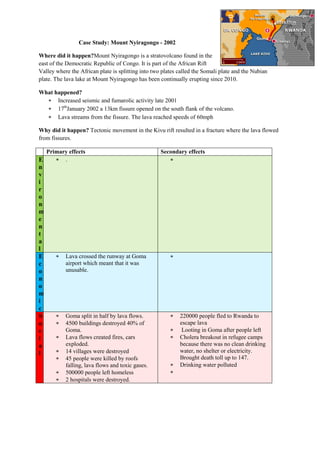
Where did it happen?Mount Nyiragongo is a stratovolcano found in the
east of the Democratic Republic of Congo. It is part of the African Rift
Valley where the African plate is splitting into two plates called the Somali plate and the Nubian
plate. The lava lake at Mount Nyiragongo has been continually erupting since 2010.
What happened?
Increased seismic and fumarolic activity late 2001
17th
January 2002 a 13km fissure opened on the south flank of the volcano.
Lava streams from the fissure. The lava reached speeds of 60mph
Why did it happen? Tectonic movement in the Kivu rift resulted in a fracture where the lava flowed
from fissures.
Primary effects Secondary effects
E
n
v
i
r
o
n
m
e
n
t
a
l
.
E
c
o
n
o
m
i
c
Lava crossed the runway at Goma
airport which meant that it was
unusable.
S
o
c
i
a
l
Goma split in half by lava flows.
4500 buildings destroyed 40% of
Goma.
Lava flows created fires, cars
exploded.
14 villages were destroyed
45 people were killed by roofs
falling, lava flows and toxic gases.
500000 people left homeless
2 hospitals were destroyed.
220000 people fled to Rwanda to
escape lava
Looting in Goma after people left
Cholera breakout in refugee camps
because there was no clean drinking
water, no shelter or electricity.
Brought death toll up to 147.
Drinking water polluted
Immediate responses Long term responses
Aid agencies gave bedding, equipment to
provide clean water for drinking and
sanitation, blankets, tents, food, and
cooking utensils to refugees.
Un supplied 260 tonnes of food, enough
for 700000 people for a week.
How was the hazard managed? The volcano erupted without much warning which meant that there
could have been little time for evacuation however the nature of the event (lava flow) meant that there
was time for the evacuation of 400000 people. This kept the death toll low.

Mount nyiragongo case study

  • 1.
    Case Study: MountNyiragongo - 2002 Where did it happen?Mount Nyiragongo is a stratovolcano found in the east of the Democratic Republic of Congo. It is part of the African Rift Valley where the African plate is splitting into two plates called the Somali plate and the Nubian plate. The lava lake at Mount Nyiragongo has been continually erupting since 2010. What happened? Increased seismic and fumarolic activity late 2001 17th January 2002 a 13km fissure opened on the south flank of the volcano. Lava streams from the fissure. The lava reached speeds of 60mph Why did it happen? Tectonic movement in the Kivu rift resulted in a fracture where the lava flowed from fissures. Primary effects Secondary effects E n v i r o n m e n t a l . E c o n o m i c Lava crossed the runway at Goma airport which meant that it was unusable. S o c i a l Goma split in half by lava flows. 4500 buildings destroyed 40% of Goma. Lava flows created fires, cars exploded. 14 villages were destroyed 45 people were killed by roofs falling, lava flows and toxic gases. 500000 people left homeless 2 hospitals were destroyed. 220000 people fled to Rwanda to escape lava Looting in Goma after people left Cholera breakout in refugee camps because there was no clean drinking water, no shelter or electricity. Brought death toll up to 147. Drinking water polluted
  • 2.
    Immediate responses Longterm responses Aid agencies gave bedding, equipment to provide clean water for drinking and sanitation, blankets, tents, food, and cooking utensils to refugees. Un supplied 260 tonnes of food, enough for 700000 people for a week. How was the hazard managed? The volcano erupted without much warning which meant that there could have been little time for evacuation however the nature of the event (lava flow) meant that there was time for the evacuation of 400000 people. This kept the death toll low.