MOTIVATION
Lecture Outcomes
Define Motivation and related terms
Discuss the General
Theories/approaches to Motivation
Describe Maslow’s Hierarchy of needs
and its application in nursing
Motivation
Motivation refers to factors that activate,
maintain, and direct behavior towards a
goal
◦ Factors include needs, desires, interests
General Theories of
Motivation
Instincts refers to inborn behavioral
patterns
◦ Instincts are biologically determined
always expressed in the same way,
and are universal within a species
◦ E.g. sexual behavior is a response to
an instinct to reproduce
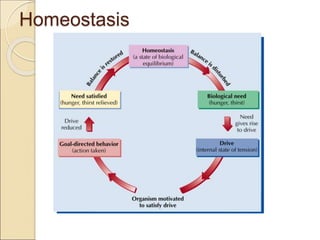
 Drive Reduction: a biological need
produces the drive to , satisfy that
need
 Hunger drives one to seek food.
 Drive : it is a motivational tension
that energizes behavior to fulfill a
need.
A drive can be primary or secondary
Primary drive : behavior fulfills an
obvious biologic need
Secondary drive :Behavior fulfills non
obvious biologic need but learned
needs
Homeostasis
Arousal approach to
motivation
Human being try to maintain a certain
level of activity and stimulation.
The level is adjusted as necessary
E.g.
Cognitive Approach
 Motivation is a result of people’s
thoughts and expectations
 Intrinsic motivation
 Extrinsic motivation
Incentives approach
Motivation is driven from a desire
to obtaining external incentives.
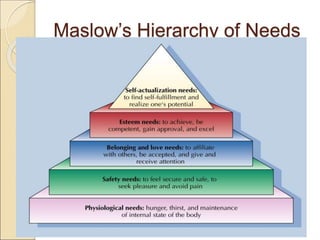
Maslow’s Hierarchy of Needs
Maslow’s Hierarchy of need
model
 Puts human motivation needs in a
hierarchy
Suggests that primary needs (basic
needs) have to be met before
secondary needs
The model is presented in a
pyramid with basic needs at the
bottom
At the top of the pyramid is self
actualization
Self actualization is a state of self
fulfillment when an individual reaches
their own highest potential

MOTIVATION.ppt

  • 1.
  • 2.
    Lecture Outcomes Define Motivationand related terms Discuss the General Theories/approaches to Motivation Describe Maslow’s Hierarchy of needs and its application in nursing
  • 3.
    Motivation Motivation refers tofactors that activate, maintain, and direct behavior towards a goal ◦ Factors include needs, desires, interests
  • 4.
    General Theories of Motivation Instinctsrefers to inborn behavioral patterns ◦ Instincts are biologically determined always expressed in the same way, and are universal within a species ◦ E.g. sexual behavior is a response to an instinct to reproduce
  • 5.
     Drive Reduction:a biological need produces the drive to , satisfy that need  Hunger drives one to seek food.  Drive : it is a motivational tension that energizes behavior to fulfill a need.
  • 6.
    A drive canbe primary or secondary Primary drive : behavior fulfills an obvious biologic need Secondary drive :Behavior fulfills non obvious biologic need but learned needs
  • 7.
  • 8.
    Arousal approach to motivation Humanbeing try to maintain a certain level of activity and stimulation. The level is adjusted as necessary E.g.
  • 9.
    Cognitive Approach  Motivationis a result of people’s thoughts and expectations  Intrinsic motivation  Extrinsic motivation
  • 10.
    Incentives approach Motivation isdriven from a desire to obtaining external incentives.
  • 11.
  • 12.
    Maslow’s Hierarchy ofneed model  Puts human motivation needs in a hierarchy Suggests that primary needs (basic needs) have to be met before secondary needs The model is presented in a pyramid with basic needs at the bottom
  • 13.
    At the topof the pyramid is self actualization Self actualization is a state of self fulfillment when an individual reaches their own highest potential