Page | 1
History of motivation:
The modern concept of motivation derives from the historical need to account for the arousal and
direction of behavior. Human and animal activity occurs in peaks and troughs and it shifts its
direction from one goal to another many times throughout a day. Even the ancients knew that these
shifts in levels of activity and direction were the result of some combination of changes in external
stimuli and internal state. What they did not know, however, was that the brain was the organ that
integrated these inputs and was responsible for both behavior and conscious experience. Plato
(428-348 B.C.), for example, thought that reason was in the head, but that courage was in the chest
and appetite in the abdomen. The temptation to think in terms of separate central-neural and
peripheral physiological controls of motivated behavior is still with us today. The lesson of history,
however, is that there must be a biologically coherent mechanism integrating both peripheral and
central controls. That mechanism is in the brain. As we trace the roots of current thinking about
motivated behavior (see Cofer & Appley, 1964; and Brown, 1979), we can see that it represents
the convergence of different lines of inquiry in the history of both philosophy and science. One of
the earliest and most relevant is the development of the concepts of instincts and taxes (tropisms),
leading directly to the observations of naturalists and to the more recent work of ethologists. A
second ancient line of inquiry is seen in the history of the concept of hedonism (pleasantness and
unpleasantness). A third, related to hedonism in recent times, is one aspect of the history of sensory
psychology and physiology, particularly beginning with Wilhelm Wundt's (1832-1920) concern
with the nature of feeling. A fourth, related in a different way, is the emergence of the concepts of
temperament, emotion, and affect. Fifth is the development of the concept of reinforcement, the
role of rewards and punishments in learning new responses and in determining the vigor of existing
responses. Sixth, and equally important, has been the idea of regulatory physiology, for many of
the basic biological motivations are in the service of homeostasis and the survival of the individual
and the species. Seventh, perhaps most important of all, have been developments in neurobiology,
for it is the brain that is the organ of all behavioral functions, and we are now learning much about
the organization, localization, and chemistry of brain circuits that form this common substrate for
motivated behavior. Finally, from all of these converging lines, there emerges a very specific
history of the development of the concept of motivation, including the concepts of drive and
satiation, goal-directed behavior, and incentive.
Page | 2
Definition of Motivation:
Often, people confuse the idea of 'happy' employees with 'motivated' employees. These may be
related, but motivation actually describes the level of desire employees feel to perform, regardless
of the level of happiness. Employees who are adequately motivated to perform will be more
productive, more engaged and feel more invested in their work. When employees feel these things,
it helps them, and thereby their managers, be more successful.
It is a manager's job to motivate employees to do their jobs well. So how do managers do this? The
answer is motivation in management, the process through which managers encourage employees
to be productive and effective.
Motivation theories:
Maslow – hierarchy of needs.
Alderfer – ERG theory: Existence needs, relatedness needs and growth
needs.
Herzberg – Two factor theory.
Vroom's expectancy theory.
Adams' equity theory.
Locke's goal-setting theory
Page | 3
Maslow’s hierarchy of needs theory:
Maslow first introduced his concept of a hierarchy of needs in his 1943 paper "A Theory of Human
Motivation" and his subsequent book Motivation and Personality. This hierarchy suggests that
people are motivated to fulfill basic needs before moving on to other, more advanced needs.
While some of the existing schools of thought at the time (such
as psychoanalysis and behaviorism) tended to focus on problematic behaviors, Maslow was much
more interested in learning about what makes people happy and the things that they do to achieve
that aim.
As a humanist, Maslow believed that people have an inborn desire to be self-actualized, that is, to
be all they can be. In order to achieve these ultimate goals, however, a number of more basic needs
must be met such as the need for food, safety, love, and self-esteem.
There are five different levels of Maslow’s hierarchy of needs. Let's take a closer look at Maslow’s
needs starting at the lowest level, which are known as physiological needs.
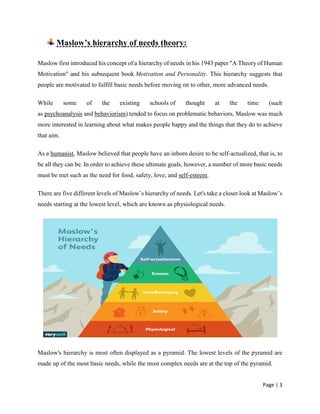
Maslow's hierarchy is most often displayed as a pyramid. The lowest levels of the pyramid are
made up of the most basic needs, while the most complex needs are at the top of the pyramid.
Page | 4
Needs at the bottom of the pyramid are basic physical requirements including the need for food,
water, sleep, and warmth. Once these lower-level needs have been met, people can move on to the
next level of needs, which are for safety and security.
As people progress up the pyramid, needs become increasingly psychological and social. Soon,
the need for love, friendship, and intimacy become important. Further up the pyramid, the need
for personal esteem and feelings of accomplishment take priority.
Like Carl Rogers, Maslow emphasized the importance of self-actualization, which is a process of
growing and developing as a person in order to achieve individual potential.
ERG theory of motivation:
ERG theory of motivation is the condensed form of Maslow’s Hierarchy of Needs. The theory was
developed by Clayton Paul Alderfer, an American psychologist, and consultant, between the 60s
and the 70s, based on the empirical study conducted at a factory in Easton, Pennsylvania.
Maslow’s Hierarchy of Needs has been criticized and modified by various critics, among which
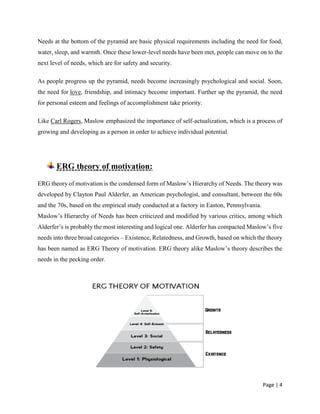
Alderfer’s is probably the most interesting and logical one. Alderfer has compacted Maslow’s five
needs into three broad categories – Existence, Relatedness, and Growth, based on which the theory
has been named as ERG Theory of motivation. ERG theory alike Maslow’s theory describes the
needs in the pecking order.
Page | 5
Existence needs (E)
What Maslow had described as “physiological needs” and “safety needs” were merged together
by Alderfer to constitute existence needs. The group is concerned with basic physical needs and
security needs, without which human body will fail to function properly, and ultimately break
down. An employee won’t be motivated to work unless his physiological needs such as food,
shelter, clothing, sleep, etc. are being fulfilled. While materialistic requirements relatively satisfy
the employee, his behavior is significantly affected by the safety needs. Here, safety is concerned
with both physical as well as economic. Any employee would be motivated to continue working
only when his health, financial and other personal security is ensured.
Relatedness needs (R)
The need for love, friendship and other intrapersonal relationship, which were categorized as
“belongingness” in Maslow’s Hierarchy of Needs were included in this group. It is the necessity
of all humans to have a good relationship with the ones who are present around him. Thus, he
always looks for a good working environment where he can establish a good relationship with his
superiors, colleagues or subordinates. Such workplace which consists of hostile employers or co-
workers contributes to grievances and conflicts, which in long run can increase labor turnover rate.
Growth needs (G)
The intrinsic desire for progress and development which were categorized as “esteem” and “self-
actualization” by Maslow was fitted by Alderfer into this group. An employee feels highly
motivated when he realizes the outcomes or consequences of his efforts. The consequences might
be feeling of achievement, respect from others, goal actualization, increase in knowledge, etc. In
absence of these factors, an employee can never be happy with his job.
Page | 6
Herzberg – Two factor theory:
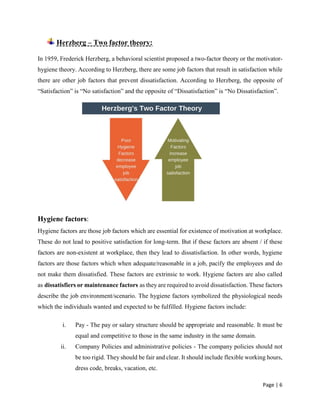
In 1959, Frederick Herzberg, a behavioral scientist proposed a two-factor theory or the motivator-
hygiene theory. According to Herzberg, there are some job factors that result in satisfaction while
there are other job factors that prevent dissatisfaction. According to Herzberg, the opposite of
“Satisfaction” is “No satisfaction” and the opposite of “Dissatisfaction” is “No Dissatisfaction”.
Hygiene factors:
Hygiene factors are those job factors which are essential for existence of motivation at workplace.
These do not lead to positive satisfaction for long-term. But if these factors are absent / if these
factors are non-existent at workplace, then they lead to dissatisfaction. In other words, hygiene
factors are those factors which when adequate/reasonable in a job, pacify the employees and do
not make them dissatisfied. These factors are extrinsic to work. Hygiene factors are also called
as dissatisfiers or maintenance factors as they are required to avoid dissatisfaction. These factors
describe the job environment/scenario. The hygiene factors symbolized the physiological needs
which the individuals wanted and expected to be fulfilled. Hygiene factors include:
i. Pay - The pay or salary structure should be appropriate and reasonable. It must be
equal and competitive to those in the same industry in the same domain.
ii. Company Policies and administrative policies - The company policies should not
be too rigid. They should be fair and clear. It should include flexible working hours,
dress code, breaks, vacation, etc.
Page | 7
iii. Fringe benefits - The employees should be offered health care plans (mediclaim),
benefits for the family members, employee help programmes, etc.
iv. Physical Working conditions - The working conditions should be safe, clean and
hygienic. The work equipment’s should be updated and well-maintained.
v. Status - The employees’ status within the organization should be familiar and
retained.
vi. Interpersonal relations - The relationship of the employees with his peers, superiors
and subordinates should be appropriate and acceptable. There should be no conflict
or humiliation element present.
vii. Job Security - The organization must provide job security to the employees.
Motivational factors:
According to Herzberg, the hygiene factors cannot be regarded as motivators. The motivational
factors yield positive satisfaction. These factors are inherent to work. These factors motivate the
employees for a superior performance. These factors are called satisfiers. These are factors
involved in performing the job. Employees find these factors intrinsically rewarding. The
motivators symbolized the psychological needs that were perceived as an additional benefit.
Motivational factors include:
i. The two-factor theory overlooks situational variables.
ii. Herzberg assumed a correlation between satisfaction and productivity. But the
research conducted by Herzberg stressed upon satisfaction and ignored
productivity.
iii. The theory’s reliability is uncertain. Analysis has to be made by the raters. The
raters may spoil the findings by analyzing same response in different manner.
iv. No comprehensive measure of satisfaction was used. An employee may find his job
acceptable despite the fact that he may hate/object part of his job.
v. The two factor theory is not free from bias as it is based on the natural reaction of
employees when they are enquired the sources of satisfaction and dissatisfaction at
work. They will blame dissatisfaction on the external factors such as salary
Page | 8
structure, company policies and peer relationship. Also, the employees will give
credit to themselves for the satisfaction factor at work.
vi. The theory ignores blue-collar workers. Despite these limitations, Herzberg’s Two-
Factor theory is acceptable broadly.
Vroom's expectancy theory:
Vroom's expectancy theory separates effort, performance and outcomes, while Maslow and
Herzberg focus on the relationship between internal needs and the resulting effort expended to
fulfil them. Vroom's expectancy theory assumes that behavior results from conscious choices
among alternatives whose purpose it is to maximize pleasure and to minimize pain. Vroom realized
that an employee's performance is based on individual factors such as personality, skills,
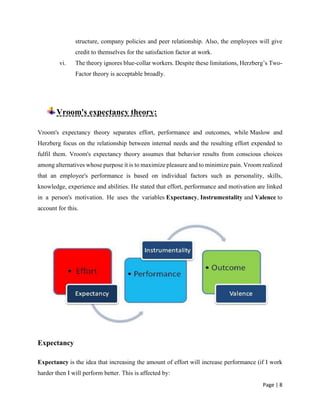
knowledge, experience and abilities. He stated that effort, performance and motivation are linked
in a person's motivation. He uses the variables Expectancy, Instrumentality and Valence to
account for this.
Expectancy
Expectancy is the idea that increasing the amount of effort will increase performance (if I work
harder then I will perform better. This is affected by:
Page | 9
i. Having the right resources available (e.g. raw materials, time)
ii. Having the right skills to do the job
iii. Having the necessary support to get the job done (e.g. supervisor support, or correct
information on the job)
Instrumentality
Instrumentality is the idea that if you perform better, then the outcome will be achieved. (If I
perform well, there I will achieve the desired outcome. This is affected by:
i. Clear understanding of the relationship between performance and outcomes – e.g.
the rules of the reward 'game'
ii. Trust in the people who will take the decisions on who gets what outcome
iii. Transparency of the process that decides who gets what outcome
Valence
Valence is the perceived value the employee puts on the outcome. For the valence to be positive,
the person must prefer attaining the outcome than not attaining it. (If someone is mainly motivated
by money, he or she might not value offers of additional time off)
The three elements are important behind choosing one element over another because they are
clearly defined: effort-performance expectancy (E-->P expectancy) and performance-outcome
expectancy (P-->O expectancy).
E-->P expectancy: our assessment of the probability that our efforts will lead to the
required performance level.
P-->O expectancy: our assessment of the probability that our successful performance will
lead to certain outcomes.
Vroom's expectancy theory works on perceptions, so even if a motivation tactic works with most
people in the organization, it doesn't mean that it will work for everybody.
Page | 10
Adams' equity theory:
John Stacey Adams, a workplace and behavioral psychologist, put forward his Equity Theory on
job motivation in 1963. There are similarities with Charles Handy's extension and interpretation
of previous simpler theories of Maslow, Herzberg and other pioneers of workplace psychology, in
that the theory acknowledges that subtle and variable factors affect each individual's assessment
and perception of their relationship with their work, and thereby their employer. However,
awareness and cognizance of the wider situation - and crucially comparison - feature more
strongly in Equity Theory than in many other earlier motivational models.
The Adams' Equity Theory model, therefore, extends beyond the individual self and incorporates
influence and comparison of other people's situations - for example, colleagues and friends - in
forming a comparative view and awareness of Equity, which commonly manifests as a sense of
what is fair.
When people feel fairly or advantageously treated they are more likely to be motivated; when they
feel unfairly treated they are highly prone to feelings of disaffection and demotivation. The way
that people measure this sense of fairness is at the heart of Equity Theory.
Equity, and therefore the motivational situation we aim to assess using the model, is not dependent
on the extent to which a person believes reward exceeds effort, nor even necessarily on the belief
that reward exceeds effort at all. Rather, Equity, and the sense of fairness which commonly
underpins motivation, is dependent on the comparison a person makes between his or her
reward/investment ratio with the ratio enjoyed (or suffered) by others considered to be in a similar
situation.
Page | 11
Inputs and Outputs
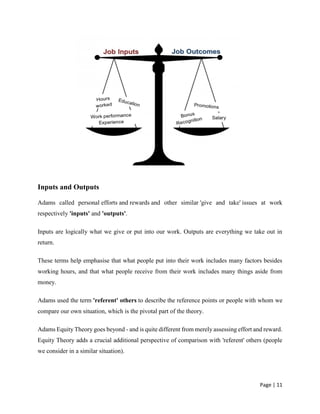
Adams called personal efforts and rewards and other similar 'give and take' issues at work
respectively 'inputs' and 'outputs'.
Inputs are logically what we give or put into our work. Outputs are everything we take out in
return.
These terms help emphasise that what people put into their work includes many factors besides
working hours, and that what people receive from their work includes many things aside from
money.
Adams used the term 'referent' others to describe the reference points or people with whom we
compare our own situation, which is the pivotal part of the theory.
Adams Equity Theory goes beyond - and is quite different from merely assessing effort and reward.
Equity Theory adds a crucial additional perspective of comparison with 'referent' others (people
we consider in a similar situation).
Page | 12
Locke's goal-setting theory:
Goal-setting theory refers to the effects of setting goals on subsequent performance. Researcher
Edwin Locke found that individuals who set specific, difficult goals performed better than those
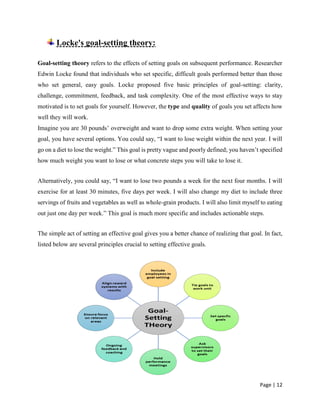
who set general, easy goals. Locke proposed five basic principles of goal-setting: clarity,
challenge, commitment, feedback, and task complexity. One of the most effective ways to stay
motivated is to set goals for yourself. However, the type and quality of goals you set affects how
well they will work.
Imagine you are 30 pounds’ overweight and want to drop some extra weight. When setting your
goal, you have several options. You could say, “I want to lose weight within the next year. I will
go on a diet to lose the weight.” This goal is pretty vague and poorly defined; you haven’t specified
how much weight you want to lose or what concrete steps you will take to lose it.
Alternatively, you could say, “I want to lose two pounds a week for the next four months. I will
exercise for at least 30 minutes, five days per week. I will also change my diet to include three
servings of fruits and vegetables as well as whole-grain products. I will also limit myself to eating
out just one day per week.” This goal is much more specific and includes actionable steps.
The simple act of setting an effective goal gives you a better chance of realizing that goal. In fact,
listed below are several principles crucial to setting effective goals.
Page | 13
Effective goal-setting principles:
i. Clarity: A clear, measurable goal is more achievable than one that is poorly
defined. In other words, be specific! The most effective goals have a specific
timeline for completion.
ii. Challenge: The goal must have a decent level of difficulty in order to motivate you
to strive toward the goal.
iii. Commitment: Put deliberate effort into meeting this goal. Share your goal with
someone else in order to increase your accountability to meet that goal.
iv. Feedback: Set up a method to receive information on your progress toward a goal.
If losing 30 pounds in four months turns out to be too hard, it is better to adjust the
difficulty of your goal mid-way through the timeline than to give up entirely.
v. Task complexity: If a goal is especially complex, make sure you give yourself
enough time to overcome the learning curve involved in completing the task. In
other words, if a goal is really tough, make sure you give yourself some padding to
give you the best chance at succeeding.

Motivational Theory

  • 1.
    Page | 1 Historyof motivation: The modern concept of motivation derives from the historical need to account for the arousal and direction of behavior. Human and animal activity occurs in peaks and troughs and it shifts its direction from one goal to another many times throughout a day. Even the ancients knew that these shifts in levels of activity and direction were the result of some combination of changes in external stimuli and internal state. What they did not know, however, was that the brain was the organ that integrated these inputs and was responsible for both behavior and conscious experience. Plato (428-348 B.C.), for example, thought that reason was in the head, but that courage was in the chest and appetite in the abdomen. The temptation to think in terms of separate central-neural and peripheral physiological controls of motivated behavior is still with us today. The lesson of history, however, is that there must be a biologically coherent mechanism integrating both peripheral and central controls. That mechanism is in the brain. As we trace the roots of current thinking about motivated behavior (see Cofer & Appley, 1964; and Brown, 1979), we can see that it represents the convergence of different lines of inquiry in the history of both philosophy and science. One of the earliest and most relevant is the development of the concepts of instincts and taxes (tropisms), leading directly to the observations of naturalists and to the more recent work of ethologists. A second ancient line of inquiry is seen in the history of the concept of hedonism (pleasantness and unpleasantness). A third, related to hedonism in recent times, is one aspect of the history of sensory psychology and physiology, particularly beginning with Wilhelm Wundt's (1832-1920) concern with the nature of feeling. A fourth, related in a different way, is the emergence of the concepts of temperament, emotion, and affect. Fifth is the development of the concept of reinforcement, the role of rewards and punishments in learning new responses and in determining the vigor of existing responses. Sixth, and equally important, has been the idea of regulatory physiology, for many of the basic biological motivations are in the service of homeostasis and the survival of the individual and the species. Seventh, perhaps most important of all, have been developments in neurobiology, for it is the brain that is the organ of all behavioral functions, and we are now learning much about the organization, localization, and chemistry of brain circuits that form this common substrate for motivated behavior. Finally, from all of these converging lines, there emerges a very specific history of the development of the concept of motivation, including the concepts of drive and satiation, goal-directed behavior, and incentive.
  • 2.
    Page | 2 Definitionof Motivation: Often, people confuse the idea of 'happy' employees with 'motivated' employees. These may be related, but motivation actually describes the level of desire employees feel to perform, regardless of the level of happiness. Employees who are adequately motivated to perform will be more productive, more engaged and feel more invested in their work. When employees feel these things, it helps them, and thereby their managers, be more successful. It is a manager's job to motivate employees to do their jobs well. So how do managers do this? The answer is motivation in management, the process through which managers encourage employees to be productive and effective. Motivation theories: Maslow – hierarchy of needs. Alderfer – ERG theory: Existence needs, relatedness needs and growth needs. Herzberg – Two factor theory. Vroom's expectancy theory. Adams' equity theory. Locke's goal-setting theory
  • 3.
    Page | 3 Maslow’shierarchy of needs theory: Maslow first introduced his concept of a hierarchy of needs in his 1943 paper "A Theory of Human Motivation" and his subsequent book Motivation and Personality. This hierarchy suggests that people are motivated to fulfill basic needs before moving on to other, more advanced needs. While some of the existing schools of thought at the time (such as psychoanalysis and behaviorism) tended to focus on problematic behaviors, Maslow was much more interested in learning about what makes people happy and the things that they do to achieve that aim. As a humanist, Maslow believed that people have an inborn desire to be self-actualized, that is, to be all they can be. In order to achieve these ultimate goals, however, a number of more basic needs must be met such as the need for food, safety, love, and self-esteem. There are five different levels of Maslow’s hierarchy of needs. Let's take a closer look at Maslow’s needs starting at the lowest level, which are known as physiological needs. Maslow's hierarchy is most often displayed as a pyramid. The lowest levels of the pyramid are made up of the most basic needs, while the most complex needs are at the top of the pyramid.
  • 4.
    Page | 4 Needsat the bottom of the pyramid are basic physical requirements including the need for food, water, sleep, and warmth. Once these lower-level needs have been met, people can move on to the next level of needs, which are for safety and security. As people progress up the pyramid, needs become increasingly psychological and social. Soon, the need for love, friendship, and intimacy become important. Further up the pyramid, the need for personal esteem and feelings of accomplishment take priority. Like Carl Rogers, Maslow emphasized the importance of self-actualization, which is a process of growing and developing as a person in order to achieve individual potential. ERG theory of motivation: ERG theory of motivation is the condensed form of Maslow’s Hierarchy of Needs. The theory was developed by Clayton Paul Alderfer, an American psychologist, and consultant, between the 60s and the 70s, based on the empirical study conducted at a factory in Easton, Pennsylvania. Maslow’s Hierarchy of Needs has been criticized and modified by various critics, among which Alderfer’s is probably the most interesting and logical one. Alderfer has compacted Maslow’s five needs into three broad categories – Existence, Relatedness, and Growth, based on which the theory has been named as ERG Theory of motivation. ERG theory alike Maslow’s theory describes the needs in the pecking order.
  • 5.
    Page | 5 Existenceneeds (E) What Maslow had described as “physiological needs” and “safety needs” were merged together by Alderfer to constitute existence needs. The group is concerned with basic physical needs and security needs, without which human body will fail to function properly, and ultimately break down. An employee won’t be motivated to work unless his physiological needs such as food, shelter, clothing, sleep, etc. are being fulfilled. While materialistic requirements relatively satisfy the employee, his behavior is significantly affected by the safety needs. Here, safety is concerned with both physical as well as economic. Any employee would be motivated to continue working only when his health, financial and other personal security is ensured. Relatedness needs (R) The need for love, friendship and other intrapersonal relationship, which were categorized as “belongingness” in Maslow’s Hierarchy of Needs were included in this group. It is the necessity of all humans to have a good relationship with the ones who are present around him. Thus, he always looks for a good working environment where he can establish a good relationship with his superiors, colleagues or subordinates. Such workplace which consists of hostile employers or co- workers contributes to grievances and conflicts, which in long run can increase labor turnover rate. Growth needs (G) The intrinsic desire for progress and development which were categorized as “esteem” and “self- actualization” by Maslow was fitted by Alderfer into this group. An employee feels highly motivated when he realizes the outcomes or consequences of his efforts. The consequences might be feeling of achievement, respect from others, goal actualization, increase in knowledge, etc. In absence of these factors, an employee can never be happy with his job.
  • 6.
    Page | 6 Herzberg– Two factor theory: In 1959, Frederick Herzberg, a behavioral scientist proposed a two-factor theory or the motivator- hygiene theory. According to Herzberg, there are some job factors that result in satisfaction while there are other job factors that prevent dissatisfaction. According to Herzberg, the opposite of “Satisfaction” is “No satisfaction” and the opposite of “Dissatisfaction” is “No Dissatisfaction”. Hygiene factors: Hygiene factors are those job factors which are essential for existence of motivation at workplace. These do not lead to positive satisfaction for long-term. But if these factors are absent / if these factors are non-existent at workplace, then they lead to dissatisfaction. In other words, hygiene factors are those factors which when adequate/reasonable in a job, pacify the employees and do not make them dissatisfied. These factors are extrinsic to work. Hygiene factors are also called as dissatisfiers or maintenance factors as they are required to avoid dissatisfaction. These factors describe the job environment/scenario. The hygiene factors symbolized the physiological needs which the individuals wanted and expected to be fulfilled. Hygiene factors include: i. Pay - The pay or salary structure should be appropriate and reasonable. It must be equal and competitive to those in the same industry in the same domain. ii. Company Policies and administrative policies - The company policies should not be too rigid. They should be fair and clear. It should include flexible working hours, dress code, breaks, vacation, etc.
  • 7.
    Page | 7 iii.Fringe benefits - The employees should be offered health care plans (mediclaim), benefits for the family members, employee help programmes, etc. iv. Physical Working conditions - The working conditions should be safe, clean and hygienic. The work equipment’s should be updated and well-maintained. v. Status - The employees’ status within the organization should be familiar and retained. vi. Interpersonal relations - The relationship of the employees with his peers, superiors and subordinates should be appropriate and acceptable. There should be no conflict or humiliation element present. vii. Job Security - The organization must provide job security to the employees. Motivational factors: According to Herzberg, the hygiene factors cannot be regarded as motivators. The motivational factors yield positive satisfaction. These factors are inherent to work. These factors motivate the employees for a superior performance. These factors are called satisfiers. These are factors involved in performing the job. Employees find these factors intrinsically rewarding. The motivators symbolized the psychological needs that were perceived as an additional benefit. Motivational factors include: i. The two-factor theory overlooks situational variables. ii. Herzberg assumed a correlation between satisfaction and productivity. But the research conducted by Herzberg stressed upon satisfaction and ignored productivity. iii. The theory’s reliability is uncertain. Analysis has to be made by the raters. The raters may spoil the findings by analyzing same response in different manner. iv. No comprehensive measure of satisfaction was used. An employee may find his job acceptable despite the fact that he may hate/object part of his job. v. The two factor theory is not free from bias as it is based on the natural reaction of employees when they are enquired the sources of satisfaction and dissatisfaction at work. They will blame dissatisfaction on the external factors such as salary
  • 8.
    Page | 8 structure,company policies and peer relationship. Also, the employees will give credit to themselves for the satisfaction factor at work. vi. The theory ignores blue-collar workers. Despite these limitations, Herzberg’s Two- Factor theory is acceptable broadly. Vroom's expectancy theory: Vroom's expectancy theory separates effort, performance and outcomes, while Maslow and Herzberg focus on the relationship between internal needs and the resulting effort expended to fulfil them. Vroom's expectancy theory assumes that behavior results from conscious choices among alternatives whose purpose it is to maximize pleasure and to minimize pain. Vroom realized that an employee's performance is based on individual factors such as personality, skills, knowledge, experience and abilities. He stated that effort, performance and motivation are linked in a person's motivation. He uses the variables Expectancy, Instrumentality and Valence to account for this. Expectancy Expectancy is the idea that increasing the amount of effort will increase performance (if I work harder then I will perform better. This is affected by:
  • 9.
    Page | 9 i.Having the right resources available (e.g. raw materials, time) ii. Having the right skills to do the job iii. Having the necessary support to get the job done (e.g. supervisor support, or correct information on the job) Instrumentality Instrumentality is the idea that if you perform better, then the outcome will be achieved. (If I perform well, there I will achieve the desired outcome. This is affected by: i. Clear understanding of the relationship between performance and outcomes – e.g. the rules of the reward 'game' ii. Trust in the people who will take the decisions on who gets what outcome iii. Transparency of the process that decides who gets what outcome Valence Valence is the perceived value the employee puts on the outcome. For the valence to be positive, the person must prefer attaining the outcome than not attaining it. (If someone is mainly motivated by money, he or she might not value offers of additional time off) The three elements are important behind choosing one element over another because they are clearly defined: effort-performance expectancy (E-->P expectancy) and performance-outcome expectancy (P-->O expectancy). E-->P expectancy: our assessment of the probability that our efforts will lead to the required performance level. P-->O expectancy: our assessment of the probability that our successful performance will lead to certain outcomes. Vroom's expectancy theory works on perceptions, so even if a motivation tactic works with most people in the organization, it doesn't mean that it will work for everybody.
  • 10.
    Page | 10 Adams'equity theory: John Stacey Adams, a workplace and behavioral psychologist, put forward his Equity Theory on job motivation in 1963. There are similarities with Charles Handy's extension and interpretation of previous simpler theories of Maslow, Herzberg and other pioneers of workplace psychology, in that the theory acknowledges that subtle and variable factors affect each individual's assessment and perception of their relationship with their work, and thereby their employer. However, awareness and cognizance of the wider situation - and crucially comparison - feature more strongly in Equity Theory than in many other earlier motivational models. The Adams' Equity Theory model, therefore, extends beyond the individual self and incorporates influence and comparison of other people's situations - for example, colleagues and friends - in forming a comparative view and awareness of Equity, which commonly manifests as a sense of what is fair. When people feel fairly or advantageously treated they are more likely to be motivated; when they feel unfairly treated they are highly prone to feelings of disaffection and demotivation. The way that people measure this sense of fairness is at the heart of Equity Theory. Equity, and therefore the motivational situation we aim to assess using the model, is not dependent on the extent to which a person believes reward exceeds effort, nor even necessarily on the belief that reward exceeds effort at all. Rather, Equity, and the sense of fairness which commonly underpins motivation, is dependent on the comparison a person makes between his or her reward/investment ratio with the ratio enjoyed (or suffered) by others considered to be in a similar situation.
  • 11.
    Page | 11 Inputsand Outputs Adams called personal efforts and rewards and other similar 'give and take' issues at work respectively 'inputs' and 'outputs'. Inputs are logically what we give or put into our work. Outputs are everything we take out in return. These terms help emphasise that what people put into their work includes many factors besides working hours, and that what people receive from their work includes many things aside from money. Adams used the term 'referent' others to describe the reference points or people with whom we compare our own situation, which is the pivotal part of the theory. Adams Equity Theory goes beyond - and is quite different from merely assessing effort and reward. Equity Theory adds a crucial additional perspective of comparison with 'referent' others (people we consider in a similar situation).
  • 12.
    Page | 12 Locke'sgoal-setting theory: Goal-setting theory refers to the effects of setting goals on subsequent performance. Researcher Edwin Locke found that individuals who set specific, difficult goals performed better than those who set general, easy goals. Locke proposed five basic principles of goal-setting: clarity, challenge, commitment, feedback, and task complexity. One of the most effective ways to stay motivated is to set goals for yourself. However, the type and quality of goals you set affects how well they will work. Imagine you are 30 pounds’ overweight and want to drop some extra weight. When setting your goal, you have several options. You could say, “I want to lose weight within the next year. I will go on a diet to lose the weight.” This goal is pretty vague and poorly defined; you haven’t specified how much weight you want to lose or what concrete steps you will take to lose it. Alternatively, you could say, “I want to lose two pounds a week for the next four months. I will exercise for at least 30 minutes, five days per week. I will also change my diet to include three servings of fruits and vegetables as well as whole-grain products. I will also limit myself to eating out just one day per week.” This goal is much more specific and includes actionable steps. The simple act of setting an effective goal gives you a better chance of realizing that goal. In fact, listed below are several principles crucial to setting effective goals.
  • 13.
    Page | 13 Effectivegoal-setting principles: i. Clarity: A clear, measurable goal is more achievable than one that is poorly defined. In other words, be specific! The most effective goals have a specific timeline for completion. ii. Challenge: The goal must have a decent level of difficulty in order to motivate you to strive toward the goal. iii. Commitment: Put deliberate effort into meeting this goal. Share your goal with someone else in order to increase your accountability to meet that goal. iv. Feedback: Set up a method to receive information on your progress toward a goal. If losing 30 pounds in four months turns out to be too hard, it is better to adjust the difficulty of your goal mid-way through the timeline than to give up entirely. v. Task complexity: If a goal is especially complex, make sure you give yourself enough time to overcome the learning curve involved in completing the task. In other words, if a goal is really tough, make sure you give yourself some padding to give you the best chance at succeeding.