Motivational Interviewing

Stephen Rollnick PhD
Cochrane Institute of Primary Care & Public Health
School of Medicine, Cardiff University, WALES
 
What is good prac.ce? 
 
 Dr:   and I don't see why it ends up like this,  I’ve been  
      doing this job for 20 years and now apparently its  
      all my fault. I want this sorted just like you do, but I 
      don’t have the Ame for all this…… 
 
You:  ? 


  What’s the problem? 
     
         Behaviour change  is hard 
   professional prac.ce, addic.on, lifestyle, 
   communica.on style 


  What’s the problem? 
     
         Behaviour change  is hard 


              Your approach? 
            
    1. What triggers change? 
 
    2. Mo.va.onal Interviewing 
 
          What triggers change?  
 
 
 You would think that….. 
 
having been disciplined twice for misconduct
would be enough to persuade a man to do anything
possible to protect his career and livelihood?


 You would think that….. 
 
having been disciplined twice for misconduct
would be enough to persuade a man to do anything
possible to protect his career and livelihood?


hangovers, damaged relationships, an auto crash,
and memory blackouts would be enough to
convince a woman to stop drinking
 
 You would think that….. 
  very real threats of blindness, amputations and
the
 
kidney failure from diabetes would be enough to
motivate weight loss and glycemic control
 You would think that….. 
  very real threats of blindness, amputations and
the
 
kidney failure from diabetes would be enough to
motivate weight loss and glycemic control

time spent in the dehumanizing privations of prison
would dissuade people from re-offending
  Does a direct approach trigger change? 


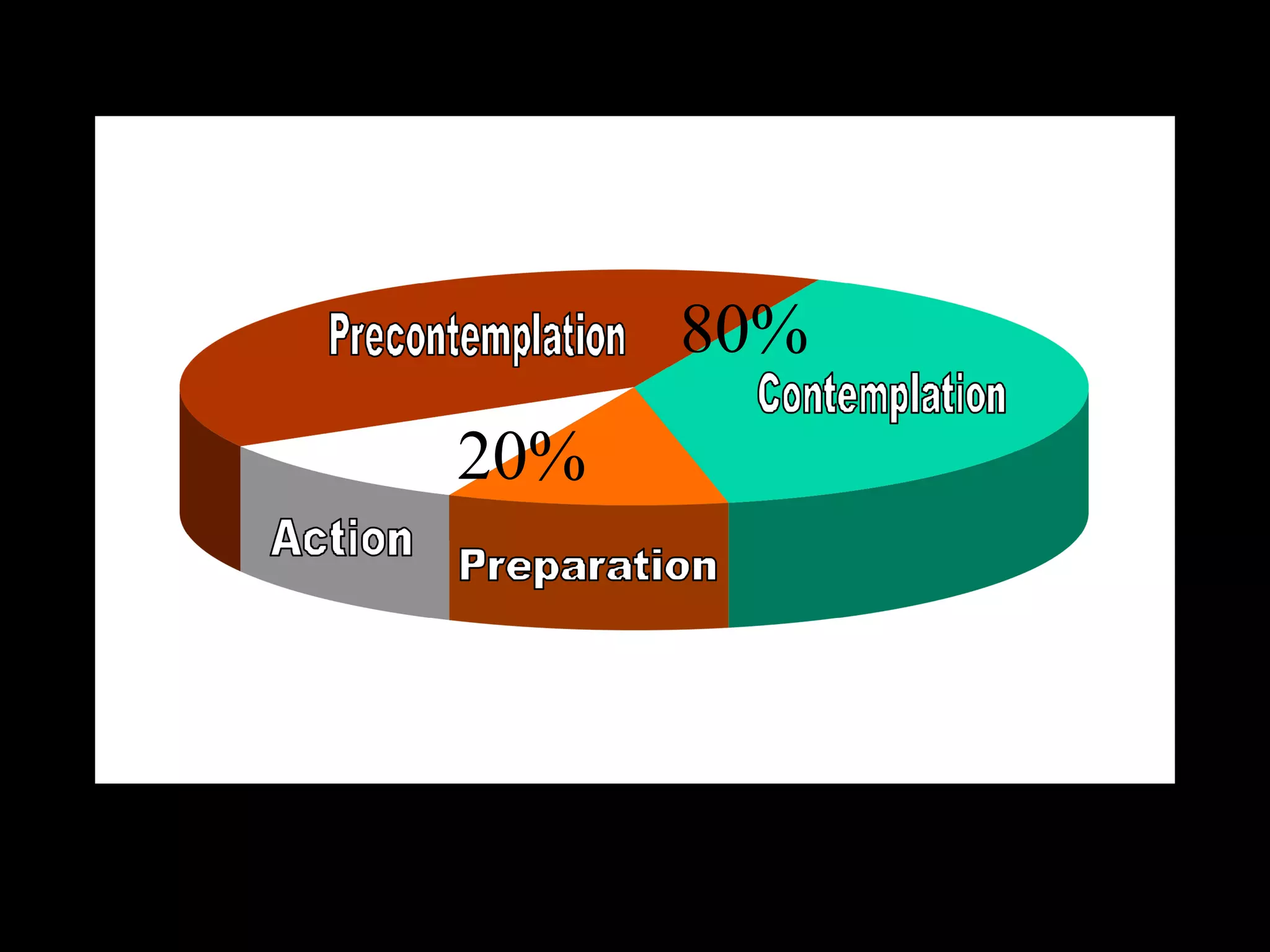
80%
20%


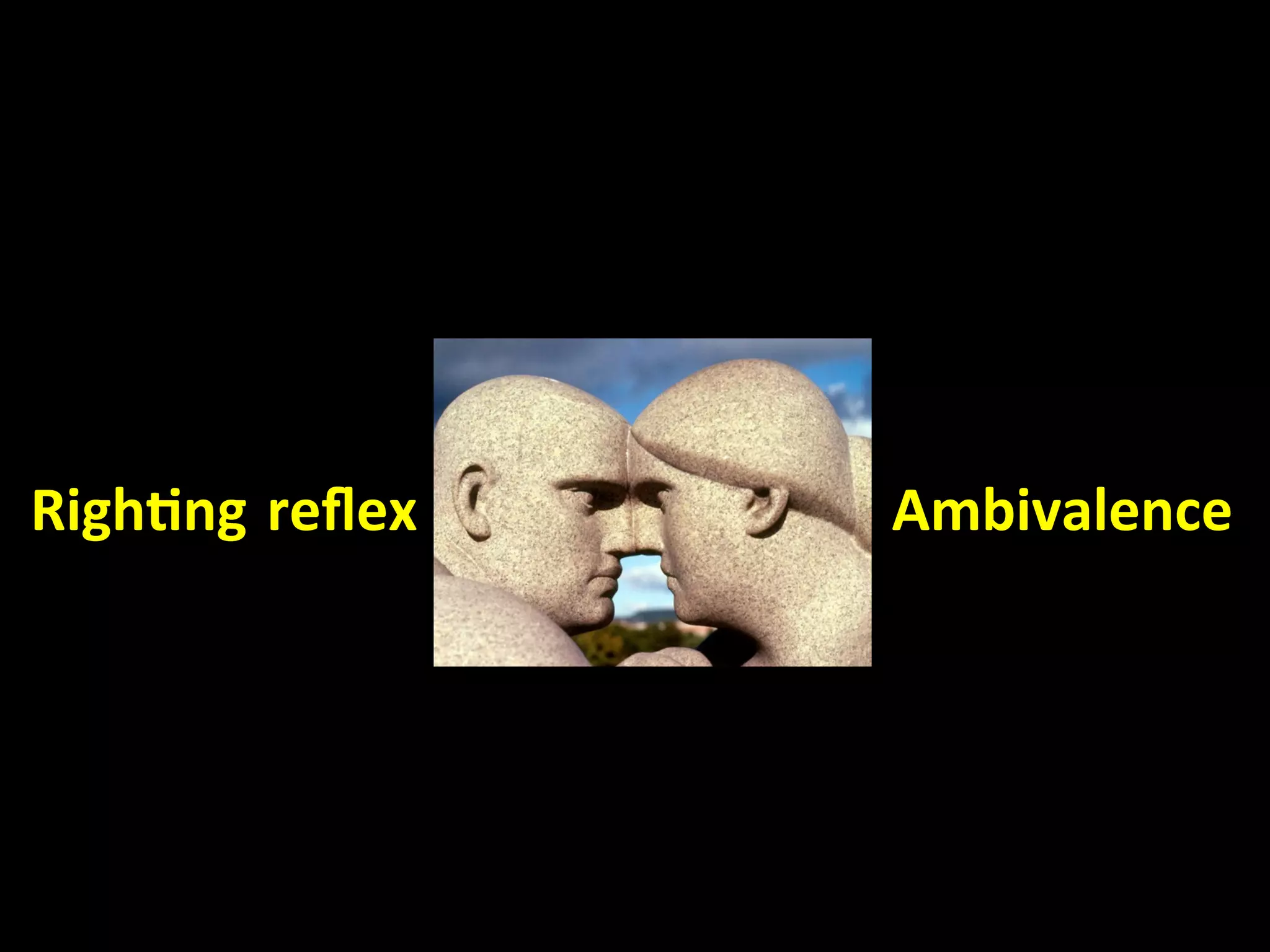
 Righ.ng reflex                         Ambivalence 


      Your role 
You don’t have to make change happen
     You can’t

You don’t have to come up with all the answers
     You probably don’t have the best ones

You’re not wrestling with patients
     You’re dancing

 
        Consider yourself 

Imagine something in your life that you’ve often
thought about changing, but haven't.


Imagine this:
 
        Consider yourself 

Imagine something in your life that you’ve often
thought about changing, but haven't.


Imagine this:

You cant leave the room until you’ve made a
decision to change!
 
       How do people change? 
 
 
We have inside us our own good reasons to change, 
and much of the strength to make it happen 
 
 
Its how you draw out this mo.va.on and strength   
that could improve outcomes 


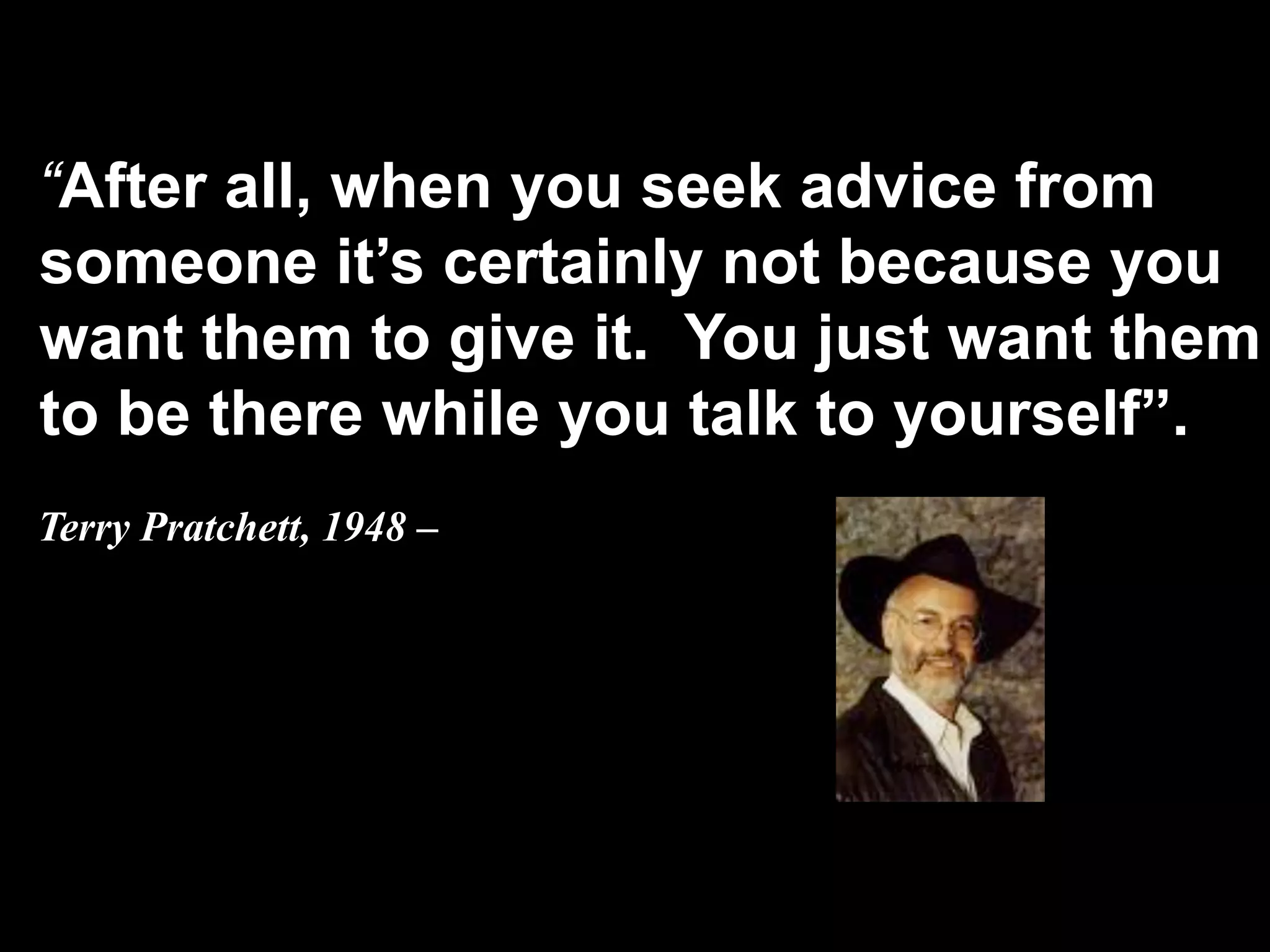
“After all, when you seek advice from
    someone it’s certainly not because you
    want them to give it. You just want them
    to be there while you talk to yourself”.
    Terry Pratchett, 1948 –


    1. What triggers change? 
 
    2. Mo.va.onal Interviewing 
 
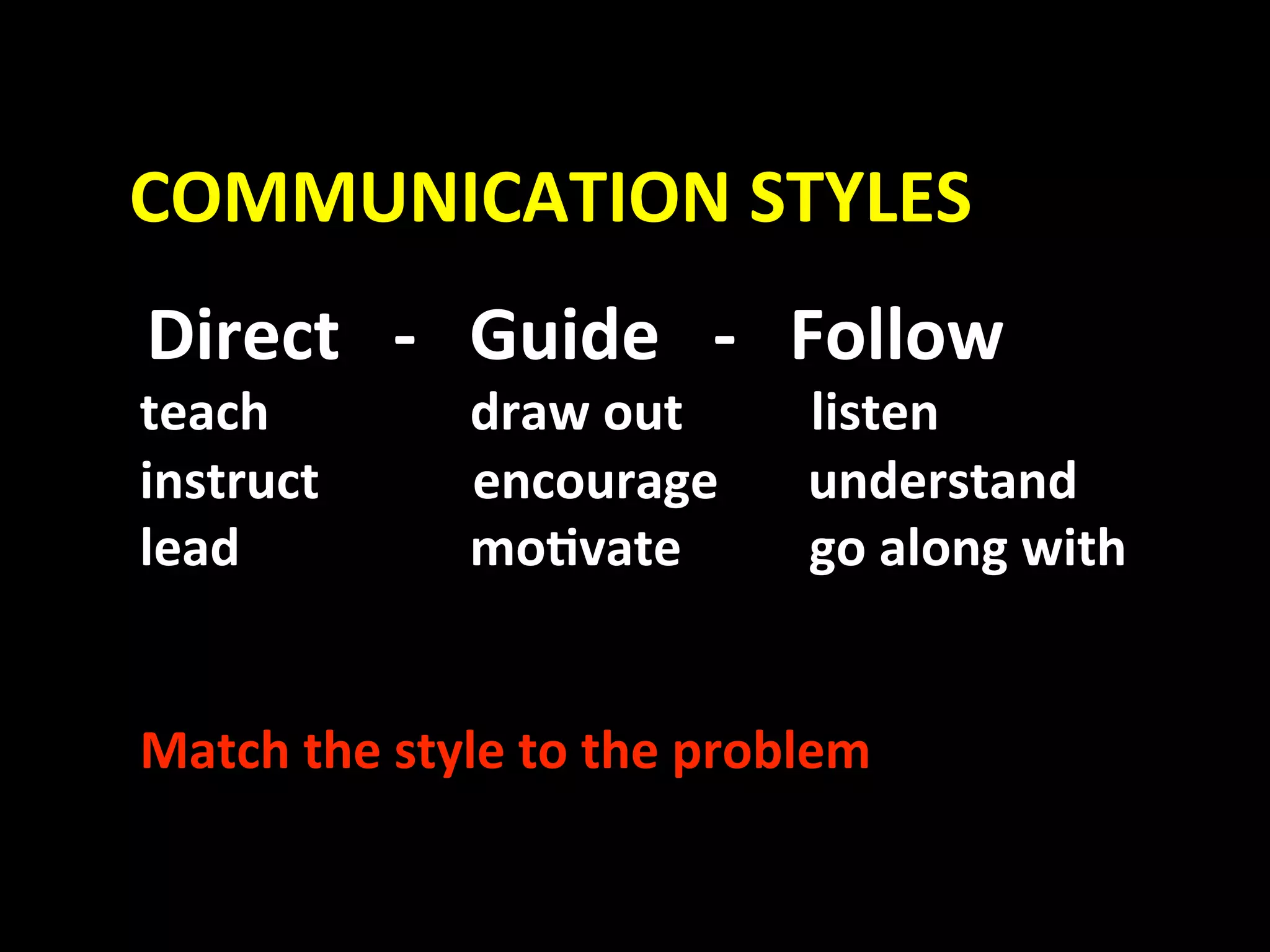
COMMUNICATION STYLES 
    Direct   ‐   Guide   ‐   Follow 
    teach                 draw out          listen 
    instruct            encourage       understand 
    lead                  mo.vate          go along with 
     
     
    Match the style to the problem       
 
 
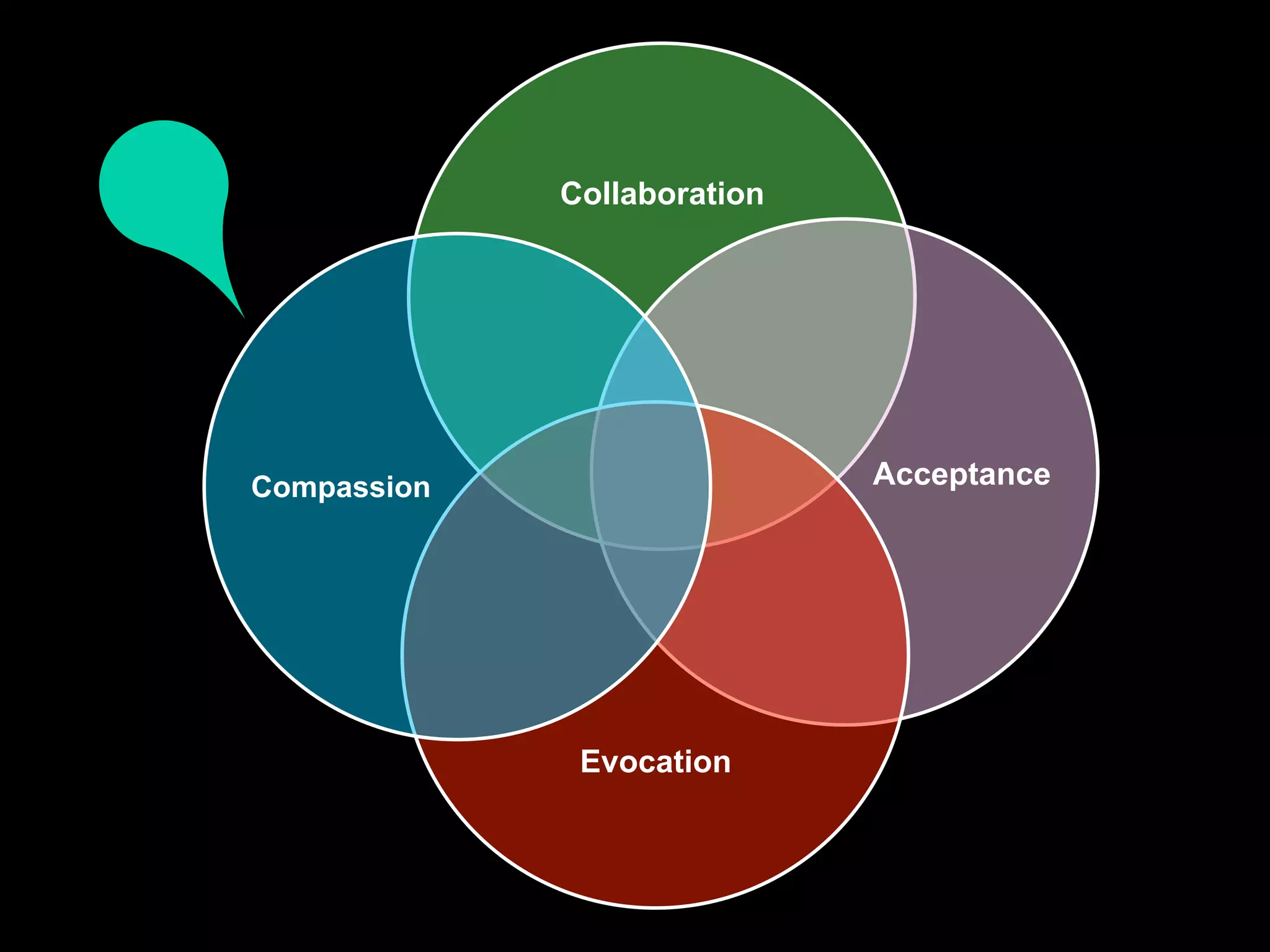
The SPIRIT OF MI
Collaboration


QUESTIONS ‐ OBSERVATIONS 
   Compassion                   Acceptance


                 Evocation
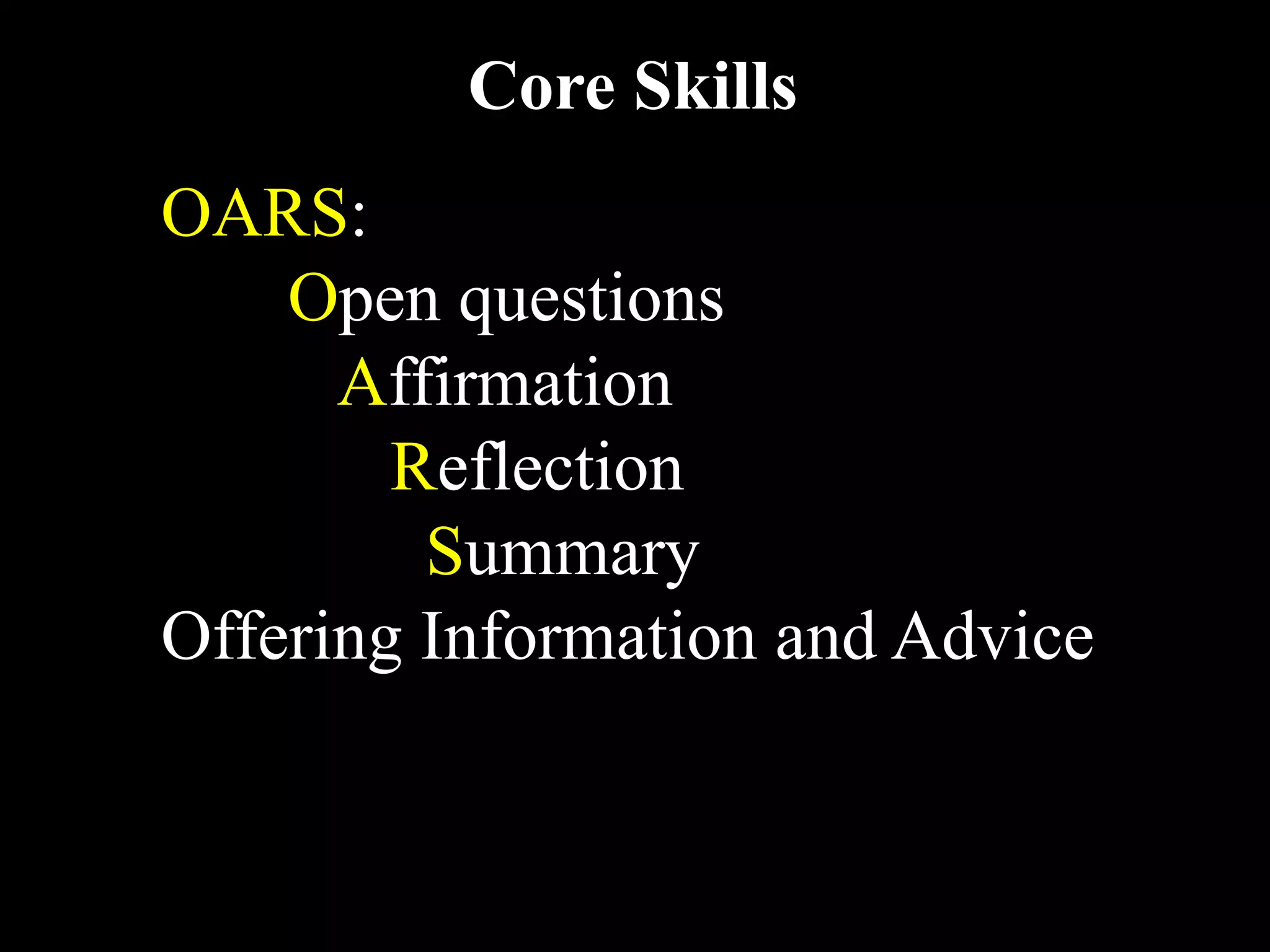
Core Skills
  
OARS:
    Open questions
      Affirmation
        Reflection
         Summary
Offering Information and Advice
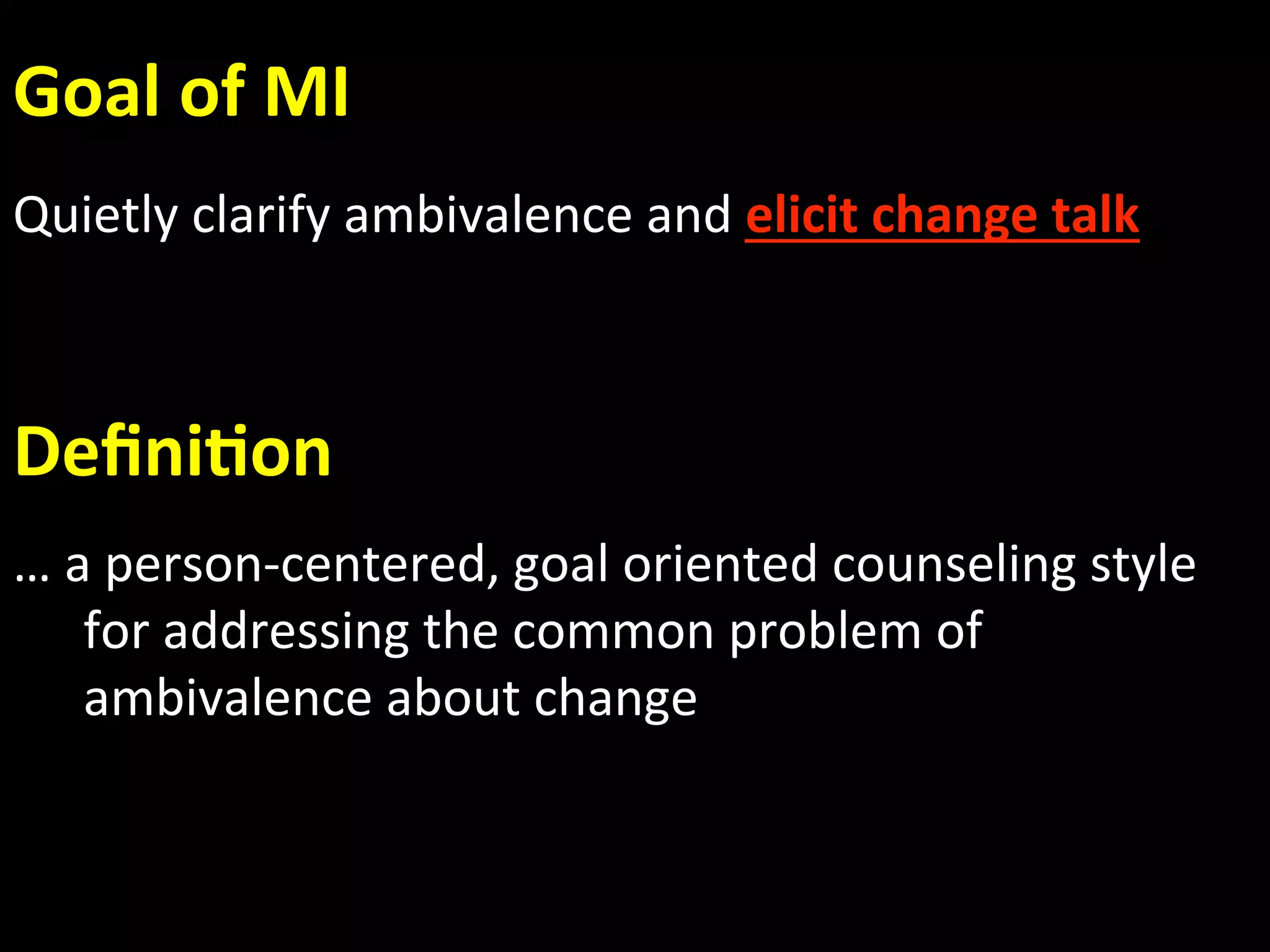
Goal of MI 
Quietly clarify ambivalence and elicit change talk 
 

Defini.on 
… a person‐centered, goal oriented counseling style 
   for addressing the common problem of 
   ambivalence about change 
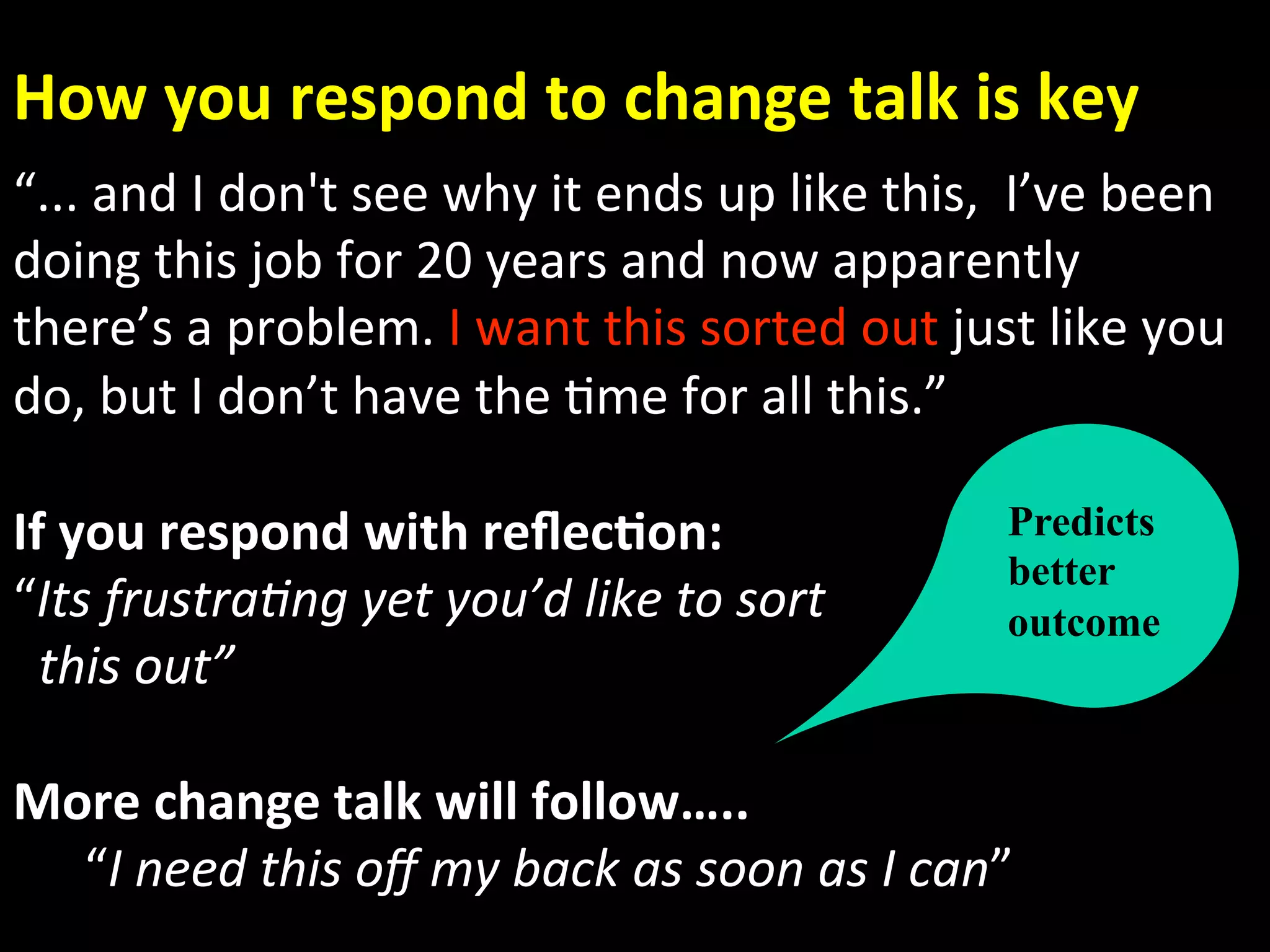
How you respond to change talk is key 

It flickers in a busy conversa.on 
 
“... and I don't see why it ends up like this,  I’ve been 
doing this job for 20 years and now apparently 
there’s a problem. I want this sorted out just like you   
do, but I don’t have the Ame for all this.” 
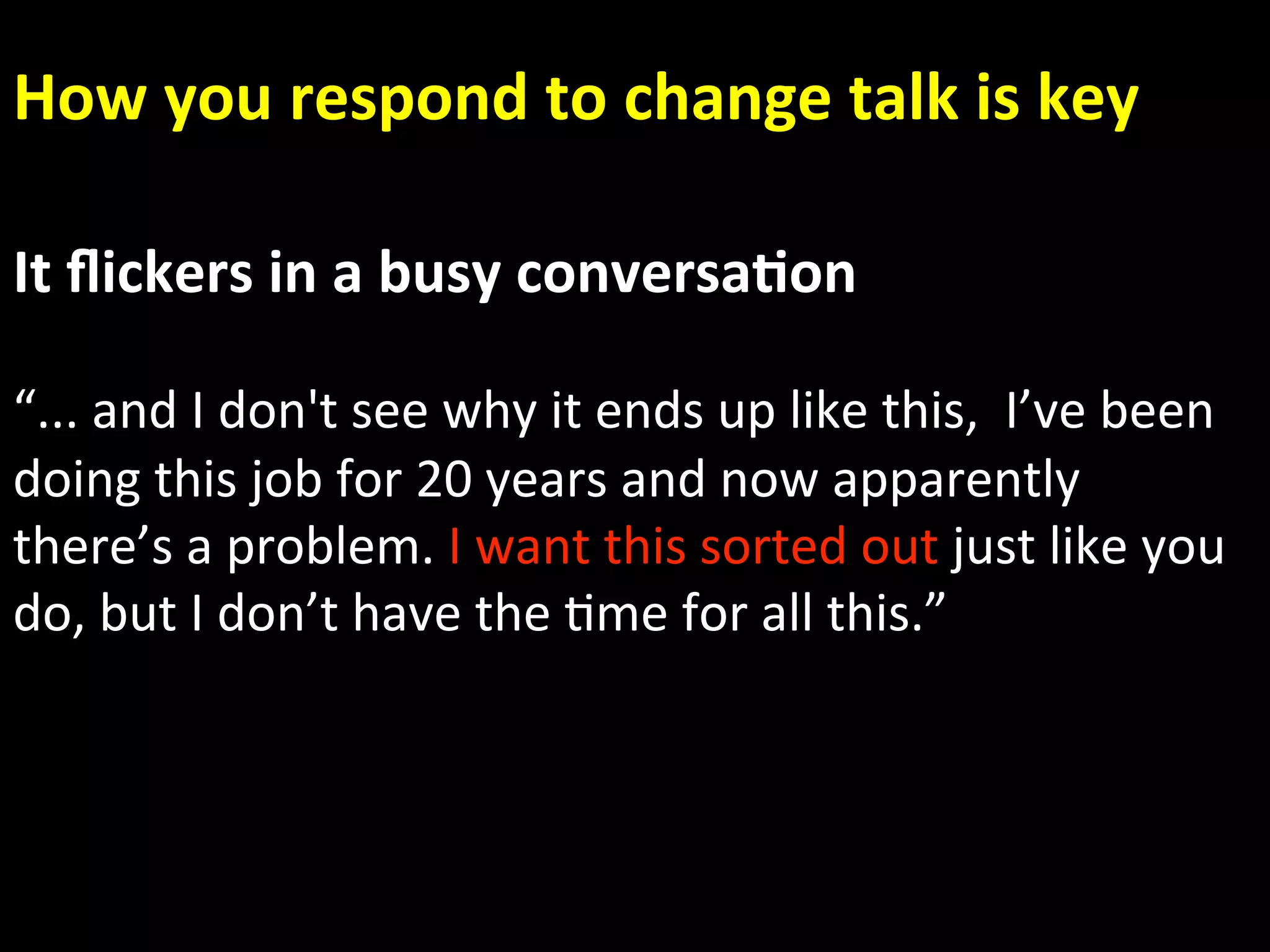
How you respond to change talk is key 

It flickers in a busy conversa.on 
 
“... and I don't see why it ends up like this,  I’ve been 
doing this job for 20 years and now apparently 
there’s a problem. I want this sorted out just like you   
do, but I don’t have the Ame for all this.” 
How you respond to change talk is key 
“... and I don't see why it ends up like this,  I’ve been 
doing this job for 20 years and now apparently 
there’s a problem. I want this sorted out just like you   
do, but I don’t have the Ame for all this.” 
 
If you respond with reflec.on:                   Predicts
                                                better
“Its frustra)ng yet you’d like to sort          outcome
  this out” 
     
More change talk will follow….. 
      “I need this off my back as soon as I can” 
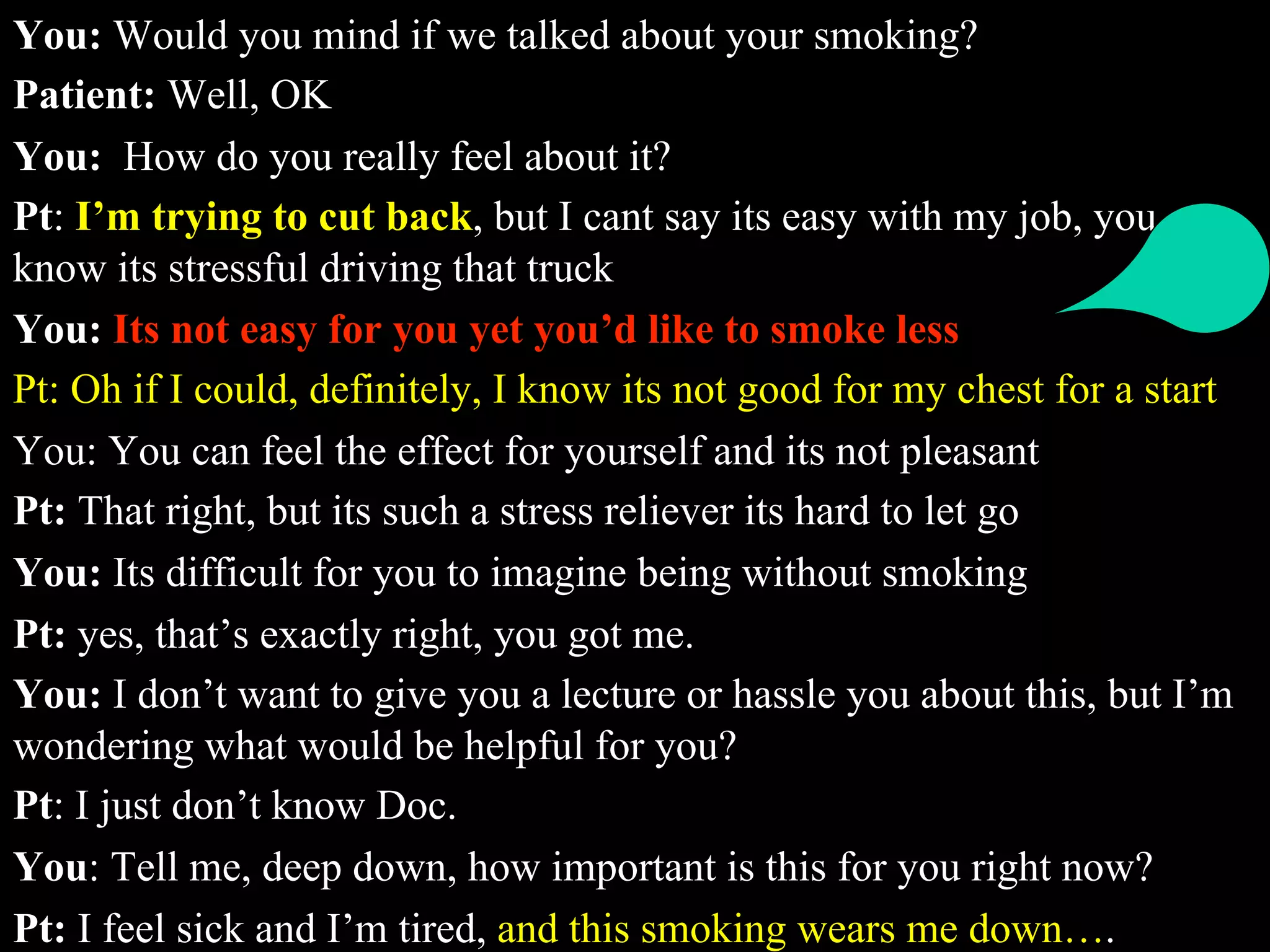
You: Would you mind if we talked about your smoking?
Patient: Well, OK
You: How do you really feel about it?
Pt: I’m trying to cut back, but I cant say its easy with my job, you
know its stressful driving that truck
You: Its not easy for you yet you’d like to smoke less
Pt: Oh if I could, definitely, I know its not good for my chest for a start
You: You can feel the effect for yourself and its not pleasant
Pt: That right, but its such a stress reliever its hard to let go
You: Its difficult for you to imagine being without smoking
Pt: yes, that’s exactly right, you got me.
You: I don’t want to give you a lecture or hassle you about this, but I’m
wondering what would be helpful for you?
Pt: I just don’t know Doc.
You: Tell me, deep down, how important is this for you right now?
Pt: I feel sick and I’m tired, and this smoking wears me down….
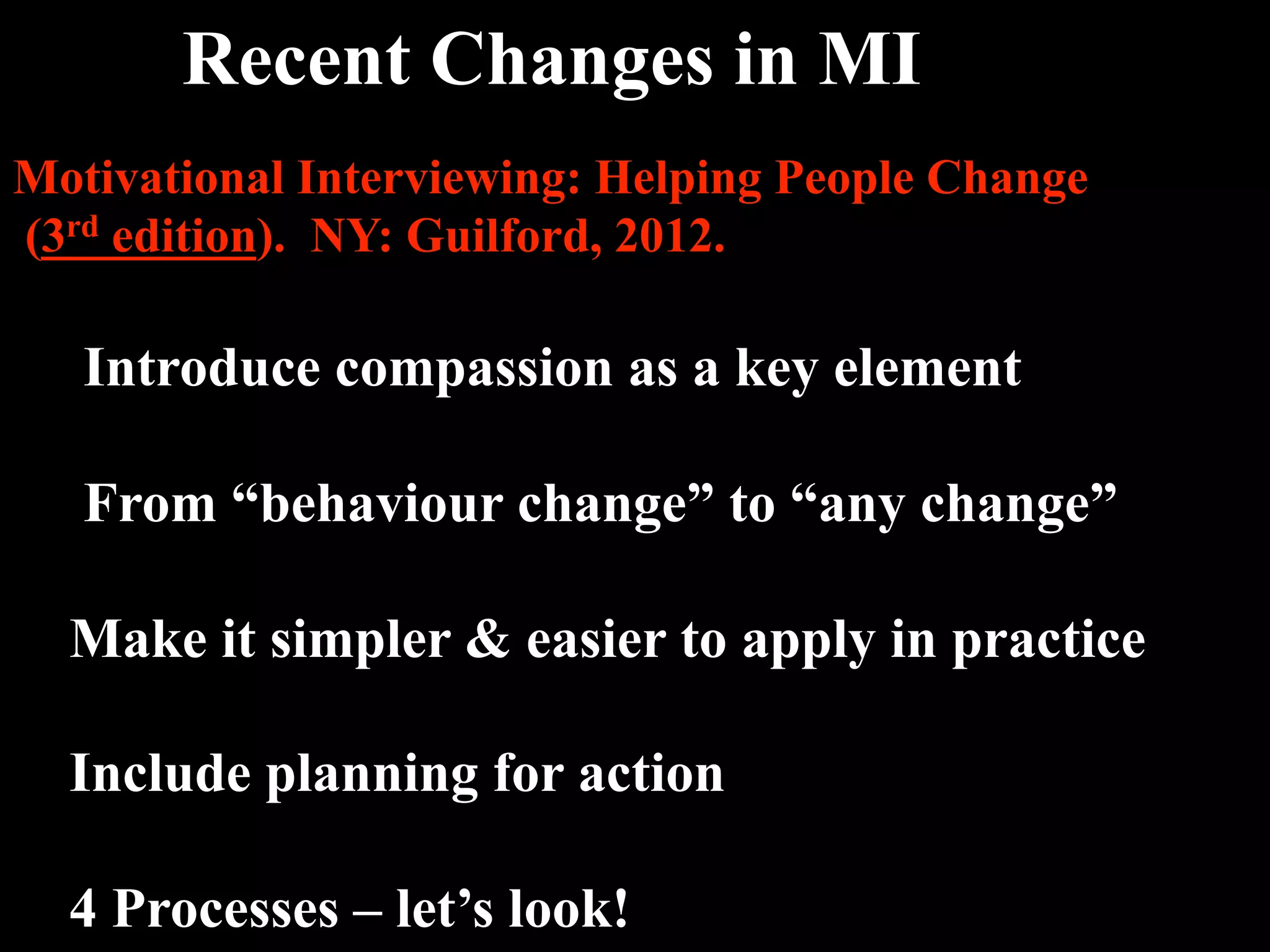
Recent Changes in MI 
Motivational Interviewing: Helping People Change
(3rd edition). NY: Guilford, 2012.

   Introduce compassion as a key element

   From “behaviour change” to “any change”

  Make it simpler & easier to apply in practice

  Include planning for action

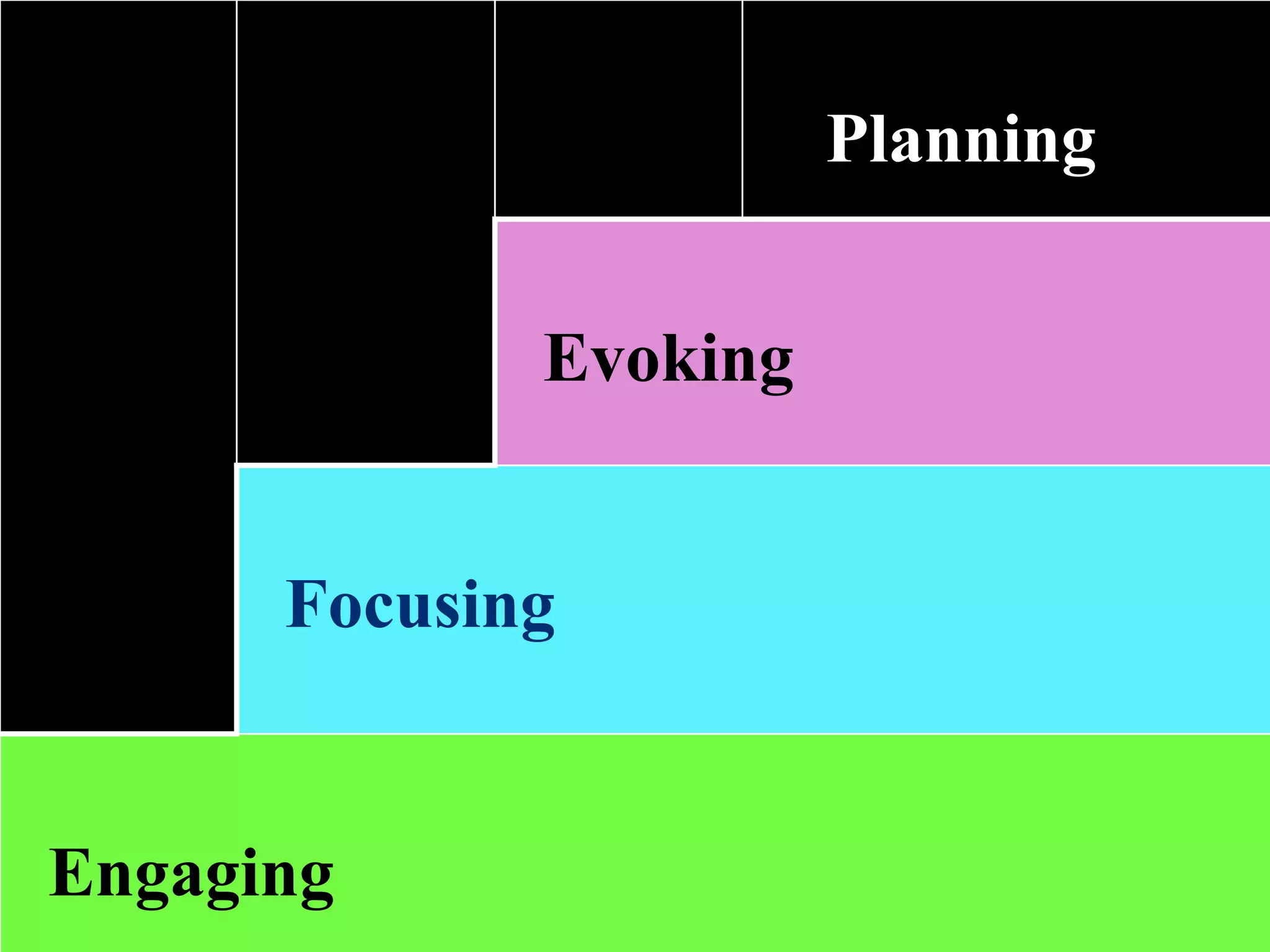
  4 Processes – let’s look!
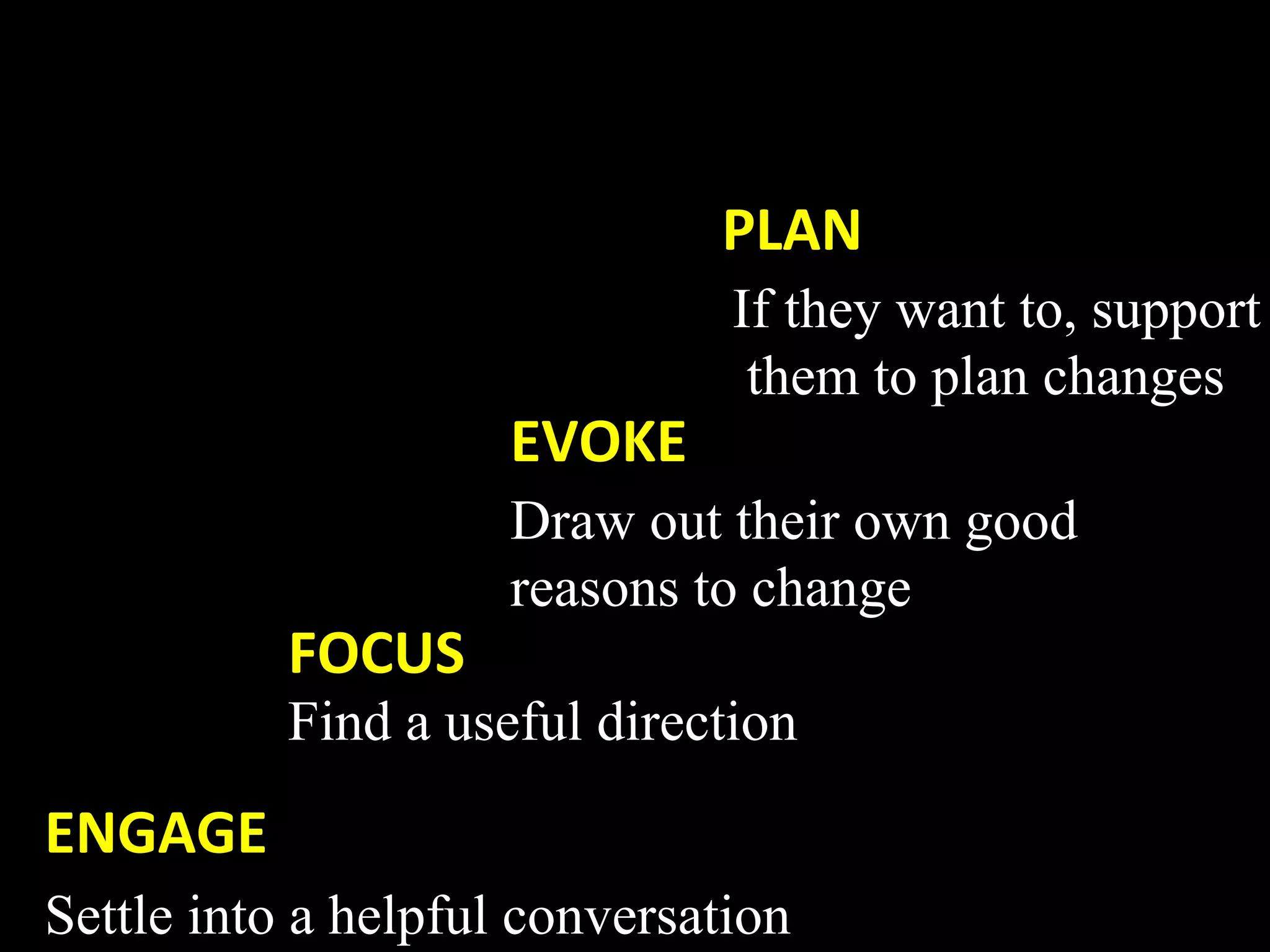
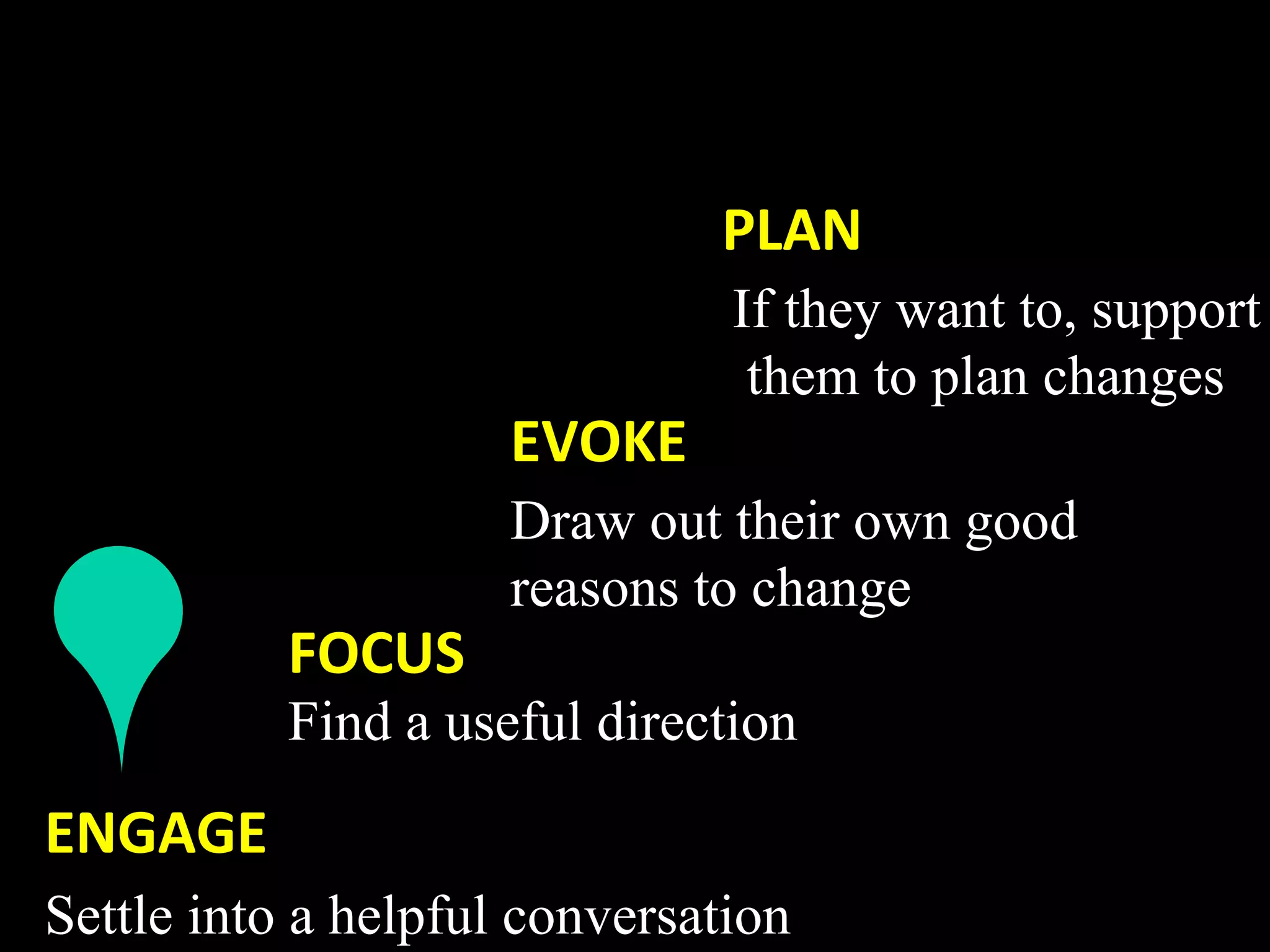
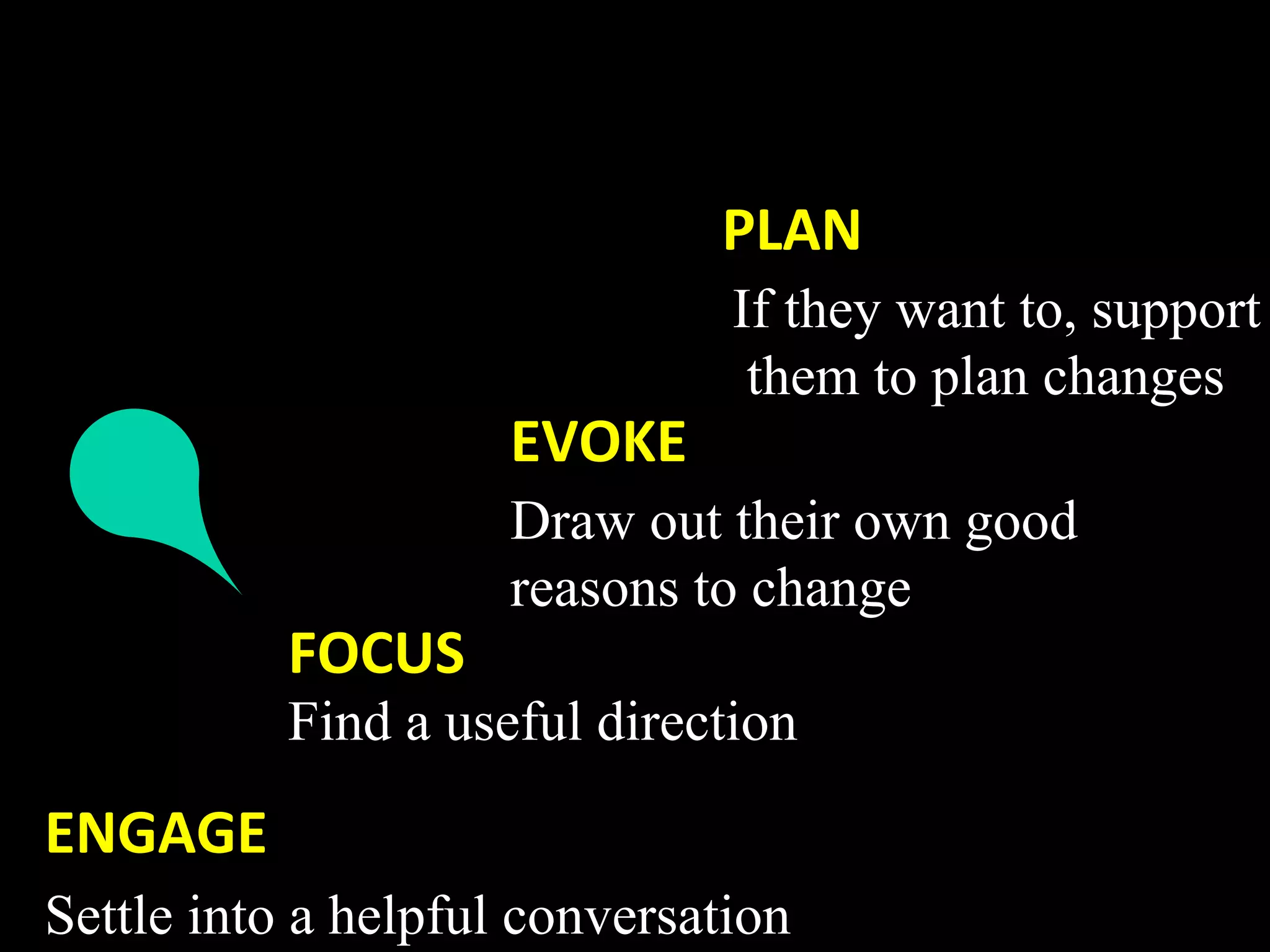
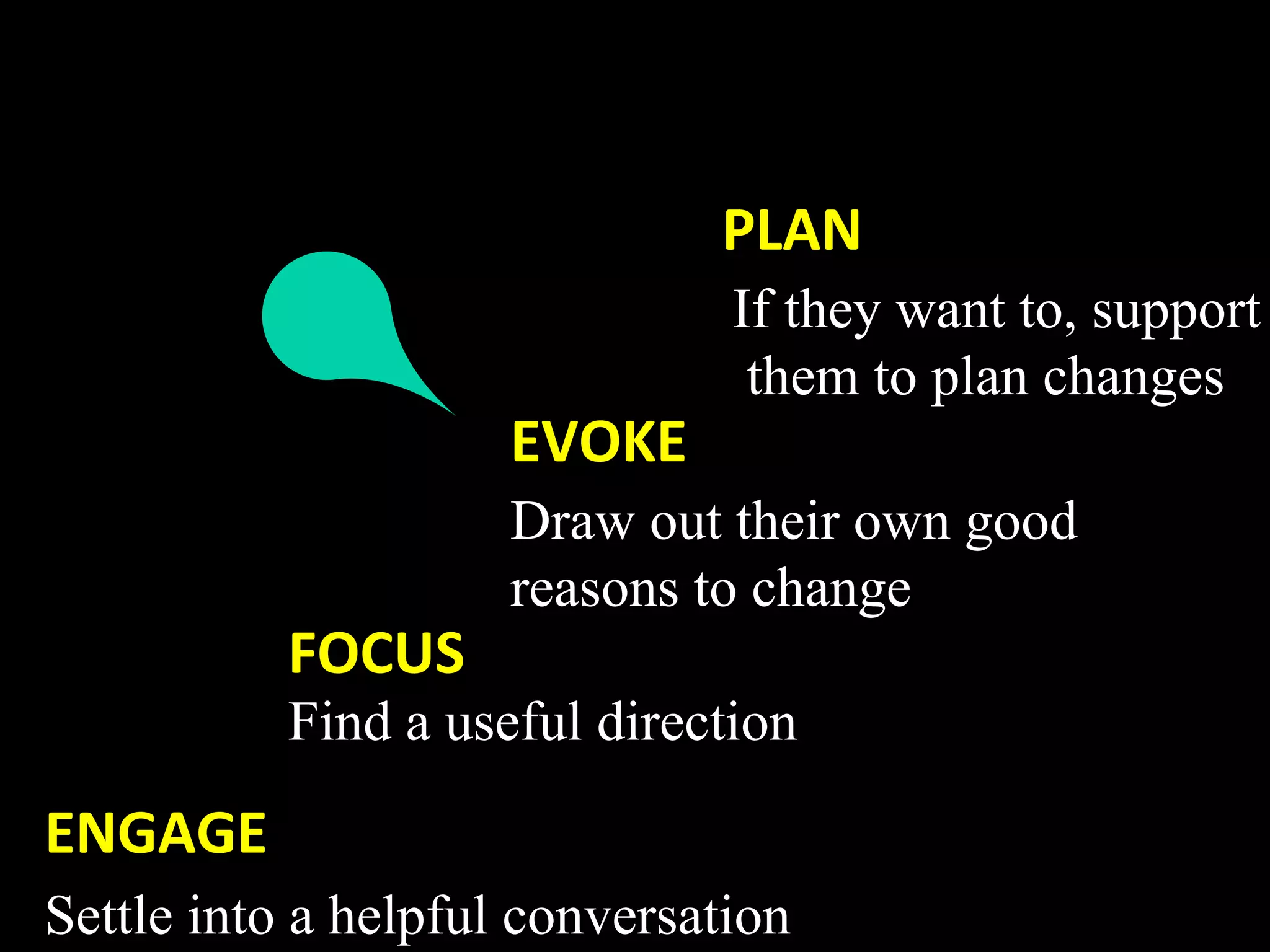
New Four Process Model


This is what happens in an effec.ve MI session 
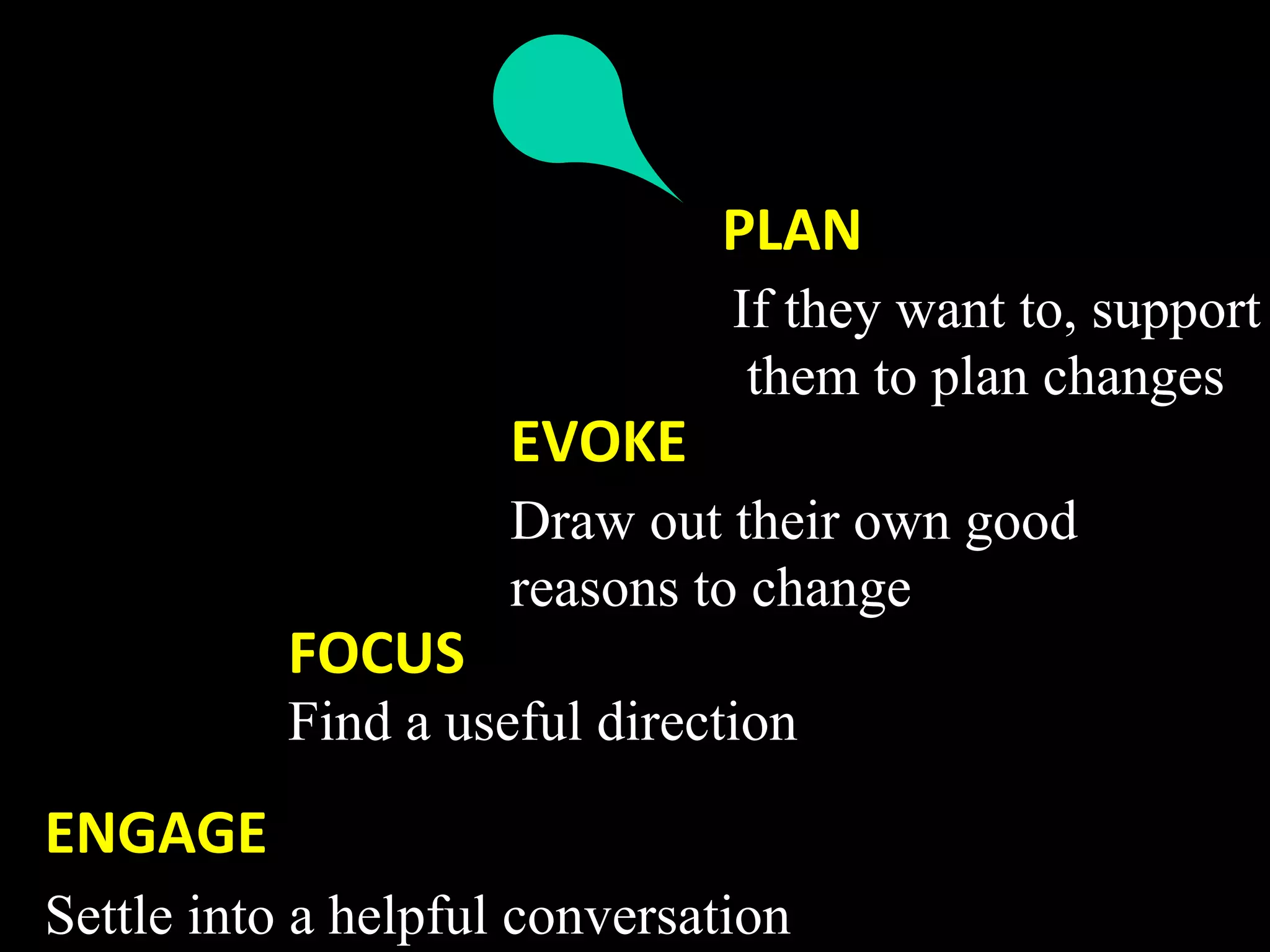
PLAN 
                               If they want to, support
                                them to plan changes
                     EVOKE   
                     Draw out their own good
                     reasons to change
           FOCUS   
           Find a useful direction
            
ENGAGE 
Settle into a helpful conversation
PLAN 
                               If they want to, support
                                them to plan changes
                     EVOKE   
                     Draw out their own good
                     reasons to change
           FOCUS   
           Find a useful direction
            
ENGAGE 
Settle into a helpful conversation
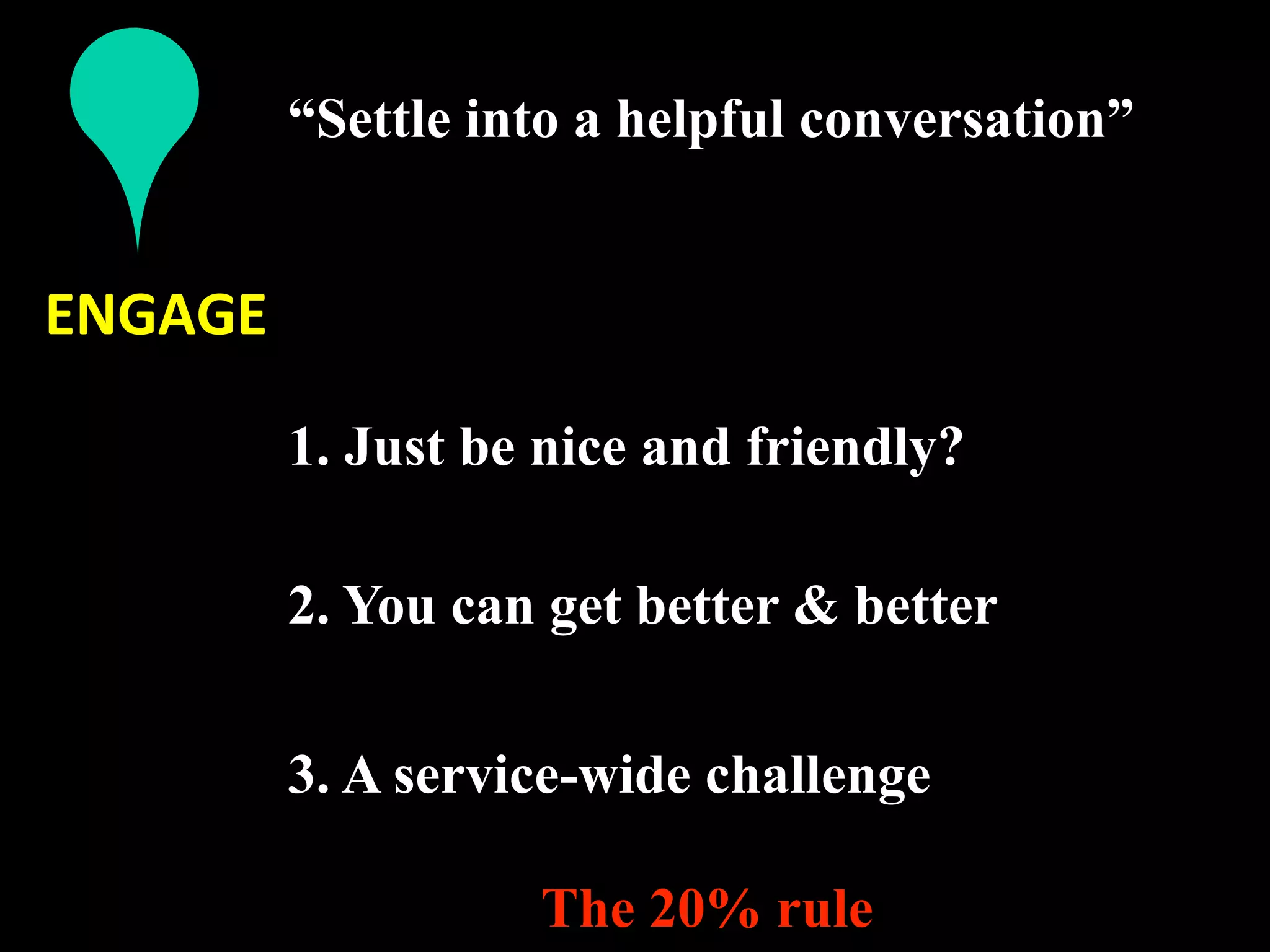
“Settle into a helpful conversation”
           
ENGAGE 

          1. Just be nice and friendly?
           
          2. You can get better & better
           
          3. A service-wide challenge

                    The 20% rule
PLAN 
                               If they want to, support
                                them to plan changes
                     EVOKE   
                     Draw out their own good
                     reasons to change
           FOCUS   
           Find a useful direction
            
ENGAGE 
Settle into a helpful conversation
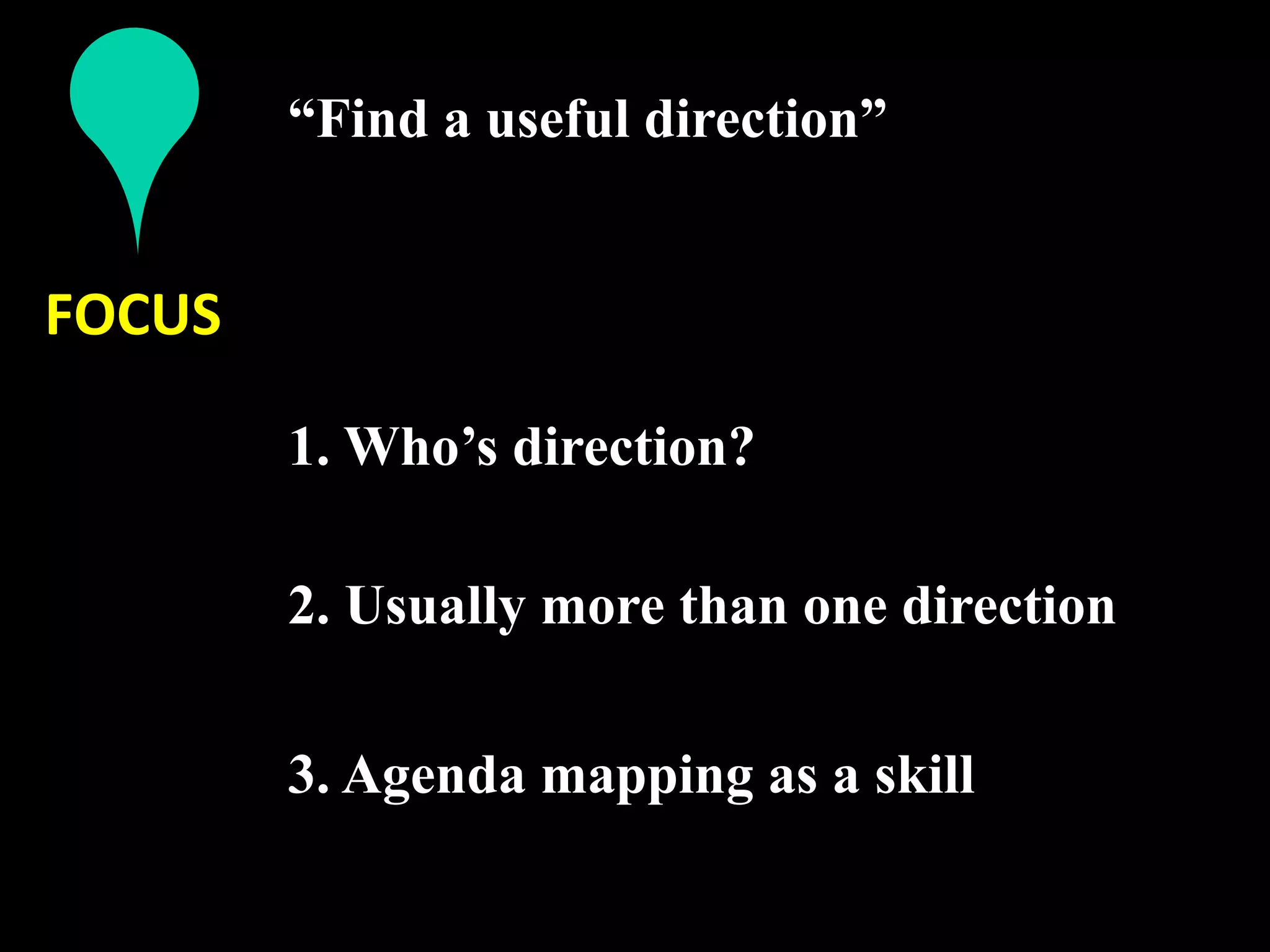
“Find a useful direction” 


FOCUS 

         1. Who’s direction?
          
         2. Usually more than one direction
          
         3. Agenda mapping as a skill
          
PLAN 
                               If they want to, support
                                them to plan changes
                     EVOKE   
                     Draw out their own good
                     reasons to change
           FOCUS   
           Find a useful direction
            
ENGAGE 
Settle into a helpful conversation
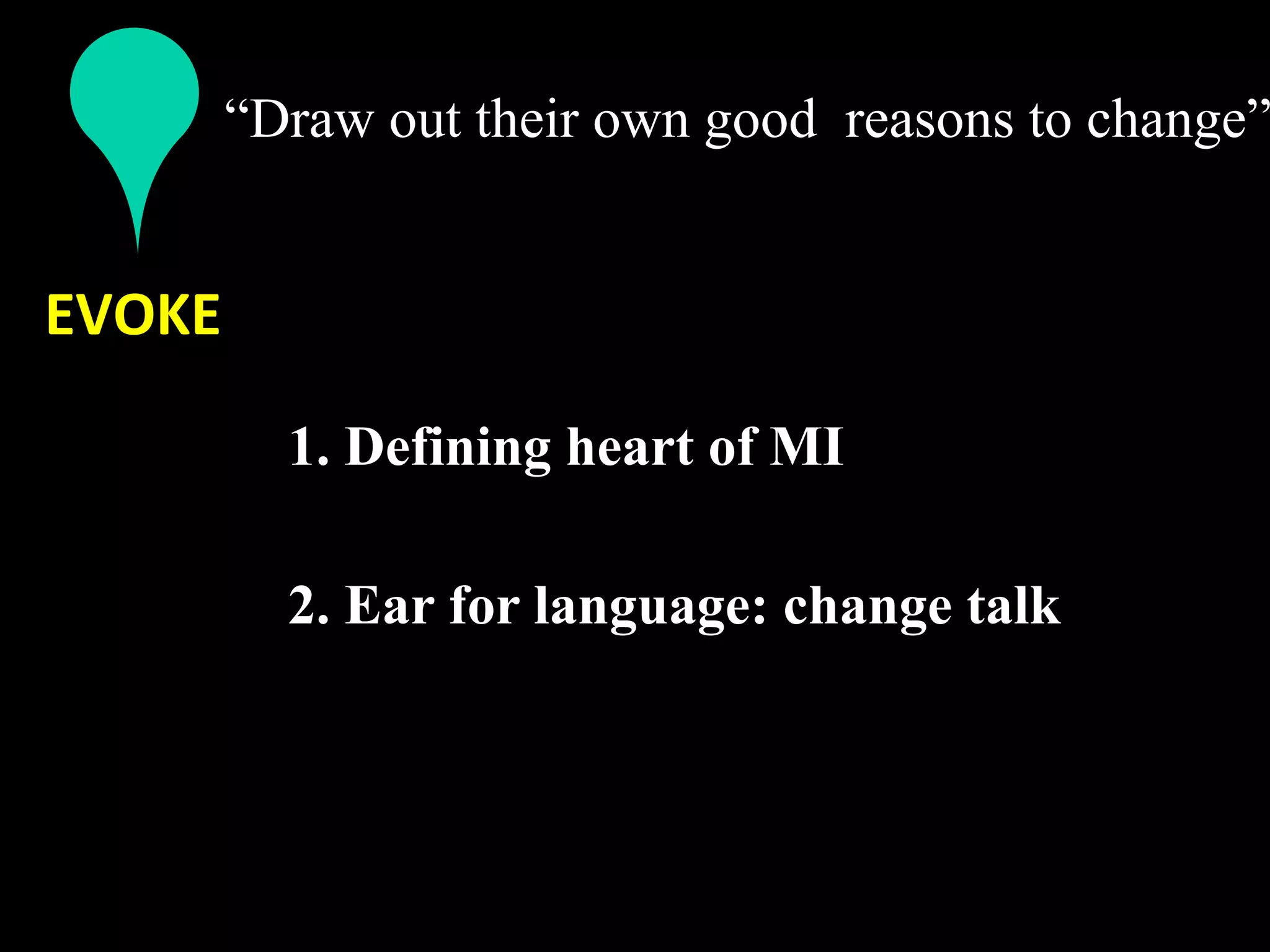
“Draw out their own good reasons to change”


EVOKE 

         1. Defining heart of MI
          
         2. Ear for language: change talk
          
PLAN 
                               If they want to, support
                                them to plan changes
                     EVOKE   
                     Draw out their own good
                     reasons to change
           FOCUS   
           Find a useful direction
            
ENGAGE 
Settle into a helpful conversation
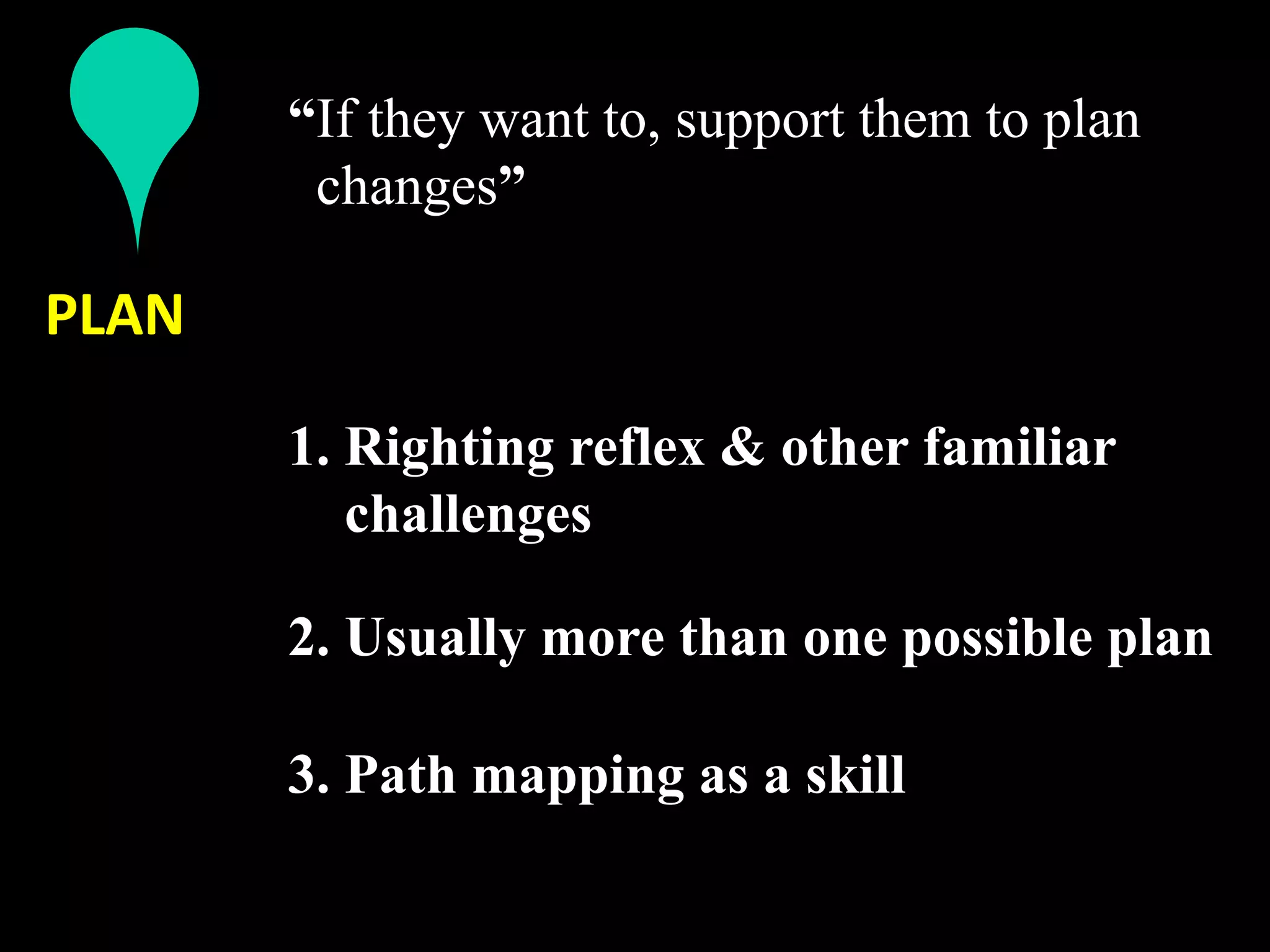
“If they want to, support them to plan
         changes” 

PLAN 

        1. Righting reflex & other familiar
           challenges
         
        2. Usually more than one possible plan
         
        3. Path mapping as a skill
         
Planning


             Evoking


      Focusing


Engaging
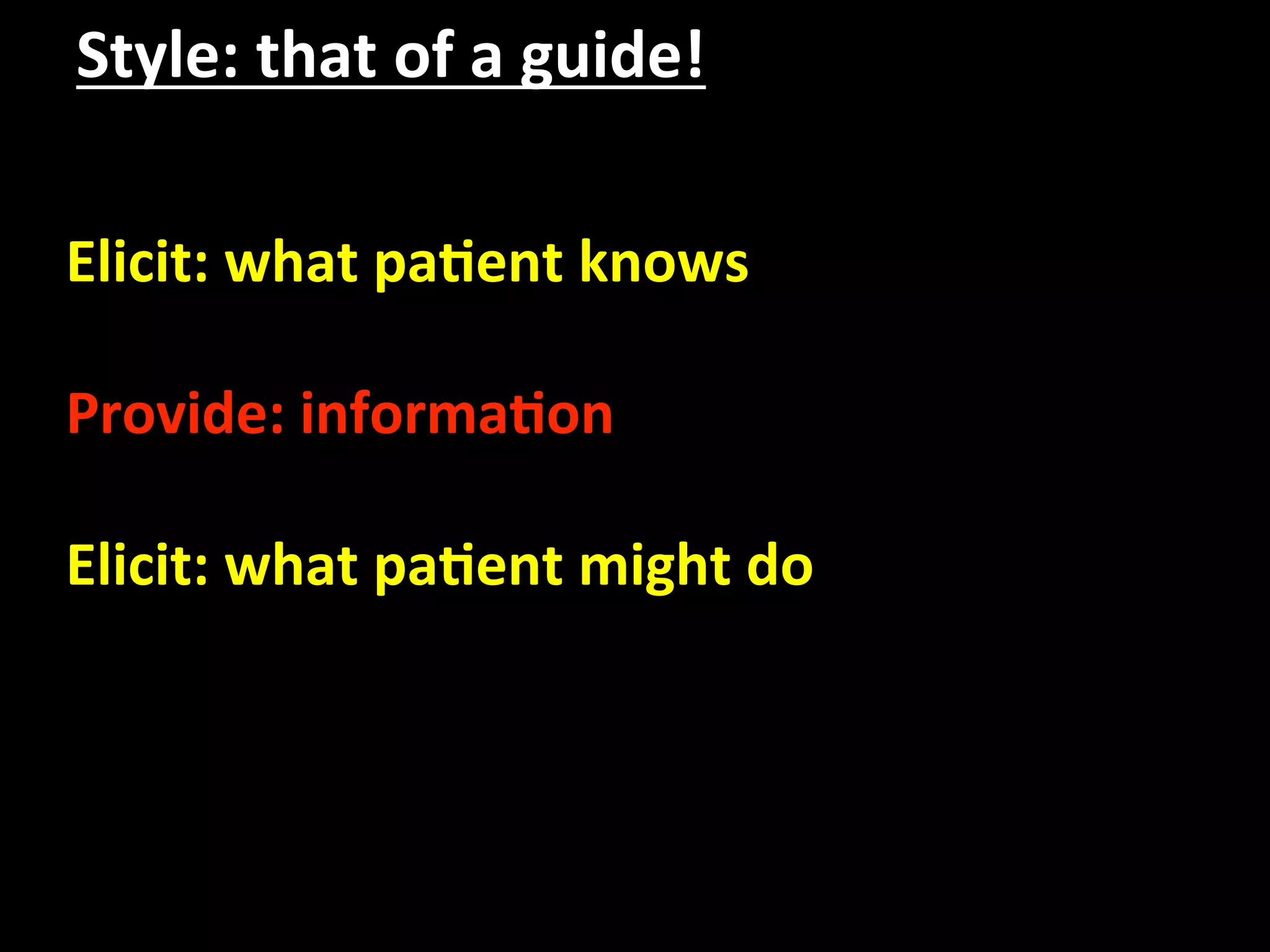
Strategy 1: Informa.on exchange 
 
Style: that of a guide! 

Elicit: what pa.ent knows 
 
Provide: informa.on 
 
Elicit: what pa.ent might do 
Strategy 2: 
Importance & confidence ques.ons 
 
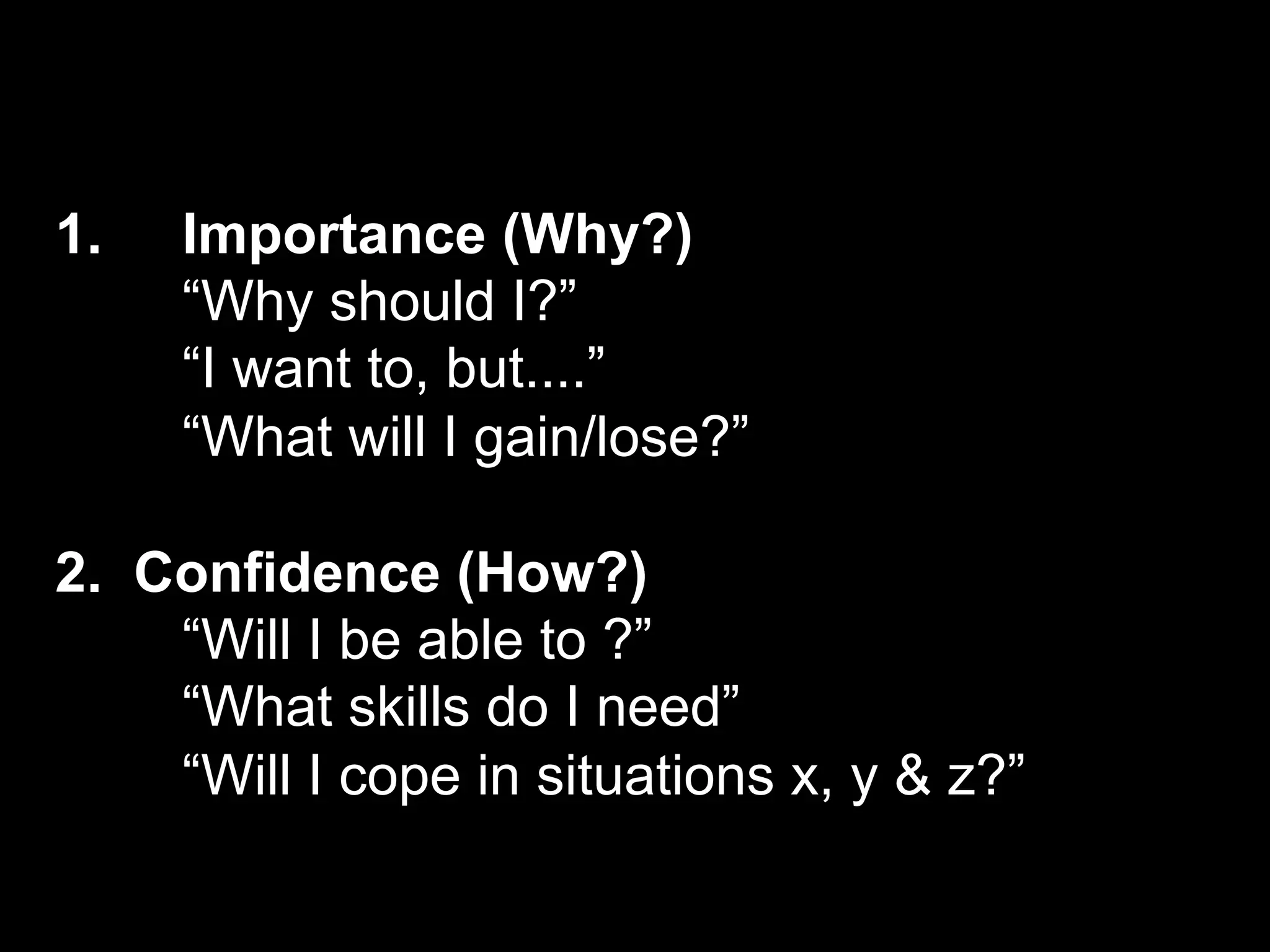
1.   Importance (Why?)
     “Why should I?”
     “I want to, but....”
     “What will I gain/lose?”

2. Confidence (How?)
    “Will I be able to ?”
    “What skills do I need”
    “Will I cope in situations x, y & z?”
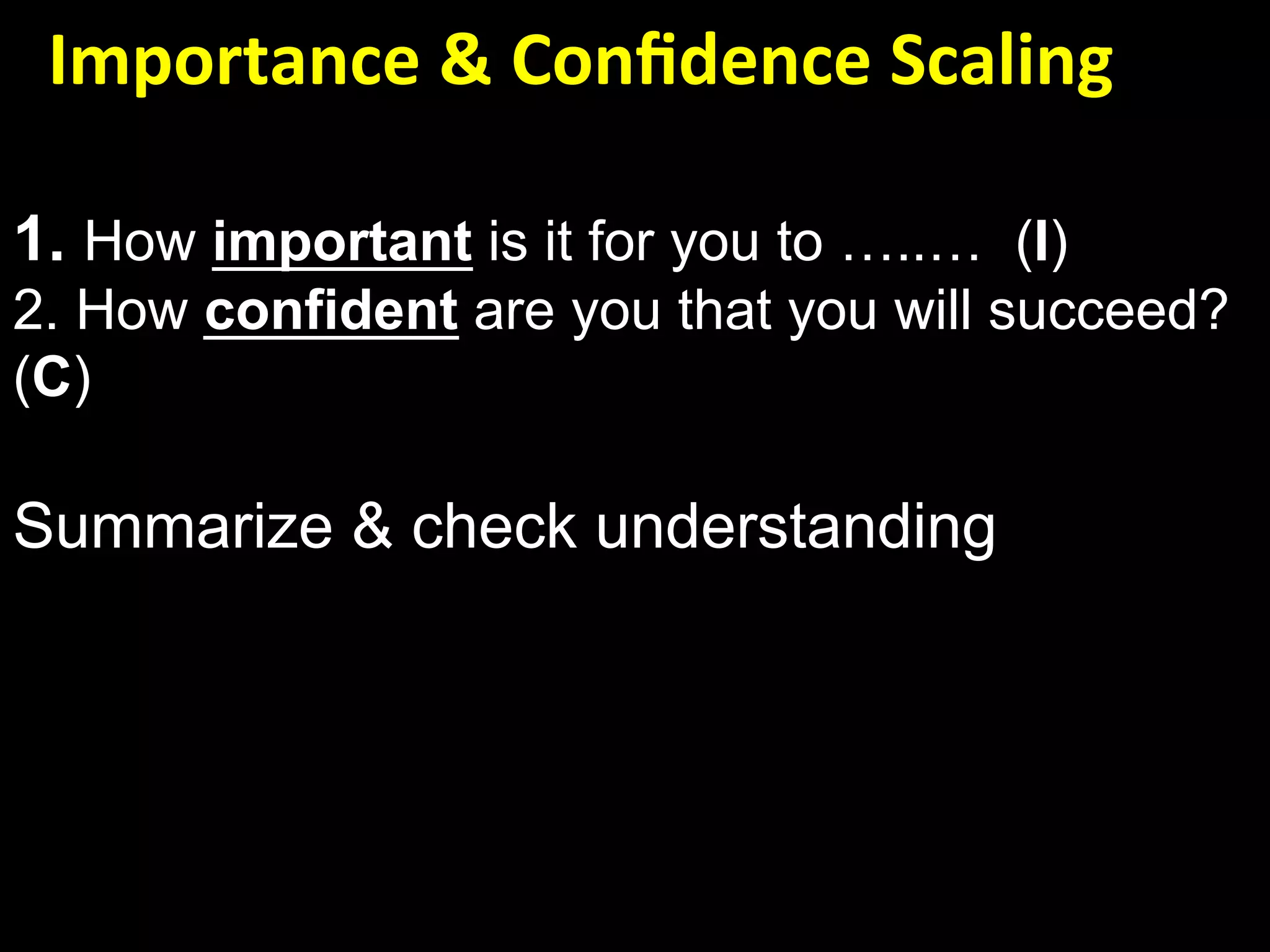
  Importance & Confidence Scaling 

1. How important is it for you to …..… (I)
2. How confident are you that you will succeed?
(C)

Summarize & check understanding
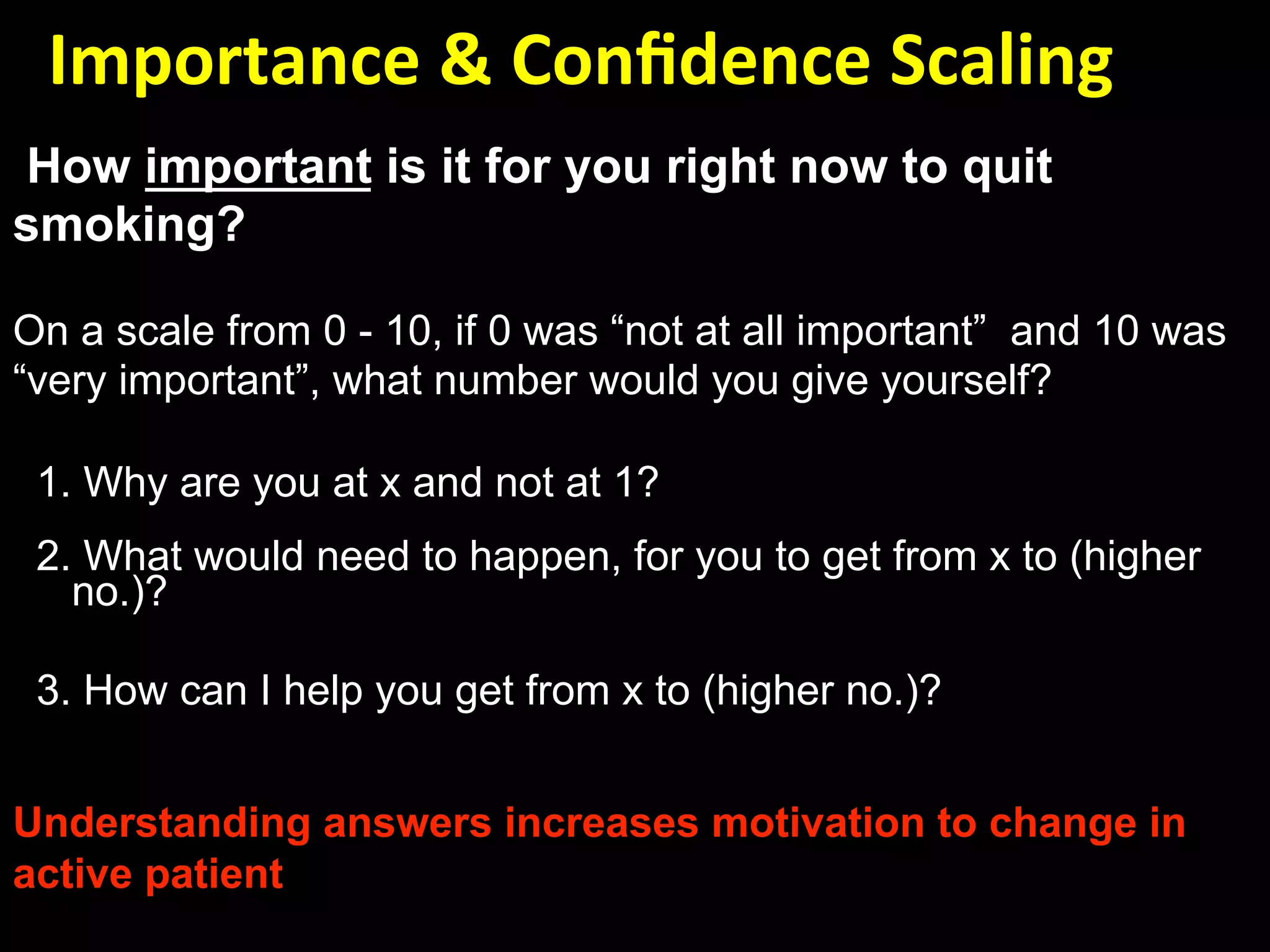
  Importance & Confidence Scaling 
How important is it for you right now to quit
smoking?

On a scale from 0 - 10, if 0 was “not at all important” and 10 was
“very important”, what number would you give yourself?

 1. Why are you at x and not at 1?
 2. What would need to happen, for you to get from x to (higher
   no.)?

 3. How can I help you get from x to (higher no.)?


Understanding answers increases motivation to change in
active patient
       Theory & Research 
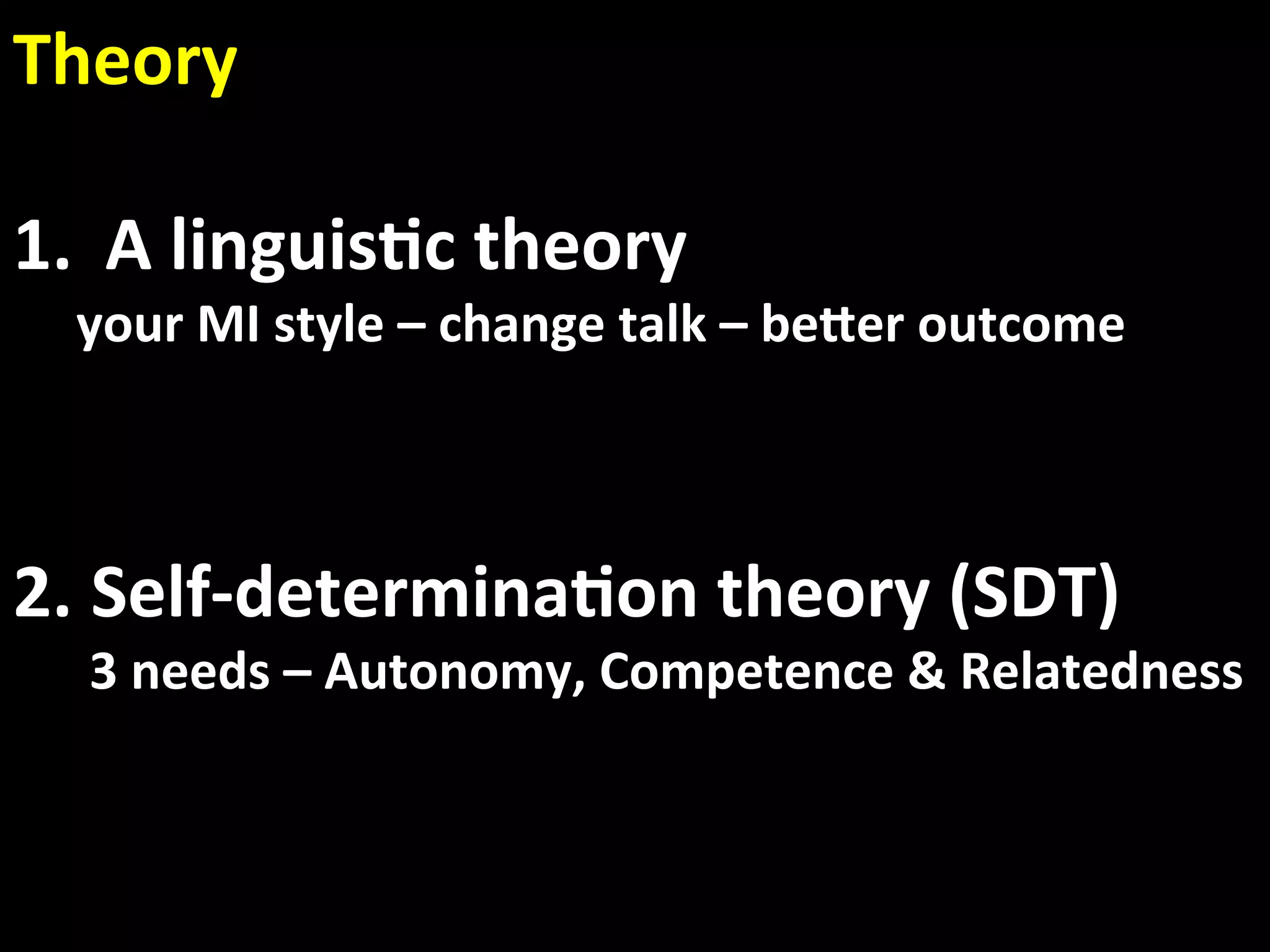
Theory 
 
1.  A linguis.c theory 
  your MI style – change talk – beaer outcome 


2.  Self‐determina.on theory (SDT) 
      3 needs – Autonomy, Competence & Relatedness 
Research 
 
Many meta‐analyses 
    Effec.ve in some areas, not in others 
   More effec.ve than advice giving  
 
One example 
 
 
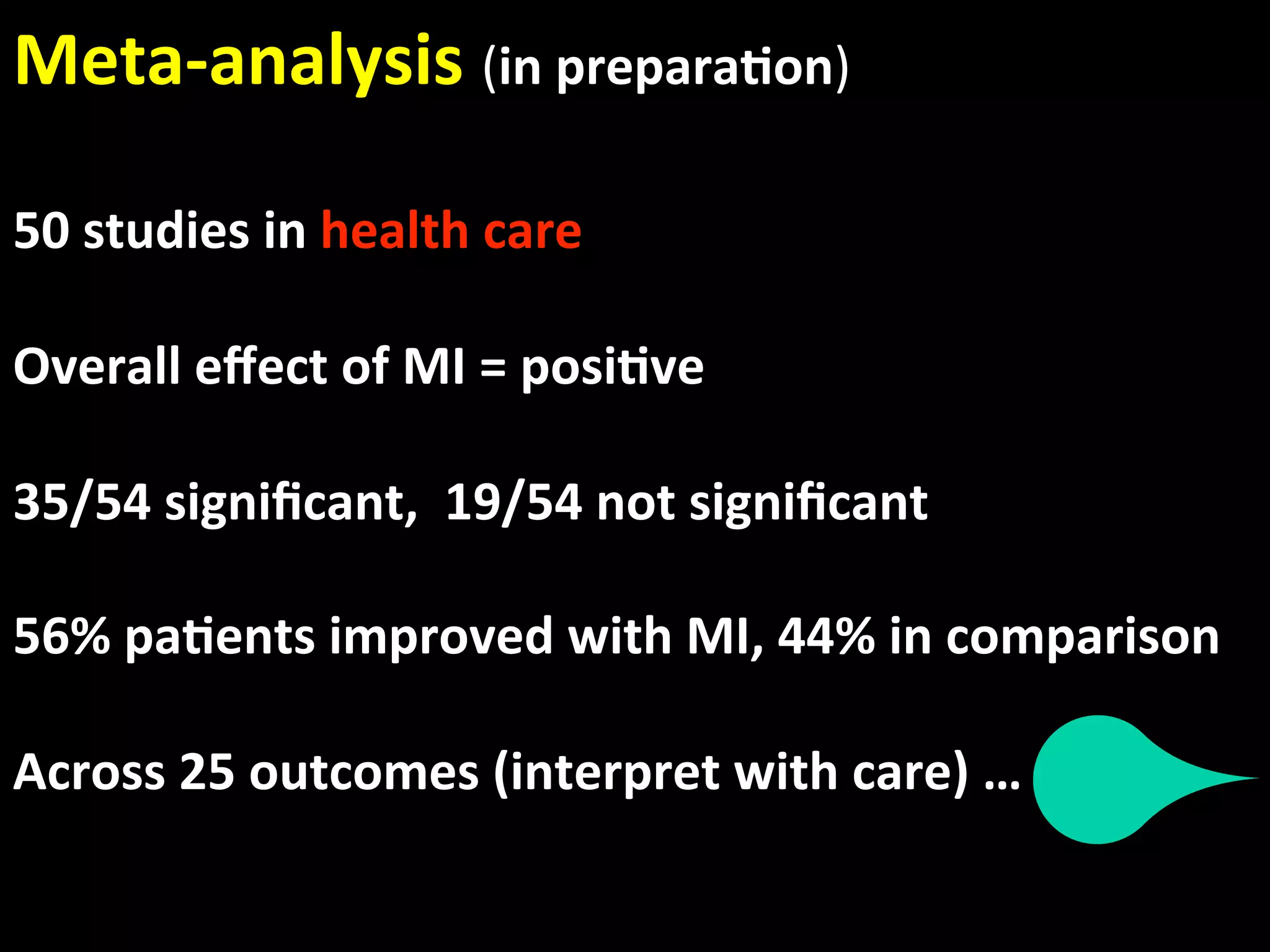
Meta‐analysis (in prepara.on) 
 
50 studies in health care  
 
Overall effect of MI = posi.ve 
 
35/54 significant,  19/54 not significant 
 
56% pa.ents improved with MI, 44% in comparison 
 
Across 25 outcomes (interpret with care) …   
 
 
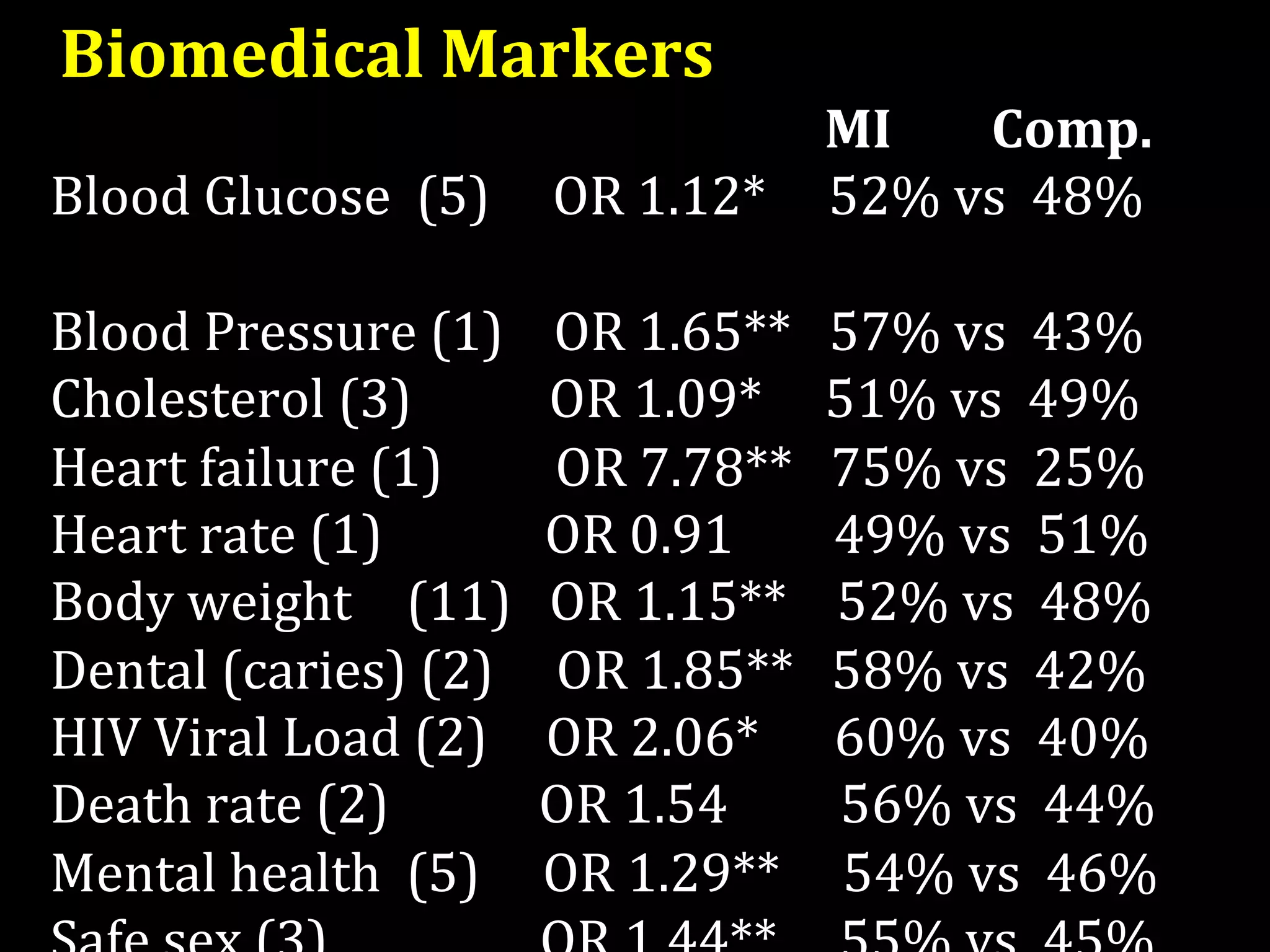
   Biomedical Markers 
                                            MI        Comp.   
   Blood Glucose  (5)     OR 1.12*     52% vs  48% 
        
   Blood Pressure (1)    OR 1.65**   57% vs  43% 
   Cholesterol (3)           OR 1.09*     51% vs  49% 
   Heart failure (1)         OR 7.78**   75% vs  25% 
   Heart rate (1)             OR 0.91        49% vs  51% 
   Body weight   (11)   OR 1.15**    52% vs  48% 
   Dental (caries) (2)     OR 1.85**   58% vs  42% 
   HIV Viral Load (2)    OR 2.06*      60% vs  40% 
   Death rate (2)            OR 1.54         56% vs  44%    
   Mental health  (5)     OR 1.29**     54% vs  46%  
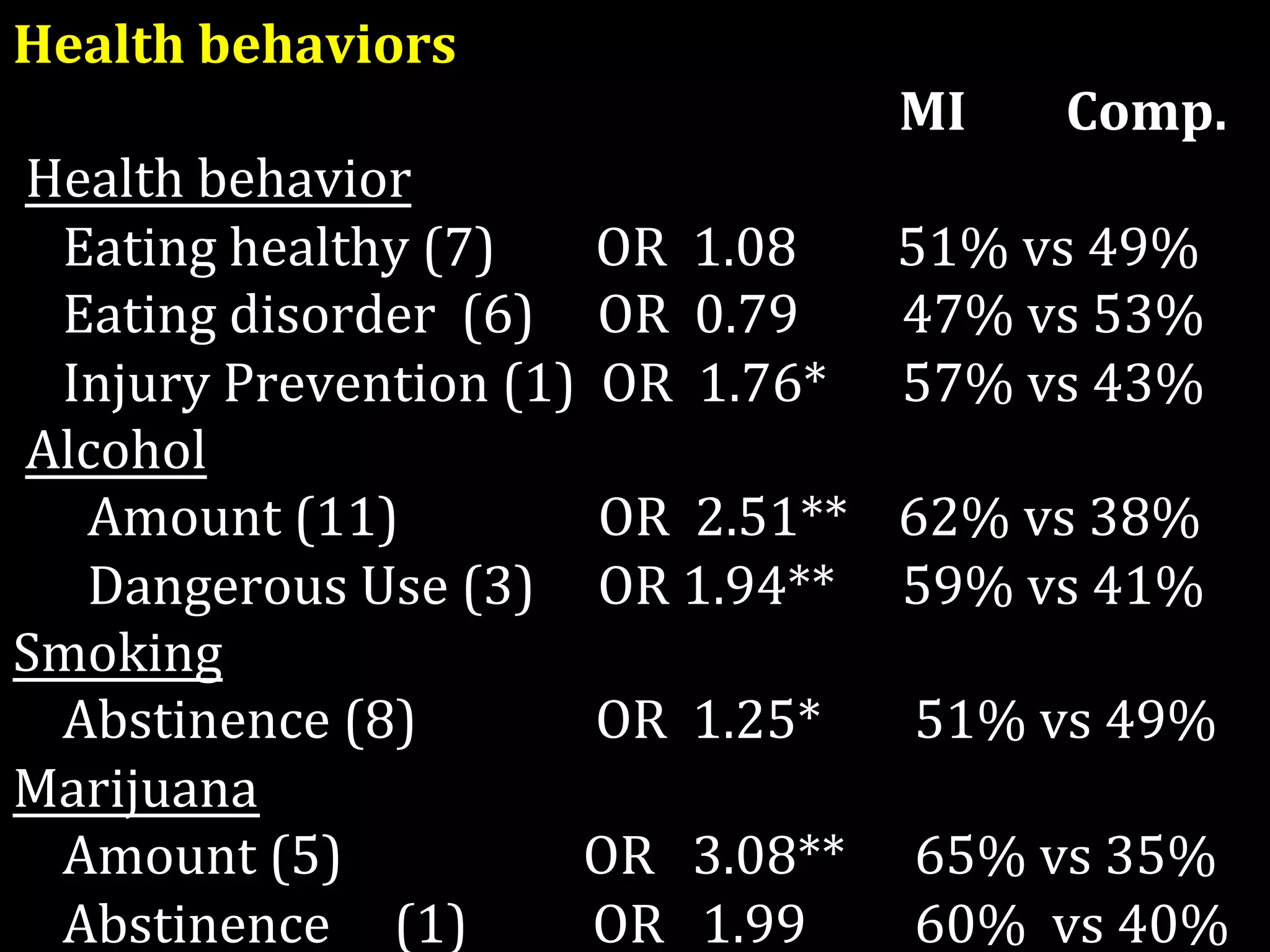
Health behaviors 
                                                   MI        Comp.   
 Health behavior 
    Eating healthy (7)        OR  1.08        51% vs 49%  
    Eating disorder  (6)     OR  0.79              47% vs 53%  
    Injury Prevention (1)  OR  1.76*      57% vs 43%  
 Alcohol                     
      Amount (11)                OR  2.51**    62% vs 38%  
      Dangerous Use (3)     OR 1.94**  59% vs 41%     
Smoking                     
    Abstinence (8)               OR  1.25*   51% vs 49%  
Marijuana                                 
    Amount (5)                  OR   3.08**   65% vs 35%  
    Abstinence  (1)          OR   1.99   60%  vs 40% 
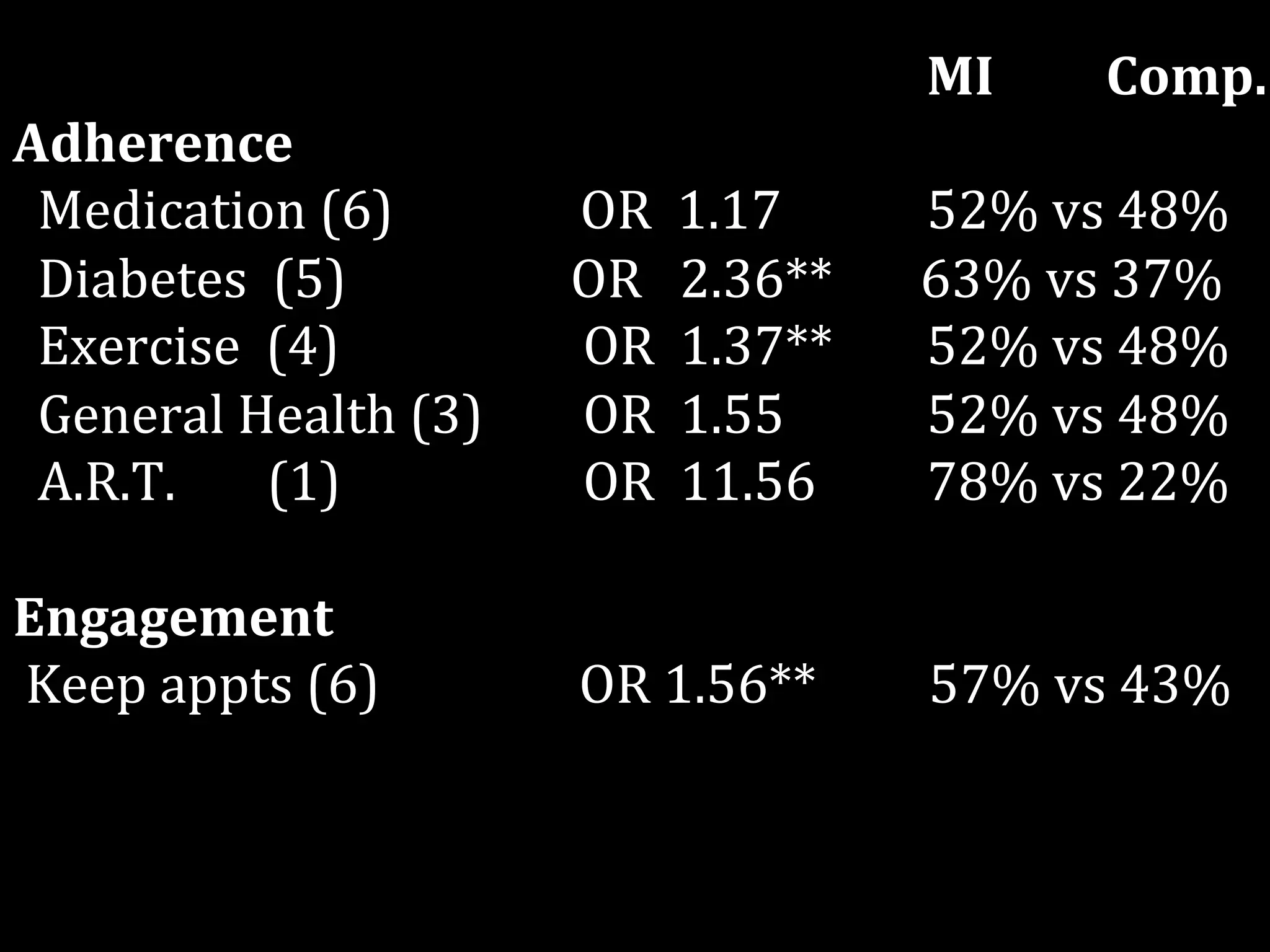
                   MI         Comp. 
Adherence 
  Medication (6)               OR  1.17      52% vs 48%    
  Diabetes  (5)                  OR   2.36**       63% vs 37%  
  Exercise  (4)                   OR  1.37**    52% vs 48%  
  General Health (3)        OR  1.55                52% vs 48%  
  A.R.T.  (1)                     OR  11.56    78% vs 22%  
  
Engagement  
 Keep appts (6)                OR 1.56**         57% vs 43%  
  
MI – Conclusions 
    
No quick fix 
 
   MI shines a light on how you speak about change 
 
   Learning MI involves skill development  
     its not just client‐centred counselling: has direc.on
 
   Do it well, outcomes should be beaer 


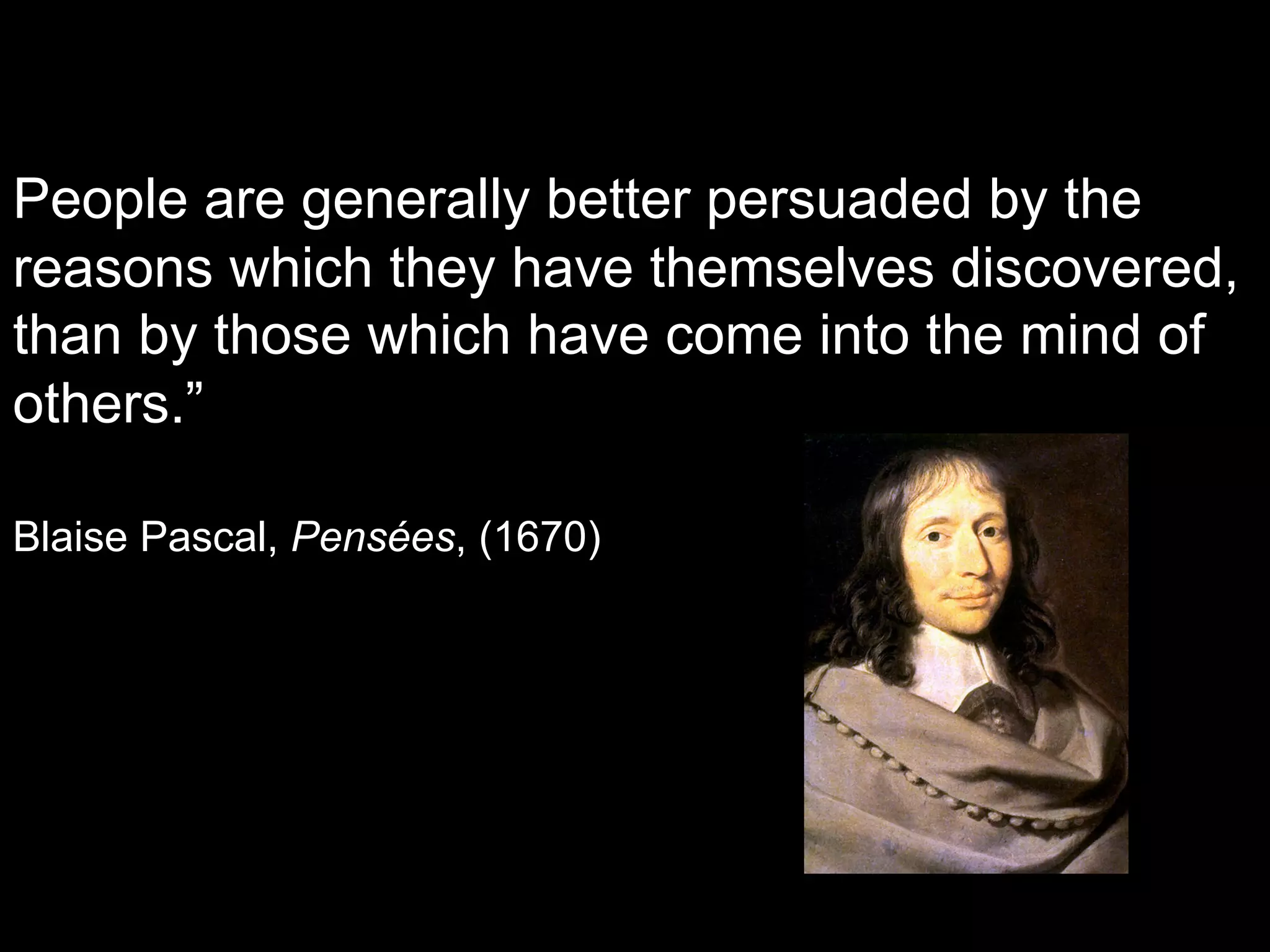
People are generally better persuaded by the
reasons which they have themselves discovered,
than by those which have come into the mind of
others.”

Blaise Pascal, Pensées, (1670)
 

Stephen Rollnick MI presentation for MPS Feb2013