
What Is Our Purpose?
ICNA Sisters Wing
Usratul Maria
Dawah Conference 2010
Saadia Yunus
WHY ARE WE HERE?
WHY WERE WE CREATED?
WHAT IS THE GOAL OF LIFE?

W H Y ?
Why do we need to know?
Mu’min Meets Martin
By SALIM YUSUFALI adapted from Even Angels Ask by Jeffrey
Lang:

Martin:"I don't think that the two major religions in
America make much sense.”
"I don't think that ANY religion makes much sense.
For example, from your religion's viewpoint, what
is the purpose of life? Why did God create us to
SUFFER here on earth?”
Mu’min: (Thinking back to Sunday School Lessons):
“Umm…I believe He created us to test us."
Mu’min is Struggling
Martin: "So your religion rejects the omniscience (Allah has all
knowledge) of God, for otherwise, what could He possibly
learn from testing us that He does not already know?”
"No, that’s not quite it…Yes!! We are created to
worship Him!"
(With a smile of victory): "Then you must believe that God has
needs and weaknesses, for why else would He demand our
worship? When a human demands our devotion, we label
him a tyrant or a psychopath. Do you hold that God has
character flaws?"
SORRY. You Lose. Try Again.
Go back to the basics and ask WHY?
Ameer al-Mu’mineen, Ali (R), said:
Allah’s mercy is upon the one knows:
• where he is from,
• where he is now,
• and where he is going!
WHERE ARE WE FROM?
Allah (swt) created us for a purpose:
– Do you suppose that We have created you in vain?
(Qur’an 23:115)
– I created jinns and humankind only so that they may
worship me. (Qur’an 51:56)
BUT WHY DOES ALLAH WANT OUR WORSHIP?

What is “worship” (`ibadah)?
How do we worship Allah?
Why should we worship Allah?
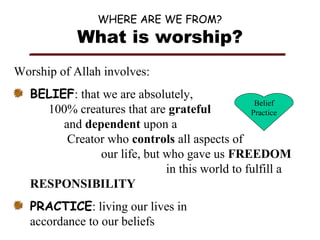
WHERE ARE WE FROM?

What is worship?
Worship of Allah involves:
BELIEF: that we are absolutely,
Belief
100% creatures that are grateful
Practice
and dependent upon a
Creator who controls all aspects of
our life, but who gave us FREEDOM
in this world to fulfill a
RESPONSIBILITY
PRACTICE: living our lives in
accordance to our beliefs
WHERE ARE WE FROM?

How do we worship Allah?
Husayn (R) explains the verse
I created jinn and humankind only so that they
worship Me (Qur’an 51:56)
Knowledge
as
of Allah
I created jinn and humankind only
so that they know and understand
Me
 True worship of Allah (swt) =
gaining knowledge of Allah (swt)
WHERE ARE WE FROM?

How do we worship Allah?
How to gain knowledge of Allah (swt):
- Reflect upon His most perfect Names
- Following the guidance (Qur’an,
Prophet) He has given us and understand
where we are
Practice those acts of worship that He has
prescribed that will help us to believe in
Him
WHERE ARE WE FROM?

Why do we worship Allah?
Worship does not benefit Him.
Allah (swt) tells us in the Qur’an:
He who PURIFIES his soul/spirit/self is
SUCCESSFUL (Surah ash-Shams)
(The one who is successful) remembers the name of
his Lord and says his prayers (Surah al-A`ala)
Worshipping Allah (swt) leads us to:
Self purification,
Success,
Fulfilling the GOAL OF LIFE
THE WHOLE works
No picking, no
choosing
•Belief in Allah and
that our purpose is to
worship Him
throughout our lives
•Acting upon that
belief!
WHERE ARE WE NOW?

What are our responsibilities?
Allah (swt) says:
Surely we have guided human being to the path. It is
up to him whether he will be grateful or disbelieving
(Qur’an 76:3).

With freedom comes responsibilities:
Fulfilling the purpose of our existence
Fulfilling the trust put on us
Establishing justice
Working towards the perfection of this society
Be grateful to God and serve Him
WHERE ARE WE NOW?

What are our responsibilities?
 By serving others, we are worshipping Allah
 Dedicating our time, energy, money in the cause of
Allah
 Helping the needy, feeding the poor, assisting others
"Never will you attain righteousness until you spend from that
which you love. And whatever you spend, indeed Allâh is
Knowing of it" [Ale-'Imran, 3:92]

 The Noble Prophet Muhammad (saw) has said: "The
Auliya Allah - Friends of Allah (SWT) are,
essentially and inherently, generous"
WHERE ARE WE GOING?
The average life span in the United States in
1990 was about 75 years (National Institute
on Aging).
Everyone shall have a taste of death. (Qur’an
3:185)
The hereafter (al-aakhirah) is a REALITY that has
already been created. Allah (swt) has described two
extremes:
JAHANNAM (Hell)
AL-JANNAH (Garden of Heaven)
What is the goal of life?
WHERE ARE WE GOING?

The Purpose of Life
Worship of the elite is done not solely out of
fear of hell or desire for heaven
Allah is worshipped because He deserves to be
worshipped – whatever is with Allah is
BETTER than what we can get anywhere else
"Say (O Muhammad) my prayer, my sacrifice, my life and my
death belong to Allah; He has no partner and I am ordered
to be among those who submit, i.e.; Muslims" (6:162, 163)
WHERE ARE WE GOING?

The Purpose of Life
What does the Quran say?
Surely we belong to Allah, and to Him is our
return.(Qur’an 2:156)
And to Allah is your eventual destination
(Qur’an 35:18)…
O’ human being, it is to your Lord that all your
efforts are directed, and you will meet Him
(Qur’an 84:6).
 The goal of life is PLEASING ALLAH (swt).
WHERE ARE WE GOING?

The Purpose of Life
Since Pleasing Allah is the goal of life:
Increasing Belief/Faith + Practice is what we do along the way
Gain a perfect understanding of Tawheed and put that
understanding into practice
OKAY…SO,

What’s next?
Remember Allah always
Read and reflect on the Quran
Give charity and be purified
Help others in every way
Establish a just society
And…WORSHIP ALLAH!

What is Our Purpose?

  • 1.
    What Is OurPurpose? ICNA Sisters Wing Usratul Maria Dawah Conference 2010 Saadia Yunus
  • 2.
    WHY ARE WEHERE? WHY WERE WE CREATED? WHAT IS THE GOAL OF LIFE? W H Y ? Why do we need to know?
  • 3.
    Mu’min Meets Martin BySALIM YUSUFALI adapted from Even Angels Ask by Jeffrey Lang: Martin:"I don't think that the two major religions in America make much sense.” "I don't think that ANY religion makes much sense. For example, from your religion's viewpoint, what is the purpose of life? Why did God create us to SUFFER here on earth?” Mu’min: (Thinking back to Sunday School Lessons): “Umm…I believe He created us to test us."
  • 4.
    Mu’min is Struggling Martin:"So your religion rejects the omniscience (Allah has all knowledge) of God, for otherwise, what could He possibly learn from testing us that He does not already know?” "No, that’s not quite it…Yes!! We are created to worship Him!" (With a smile of victory): "Then you must believe that God has needs and weaknesses, for why else would He demand our worship? When a human demands our devotion, we label him a tyrant or a psychopath. Do you hold that God has character flaws?"
  • 5.
    SORRY. You Lose.Try Again. Go back to the basics and ask WHY? Ameer al-Mu’mineen, Ali (R), said: Allah’s mercy is upon the one knows: • where he is from, • where he is now, • and where he is going!
  • 6.
    WHERE ARE WEFROM? Allah (swt) created us for a purpose: – Do you suppose that We have created you in vain? (Qur’an 23:115) – I created jinns and humankind only so that they may worship me. (Qur’an 51:56) BUT WHY DOES ALLAH WANT OUR WORSHIP? What is “worship” (`ibadah)? How do we worship Allah? Why should we worship Allah?
  • 7.
    WHERE ARE WEFROM? What is worship? Worship of Allah involves: BELIEF: that we are absolutely, Belief 100% creatures that are grateful Practice and dependent upon a Creator who controls all aspects of our life, but who gave us FREEDOM in this world to fulfill a RESPONSIBILITY PRACTICE: living our lives in accordance to our beliefs
  • 8.
    WHERE ARE WEFROM? How do we worship Allah? Husayn (R) explains the verse I created jinn and humankind only so that they worship Me (Qur’an 51:56) Knowledge as of Allah I created jinn and humankind only so that they know and understand Me  True worship of Allah (swt) = gaining knowledge of Allah (swt)
  • 9.
    WHERE ARE WEFROM? How do we worship Allah? How to gain knowledge of Allah (swt): - Reflect upon His most perfect Names - Following the guidance (Qur’an, Prophet) He has given us and understand where we are Practice those acts of worship that He has prescribed that will help us to believe in Him
  • 10.
    WHERE ARE WEFROM? Why do we worship Allah? Worship does not benefit Him. Allah (swt) tells us in the Qur’an: He who PURIFIES his soul/spirit/self is SUCCESSFUL (Surah ash-Shams) (The one who is successful) remembers the name of his Lord and says his prayers (Surah al-A`ala) Worshipping Allah (swt) leads us to: Self purification, Success, Fulfilling the GOAL OF LIFE
  • 11.
    THE WHOLE works Nopicking, no choosing •Belief in Allah and that our purpose is to worship Him throughout our lives •Acting upon that belief!
  • 12.
    WHERE ARE WENOW? What are our responsibilities? Allah (swt) says: Surely we have guided human being to the path. It is up to him whether he will be grateful or disbelieving (Qur’an 76:3). With freedom comes responsibilities: Fulfilling the purpose of our existence Fulfilling the trust put on us Establishing justice Working towards the perfection of this society Be grateful to God and serve Him
  • 13.
    WHERE ARE WENOW? What are our responsibilities?  By serving others, we are worshipping Allah  Dedicating our time, energy, money in the cause of Allah  Helping the needy, feeding the poor, assisting others "Never will you attain righteousness until you spend from that which you love. And whatever you spend, indeed Allâh is Knowing of it" [Ale-'Imran, 3:92]  The Noble Prophet Muhammad (saw) has said: "The Auliya Allah - Friends of Allah (SWT) are, essentially and inherently, generous"
  • 14.
    WHERE ARE WEGOING? The average life span in the United States in 1990 was about 75 years (National Institute on Aging). Everyone shall have a taste of death. (Qur’an 3:185) The hereafter (al-aakhirah) is a REALITY that has already been created. Allah (swt) has described two extremes: JAHANNAM (Hell) AL-JANNAH (Garden of Heaven) What is the goal of life?
  • 15.
    WHERE ARE WEGOING? The Purpose of Life Worship of the elite is done not solely out of fear of hell or desire for heaven Allah is worshipped because He deserves to be worshipped – whatever is with Allah is BETTER than what we can get anywhere else "Say (O Muhammad) my prayer, my sacrifice, my life and my death belong to Allah; He has no partner and I am ordered to be among those who submit, i.e.; Muslims" (6:162, 163)
  • 16.
    WHERE ARE WEGOING? The Purpose of Life What does the Quran say? Surely we belong to Allah, and to Him is our return.(Qur’an 2:156) And to Allah is your eventual destination (Qur’an 35:18)… O’ human being, it is to your Lord that all your efforts are directed, and you will meet Him (Qur’an 84:6).  The goal of life is PLEASING ALLAH (swt).
  • 17.
    WHERE ARE WEGOING? The Purpose of Life Since Pleasing Allah is the goal of life: Increasing Belief/Faith + Practice is what we do along the way Gain a perfect understanding of Tawheed and put that understanding into practice
  • 18.
    OKAY…SO, What’s next? Remember Allahalways Read and reflect on the Quran Give charity and be purified Help others in every way Establish a just society And…WORSHIP ALLAH!

Editor's Notes

  • #9 6th Imam (a): The most excellent and most necessary obligation incumbent upon man is knowledge of the Lord, and acknowledgement of one's servitude to Him. what does it mean to gain knowledge of Allah (swt)? one can make an analogy to seeing. suppose that you want to pay attention to something. often times you would bring it closer or you would go close to it so you can observe it better. now here it is seeing not with the eyes but with the heart. that is why the hadith of the prophet says worship your Lord as if you see Him, and if you do not see Him, then know that He sees you. Or Imam Ali (a) was asked: do you see your Lord? He (a) said: I would not worship a Lord that I could not see. Slide 9: aside from the definition of ibadah given in Fiqh and Fuqaha (I sent you the link to this list time), ibadah can also be defined as Taa`ah (obedience to Allah) + Tasleem (surrender to the will of Allah). if you love someone or something, you will obey it and surrender your will to it. for example, if there is a person who is in love with something of this world (you can choose a good example), you'll find that he obeys it (meaning that he follows it and uses it as a guide to make decisions on what to do and how to do things) and surrenders it (he lets it dominate his thinking). If there is someone who loves Allah (swt) because of the gratitude he has to Him for all that He has given, and he loves Allah (swt) because He is the source of all perfection, then he will obey him and surrender his will to Him.
  • #10 the goal of the obligations we have for doing certain actions is to "make our lives confirm with our beliefs" (Doctrines of Shi'i Islam, 3)- The substance of the message delivered by God's Prophets can be summarize under two headings, belief and action- human being has free will...the gateway to the transcendent path of right guidance leading back to God is always open to man; it is only at the moment of death that it closes, that is when repentance is no longer accepted (Doctrines 10) Slide 10: gaining knowledge of Allah (swt) - another way of saying this is that you gain awareness of the presence of Allah (swt) in all matters of place and time. In du`a 1 of Sahifa Imam al-Sajjad (a) refers to this type of knowledge and awareness of Allah (swt):Praise belongs to God, for,           had He withheld from His servants the knowledge to praise Him                     for the uninterrupted kindnesses                               with which He has tried them                     and the manifest favours                               which He has lavished upon them,           they would have moved about in His kindnesses                     without praising Him,           and spread themselves out in His provision                     without thanking Him.            Had such been the case,                     they would have left the bounds of humanity                               for that of beastliness                     and become as He has described in the firm text of His Book:                     They are but as the cattle—nay, but they are further astray from the way!
  • #11 worship does not benefit Him since He is from need because if He was in need then He would be imperfect. - in general, when you do something you want to do it successfully. so let us see if the way that Allah (swt) has defined success involves worshipping Allah (swt). in adhan/iqama we say "hayya al-falah" which is hasten towards success. means that salaat is a form of success. then in the qur'an we see that success is tied towards purification of the soul, salaat, and remembering the name of Allah. as far as the tazkiyaat al-nafs is concerned (purification of soul), this has to do with ethics. the other two (salaat +  remembrance) have to do with ibadah. to understand basics of ethics, - example of name of Allah is al-tawwab (you have commentary for this). Or al-salaam. People in america are looking everywhere for peace after 9/11: rock concerts, candlelight vigils, memorial services, curtailing personal freedom, cracking down on immigrants, fingerprinting Muslims, having your neighbors spy on you. but they do so without any sense of spirituality, while the true source of peace is al-Salaam. Quran 59;23 this name of Allah is given along with other names of Allah.
  • #13 Slide 16: Allah (swt) gave us freedom and power to do things. human being is such a powerful creature that he can dominate all other forms of life in plants and animals and he can even come to dominate over other human beings. one who realizes where he is will come to the conclusion that this freedom does not come unrestricted but rather we are to apply this freedom and power in order to fulfill certain responsibilities and duties. this makes sense since whenever someone gives you something there is an obligation you have towards the one who gave and that which you were given. these responsibilities are in the form of worship of Allah (swt) and also in relation to ourselves, our family, and our society. duties for example come in the form of Islamic laws as interpreted by mujtahids. Others come in the form of rights that people have on you (like in treatise of rights by 4th Imam (a).
  • #14 Slide 16: nerosity is one of the ethics of the Prophets, a pillar of faith and a ray of the light of firm faith. The Noble Prophet Muhammad (saw) has said: "The Auliya Allah - Friends of Allah (SWT) are, essentially and inherently, generous." Hence, in order to acquire this attribute, a Mu'min (believer) should endeavour hard to be munificent and generous towards relatives, deserving ones and the like, for the pleasure of Allah (SWT). It is better that a person's generosity is associated with a thing that is dear to him - eatables, clothes, money etc. - and that no obligation is placed upon the person towards whom generosity has been exhibited; man should only view himself as a trustworthy person, whose responsibility is to pass on Allah's (SWT) things to deserving and needy individuals. 
  • #15 slide 17: these are realities already created. we know that from ahadeeth that describe what hell and heaven look like right now. also i believe that during mi'raaj prophet (s) saw them but i am not sure.   since we know there are two outcomes in terms of the hereafter, the question is, is getting heaven the goal of life? is avoiding hell the goal of life? what is the goal of life?
  • #16 slide 20:   worship of the elite. this is what imam ali (a) has referred to in his famous hadith of the three times of worshippers. this is reserved for those awliyaa' (saints) who have achieved a high level, but it is a level that is accessible if we only try hard enough. and besides, understanding it is very important since understanding is the first step.   now take something like power/status. a lot of people in this world would like to have power and the reigns of leadership. they see other people who have power or status and envy that person's position in society. they can console themselves however knowing that they will be rewarded in the hereafter with delights beyond imagination. however, the true awliyaa' will look at the type of power/status that is in the hands of people and they will want nothing from it, because they realize that what is with Allah (swt) is better. and in fact they realize that true power lies in the hands of Allah (swt) and it is that which Allah (swt) says in the Qur'an:   [3:26] Say: "O Allah! Lord of Power (And Rule), Thou givest power to whom Thou pleasest, and Thou strippest off power from whom Thou pleasest: Thou enduest with honour whom Thou pleasest, and Thou bringest low whom Thou pleasest: In Thy hand is all good. Verily, over all things Thou hast power. [28:83] (As for) that future abode, We assign it to those who have no desire to exalt themselves in the earth nor to make mischief and the good end is for those who guard (against evil) these are people who like Imam Ali (a) see only Allah (swt) because he is the provider of all their needs and desires.  
  • #17 slide 22:   qur'anic verses clearly establish that the goal of life is Allah (swt). and since reaching Allah (swt) is impossible (because we are created and He is Creator), you can say that the goal of life is getting near to Allah (swt). this is in fact why our niyyah in performing ibadah should always be "qurbatan illallaah", to obtain nearness to Allah (swt). du'a kumayl to see the same point, for example near the beginning we say "allahumma innee ataqarrabu ilaykha bi dhikrika" (O Allah, indeed I am trying to get closer to you by remembering you and thinking of you), "ya ghaayata amaalil aarifeen", O' (Thou who art) the last hope and resort of those who acknowledge Thee.  
  • #18 slide 24:   since goal is Allah (swt), it all comes back to where we started out from, which is Allah (swt) and knowing Allah. this is exactly what Tawheed is all about -- not a theoretical sort of tawheed that you just read about and never put into practice, but a tawheed where you really understand who Allah (swt) is and how He is the source of all perfection and your eventual goal.   the line about perfect balance of powers and instincts -- this is to say if you choose to travel on the path of Tawheed, there are well known steps that the ulamaa' have described for being a "wayfarer" on this path (books like Self Building explain this in detail). one of the main things you have to do is to achieve self purification, and a quick way of understanding this is to say that if human being has all these different "malakah" or senses, like the animal sense, the sense of lust, the sense of imagination, etc., the perfect human being is the one who is able to regulate all these senses with complete and absolute justice over him/herself. for example if you prevent yourself from going out w/ your friends to watch a haram movie, your animal senses tell you you should go because it will be fun and having fun is pleasurable which is a good thing for all animals. but your sense of self justice will realize that this act of yours will have an immediate negative spiritual reaction that will be painful and harmful to your spirit, and throw you on a detour from the path to Allah (swt) from which you may never recover. therefore if you let your self justice always prevail you will be successful.   when we ask Allah (swt) to help us attain this goal He will help us. this is the idea of "lutf". quick definition from Doctrines of Shi'i Islam: the purpose of creation is to attain all that the human soul can aspire to, doing so by means of the graces realized through devotion to God. Once you are a) aware of this purpose and b) pledge yourself to undertake the first steps towards its realization, Allah will Himself help you with his loving-kindness (lutf).
  • #19 we started out saying that you can "be a good muslim" by doing all these acts of praying and fasting etc. we end up at the same place and with the same answer, but the difference is that now we are doing these acts with a purpose and we understand what is the eventual goal and why we are doing what we are doing. so for example when you fast it's not about starving yourself, it's about being a guest of Allah (swt) and attain nearness to Him. when you pray to Allah (swt), always thank him and acknowledge all of the blessings He has given you, and ask Him whatever good things your heart desires, for if you do neither of these, your salat may be thrown back on your face. when you give charity, understand that the root of the word in arabic (zakaat) is purification, and that by giving of your money you give away your love of worldly things and you become closer to Allah. etc.