
Chapter 5, Douglas Brown (2001)
Teaching by Principles: An Interactive Approach to
Language Pedagogy.Addison Wesley,Longman.
Prof. Estela N. Braun- Adjunto Regular Práctica
Educativa II, Didáctica del Inglés y Residencia en
Primaria (Abril, 2014)
MOTIVATION
DEFINING MOTIVATION
 1. a Behaviouristic Definition: Skinner (1958)
Motivation as “…the anticipation of
reward”.
 2. Cognitive definition:
 Internal drives: Ausubel (1968):
exploration-manipulation-stimulation-
activity-knowledge-ego
enhancement.
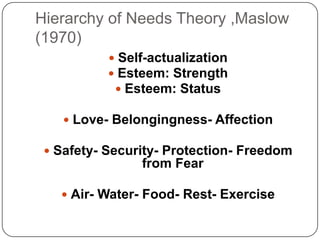
Hierarchy of Needs Theory ,Maslow
(1970)
 Self-actualization
 Esteem: Strength
 Esteem: Status
 Love- Belongingness- Affection
 Safety- Security- Protection- Freedom
from Fear
 Air- Water- Food- Rest- Exercise
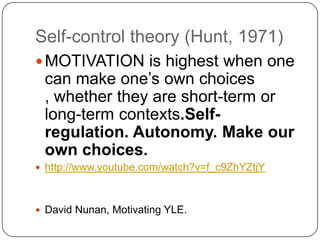
Self-control theory (Hunt, 1971)
MOTIVATION is highest when one
can make one’s own choices
, whether they are short-term or
long-term contexts.Self-
regulation. Autonomy. Make our
own choices.
 http://www.youtube.com/watch?v=f_c9ZhYZtjY
 David Nunan, Motivating YLE.
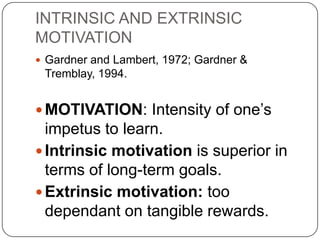
INTRINSIC AND EXTRINSIC
MOTIVATION
 Gardner and Lambert, 1972; Gardner &
Tremblay, 1994.
 MOTIVATION: Intensity of one’s
impetus to learn.
 Intrinsic motivation is superior in
terms of long-term goals.
 Extrinsic motivation: too
dependant on tangible rewards.
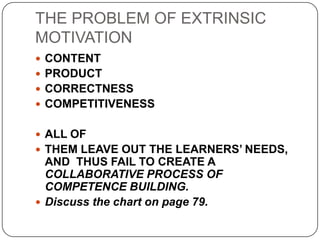
THE PROBLEM OF EXTRINSIC
MOTIVATION
 CONTENT
 PRODUCT
 CORRECTNESS
 COMPETITIVENESS
 ALL OF
 THEM LEAVE OUT THE LEARNERS’ NEEDS,
AND THUS FAIL TO CREATE A
COLLABORATIVE PROCESS OF
COMPETENCE BUILDING.
 Discuss the chart on page 79.
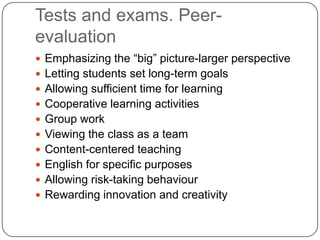
Tests and exams. Peer-
evaluation
 Emphasizing the “big” picture-larger perspective
 Letting students set long-term goals
 Allowing sufficient time for learning
 Cooperative learning activities
 Group work
 Viewing the class as a team
 Content-centered teaching
 English for specific purposes
 Allowing risk-taking behaviour
 Rewarding innovation and creativity
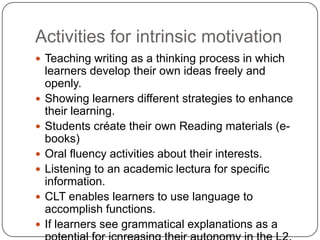
Activities for intrinsic motivation
 Teaching writing as a thinking process in which
learners develop their own ideas freely and
openly.
 Showing learners different strategies to enhance
their learning.
 Students créate their own Reading materials (e-
books)
 Oral fluency activities about their interests.
 Listening to an academic lectura for specific
information.
 CLT enables learners to use language to
accomplish functions.
 If learners see grammatical explanations as a
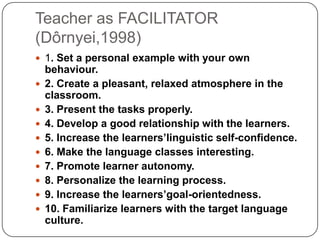
Teacher as FACILITATOR
(Dôrnyei,1998)
 1. Set a personal example with your own
behaviour.
 2. Create a pleasant, relaxed atmosphere in the
classroom.
 3. Present the tasks properly.
 4. Develop a good relationship with the learners.
 5. Increase the learners’linguistic self-confidence.
 6. Make the language classes interesting.
 7. Promote learner autonomy.
 8. Personalize the learning process.
 9. Increase the learners’goal-orientedness.
 10. Familiarize learners with the target language
culture.
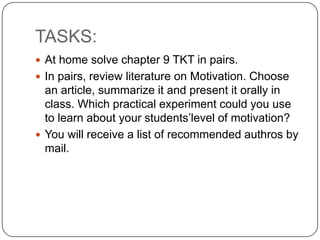
TASKS:
 At home solve chapter 9 TKT in pairs.
 In pairs, review literature on Motivation. Choose
an article, summarize it and present it orally in
class. Which practical experiment could you use
to learn about your students’level of motivation?
 You will receive a list of recommended authros by
mail.
Internet Resources for
teachers
 http://learnenglishkids.britishcouncil.org/en/
 http://www.macmillanenglish.com/resources/
 http://www.pearsonlongman.com/ae/heythere/tea
cher-resources.asp
 http://www.cambridge.org/ar/elt/?site_locale=es_
AR

Motivation by douglas brown

  • 1.
    Chapter 5, DouglasBrown (2001) Teaching by Principles: An Interactive Approach to Language Pedagogy.Addison Wesley,Longman. Prof. Estela N. Braun- Adjunto Regular Práctica Educativa II, Didáctica del Inglés y Residencia en Primaria (Abril, 2014) MOTIVATION
  • 2.
    DEFINING MOTIVATION  1.a Behaviouristic Definition: Skinner (1958) Motivation as “…the anticipation of reward”.  2. Cognitive definition:  Internal drives: Ausubel (1968): exploration-manipulation-stimulation- activity-knowledge-ego enhancement.
  • 3.
    Hierarchy of NeedsTheory ,Maslow (1970)  Self-actualization  Esteem: Strength  Esteem: Status  Love- Belongingness- Affection  Safety- Security- Protection- Freedom from Fear  Air- Water- Food- Rest- Exercise
  • 4.
    Self-control theory (Hunt,1971) MOTIVATION is highest when one can make one’s own choices , whether they are short-term or long-term contexts.Self- regulation. Autonomy. Make our own choices.  http://www.youtube.com/watch?v=f_c9ZhYZtjY  David Nunan, Motivating YLE.
  • 5.
    INTRINSIC AND EXTRINSIC MOTIVATION Gardner and Lambert, 1972; Gardner & Tremblay, 1994.  MOTIVATION: Intensity of one’s impetus to learn.  Intrinsic motivation is superior in terms of long-term goals.  Extrinsic motivation: too dependant on tangible rewards.
  • 6.
    THE PROBLEM OFEXTRINSIC MOTIVATION  CONTENT  PRODUCT  CORRECTNESS  COMPETITIVENESS  ALL OF  THEM LEAVE OUT THE LEARNERS’ NEEDS, AND THUS FAIL TO CREATE A COLLABORATIVE PROCESS OF COMPETENCE BUILDING.  Discuss the chart on page 79.
  • 7.
    Tests and exams.Peer- evaluation  Emphasizing the “big” picture-larger perspective  Letting students set long-term goals  Allowing sufficient time for learning  Cooperative learning activities  Group work  Viewing the class as a team  Content-centered teaching  English for specific purposes  Allowing risk-taking behaviour  Rewarding innovation and creativity
  • 8.
    Activities for intrinsicmotivation  Teaching writing as a thinking process in which learners develop their own ideas freely and openly.  Showing learners different strategies to enhance their learning.  Students créate their own Reading materials (e- books)  Oral fluency activities about their interests.  Listening to an academic lectura for specific information.  CLT enables learners to use language to accomplish functions.  If learners see grammatical explanations as a
  • 9.
    Teacher as FACILITATOR (Dôrnyei,1998) 1. Set a personal example with your own behaviour.  2. Create a pleasant, relaxed atmosphere in the classroom.  3. Present the tasks properly.  4. Develop a good relationship with the learners.  5. Increase the learners’linguistic self-confidence.  6. Make the language classes interesting.  7. Promote learner autonomy.  8. Personalize the learning process.  9. Increase the learners’goal-orientedness.  10. Familiarize learners with the target language culture.
  • 10.
    TASKS:  At homesolve chapter 9 TKT in pairs.  In pairs, review literature on Motivation. Choose an article, summarize it and present it orally in class. Which practical experiment could you use to learn about your students’level of motivation?  You will receive a list of recommended authros by mail.
  • 11.
    Internet Resources for teachers http://learnenglishkids.britishcouncil.org/en/  http://www.macmillanenglish.com/resources/  http://www.pearsonlongman.com/ae/heythere/tea cher-resources.asp  http://www.cambridge.org/ar/elt/?site_locale=es_ AR