Objectives
The studentshould be able to;
Identify what is cognitive processes and its stages.
Impact of motivation in learning;
And understand the relationship between cognitive
processes and motivation
3.
What is cognitiveprocesses
The cognitive learning definition refers to the
mental pathways used to comprehend, learn,
and communicate.
Cognition involves the processes used to think,
remember, solve problems, speak, imagine, and
think.
4.
Stages of cognitiveprocesses
Sensation – it refers to our awareness about
various stimuli which we encounter in different
modalities such as vision, touch, smell , and
taste.
Various physical energies in the environment act
on the sense organs.
Visual attention
Basedon location and color
Auditory attention
Based on color, timbre , and intensity.
7.
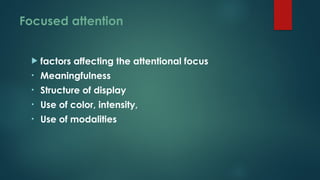
Focused attention
factorsaffecting the attentional focus
• Meaningfulness
• Structure of display
• Use of color, intensity,
• Use of modalities
8.
Perceptions
In thecase of perception we process the
information and make out the meaning of the
stimuli available to us.
9.
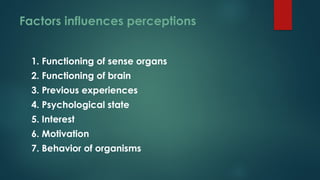
Factors influences perceptions
1.Functioning of sense organs
2. Functioning of brain
3. Previous experiences
4. Psychological state
5. Interest
6. Motivation
7. Behavior of organisms
10.
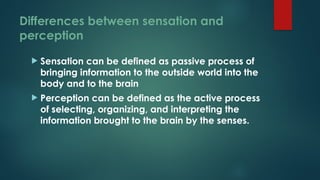
Differences between sensationand
perception
Sensation can be defined as passive process of
bringing information to the outside world into the
body and to the brain
Perception can be defined as the active process
of selecting, organizing, and interpreting the
information brought to the brain by the senses.
11.
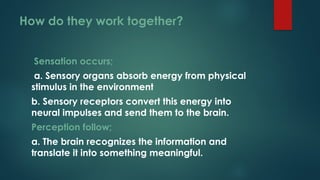
How do theywork together?
Sensation occurs;
a. Sensory organs absorb energy from physical
stimulus in the environment
b. Sensory receptors convert this energy into
neural impulses and send them to the brain.
Perception follow;
a. The brain recognizes the information and
translate it into something meaningful.
12.
Learning
It helpsus acquiring new knowledge through
experience and practices.
The acquired knowledge and skills further bring
a relative change in our behavior and facilitate
our adjustment in varied settings.
13.
Memory
The informationwe processed and learn is
registered and stored in the memory system.
Memory also helps us to easily retrieve the
stored information when it is required for use.
14.
Memory has threecomponents
Sensory memory
Long – term memory
Short – term memory
15.
Sensory memory
Afterthe information reaches the senses it is
briefly registered in the sensory store.
Some of this information is successfully passed to
the short – term memory store.
16.
Short – termmemory
Hold information longer than sensory memory
and has limited capacity.
It has been suggested that approximately seven
items can be held in short term memory. (Miller
1965)
17.
Long – termmemory
It has been suggested has virtually unlimited
capacity. However, the process of remembering
or the bringing back into consciousness relevant
items of information accurately and speedily, is
rarely achieved with perfection.
Information about meanings, concepts,
properties, and events are stored over a long
time. This stored knowledge is organized into
what are referred to as schemata.
18.
Thinking
In thecase of thinking we use our stored
knowledge to solve various task.
We logically establish the relationship among
various objects in our mind and take rational
decision to a given problem.
19.
Decision Making
Theprocess of selecting a logical choice from
the available options. When trying to make a
good decision, a person must weight the
positives and negatives of every options, and
consider all the alternatives.
20.
Problem – Solving
Is a mental process that involves discovering,
analyzing, and solving problems.
21.
The steps inproblem solving
I. Identifying the problem
II. Defining the problem
III. Forming a strategy
IV. Organizing information
V. Allocating resources
VI. Monitoring progress and;
VII. Evaluating the result
22.
Application of cognitiveprocesses
We will look on how cognitive processes applied
to our daily life, we can try to make
generalization and consider their application for
educational.
People control their own learning B.F Skinner
(1954, 1968) argued that student must make
active responses in the classroom if they are to
learn anything.
23.
What is motivation?
Motivation, as the name suggests, is what
‘moves’ us. It is the reason we do anything at all.
For teachers, a lack of motivation has long been
one of the most frustrating obstacles to student
learning.
Extrinsic motivation
Theuse of external rewards or punishments to
encourage student work completion, is
generally painted in education as the enemy of
good instruction.
26.
Intrinsic motivation
Isthe act of doing an activity purely for the joy of
doing it, and it is frankly very rare in school and
work contexts.
27.
Achievement Goal Theory
Achievement Goal Theory argues that all motivation can
be linked to one’s orientation towards a goal. According
to this theory, there are two forms of goal: performance
goals and mastery goals.
Performance goals are based on satisfying one’s ego
by appearing smart in front of one’s peers or on
achieving a sense of superiority.
Mastery goals are, as they sound, motivated by a desire
to fully master a skill or concept.
28.
Expectancy Value Theory
Goal orientation has a strong impact on
persistence through a rigorous task, as
described in Expectancy Value Theory.
According to this model, expectations and
values influence performance and task choice
directly.
29.
Nature versus nurture
Each of these theories points to the malleability
of motivation. While natural genetic variability
will lead to differences in a student’s innate
drive, every student has the desire to reach their
goals. Our task as teachers, then, is to apply
what we know from social science research to
create environments, instruction, and activities
to cultivate student motivation.
30.
Why is motivationimportant?
Motivation is an orientation towards learning.
Therefore, it impacts how likely a student is either
to give up or push forward, and how thoughtful
their reflection on their learning will be.
31.
Motivation fosters creativityand critical
thinking
Motivated students are not more intelligent than
unmotivated students, but their need to find out
the answer to a question or to master a concept
pushes their thinking.
Motivated students, by virtue of thinking longer
and harder and enjoying the challenge of being
confused, will ask deeper.
32.
Motivation cultivates resilienceand self-
assurance
When a student is truly engrossed in a task, they
have less cognitive and emotional energy to
focus on social image.
Intrinsically motivated students are not driven by
fear of failure or criticism, they are less likely to
disengage in such circumstances.
33.
Motivation and agency
Agency and motivation are inextricably linked
concepts because, as a student becomes more
driven to reach a goal, they consequently
develop a stronger sense of purpose in directing
their energy towards that goal.
34.
The relationship betweencognitive
processes and motivation
Cognitive processes is the mental state, it
involves thinking, perception, senses, memory,
decision making, and problem – solving.
Motivation play a significant role in determining
the action of achieving goals and objectives.
Cognitive processes influence motivation by
shaping how individuals perceive and evaluate
goals, their self belief, and their assessment of
potential outcomes.