Motion and Time Study
The Goals of Motion Study
• Improvement
• Planning / Scheduling (Cost)
• Safety
Know How Long to Complete Task for
• Scheduling (Sequencing)
• Efficiency (Best Way)
• Safety (Easiest Way)
How Does a Job Incumbent Spend a Day
• Value Added vs. Non-Value Added
The General Strategy of IE to Reduce and
Control Cost
• Are people productive ALL of the time ?
• Which parts of job are really necessary ?
• Can the job be done EASIER, SAFER and
FASTER ?
• Is there a sense of employee involvement?
Some Techniques of Industrial
Engineering
• Measure
– Time and Motion Study
– Work Sampling
• Control
– Work Standards (Best Practices)
– Accounting – Labor Reporting
• Improve
– Small group activities
Time Study
• Observation
– Stop Watch
– Computer / Interactive
• Engineering Labor Standards (Bad Idea)
• Job Order / Labor reporting data
History
• Frederick Taylor (1900’s)
Studied motions of iron workers – attempted to
“mechanize” motions to maximize efficiency –
including proper rest, ergonomics, etc.
• Frank and Lillian Gilbreth used motion picture to
study worker motions – developed 17 motions
called “therbligs” that describe all possible work.
• GET G
• PUT P
• GET WEIGHT GW
• PUT WEIGHT PW
• REGRASP R
• APPLY PRESSURE A
• EYE ACTION E
• FOOT ACTION F
• STEP S
• BEND & ARISE B
• CRANK C
Time Study (Stopwatch
Measurement)
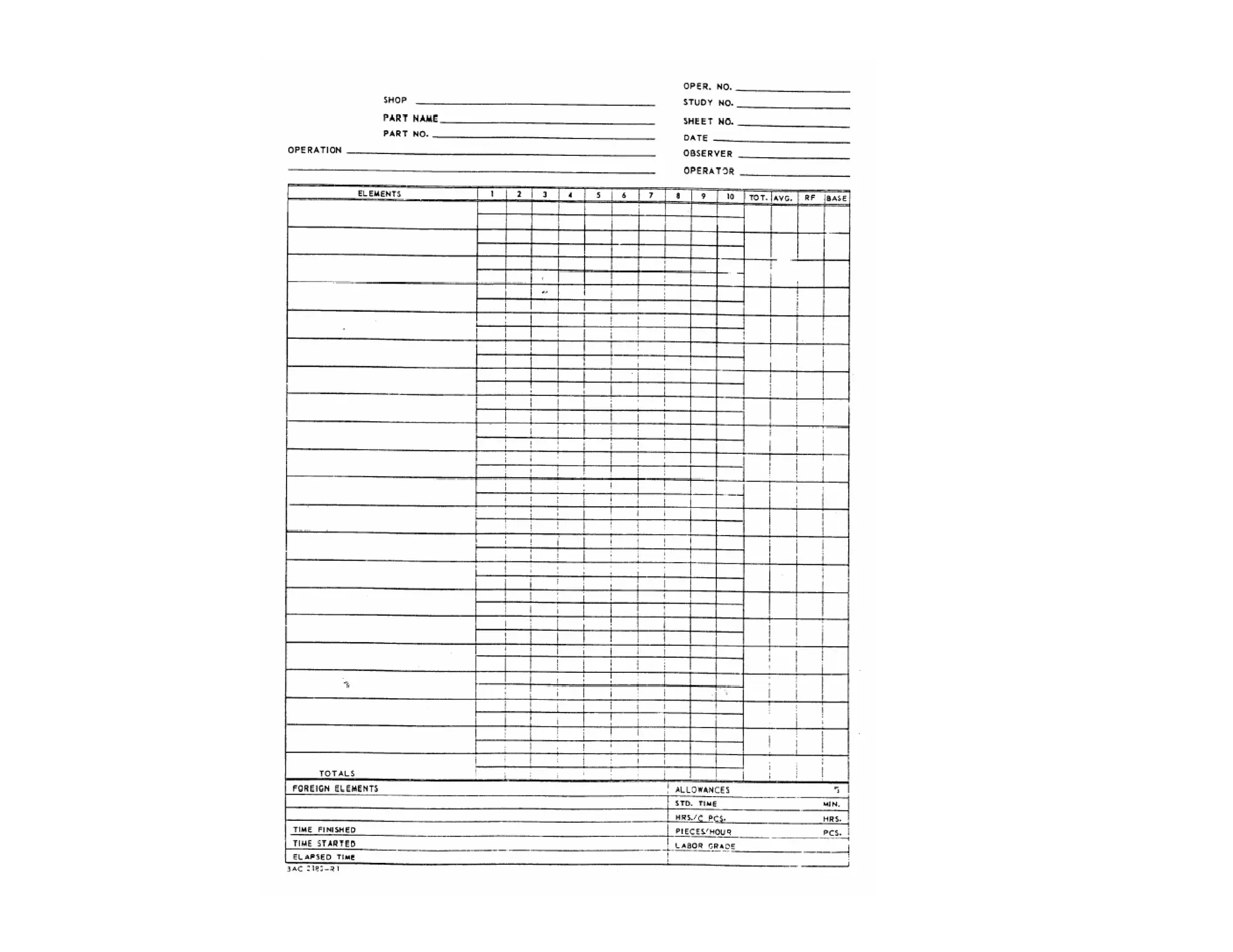
1. List work elements
2. Discuss with worker
3. Measure with stopwatch (running VS reset)
4. Repeat for n Observations
5. Compute mean and std dev of work station time
6. Be aware of allowances/foreign element, etc
Work Sampling
• Determined what is done over typical day
• Random Reporting
• Periodic Reporting
Learning Curve
• For repetitive work, worker gains skill,
knowledge of product/process, etc over
time
• Thus we expect output to increase over
time as more units are produced over time
to complete task decreases as more units
are produced
Traditional Learning Curve
Actual Curve
Change, Design, Process, etc
Learning Curve
• Usually define learning as a percentage reduction
in the time it takes to make a unit.
• The definition says a doubling of the total number
of units made produce a constant decrease in the
time per unit
• An 80% learning curve implies a 20% decrease in
unit time with each doubling of the number
produced (90% implies 10% decrease, 100%
implies no improvement)
Learning Curve
• For an 80% learning Curve:
Unit Unit Time (hours)
1 10
2 (.8)(10) = 8
4 (.8)(8) = 6.4
8 (.8)(6.4)= 5.12
16 (.8)(5.12)= 4.096
Learning Curve
• We can also compute the time to complete
the nth unit based on the learning %, and the
time for the 1st unit
Tn = T1 x n ^ b
Where, b = (natural log of learning %) /
(natural log of 2)
Learning Curve
• From Previous 80% learning curve
example:
b = ln (.8) / ln (2)
= -.22314/.69315
= -.322
For 3rd unit:
T3 = T1 (3 ^ (ln(.8)/ln(2)))
T3 = T1 (.702)
Learning Curve
• Can plot using log/log paper as a straight
line and can also got unit curve and average
curve
Learning Curve Applies
• Mass Production – Assembly line
• G.T. Cell – Repetitive work
• Other places where rep. Works performed.

Motion and time study

  • 1.
  • 2.
    The Goals ofMotion Study • Improvement • Planning / Scheduling (Cost) • Safety
  • 3.
    Know How Longto Complete Task for • Scheduling (Sequencing) • Efficiency (Best Way) • Safety (Easiest Way)
  • 4.
    How Does aJob Incumbent Spend a Day • Value Added vs. Non-Value Added
  • 5.
    The General Strategyof IE to Reduce and Control Cost • Are people productive ALL of the time ? • Which parts of job are really necessary ? • Can the job be done EASIER, SAFER and FASTER ? • Is there a sense of employee involvement?
  • 6.
    Some Techniques ofIndustrial Engineering • Measure – Time and Motion Study – Work Sampling • Control – Work Standards (Best Practices) – Accounting – Labor Reporting • Improve – Small group activities
  • 7.
    Time Study • Observation –Stop Watch – Computer / Interactive • Engineering Labor Standards (Bad Idea) • Job Order / Labor reporting data
  • 8.
    History • Frederick Taylor(1900’s) Studied motions of iron workers – attempted to “mechanize” motions to maximize efficiency – including proper rest, ergonomics, etc. • Frank and Lillian Gilbreth used motion picture to study worker motions – developed 17 motions called “therbligs” that describe all possible work.
  • 12.
    • GET G •PUT P • GET WEIGHT GW • PUT WEIGHT PW • REGRASP R • APPLY PRESSURE A • EYE ACTION E • FOOT ACTION F • STEP S • BEND & ARISE B • CRANK C
  • 13.
    Time Study (Stopwatch Measurement) 1.List work elements 2. Discuss with worker 3. Measure with stopwatch (running VS reset) 4. Repeat for n Observations 5. Compute mean and std dev of work station time 6. Be aware of allowances/foreign element, etc
  • 16.
    Work Sampling • Determinedwhat is done over typical day • Random Reporting • Periodic Reporting
  • 17.
    Learning Curve • Forrepetitive work, worker gains skill, knowledge of product/process, etc over time • Thus we expect output to increase over time as more units are produced over time to complete task decreases as more units are produced
  • 18.
  • 19.
  • 20.
    Learning Curve • Usuallydefine learning as a percentage reduction in the time it takes to make a unit. • The definition says a doubling of the total number of units made produce a constant decrease in the time per unit • An 80% learning curve implies a 20% decrease in unit time with each doubling of the number produced (90% implies 10% decrease, 100% implies no improvement)
  • 21.
    Learning Curve • Foran 80% learning Curve: Unit Unit Time (hours) 1 10 2 (.8)(10) = 8 4 (.8)(8) = 6.4 8 (.8)(6.4)= 5.12 16 (.8)(5.12)= 4.096
  • 22.
    Learning Curve • Wecan also compute the time to complete the nth unit based on the learning %, and the time for the 1st unit Tn = T1 x n ^ b Where, b = (natural log of learning %) / (natural log of 2)
  • 23.
    Learning Curve • FromPrevious 80% learning curve example: b = ln (.8) / ln (2) = -.22314/.69315 = -.322 For 3rd unit: T3 = T1 (3 ^ (ln(.8)/ln(2))) T3 = T1 (.702)
  • 24.
    Learning Curve • Canplot using log/log paper as a straight line and can also got unit curve and average curve
  • 25.
    Learning Curve Applies •Mass Production – Assembly line • G.T. Cell – Repetitive work • Other places where rep. Works performed.