16-04-2024 Side 1
Madan Mohan Malaviya Univ. of Technology, Gorakhpur
Molecular orbital theory, LCAO approximation, MO diagrams of diatomic
molecules. Band theory of metallic bond, Hydrogen bonding, Structure of
graphite and fullerene- C60, Liquid crystallite state, classification and
applications of liquid crystals, Types of unit cell, space lattice (only
cubes), Bragg’s Law, Calculation and density of the cubic unit cell, Phase
Rule and its application to water system.
16-04-2024 Side 2
Madan Mohan Malaviya Univ. of Technology, Gorakhpur
When two atoms are combine to form a molecule then each atoms
of atomic orbitals combine to molecular orbitals.
Molecular orbitals form when atomic orbitals with similar energies
and proper symmetry can overlap.
Orbitals are classified on the basis of energy.
Molecular Orbital
Bonding Antibonding
16-04-2024 Side 3
Madan Mohan Malaviya Univ. of Technology, Gorakhpur
Bonding Molecular Orbitals:
The orbital having lowest energy is called boding orbitals.
 When addition of wave function takes place, the types of molecular
orbital formed are called bonding molecular orbital and is represented by
ѰMO = ѰA + ѰB
Antibonding Molecular Orbitals:
The orbital having high energy is called antiboding orbitals.
When molecular orbital is formed by subtraction of wave function takes
place, the types of molecular orbital formed are called antibonding
molecular orbital and is represented by ѰMO = ѰA - ѰB
16-04-2024 Side 4
Madan Mohan Malaviya Univ. of Technology, Gorakhpur
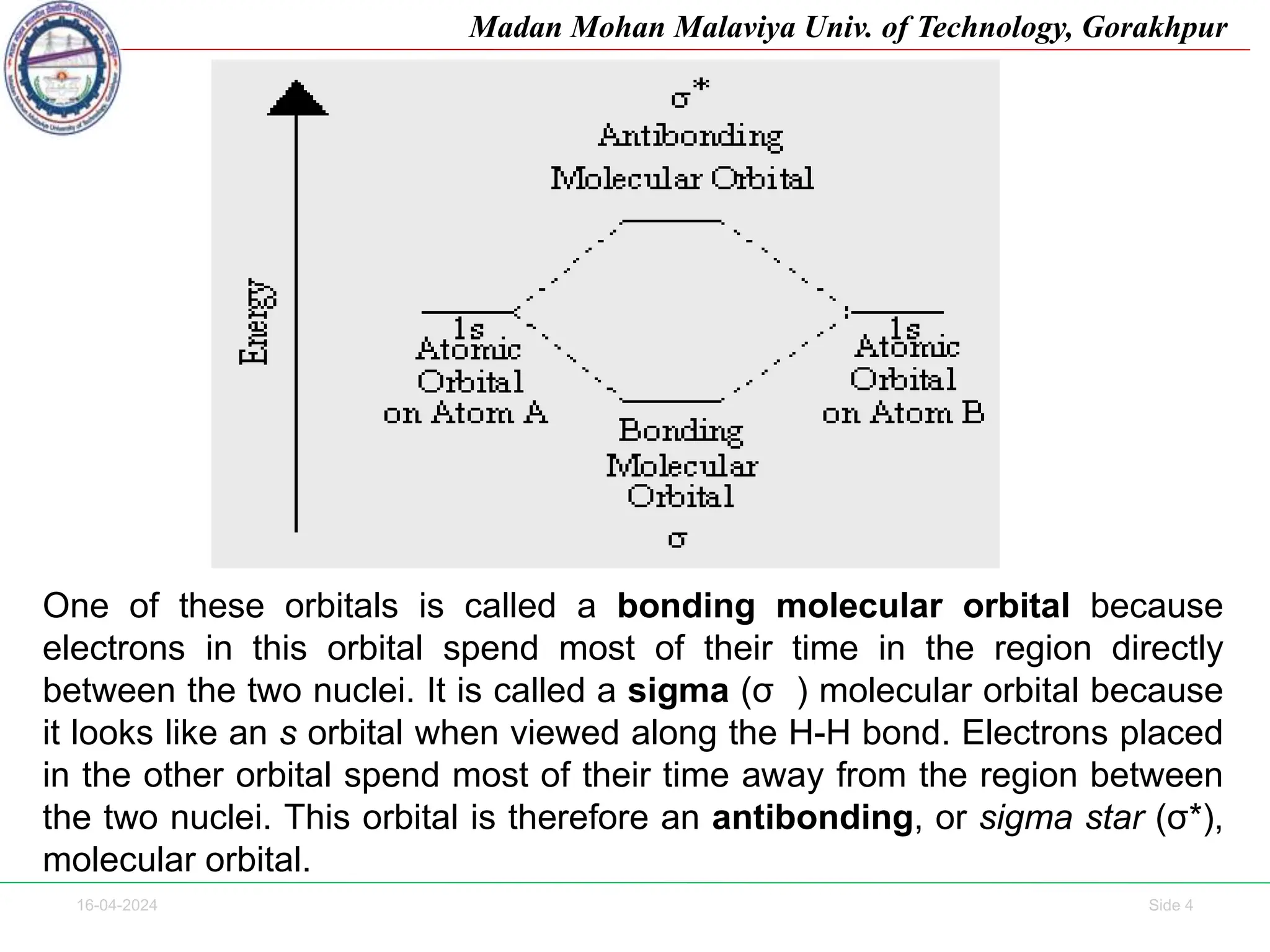
One of these orbitals is called a bonding molecular orbital because
electrons in this orbital spend most of their time in the region directly
between the two nuclei. It is called a sigma (σ ) molecular orbital because
it looks like an s orbital when viewed along the H-H bond. Electrons placed
in the other orbital spend most of their time away from the region between
the two nuclei. This orbital is therefore an antibonding, or sigma star (σ*),
molecular orbital.
16-04-2024 Side 5
Madan Mohan Malaviya Univ. of Technology, Gorakhpur
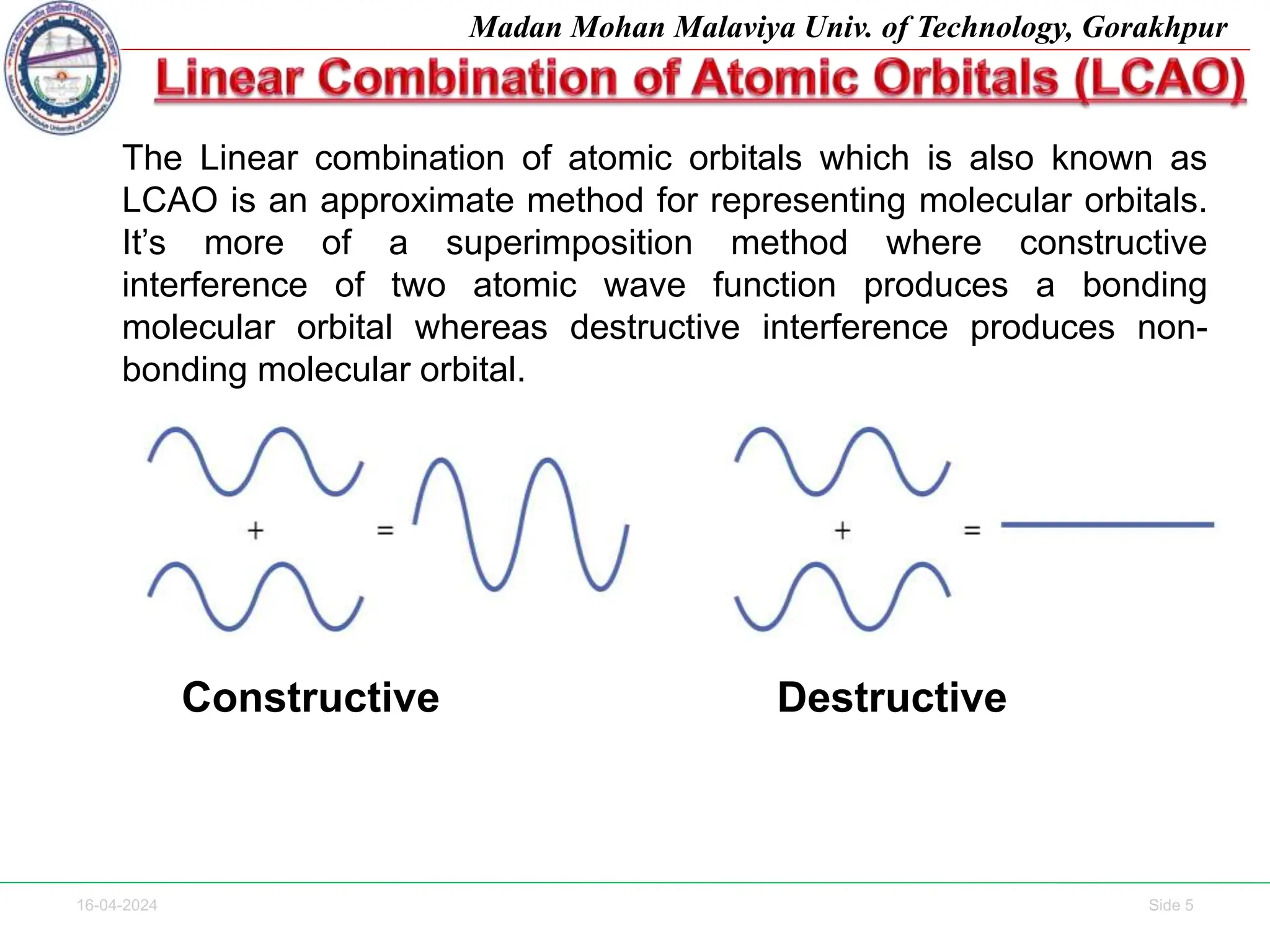
The Linear combination of atomic orbitals which is also known as
LCAO is an approximate method for representing molecular orbitals.
It’s more of a superimposition method where constructive
interference of two atomic wave function produces a bonding
molecular orbital whereas destructive interference produces non-
bonding molecular orbital.
Constructive Destructive
16-04-2024 Side 6
Madan Mohan Malaviya Univ. of Technology, Gorakhpur
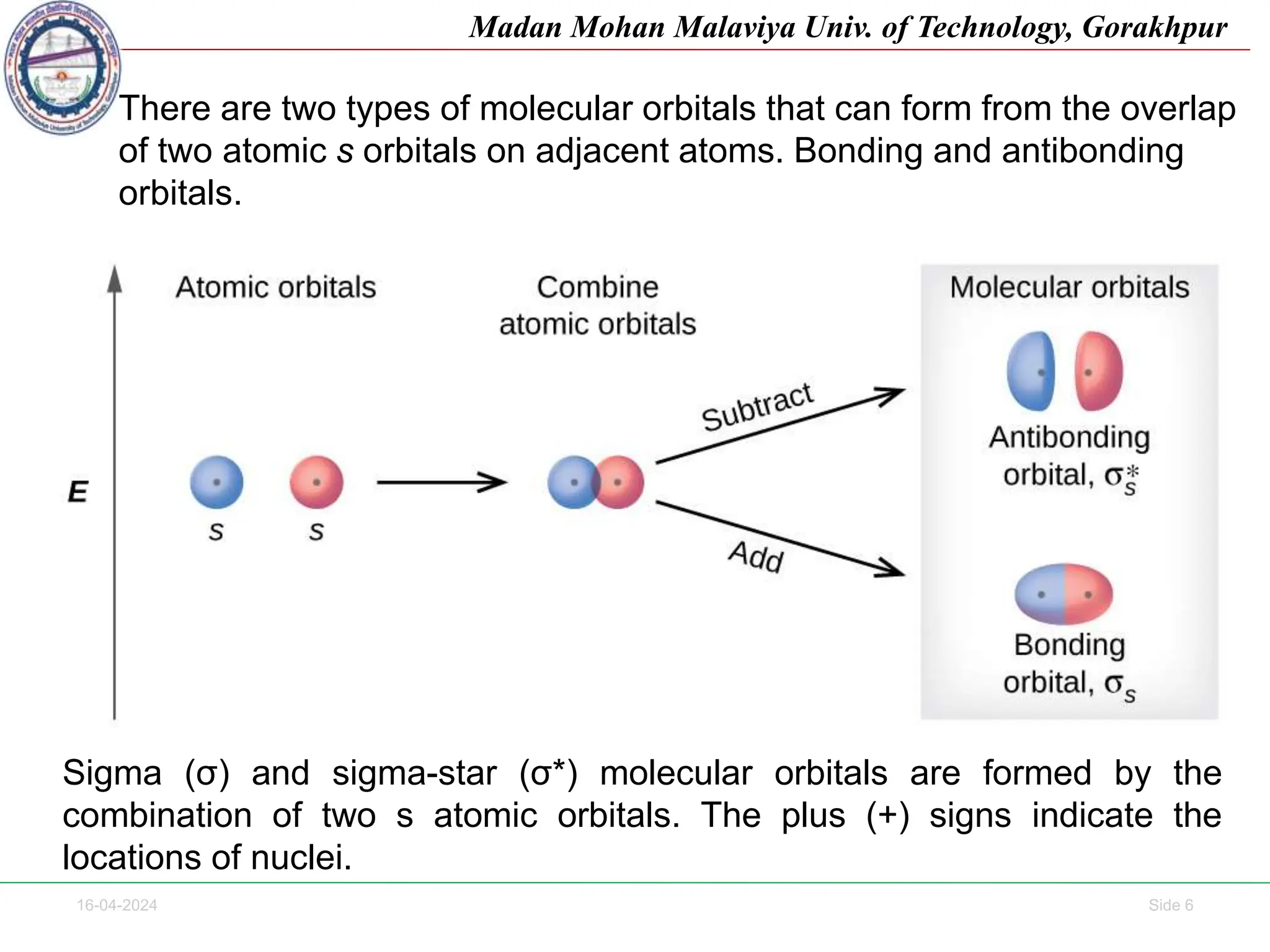
Sigma (σ) and sigma-star (σ*) molecular orbitals are formed by the
combination of two s atomic orbitals. The plus (+) signs indicate the
locations of nuclei.
There are two types of molecular orbitals that can form from the overlap
of two atomic s orbitals on adjacent atoms. Bonding and antibonding
orbitals.
16-04-2024 Side 7
Madan Mohan Malaviya Univ. of Technology, Gorakhpur
Relationship between Electronic configuration
and Molecular behaviour :
1.Bond order :
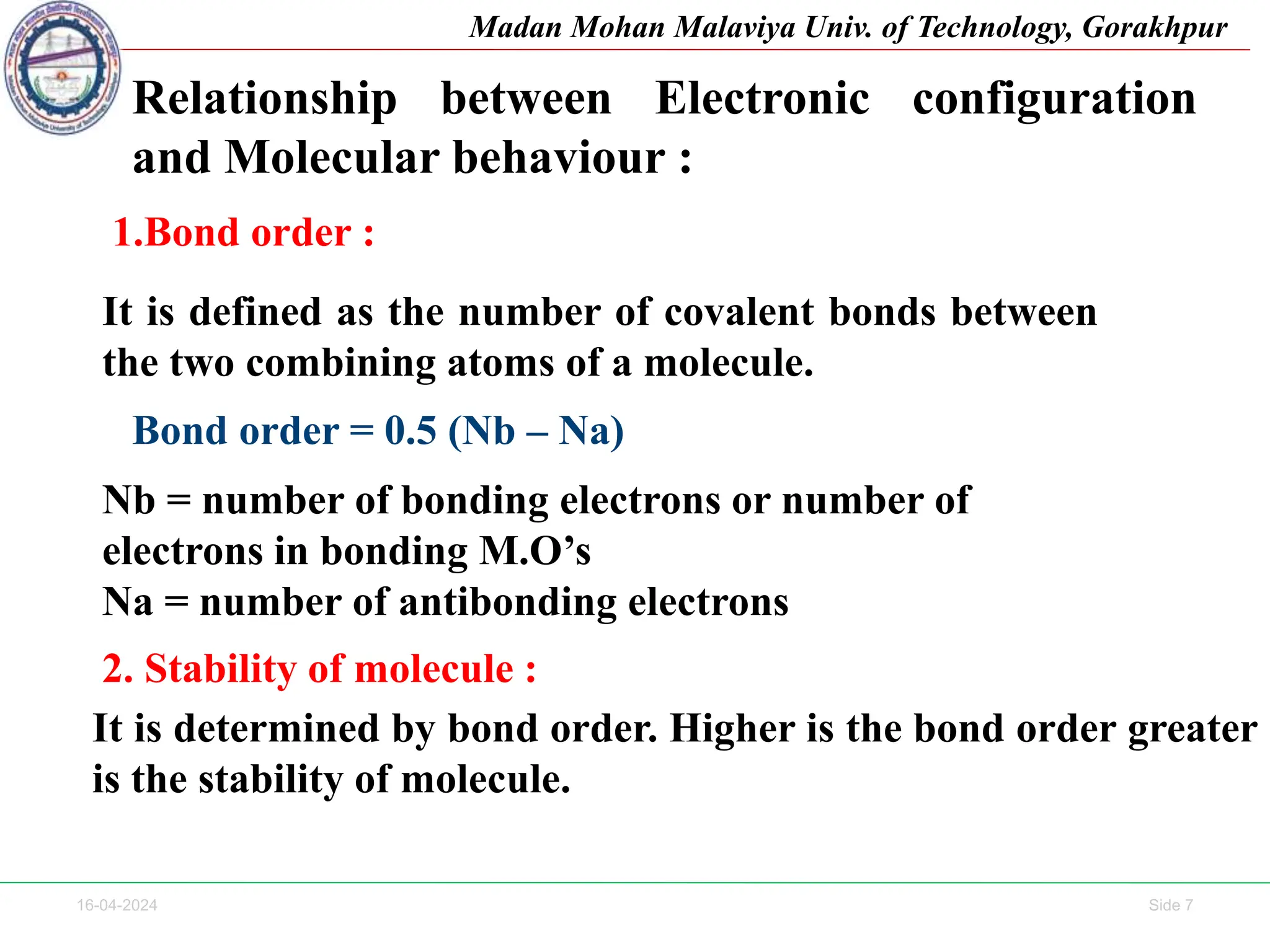
It is defined as the number of covalent bonds between
the two combining atoms of a molecule.
Bond order = 0.5 (Nb – Na)
Nb = number of bonding electrons or number of
electrons in bonding M.O’s
Na = number of antibonding electrons
2. Stability of molecule :
It is determined by bond order. Higher is the bond order greater
is the stability of molecule.
16-04-2024 Side 8
Madan Mohan Malaviya Univ. of Technology, Gorakhpur
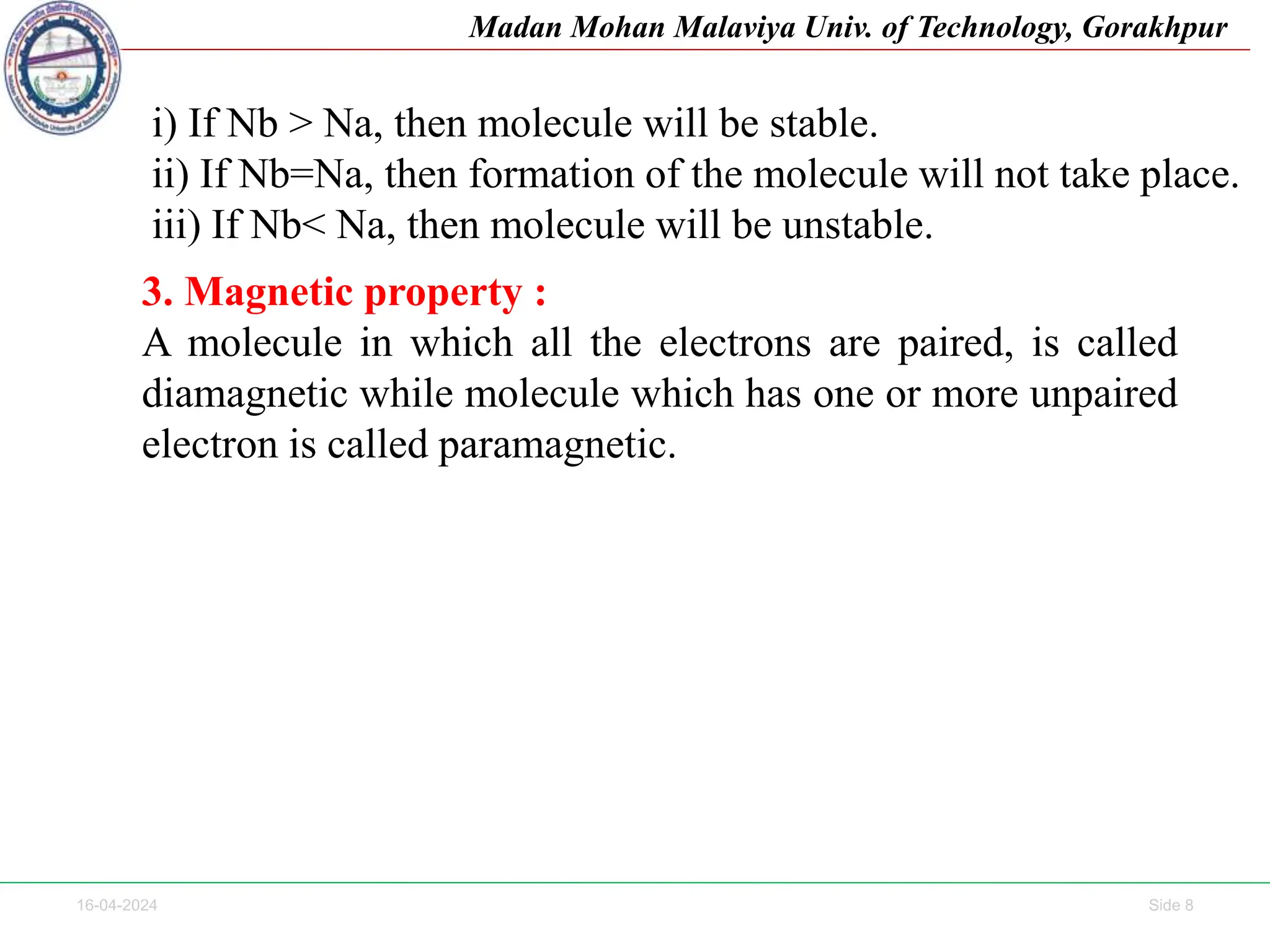
i) If Nb > Na, then molecule will be stable.
ii) If Nb=Na, then formation of the molecule will not take place.
iii) If Nb< Na, then molecule will be unstable.
3. Magnetic property :
A molecule in which all the electrons are paired, is called
diamagnetic while molecule which has one or more unpaired
electron is called paramagnetic.
16-04-2024 Side 9
Madan Mohan Malaviya Univ. of Technology, Gorakhpur
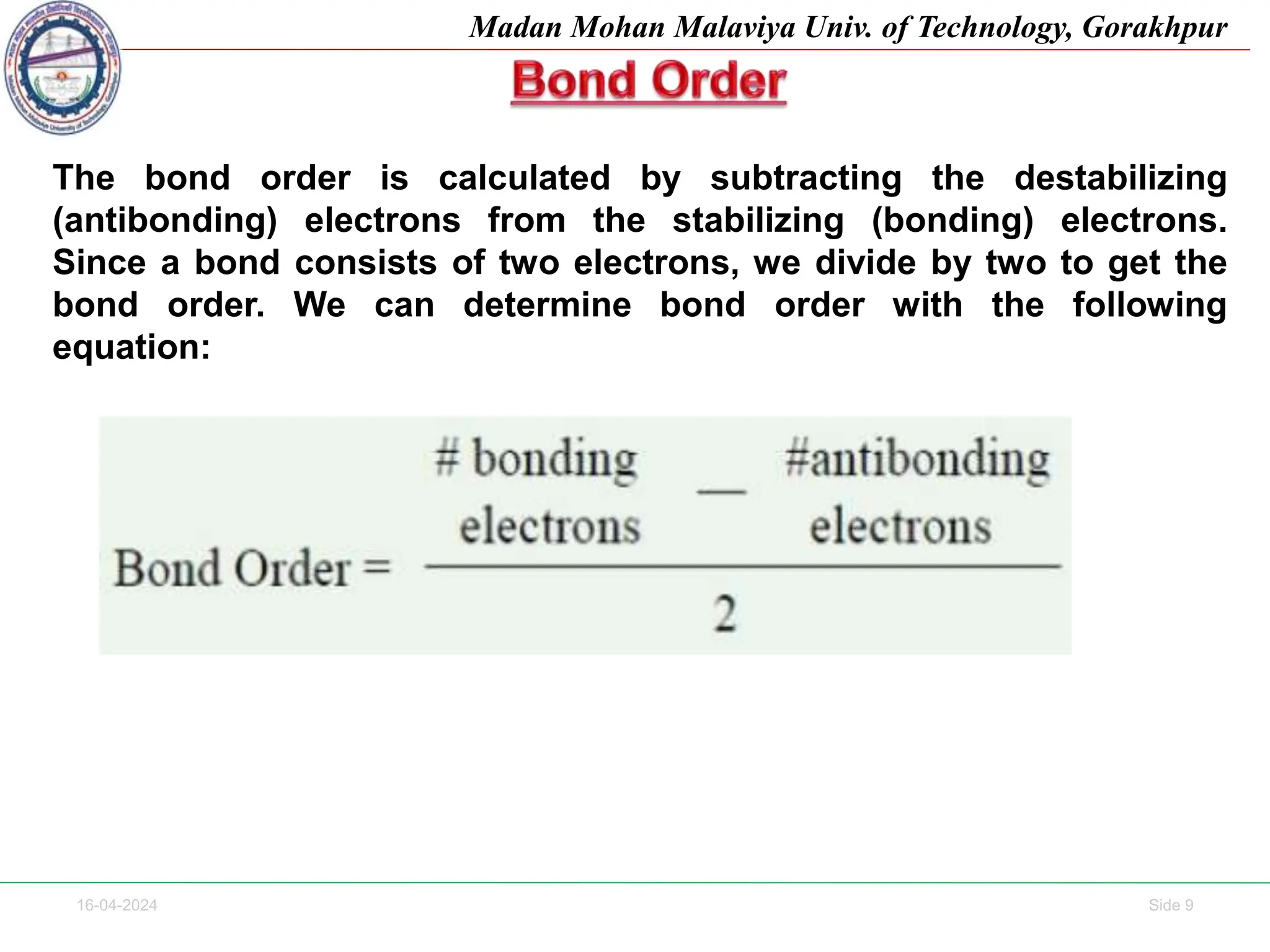
The bond order is calculated by subtracting the destabilizing
(antibonding) electrons from the stabilizing (bonding) electrons.
Since a bond consists of two electrons, we divide by two to get the
bond order. We can determine bond order with the following
equation:
16-04-2024 Side 10
Madan Mohan Malaviya Univ. of Technology, Gorakhpur
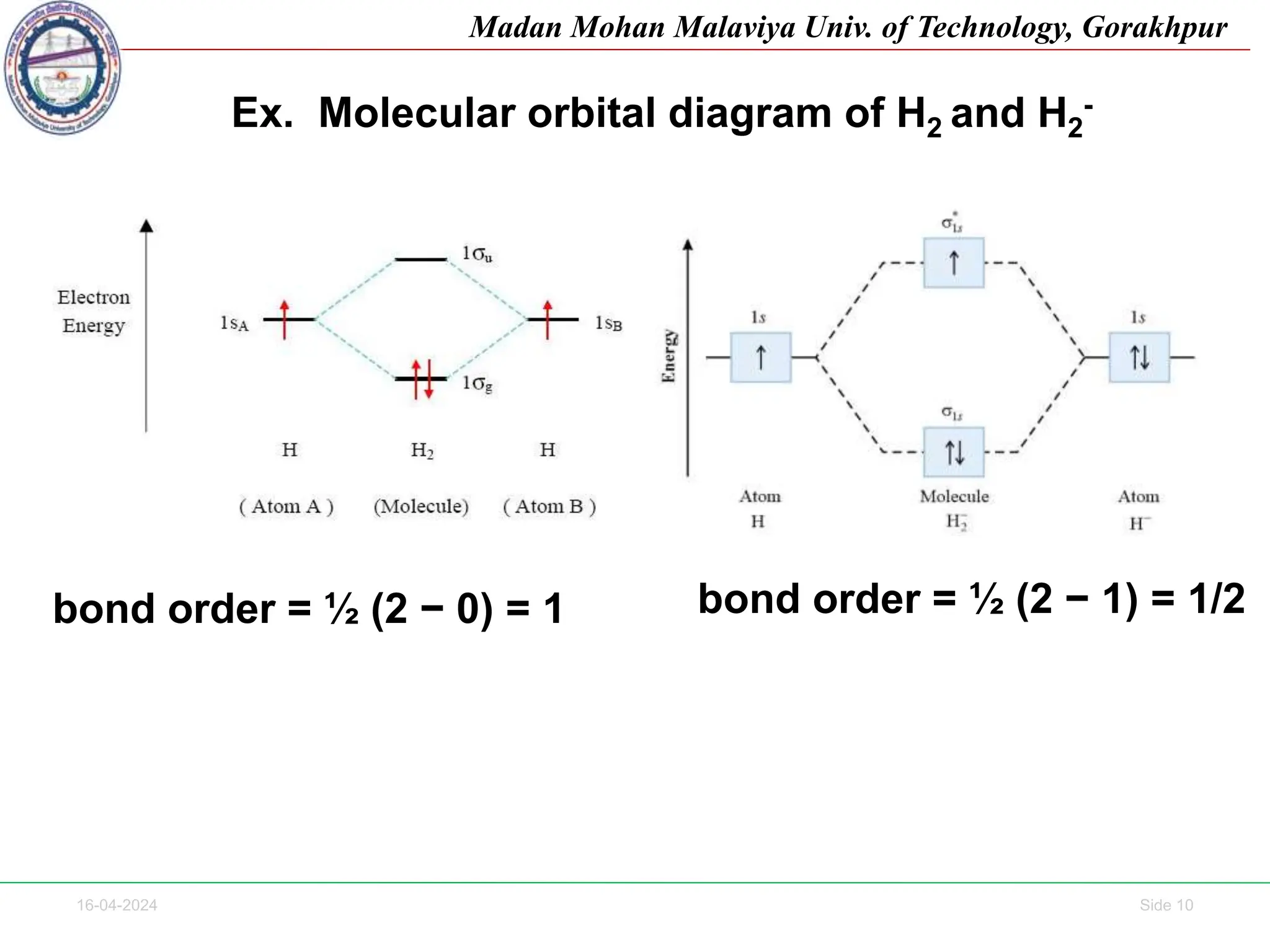
Ex. Molecular orbital diagram of H2 and H2
-
bond order = ½ (2 − 0) = 1 bond order = ½ (2 − 1) = 1/2
16-04-2024 Side 11
Madan Mohan Malaviya Univ. of Technology, Gorakhpur
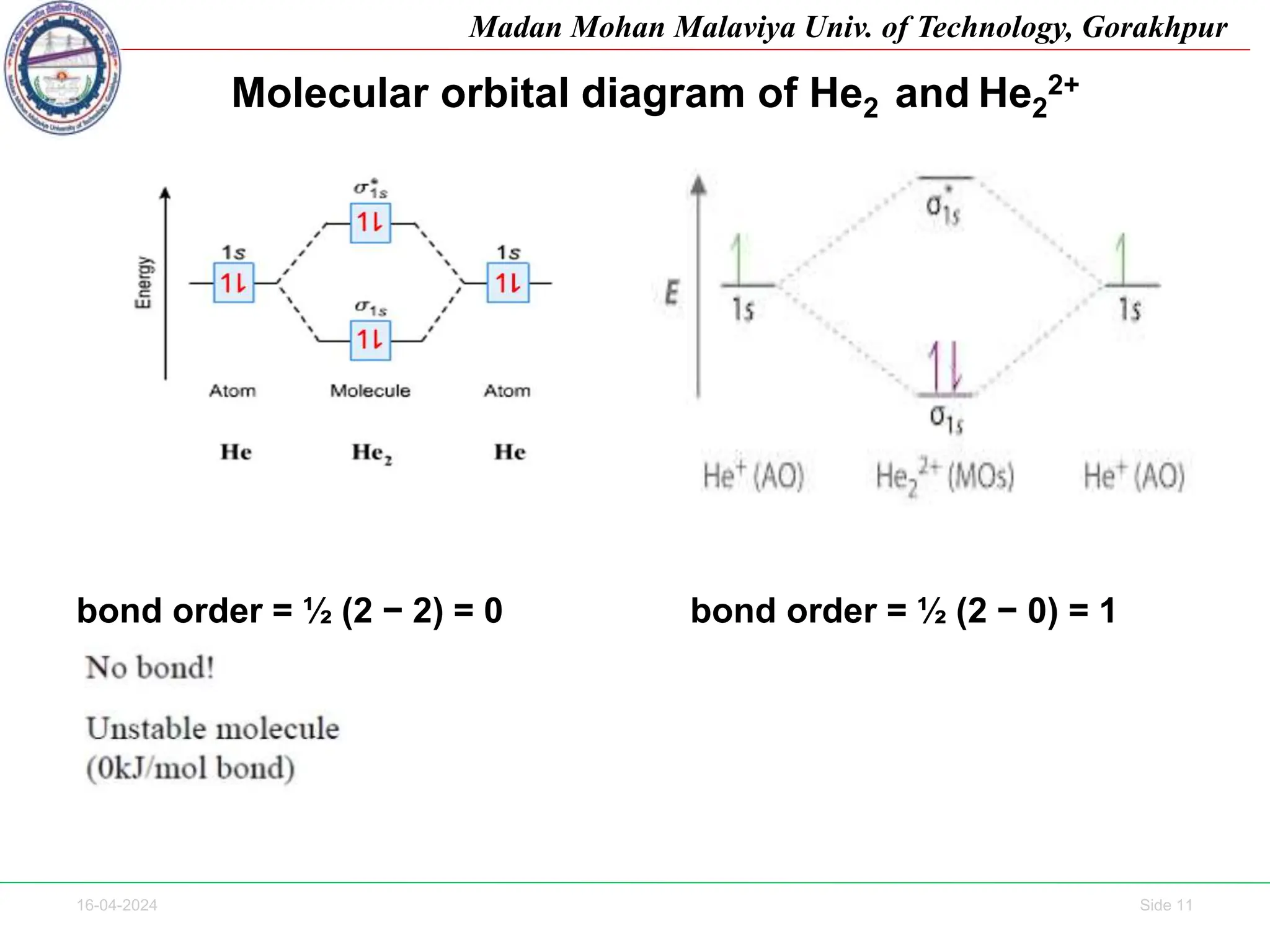
Molecular orbital diagram of He2 and He2
2+
bond order = ½ (2 − 2) = 0 bond order = ½ (2 − 0) = 1
16-04-2024 Side 12
Madan Mohan Malaviya Univ. of Technology, Gorakhpur
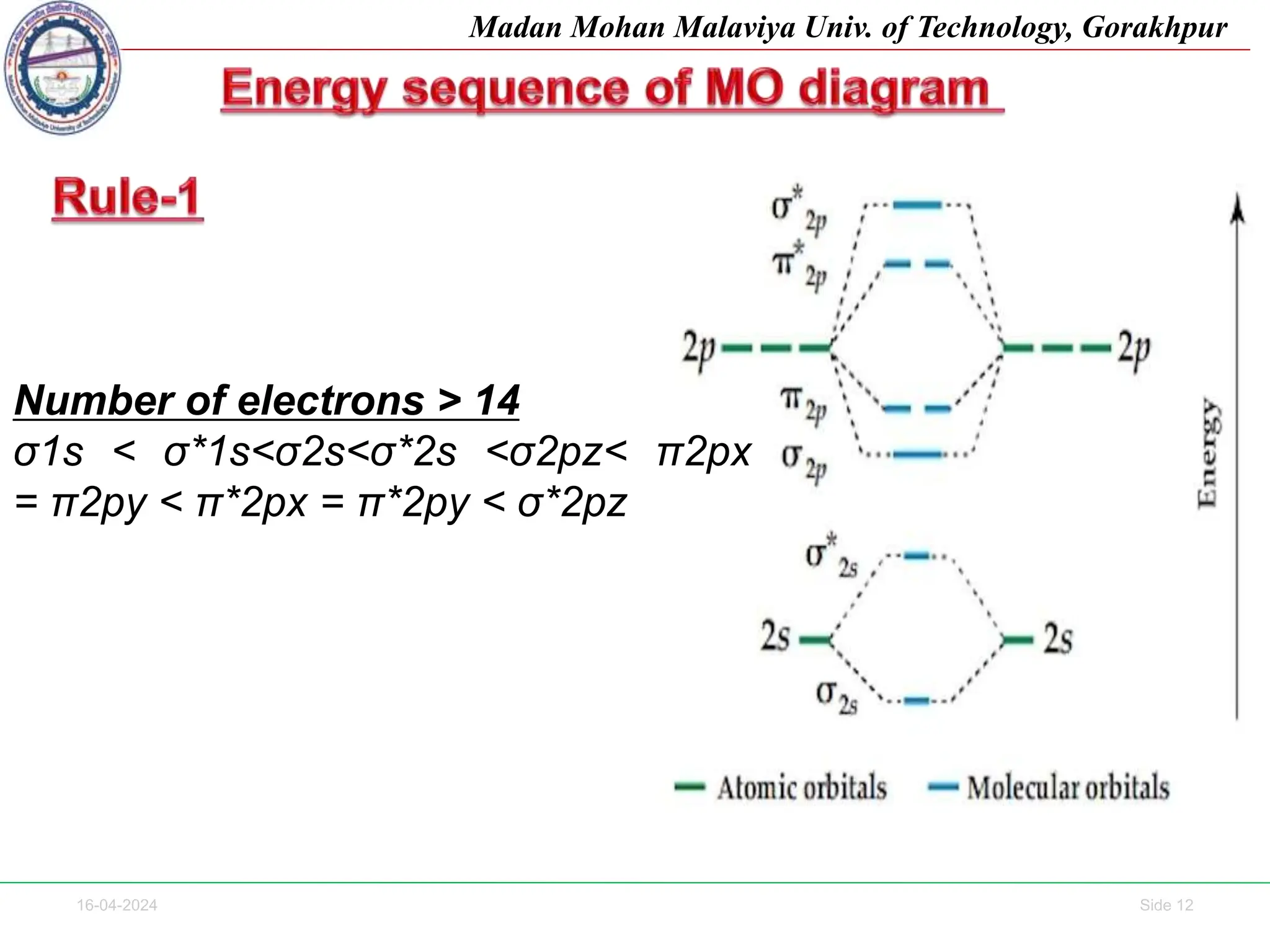
Number of electrons > 14
σ1s < σ*1s<σ2s<σ*2s <σ2pz< π2px
= π2py < π*2px = π*2py < σ*2pz
16-04-2024 Side 13
Madan Mohan Malaviya Univ. of Technology, Gorakhpur
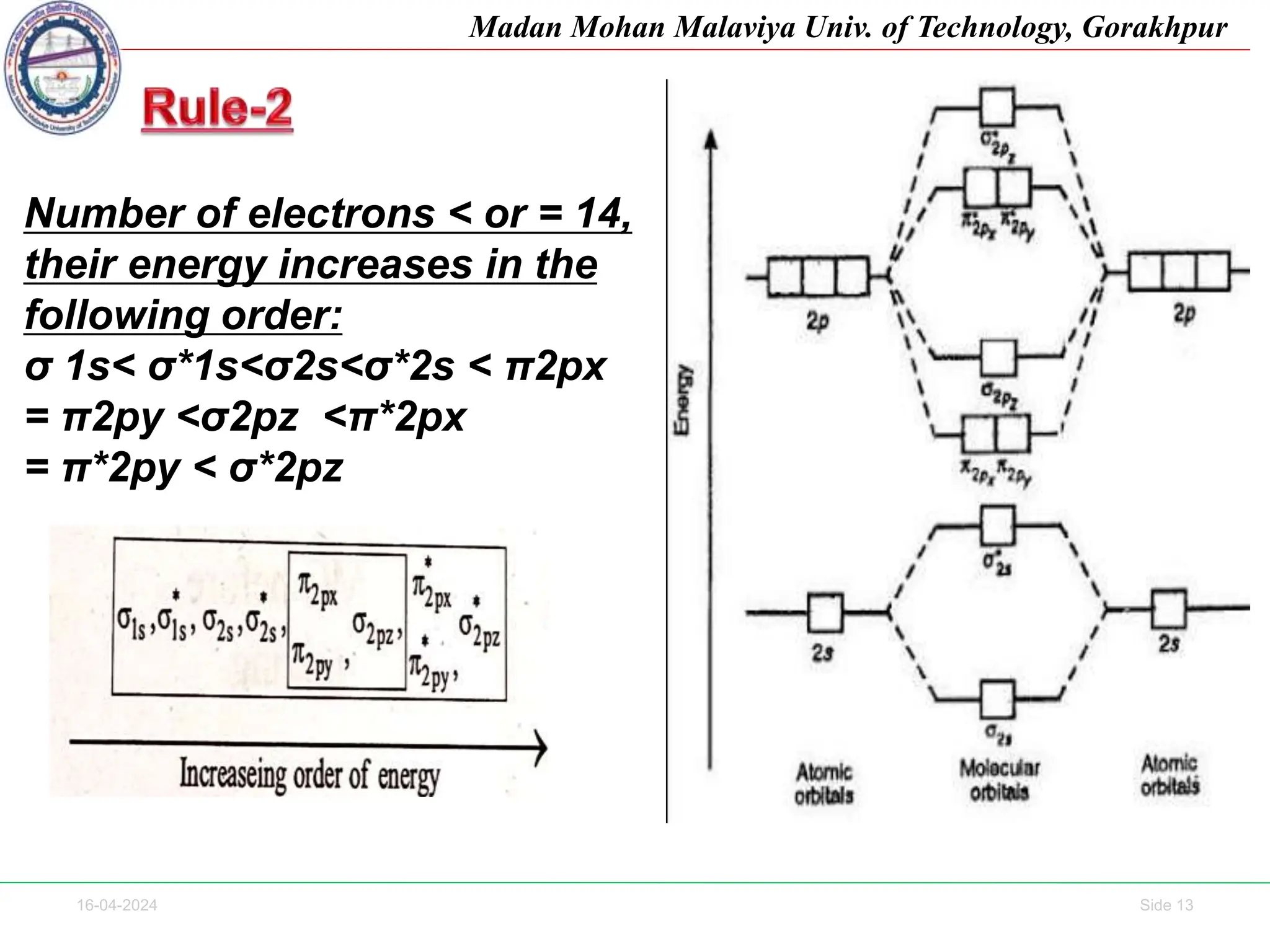
Number of electrons < or = 14,
their energy increases in the
following order:
σ 1s< σ*1s<σ2s<σ*2s < π2px
= π2py <σ2pz <π*2px
= π*2py < σ*2pz
16-04-2024 Side 14
Madan Mohan Malaviya Univ. of Technology, Gorakhpur
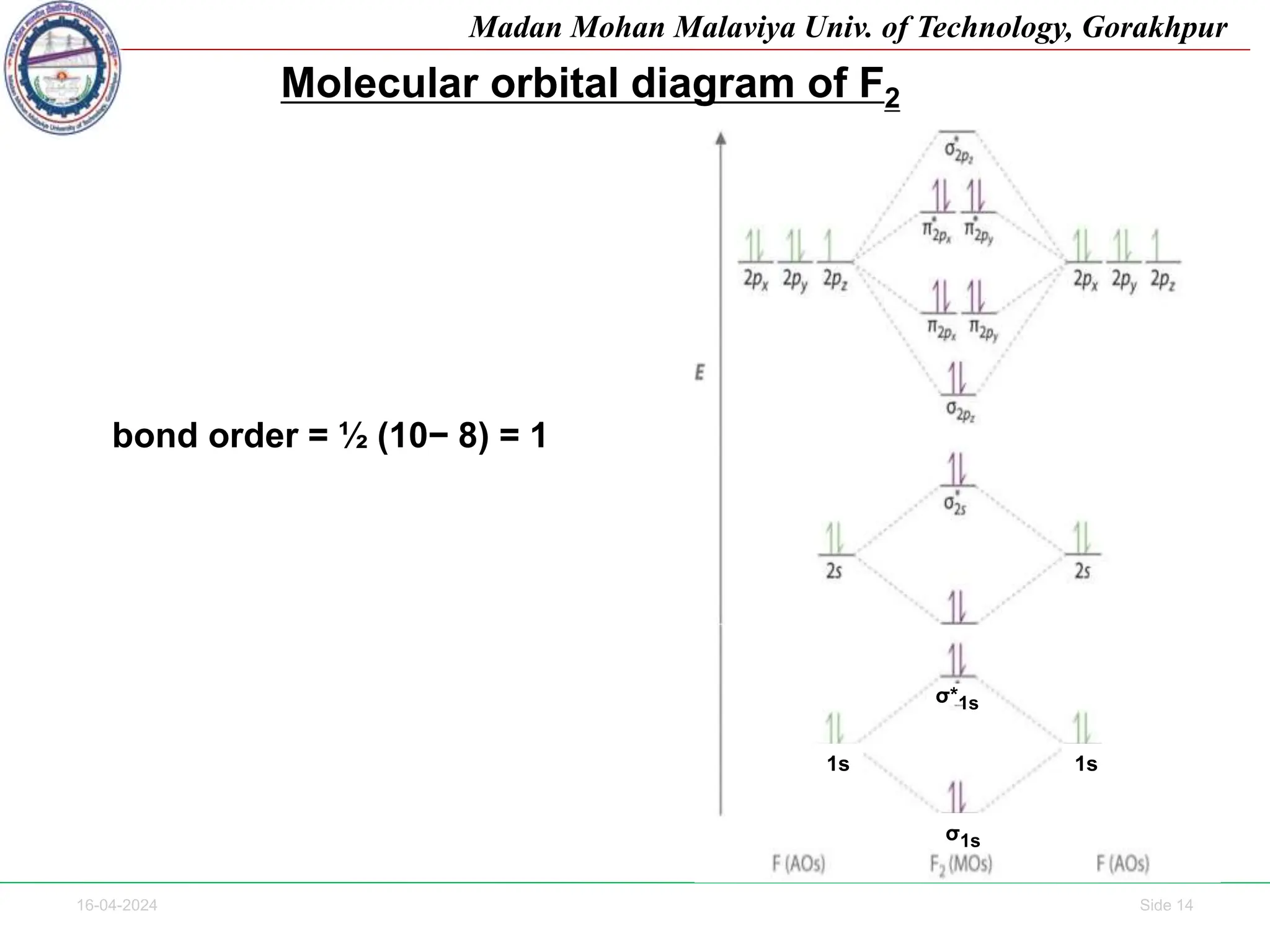
bond order = ½ (10− 8) = 1
Molecular orbital diagram of F2
1s
1s
σ1s
σ*1s
16-04-2024 Side 15
Madan Mohan Malaviya Univ. of Technology, Gorakhpur
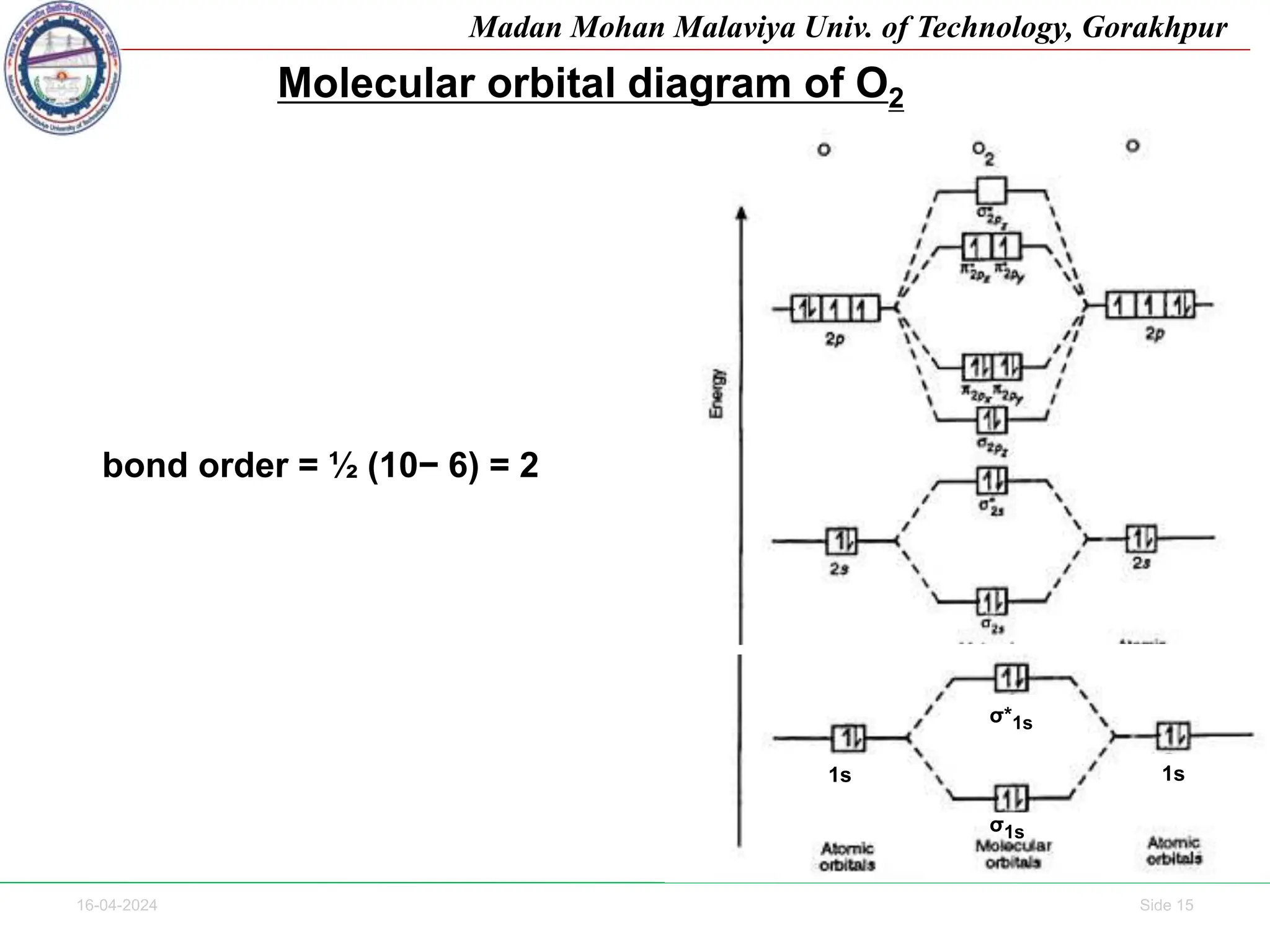
Molecular orbital diagram of O2
1s 1s
σ*1s
σ1s
bond order = ½ (10− 6) = 2
16-04-2024 Side 16
Madan Mohan Malaviya Univ. of Technology, Gorakhpur
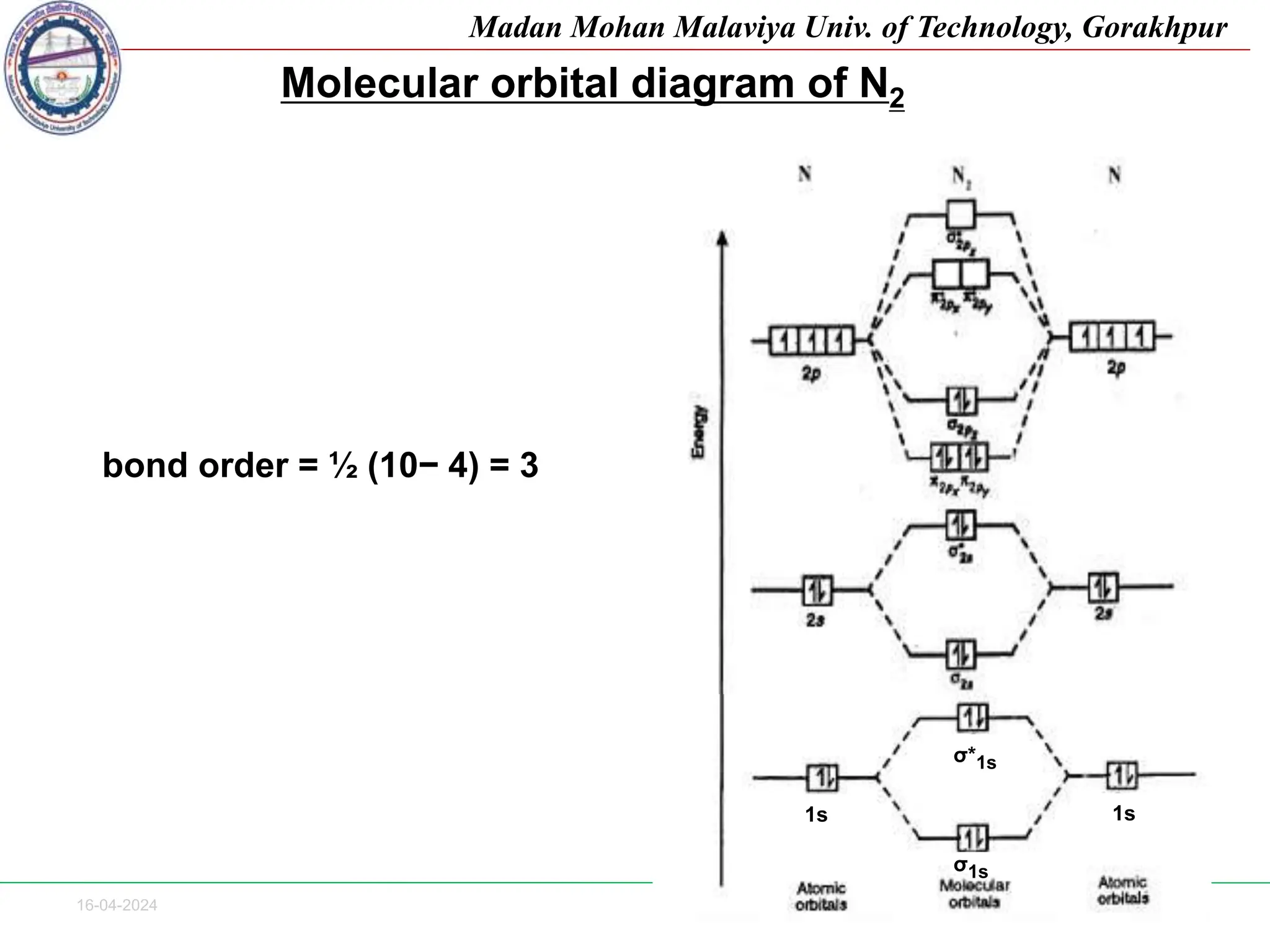
Molecular orbital diagram of N2
1s 1s
σ*1s
σ1s
bond order = ½ (10− 4) = 3
16-04-2024 Side 17
Madan Mohan Malaviya Univ. of Technology, Gorakhpur
Relationship between Electronic configuration
and Molecular behaviour :
1) Bond order :
It is defined as the number of covalent bonds
between the two combining atoms of a molecule.
Bond order = 0.5 (Nb – Na)
Nb = number of bonding electrons or number of
electrons in bonding M.O’s
Na = number of antibonding electrons
Stability of molecule :
It is determined by bond order. Higher is the bond order greater
is the stability of molecule.
16-04-2024 Side 18
Madan Mohan Malaviya Univ. of Technology, Gorakhpur
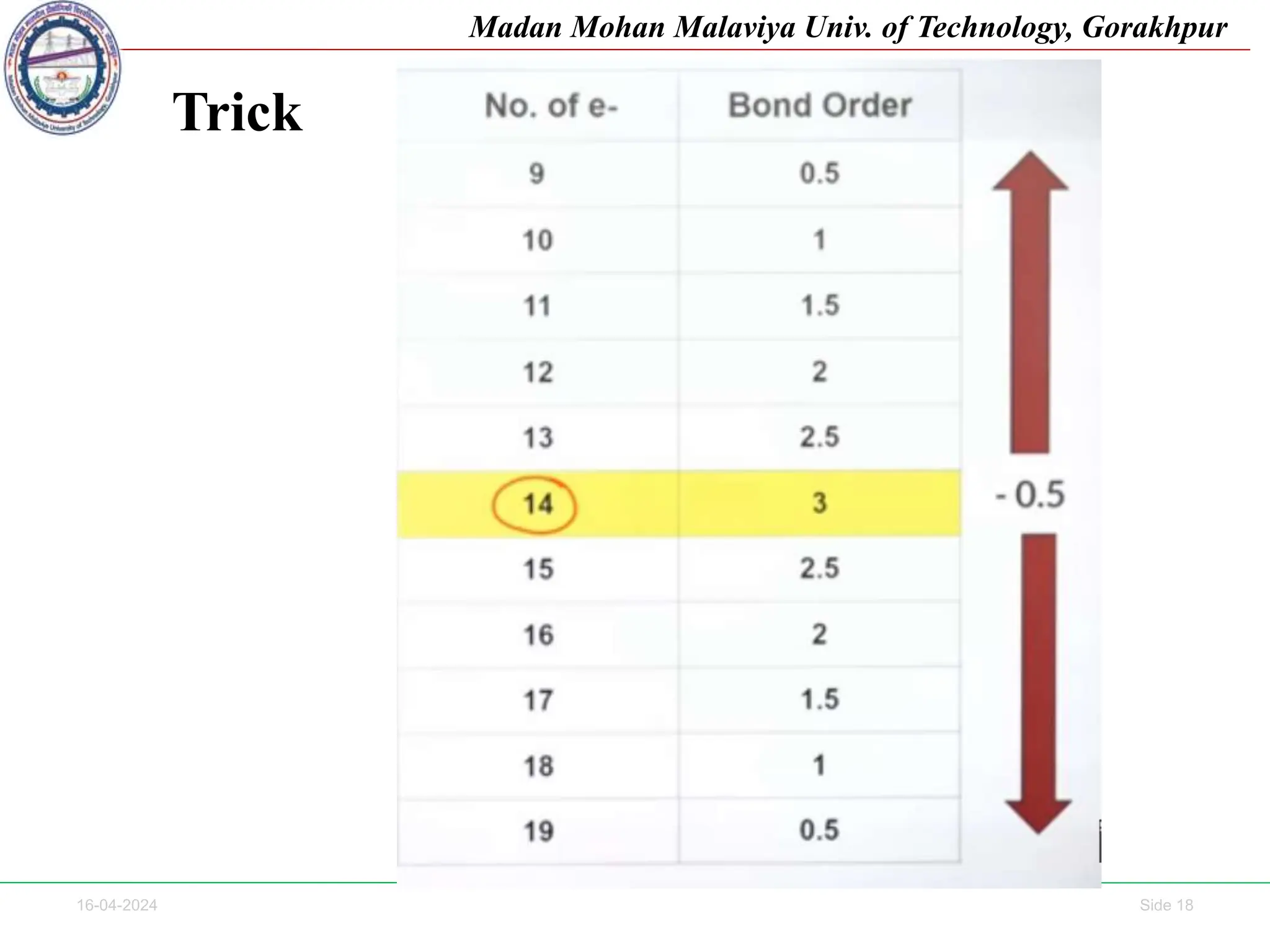
Trick
16-04-2024 Side 19
Madan Mohan Malaviya Univ. of Technology, Gorakhpur
?
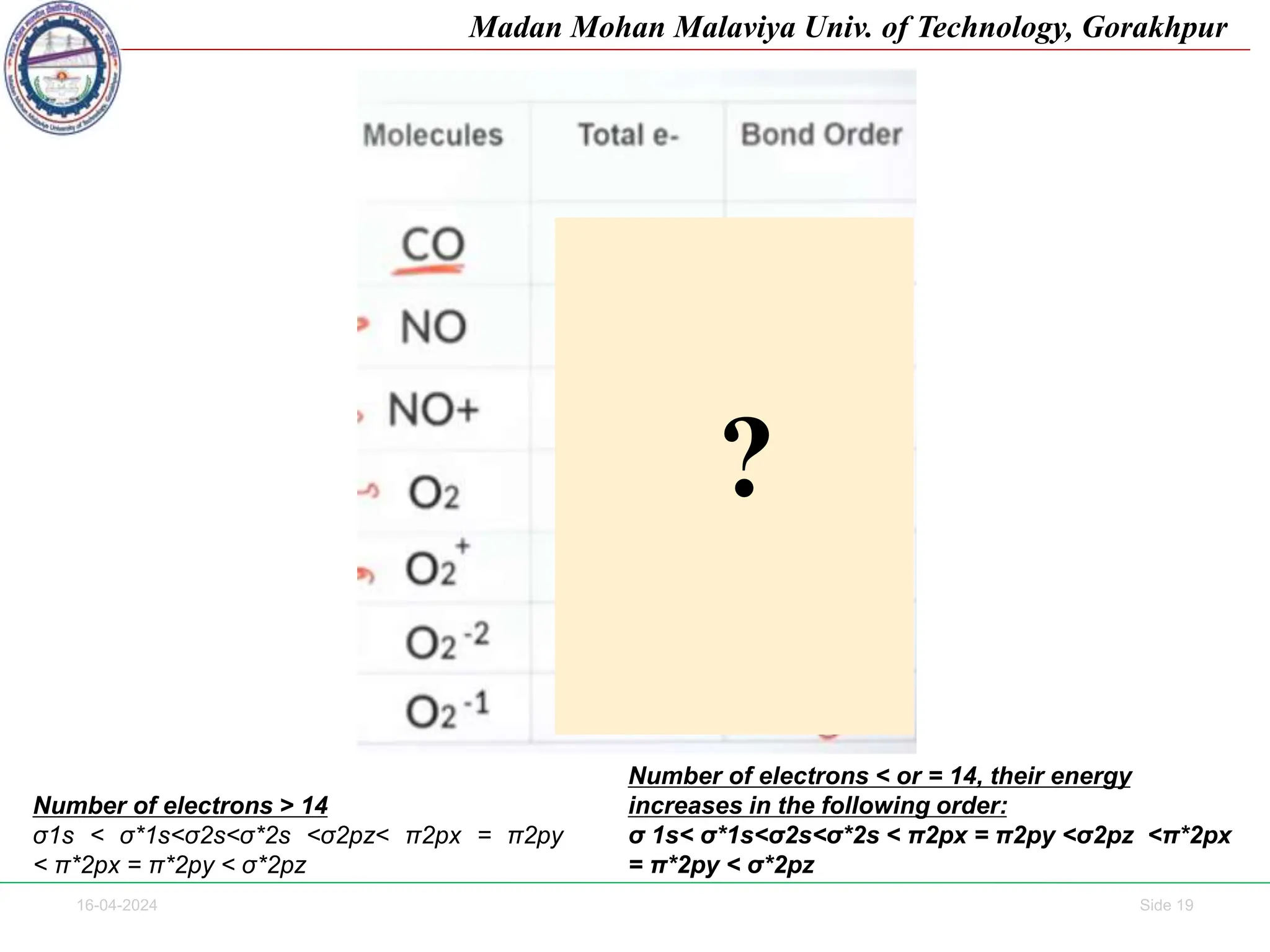
Number of electrons < or = 14, their energy
increases in the following order:
σ 1s< σ*1s<σ2s<σ*2s < π2px = π2py <σ2pz <π*2px
= π*2py < σ*2pz
Number of electrons > 14
σ1s < σ*1s<σ2s<σ*2s <σ2pz< π2px = π2py
< π*2px = π*2py < σ*2pz
16-04-2024 Side 20
Madan Mohan Malaviya Univ. of Technology, Gorakhpur
16-04-2024 Side 21
Madan Mohan Malaviya Univ. of Technology, Gorakhpur
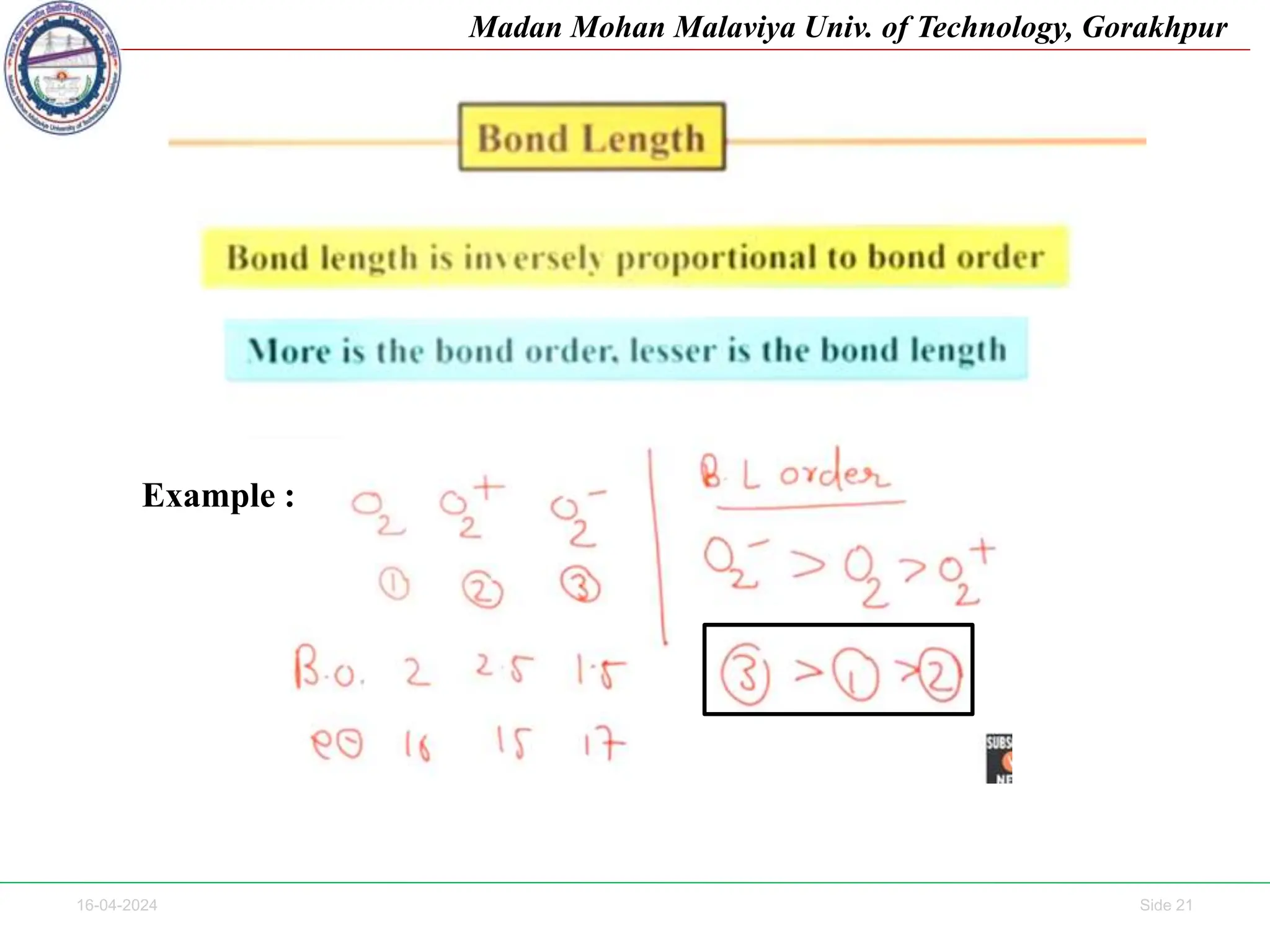
Example :
16-04-2024 Side 22
Madan Mohan Malaviya Univ. of Technology, Gorakhpur
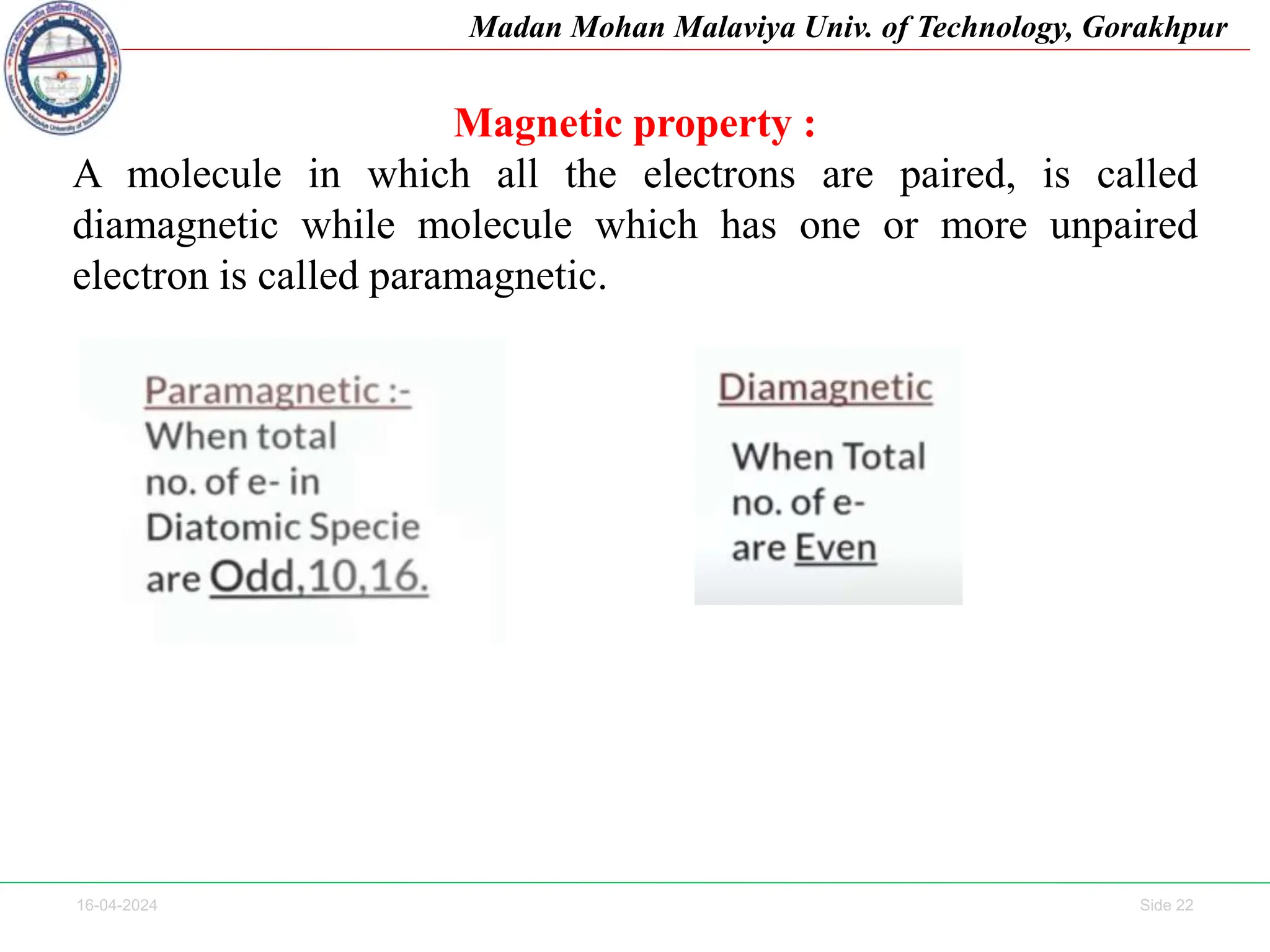
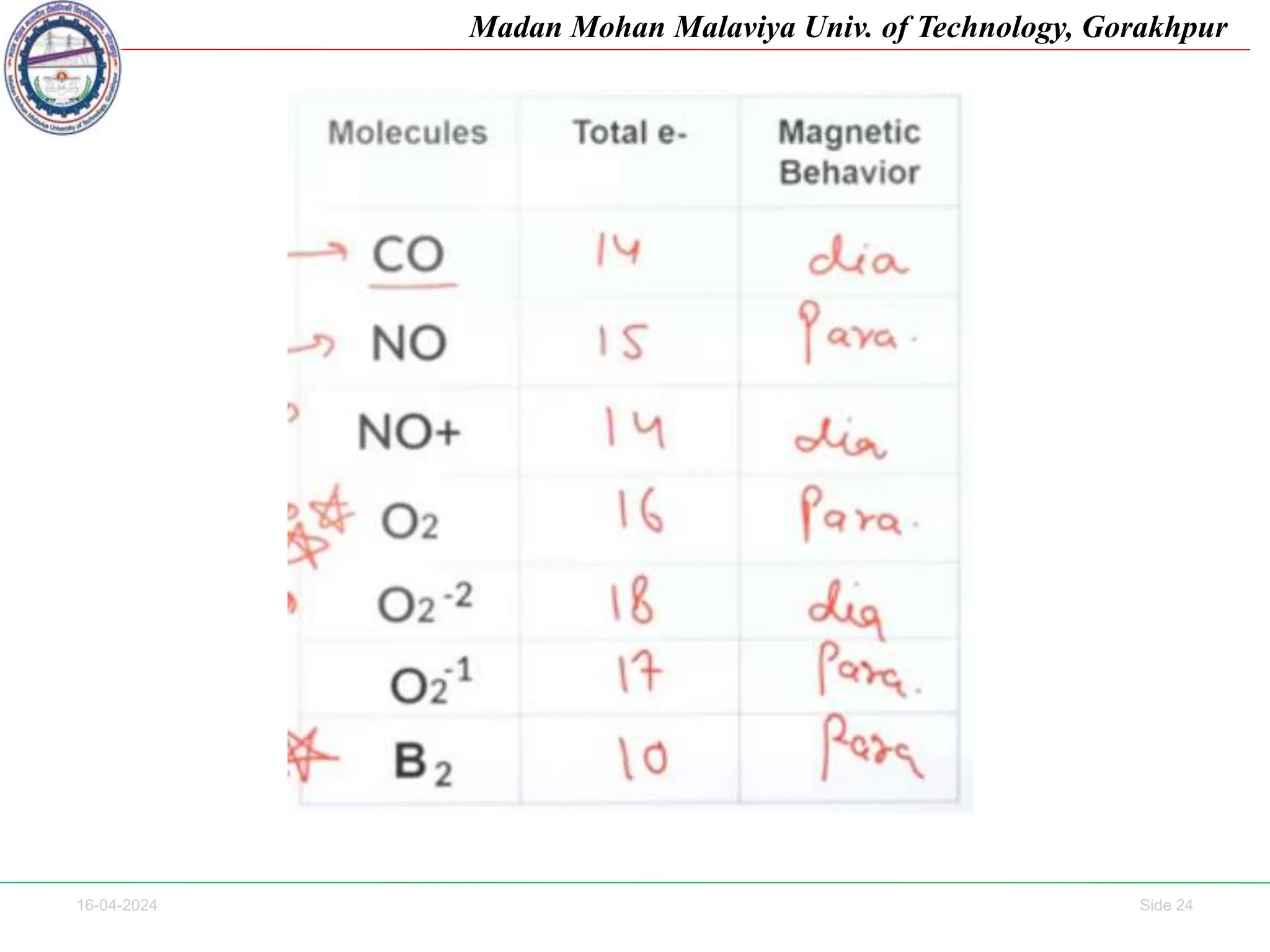
Magnetic property :
A molecule in which all the electrons are paired, is called
diamagnetic while molecule which has one or more unpaired
electron is called paramagnetic.
16-04-2024 Side 23
Madan Mohan Malaviya Univ. of Technology, Gorakhpur
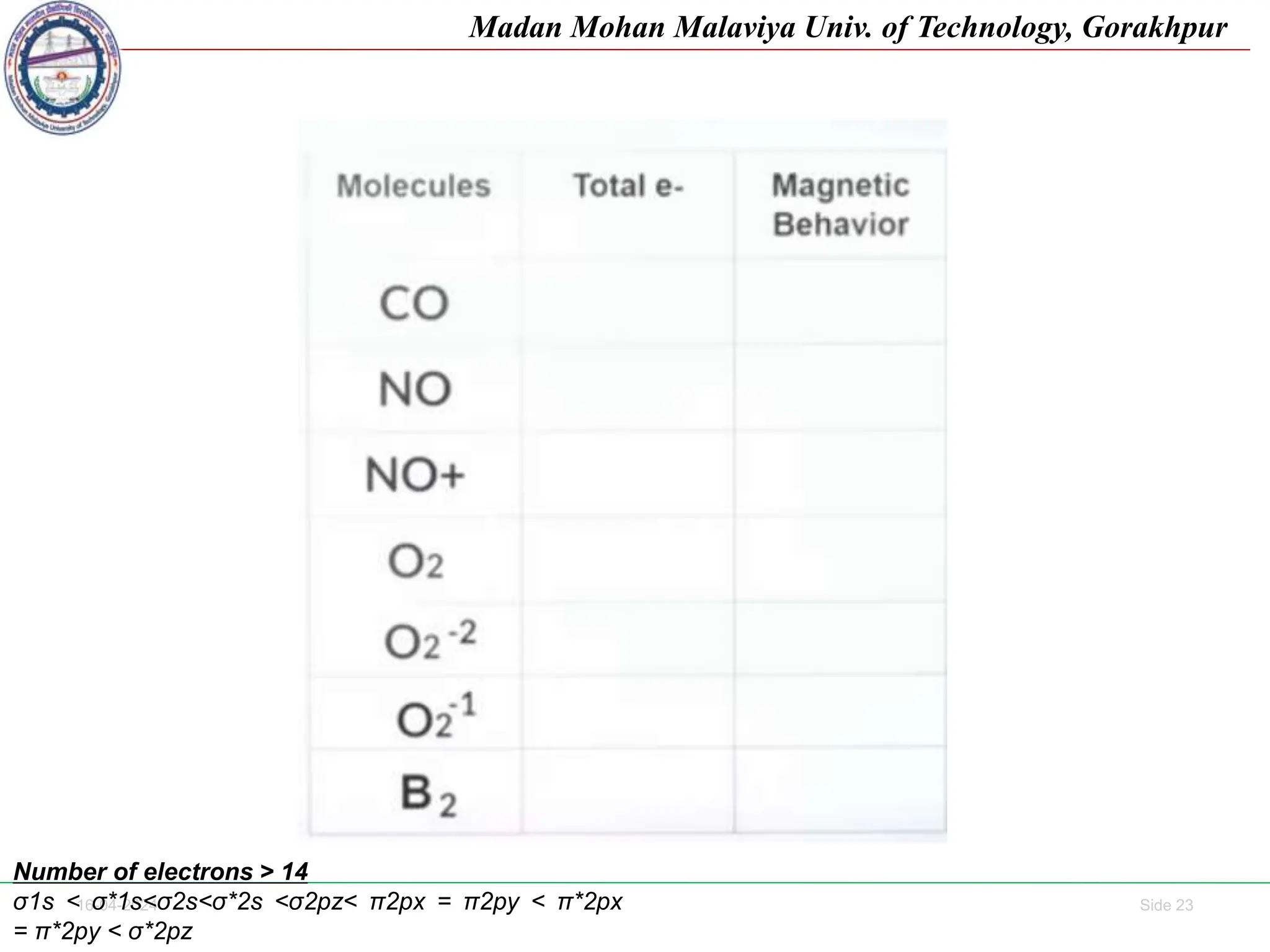
Number of electrons > 14
σ1s < σ*1s<σ2s<σ*2s <σ2pz< π2px = π2py < π*2px
= π*2py < σ*2pz
16-04-2024 Side 24
Madan Mohan Malaviya Univ. of Technology, Gorakhpur
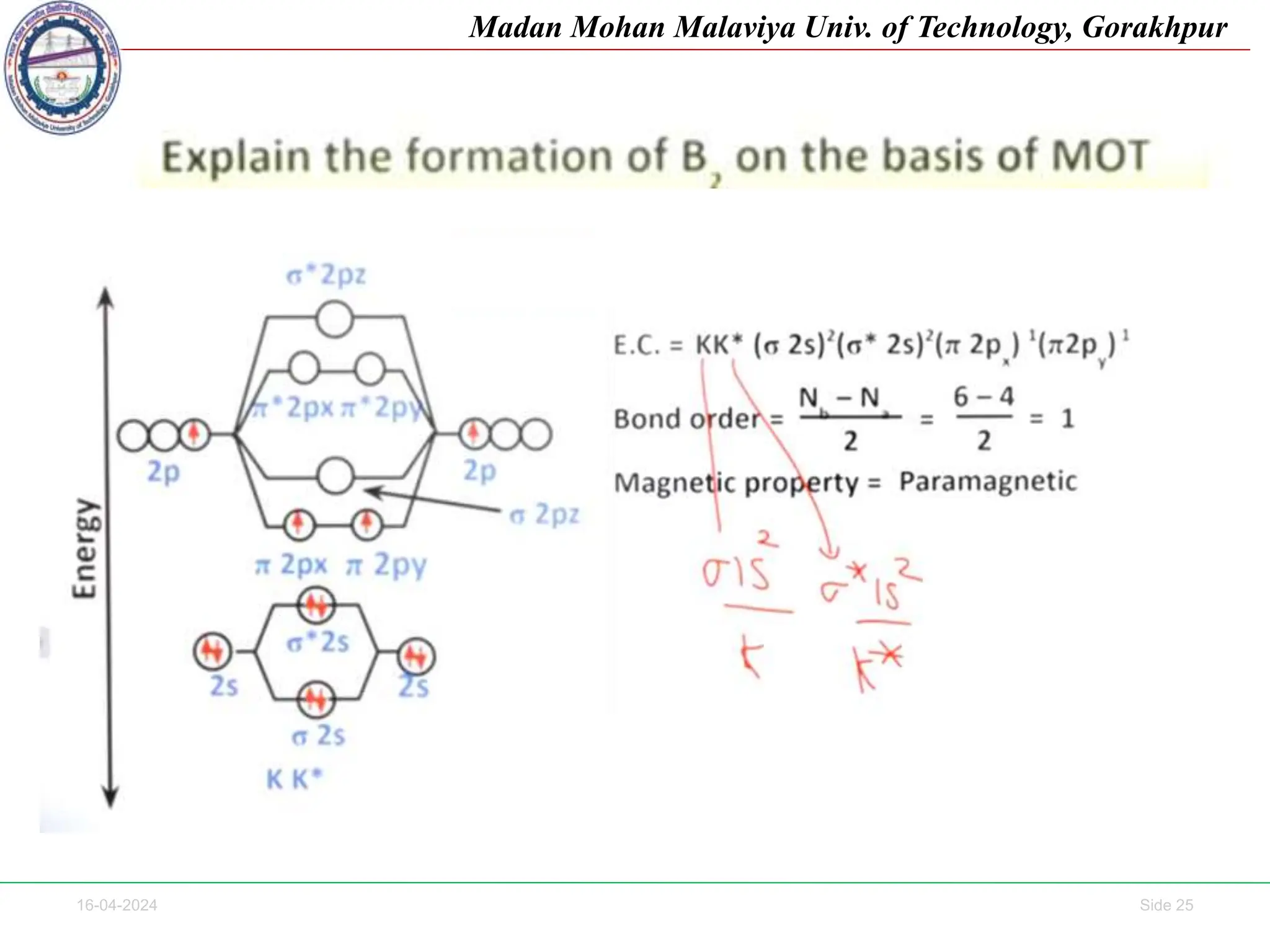
16-04-2024 Side 25
Madan Mohan Malaviya Univ. of Technology, Gorakhpur
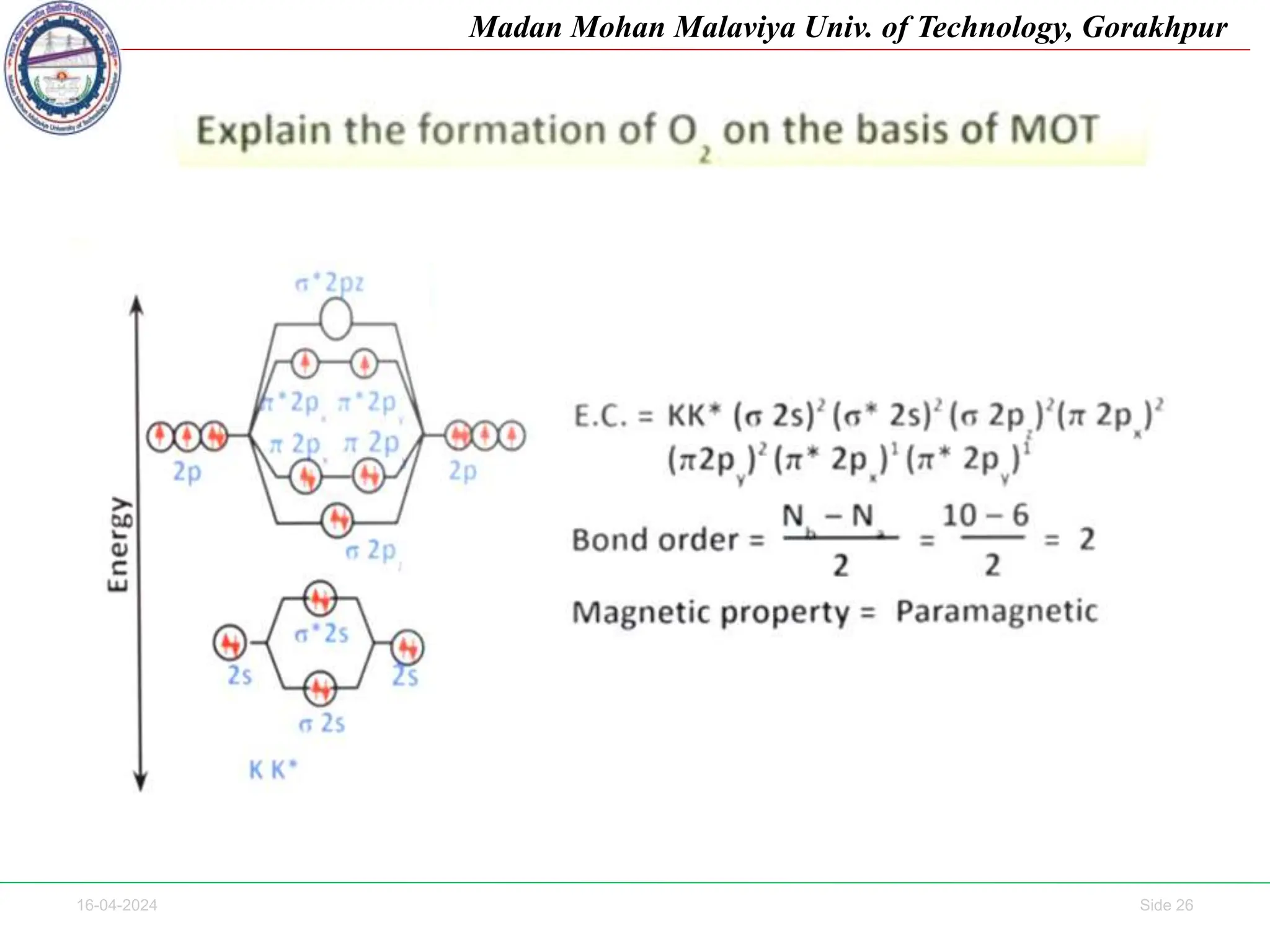
16-04-2024 Side 26
Madan Mohan Malaviya Univ. of Technology, Gorakhpur
16-04-2024 Side 27
Madan Mohan Malaviya Univ. of Technology, Gorakhpur
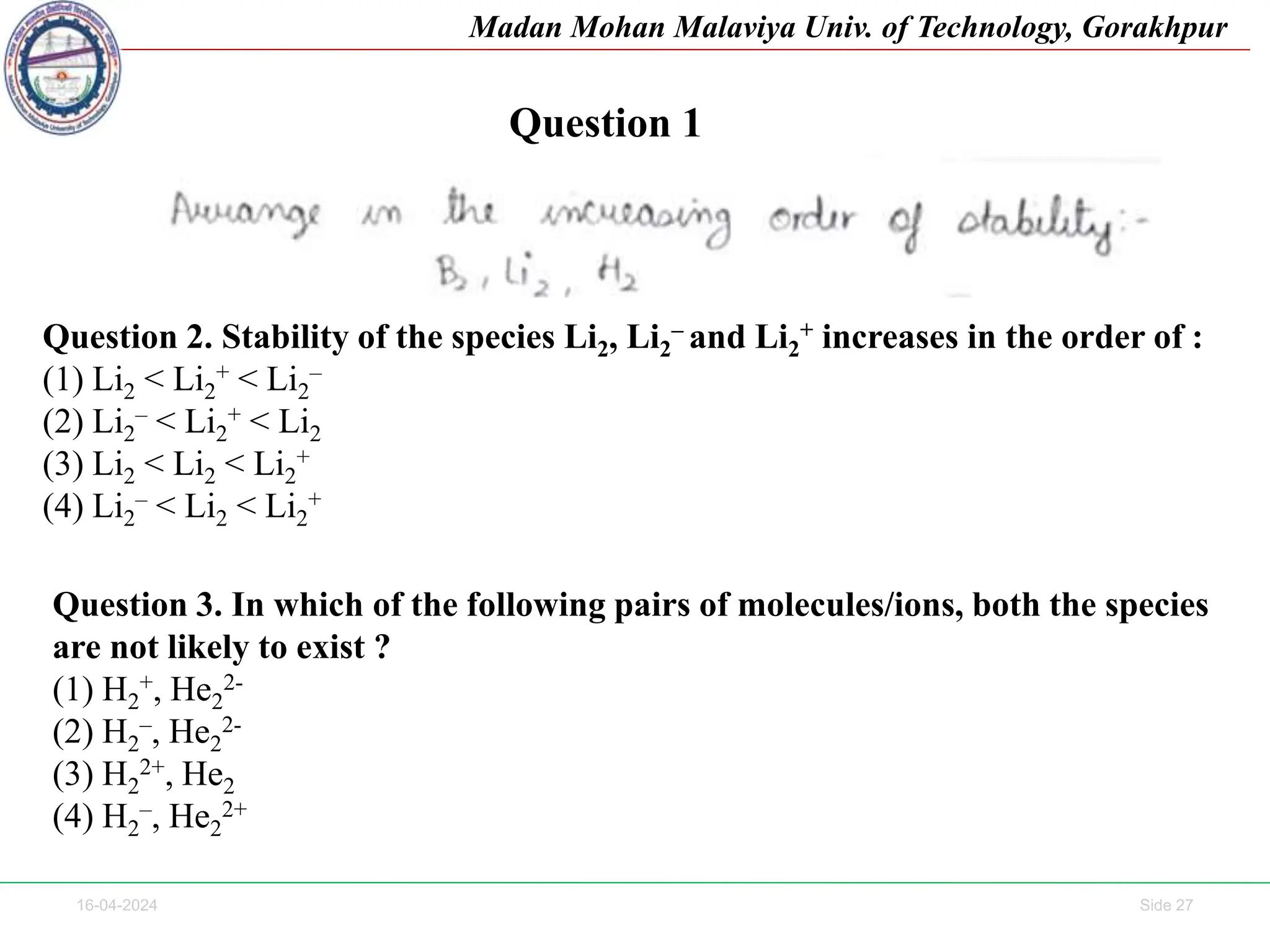
Question 1
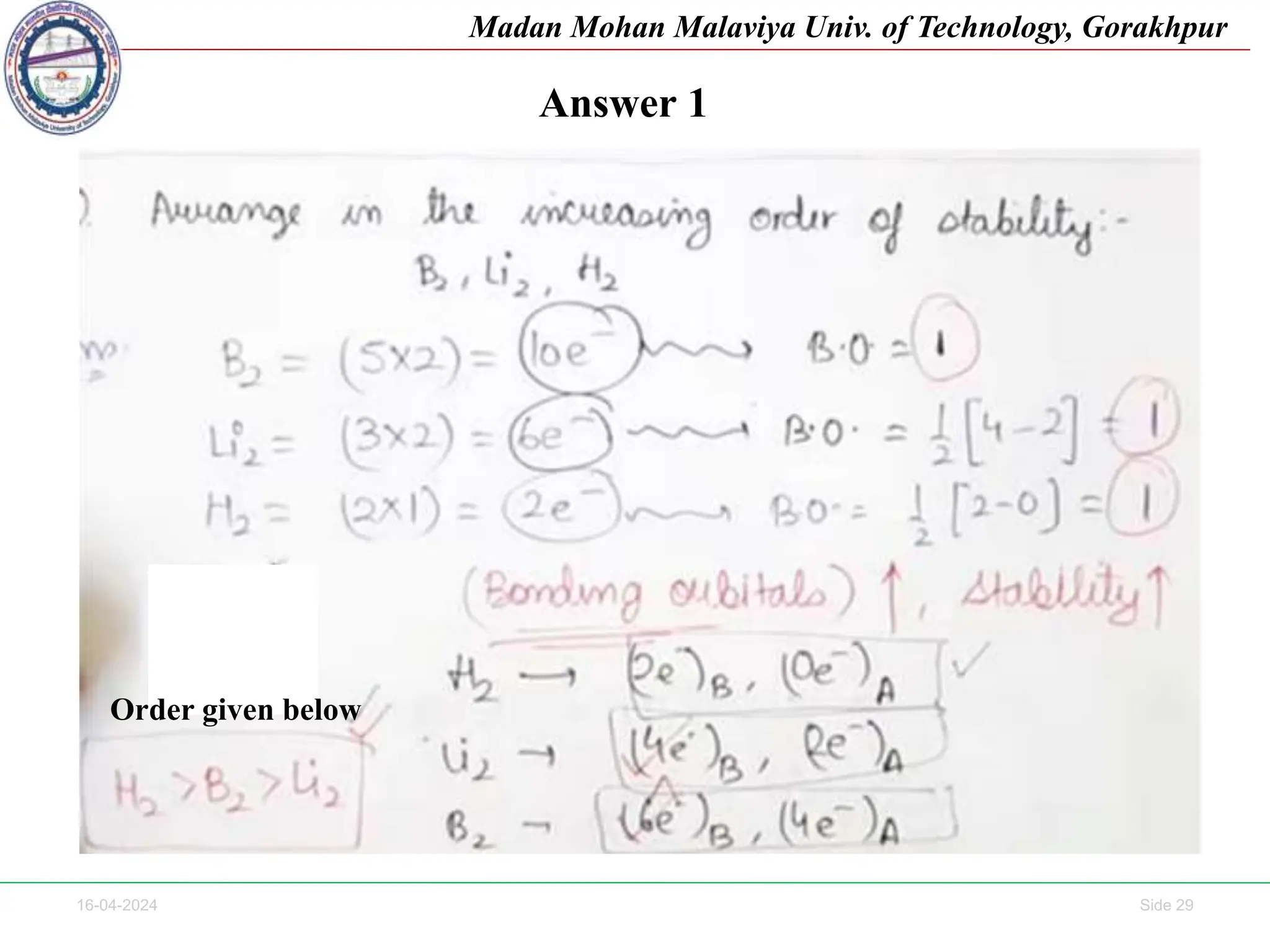
Question 2. Stability of the species Li2, Li2
– and Li2
+ increases in the order of :
(1) Li2 < Li2
+ < Li2
–
(2) Li2
– < Li2
+ < Li2
(3) Li2 < Li2 < Li2
+
(4) Li2
– < Li2 < Li2
+
Question 3. In which of the following pairs of molecules/ions, both the species
are not likely to exist ?
(1) H2
+, He2
2-
(2) H2
–, He2
2-
(3) H2
2+, He2
(4) H2
–, He2
2+
16-04-2024 Side 28
Madan Mohan Malaviya Univ. of Technology, Gorakhpur
Queston 4. In which of the following ionization processes the
bond energy has increased and also the magnetic behaviour has
changed from paramagnetic to diamagnetic?
(1) NO → NO+
(2) O2 → O2
+
(3) N2 → N2
+
(4) C2 → C2
+
Question 5. Which one of the following molecules is paramagnetic?
(1) NO
( 2) O3
(3) N2
(4) CO
16-04-2024 Side 29
Madan Mohan Malaviya Univ. of Technology, Gorakhpur
Order given below
Answer 1
16-04-2024 Side 30
Madan Mohan Malaviya Univ. of Technology, Gorakhpur
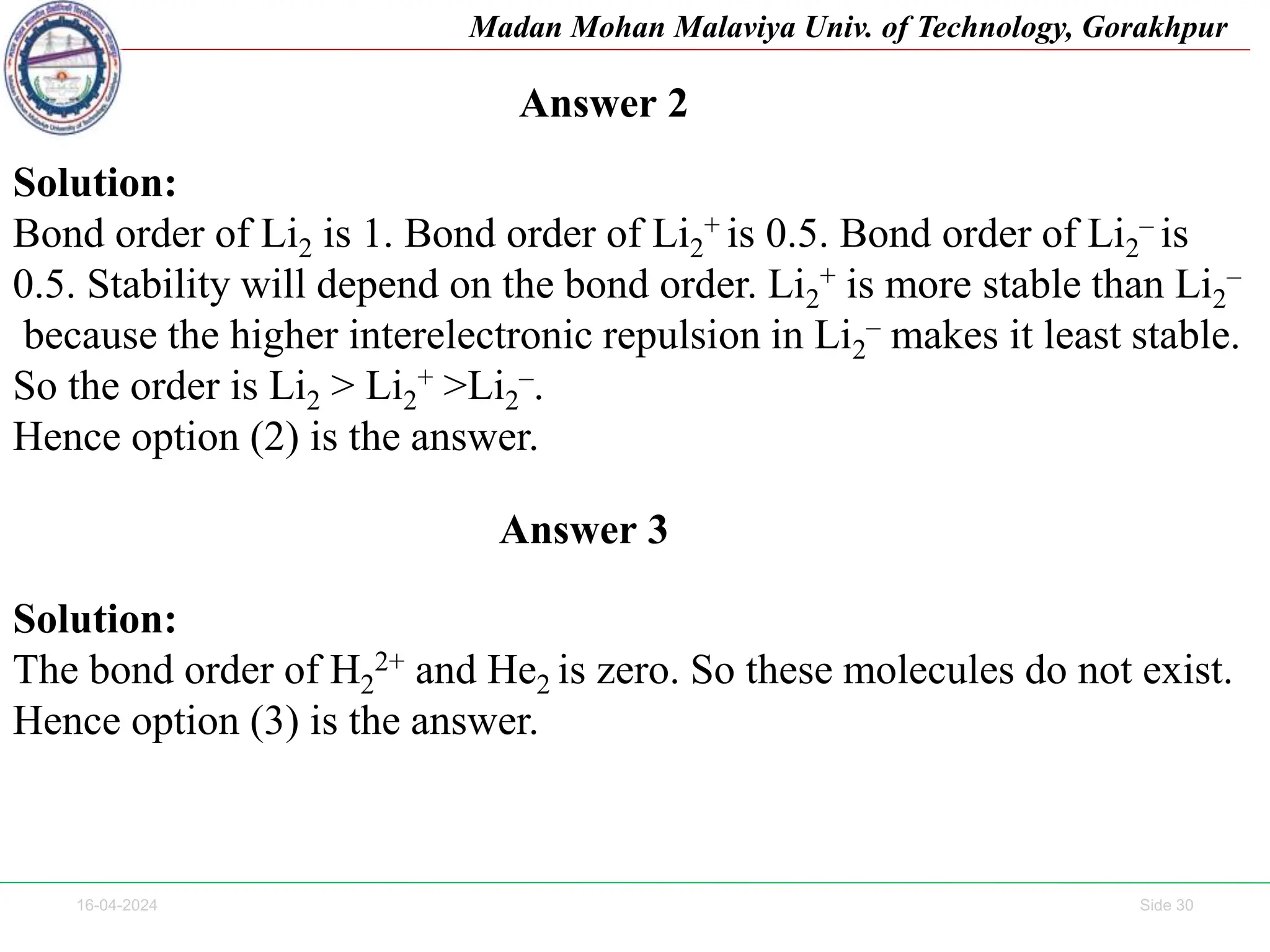
Solution:
Bond order of Li2 is 1. Bond order of Li2
+ is 0.5. Bond order of Li2
– is
0.5. Stability will depend on the bond order. Li2
+ is more stable than Li2
–
because the higher interelectronic repulsion in Li2
– makes it least stable.
So the order is Li2 > Li2
+ >Li2
–.
Hence option (2) is the answer.
Answer 2
Answer 3
Solution:
The bond order of H2
2+ and He2 is zero. So these molecules do not exist.
Hence option (3) is the answer.
16-04-2024 Side 31
Madan Mohan Malaviya Univ. of Technology, Gorakhpur
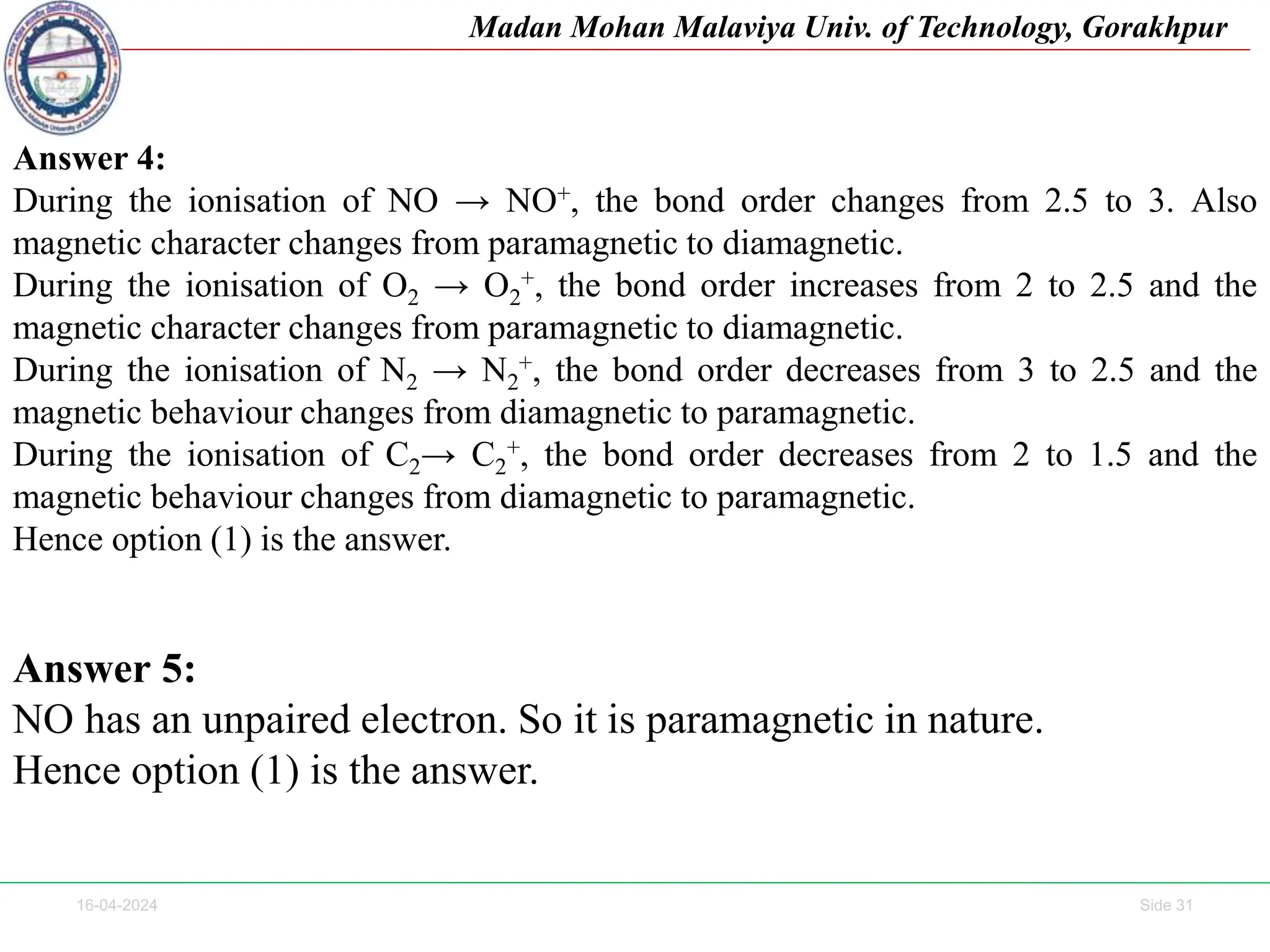
Answer 4:
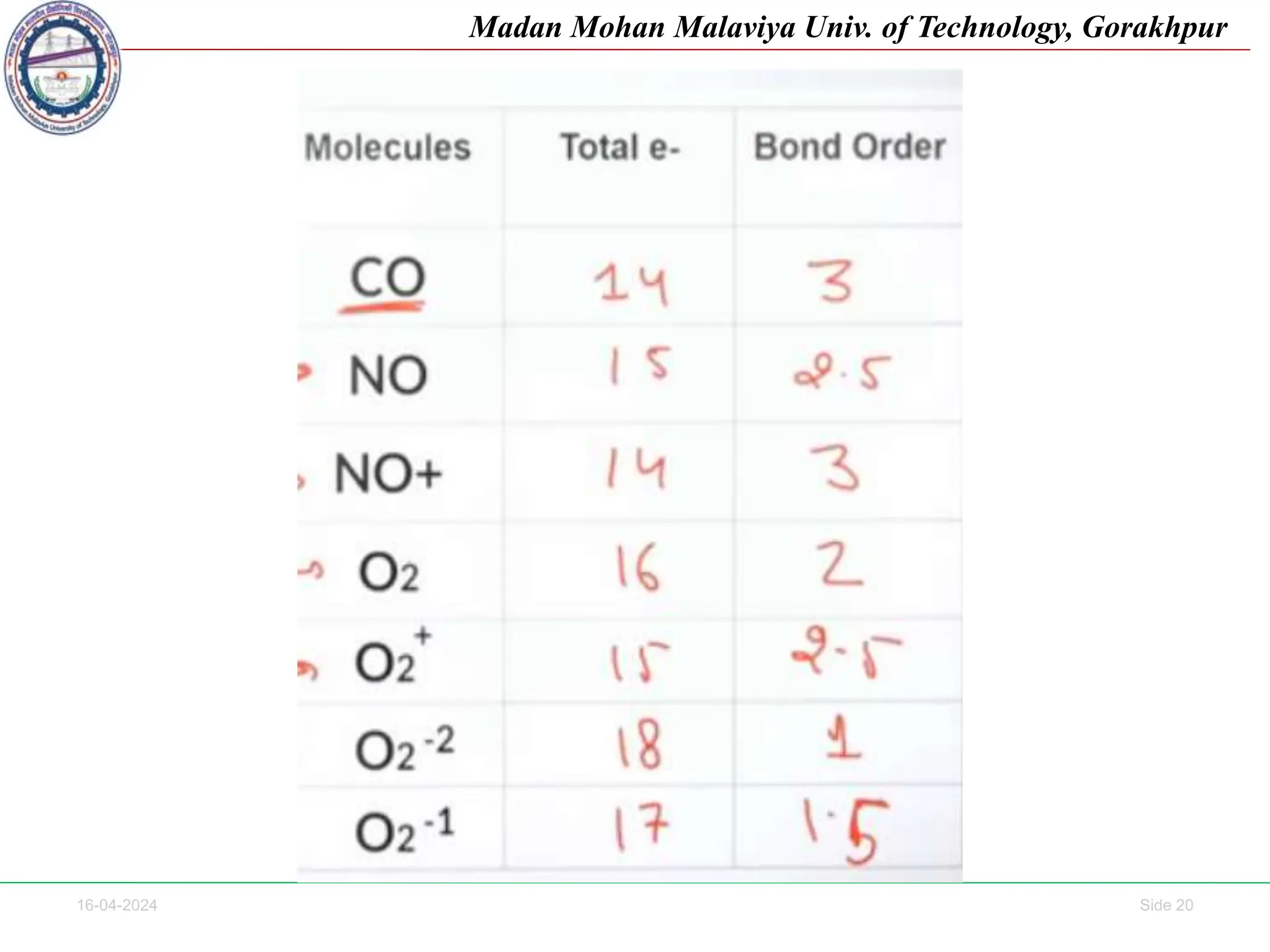
During the ionisation of NO → NO+, the bond order changes from 2.5 to 3. Also
magnetic character changes from paramagnetic to diamagnetic.
During the ionisation of O2 → O2
+, the bond order increases from 2 to 2.5 and the
magnetic character changes from paramagnetic to diamagnetic.
During the ionisation of N2 → N2
+, the bond order decreases from 3 to 2.5 and the
magnetic behaviour changes from diamagnetic to paramagnetic.
During the ionisation of C2→ C2
+, the bond order decreases from 2 to 1.5 and the
magnetic behaviour changes from diamagnetic to paramagnetic.
Hence option (1) is the answer.
Answer 5:
NO has an unpaired electron. So it is paramagnetic in nature.
Hence option (1) is the answer.

Chemistry 1 and 2 ,mot unit cell ppt.ppt

  • 1.
    16-04-2024 Side 1 MadanMohan Malaviya Univ. of Technology, Gorakhpur Molecular orbital theory, LCAO approximation, MO diagrams of diatomic molecules. Band theory of metallic bond, Hydrogen bonding, Structure of graphite and fullerene- C60, Liquid crystallite state, classification and applications of liquid crystals, Types of unit cell, space lattice (only cubes), Bragg’s Law, Calculation and density of the cubic unit cell, Phase Rule and its application to water system.
  • 2.
    16-04-2024 Side 2 MadanMohan Malaviya Univ. of Technology, Gorakhpur When two atoms are combine to form a molecule then each atoms of atomic orbitals combine to molecular orbitals. Molecular orbitals form when atomic orbitals with similar energies and proper symmetry can overlap. Orbitals are classified on the basis of energy. Molecular Orbital Bonding Antibonding
  • 3.
    16-04-2024 Side 3 MadanMohan Malaviya Univ. of Technology, Gorakhpur Bonding Molecular Orbitals: The orbital having lowest energy is called boding orbitals.  When addition of wave function takes place, the types of molecular orbital formed are called bonding molecular orbital and is represented by ѰMO = ѰA + ѰB Antibonding Molecular Orbitals: The orbital having high energy is called antiboding orbitals. When molecular orbital is formed by subtraction of wave function takes place, the types of molecular orbital formed are called antibonding molecular orbital and is represented by ѰMO = ѰA - ѰB
  • 4.
    16-04-2024 Side 4 MadanMohan Malaviya Univ. of Technology, Gorakhpur One of these orbitals is called a bonding molecular orbital because electrons in this orbital spend most of their time in the region directly between the two nuclei. It is called a sigma (σ ) molecular orbital because it looks like an s orbital when viewed along the H-H bond. Electrons placed in the other orbital spend most of their time away from the region between the two nuclei. This orbital is therefore an antibonding, or sigma star (σ*), molecular orbital.
  • 5.
    16-04-2024 Side 5 MadanMohan Malaviya Univ. of Technology, Gorakhpur The Linear combination of atomic orbitals which is also known as LCAO is an approximate method for representing molecular orbitals. It’s more of a superimposition method where constructive interference of two atomic wave function produces a bonding molecular orbital whereas destructive interference produces non- bonding molecular orbital. Constructive Destructive
  • 6.
    16-04-2024 Side 6 MadanMohan Malaviya Univ. of Technology, Gorakhpur Sigma (σ) and sigma-star (σ*) molecular orbitals are formed by the combination of two s atomic orbitals. The plus (+) signs indicate the locations of nuclei. There are two types of molecular orbitals that can form from the overlap of two atomic s orbitals on adjacent atoms. Bonding and antibonding orbitals.
  • 7.
    16-04-2024 Side 7 MadanMohan Malaviya Univ. of Technology, Gorakhpur Relationship between Electronic configuration and Molecular behaviour : 1.Bond order : It is defined as the number of covalent bonds between the two combining atoms of a molecule. Bond order = 0.5 (Nb – Na) Nb = number of bonding electrons or number of electrons in bonding M.O’s Na = number of antibonding electrons 2. Stability of molecule : It is determined by bond order. Higher is the bond order greater is the stability of molecule.
  • 8.
    16-04-2024 Side 8 MadanMohan Malaviya Univ. of Technology, Gorakhpur i) If Nb > Na, then molecule will be stable. ii) If Nb=Na, then formation of the molecule will not take place. iii) If Nb< Na, then molecule will be unstable. 3. Magnetic property : A molecule in which all the electrons are paired, is called diamagnetic while molecule which has one or more unpaired electron is called paramagnetic.
  • 9.
    16-04-2024 Side 9 MadanMohan Malaviya Univ. of Technology, Gorakhpur The bond order is calculated by subtracting the destabilizing (antibonding) electrons from the stabilizing (bonding) electrons. Since a bond consists of two electrons, we divide by two to get the bond order. We can determine bond order with the following equation:
  • 10.
    16-04-2024 Side 10 MadanMohan Malaviya Univ. of Technology, Gorakhpur Ex. Molecular orbital diagram of H2 and H2 - bond order = ½ (2 − 0) = 1 bond order = ½ (2 − 1) = 1/2
  • 11.
    16-04-2024 Side 11 MadanMohan Malaviya Univ. of Technology, Gorakhpur Molecular orbital diagram of He2 and He2 2+ bond order = ½ (2 − 2) = 0 bond order = ½ (2 − 0) = 1
  • 12.
    16-04-2024 Side 12 MadanMohan Malaviya Univ. of Technology, Gorakhpur Number of electrons > 14 σ1s < σ*1s<σ2s<σ*2s <σ2pz< π2px = π2py < π*2px = π*2py < σ*2pz
  • 13.
    16-04-2024 Side 13 MadanMohan Malaviya Univ. of Technology, Gorakhpur Number of electrons < or = 14, their energy increases in the following order: σ 1s< σ*1s<σ2s<σ*2s < π2px = π2py <σ2pz <π*2px = π*2py < σ*2pz
  • 14.
    16-04-2024 Side 14 MadanMohan Malaviya Univ. of Technology, Gorakhpur bond order = ½ (10− 8) = 1 Molecular orbital diagram of F2 1s 1s σ1s σ*1s
  • 15.
    16-04-2024 Side 15 MadanMohan Malaviya Univ. of Technology, Gorakhpur Molecular orbital diagram of O2 1s 1s σ*1s σ1s bond order = ½ (10− 6) = 2
  • 16.
    16-04-2024 Side 16 MadanMohan Malaviya Univ. of Technology, Gorakhpur Molecular orbital diagram of N2 1s 1s σ*1s σ1s bond order = ½ (10− 4) = 3
  • 17.
    16-04-2024 Side 17 MadanMohan Malaviya Univ. of Technology, Gorakhpur Relationship between Electronic configuration and Molecular behaviour : 1) Bond order : It is defined as the number of covalent bonds between the two combining atoms of a molecule. Bond order = 0.5 (Nb – Na) Nb = number of bonding electrons or number of electrons in bonding M.O’s Na = number of antibonding electrons Stability of molecule : It is determined by bond order. Higher is the bond order greater is the stability of molecule.
  • 18.
    16-04-2024 Side 18 MadanMohan Malaviya Univ. of Technology, Gorakhpur Trick
  • 19.
    16-04-2024 Side 19 MadanMohan Malaviya Univ. of Technology, Gorakhpur ? Number of electrons < or = 14, their energy increases in the following order: σ 1s< σ*1s<σ2s<σ*2s < π2px = π2py <σ2pz <π*2px = π*2py < σ*2pz Number of electrons > 14 σ1s < σ*1s<σ2s<σ*2s <σ2pz< π2px = π2py < π*2px = π*2py < σ*2pz
  • 20.
    16-04-2024 Side 20 MadanMohan Malaviya Univ. of Technology, Gorakhpur
  • 21.
    16-04-2024 Side 21 MadanMohan Malaviya Univ. of Technology, Gorakhpur Example :
  • 22.
    16-04-2024 Side 22 MadanMohan Malaviya Univ. of Technology, Gorakhpur Magnetic property : A molecule in which all the electrons are paired, is called diamagnetic while molecule which has one or more unpaired electron is called paramagnetic.
  • 23.
    16-04-2024 Side 23 MadanMohan Malaviya Univ. of Technology, Gorakhpur Number of electrons > 14 σ1s < σ*1s<σ2s<σ*2s <σ2pz< π2px = π2py < π*2px = π*2py < σ*2pz
  • 24.
    16-04-2024 Side 24 MadanMohan Malaviya Univ. of Technology, Gorakhpur
  • 25.
    16-04-2024 Side 25 MadanMohan Malaviya Univ. of Technology, Gorakhpur
  • 26.
    16-04-2024 Side 26 MadanMohan Malaviya Univ. of Technology, Gorakhpur
  • 27.
    16-04-2024 Side 27 MadanMohan Malaviya Univ. of Technology, Gorakhpur Question 1 Question 2. Stability of the species Li2, Li2 – and Li2 + increases in the order of : (1) Li2 < Li2 + < Li2 – (2) Li2 – < Li2 + < Li2 (3) Li2 < Li2 < Li2 + (4) Li2 – < Li2 < Li2 + Question 3. In which of the following pairs of molecules/ions, both the species are not likely to exist ? (1) H2 +, He2 2- (2) H2 –, He2 2- (3) H2 2+, He2 (4) H2 –, He2 2+
  • 28.
    16-04-2024 Side 28 MadanMohan Malaviya Univ. of Technology, Gorakhpur Queston 4. In which of the following ionization processes the bond energy has increased and also the magnetic behaviour has changed from paramagnetic to diamagnetic? (1) NO → NO+ (2) O2 → O2 + (3) N2 → N2 + (4) C2 → C2 + Question 5. Which one of the following molecules is paramagnetic? (1) NO ( 2) O3 (3) N2 (4) CO
  • 29.
    16-04-2024 Side 29 MadanMohan Malaviya Univ. of Technology, Gorakhpur Order given below Answer 1
  • 30.
    16-04-2024 Side 30 MadanMohan Malaviya Univ. of Technology, Gorakhpur Solution: Bond order of Li2 is 1. Bond order of Li2 + is 0.5. Bond order of Li2 – is 0.5. Stability will depend on the bond order. Li2 + is more stable than Li2 – because the higher interelectronic repulsion in Li2 – makes it least stable. So the order is Li2 > Li2 + >Li2 –. Hence option (2) is the answer. Answer 2 Answer 3 Solution: The bond order of H2 2+ and He2 is zero. So these molecules do not exist. Hence option (3) is the answer.
  • 31.
    16-04-2024 Side 31 MadanMohan Malaviya Univ. of Technology, Gorakhpur Answer 4: During the ionisation of NO → NO+, the bond order changes from 2.5 to 3. Also magnetic character changes from paramagnetic to diamagnetic. During the ionisation of O2 → O2 +, the bond order increases from 2 to 2.5 and the magnetic character changes from paramagnetic to diamagnetic. During the ionisation of N2 → N2 +, the bond order decreases from 3 to 2.5 and the magnetic behaviour changes from diamagnetic to paramagnetic. During the ionisation of C2→ C2 +, the bond order decreases from 2 to 1.5 and the magnetic behaviour changes from diamagnetic to paramagnetic. Hence option (1) is the answer. Answer 5: NO has an unpaired electron. So it is paramagnetic in nature. Hence option (1) is the answer.