• Incorrect: If I will visit London, I will meet you.
• Correct: If I visit London, I will meet you.
• Rule: Use simple present tense to refer to the future
after conjunctions like when, after, if, as soon as.
• Examples: I will talk to him when I see him in the next
two days.
• I will call you as soon as I arrive at the airport.
• If the plan succeeds, I will come.
1. Using If conditionals
• Incorrect: Every students is intelligent in the class.
• Correct: Every student is intelligent in the class.
• Rule : A Singular noun is used with every.
3. Every with (singular noun)/
Every with (plural noun)
• Incorrect: Although it was raining, but we went to
market.
• Correct: Although it was raining, we went to market.
• Rule : If the sentence starts with although, don't use
but with that.
• Examples : Although cell phones have many merits,
demerits cannot be overlooked.
• Although he was not well, he attended the function.
4. Using but and although
together
• Incorrect: What was you're answer?
• Correct: What was your answer?
• Rule : Your indicates possession that is something
belonging to you while “You’re” is a contraction
for “you are”.
• Examples : Where is your cell phone?
• You're responsible for this project.
5. Your/you’re
• Incorrect: Its Sunday morning.
• Correct: It's Sunday morning.
• Rule : “It's” is a contraction for it is.
• “Its” is a possessive pronoun for things.
• Examples : The floor looks great with its new mat.
• It's raining outside.
6. Its/it’s
• Incorrect: Smith and me went to the mall.
• Correct: Smith and I went to the mall.
• Rule : When talking about doing some activity
with someone else, use his/her name followed by I.
• Examples : My brother and I love ice cream.
• John and I are planning a trip.
7. Me/ I
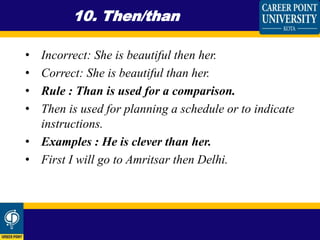
• Incorrect: She is beautiful then her.
• Correct: She is beautiful than her.
• Rule : Than is used for a comparison.
• Then is used for planning a schedule or to indicate
instructions.
• Examples : He is clever than her.
• First I will go to Amritsar then Delhi.
8. Then/than
• Incorrect: A greater amount of people are visiting
the stadium.
• Correct: A greater number of people are visiting the
stadium.
• Rule : Amount is used for uncountable
commodities.
• Number is used for countable things.
• Examples : A large amount of sand is needed for
the project.
9. Amount/number
• Incorrect: She is beautiful then her.
• Correct: She is beautiful than her.
• Rule : Than is used for a comparison.
• Then is used for planning a schedule or to indicate
instructions.
• Examples : He is clever than her.
• First I will go to Amritsar then Delhi.
10. Then/than
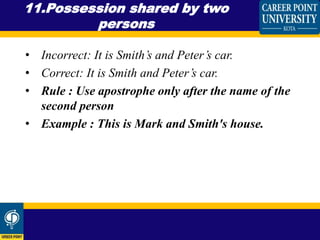
• Incorrect: It is Smith’s and Peter’s car.
• Correct: It is Smith and Peter’s car.
• Rule : Use apostrophe only after the name of the
second person
• Example : This is Mark and Smith's house.
11.Possession shared by two
persons
• Incorrect: Each of the cars are fast.
• Correct: Each of the cars is fast.
• Rule : Use singular verb (is) with indefinite
pronouns (such as each, none, neither)
• Example : Each of the students is fast.
• Neither of them is my classmate.
• One of my friends is obese.
12. Each is/ Each are
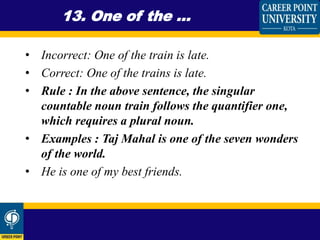
• Incorrect: One of the train is late.
• Correct: One of the trains is late.
• Rule : In the above sentence, the singular
countable noun train follows the quantifier one,
which requires a plural noun.
• Examples : Taj Mahal is one of the seven wonders
of the world.
• He is one of my best friends.
13. One of the ...
• Incorrect: The police is coming.
• Correct: The police are coming.
• Rule : Use plural form 'are' when referring to police in
general.
• The word police is an aggregate noun, a word
representing an indefinite number of parts; aggregate
nouns have a plural form.
• When referring to a single person or a specific
department, use singular 'is'.
• Examples : The police are blocking off the street where the
robbery occurred.
• The police department is at the corner of the Main street.
14. Police is / police are
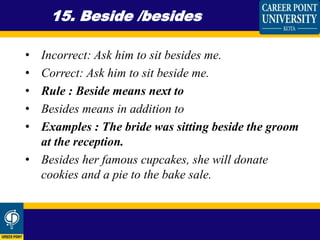
• Incorrect: Ask him to sit besides me.
• Correct: Ask him to sit beside me.
• Rule : Beside means next to
• Besides means in addition to
• Examples : The bride was sitting beside the groom
at the reception.
• Besides her famous cupcakes, she will donate
cookies and a pie to the bake sale.
15. Beside /besides
Most common grammar errors

Most common grammar errors

  • 2.
    • Incorrect: IfI will visit London, I will meet you. • Correct: If I visit London, I will meet you. • Rule: Use simple present tense to refer to the future after conjunctions like when, after, if, as soon as. • Examples: I will talk to him when I see him in the next two days. • I will call you as soon as I arrive at the airport. • If the plan succeeds, I will come. 1. Using If conditionals
  • 3.
    • Incorrect: Everystudents is intelligent in the class. • Correct: Every student is intelligent in the class. • Rule : A Singular noun is used with every. 3. Every with (singular noun)/ Every with (plural noun)
  • 4.
    • Incorrect: Althoughit was raining, but we went to market. • Correct: Although it was raining, we went to market. • Rule : If the sentence starts with although, don't use but with that. • Examples : Although cell phones have many merits, demerits cannot be overlooked. • Although he was not well, he attended the function. 4. Using but and although together
  • 5.
    • Incorrect: Whatwas you're answer? • Correct: What was your answer? • Rule : Your indicates possession that is something belonging to you while “You’re” is a contraction for “you are”. • Examples : Where is your cell phone? • You're responsible for this project. 5. Your/you’re
  • 6.
    • Incorrect: ItsSunday morning. • Correct: It's Sunday morning. • Rule : “It's” is a contraction for it is. • “Its” is a possessive pronoun for things. • Examples : The floor looks great with its new mat. • It's raining outside. 6. Its/it’s
  • 7.
    • Incorrect: Smithand me went to the mall. • Correct: Smith and I went to the mall. • Rule : When talking about doing some activity with someone else, use his/her name followed by I. • Examples : My brother and I love ice cream. • John and I are planning a trip. 7. Me/ I
  • 8.
    • Incorrect: Sheis beautiful then her. • Correct: She is beautiful than her. • Rule : Than is used for a comparison. • Then is used for planning a schedule or to indicate instructions. • Examples : He is clever than her. • First I will go to Amritsar then Delhi. 8. Then/than
  • 9.
    • Incorrect: Agreater amount of people are visiting the stadium. • Correct: A greater number of people are visiting the stadium. • Rule : Amount is used for uncountable commodities. • Number is used for countable things. • Examples : A large amount of sand is needed for the project. 9. Amount/number
  • 10.
    • Incorrect: Sheis beautiful then her. • Correct: She is beautiful than her. • Rule : Than is used for a comparison. • Then is used for planning a schedule or to indicate instructions. • Examples : He is clever than her. • First I will go to Amritsar then Delhi. 10. Then/than
  • 11.
    • Incorrect: Itis Smith’s and Peter’s car. • Correct: It is Smith and Peter’s car. • Rule : Use apostrophe only after the name of the second person • Example : This is Mark and Smith's house. 11.Possession shared by two persons
  • 12.
    • Incorrect: Eachof the cars are fast. • Correct: Each of the cars is fast. • Rule : Use singular verb (is) with indefinite pronouns (such as each, none, neither) • Example : Each of the students is fast. • Neither of them is my classmate. • One of my friends is obese. 12. Each is/ Each are
  • 13.
    • Incorrect: Oneof the train is late. • Correct: One of the trains is late. • Rule : In the above sentence, the singular countable noun train follows the quantifier one, which requires a plural noun. • Examples : Taj Mahal is one of the seven wonders of the world. • He is one of my best friends. 13. One of the ...
  • 14.
    • Incorrect: Thepolice is coming. • Correct: The police are coming. • Rule : Use plural form 'are' when referring to police in general. • The word police is an aggregate noun, a word representing an indefinite number of parts; aggregate nouns have a plural form. • When referring to a single person or a specific department, use singular 'is'. • Examples : The police are blocking off the street where the robbery occurred. • The police department is at the corner of the Main street. 14. Police is / police are
  • 15.
    • Incorrect: Askhim to sit besides me. • Correct: Ask him to sit beside me. • Rule : Beside means next to • Besides means in addition to • Examples : The bride was sitting beside the groom at the reception. • Besides her famous cupcakes, she will donate cookies and a pie to the bake sale. 15. Beside /besides