Dramatic monologue
a poem written in the form of a speech of an individual character; it compresses into a
single vivid scene a narrative sense of the speaker’s history and psychological insight into
his character.
refers to a type of poetry. These poems are dramatic in the sense that they have a
theatrical quality; that is, the poem is meant to be read to an audience. To say that the
poem is a monologue means that these are the words of one solitary speaker with no
dialogue coming from any other characters. One person standing alone on a stage
speaking to an audience.
A poem in which an imagined speaker addresses a silent listener, usually not the reader.
Examples include Robert Browning’s “My Last Duchess,” T.S. Eliot’s “The Love Song of J.
Alfred Prufrock,” and Ai’s “Killing Floor.”
https://www.britannica.com/art/ode-poetic-form
https://www.cliffsnotes.com/cliffsnotes/subjects/literature/what-is-a-dramatic-monologue
https://www.poetryfoundation.org/learn/glossary-terms/dramatic-monologue
Different types of monologues
Monologues can be either classical or contemporary; they can also be dramatic or comedic.
It’s helpful to be familiar with these terms as an actor, since you may be asked to prepare a
specific type of monologue for an audition.
Classical vs. contemporary monologues
Classical monologues are generally taken from works written before the 20th century, and
contemporary monologues are those from the 20th century onward
Dramatic vs. comedic monologues
Dramatic and comedic monologues are exactly what they suggest: dramatic monologues
tackle a serious, often emotionally challenging topic, whereas comedic monologues are
more humorous and lighthearted.
https://www.backstage.com/magazine/article/need-know-delivering-next-monologue-5067/
Preparing for Dramatic Monologue
1. If you get to select your monologue, choose one you really like.
2. Break down the monologue
3. Get memorization out of the way early
4. Record yourself performing the monologue, then watch the recording
5. Focus on your character and block everything else out
https://www.theatrefolk.com/blog/5-tips-for-preparing-a-monologue-with-confidence/
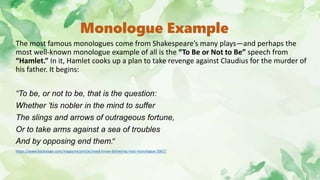
Monologue Example
The most famous monologues come from Shakespeare’s many plays—and perhaps the
most well-known monologue example of all is the “To Be or Not to Be” speech from
“Hamlet.” In it, Hamlet cooks up a plan to take revenge against Claudius for the murder of
his father. It begins:
“To be, or not to be, that is the question:
Whether ’tis nobler in the mind to suffer
The slings and arrows of outrageous fortune,
Or to take arms against a sea of troubles
And by opposing end them.”
https://www.backstage.com/magazine/article/need-know-delivering-next-monologue-5067/
Dramatic Monologue Example
https://www.youtube.com/wat
ch?v=IN8-XXXOj6M
ORATION
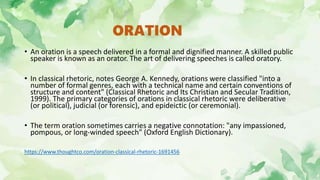
• An oration is a speech delivered in a formal and dignified manner. A skilled public
speaker is known as an orator. The art of delivering speeches is called oratory.
• In classical rhetoric, notes George A. Kennedy, orations were classified "into a
number of formal genres, each with a technical name and certain conventions of
structure and content" (Classical Rhetoric and Its Christian and Secular Tradition,
1999). The primary categories of orations in classical rhetoric were deliberative
(or political), judicial (or forensic), and epideictic (or ceremonial).
• The term oration sometimes carries a negative connotation: "any impassioned,
pompous, or long-winded speech" (Oxford English Dictionary).
https://www.thoughtco.com/oration-classical-rhetoric-1691456
Impressive examples of Oration
by famous orators.
1.Gandhi's "I Quit India" Speech
2.John F. Kennedy's inaugural address
3. Abraham Lincoln's Gettysburg Address
4. Martin Luther King's I Have a Dream Speech
5. Barack Obama's Key Note Speech
6. Bill Clinton's I Have Sinned Speech
7. Winston Churchill's We Shall Fight on the Beaches Speech
8. Margaret Thatcher's The Lady Not for Turning Speech
9. Tony Blaire's Address to Irish Parliament
https://examples.yourdictionary.com/examples-of-oration.html
How to be a better Orator
1.Be confident, no one wants to listen to a guy who is nervous or doesn't seem to believe what he's saying.
2.Believe what you're saying, if you don't no one will
3.Prepare your speech whenever possible, ahead of time, and read through it, out loud at least seven times before you
give it.
4.Create a stage persona, not to go crazy or dress weird, but it's best to act much differently on stage than you do in
private company, on stage you rule, everyone must listen to you, and you can be whoever you want.
5. Create a good appearance, dress nicely, keep yourself clean, and avoid outrageous hairstyles, makeup or facial hair.
6.Speak off of a deep breath, take in a deep breath, and then use it to begin speaking, project, don't shout, don't fire
your words like a cannon, rather lob them like a catapult.
7.Breathe, it's very important to breathe, if you don't get enough breath, you'll speed up, and even pass out
8.Make good eye contact, this takes three forms; direct, broad sweeping, and gazing into the distance.
9. Be careful with your posture, stand up straight, don't slouch, don't put your hands in your pockets, fidget, or
play with the lectern.
https://www.wikihow.com/Be-a-Better-Orator
Example of Oration
https://www.youtube.com/watch?v=tLsjFnGIRLI

dramatic-monologue-and-oration-remedial-reading.pptx

  • 2.
    Dramatic monologue a poemwritten in the form of a speech of an individual character; it compresses into a single vivid scene a narrative sense of the speaker’s history and psychological insight into his character. refers to a type of poetry. These poems are dramatic in the sense that they have a theatrical quality; that is, the poem is meant to be read to an audience. To say that the poem is a monologue means that these are the words of one solitary speaker with no dialogue coming from any other characters. One person standing alone on a stage speaking to an audience. A poem in which an imagined speaker addresses a silent listener, usually not the reader. Examples include Robert Browning’s “My Last Duchess,” T.S. Eliot’s “The Love Song of J. Alfred Prufrock,” and Ai’s “Killing Floor.” https://www.britannica.com/art/ode-poetic-form https://www.cliffsnotes.com/cliffsnotes/subjects/literature/what-is-a-dramatic-monologue https://www.poetryfoundation.org/learn/glossary-terms/dramatic-monologue
  • 3.
    Different types ofmonologues Monologues can be either classical or contemporary; they can also be dramatic or comedic. It’s helpful to be familiar with these terms as an actor, since you may be asked to prepare a specific type of monologue for an audition. Classical vs. contemporary monologues Classical monologues are generally taken from works written before the 20th century, and contemporary monologues are those from the 20th century onward Dramatic vs. comedic monologues Dramatic and comedic monologues are exactly what they suggest: dramatic monologues tackle a serious, often emotionally challenging topic, whereas comedic monologues are more humorous and lighthearted. https://www.backstage.com/magazine/article/need-know-delivering-next-monologue-5067/
  • 4.
    Preparing for DramaticMonologue 1. If you get to select your monologue, choose one you really like. 2. Break down the monologue 3. Get memorization out of the way early 4. Record yourself performing the monologue, then watch the recording 5. Focus on your character and block everything else out https://www.theatrefolk.com/blog/5-tips-for-preparing-a-monologue-with-confidence/
  • 5.
    Monologue Example The mostfamous monologues come from Shakespeare’s many plays—and perhaps the most well-known monologue example of all is the “To Be or Not to Be” speech from “Hamlet.” In it, Hamlet cooks up a plan to take revenge against Claudius for the murder of his father. It begins: “To be, or not to be, that is the question: Whether ’tis nobler in the mind to suffer The slings and arrows of outrageous fortune, Or to take arms against a sea of troubles And by opposing end them.” https://www.backstage.com/magazine/article/need-know-delivering-next-monologue-5067/
  • 7.
  • 8.
    ORATION • An orationis a speech delivered in a formal and dignified manner. A skilled public speaker is known as an orator. The art of delivering speeches is called oratory. • In classical rhetoric, notes George A. Kennedy, orations were classified "into a number of formal genres, each with a technical name and certain conventions of structure and content" (Classical Rhetoric and Its Christian and Secular Tradition, 1999). The primary categories of orations in classical rhetoric were deliberative (or political), judicial (or forensic), and epideictic (or ceremonial). • The term oration sometimes carries a negative connotation: "any impassioned, pompous, or long-winded speech" (Oxford English Dictionary). https://www.thoughtco.com/oration-classical-rhetoric-1691456
  • 9.
    Impressive examples ofOration by famous orators. 1.Gandhi's "I Quit India" Speech 2.John F. Kennedy's inaugural address 3. Abraham Lincoln's Gettysburg Address 4. Martin Luther King's I Have a Dream Speech 5. Barack Obama's Key Note Speech 6. Bill Clinton's I Have Sinned Speech 7. Winston Churchill's We Shall Fight on the Beaches Speech 8. Margaret Thatcher's The Lady Not for Turning Speech 9. Tony Blaire's Address to Irish Parliament https://examples.yourdictionary.com/examples-of-oration.html
  • 10.
    How to bea better Orator 1.Be confident, no one wants to listen to a guy who is nervous or doesn't seem to believe what he's saying. 2.Believe what you're saying, if you don't no one will 3.Prepare your speech whenever possible, ahead of time, and read through it, out loud at least seven times before you give it. 4.Create a stage persona, not to go crazy or dress weird, but it's best to act much differently on stage than you do in private company, on stage you rule, everyone must listen to you, and you can be whoever you want. 5. Create a good appearance, dress nicely, keep yourself clean, and avoid outrageous hairstyles, makeup or facial hair. 6.Speak off of a deep breath, take in a deep breath, and then use it to begin speaking, project, don't shout, don't fire your words like a cannon, rather lob them like a catapult. 7.Breathe, it's very important to breathe, if you don't get enough breath, you'll speed up, and even pass out 8.Make good eye contact, this takes three forms; direct, broad sweeping, and gazing into the distance. 9. Be careful with your posture, stand up straight, don't slouch, don't put your hands in your pockets, fidget, or play with the lectern. https://www.wikihow.com/Be-a-Better-Orator
  • 12.