Morning Report
Aalap Shah, MD
Jue Wang, MD
6.28.2016
11
(61%)
4
(22%)
3
(17%)
# Procedures
I
II
III
ASA
Cases by ASA Classification
Cases by Surgical Service
10
(56%)5
(28%)
1 (5%)
1
(5%)
1
(6%)
# Procedures
GS
Ortho
OMFS
ORL
Onc
0
2
4
6
8
10
12
GS Ortho OMFS ORL Onc
III
II
I
ASA
Cases by Surgical Service and ASA
Cases by Patient Age
0
1
2
3
4
5
6
7
8
9
0-1 mon 1-12 mon 1-2 year 3-11 year 12-17 yr 18+ yr
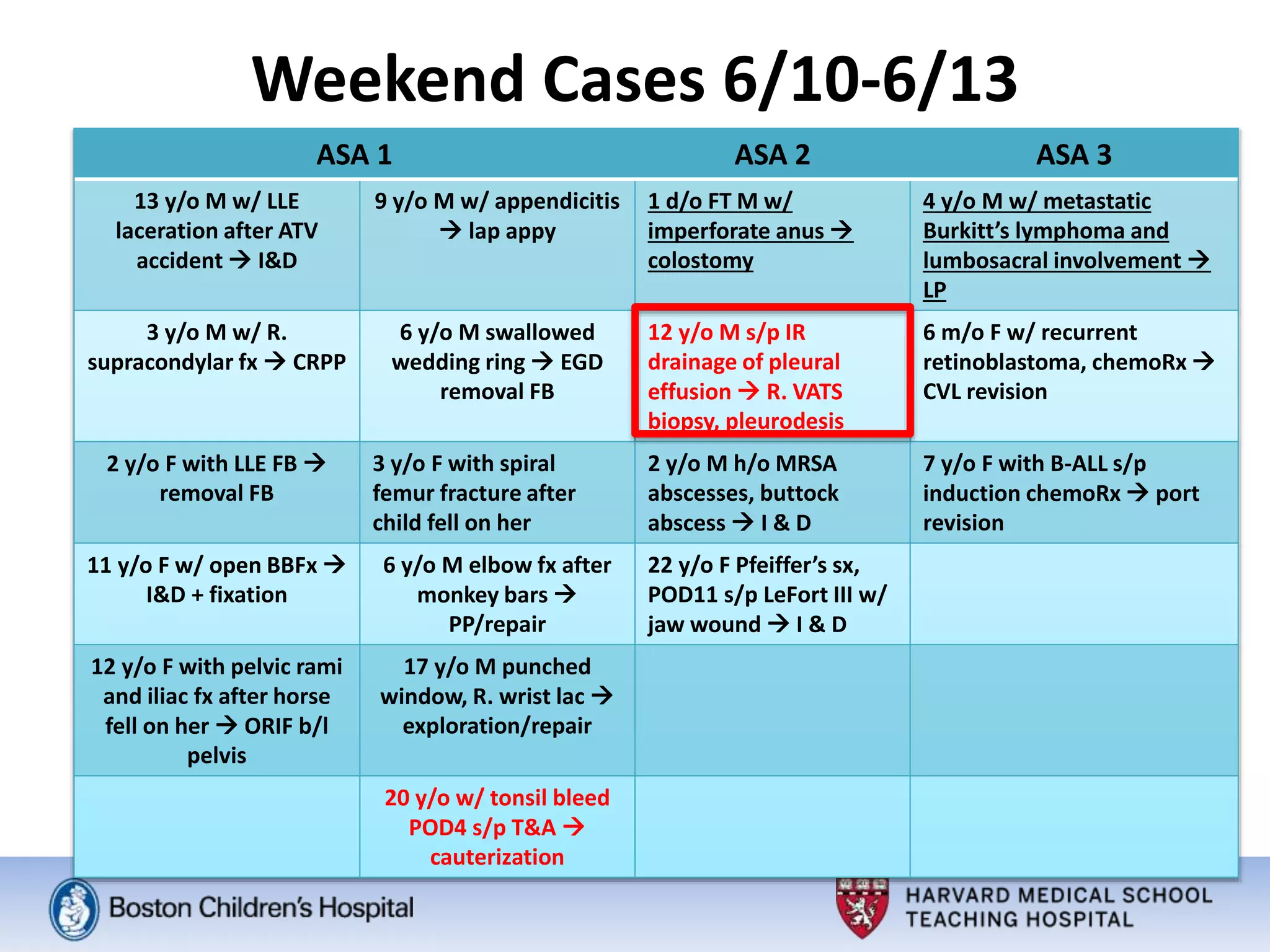
Weekend Cases 6/10-6/13
ASA 1 ASA 2 ASA 3
13 y/o M w/ LLE
laceration after ATV
accident  I&D
9 y/o M w/ appendicitis
 lap appy
1 d/o FT M w/
imperforate anus 
colostomy
4 y/o M w/ metastatic
Burkitt’s lymphoma and
lumbosacral involvement 
LP
3 y/o M w/ R.
supracondylar fx  CRPP
6 y/o M swallowed
wedding ring  EGD
removal FB
12 y/o M s/p IR
drainage of pleural
effusion  R. VATS
biopsy, pleurodesis
6 m/o F w/ recurrent
retinoblastoma, chemoRx 
CVL revision
2 y/o F with LLE FB 
removal FB
3 y/o F with spiral
femur fracture after
child fell on her
2 y/o M h/o MRSA
abscesses, buttock
abscess  I & D
7 y/o F with B-ALL s/p
induction chemoRx  port
revision
11 y/o F w/ open BBFx 
I&D + fixation
6 y/o M elbow fx after
monkey bars 
PP/repair
22 y/o F Pfeiffer’s sx,
POD11 s/p LeFort III w/
jaw wound  I & D
12 y/o F with pelvic rami
and iliac fx after horse
fell on her  ORIF b/l
pelvis
17 y/o M punched
window, R. wrist lac 
exploration/repair
20 y/o w/ tonsil bleed
POD4 s/p T&A 
cauterization
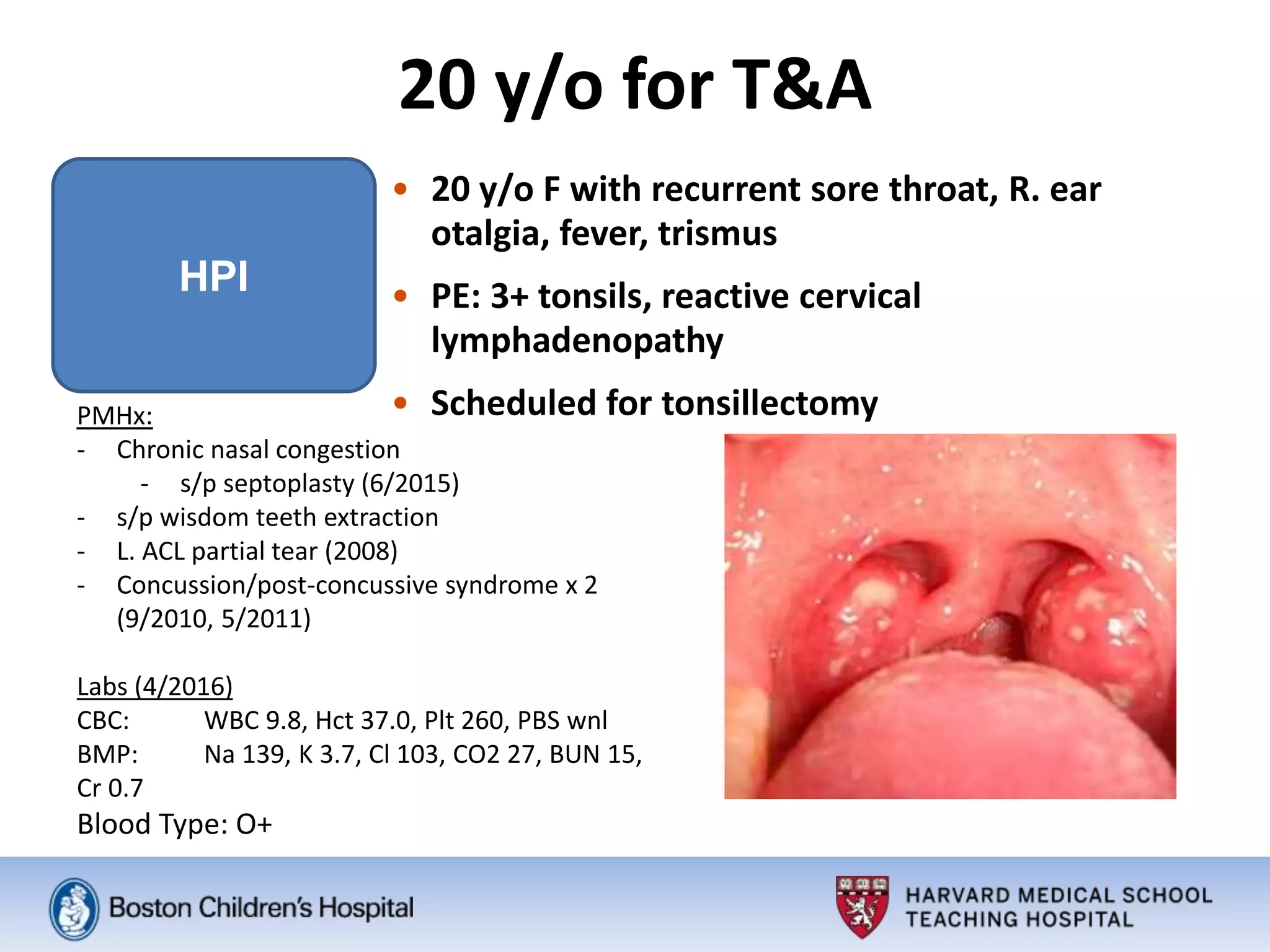
20 y/o for T&A
HPI
• 20 y/o F with recurrent sore throat, R. ear
otalgia, fever, trismus
• PE: 3+ tonsils, reactive cervical
lymphadenopathy
• Scheduled for tonsillectomyPMHx:
- Chronic nasal congestion
- s/p septoplasty (6/2015)
- s/p wisdom teeth extraction
- L. ACL partial tear (2008)
- Concussion/post-concussive syndrome x 2
(9/2010, 5/2011)
Labs (4/2016)
CBC: WBC 9.8, Hct 37.0, Plt 260, PBS wnl
BMP: Na 139, K 3.7, Cl 103, CO2 27, BUN 15,
Cr 0.7
Blood Type: O+
20 y/o for T&A
• Indications for tonsillectomy?
– Sleep-disordered breathing and sleep apnea
• Tonsillar hypertrophy (age 3-6); involution after age 8
• Children with sleep apnea benefit from tonsillectomy, although decreased
efficacy with obesity
– Severe recurrent sore throats
• Cochrane Review 11/2014: 3 vs 3.6 episodes/year (decrease in 0.6/year)
• Recurrent strep infection despite abx
– Various other relative indications (ex, Peritonsillar cellulitis/abscess, dental
malocclusion, hemorrhagic tonsillitis, prevention of secondary rheumatic fever)
• Comorbid conditions with long-standing disease?
– Pulmonary Hypertension, cor pulmonale
– OSA and “adult” comorbidities : DM, HTN, stroke
• How would you induce this patient?
20 y/o - Anesthetic Plan?
• Pre-med: Midazolam
• Airway: 7.0 cETT, Mac 3, Gr 1 view
• Monitors: ASA Standard
• Induction: Propofol/Lidocaine/Fentanyl
• Analgesia: Acetaminophen
• Anti-emetics: Dexamethasone / Ondansetron
NSAIDs also work
• IV Fluids: LR 900cc
• Discharge Rx: Acetaminophen, Oxycodone
20 y/o - Anesthetic Plan?
T&A POD 5…
•  BCH ED after spitting up ~1.5 tbsp. of BRB
while taking PO
• To OR for Tonsillar cauterization
– Labs? Hydration? IV?
• WBC 9.8, Hct 37.0, Plt 260, PBS wnl
– Findings: bleeding from R. tonsillar fossa; b/l inferior
poles, EBL “minimal”
T&A POD 5…
• What are some common complications?
• Does age or time course of bleeding matter?
• How will you induce her now?
– RSI, Propofol/Succinylcholine
Cauterization POD 5…
Tonsillectomy: Management Pearls
• Children who undergo the procedure for OSA are at particularly high risk
of significant respiratory complications in the postoperative period
• Complications:
– Pre-: Turbulent flow with anxiety/rapid breathing
– Induction: Laryngospasm (↑ incidence vs. general population)
– Intra: secretions, laryngospasm with extubation
– Post: PONV, hypopnea, bleeding*
• Who should be observed overnight?
– Pts. With OSA or evidence of RH dysfunction
The airway is shared between the anesthesiologist and the surgeon and
must be protected from blood and secretions.
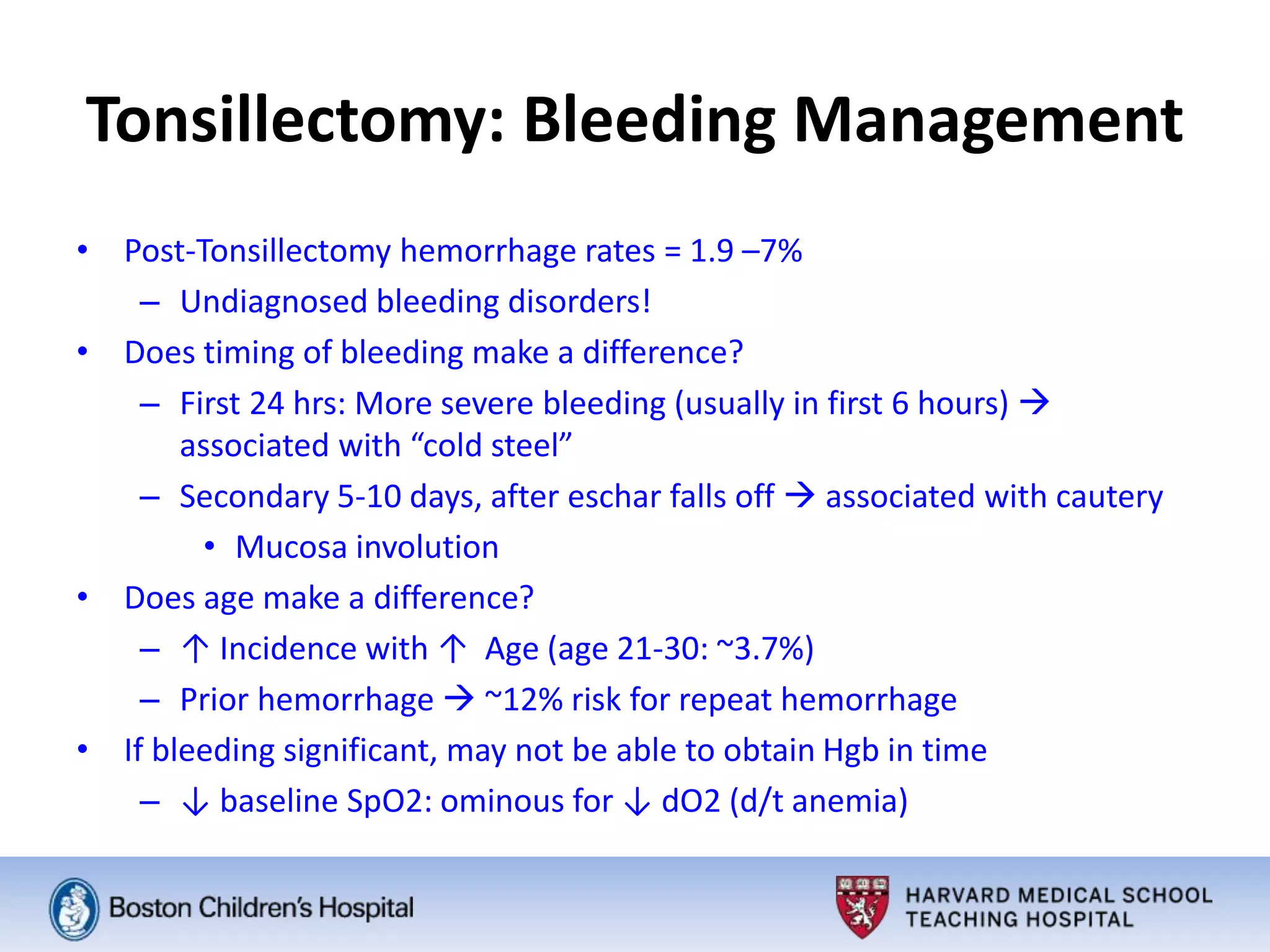
Tonsillectomy: Bleeding Management
• Post-Tonsillectomy hemorrhage rates = 1.9 –7%
– Undiagnosed bleeding disorders!
• Does timing of bleeding make a difference?
– First 24 hrs: More severe bleeding (usually in first 6 hours) 
associated with “cold steel”
– Secondary 5-10 days, after eschar falls off  associated with cautery
• Mucosa involution
• Does age make a difference?
– ↑ Incidence with ↑ Age (age 21-30: ~3.7%)
– Prior hemorrhage  ~12% risk for repeat hemorrhage
• If bleeding significant, may not be able to obtain Hgb in time
– ↓ baseline SpO2: ominous for ↓ dO2 (d/t anemia)
ASA 1 ASA 2 ASA 3
13 y/o M w/ LLE
laceration after ATV
accident  I&D
9 y/o M w/ appendicitis
 lap appy
1 d/o FT M w/
imperforate anus 
colostomy
4 y/o M w/ metastatic
Burkitt’s lymphoma and
lumbosacral involvement 
LP
3 y/o M w/ R.
supracondylar fx  CRPP
6 y/o M swallowed
wedding ring  EGD
removal FB
12 y/o M s/p IR
drainage of pleural
effusion  R. VATS
biopsy, pleurodesis
6 m/o F w/ recurrent
retinoblastoma, chemoRx 
CVL revision
2 y/o F with LLE FB 
removal FB
3 y/o F with spiral
femur fracture after
child fell on her
2 y/o M h/o MRSA
abscesses, buttock
abscess  I & D
7 y/o F with B-ALL s/p
induction chemoRx  port
revision
11 y/o F w/ open BBFx 
I&D + fixation
6 y/o M elbow fx after
monkey bars 
PP/repair
22 y/o F Pfeiffer’s sx,
POD11 s/p LeFort III w/
jaw wound  I & D
12 y/o F with pelvic rami
and iliac fx after horse
fell on her  ORIF b/l
pelvis
17 y/o M punched
window, R. wrist lac 
exploration/repair
20 y/o w/ tonsil bleed
POD4 s/p T&A 
cauterization
Weekend Cases 6/10-6/13
12 y/o M for VATS biopsy
HPI
• P/w fever, cough, myalgias, congestion, nausea,
vomiting, sore throat, intermittent H/A
• Dx PNA 3 months ago with mild R. pleural effusion
• Treated with CTX  complete resolution (per CXR)
PMHx: Born at at 31wks, 2-wks in NICU intubated; Otherwise Healthy
SocHx: From Sudan, travelling through Istanbul to US
PE: Lethargic
- CBC: [6/2]: WBC 5.5, Hct 36, PLT 455; ESR 62, CRP 10, LDH 176  264
- CXR [6/2]: RML/RLL consolidation + R. effusion: c/fPNA + parapneumonic effusion
- CT [6/2]: R. pleural effusion with pleural thickening,
mediastinal + hilar LN: c/f empyema
- Nl ECHO, respiratory cultures, ANA, pleural fluid flow cytometry and various bacterial/fungal cx
 Received CG in Sudan, started on Vancomycin/ceftriaxone at BCH
- To IR 6/3: PICC, 10Fr pigtail CT  825 ml serous straw-colored fluid (+400cc up to 6/10)
- Negative induced sputum AFB x 3, but persistent fevers…
- 6/8: Positive Tspot and slightly elevated ADA (suggestive of isolated TB effusion)  VATS
12 y/o M for VATS biopsy
• How will you induce this patient and secure airway?
• What are the absolute indications for single/one-lung
ventilation? How can you achieve it?
– Protection (Blood/Pus/need for lavage)
– Vt mismatch (BP/BPCF, ominous bullae, bronchial
disruption)
– VATS
• In addition to ASA standard monitors, what else would
you like to look at?
– Spirometry
– Reliable Pulse oximeter!!!
– ART (Measure PO2(A-a) gradient)
OLV - Approach
• Age < 8 yrs
– Mainstem intubation +/- FOB, active/passive ipsilateral decompression
• PRO: Single airway maneuver
• CON: Cannot apply CPAP to nondependent lung; must withdraw tube for TLV
– Bronchial Blocker (individual, coaxial)
• PRO: ETT in situ
• CON: No passive oxygenation to dependent lung, inexperience
• Age > 8 (26+ F)
• Robertshaw tubes (DL ETT)
– PRO: Seals/protects lung (suppurative pus), passive oxygenation and application of PEEP
to dependent lung
– CON: Decreased airway diameter  SLETT exchange for ICU, balloon herniation,
inexperience, size
DLETT Placement: OpenAnesthesia.org
12 y/o - Anesthetic Plan?
Pre-med: IV Midazolam
Airway: 6.5 cETT, Mac 3, Gr 1 view 
EZ Blocker (41 min)
Monitors: ASA Standard
Induction: IV Propofol/Fentanyl
Analgesia: IV Morphine/Ketorolac
Anti-emetics: IV Dexamethasone/Ondansetron
IV Fluids: LR 300cc
12 y/o - Anesthetic Plan
OLV - Hypoxemia
• What are your SpO2 goals for this patient?
– What happens to PaO2 with OLV? For how long does
this last?
• What are some predictors of hypoxemia?
• What do you do?
– FOB
– CPAP 10mmHg (at what lung volume? Contraindications?)
– PEEP (dependent lung)
– Pause surgery/OLV
– Compress/clamp ipsilateral PA
OLV Hypoxemia - Pearls
• Incidence of hypoxemia (with FiO2 1.0):
– 1950s 20%, 1980s 10%, Today 1%
• V/Q mismatch + shunt (↑ with open chest)
• Prediction of Hypoxemia:
– Hypoxemia (increased A-a pO2 gradient) during TLV
– R > L (higher paO2 in PV return from L side)
– GOOD spirometric PFTs
• Don’t have auto-PEEP
– Baseline restrictive lung disease or severe COPD
• Avoid aggressive hyperventilation
– ↓CO2 Inhibits beneficial hypoxic pulmonary vasoconstriction
in ipsi lung
– Increased alveolar pressures ↓ PBF in dependent lung
OLV Hypoxemia – Infants
1. Easily compressible rib cage  promotes atelectasis of the
dependent (ventilated) lung
2. ↓ hydrostatic pressure gradient between the dependent and
nondependent lungs  expected increase in dependent PBF is
diminished
3. ↓ abdominal hydrostatic pressure gradient  ↓ functional
advantage of dependent diaphragm
4. ↑ VO2
OLV Hypoxemia - Algorithm
Thank You!
• Jue Wang, MD
• Thomas Mancuso, MD [Course Director]
• Carlos Munoz-San Julian, MD; Izabela Leahy,
RN BSN MS [Course Planners]

Post-Tonsillectomy Bleed and One-Lung Ventilation - Anesthetic Management

  • 1.
    Morning Report Aalap Shah,MD Jue Wang, MD 6.28.2016
  • 2.
  • 3.
    Cases by SurgicalService 10 (56%)5 (28%) 1 (5%) 1 (5%) 1 (6%) # Procedures GS Ortho OMFS ORL Onc
  • 4.
    0 2 4 6 8 10 12 GS Ortho OMFSORL Onc III II I ASA Cases by Surgical Service and ASA
  • 5.
    Cases by PatientAge 0 1 2 3 4 5 6 7 8 9 0-1 mon 1-12 mon 1-2 year 3-11 year 12-17 yr 18+ yr
  • 6.
    Weekend Cases 6/10-6/13 ASA1 ASA 2 ASA 3 13 y/o M w/ LLE laceration after ATV accident  I&D 9 y/o M w/ appendicitis  lap appy 1 d/o FT M w/ imperforate anus  colostomy 4 y/o M w/ metastatic Burkitt’s lymphoma and lumbosacral involvement  LP 3 y/o M w/ R. supracondylar fx  CRPP 6 y/o M swallowed wedding ring  EGD removal FB 12 y/o M s/p IR drainage of pleural effusion  R. VATS biopsy, pleurodesis 6 m/o F w/ recurrent retinoblastoma, chemoRx  CVL revision 2 y/o F with LLE FB  removal FB 3 y/o F with spiral femur fracture after child fell on her 2 y/o M h/o MRSA abscesses, buttock abscess  I & D 7 y/o F with B-ALL s/p induction chemoRx  port revision 11 y/o F w/ open BBFx  I&D + fixation 6 y/o M elbow fx after monkey bars  PP/repair 22 y/o F Pfeiffer’s sx, POD11 s/p LeFort III w/ jaw wound  I & D 12 y/o F with pelvic rami and iliac fx after horse fell on her  ORIF b/l pelvis 17 y/o M punched window, R. wrist lac  exploration/repair 20 y/o w/ tonsil bleed POD4 s/p T&A  cauterization
  • 7.
    20 y/o forT&A HPI • 20 y/o F with recurrent sore throat, R. ear otalgia, fever, trismus • PE: 3+ tonsils, reactive cervical lymphadenopathy • Scheduled for tonsillectomyPMHx: - Chronic nasal congestion - s/p septoplasty (6/2015) - s/p wisdom teeth extraction - L. ACL partial tear (2008) - Concussion/post-concussive syndrome x 2 (9/2010, 5/2011) Labs (4/2016) CBC: WBC 9.8, Hct 37.0, Plt 260, PBS wnl BMP: Na 139, K 3.7, Cl 103, CO2 27, BUN 15, Cr 0.7 Blood Type: O+
  • 8.
    20 y/o forT&A • Indications for tonsillectomy? – Sleep-disordered breathing and sleep apnea • Tonsillar hypertrophy (age 3-6); involution after age 8 • Children with sleep apnea benefit from tonsillectomy, although decreased efficacy with obesity – Severe recurrent sore throats • Cochrane Review 11/2014: 3 vs 3.6 episodes/year (decrease in 0.6/year) • Recurrent strep infection despite abx – Various other relative indications (ex, Peritonsillar cellulitis/abscess, dental malocclusion, hemorrhagic tonsillitis, prevention of secondary rheumatic fever) • Comorbid conditions with long-standing disease? – Pulmonary Hypertension, cor pulmonale – OSA and “adult” comorbidities : DM, HTN, stroke • How would you induce this patient?
  • 9.
    20 y/o -Anesthetic Plan? • Pre-med: Midazolam • Airway: 7.0 cETT, Mac 3, Gr 1 view • Monitors: ASA Standard • Induction: Propofol/Lidocaine/Fentanyl • Analgesia: Acetaminophen • Anti-emetics: Dexamethasone / Ondansetron NSAIDs also work • IV Fluids: LR 900cc • Discharge Rx: Acetaminophen, Oxycodone
  • 10.
    20 y/o -Anesthetic Plan?
  • 11.
    T&A POD 5… • BCH ED after spitting up ~1.5 tbsp. of BRB while taking PO • To OR for Tonsillar cauterization – Labs? Hydration? IV? • WBC 9.8, Hct 37.0, Plt 260, PBS wnl – Findings: bleeding from R. tonsillar fossa; b/l inferior poles, EBL “minimal”
  • 12.
    T&A POD 5… •What are some common complications? • Does age or time course of bleeding matter? • How will you induce her now? – RSI, Propofol/Succinylcholine
  • 13.
  • 14.
    Tonsillectomy: Management Pearls •Children who undergo the procedure for OSA are at particularly high risk of significant respiratory complications in the postoperative period • Complications: – Pre-: Turbulent flow with anxiety/rapid breathing – Induction: Laryngospasm (↑ incidence vs. general population) – Intra: secretions, laryngospasm with extubation – Post: PONV, hypopnea, bleeding* • Who should be observed overnight? – Pts. With OSA or evidence of RH dysfunction The airway is shared between the anesthesiologist and the surgeon and must be protected from blood and secretions.
  • 15.
    Tonsillectomy: Bleeding Management •Post-Tonsillectomy hemorrhage rates = 1.9 –7% – Undiagnosed bleeding disorders! • Does timing of bleeding make a difference? – First 24 hrs: More severe bleeding (usually in first 6 hours)  associated with “cold steel” – Secondary 5-10 days, after eschar falls off  associated with cautery • Mucosa involution • Does age make a difference? – ↑ Incidence with ↑ Age (age 21-30: ~3.7%) – Prior hemorrhage  ~12% risk for repeat hemorrhage • If bleeding significant, may not be able to obtain Hgb in time – ↓ baseline SpO2: ominous for ↓ dO2 (d/t anemia)
  • 16.
    ASA 1 ASA2 ASA 3 13 y/o M w/ LLE laceration after ATV accident  I&D 9 y/o M w/ appendicitis  lap appy 1 d/o FT M w/ imperforate anus  colostomy 4 y/o M w/ metastatic Burkitt’s lymphoma and lumbosacral involvement  LP 3 y/o M w/ R. supracondylar fx  CRPP 6 y/o M swallowed wedding ring  EGD removal FB 12 y/o M s/p IR drainage of pleural effusion  R. VATS biopsy, pleurodesis 6 m/o F w/ recurrent retinoblastoma, chemoRx  CVL revision 2 y/o F with LLE FB  removal FB 3 y/o F with spiral femur fracture after child fell on her 2 y/o M h/o MRSA abscesses, buttock abscess  I & D 7 y/o F with B-ALL s/p induction chemoRx  port revision 11 y/o F w/ open BBFx  I&D + fixation 6 y/o M elbow fx after monkey bars  PP/repair 22 y/o F Pfeiffer’s sx, POD11 s/p LeFort III w/ jaw wound  I & D 12 y/o F with pelvic rami and iliac fx after horse fell on her  ORIF b/l pelvis 17 y/o M punched window, R. wrist lac  exploration/repair 20 y/o w/ tonsil bleed POD4 s/p T&A  cauterization Weekend Cases 6/10-6/13
  • 17.
    12 y/o Mfor VATS biopsy HPI • P/w fever, cough, myalgias, congestion, nausea, vomiting, sore throat, intermittent H/A • Dx PNA 3 months ago with mild R. pleural effusion • Treated with CTX  complete resolution (per CXR) PMHx: Born at at 31wks, 2-wks in NICU intubated; Otherwise Healthy SocHx: From Sudan, travelling through Istanbul to US PE: Lethargic - CBC: [6/2]: WBC 5.5, Hct 36, PLT 455; ESR 62, CRP 10, LDH 176  264 - CXR [6/2]: RML/RLL consolidation + R. effusion: c/fPNA + parapneumonic effusion - CT [6/2]: R. pleural effusion with pleural thickening, mediastinal + hilar LN: c/f empyema - Nl ECHO, respiratory cultures, ANA, pleural fluid flow cytometry and various bacterial/fungal cx  Received CG in Sudan, started on Vancomycin/ceftriaxone at BCH - To IR 6/3: PICC, 10Fr pigtail CT  825 ml serous straw-colored fluid (+400cc up to 6/10) - Negative induced sputum AFB x 3, but persistent fevers… - 6/8: Positive Tspot and slightly elevated ADA (suggestive of isolated TB effusion)  VATS
  • 18.
    12 y/o Mfor VATS biopsy • How will you induce this patient and secure airway? • What are the absolute indications for single/one-lung ventilation? How can you achieve it? – Protection (Blood/Pus/need for lavage) – Vt mismatch (BP/BPCF, ominous bullae, bronchial disruption) – VATS • In addition to ASA standard monitors, what else would you like to look at? – Spirometry – Reliable Pulse oximeter!!! – ART (Measure PO2(A-a) gradient)
  • 19.
    OLV - Approach •Age < 8 yrs – Mainstem intubation +/- FOB, active/passive ipsilateral decompression • PRO: Single airway maneuver • CON: Cannot apply CPAP to nondependent lung; must withdraw tube for TLV – Bronchial Blocker (individual, coaxial) • PRO: ETT in situ • CON: No passive oxygenation to dependent lung, inexperience • Age > 8 (26+ F) • Robertshaw tubes (DL ETT) – PRO: Seals/protects lung (suppurative pus), passive oxygenation and application of PEEP to dependent lung – CON: Decreased airway diameter  SLETT exchange for ICU, balloon herniation, inexperience, size DLETT Placement: OpenAnesthesia.org
  • 20.
    12 y/o -Anesthetic Plan? Pre-med: IV Midazolam Airway: 6.5 cETT, Mac 3, Gr 1 view  EZ Blocker (41 min) Monitors: ASA Standard Induction: IV Propofol/Fentanyl Analgesia: IV Morphine/Ketorolac Anti-emetics: IV Dexamethasone/Ondansetron IV Fluids: LR 300cc
  • 21.
    12 y/o -Anesthetic Plan
  • 22.
    OLV - Hypoxemia •What are your SpO2 goals for this patient? – What happens to PaO2 with OLV? For how long does this last? • What are some predictors of hypoxemia? • What do you do? – FOB – CPAP 10mmHg (at what lung volume? Contraindications?) – PEEP (dependent lung) – Pause surgery/OLV – Compress/clamp ipsilateral PA
  • 23.
    OLV Hypoxemia -Pearls • Incidence of hypoxemia (with FiO2 1.0): – 1950s 20%, 1980s 10%, Today 1% • V/Q mismatch + shunt (↑ with open chest) • Prediction of Hypoxemia: – Hypoxemia (increased A-a pO2 gradient) during TLV – R > L (higher paO2 in PV return from L side) – GOOD spirometric PFTs • Don’t have auto-PEEP – Baseline restrictive lung disease or severe COPD • Avoid aggressive hyperventilation – ↓CO2 Inhibits beneficial hypoxic pulmonary vasoconstriction in ipsi lung – Increased alveolar pressures ↓ PBF in dependent lung
  • 24.
    OLV Hypoxemia –Infants 1. Easily compressible rib cage  promotes atelectasis of the dependent (ventilated) lung 2. ↓ hydrostatic pressure gradient between the dependent and nondependent lungs  expected increase in dependent PBF is diminished 3. ↓ abdominal hydrostatic pressure gradient  ↓ functional advantage of dependent diaphragm 4. ↑ VO2
  • 25.
    OLV Hypoxemia -Algorithm
  • 26.
    Thank You! • JueWang, MD • Thomas Mancuso, MD [Course Director] • Carlos Munoz-San Julian, MD; Izabela Leahy, RN BSN MS [Course Planners]